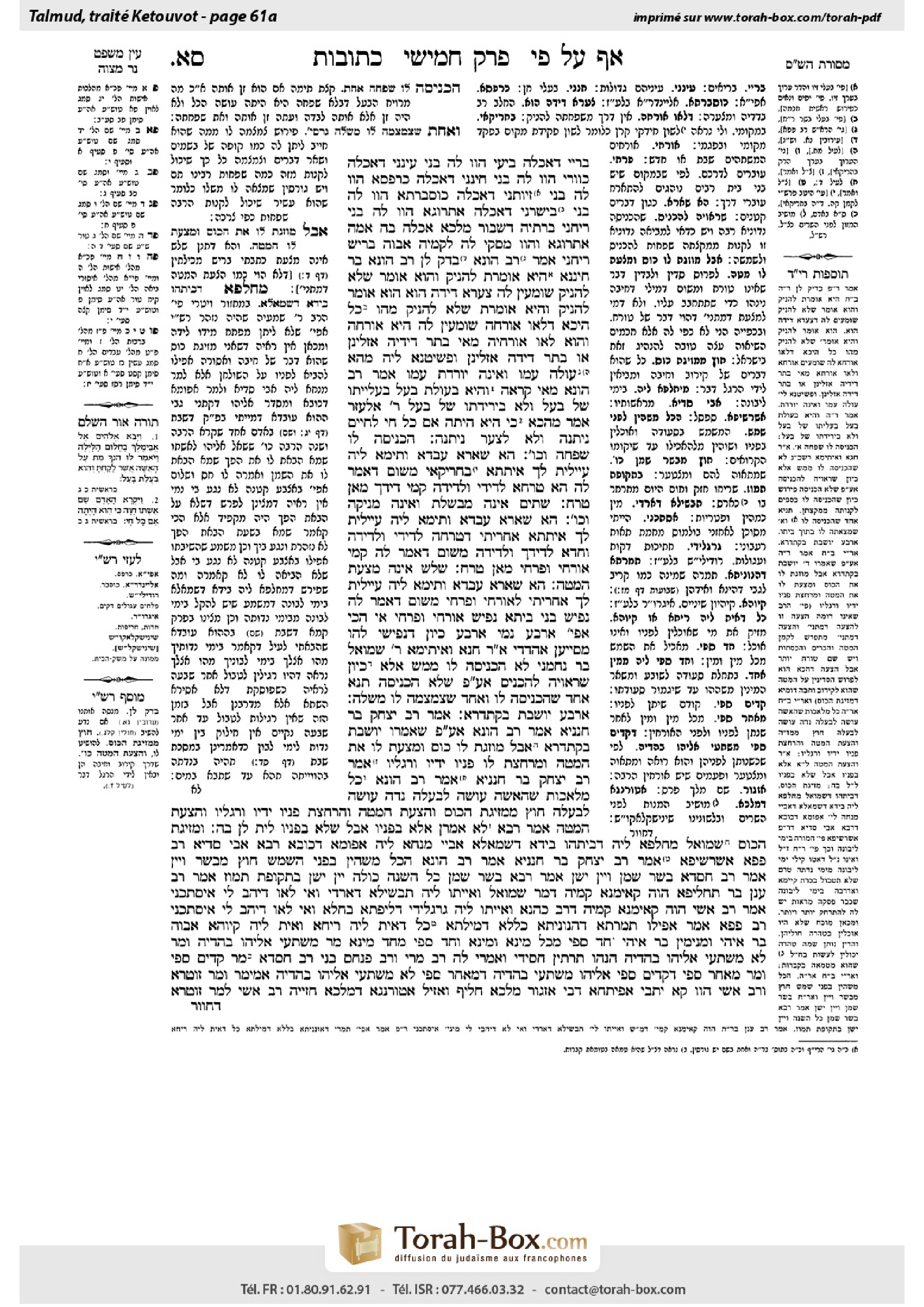
Ketubot 61a: Talmud study for Daf Yomi
Daf Yomi is the daily study of one Talmud folio. Explore 37 tractates with scans, Hebrew text, Sefaria English and AI-generated French translations where annotated.
Passage selection and English or AI-generated French translation are available where the scan has annotations. Daf Study is independent of Torah-Box and Sefaria.
Browse Ketubot · כתובות · All tractatesKetubot 61a text and translations
This page of Ketubot includes the Aramaic text, an English translation and an AI-generated French translation, alongside the scan above.
כתובות ס״א א · Aramaic and Hebrew text
בָּרְיֵי. דְּאָכְלָה בֵּיעֵי — הָווּ לַהּ בְּנֵי עֵינָנֵי. דְּאָכְלָה כְּווֹרֵי — הָווּ לַהּ בְּנֵי חִינָּנֵי. דְּאָכְלָה כַּרְפְּסָא — הָווּ לַהּ בְּנֵי זִיוְתָנֵי. דְּאָכְלָה כּוּסְבַּרְתָּא — הָווּ לַהּ בְּנֵי בִּישְׂרָנֵי. דְּאָכְלָה אֶתְרוֹגָא — הָווּ לַהּ בְּנֵי רֵיחָנֵי. בְּרַתֵּיה דְּשַׁבּוּר מַלְכָּא אֲכַלָה בַּהּ אַמָּה אֶתְרוֹגָא, וַהֲווֹ מַסְּקִי לַהּ לְקַמֵּיהּ אֲבוּהּ בְּרֵישׁ רֵיחָנֵי.
אָמַר רַב הוּנָא, בְּדַק לַן רַב הוּנָא בַּר חִינָּנָא: הִיא אוֹמֶרֶת לְהָנִיק, וְהוּא אוֹמֵר שֶׁלֹּא לְהָנִיק — שׁוֹמְעִין לָהּ. צַעֲרָא דִּידַהּ הוּא. הוּא אוֹמֵר לְהָנִיק, וְהִיא אוֹמֶרֶת שֶׁלֹּא לְהָנִיק, מַהוּ? כֹּל הֵיכָא דְּלָאו אוֹרְחַהּ — שׁוֹמְעִין לָהּ. הִיא אוֹרְחַהּ וְהוּא לָאו אוֹרְחֵיהּ, מַאי? בָּתַר דִּידֵיהּ אָזְלִינַן, אוֹ בָּתַר דִּידַהּ אָזְלִינַן?
וּפָשֵׁיטְנָא לֵיהּ מֵהָא: עוֹלָה עִמּוֹ וְאֵינָהּ יוֹרֶדֶת עִמּוֹ. אָמַר רַב הוּנָא: מַאי קְרָאָה — ״וְהִיא בְּעוּלַת בָּעַל״, בַּעֲלִיָּיתוֹ שֶׁל בַּעַל, וְלֹא בִּירִידָתוֹ שֶׁל בַּעַל. רַבִּי אֶלְעָזָר אָמַר מֵהָכָא: ״כִּי הִיא הָיְתָה אֵם כׇּל חָי״, לְחַיִּים נִיתְּנָה, וְלֹא לְצַעַר נִיתְּנָה.
הִכְנִיסָה לוֹ שִׁפְחָה וְכוּ׳. הָא שְׁאָרָא עָבְדָא. וְתֵימָא לֵיהּ: עַיֵּילִית לָךְ אִיתְּתָא בַּחֲרִיקַאי! מִשּׁוּם דְּאָמַר לַהּ: הָא טָרְחָא לְדִידִי וּלְדִידַהּ, קַמֵּי דִידָךְ מַאן טָרַח?
שְׁתַּיִם אֵינָהּ מְבַשֶּׁלֶת וְאֵינָהּ מְנִיקָה וְכוּ׳. הָא שְׁאָרָא עָבְדָא. וְתֵימָא לֵיהּ: עַיֵּילִית לָךְ אִיתְּתָא אַחֲרִיתִי דְּטָרְחָה לְדִידִי וּלְדִידַהּ, וַחֲדָא לְדִידָךְ וּלְדִידַהּ! מִשּׁוּם דְּאָמַר לַהּ: קַמֵּי אוֹרְחֵי וּפָרְחֵי מַאן טָרַח?
שָׁלֹשׁ, אֵינָהּ מַצַּעַת הַמִּטָּה. הָא שְׁאָרָא עָבְדָא. וְתֵימָא לֵיהּ: עַיֵּילִית לָךְ אַחֲרִיתִי לְאוֹרְחֵי וּפָרְחֵי! מִשּׁוּם דְּאָמַר לַהּ: נְפִישׁ בְּנֵי בֵיתָא, נְפִישׁ אוֹרְחֵי וּפָרְחֵי.
אִי הָכִי, אֲפִילּוּ אַרְבַּע נָמֵי! אַרְבַּע, כֵּיוָן דִּנְפִישִׁי לְהוּ, מְסַיְּיעָן אַהֲדָדֵי.
אָמַר רַב חָנָא וְאִיתֵּימָא רַבִּי שְׁמוּאֵל בַּר נַחְמָנִי: לֹא הִכְנִיסָה לוֹ מַמָּשׁ, אֶלָּא כֵּיוָן שֶׁרְאוּיָה לְהַכְנִיס, אַף עַל פִּי שֶׁלֹּא הִכְנִיסָה. תָּנָא: אֶחָד שֶׁהִכְנִיסָה לוֹ, וְאֶחָד שֶׁצִּמְצְמָה לוֹ מִשֶּׁלָּהּ.
אַרְבַּע, יוֹשֶׁבֶת בְּקָתֶדְרָא. אָמַר רַב יִצְחָק בַּר חֲנַנְיָא אָמַר רַב הוּנָא: אַף עַל פִּי שֶׁאָמְרוּ יוֹשֶׁבֶת בְּקָתֶדְרָא, אֲבָל מוֹזֶגֶת לוֹ כּוֹס וּמַצַּעַת לוֹ אֶת הַמִּטָּה ומַרְחֶצֶת לוֹ פָּנָיו יָדָיו וְרַגְלָיו.
אָמַר רַב יִצְחָק בַּר חֲנַנְיָא אָמַר רַב הוּנָא: כׇּל מְלָאכוֹת שֶׁהָאִשָּׁה עוֹשָׂה לְבַעְלָהּ, נִדָּה עוֹשָׂה לְבַעְלָהּ, חוּץ מִמְּזִיגַת הַכּוֹס, וְהַצָּעַת הַמִּטָּה, וְהַרְחָצַת פָּנָיו יָדָיו וְרַגְלָיו.
וְהַצָּעַת הַמִּטָּה. אָמַר רָבָא: לָא אֲמַרַן אֶלָּא בְּפָנָיו, אֲבָל שֶׁלֹּא בְּפָנָיו — לֵית לַן בַּהּ. וּמְזִיגַת הַכּוֹס. שְׁמוּאֵל מְחַלְּפָא לֵיהּ דְּבֵיתְהוּ בִּידָא דִשְׂמָאלָא. אַבָּיֵי מַנְּחָא לֵיהּ אַפּוּמָּא דְכוּבָּא. רָבָא אַבֵּי סַדְיָא. רַב פָּפָּא אַשַּׁרְשִׁיפָא.
אָמַר רַב יִצְחָק בַּר חֲנַנְיָא אָמַר רַב הוּנָא: הַכֹּל מְשַׁהִין בִּפְנֵי הַשַּׁמָּשׁ, חוּץ מִבָּשָׂר וְיַיִן. אָמַר רַב חִסְדָּא: בָּשָׂר שָׁמֵן וְיַיִן יָשָׁן. אָמַר רָבָא: בָּשָׂר שָׁמֵן — כׇּל הַשָּׁנָה כּוּלָּהּ, יַיִן יָשָׁן — בִּתְקוּפַת תַּמּוּז.
אָמַר רַב עָנָן בַּר תַּחְלִיפָא: הֲוָה קָאֵימְנָא קַמֵּיהּ דְּמָר שְׁמוּאֵל וְאַיְיתוֹ לֵיהּ תַּבְשִׁילָא דְאַרְדֵי, וְאִי לָאו דִּיהַב לִי, אִיסְתַּכַּנִי. אָמַר רַב אָשֵׁי: הֲוָה קָאֵימְנָא קַמֵּיהּ דְּרַב כָּהֲנָא וְאַיְיתוֹ לֵיהּ גַּרְגְּלִידֵי דְלִיפְתָּא בְּחַלָּא, וְאִי לָאו דִּיהַב לִי, אִיסְתַּכַּנִי. רַב פָּפָּא אָמַר: אֲפִילּוּ תְּמַרְתָּא דַּהֲנוּנִיתָא. כְּלָלָא דְמִילְּתָא: כֹּל דְּאִית לֵיהּ רֵיחָא וְאִית לֵיהּ קִיּוּהָא.
אֲבוּהּ בַּר אִיהִי וּמִנְיָמִין בַּר אִיהִי, חַד סָפֵי מִכֹּל מִינָא וּמִינָא, וְחַד סָפֵי מֵחַד מִינָא. מָר — מִשְׁתַּעֵי אֵלִיָּהוּ בַּהֲדֵיהּ, וּמָר — לָא מִשְׁתַּעֵי אֵלִיָּהוּ בַּהֲדֵיהּ.
הָנְהוּ תַּרְתֵּין חֲסִידֵי, וְאָמְרִי לַהּ: רַב מָרִי וְרַב פִּנְחָס בְּנֵי רַב חִסְדָּא, מָר קָדֵים סָפֵי, וּמָר מְאַחַר סָפֵי. דְּקָדֵים סָפֵי — אֵלִיָּהוּ מִשְׁתַּעֵי בַּהֲדֵיהּ, דִּמְאַחַר סָפֵי — לָא מִשְׁתַּעֵי אֵלִיָּהוּ בַּהֲדֵיהּ.
אַמֵּימָר וּמָר זוּטְרָא וְרַב אָשֵׁי הָווּ קָא יָתְבִי אַפִּיתְחָא דְּבֵי אִזְגּוּר מַלְכָּא. חָלֵיף וְאָזֵיל אֲטוּרַנְגָּא דְמַלְכָּא. חַזְיֵיהּ רַב אָשֵׁי לְמָר זוּטְרָא
Ketubot 61a · English translation
healthy; one who eats eggs will have large-eyed children; one who eats fish will have graceful children; one who eats celery will have beautiful children; one who eats coriander [kusbarta] will have corpulent children; and one who eats etrogim will have sweet-smelling children. It is related with regard to the daughter of King Shapur of Persia, that her mother ate etrogim while pregnant with her and they used to place her in front of her father on top of all the spices, as she was so fragrant.
§ Rav Huna said: Rav Huna bar Ḥinnana tested us, by asking: If she says that she wants to nurse and he says that he does not want her to nurse but rather to give the child to a wet nurse, we accede to her desires, as she is the one suffering from engorgement of her breasts. However, if he says that he wants her to nurse and she says that she does not want to nurse, what is the halakha? He then narrowed the scope of the question: Anywhere that she is not accustomed, as the women of her family generally do not nurse their children but give them to wet nurses instead, we accede to her desires. However, if she is accustomed to nursing and he is not accustomed, i.e., the women of her family generally nurse their babies but the women in his family do not, what is the halakha: Do we follow his wishes to follow her family custom or do we follow her wishes to follow his family custom?
And we answered his question from this amoraic statement: When a woman marries a man, she ascends with him to his socioeconomic status, if it is higher than hers, but she does not descend with him if his status is lower. Consequently, if his family is not accustomed to nurse, she is not obligated to nurse either. Rav Huna said: What is the verse from which this is derived? It is derived from: “She is a man’s wife” (Genesis 20:3). The Gemara explains: The word used here for “wife [be’ula]” hints through similar spelling that she ascends in status with the ascension [aliya] of her husband but does not descend with the descent of her husband. Rabbi Elazar said: There is a hint to this principle from here: “As she was the mother of all living” (Genesis 3:20), which indicates that she was given to her husband for living with him, but was not given to suffer pain with him.
§ The mishna states that if she brought him one maidservant into the marriage with her, she does not need to grind wheat, bake, or wash clothes. The Gemara infers from this statement that she must nevertheless perform the other tasks. The Gemara asks: Let the wife say to him: I brought you a woman in my place [baḥarikai] who can perform all the tasks I am supposed to do, and the wife should be completely exempt. The Gemara answers: This is not a valid argument because the husband can say to her: This maidservant toils for me and for herself like any other woman, but who will toil for you? It is necessary for the wife to do some work in order to cover some of her own expenses.
The mishna further said that if she brought him two maidservants, she does not need to cook and does not need to nurse her child. The Gemara infers: She must nevertheless perform the other tasks. The Gemara asks: Let the wife say to him: I brought you another woman who can toil for me and for herself, and one who can toil for you and for herself. Consequently, I do not need to do any work at all. The Gemara answers: This is also not a valid argument because he can say to her: Who is going to toil for the guests and wayfarers who will come because we are a large household? There are still other tasks that need to be performed.
The mishna further said that if she brought him three maidservants, she does not need to make his bed or make thread from wool. The Gemara infers: She must nevertheless perform the other tasks. The Gemara asks: Let her say to him: I brought you another woman to toil for the guests and wayfarers, in addition to one to toil for herself and for me, and another to toil for herself and for you. Therefore, I do not need to do any work at all. The Gemara answers: This is also not a valid argument because he can say to her: When the members of the house increase, the number of guests and wayfarers also increases and therefore there is still more work to be done.
The Gemara asks: If so, then even if she brought him four maidservants as well, she should also have to work, as there will be many more guests. But the mishna says that if she brought four maidservants she does not need to do anything. The Gemara answers: When there are four, since there are many of them, they assist one another and can complete all the necessary tasks.
Rav Ḥana, and some say Rav Shmuel bar Naḥmani, said: This does not necessarily mean that she actually brought him maidservants. Rather, once she is able to bring him maidservants, i.e., once her dowry is sufficiently large to buy maidservants, then she is exempt from performing the tasks, although she did not actually bring him maidservants. The Sages taught: Whether she brought him actual maidservants or whether she reduced her own needs in order to release enough money to bring a maidservant to work, she is exempt from the tasks.
§ The mishna says that if she brought him four maidservants, she may sit in a chair and not do anything. Rav Yitzḥak bar Ḥananya said that Rav Huna said: Although they said that she may sit in a chair and does not need to work, she should still pour his cup; and make his bed; and wash his face, hands, and feet, as these responsibilities are not household tasks that can be delegated to a maidservant. Rather, they are gestures of affection toward her husband.
Rav Yitzḥak bar Ḥananya also said that Rav Huna said a similar halakha: All tasks that a wife performs for her husband, a menstruating woman may similarly perform for her husband, except for: Pouring his cup; and making his bed; and washing his face, hands, and feet. As explained above, these are acts of affection. If she is menstruating she should not perform them, so as not to lead to forbidden intercourse.
And with regard to the prohibition against making the husband’s bed, Rava said: We said this only if she made the bed in front of him, but if it was not in front of him, we have no problem with it. With regard to the prohibition against pouring his cup, the Gemara comments: Shmuel’s wife would change her practice toward him during her menstruation period and pour with her left hand, since if she made some change in the manner of pouring, this would serve as a reminder of her status and mitigate the concern that it might lead to intimacy. Abaye’s wife would place his cup on top of a barrel, Rava’s wife would place it on his pillow, and Rav Pappa’s wife would place it on the bench to create a change.
§ Apropos statements by Rav Yitzḥak ben Ḥananya, the Gemara cites other statements in his name. Rav Yitzḥak bar Ḥananya said that Rav Huna said: All foods may be withheld from before the waiter, as one who is a waiter at the meal must wait until the guests have eaten from every food and only then may he eat, except for meat and wine, as these foods arouse the appetite more and the waiter would suffer if he could not eat them together with the other participants. Rav Ḥisda said: This is referring only to fatty meat and aged wine. Rava said: It applies to fatty meat all year round but aged wine only during the season of Tammuz, in the summer. Due to the heat, the aroma of the wine is more pervasive at that time.
Rav Anan bar Taḥalifa said: I was once standing before Mar Shmuel, and they brought him a cooked dish of mushrooms, and if he had not given me some, I would have been endangered due to the craving that I suffered. Rav Ashi said: I was once standing before Rav Kahana, and they brought him slices [gargelidei] of turnip in vinegar, and if he had not given me some, I would have been endangered. Rav Pappa said: Even a fragrant date should be offered to the waiter. The Gemara concludes: The principle of the matter is: One should offer some of everything that either has an aroma or that has a sharp taste to whomever is present when it is served, so that no one suffer by being unable to partake of these foods.
It is related about two Sages, Avuh bar Ihi and Minyamin bar Ihi, that one of them was accustomed to give his waiter from every type of food that he ate, while the other one would give him only one of the types of food that he ate. The Gemara says: Elijah spoke with this Sage, but Elijah did not speak with that Sage, since he did not act with piety and caused his waiter to suffer.
Similarly, the Gemara relates an incident with regard to two pious men, and some say they were Rav Mari and Rav Pineḥas, the sons of Rav Ḥisda: One Sage would give the waiter something to eat before the meal, and the other Sage would give the waiter something to eat after the guests had eaten. With regard to the one who gave it to him earlier, Elijah spoke with him. But with regard to the one who gave it to him later, Elijah did not speak with him.
The Gemara relates another incident with regard to this matter: Ameimar and Mar Zutra and Rav Ashi were sitting at the entrance to the house of King Izgur. The king’s chief butler was passing by with various foods. Rav Ashi saw Mar Zutra’s
Ketubot 61a · Traduction française (IA)
en bonne santé ; celui qui mange des œufs aura des enfants aux grands yeux ; celui qui mange du poisson aura des enfants gracieux ; celui qui mange du céleri aura de beaux enfants ; celui qui mange de la coriandre [kusbarta] aura des enfants corpulents ; et celui qui mange des étrogim aura des enfants qui sentent bon. On raconte au sujet de la fille du roi Shapur de Perse que sa mère mangeait des étrogim alors qu’elle était enceinte d’elle, et qu’on avait coutume de la placer devant son père, au-dessus de toutes les épices, tant elle était parfumée.
§ Rav Houna dit : Rav Houna bar Ḥinnana nous mit à l’épreuve en demandant : si elle dit qu’elle veut allaiter et que lui dit qu’il ne veut pas qu’elle allaite, mais préfère confier l’enfant à une nourrice, accède-t-on à son désir, puisqu’elle est celle qui souffre de l’engorgement de ses seins ? Cependant, s’il dit qu’il veut qu’elle allaite et qu’elle dit qu’elle ne veut pas allaiter, quelle est la halakha ? Il précisa la question : si elle n’en a pas l’habitude, c’est-à-dire si les femmes de sa famille n’allaitent généralement pas leurs enfants, mais les confient plutôt à des nourrices, accède-t-on à son désir ? Cependant, si elle a l’habitude d’allaiter et que lui ne l’a pas, c’est-à-dire si les femmes de sa famille à elle allaitent généralement leurs bébés, tandis que celles de sa famille à lui ne le font pas, quelle est la halakha ? Suit-on la volonté du mari, en s’alignant sur la coutume de sa famille à elle, ou celle de l’épouse, en s’alignant sur la coutume de sa famille à lui ?
Nous répondîmes à sa question par cet enseignement amoraïque : lorsqu’une femme épouse un homme, elle s’élève avec lui au niveau socio-économique de celui-ci, si ce niveau est supérieur au sien, mais elle ne déchoit pas avec lui si son niveau est inférieur. Par conséquent, si sa famille à lui n’a pas l’habitude d’allaiter, elle non plus n’est pas tenue de le faire. Rav Houna dit : Quel est le verset dont on déduit cela ? On le déduit de : « Elle est la femme d’un homme » (Genèse 20:3). La Guemara explique : le terme employé ici pour « femme [be’ula] » suggère, par sa graphie similaire, qu’elle s’élève au statut de son mari avec l’élévation [aliya] de celui-ci, mais qu’elle ne déchoit pas avec lui. Rabbi Elazar dit : On trouve une allusion à ce principe ici : « car elle fut la mère de tous les vivants » (Genèse 3:20), ce qui indique qu’elle fut donnée à son mari pour vivre avec lui, mais non pour souffrir avec lui.
§ La Michna enseigne que si elle lui a apporté une servante dans le mariage, elle n’a pas besoin de moudre le blé, de faire du pain ni de laver le linge. La Guemara déduit de cette déclaration qu’elle doit néanmoins accomplir les autres tâches. La Guemara demande : pourquoi la femme ne lui dirait-elle pas : « Je t’ai apporté une femme à ma place [baḥarikai], qui peut accomplir toutes les tâches que je suis censée faire », de sorte qu’elle soit entièrement dispensée ? La Guemara répond : cet argument n’est pas valable, car le mari peut lui dire : « Cette servante travaille pour moi et pour elle-même, comme toute autre femme ; mais qui travaillera pour toi ? » Il faut que la femme accomplisse un certain travail afin de couvrir une partie de ses propres dépenses.
La Michna enseigne en outre que si elle lui a apporté deux servantes, elle n’a pas besoin de cuisiner ni d’allaiter son enfant. La Guemara en déduit qu’elle doit néanmoins accomplir les autres tâches. La Guemara demande : pourquoi la femme ne lui dirait-elle pas : « Je t’ai apporté une autre femme qui peut travailler pour moi et pour elle-même, ainsi qu’une autre qui peut travailler pour toi et pour elle-même. » Par conséquent, je n’ai pas besoin de faire le moindre travail. La Guemara répond : cet argument n’est pas valable non plus, car il peut lui dire : « Qui travaillera pour les invités et les voyageurs qui viendront parce que notre foyer est nombreux ? » Il reste d’autres tâches à accomplir.
La Michna enseigne en outre que si elle lui a apporté trois servantes, elle n’a pas besoin de faire son lit ni de filer la laine. La Guemara en déduit qu’elle doit néanmoins accomplir les autres tâches. La Guemara demande : pourquoi ne lui dirait-elle pas : « Je t’ai apporté une autre femme pour travailler pour les invités et les voyageurs, en plus d’une qui travaille pour elle-même et pour moi, et d’une autre qui travaille pour elle-même et pour toi. » Par conséquent, je n’ai pas besoin de faire le moindre travail. La Guemara répond : cet argument n’est pas valable non plus, car il peut lui dire : « Lorsque le nombre de membres du foyer augmente, celui des invités et des voyageurs augmente aussi ; il y a donc encore davantage de travail à accomplir. »
La Guemara demande : si tel est le cas, même si elle lui a apporté quatre servantes, elle devrait devoir travailler, puisqu’il y aura beaucoup plus d’invités. Or, la Michna dit que si elle lui a apporté quatre servantes, elle n’a besoin de rien faire. La Guemara répond : lorsqu’elles sont quatre, leur nombre leur permet de s’entraider et d’accomplir toutes les tâches nécessaires.
Rav Ḥana — et certains disent Rav Shmuel bar Naḥmani — dit : cela ne signifie pas nécessairement qu’elle lui a effectivement apporté des servantes. Au contraire, dès lors qu’elle est en mesure de lui en apporter, c’est-à-dire dès lors que sa dot est assez importante pour acheter des servantes, elle est dispensée des tâches, même si elle ne lui en a pas réellement apporté. Les Sages ont enseigné : qu’elle lui ait apporté des servantes ou qu’elle ait réduit ses propres besoins afin de dégager assez d’argent pour engager une servante, elle est dispensée des tâches.
§ La Michna dit que si elle lui a apporté quatre servantes, elle peut s’asseoir sur une chaise et ne rien faire. Rav Yitzḥak bar Ḥananya dit au nom de Rav Houna : bien qu’ils aient dit qu’elle peut s’asseoir sur une chaise et n’a pas besoin de travailler, elle doit tout de même lui verser sa coupe, faire son lit et lui laver le visage, les mains et les pieds, car ces gestes ne sont pas des tâches domestiques qui peuvent être déléguées à une servante. Ce sont plutôt des marques d’affection envers son mari.
Rav Yitzḥak bar Ḥananya dit également au nom de Rav Houna une halakha similaire : une femme qui a ses règles peut accomplir pour son mari toutes les tâches qu’une épouse accomplit pour lui, à l’exception de lui verser sa coupe, de faire son lit et de lui laver le visage, les mains et les pieds. Comme on l’a expliqué plus haut, ce sont des gestes d’affection. Si elle a ses règles, elle ne doit pas les accomplir, afin de ne pas conduire à des relations interdites.
Quant à l’interdiction de faire le lit de son mari, Rava dit : nous ne l’avons dit que si elle fait le lit devant lui ; si elle ne le fait pas devant lui, cela ne pose pas de problème. Quant à l’interdiction de lui verser sa coupe, la Guemara fait remarquer que la femme de Shmuel changeait sa manière d’agir pendant ses règles et versait de la main gauche. En effet, une modification de sa façon de verser lui rappelait son état et atténuait la crainte que cela ne conduise à l’intimité. La femme d’Abaye posait sa coupe sur un tonneau, celle de Rava la posait sur son oreiller, et celle de Rav Pappa la posait sur le banc, afin de marquer un changement.
§ À propos des enseignements de Rav Yitzḥak ben Ḥananya, la Guemara cite d’autres enseignements transmis en son nom. Rav Yitzḥak bar Ḥananya dit au nom de Rav Houna : on peut priver le préposé au service de tous les aliments, car celui qui sert pendant le repas doit attendre que les invités aient goûté à chaque plat ; ce n’est qu’ensuite qu’il peut manger. Il y a toutefois une exception pour la viande et le vin, car ces aliments ouvrent davantage l’appétit et le préposé souffrirait s’il ne pouvait pas en manger avec les autres convives. Rav Ḥisda dit : cela ne concerne que la viande grasse et le vin vieux. Rava dit : cela s’applique à la viande grasse toute l’année, mais au vin vieux seulement pendant la saison de Tammouz, en été. En raison de la chaleur, l’arôme du vin se répand davantage à cette période.
Rav Anan bar Taḥalifa dit : un jour, je me tenais devant Mar Shmuel et on lui apporta un plat de champignons cuits ; s’il ne m’en avait pas donné, j’aurais été en danger à cause de l’envie que j’éprouvais. Rav Ashi dit : un jour, je me tenais devant Rav Kahana et on lui apporta des tranches [gargelidei] de navet au vinaigre ; s’il ne m’en avait pas donné, j’aurais été en danger. Rav Pappa dit : on doit même offrir au préposé une datte parfumée. La Guemara conclut : le principe est le suivant : il faut offrir une part de tout ce qui a une odeur ou une saveur piquante à quiconque est présent au moment où on le sert, afin que personne ne souffre de ne pas pouvoir goûter ces aliments.
On raconte au sujet de deux Sages, Avuh bar Ihi et Minyamin bar Ihi, que l’un avait l’habitude de donner à son préposé une part de chaque sorte d’aliment qu’il mangeait, tandis que l’autre ne lui en donnait qu’une seule sorte. La Guemara dit : Élie parlait avec ce Sage, mais ne parlait pas avec l’autre, car celui-ci n’agissait pas avec piété et faisait souffrir son préposé.
De même, la Guemara rapporte une histoire au sujet de deux hommes pieux — certains disent qu’il s’agissait de Rav Mari et de Rav Pineḥas, les fils de Rav Ḥisda — : l’un des Sages donnait à manger au préposé avant le repas, tandis que l’autre lui donnait à manger après que les invités avaient mangé. Élie parlait avec celui qui le lui donnait plus tôt, mais ne parlait pas avec celui qui le lui donnait plus tard.
La Guemara rapporte un autre épisode à ce sujet : Ameimar, Mar Zutra et Rav Ashi étaient assis à l’entrée de la maison du roi Izgur. Le grand échanson du roi passait avec divers aliments. Rav Ashi vit le
Traduction française générée par IA à partir de l’édition anglaise de Sefaria. Vérifie toujours un passage avec le texte source.
Text from Sefaria: William Davidson Edition - Vocalized Aramaic (CC BY NC); William Davidson Edition - English (CC BY NC).