Ketubot 61b: Talmud study for Daf Yomi
Daf Yomi is the daily study of one Talmud folio. Explore 37 tractates with scans, Hebrew text, Sefaria English and AI-generated French translations where annotated.
Passage selection and English or AI-generated French translation are available where the scan has annotations. Daf Study is independent of Torah-Box and Sefaria.
Browse Ketubot · כתובות · All tractatesKetubot 61b text and translations
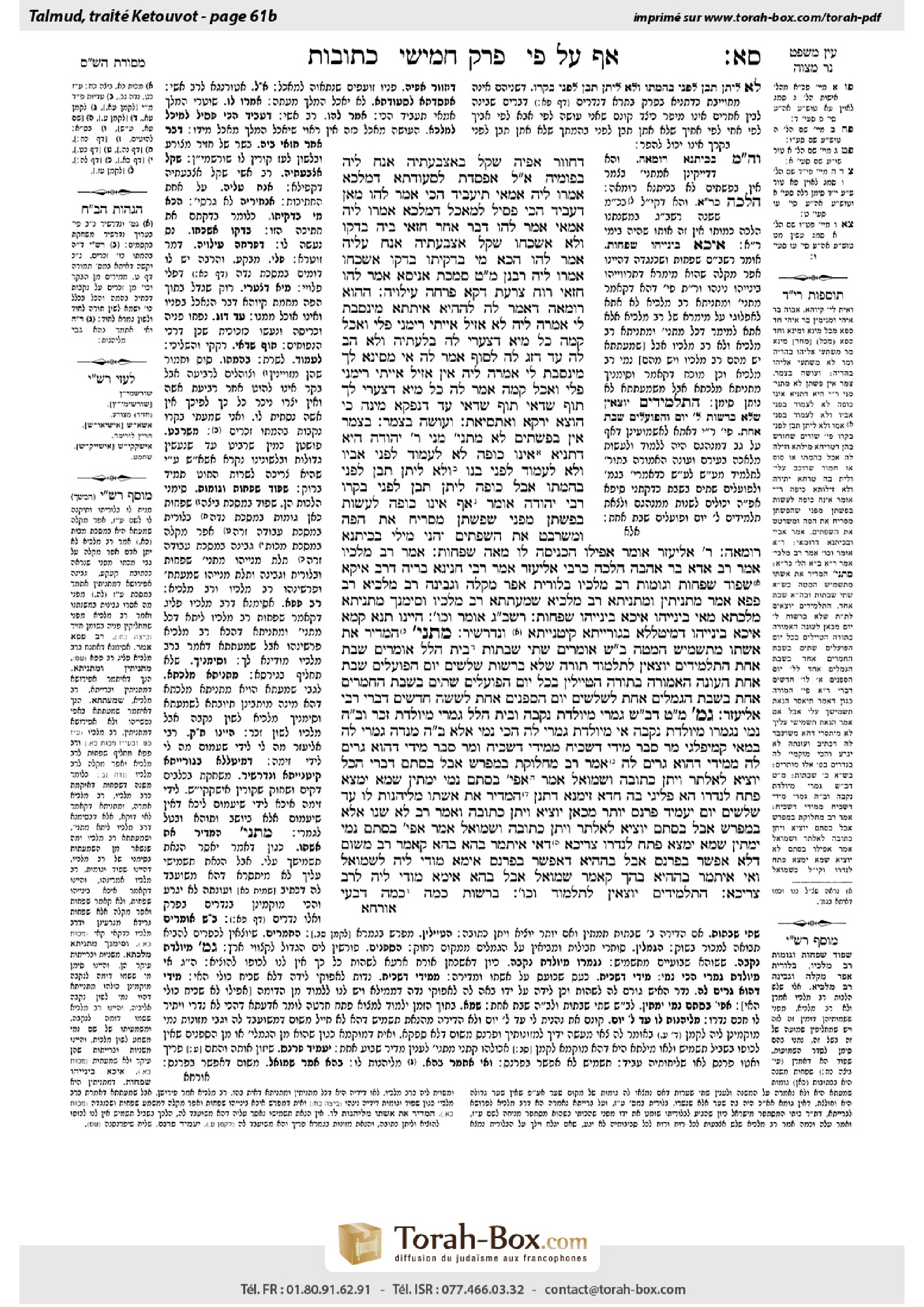
This page of Ketubot includes the Aramaic text, an English translation and an AI-generated French translation, alongside the scan above.
כתובות ס״א ב · Aramaic and Hebrew text
דַּחֲוַור אַפֵּיהּ, שְׁקַל בְּאֶצְבַּעְתֵּיהּ אַנַּח לֵיהּ בְּפוּמֵּיהּ. אֲמַר לֵיהּ: אַפְסַדְתְּ לִסְעוֹדְתָּא דְּמַלְכָּא. אֲמַרוּ לֵיהּ: אַמַּאי תִּיעְבֵּיד הָכִי? אֲמַר לְהוּ: מַאן דְּעָבֵיד הָכִי פְּסִיל לְמַאֲכַל דְּמַלְכָּא. אֲמַרוּ לֵיהּ: אַמַּאי? אֲמַר לְהוּ: דָּבָר אַחֵר חֲזַאי בֵּיהּ. בְּדַקוּ וְלָא אַשְׁכַּחוּ. שְׁקַל אֶצְבַּעְתֵּיהּ, אַנַּח עֲלֵיהּ, אֲמַר לְהוּ: הָכָא מִי בָּדְקִיתוּ? בְּדַקוּ אַשְׁכַּחוּ. אֲמַרוּ לֵיהּ רַבָּנַן: מַאי טַעְמָא סָמְכַתְּ אַנִּיסָּא? אֲמַר לְהוּ: חֲזַאי רוּחַ צָרַעַת דְּקָא פָרְחָה עִילָּוֵיהּ.
הָהוּא רוֹמָאָה דַּאֲמַר לָהּ לְהַהִיא אִיתְּתָא: מִינַּסְבַת לִי? אֲמַרָה לֵיהּ: לָא. אֲזַל אַיְיתִי רֻימָּנֵי, פַּלִּי וַאֲכַל קַמַּהּ. כֹּל מַיָּא דְּצַעֲרִי לַהּ, בְּלַעְתֵּיהּ, וְלָא הַב לַהּ עַד דְּזָג לַהּ. לְסוֹף אֲמַר לַהּ: אִי מַסֵּינָא לָךְ, מִינַּסְבַת לִי? אֲמַרָה לֵיהּ: אִין. אֲזַל אַיְיתִי רֻימָּנֵי, פַּלִּי וַאֲכַל קַמַּהּ. אֲמַר לַהּ: כֹּל מַיָּא דְּצַעֲרִי לִךְ, תּוּף שְׁדַאי תּוּף שְׁדַאי! עַד דְּנָפְקָא מִינַּהּ כִּי הוּצָא יַרְקָא וְאִתְּסִיאַת.
וְעוֹשָׂה בַּצֶּמֶר. בְּצֶמֶר אִין, בְּפִשְׁתִּים לָא. מַתְנִיתִין מַנִּי — רַבִּי יְהוּדָה הִיא. דְּתַנְיָא: אֵינוֹ כּוֹפָהּ לֹא לַעֲמוֹד לִפְנֵי אָבִיו, וְלֹא לַעֲמוֹד לִפְנֵי בְנוֹ, וְלֹא לִיתֵּן תֶּבֶן לִפְנֵי בְהֶמְתּוֹ. אֲבָל כּוֹפָהּ לִיתֵּן תֶּבֶן לִפְנֵי בְקָרוֹ. רַבִּי יְהוּדָה אוֹמֵר: אַף אֵינוֹ כּוֹפָהּ לַעֲשׂוֹת בְּפִשְׁתָּן, מִפְּנֵי שֶׁפִּשְׁתָּן מַסְרִיחַ אֶת הַפֶּה, וּמְשַׁרְבֵּט אֶת הַשְּׂפָתַיִם. וְהָנֵי מִילֵּי בְּכִיתָּנָא רוֹמָאָה.
רַבִּי אֱלִיעֶזֶר אוֹמֵר: אֲפִילּוּ הִכְנִיסָה לוֹ מֵאָה שְׁפָחוֹת. אָמַר רַב מַלְכִּיּוֹ אָמַר רַב אַדָּא בַּר אַהֲבָה: הֲלָכָה כְּרַבִּי אֱלִיעֶזֶר.
אָמַר רַבִּי חֲנִינָא בְּרֵיהּ דְּרַב אִיקָא: שַׁפּוּד, שְׁפָחוֹת וְגוּמוֹת — רַב מַלְכִּיּוֹ.
בְּלוֹרִית, אֵפֶר מִקְלֶה וּגְבִינָה — רַב מַלְכִּיָּא.
רַב פָּפָּא אָמַר: מַתְנִיתִין וּמַתְנִיתָא — רַב מַלְכִּיָּא. שְׁמַעְתָּתָא — רַב מַלְכִּיּוֹ. וְסִימָנָךְ: מַתְנִיתָא מַלְכְּתָא. מַאי בֵּינַיְיהוּ — אִיכָּא בֵּינַיְיהוּ שְׁפָחוֹת.
רַבָּן שִׁמְעוֹן בֶּן גַּמְלִיאֵל אוֹמֵר וְכוּ׳. הַיְינוּ תַּנָּא קַמָּא! אִיכָּא בֵּינַיְיהוּ דְּמִיטַּלְּלָא בְּגוּרְיָיתָא קִיטָנְיָיתָא וְנַדְרְשִׁיר.
מַתְנִי׳ הַמַּדִּיר אֶת אִשְׁתּוֹ מִתַּשְׁמִישׁ הַמִּטָּה, בֵּית שַׁמַּאי אוֹמְרִים: שְׁתֵּי שַׁבָּתוֹת. בֵּית הִלֵּל אוֹמְרִים: שַׁבָּת אַחַת.
הַתַּלְמִידִים יוֹצְאִין לְתַלְמוּד תּוֹרָה שֶׁלֹּא בִּרְשׁוּת שְׁלֹשִׁים יוֹם. הַפּוֹעֲלִים שַׁבָּת אַחַת. הָעוֹנָה הָאֲמוּרָה בַּתּוֹרָה: הַטַּיָּילִין — בְּכׇל יוֹם. הַפּוֹעֲלִים — שְׁתַּיִם בְּשַׁבָּת. הַחַמָּרִים — אַחַת בְּשַׁבָּת. הַגַּמָּלִים — אַחַת לִשְׁלשִׁים יוֹם. הַסַּפָּנִים — אַחַת לְשִׁשָּׁה חֳדָשִׁים. דִּבְרֵי רַבִּי אֱלִיעֶזֶר.
גְּמָ׳ מַאי טַעְמָא דְּבֵית שַׁמַּאי? גָּמְרִי מִיּוֹלֶדֶת נְקֵבָה. וּבֵית הִלֵּל? גָּמְרִי מִיּוֹלֶדֶת זָכָר.
וּבֵית הִלֵּל נָמֵי נִגְמְרוּ מִיּוֹלֶדֶת נְקֵבָה! אִי מִיּוֹלֶדֶת גָּמְרִי לַהּ — הָכִי נָמֵי, אֶלָּא בֵּית הִלֵּל מִנִּדָּה גָּמְרִי לַהּ.
בְּמַאי קָמִיפַּלְגִי? מָר סָבַר: מִידֵּי דִּשְׁכִיחַ מִמִּידֵּי דִּשְׁכִיחַ, וּמָר סָבַר: מִידֵּי דְּהוּא גָּרֵים לַהּ מִמִּידֵּי דְּהוּא גָּרֵים לַהּ.
אָמַר רַב: מַחְלוֹקֶת בִּמְפָרֵשׁ, אֲבָל בִּסְתָם — דִּבְרֵי הַכֹּל יוֹצִיא לְאַלְתַּר וְיִתֵּן כְּתוּבָּה. וּשְׁמוּאֵל אָמַר: אֲפִילּוּ בִּסְתָם נָמֵי יַמְתִּין, שֶׁמָּא יִמְצָא פֶּתַח לְנִדְרוֹ.
הָא פְּלִיגִי בַּהּ חֲדָא זִימְנָא, דִּתְנַן: הַמַּדִּיר אֶת אִשְׁתּוֹ מִלֵּיהָנוֹת לוֹ, עַד שְׁלֹשִׁים יוֹם — יַעֲמִיד פַּרְנָס, יוֹתֵר מִכָּאן — יוֹצִיא וְיִתֵּן כְּתוּבָּה. וְאָמַר רַב: לֹא שָׁנוּ אֶלָּא בִּמְפָרֵשׁ, אֲבָל בִּסְתָם — יוֹצִיא לְאַלְתַּר וְיִתֵּן כְּתוּבָּה. וּשְׁמוּאֵל אָמַר: אֲפִילּוּ בִּסְתָם נָמֵי יַמְתִּין, שֶׁמָּא יִמְצָא פֶּתַח לְנִדְרוֹ!
צְרִיכָא, דְּאִי אִיתְּמַר בְּהָא: בְּהָא קָאָמַר רַב — מִשּׁוּם דְּלָא אֶפְשָׁר בְּפַרְנָס, אֲבָל בְּהַהִיא דְּאֶפְשָׁר בְּפַרְנָס — אֵימָא מוֹדֵי לֵיהּ לִשְׁמוּאֵל. וְאִי אִיתְּמַר בְּהָהִיא — בְּהָךְ קָאָמַר שְׁמוּאֵל, אֲבָל בְּהָא — אֵימָא מוֹדֵי לֵיהּ לְרַב, צְרִיכָא.
הַתַּלְמִידִים יוֹצְאִין לְתַלְמוּד וְכוּ׳. בִּרְשׁוּת כַּמָּה? כַּמָּה דְּבָעֵי.
Ketubot 61b · English translation
face blanch because he craved the food, so he took some of the food with his finger and put it in Mar Zutra’s mouth. The chief butler said to him: You have spoiled the king’s meal, as now he will not eat from it. The king’s soldiers who were there said to him: Why did you do this? He said to them: The one who makes such awful dishes is the one who actually spoiled the king’s food. They said to him: Why do you say this? He said to them: I saw something else, i.e., a leprous infection, in this meat. They checked and didn’t find anything. He took his finger and placed it on the food and said to them: Did you check here? They then checked that spot and found the infection. The Sages said to Rav Ashi: What is the reason that you relied on a miracle and assumed that leprosy would in fact be found there? He said to them: I saw a leprous spirit hovering over the food and realized that it had this defect.
The Gemara relates another incident with regard to a similar subject: A certain Roman said to a certain woman: Will you marry me? She said to him: No. In order to convince her, he went and brought pomegranates and peeled them and ate them in front of her and did not give her any of them. The aroma of the pomegranates caused her mouth to water, so she swallowed all of the saliva that caused her anguish, but he did not give her any until she became ill and bloated. Ultimately, he said to her: If I cure you, will you marry me? She said to him: Yes. He went and brought pomegranates, peeled them and ate them in front of her. He said to her: All of the saliva that causes you anguish, spit it out, spit it out. She did this until something like a green leaf came out of her, and then she was cured.
§ The mishna says that a wife must make thread from wool. The Gemara infers: She must make thread from wool, but she is not obligated to do so from flax. The Gemara explains: Whose opinion is expressed in the mishna? It is in accordance with the opinion of Rabbi Yehuda, as it is taught in a baraita: A husband may not compel his wife to stand before his father and serve him, or to stand before his son and serve him, or to place straw before his animals, i.e., horses and donkeys, but he can compel her to place straw before his cattle, i.e., cows and bulls. Rabbi Yehuda said: He also cannot compel her to make thread from flax, because flax, while it is being spun, causes the mouth to smell foul and the lips to stiffen. The Gemara comments: This applies only to Roman flax, which causes the most damage.
§ The mishna continues: Rabbi Eliezer says: Even if she brought him a hundred maidservants, he may compel her to make thread from wool, since idleness leads to licentiousness. Rav Malkiyyu said that Rav Adda bar Ahava said: The halakha is in accordance with the opinion of Rabbi Eliezer.
Rabbi Ḥanina, son of Rav Ika, said: The halakha discussed in tractate Beitza (28b) that a skewer that had been used for roasting meat but no longer has an olive-bulk of meat on it may be moved to a corner on a Festival; the halakha with regard to maidservants in the mishna here; and the halakha discussed in tractate Nidda (52a) that if a girl has two hair follicles in her pubic region, even if there are no hairs growing from them, she is considered to have reached majority and may perform ḥalitza; these three halakhot were all stated by Rav Malkiyyu.
However, the halakha discussed in tractate Avoda Zara (29a) that a Jew who cuts the hair of a pagan must stop at a distance of three fingerbreadths on every side before he reaches his forelock, as the pagans would grow their forelocks for idolatry and the Jew must not appear as if he were dressing the forelock for idolatrous purposes; and the halakha discussed in tractate Makkot (21a) that one may not place burnt ashes on a wound, as it looks like a tattoo; and the halakha discussed in tractate Avoda Zara (35b) that cheese made by a gentile is forbidden, because gentiles smooth the surface of their cheese with lard; these three halakhot were all stated by a different Sage named Rav Malkiya.
Rav Pappa said: The halakhot mentioned above that relate to a mishna or a baraita were stated by Rav Malkiya, whereas amoraic statements of halakhot that are not related to a mishna or baraita were taught by Rav Malkiyyu. And your mnemonic to remember this is: The mishna is a queen [malketa], indicating that the comments that are referring to a mishna were made by Rav Malkiya, whose name is similar to the Aramaic term for queen. The Gemara asks: What is the difference between Rabbi Ḥanina, son of Rav Ika, and Rav Pappa? The Gemara answers: There is a practical difference between them with regard to the halakha concerning maidservants. According to Rabbi Ḥanina, this halakha was stated by Rav Malkiyyu, whereas Rav Pappa holds that it was taught by Rav Malkiya, since it is referring to a dispute in a mishna.
§ The mishna says: Rabban Shimon ben Gamliel says: Even one who vows that his wife is prohibited from doing any work must divorce her and give her the payment for her marriage contract, since idleness leads to idiocy. The Gemara asks: This is essentially the same as the opinion of the first tanna, Rabbi Eliezer, who said that idleness leads to licentiousness. The Gemara answers: The practical difference between them is in a case when she plays with small dogs [guriyyata kitanyata] or with games [nadrashir] like chess. Since there is something occupying her she is not in danger of idiocy, but occupying oneself with diversions of this type may still lead to licentiousness.
MISHNA: With regard to one who vows that his wife may not derive benefit from marital relations with him, Beit Shammai say: He may maintain this situation for up to two weeks, but beyond that he must divorce her and give her the payment for her marriage contract. Beit Hillel say: He must divorce her if it continues beyond one week.
Apropos the husband’s obligation to his wife regarding marital relations, the Gemara mentions other aspects of this issue: Students may leave their homes and travel in order to learn Torah without their wives’ permission for up to thirty days, and laborers may leave their homes without their wives’ permission for up to one week. The set interval defining the frequency of a husband’s conjugal obligation to his wife stated in the Torah (see Exodus 21:10), unless the couple stipulated otherwise, varies according to the man’s occupation and proximity to his home: Men of leisure, who do not work, must engage in marital relations every day, laborers must do so twice a week, donkey drivers once a week, camel drivers once every thirty days, and sailors once every six months. This is the statement of Rabbi Eliezer.
GEMARA: The Gemara asks: What is the reason that Beit Shammai say a husband may force abstinence on his wife by a vow for a period of up to two weeks without being compelled to divorce her? They derive this from the halakha that a woman who gave birth to a female is ritually impure and prohibited from engaging in conjugal relations with her husband for two weeks after childbirth (see Leviticus 12:5). From this they derive that a period of up to two weeks of abstinence is not deemed undue suffering. And from where do Beit Hillel derive their opinion? They derive it from a woman who gave birth to a male, as she is ritually impure for one week (see Leviticus 12:1–4).
The Gemara asks: And if this is so, Beit Hillel should also derive the halakha from a woman who gave birth to a female, since it is clear that the Torah does at times mandate a period of abstinence longer than one week. The Gemara answers: If they derived it from a woman who gave birth, this is indeed how they would have derived it. Rather, Beit Hillel derived it from the halakha with regard to a menstruating woman, who is prohibited from marital relations for seven days according to Torah law.
The Gemara explains: With regard to what do they disagree? One Sage, Beit Hillel, holds that one should derive a common matter from a common matter. Consequently, they derive the halakha of a permitted abstinence by a husband who vowed not to engage in marital relations with his wife from the halakha of a menstruating woman, since both are common cases. And one Sage, Beit Shammai, holds that one should derive a matter that one caused, such as a vow, from a different matter that he caused, i.e., childbirth, and not from menstruation, which was not caused by him at all.
Rav said: The dispute between Beit Hillel and Beit Shammai concerns one who specifies the given period of time in his vow, but if he vowed not to engage in marital relations with her for an unspecified period of time, all agree that he must divorce her immediately and give her the payment for her marriage contract. The reason is that since he did not indicate how long he intended to keep the vow, her suffering begins immediately. And Shmuel said: Even with regard to an unspecified vow he should also wait for the same period of time, as perhaps he will find an extenuation enabling the dissolution of his vow and then he will not need to divorce her.
The Gemara asks: Didn’t they disagree about this issue once already? As we learned in a mishna (70a): In the case of one who vows that his wife is prohibited from benefiting from him or his property, if his vow will remain in effect for up to thirty days, he must appoint a trustee to support her. But if the vow will remain in effect for more than that amount of time, he must divorce her and give her the payment for her marriage contract. And Rav said there: They taught this only with regard to a case where he specifies a limited time during which the vow would be in effect, but if he vows without specification, he must divorce her immediately and give her the payment for her marriage contract. And Shmuel said: Even when he vowed without specification, he should also wait, as perhaps he will discover an extenuation enabling the dissolution of his vow.
The Gemara answers: It is necessary to cite the dispute in both cases, as if it were stated only with regard to this case, of one who vows not to engage in marital relations, one might think that in this case Rav says he must divorce her because there is no possibility of appointing a trustee, but that with regard to that halakha, in the case when he vows not to provide sustenance, which can be provided by a trustee, one would say that Rav concedes to Shmuel that he should wait. Conversely, if the dispute was stated with regard to that case, where a trustee can be appointed, one might think that in that case Shmuel said to wait, but in this case of one who vows not to engage in marital relations, one might say that Shmuel concedes to Rav. Therefore, it is necessary to cite the dispute in both cases.
§ The mishna said that students may leave their homes and travel for up to thirty days in order to learn Torah, without their wives’ permission. The Gemara asks: If they went with permission, for how long can they go? The Gemara expresses wonderment at this question: If they went with the permission of their wives, they can go for as long as they want. If the husband and wife agree on this, why is there any reason for the court to intervene?
Ketubot 61b · Traduction française (IA)
son visage pâlit parce qu’il convoitait la nourriture ; il en prit donc un peu du doigt et le mit dans la bouche de Mar Zutra. Le maître d’hôtel lui dit : « Tu as gâché le repas du roi, car désormais il n’en mangera plus. » Les soldats du roi qui se trouvaient là lui demandèrent : « Pourquoi as-tu fait cela ? » Il leur répondit : « Celui qui prépare des plats aussi répugnants est le véritable responsable d’avoir gâché la nourriture du roi. » Ils lui demandèrent : « Pourquoi dis-tu cela ? » Il leur répondit : « J’ai vu autre chose dans cette viande, à savoir une lésion lépreuse. » Ils vérifièrent, mais ne trouvèrent rien. Il posa le doigt sur la nourriture et leur demanda : « Avez-vous vérifié ici ? » Ils examinèrent alors cet endroit et y trouvèrent la lésion. Les Sages dirent à Rav Ashi : « Pourquoi t’es-tu fié à un miracle et as-tu supposé qu’on y trouverait effectivement une lésion lépreuse ? » Il leur répondit : « J’ai vu un esprit lépreux planer au-dessus de la nourriture et compris qu’elle présentait ce défaut. »
La Guemara rapporte un autre incident sur un sujet semblable. Un Romain dit à une femme : « Veux-tu m’épouser ? » Elle lui répondit : « Non. » Pour la convaincre, il alla chercher des grenades, les éplucha et les mangea devant elle sans lui en donner. Leur parfum lui mit l’eau à la bouche ; elle avala donc toute la salive qui la tourmentait, mais il ne lui en donna pas, jusqu’à ce qu’elle tombe malade et soit ballonnée. Finalement, il lui dit : « Si je te guéris, m’épouseras-tu ? » Elle répondit : « Oui. » Il alla chercher des grenades, les éplucha et les mangea devant elle. Il lui dit : « Crache toute la salive qui te tourmente, crache ! » Elle le fit jusqu’à ce qu’il sorte d’elle quelque chose qui ressemblait à une feuille verte ; elle fut alors guérie.
§ La Michna dit qu’une épouse doit filer de la laine. La Guemara en déduit qu’elle doit filer de la laine, mais qu’elle n’est pas tenue de filer du lin. La Guemara explique : De l’avis de qui la Michna exprime-t-elle cette règle ? Elle suit l’avis de Rabbi Yehouda, comme il est enseigné dans une baraïta : Un mari ne peut pas contraindre son épouse à se tenir devant son père pour le servir, ni à se tenir devant son fils pour le servir, ni à mettre de la paille devant ses bêtes, c’est-à-dire ses chevaux et ses ânes ; mais il peut la contraindre à mettre de la paille devant son bétail, c’est-à-dire ses vaches et ses taureaux. Rabbi Yehouda dit : Il ne peut pas non plus la contraindre à filer du lin, car le lin, lorsqu’on le file, donne une mauvaise odeur à la bouche et raidit les lèvres. La Guemara précise : Cela ne concerne que le lin romain, qui est particulièrement nocif.
§ La Michna poursuit : Rabbi Eliezer dit : Même si elle lui a apporté cent servantes, il peut la contraindre à filer de la laine, car l’oisiveté mène à la débauche. Rav Malkiyyu a dit au nom de Rav Adda bar Ahava : La halakha suit l’avis de Rabbi Eliezer.
Rabbi Ḥanina, fils de Rav Ika, a dit : La halakha discutée dans le traité Beitza (28b), selon laquelle une broche utilisée pour rôtir de la viande, mais sur laquelle il ne reste plus une quantité de viande équivalant à une olive, peut être déplacée dans un coin pendant un jour de fête ; la halakha relative aux servantes dans la Michna ici ; et la halakha discutée dans le traité Nidda (52a), selon laquelle une jeune fille qui a deux follicules pileux dans la région pubienne est considérée comme majeure, même si aucun poil n’en pousse, et peut accomplir la ḥalitsa : ces trois halakhot ont toutes été énoncées par Rav Malkiyyu.
En revanche, les trois halakhot suivantes ont toutes été énoncées par un autre Sage nommé Rav Malkiya : la halakha discutée dans le traité Avoda Zara (29a), selon laquelle un Juif qui coupe les cheveux d’un idolâtre doit s’arrêter à trois largeurs de doigt de chaque côté avant d’atteindre sa mèche de cheveux, car les idolâtres la laissaient pousser à des fins idolâtres et le Juif ne doit pas donner l’impression qu’il l’arrange à des fins idolâtres ; la halakha discutée dans le traité Makkot (21a), selon laquelle il est interdit de mettre de la cendre brûlée sur une plaie, car cela ressemble à un tatouage ; et la halakha discutée dans le traité Avoda Zara (35b), selon laquelle le fromage fabriqué par un non-Juif est interdit, parce que les non-Juifs en lissent la surface avec du saindoux.
Rav Pappa a dit : Les halakhot mentionnées ci-dessus qui se rapportent à une Michna ou à une baraïta ont été énoncées par Rav Malkiya, tandis que les enseignements amoraïques concernant des halakhot sans rapport avec une Michna ou une baraïta ont été transmis par Rav Malkiyyu. Voici un moyen mnémotechnique pour s’en souvenir : « La Michna est une reine [malketa] », ce qui indique que les commentaires relatifs à une Michna ont été formulés par Rav Malkiya, dont le nom ressemble au terme araméen désignant une reine. La Guemara demande : Quelle différence pratique y a-t-il entre Rabbi Ḥanina, fils de Rav Ika, et Rav Pappa ? La Guemara répond : La halakha relative aux servantes constitue une différence pratique. Selon Rabbi Ḥanina, cette halakha a été énoncée par Rav Malkiyyu, tandis que, selon Rav Pappa, elle a été enseignée par Rav Malkiya, puisqu’elle concerne une controverse dans une Michna.
§ La Michna dit : Rabban Shimon ben Gamliel affirme : Même celui qui fait le vœu d’interdire à son épouse d’accomplir tout travail doit divorcer d’elle et lui verser la somme prévue par sa ketouba, car l’oisiveté mène à la folie. La Guemara demande : N’est-ce pas essentiellement la même chose que l’avis du premier tanna, Rabbi Eliezer, qui a dit que l’oisiveté mène à la débauche ? La Guemara répond : La différence pratique entre eux concerne le cas où elle joue avec de petits chiens [guriyyata kitanyata] ou à des jeux [nadrashir], comme les échecs. Puisqu’elle est occupée, elle ne risque pas de devenir folle ; mais s’occuper de ce genre de divertissements peut tout de même mener à la débauche.
MICHNA : À propos de celui qui fait le vœu d’interdire à son épouse de tirer profit de relations conjugales avec lui, Beit Shammaï disent : Il peut maintenir cette situation pendant deux semaines au plus ; au-delà, il doit divorcer d’elle et lui verser la somme prévue par sa ketouba. Beit Hillel disent : Il doit divorcer d’elle si la situation se prolonge au-delà d’une semaine.
À propos de l’obligation du mari envers son épouse concernant les relations conjugales, la Guemara mentionne d’autres aspects de cette question : les étudiants peuvent quitter leur domicile et voyager pour étudier la Torah sans l’autorisation de leur épouse pendant trente jours au plus, et les ouvriers peuvent quitter leur domicile sans son autorisation pendant une semaine au plus. L’intervalle fixe déterminant la fréquence des relations conjugales que le mari doit à son épouse, selon la Torah (voir Exode 21:10), sauf accord contraire du couple, varie selon la profession de l’homme et la proximité de son domicile : les hommes oisifs, qui ne travaillent pas, doivent avoir des relations conjugales chaque jour ; les ouvriers, deux fois par semaine ; les conducteurs d’ânes, une fois par semaine ; les chameliers, une fois tous les trente jours ; et les marins, une fois tous les six mois. Telle est la déclaration de Rabbi Eliezer.
GUEMARA : La Guemara demande : Pour quelle raison Beit Shammaï disent-ils qu’un mari peut imposer à son épouse l’abstinence par un vœu pendant deux semaines au plus sans être contraint de divorcer d’elle ? Ils déduisent cette règle de la halakha selon laquelle une femme qui a donné naissance à une fille est rituellement impure et ne peut avoir de relations conjugales avec son mari pendant les deux semaines qui suivent l’accouchement (voir Lévitique 12:5). Ils en déduisent qu’une période d’abstinence pouvant aller jusqu’à deux semaines n’est pas considérée comme une souffrance excessive. Et de quoi Beit Hillel déduisent-ils leur avis ? Ils le déduisent du cas d’une femme qui a donné naissance à un garçon, car elle est rituellement impure pendant une semaine (voir Lévitique 12:1–4).
La Guemara demande : Dans ce cas, Beit Hillel devraient eux aussi déduire la halakha du cas d’une femme qui a donné naissance à une fille, puisque la Torah prescrit clairement parfois une période d’abstinence de plus d’une semaine. La Guemara répond : S’ils avaient déduit la règle du cas d’une femme ayant accouché, ils l’auraient effectivement déduite ainsi. En réalité, Beit Hillel l’ont déduite de la halakha concernant une femme menstruée, qui ne peut avoir de relations conjugales pendant sept jours selon la Torah.
La Guemara explique : Sur quoi porte leur désaccord ? Un Sage, Beit Hillel, estime qu’il faut déduire une situation courante d’une autre situation courante. Par conséquent, ils déduisent la halakha relative à l’abstinence permise d’un mari ayant fait le vœu de ne pas avoir de relations conjugales avec son épouse de la halakha concernant une femme menstruée, car ces deux situations sont courantes. L’autre Sage, Beit Shammaï, estime qu’il faut déduire une situation provoquée par quelqu’un, comme un vœu, d’une autre situation qu’il a provoquée, c’est-à-dire l’accouchement, et non de la menstruation, qu’il n’a absolument pas provoquée.
Rav a dit : Le désaccord entre Beit Hillel et Beit Shammaï concerne celui qui précise la durée de son vœu ; mais s’il fait le vœu de ne pas avoir de relations conjugales avec son épouse sans en préciser la durée, tous conviennent qu’il doit immédiatement divorcer d’elle et lui verser la somme prévue par sa ketouba. En effet, puisqu’il n’a pas indiqué combien de temps il comptait maintenir son vœu, ses souffrances commencent immédiatement. Shmuel a dit : Même dans le cas d’un vœu dont la durée n’est pas précisée, il doit lui aussi attendre la même durée, car il trouvera peut-être un motif permettant de dissoudre son vœu et n’aura alors pas besoin de divorcer d’elle.
La Guemara demande : N’ont-ils pas déjà été en désaccord sur cette question ? En effet, nous avons appris dans une Michna (70a) : Celui qui fait le vœu d’interdire à son épouse de tirer profit de lui ou de ses biens doit désigner un administrateur chargé de subvenir à ses besoins si son vœu reste en vigueur pendant trente jours au plus. Mais si le vœu reste en vigueur plus longtemps, il doit divorcer d’elle et lui verser la somme prévue par sa ketouba. Et Rav a dit à ce sujet : Cet enseignement ne concerne que le cas où il précise une durée limitée pendant laquelle le vœu restera en vigueur ; mais, s’il fait un vœu sans en préciser la durée, il doit immédiatement divorcer d’elle et lui verser la somme prévue par sa ketouba. Shmuel a dit : Même lorsqu’il a fait un vœu sans en préciser la durée, il doit lui aussi attendre, car il découvrira peut-être un motif permettant de dissoudre son vœu.
La Guemara répond : Il faut rapporter leur désaccord dans les deux cas. En effet, si l’on ne rapportait ce désaccord que dans le cas de celui qui fait le vœu de ne pas avoir de relations conjugales, on pourrait penser que Rav dit qu’il doit divorcer d’elle parce qu’il n’est pas possible de désigner un administrateur ; mais que, dans l’autre cas, celui du vœu de ne pas subvenir à ses besoins, qui peuvent être assurés par un administrateur, Rav serait d’accord avec Shmuel pour dire qu’il doit attendre. À l’inverse, si le désaccord n’était rapporté que dans l’autre cas, où un administrateur peut être désigné, on pourrait penser que Shmuel a dit d’attendre dans ce cas, mais que, dans le cas de celui qui fait le vœu de ne pas avoir de relations conjugales, Shmuel serait d’accord avec Rav. Il est donc nécessaire de rapporter leur désaccord dans les deux cas.
§ La Michna dit que les étudiants peuvent quitter leur domicile et voyager pendant trente jours au plus pour étudier la Torah sans l’autorisation de leur épouse. La Guemara demande : S’ils sont partis avec son autorisation, combien de temps peuvent-ils rester partis ? La Guemara s’étonne de cette question : s’ils sont partis avec l’autorisation de leur épouse, ils peuvent partir aussi longtemps qu’ils le souhaitent. Si le mari et son épouse sont d’accord, pourquoi le tribunal aurait-il à intervenir ?
Traduction française générée par IA à partir de l’édition anglaise de Sefaria. Vérifie toujours un passage avec le texte source.
Text from Sefaria: William Davidson Edition - Vocalized Aramaic (CC BY NC); William Davidson Edition - English (CC BY NC).