Ketubot 62a: Talmud study for Daf Yomi
Daf Yomi is the daily study of one Talmud folio. Explore 37 tractates with scans, Hebrew text, Sefaria English and AI-generated French translations where annotated.
Passage selection and English or AI-generated French translation are available where the scan has annotations. Daf Study is independent of Torah-Box and Sefaria.
Browse Ketubot · כתובות · All tractatesKetubot 62a text and translations
This page of Ketubot includes the Aramaic text, an English translation and an AI-generated French translation, alongside the scan above.
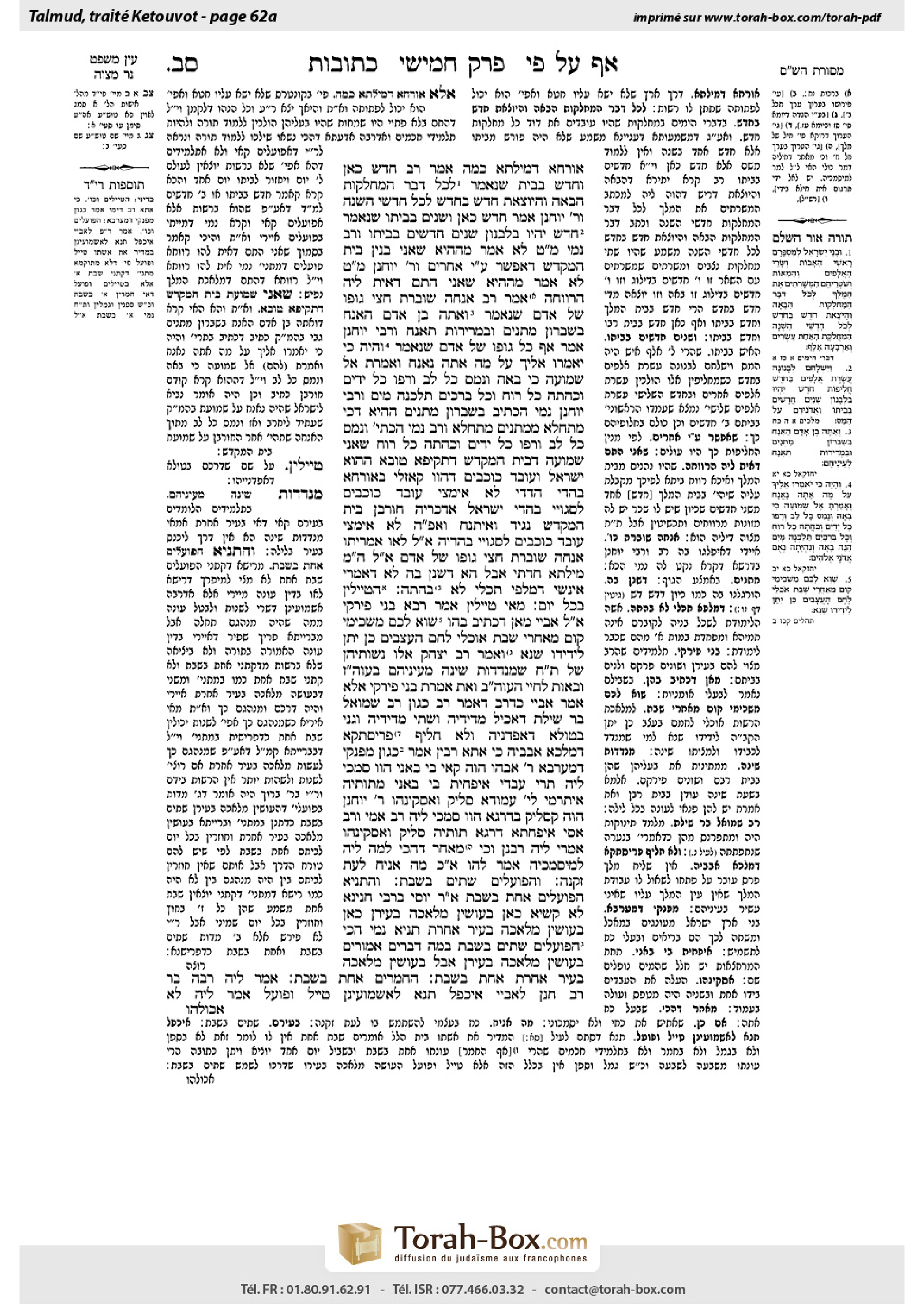
כתובות ס״ב א · Aramaic and Hebrew text
אוֹרְחָא דְמִילְּתָא כַּמָּה? אָמַר רַב: חֹדֶשׁ כָּאן, וְחֹדֶשׁ בַּבַּיִת. שֶׁנֶּאֱמַר: ״לְכׇל דְּבַר הַמַּחְלְקוֹת הַבָּאָה וְהַיּוֹצֵאת חֹדֶשׁ בְּחֹדֶשׁ לְכֹל חׇדְשֵׁי הַשָּׁנָה״. וְרַבִּי יוֹחָנָן אָמַר: חֹדֶשׁ כָּאן וּשְׁנַיִם בְּבֵיתוֹ, שֶׁנֶּאֱמַר: ״חֹדֶשׁ יִהְיוּ בַלְּבָנוֹן שְׁנַיִם חֳדָשִׁים בְּבֵיתוֹ״.
וְרַב נָמֵי, מַאי טַעְמָא לָא אָמַר מֵהַהִיא? שָׁאנֵי בִּנְיַן בֵּית הַמִּקְדָּשׁ, דְּאֶפְשָׁר עַל יְדֵי אֲחֵרִים: וְרַבִּי יוֹחָנָן מַאי טַעְמָא לָא אָמַר מֵהַהִיא? שָׁאנֵי הָתָם, דְּאִית לֵיהּ הַרְוָוחָה.
אָמַר רַב: אֲנָחָה שׁוֹבֶרֶת חֲצִי גּוּפוֹ שֶׁל אָדָם, שֶׁנֶּאֱמַר: ״וְאַתָּה בֶן אָדָם הֵאָנַח בְּשִׁבְרוֹן מׇתְנַיִם וּבִמְרִירוּת תֵּאָנַח״. וְרַבִּי יוֹחָנָן אָמַר: אַף כׇּל גּוּפוֹ שֶׁל אָדָם, שֶׁנֶּאֱמַר: ״וְהָיָה כִּי יֹאמְרוּ אֵלֶיךָ עַל מָה אַתָּה נֶאֱנָח וְאָמַרְתָּ אֶל שְׁמוּעָה כִי בָאָה וְנָמֵס כׇּל לֵב וְרָפוּ כׇל יָדַיִם וְכִהֲתָה כׇל רוּחַ וְכׇל בִּרְכַּיִם תֵּלַכְנָה מַּיִם״.
וְרַבִּי יוֹחָנָן נָמֵי, הָכְתִיב ״בְּשִׁבְרוֹן מׇתְנַיִם״! הָהִיא דְּכִי מַתְחֲלָא — מִמׇּתְנַיִם מַתְחֲלָא. וְרַב נָמֵי, הָכְתִיב: ״וְנָמֵס כׇּל לֵב וְרָפוּ כׇל יָדַיִם וְכִהֲתָה כׇל רוּחַ״! שָׁאנֵי שְׁמוּעָה דְּבֵית הַמִּקְדָּשׁ, דְּתַקִּיפָא טוּבָא.
הָהוּא יִשְׂרָאֵל וְגוֹי דַּהֲווֹ קָאָזְלִי בְּאוֹרְחָא בַּהֲדֵי הֲדָדֵי. לָא אִימְּצִי גּוֹי לְסַגּוֹיֵי בַּהֲדֵי יִשְׂרָאֵל. אַדְכְּרֵיהּ חוּרְבַּן בֵּית הַמִּקְדָּשׁ, נְגִיד וְאִיתְּנַח, וַאֲפִילּוּ הָכִי לָא אִימְּצִי גּוֹי לְסַגּוֹיֵי בַּהֲדֵיהּ. אֲמַר לֵיהּ: לָאו אָמְרִיתוּ ״אֲנָחָה שׁוֹבֶרֶת חֲצִי גּוּפוֹ שֶׁל אָדָם״? אֲמַר לֵיהּ: הָנֵי מִילֵּי מִילְּתָא חַדְתִּי, אֲבָל הָא דַּשְׁנַן בָּהּ — לָא. דְּאָמְרִי אִינָשֵׁי: (דְּמַלְּפִי) [דְּמַלְּפָא] תִּכְלֵי — לָא בָּהֲתָה.
הַטַּיָּילִין בְּכׇל יוֹם. מַאי ״טַיָּילִין״? אָמַר רָבָא: בְּנֵי פִירְקֵי. אֲמַר לֵיהּ אַבָּיֵי: מַאן דִּכְתִיב בְּהוּ ״שָׁוְא לָכֶם מַשְׁכִּימֵי קוּם מְאַחֲרֵי שֶׁבֶת אוֹכְלֵי לֶחֶם הָעֲצָבִים כֵּן יִתֵּן לִידִידוֹ שֵׁנָא״, וְאָמַר רַב יִצְחָק: אֵלּוּ נְשׁוֹתֵיהֶן שֶׁל תַּלְמִידֵי חֲכָמִים, שֶׁמְּנַדְּדוֹת שֵׁינָה מֵעֵינֵיהֶם בָּעוֹלָם הַזֶּה, וּבָאוֹת לְחַיֵּי הָעוֹלָם הַבָּא, וְאַתְּ אָמְרַתְּ בְּנֵי פִירְקֵי?!
אֶלָּא אָמַר אַבָּיֵי: כִּדְרַב, דְּאָמַר רַב: כְּגוֹן רַב שְׁמוּאֵל בַּר שִׁילַת, דְּאָכֵיל מִדִּידֵיהּ, וְשָׁתֵי מִדִּידֵיהּ, וְגָנֵי בְּטוּלָּא דְאַפַּדְנֵיהּ, וְלָא חָלֵיף פְּרִיסְתְּקָא דְמַלְכָּא אַבָּבֵיהּ. כִּי אֲתָא רָבִין אָמַר: כְּגוֹן מְפַנְּקִי דְמַעְרְבָא.
רַבִּי אֲבָהוּ הֲוָה קָאֵי בֵּי בָאנֵי. הֲווֹ סָמְכִי לֵיהּ תְּרֵי עַבְדֵי. אִיפְּחִית בֵּי בָאנֵי מִתּוּתֵיהּ, אִיתְרְמִי לֵיהּ עַמּוּדָא, סְלֵיק וְאַסְּקִינְהוּ. רַבִּי יוֹחָנָן הֲוָה קָסָלֵיק בְּדַרְגָּא, הֲווֹ סָמְכִי לֵיהּ רַב אַמֵּי וְרַב אַסִּי. אִיפְּחִתָא דַּרְגָּא תּוּתֵיהּ, סְלֵיק וְאַסְּקִינְהוּ. אָמְרִי לֵיהּ רַבָּנַן: וְכִי מֵאַחַר דְּהָכִי, לְמָה לֵיהּ לְמִיסְמְכֵיהּ? אֲמַר לְהוּ: אִם כֵּן מָה אַנִּיחַ לְעֵת זִקְנָה?
וְהַפּוֹעֲלִים שְׁתַּיִם בַּשַּׁבָּת. וְהָתַנְיָא: הַפּוֹעֲלִים אַחַת בַּשַּׁבָּת! אָמַר רַבִּי יוֹסֵי בְּרַבִּי חֲנִינָא, לָא קַשְׁיָא: כָּאן בְּעוֹשִׂין מְלָאכָה בְּעִירָן, כָּאן בְּעוֹשִׂין מְלָאכָה בְּעִיר אַחֶרֶת. תַּנְיָא נָמֵי הָכִי: הַפּוֹעֲלִים שְׁתַּיִם בַּשַּׁבָּת, בַּמֶּה דְּבָרִים אֲמוּרִים — בְּעוֹשִׂין מְלָאכָה בְּעִירָן, אֲבָל בְּעוֹשִׂין מְלָאכָה בְּעִיר אַחֶרֶת — אַחַת בַּשַּׁבָּת.
הַחַמָּרִים אַחַת בַּשַּׁבָּת. אֲמַר לֵיהּ רַבָּה בַּר רַב חָנָן לְאַבָּיֵי: אִיכְּפַל תַּנָּא לְאַשְׁמוֹעִינַן טַיָּיל וּפוֹעֵל? אֲמַר לֵיהּ: לָא,
Ketubot 62a · English translation
The Gemara explains its query: Although a man can legally make any agreement with his wife to limit her conjugal rights, how much is an acceptable manner for this matter? Rav said: The husband may spend a month here, in the study hall, and then must spend a month at home. The allusion to this is as it is stated with regard to reserve units serving in King David’s army: “In any matter of the courses, which came in and went out month by month throughout all the months of the year” (I Chronicles 27:1). And Rabbi Yoḥanan said: He may spend one month here, in the study hall, and then two months in his home, as it is stated with regard to workers who worked in the construction of the Temple: “A month they were in Lebanon, and two months at home” (I Kings 5:28).
The Gemara asks: And what is the reason that Rav did not also say a proof from that source that Rabbi Yoḥanan quoted? The Gemara answers: The construction of the Temple is different, since it is possible for this work to be performed by others, as there were many people involved in it, but with regard to Torah study, which cannot be performed by others, he is given permission to spend a month here and a month there. The Gemara further questions: And what is the reason that Rabbi Yoḥanan did not say a proof from that source that Rav quoted? The Gemara answers: There, with regard to King David, it is different, since he gains profit from working for the king; since there is profit involved, his wife might be willing to forgo his staying with her. However, in general a woman wants her husband to spend most of his time at home, so with regard to Torah study, where there is no monetary profit, she will not waive her right for as long.
§ Apropos a dispute between Rav and Rabbi Yoḥanan with regard to the construction of the Temple, the Gemara cites another dispute between them. Rav said: Groaning breaks half of a person’s body, as it is stated: “Groan, therefore, you son of man, with the breaking of your loins, groan so bitterly” (Ezekiel 21:11), which indicates that groaning breaks half of one’s body, down to his loins. And Rabbi Yoḥanan said that groaning breaks even a person’s entire body, as it is stated: “And it shall be, when they say to you: Why are you groaning? That you shall say: Due to the tiding, for it comes, and every heart shall melt, and all hands shall be slack, and every spirit shall be faint, and all knees shall drip with water” (Ezekiel 21:12).
The Gemara asks: And why doesn’t Rabbi Yoḥanan also say that it breaks half of one’s body? Isn’t it written: “With the breaking of your loins,” implying that it does not break the entire body? The Gemara answers: This does not mean that the breakage only reaches the loins, but rather that when the sigh begins to affect a person, it begins from his loins. The Gemara asks: And why doesn’t Rav also say that it breaks the entire body? Isn’t it written: “And every heart shall melt, and all hands shall be slack, and every spirit shall be faint,” which indicates that groaning causes the entire body to break? The Gemara answers: The news with regard to the destruction of the Temple is different, as it is extremely crushing and causes great anguish, but in general a sigh causes only half of the body to break.
It is related that a certain Jew and a gentile were walking along the road together. The gentile could not keep up with the Jew, who was walking faster, and he therefore reminded him of the destruction of the Temple in order to make the Jew feel sorrowful and slow down. The Jew sighed and groaned, but even so the gentile could not keep up with him, as the Jew was still walking faster. The gentile said to him: Don’t you say that groaning breaks half of a person’s body? Why didn’t it affect you? He said to him: This applies only with regard to a new sorrowful affair, but this, from which we have suffered repeatedly and to which we have become accustomed, does not affect us as much, as people say: One who is used to being bereaved of her children does not panic [bahata] when one of them dies, and similarly, one who is used to a tragedy is not as devastated when being reminded of it.
§ The mishna said that men of leisure must engage in marital relations with their wives every day. The Gemara asks: What is meant by the term men of leisure? Rava said: These are students of Torah who go daily to review their lectures at a local study hall and return home each evening. Abaye said to him: Wives of Torah scholars are those about whom it is written: “It is vain for you to rise early and sit up late, you that eat the bread of toil, so He gives to His beloved in sleep” (Psalms 127:2), and Rabbi Yitzḥak said in explanation of this verse: These are the wives of Torah scholars who deprive their eyes of sleep in this world and reach the life of the World-to-Come. This indicates that Torah scholars exert themselves greatly in their studies and are not home in the evenings, and you say that the students reviewing their lectures are men of leisure, whose wives have conjugal rights for every night?
Rather, Abaye said: The mishna should be explained in accordance with the opinion of Rav, as Rav said: This is referring to a man such as Rabbi Shmuel bar Sheilat, who ate his own food, drank his own drinks, slept in the shade of his own house, and the king’s tax collector [peristaka] did not pass by his door, as they did not know that he was a man of means. A man like this, who has a steady income and no worries, is called a man of leisure. When Ravin came from Eretz Yisrael he said: For example, the wealthy, pampered men in the West, Eretz Yisrael, are called men of leisure. Due to the time they have available and the richness of their diet, they have the ability to satisfy their wives every night.
To illustrate this point, the Gemara relates two incidents demonstrating the health and strength of the inhabitants of Eretz Yisrael: Rabbi Abbahu was once standing in the bathhouse and two slaves were supporting his walking. The bathhouse collapsed under him and was destroyed. He found a pillar, stood on it and got out, and pulled them both up with him. Similarly, Rabbi Yoḥanan was once going up stairs, and Rav Ami and Rav Asi were supporting him. The stair collapsed under him, but he went up and pulled them both up with him. The Sages said to him: Since it is clear that you are so strong, why do you need people to support you? He said to them: If so, if I were to expend all my strength now, what will I leave for myself in my old age?
§ The mishna said: The set interval for laborers to fulfill their conjugal obligations to their wives is twice a week. The Gemara asks: Isn’t it taught in a baraita: For laborers, once a week? Rabbi Yosei, son of Rabbi Ḥanina, said: This is not difficult: Here, the case is where they work in their own city. There, the case is where they work in another city. This is also taught in the Tosefta (5:6): For laborers, twice a week. In what case is this statement said? It is when they work in their own city, but when they work in another city, the set interval for their conjugal obligations is once a week.
§ The mishna said: The set interval for donkey drivers is once a week, and for other professions it is even less frequent. Rabba bar Rav Ḥanan said to Abaye: Did the tanna go to all that trouble just to teach us the halakha for a man of leisure and for a laborer? According to the set intervals given for conjugal obligations, it seems that the halakha that one who vowed to prohibit his wife from conjugal relations for longer than a week must divorce her is referring only to a man of leisure or a laborer, whose set interval for conjugal relations is less than that period. However, for other people, whose set interval is once a month or even less frequent, there should be no need to divorce the wife, since the vow does not deprive her of conjugal rights for longer than she would have been deprived anyway. He said to him: No,
Ketubot 62a · Traduction française (IA)
La Guemara précise sa question : bien qu’un homme puisse légalement conclure avec sa femme tout accord limitant ses droits conjugaux, quelle fréquence est-elle acceptable en la matière ? Rav dit : le mari peut passer un mois ici, à la maison d’étude, puis doit passer un mois chez lui. On en trouve une allusion dans ce qui est dit au sujet des troupes de réserve servant dans l’armée du roi David : « Pour chacun des groupes, ceux qui entraient et sortaient mois après mois, durant tous les mois de l’année » (I Chroniques 27, 1). Rabbi Yoḥanan dit : il peut passer un mois ici, à la maison d’étude, puis deux mois chez lui, comme il est dit au sujet des ouvriers qui travaillèrent à la construction du Temple : « Un mois, ils étaient au Liban, et deux mois chez eux » (I Rois 5, 28).
La Guemara demande : pourquoi Rav ne cite-t-il pas lui aussi une preuve tirée de la source citée par Rabbi Yoḥanan ? La Guemara répond : la construction du Temple est un cas différent, car ce travail peut être effectué par d’autres, puisqu’un grand nombre de personnes y participaient ; mais, pour l’étude de la Torah, qui ne peut être accomplie par d’autres, il est autorisé à passer un mois ici et un mois là. La Guemara pose encore la question : pourquoi Rabbi Yoḥanan ne cite-t-il pas lui aussi une preuve tirée de la source citée par Rav ? La Guemara répond : dans le cas du roi David, c’est différent, car il tire un profit de son service pour le roi ; puisqu’il y a un avantage financier, sa femme peut être disposée à renoncer à ce qu’il reste auprès d’elle. Mais, en général, une femme veut que son mari passe la majeure partie de son temps chez lui ; ainsi, pour l’étude de la Torah, qui ne procure aucun avantage financier, elle ne renoncera pas à son droit aussi longtemps.
§ À propos d’un désaccord entre Rav et Rabbi Yoḥanan au sujet de la construction du Temple, la Guemara rapporte un autre désaccord entre eux. Rav dit : un soupir brise la moitié du corps d’une personne, comme il est dit : « Gémis donc, fils d’homme, les reins brisés, gémis avec amertume » (Ézéchiel 21, 11), ce qui indique que le soupir brise la moitié du corps, jusqu’aux reins. Rabbi Yoḥanan dit qu’un soupir brise même tout le corps d’une personne, comme il est dit : « Et quand ils te diront : Pourquoi gémis-tu ? Tu répondras : À cause de la nouvelle, car elle vient ; tout cœur fondra, toutes les mains faibliront, tout esprit défaillira, et tous les genoux ruisselleront d’eau » (Ézéchiel 21, 12).
La Guemara demande : pourquoi Rabbi Yoḥanan ne dit-il pas lui aussi que le soupir brise la moitié du corps ? N’est-il pas écrit : « Les reins brisés », ce qui implique qu’il ne brise pas tout le corps ? La Guemara répond : cela ne signifie pas que la brisure ne va que jusqu’aux reins, mais plutôt que, lorsque le soupir commence à affecter une personne, il commence par ses reins. La Guemara demande : pourquoi Rav ne dit-il pas lui aussi qu’il brise tout le corps ? N’est-il pas écrit : « Tout cœur fondra, toutes les mains faibliront, tout esprit défaillira », ce qui indique que le soupir brise tout le corps ? La Guemara répond : la nouvelle concernant la destruction du Temple est un cas différent, car elle est extrêmement accablante et provoque une grande détresse ; mais, en général, un soupir ne brise que la moitié du corps.
On raconte qu’un certain Juif et un non-Juif cheminaient ensemble. Le non-Juif ne parvenait pas à suivre le Juif, qui marchait plus vite ; il lui rappela donc la destruction du Temple afin de l’attrister et de le ralentir. Le Juif soupira et gémit, mais le non-Juif ne parvint toujours pas à le suivre, car le Juif marchait encore plus vite. Le non-Juif lui dit : « Ne dis-tu pas qu’un soupir brise la moitié du corps d’une personne ? Pourquoi cela ne t’a-t-il pas affecté ? » Il lui répondit : « Cela ne s’applique qu’à un chagrin nouveau ; mais cette souffrance, que nous avons éprouvée à maintes reprises et à laquelle nous nous sommes habitués, ne nous affecte pas autant. » Car, comme on dit, celle qui a l’habitude de perdre ses enfants ne panique pas [bahata] quand l’un d’eux meurt ; de même, celui qui est habitué à une tragédie n’est pas aussi bouleversé lorsqu’on la lui rappelle.
§ La Michna dit que les hommes qui ont des loisirs doivent avoir des relations conjugales avec leurs femmes chaque jour. La Guemara demande : que désigne l’expression « hommes qui ont des loisirs » ? Rava dit : il s’agit d’étudiants en Torah qui se rendent chaque jour à une maison d’étude locale pour réviser leurs cours et rentrent chez eux chaque soir. Abaye lui dit : c’est au sujet des femmes des érudits en Torah qu’il est écrit : « C’est en vain que vous vous levez tôt, que vous vous couchez tard, que vous mangez le pain de la peine ; il en donne autant à son bien-aimé pendant son sommeil » (Psaumes 127, 2). Rabbi Yitzḥak explique ce verset ainsi : il s’agit des femmes des érudits en Torah, qui se privent de sommeil dans ce monde et accèdent à la vie du Monde à venir. Cela indique que les érudits en Torah s’investissent énormément dans leurs études et ne sont pas chez eux le soir ; et toi, tu dis que les étudiants qui révisent leurs cours sont des hommes qui ont des loisirs, dont les femmes ont droit à des relations conjugales chaque nuit ?
Abaye dit plutôt : la Michna doit être expliquée conformément à l’avis de Rav, car Rav a dit qu’il s’agit d’un homme tel que Rabbi Shmuel bar Sheilat, qui mangeait sa propre nourriture, buvait ses propres boissons, dormait à l’ombre de sa propre maison, et devant la porte duquel le percepteur des impôts du roi [peristaka] ne passait pas, car on ne savait pas qu’il était un homme aisé. Un homme comme lui, qui a un revenu régulier et n’a aucun souci, est appelé un homme qui a des loisirs. Lorsque Ravin arriva d’Eretz Israël, il dit : par exemple, les hommes riches et choyés de l’Ouest, Eretz Israël, sont appelés des hommes qui ont des loisirs. Le temps dont ils disposent et la richesse de leur alimentation leur permettent de satisfaire leurs femmes chaque nuit.
Pour illustrer ce point, la Guemara rapporte deux incidents qui témoignent de la santé et de la force des habitants d’Eretz Israël. Rabbi Abbahu se tenait un jour dans un bain public, et deux esclaves le soutenaient pendant qu’il marchait. Le bain public s’effondra sous lui et fut détruit. Il trouva une colonne, se mit debout dessus et en sortit, puis les tira tous deux avec lui. De même, un jour, Rabbi Yoḥanan montait un escalier, soutenu par Rav Ami et Rav Asi. L’escalier s’effondra sous lui, mais il continua à monter et les tira tous deux avec lui. Les Sages lui dirent : « Puisqu’il est évident que tu es si fort, pourquoi as-tu besoin qu’on te soutienne ? » Il leur répondit : « Si c’est le cas, si je dépense toute ma force maintenant, que me restera-t-il pour ma vieillesse ? »
§ La Michna dit que l’intervalle fixé pour que les ouvriers s’acquittent de leurs obligations conjugales envers leurs femmes est de deux fois par semaine. La Guemara demande : n’est-il pas enseigné dans une baraïta que, pour les ouvriers, c’est une fois par semaine ? Rabbi Yosei, fils de Rabbi Ḥanina, dit : il n’y a pas de contradiction. Ici, il s’agit de ceux qui travaillent dans leur propre ville ; là, de ceux qui travaillent dans une autre ville. Cela est également enseigné dans la Tosefta (5, 6) : pour les ouvriers, deux fois par semaine. Dans quel cas cette affirmation s’applique-t-elle ? Lorsqu’ils travaillent dans leur propre ville ; mais lorsqu’ils travaillent dans une autre ville, l’intervalle fixé pour leurs obligations conjugales est d’une fois par semaine.
§ La Michna dit que l’intervalle fixé pour les conducteurs d’ânes est d’une fois par semaine, et que, pour les autres professions, il est encore moins fréquent. Rabba bar Rav Ḥanan dit à Abaye : le tanna s’est-il donné tant de peine uniquement pour nous enseigner la halakha relative à un homme qui a des loisirs et à un ouvrier ? D’après les intervalles fixés pour les obligations conjugales, il semble que la halakha selon laquelle celui qui a fait le vœu d’interdire à sa femme les relations conjugales pendant plus d’une semaine doit divorcer d’elle ne concerne qu’un homme qui a des loisirs ou un ouvrier, dont l’intervalle fixé pour les relations conjugales est inférieur à cette durée. Mais, pour les autres personnes, dont l’intervalle fixé est d’un mois ou même moins fréquent, il ne devrait pas être nécessaire de divorcer de leur femme, puisque le vœu ne la prive pas de ses droits conjugaux plus longtemps qu’elle n’en aurait été privée de toute façon. Il lui répondit : « Non. »
Traduction française générée par IA à partir de l’édition anglaise de Sefaria. Vérifie toujours un passage avec le texte source.
Text from Sefaria: William Davidson Edition - Vocalized Aramaic (CC BY NC); William Davidson Edition - English (CC BY NC).