Ketubot 62b: Talmud study for Daf Yomi
Daf Yomi is the daily study of one Talmud folio. Explore 37 tractates with scans, Hebrew text, Sefaria English and AI-generated French translations where annotated.
Passage selection and English or AI-generated French translation are available where the scan has annotations. Daf Study is independent of Torah-Box and Sefaria.
Browse Ketubot · כתובות · All tractatesKetubot 62b text and translations
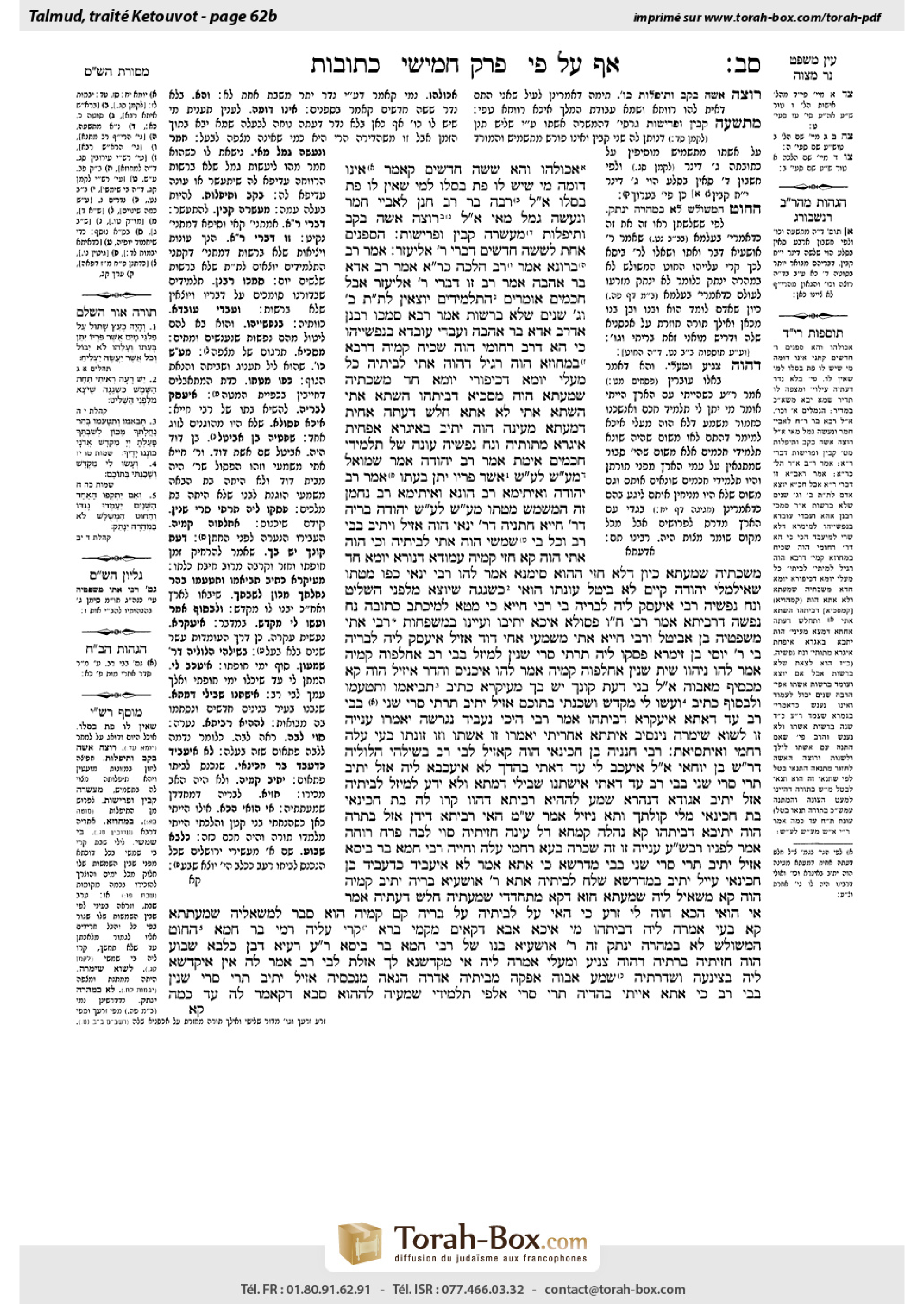
This page of Ketubot includes the Aramaic text, an English translation and an AI-generated French translation, alongside the scan above.
כתובות ס״ב ב · Aramaic and Hebrew text
אַכּוּלְּהוּ. וְהָא שִׁשָּׁה חֳדָשִׁים קָאָמַר? אֵינוֹ דּוֹמֶה מִי שֶׁיֵּשׁ לוֹ פַּת בְּסַלּוֹ לְמִי שֶׁאֵין לוֹ פַּת בְּסַלּוֹ.
אֲמַר לֵיהּ רַבָּה בַּר רַב חָנָן לְאַבָּיֵי: חַמָּר וְנַעֲשֶׂה גַּמָּל, מַאי? אֲמַר לֵיהּ: רוֹצָה אִשָּׁה בְּקַב וְתִיפְלוּת מֵעֲשָׂרָה קַבִּין וּפְרִישׁוּת.
הַסַּפָּנִים אַחַת לְשִׁשָּׁה חֳדָשִׁים, דִּבְרֵי רַבִּי אֱלִיעֶזֶר. אָמַר רַב בְּרוֹנָא אָמַר רַב: הֲלָכָה כְּרַבִּי אֱלִיעֶזֶר. אָמַר רַב אַדָּא בַּר אַהֲבָה אָמַר רַב: זוֹ דִּבְרֵי רַבִּי אֱלִיעֶזֶר, אֲבָל חֲכָמִים אוֹמְרִים: הַתַּלְמִידִים יוֹצְאִין לְתַלְמוּד תּוֹרָה שְׁתַּיִם וְשָׁלֹשׁ שָׁנִים שֶׁלֹּא בִּרְשׁוּת. אָמַר רָבָא: סָמְכוּ רַבָּנַן אַדְּרַב אַדָּא בַּר אַהֲבָה וְעָבְדִי עוֹבָדָא בְּנַפְשַׁיְיהוּ.
כִּי הָא דְּרַב רְחוּמִי הֲוָה שְׁכִיחַ קַמֵּיהּ דְּרָבָא בְּמָחוֹזָא, הֲוָה רְגִיל דַּהֲוָה אָתֵי לְבֵיתֵיהּ כֹּל מַעֲלֵי יוֹמָא דְכִיפּוּרֵי. יוֹמָא חַד מְשַׁכְתֵּיהּ שְׁמַעְתָּא. הֲוָה מְסַכְּיָא דְּבֵיתְהוּ: הַשְׁתָּא אָתֵי, הַשְׁתָּא אָתֵי. לָא אֲתָא. חֲלַשׁ דַּעְתַּהּ, אַחִית דִּמְעֲתָא מֵעֵינַהּ. הֲוָה יָתֵיב בְּאִיגָּרָא, אִפְּחִית אִיגָּרָא מִתּוּתֵיהּ וְנָח נַפְשֵׁיהּ.
עוֹנָה שֶׁל תַּלְמִידֵי חֲכָמִים אֵימַת? אָמַר רַב יְהוּדָה אָמַר שְׁמוּאֵל: מֵעֶרֶב שַׁבָּת לְעֶרֶב שַׁבָּת. ״אֲשֶׁר פִּרְיוֹ יִתֵּן בְּעִתּוֹ״, אָמַר רַב יְהוּדָה, וְאִיתֵּימָא רַב הוּנָא, וְאִיתֵּימָא רַב נַחְמָן: זֶה הַמְשַׁמֵּשׁ מִטָּתוֹ מֵעֶרֶב שַׁבָּת לְעֶרֶב שַׁבָּת.
יְהוּדָה בְּרֵיהּ דְּרַבִּי חִיָּיא, חַתְנֵיהּ דְּרַבִּי יַנַּאי, הֲוָה אָזֵיל וְיָתֵיב בְּבֵי רַב, וְכׇל בֵּי שִׁמְשֵׁי הֲוָה אָתֵי לְבֵיתֵיהּ, וְכִי הֲוָה אָתֵי, הֲוָה קָא חָזֵי קַמֵּיהּ עַמּוּדָא דְנוּרָא. יוֹמָא חַד מְשַׁכְתֵּיהּ שְׁמַעְתָּא. כֵּיוָן דְּלָא חָזֵי הָהוּא סִימָנָא, אֲמַר לְהוּ רַבִּי יַנַּאי: כְּפוּ מִטָּתוֹ, שֶׁאִילְמָלֵי יְהוּדָה קַיָּים לֹא בִּיטֵּל עוֹנָתוֹ. הֲוַאי כִּ״שְׁגָגָה שֶׁיּוֹצָא מִלִּפְנֵי הַשַּׁלִּיט״, וְנָח נַפְשֵׁיהּ.
רַבִּי אִיעֲסֵק לֵיהּ לִבְרֵיהּ בֵּי רַבִּי חִיָּיא, כִּי מְטָא לְמִיכְתַּב כְּתוּבָּה נָח נַפְשַׁהּ דִּרְבִיתָא. אָמַר רַבִּי: חַס וְשָׁלוֹם פְּסוּלָא אִיכָּא? יְתִיבוּ וְעַיִּינוּ בְּמִשְׁפָּחוֹת, רַבִּי אָתֵי מִשְּׁפַטְיָה בֶּן אֲבִיטַל, וְרַבִּי חִיָּיא אָתֵי מִשִּׁמְעִי אֲחִי דָוִד.
אֲזַל אִיעֲסֵק לֵיהּ לִבְרֵיהּ בֵּי רַבִּי יוֹסֵי בֶּן זִימְרָא. פְּסַקוּ לֵיהּ תַּרְתֵּי סְרֵי שְׁנִין לְמֵיזַל בְּבֵי רַב. אַחְלְפוּהָ קַמֵּיהּ, אֲמַר לְהוּ: נִיהְווֹ שֵׁית שְׁנִין. אַחְלְפוּהָ קַמֵּיהּ, אֲמַר לְהוּ: אֶיכְנֹיס וַהֲדַר אֵיזִיל. הֲוָה קָא מִכְּסִיף מֵאֲבוּהּ. אֲמַר לֵיהּ: בְּנִי, דַּעַת קוֹנְךָ יֵשׁ בָּךְ —
מֵעִיקָּרָא כְּתִיב: ״תְּבִיאֵמוֹ וְתִטָּעֵמוֹ״, וּלְבַסּוֹף כְּתִיב: ״וְעָשׂוּ לִי מִקְדָּשׁ וְשָׁכַנְתִּי בְּתוֹכָם״.
אֲזַל יְתֵיב תַּרְתֵּי סְרֵי שְׁנֵי בְּבֵי רַב. עַד דַּאֲתָא, אִיעֲקַרָא דְּבֵיתְהוּ. אָמַר רַבִּי: הֵיכִי נַעֲבֵיד, נְגָרְשָׁהּ — יֹאמְרוּ: עֲנִיָּיהּ זוֹ לַשָּׁוְא שִׁימְּרָה. נִינְּסִיב אִיתְּתָא אַחֲרִיתִי — יֹאמְרוּ: זוֹ אִשְׁתּוֹ, וְזוֹ זוֹנָתוֹ. בְּעָא עֲלַהּ רַחֲמֵי וְאִיתַּסִּיאַת.
רַבִּי חֲנַנְיָה בֶּן חֲכִינַאי הֲוָה קָאָזֵיל לְבֵי רַב בְּשִׁילְהֵי הִלּוּלֵיהּ דְּרַבִּי שִׁמְעוֹן בֶּן יוֹחַאי, אֲמַר לֵיהּ: אִיעַכַּב לִי עַד דְּאָתֵי בַּהֲדָךְ. לָא אִיעַכַּב לֵיהּ. אֲזַל יְתֵיב תְּרֵי סְרֵי שְׁנֵי בְּבֵי רַב. עַד דְּאָתֵי, אִישְׁתַּנּוֹ שְׁבִילֵי דְמָתָא וְלָא יְדַע לְמֵיזַל לְבֵיתֵיהּ.
אֲזַל יְתֵיב אַגּוּדָּא דְּנַהֲרָא. שְׁמַע לְהַהִיא רְבִיתָא דַּהֲווֹ קָרוּ לַהּ: ״בַּת חֲכִינַאי, בַּת חֲכִינַאי, מַלַּי קוּלְּתִיךְ וְתָא נֵיזִיל״. אֲמַר: שְׁמַע מִינַּהּ הַאי רְבִיתָא דִּידַן. אֲזַל בָּתְרַהּ. הֲוָה יְתִיבָא דְּבֵיתְהוּ קָא נָהֲלָה קִמְחָא, דַּל עֵינַהּ חֲזִיתֵיהּ, סְוִי לִבַּהּ, פְּרַח רוּחַהּ, אָמַר לְפָנָיו: רִבּוֹנוֹ שֶׁל עוֹלָם, עֲנִיָּיה זוֹ זֶה שְׂכָרָהּ?! בְּעָא רַחֲמֵי עֲלַהּ וְ[אַ]חֲיַיהּ.
רַבִּי חָמָא בַּר בֵּיסָא אֲזַיל יְתֵיב תְּרֵי סְרֵי שְׁנֵי בְּבֵי מִדְרְשָׁא. כִּי אֲתָא, אֲמַר: לָא אֶיעֱבֵיד כִּדְעָבֵיד בֶּן חֲכִינַאי. עָיֵיל יָתֵיב בֵּ[י] מִדְרְשָׁא, שְׁלַח לְבֵיתֵיהּ. אֲתָא רַבִּי אוֹשַׁעְיָא בְּרֵיהּ, יָתֵיב קַמֵּיהּ. הֲוָה קָא מְשַׁאֵיל לֵיהּ שְׁמַעְתָּא, חֲזָא דְּקָא מְחַדְּדִי שְׁמַעְתָּתֵיהּ, חֲלַשׁ דַּעְתֵּיהּ, אֲמַר: אִי הֲוַאי הָכָא, הֲוָה לִי זֶרַע כִּי הַאי.
עָל לְבֵיתֵיהּ, עָל בְּרֵיהּ, קָם קַמֵּיהּ. הוּא סָבַר לְמִשְׁאֲלֵיהּ שְׁמַעְתְּתָא קָא בָעֵי, אֲמַרָה לֵיהּ דְּבֵיתְהוּ: מִי אִיכָּא אַבָּא דְּקָאֵים מִקַּמֵּי בְּרָא? קָרֵי עֲלֵיהּ רָמֵי בַּר חָמָא: ״הַחוּט הַמְשׁוּלָּשׁ לֹא בִּמְהֵרָה יִנָּתֵק״ — זֶה רַבִּי אוֹשַׁעְיָא בְּנוֹ שֶׁל רַבִּי חָמָא בַּר בֵּיסָא.
רַבִּי עֲקִיבָא רָעֲיָא דְּבֶן כַּלְבָּא שָׂבוּעַ הֲוָה, חֲזִיתֵיהּ בְּרַתֵּיה דַּהֲוָה צְנִיעַ וּמְעַלֵּי, אֲמַרָה לֵיהּ: אִי מִקַּדַּשְׁנָא לָךְ, אָזְלַתְּ לְבֵי רַב? אֲמַר לַהּ: אִין, אִיקַּדַּשָׁא לֵיהּ בְּצִינְעָה וְשַׁדַּרְתֵּיהּ. שְׁמַע אֲבוּהָ, אַפְּקַהּ מִבֵּיתֵיהּ אַדְּרַהּ הֲנָאָה מִנִּכְסֵיהּ. אֲזַל יְתֵיב תְּרֵי סְרֵי שְׁנִין בְּבֵי רַב. כִּי אֲתָא, אַיְיתִי בַּהֲדֵיהּ תְּרֵי סְרֵי אַלְפֵי תַּלְמִידֵי. שַׁמְעֵיהּ לְהָהוּא סָבָא דְּקָאָמַר לַהּ: עַד כַּמָּה
Ketubot 62b · English translation
the tanna taught us a halakha with regard to all of them, not only a man of leisure or a laborer. He asked him: But with regard to a sailor it said that the set interval for conjugal relations is six months; why, then, should he have to divorce her if he vowed to forbid these relations for only a week? He answered him: It is well known that one who has bread in his basket is not comparable to one who does not have bread in his basket. On a fast day, one who does not have bread available in his basket suffers more than one who does have bread available and knows that he will be able to eat later. In this case as well, when a woman knows that marital relations are forbidden to her due to a vow, her suffering from waiting for her husband to return is increased.
Rabba bar Rav Hanan said to Abaye: If a donkey driver who is already married wants to become a camel driver, what is the halakha? Is he permitted to change his profession in order to earn more money from his work, even though this will mean he reduces the frequency with which he engages in conjugal relations with his wife? He answered him: A woman prefers a kav, i.e., modest means, with conjugal relations to ten kav with abstinence. Consequently, he is not allowed to change his profession without her permission.
§ The mishna stated: For sailors, the set interval for conjugal relations is once every six months. This is the statement of Rabbi Eliezer. Rav Berona said that Rav said: The halakha is in accordance with the opinion of Rabbi Eliezer. Rav Adda bar Ahava said that Rav said: This is the statement of Rabbi Eliezer, but the Rabbis say: Students may leave their homes to study Torah for as long as two or three years without permission from their wives. Rava said: The Sages relied on Rabbi Adda bar Ahava’s opinion and performed an action like this themselves, but the results were sometimes fatal.
This is as it is related about Rav Reḥumi, who would commonly study before Rava in Meḥoza: He was accustomed to come back to his home every year on the eve of Yom Kippur. One day he was particularly engrossed in the halakha he was studying, and so he remained in the study hall and did not go home. His wife was expecting him that day and continually said to herself: Now he is coming, now he is coming. But in the end, he did not come. She was distressed by this and a tear fell from her eye. At that exact moment, Rav Reḥumi was sitting on the roof. The roof collapsed under him and he died. This teaches how much one must be careful, as he was punished severely for causing anguish to his wife, even inadvertently.
§ When is the ideal time for Torah scholars to fulfill their conjugal obligations? Rav Yehuda said that Shmuel said: The appropriate time for them is from Shabbat eve to Shabbat eve, i.e., on Friday nights. Similarly, it is stated with regard to the verse “that brings forth its fruit in its season” (Psalms 1:3): Rav Yehuda said, and some say that it was Rav Huna, and some say that it was Rav Naḥman: This is referring to one who engages in marital relations, bringing forth his fruit, from Shabbat eve to Shabbat eve.
It is related further that Yehuda, son of Rabbi Ḥiyya and son-in-law of Rabbi Yannai, would go and sit in the study hall, and every Shabbat eve at twilight he would come to his house. When he would come, Rabbi Yannai would see a pillar of fire preceding him due to his sanctity. One day he was engrossed in the halakha he was studying, and he stayed in the study hall and did not return home. When Rabbi Yannai did not see that sign preceding him, he said to the family: Turn his bed over, as one does at times of mourning, since he must have died, reasoning that if Yehuda were alive he would not have missed his set interval for conjugal relations and would certainly have come home. What he said became “like an error that proceeds from a ruler” (Ecclesiastes 10:5), and Yehuda, son of Rabbi Ḥiyya, died.
It is related further that Rabbi Yehuda HaNasi arranged for his son to marry a daughter of the household of Rabbi Ḥiyya. When he came to write the marriage contract, the girl died. Rabbi Yehuda HaNasi said: Is there, Heaven forbid, some disqualification in these families, as it appears that God prevented this match from taking place? They sat and looked into the families’ ancestry and found that Rabbi Yehuda HaNasi was descended from Shefatya ben Avital, the wife of David, whereas Rabbi Ḥiyya was descended from Shimi, David’s brother.
He went and arranged for his son to marry a daughter of the household of Rabbi Yosei ben Zimra. They agreed for him that they would support him for twelve years to go to study in the study hall. It was assumed that he would first go to study and afterward get married. They passed the girl in front of the groom and when he saw her he said: Let it be just six years. They passed her in front of him again and he said to them: I will marry her now and then go to study. He was then ashamed to see his father, as he thought he would reprimand him because when he saw the girl he desired her and could not wait. His father placated him and said to him: My son, you have your Maker’s perception, meaning you acted the same way that God does.
The proof for this is that initially it is written: “You bring them and plant them in the mountain of Your inheritance, the place that You, O Lord, have made for You to dwell in” (Exodus 15:17), which indicates that God’s original intention was to build a Temple for the Jewish people after they had entered Eretz Yisrael. And ultimately it is written: “And let them make Me a Sanctuary, that I may dwell among them” (Exodus 25:8), i.e., even while they were still in the desert, which indicates that due to their closeness to God, they enjoyed greater affection and He therefore advanced what would originally have come later.
After his wedding he went and sat for twelve years in the study hall. By the time he came back his wife had become infertile, as a consequence of spending many years without her husband. Rabbi Yehuda HaNasi said: What should we do? If he will divorce her, people will say: This poor woman waited and hoped for naught. If he will marry another woman to beget children, people will say: This one, who bears him children, is his wife and that one, who lives with him, is his mistress. Therefore, her husband pleaded with God to have mercy on her and she was cured.
Rabbi Ḥananya ben Ḥakhinai went to the study hall at the end of Rabbi Shimon ben Yoḥai’s wedding feast. Rabbi Shimon said to him: Wait for me until I can come with you, after my days of celebration are over. However, since he wanted to learn Torah, he did not wait and went and sat for twelve years in the study hall. By the time he came back, all the paths of his city had changed and he did not know how to go to his home.
He went and sat on the bank of the river and heard people calling to a certain girl: Daughter of Ḥakhinai, daughter of Ḥakhinai, fill your pitcher and come up. He said: I can conclude from this that this is our daughter, meaning his own daughter, whom he had not recognized after so many years. He followed her to his house. His wife was sitting and sifting flour. She lifted her eyes up, saw him and recognized him, and her heart fluttered with agitation and she passed away from the emotional stress. Rabbi Ḥananya said before God: Master of the universe, is this the reward of this poor woman? He pleaded for mercy for her and she lived.
Rabbi Ḥama bar Bisa went and sat for twelve years in the study hall. When he came back to his house, he said: I will not do what the son of Ḥakhinai, who came home suddenly with tragic consequences for his wife, did. He went and sat in the study hall in his hometown, and sent a message to his house that he had arrived. While he was sitting there his son Rabbi Oshaya, whom he did not recognize, came and sat before him. Rabbi Oshaya asked him questions about halakha, and Rabbi Ḥama saw that the halakhot of Rabbi Oshaya were incisive, i.e., he was very sharp. Rabbi Ḥama was distressed and said: If I had been here and had taught my son I would have had a child like this.
Rabbi Ḥama went in to his house and his son went in with him. Rabbi Ḥama then stood up before him to honor a Torah scholar, since he thought that he wanted to ask him a matter of halakha. His wife said to him: Is there a father who stands up before his son? The Gemara comments: Rami bar Ḥama read the verse about him: “A threefold cord is not quickly broken” (Ecclesiastes 4:12). This is referring to Rabbi Oshaya, son of Rabbi Ḥama bar Bisa, as he represented the third generation of Torah scholars in his family.
The Gemara further relates: Rabbi Akiva was the shepherd of ben Kalba Savua, one of the wealthy residents of Jerusalem. The daughter of Ben Kalba Savua saw that he was humble and refined. She said to him: If I betroth myself to you, will you go to the study hall to learn Torah? He said to her: Yes. She became betrothed to him privately and sent him off to study. Her father heard this and became angry. He removed her from his house and took a vow prohibiting her from benefiting from his property. Rabbi Akiva went and sat for twelve years in the study hall. When he came back to his house he brought twelve thousand students with him, and as he approached he heard an old man saying to his wife: For how long
Ketubot 62b · Traduction française (IA)
Le tanna nous enseigne une halakha concernant tous ces hommes, et pas seulement un homme oisif ou un ouvrier. Il lui demanda : « Mais, au sujet d’un marin, il est dit que l’intervalle fixé pour les relations conjugales est de six mois ; pourquoi devrait-il donc divorcer d’elle s’il a fait vœu de s’abstenir de ces relations pendant une seule semaine ? » Il lui répondit : « Il est bien connu que celui qui a du pain dans son panier n’est pas comparable à celui qui n’en a pas. » Un jour de jeûne, celui qui n’a pas de pain dans son panier souffre davantage que celui qui en a et sait qu’il pourra manger plus tard. De même, lorsqu’une femme sait que les relations conjugales lui sont interdites en raison d’un vœu, l’attente du retour de son mari lui est d’autant plus pénible.
Rabba bar Rav Hanan dit à Abaye : « Si un conducteur d’ânes déjà marié souhaite devenir conducteur de chameaux, quelle est la halakha ? Lui est-il permis de changer de profession afin de gagner davantage grâce à son travail, même si cela signifie qu’il aura moins souvent de relations conjugales avec sa femme ? » Il lui répondit : « Une femme préfère un kav, c’est-à-dire des moyens modestes, avec des relations conjugales, à dix kav sans elles. » Par conséquent, il ne peut pas changer de profession sans son accord.
§ La Michna énonce : Pour les marins, l’intervalle fixé pour les relations conjugales est d’une fois tous les six mois. Telle est l’opinion de Rabbi Eliezer. Rav Berona dit au nom de Rav : « La halakha suit l’opinion de Rabbi Eliezer. » Rav Adda bar Ahava dit au nom de Rav : « Telle est l’opinion de Rabbi Eliezer, mais les Rabbins disent que les étudiants peuvent quitter leur foyer pour étudier la Torah pendant deux ou trois ans sans l’autorisation de leur femme. » Rava dit : « Les Sages se sont appuyés sur l’opinion de Rav Adda bar Ahava et ont eux-mêmes agi ainsi, mais cela a parfois eu des conséquences fatales. »
C’est ce qui arriva à Rav Reḥumi, qui avait l’habitude d’étudier auprès de Rava à Meḥoza. Il avait coutume de rentrer chez lui chaque année, la veille de Yom Kippour. Un jour, il était particulièrement absorbé par la halakha qu’il étudiait ; il resta donc à la maison d’étude et ne rentra pas chez lui. Sa femme l’attendait ce jour-là et se répétait sans cesse : « Maintenant, il arrive ; maintenant, il arrive. » Mais finalement, il ne vint pas. Elle en fut bouleversée et une larme coula de son œil. À cet instant précis, Rav Reḥumi était assis sur le toit. Le toit s’effondra sous lui et il mourut. Cela montre combien il faut être vigilant : il fut sévèrement puni pour avoir causé de la peine à sa femme, même involontairement.
§ Quel est le moment idéal pour que les sages de la Torah s’acquittent de leurs obligations conjugales ? Rav Yehuda dit au nom de Shmuel : « Le moment qui leur convient est d’une veille de Chabbat à l’autre », c’est-à-dire le vendredi soir. De même, à propos du verset « qui donne son fruit en sa saison » (Psaumes 1:3), Rav Yehuda dit — certains disent que c’est Rav Huna, et d’autres que c’est Rav Naḥman — que cela désigne celui qui a des relations conjugales, faisant ainsi fructifier son fruit, d’une veille de Chabbat à l’autre.
On raconte également que Yehuda, fils de Rabbi Ḥiyya et gendre de Rabbi Yannai, se rendait à la maison d’étude et y restait assis ; chaque veille de Chabbat, au crépuscule, il rentrait chez lui. Lorsqu’il arrivait, Rabbi Yannai voyait une colonne de feu le précéder, en raison de sa sainteté. Un jour, Yehuda fut absorbé par la halakha qu’il étudiait et resta à la maison d’étude sans rentrer chez lui. Comme Rabbi Yannai ne vit pas le signe qui le précédait, il dit à la famille : « Retournez son lit », comme on le fait parfois en période de deuil, car il doit être mort ; en effet, s’il était vivant, Yehuda n’aurait pas manqué l’intervalle fixé pour les relations conjugales et serait certainement rentré chez lui. Ses paroles devinrent « comme une erreur qui vient d’un souverain » (Ecclésiaste 10:5), et Yehuda, fils de Rabbi Ḥiyya, mourut.
On raconte également que Rabbi Yehuda HaNasi arrangea le mariage de son fils avec une fille de la famille de Rabbi Ḥiyya. Au moment où il allait rédiger le contrat de mariage, la jeune fille mourut. Rabbi Yehuda HaNasi dit : « Se pourrait-il, à Dieu ne plaise, qu’il y ait quelque défaut dans ces familles, puisque Dieu semble avoir empêché cette union ? » Ils examinèrent les généalogies des deux familles et découvrirent que Rabbi Yehuda HaNasi descendait de Shefatya ben Avital, l’épouse de David, tandis que Rabbi Ḥiyya descendait de Shimi, le frère de David.
Il arrangea le mariage de son fils avec une fille de la famille de Rabbi Yosei ben Zimra. On lui promit de subvenir à ses besoins pendant douze ans afin qu’il puisse étudier à la maison d’étude. On supposait qu’il partirait d’abord étudier, puis se marierait. On fit passer la jeune fille devant le fiancé ; lorsqu’il la vit, il dit : « Que ce soit seulement six ans. » On la fit de nouveau passer devant lui, et il leur dit : « Je vais l’épouser maintenant, puis partir étudier. » Il eut alors honte de se présenter devant son père, car il pensait que celui-ci le réprimanderait : en voyant la jeune fille, il l’avait désirée et n’avait pas pu attendre. Son père le rassura et lui dit : « Mon fils, tu as le discernement de ton Créateur », c’est-à-dire que tu as agi comme Dieu.
La preuve en est qu’il est d’abord écrit : « Tu les amèneras et les planteras sur la montagne de ton héritage, le lieu que tu as préparé, Seigneur, pour y habiter » (Exode 15:17), ce qui indique que l’intention initiale de Dieu était de construire un Temple pour le peuple juif après son entrée en Eretz Yisrael. Mais il est ensuite écrit : « Qu’ils me fassent un Sanctuaire, et je résiderai parmi eux » (Exode 25:8), c’est-à-dire alors qu’ils étaient encore dans le désert. Cela indique qu’en raison de leur proximité avec Dieu, ils bénéficièrent d’une plus grande affection et qu’il avança donc ce qui, à l’origine, devait venir plus tard.
Après son mariage, il partit étudier à la maison d’étude pendant douze ans. À son retour, sa femme était devenue stérile, après avoir passé de nombreuses années sans son mari. Rabbi Yehuda HaNasi dit : « Que devons-nous faire ? S’il divorce d’elle, les gens diront : “Cette pauvre femme a attendu et espéré en vain.” S’il épouse une autre femme pour avoir des enfants, les gens diront : “Celle-ci, qui lui donne des enfants, est son épouse, et l’autre, qui vit avec lui, est sa maîtresse.” » Son mari implora donc Dieu d’avoir pitié d’elle, et elle fut guérie.
Rabbi Ḥananya ben Ḥakhinai se rendit à la maison d’étude à la fin du festin de mariage de Rabbi Shimon ben Yoḥai. Rabbi Shimon lui dit : « Attends-moi, afin que je puisse partir avec toi lorsque mes jours de réjouissance seront terminés. » Cependant, désireux d’étudier la Torah, il ne l’attendit pas et partit étudier à la maison d’étude pendant douze ans. À son retour, tous les chemins de sa ville avaient changé et il ne savait plus comment rejoindre sa maison.
Il alla s’asseoir sur la rive du fleuve et entendit des gens appeler une jeune fille : « Fille de Ḥakhinai, fille de Ḥakhinai, remplis ta cruche et remonte. » Il se dit : « Je peux en conclure que c’est notre fille », c’est-à-dire sa propre fille, qu’il ne reconnaissait plus après tant d’années. Il la suivit jusqu’à sa maison. Sa femme était assise et tamisait de la farine. Elle leva les yeux, le vit et le reconnut ; son cœur s’affola sous le coup de l’émotion et elle mourut. Rabbi Ḥananya dit devant Dieu : « Maître de l’univers, est-ce là la récompense de cette pauvre femme ? » Il implora Dieu d’avoir pitié d’elle et elle reprit vie.
Rabbi Ḥama bar Bisa partit étudier à la maison d’étude pendant douze ans. À son retour chez lui, il dit : « Je ne ferai pas comme le fils de Ḥakhinai, qui est rentré à l’improviste, avec des conséquences tragiques pour sa femme. » Il se rendit à la maison d’étude de sa ville natale et fit porter un message chez lui pour annoncer son arrivée. Tandis qu’il était assis là, son fils Rabbi Oshaya, qu’il ne reconnut pas, vint s’asseoir devant lui. Rabbi Oshaya lui posa des questions de halakha, et Rabbi Ḥama constata que ses halakhot étaient incisives, c’est-à-dire qu’il était très perspicace. Rabbi Ḥama en fut affligé et dit : « Si j’avais été ici pour enseigner à mon fils, j’aurais eu un enfant comme celui-ci. »
Rabbi Ḥama rentra chez lui et son fils entra avec lui. Rabbi Ḥama se leva alors devant lui pour honorer un sage de la Torah, pensant que celui-ci voulait lui poser une question de halakha. Sa femme lui dit : « Y a-t-il un père qui se lève devant son fils ? » La Guemara commente : Rami bar Ḥama appliqua à son sujet le verset : « Une corde à trois brins ne se rompt pas rapidement » (Ecclésiaste 4:12). Cela désigne Rabbi Oshaya, fils de Rabbi Ḥama bar Bisa, car il représentait la troisième génération de sages de la Torah dans sa famille.
La Guemara raconte encore que Rabbi Akiva était le berger de ben Kalba Savua, l’un des riches habitants de Jérusalem. La fille de Ben Kalba Savua remarqua qu’il était humble et raffiné. Elle lui dit : « Si je me fiance à toi, iras-tu à la maison d’étude pour apprendre la Torah ? » Il lui répondit : « Oui. » Elle se fiança à lui en secret et l’envoya étudier. Son père l’apprit et se mit en colère. Il la chassa de sa maison et fit le vœu de lui interdire de tirer profit de ses biens. Rabbi Akiva partit étudier à la maison d’étude pendant douze ans. À son retour chez lui, il ramenait avec lui douze mille étudiants et, tandis qu’il approchait, il entendit un vieil homme dire à sa femme : « Jusqu’à quand
Traduction française générée par IA à partir de l’édition anglaise de Sefaria. Vérifie toujours un passage avec le texte source.
Text from Sefaria: William Davidson Edition - Vocalized Aramaic (CC BY NC); William Davidson Edition - English (CC BY NC).