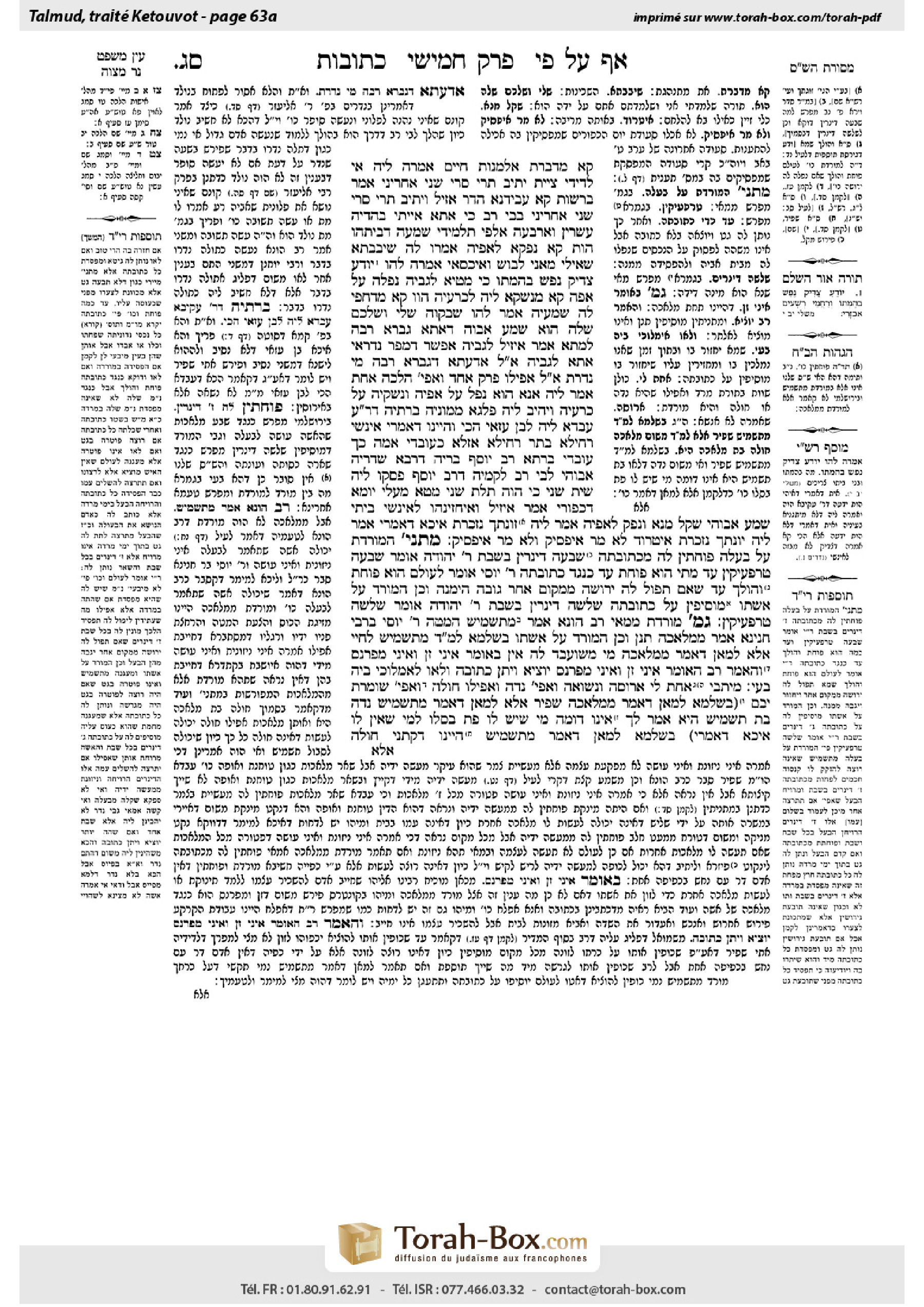
Ketubot 63a: Talmud study for Daf Yomi
Daf Yomi is the daily study of one Talmud folio. Explore 37 tractates with scans, Hebrew text, Sefaria English and AI-generated French translations where annotated.
Passage selection and English or AI-generated French translation are available where the scan has annotations. Daf Study is independent of Torah-Box and Sefaria.
Browse Ketubot · כתובות · All tractatesKetubot 63a text and translations
This page of Ketubot includes the Aramaic text, an English translation and an AI-generated French translation, alongside the scan above.
כתובות ס״ג א · Aramaic and Hebrew text
קָא מִדַּבְּרַתְּ אַלְמְנוּת חַיִּים?! אֲמַרָה לֵיהּ: אִי לְדִידִי צָיֵית — יָתֵיב תְּרֵי סְרֵי שְׁנֵי אַחְרָינְיָי[תָא]. אָמַר: בִּרְשׁוּת קָא עָבֵידְנָא. הֲדַר אָזֵיל וְיָתֵיב תְּרֵי סְרֵי שְׁנֵי אַחְרָינְיָי[תָא] בְּבֵי רַב. כִּי אֲתָא אַיְיתִי בַּהֲדֵיהּ עֶשְׂרִין וְאַרְבְּעָה אַלְפֵי תַּלְמִידֵי, שְׁמַעָה דְּבֵיתְהוּ, הֲוָת קָא נָפְקָא לְאַפֵּיהּ. אֲמַרוּ לַהּ שִׁיבָבָתָא: שְׁאִילִי מָאנֵי לְבוֹשׁ וְאִיכַּסַּאי. אֲמַרָה לְהוּ: ״יוֹדֵעַ צַדִּיק נֶפֶשׁ בְּהֶמְתּוֹ״. כִּי מָטְיָא לְגַבֵּיהּ, נְפַלָה עַל אַפַּהּ, קָא מְנַשְּׁקָא לֵיהּ לְכַרְעֵיהּ. הֲווֹ קָא מְדַחֲפִי לַהּ שַׁמָּעֵיהּ. אֲמַר לְהוּ: שִׁבְקוּהָ, שֶׁלִּי וְשֶׁלָּכֶם — שֶׁלָּהּ הוּא.
שְׁמַע אֲבוּהָ דַּאֲתָא גַּבְרָא רַבָּה לְמָתָא, אָמַר: אֵיזִיל לְגַבֵּיהּ, אֶפְשָׁר דְּמֵפַר נִדְרַאי. אֲתָא לְגַבֵּיהּ, אֲמַר לֵיהּ: אַדַּעְתָּא דְּגַבְרָא רַבָּה מִי נְדַרְתְּ? אָמַר לוֹ: אֲפִילּוּ פֶּרֶק אֶחָד, וַאֲפִילּוּ הֲלָכָה אַחַת. אֲמַר לֵיהּ: אֲנָא הוּא. נְפַל עַל אַפֵּיהּ וְנַשְּׁקֵיהּ עַל כַּרְעֵיהּ וִיהַב לֵיהּ פַּלְגָא מָמוֹנֵיהּ. בְּרַתֵּיה דְּרַבִּי עֲקִיבָא עֲבַדָא לֵיהּ לְבֶן עַזַּאי הָכִי. וְהַיְינוּ דְּאָמְרִי אִינָשֵׁי: רְחֵילָא בָּתַר רְחֵילָא אָזְלָא, כְּעוֹבָדֵי אִמָּא כָּךְ עוֹבָדֵי בְּרַתָּא.
רַב יוֹסֵף בְּרֵיהּ דְּרָבָא שַׁדְּרֵיהּ אֲבוּהִי לְבֵי רַב לְקַמֵּיהּ דְּרַב יוֹסֵף. פְּסַקוּ לֵיהּ שֵׁית שְׁנֵי. כִּי הֲוָה תְּלָת שְׁנֵי, מְטָא מַעֲלֵי יוֹמָא דְכִפּוּרֵי, אָמַר: אֵיזִיל וְאֶיחְזִינְהוּ לְאִינָשֵׁי בֵּיתִי. שְׁמַע אֲבוּהִי, שְׁקַל מָנָא וּנְפַק לְאַפֵּיהּ. אֲמַר לֵיהּ: זוֹנָתְךָ נִזְכַּרְתָּ? אִיכָּא דְאָמְרִי אֲמַר לֵיהּ: יוֹנָתְךָ נִזְכַּרְתָּ? אִיטְּרוּד. לָא מָר אִיפְּסִיק, וְלָא מָר אִיפְּסִיק.
מַתְנִי׳ הַמּוֹרֶדֶת עַל בַּעְלָהּ — פּוֹחֲתִין לָהּ מִכְּתוּבָּתָהּ שִׁבְעָה דִּינָרִין בַּשַּׁבָּת. רַבִּי יְהוּדָה אוֹמֵר: שִׁבְעָה טַרְפְּעִיקִין. עַד מָתַי הוּא פּוֹחֵת — עַד כְּנֶגֶד כְּתוּבָּתָהּ. רַבִּי יוֹסֵי אוֹמֵר: לְעוֹלָם הוּא פּוֹחֵת וְהוֹלֵךְ, עַד שֶׁאִם תִּפּוֹל לָהּ יְרוּשָּׁה מִמָּקוֹם אַחֵר, גּוֹבָה הֵימֶנָּה. וְכֵן, הַמּוֹרֵד עַל אִשְׁתּוֹ — מוֹסִיפִין עַל כְּתוּבָּתָהּ שְׁלֹשָׁה דִּינָרִין בְּשַׁבָּת. רַבִּי יְהוּדָה אוֹמֵר: שְׁלֹשָׁה טַרְפְּעִיקִין.
גְּמָ׳ מוֹרֶדֶת מִמַּאי? רַב הוּנָא אָמַר: מִתַּשְׁמִישׁ הַמִּטָּה. רַבִּי יוֹסֵי בְּרַבִּי חֲנִינָא אָמַר: מִמְּלָאכָה. תְּנַן: וְכֵן הַמּוֹרֵד עַל אִשְׁתּוֹ. בִּשְׁלָמָא לְמַאן דְּאָמַר מִתַּשְׁמִישׁ, לְחַיֵּי. אֶלָּא לְמַאן דְּאָמַר מִמְּלָאכָה, מִי מְשׁוּעְבָּד לַהּ? אִין, בְּאוֹמֵר ״אֵינִי זָן וְאֵינִי מְפַרְנֵס״.
וְהָאָמַר רַב: הָאוֹמֵר ״אֵינִי זָן וְאֵינִי מְפַרְנֵס״ — יוֹצִיא וְיִתֵּן כְּתוּבָּה! וְלָאו לְאִמְּלוֹכֵי בֵּיהּ בָּעֵי?
מֵיתִבִי: אַחַת לִי אֲרוּסָה, וּנְשׂוּאָה, וַאֲפִילּוּ נִדָּה, וַאֲפִילּוּ חוֹלָה, וַאֲפִילּוּ שׁוֹמֶרֶת יָבָם.
בִּשְׁלָמָא לְמַאן דְּאָמַר מִמְּלָאכָה, שַׁפִּיר. אֶלָּא לְמַאן דְּאָמַר מִתַּשְׁמִישׁ — נִדָּה בַּת תַּשְׁמִישׁ הִיא? אָמַר לָךְ: אֵינוֹ דּוֹמֶה מִי שֶׁיֵּשׁ לוֹ פַּת בְּסַלּוֹ לְמִי שֶׁאֵין לוֹ.
אִיכָּא דְּאָמְרִי: בִּשְׁלָמָא לְמַאן דְּאָמַר מִתַּשְׁמִישׁ, הַיְינוּ דְּקָתָנֵי חוֹלָה.
Ketubot 63a · English translation
will you lead the life of a widow of a living man, living alone while your husband is in another place? She said to him: If he would listen to me, he would sit and study for another twelve years. When Rabbi Akiva heard this he said: I have permission to do this. He went back and sat for another twelve years in the study hall. When he came back he brought twenty-four thousand students with him. His wife heard and went out toward him to greet him. Her neighbors said: Borrow some clothes and wear them, as your current apparel is not appropriate to meet an important person. She said to them: “A righteous man understands the life of his beast” (Proverbs 12:10). When she came to him she fell on her face and kissed his feet. His attendants pushed her away as they did not know who she was, and he said to them: Leave her alone, as my Torah knowledge and yours is actually hers.
In the meantime her father heard that a great man came to the town. He said: I will go to him. Maybe he will nullify my vow and I will be able to support my daughter. He came to him to ask about nullifying his vow, and Rabbi Akiva said to him: Did you vow thinking that this Akiva would become a great man? He said to him: If I had believed he would know even one chapter or even one halakha I would not have been so harsh. He said to him: I am he. Ben Kalba Savua fell on his face and kissed his feet and gave him half of his money. The Gemara relates: Rabbi Akiva’s daughter did the same thing for ben Azzai, who was also a simple person, and she caused him to learn Torah in a similar way, by betrothing herself to him and sending him off to study. This explains the folk saying that people say: The ewe follows the ewe; the daughter’s actions are the same as her mother’s.
On the same subject it is related: Rav Yosef, son of Rava, was sent by his father to the study hall to learn before the great Sage Rav Yosef. They agreed that he should sit for six years in the study hall. When three years had passed, the eve of Yom Kippur arrived and he said: I will go and see the members of my household, meaning his wife. His father heard and took a weapon, as if he were going to war, and went to meet him. According to one version he said to him: Did you remember your mistress, as you are abandoning your studies to see a woman? There are those who say that he said to him: Did you remember your dove? Since both father and son were involved in an argument, they were preoccupied and this Master did not eat the cessation meal before Yom Kippur and that Master also did not eat the cessation meal that day.
MISHNA: A woman who rebels against her husband is fined; her marriage contract is reduced by seven dinars each week. Rabbi Yehuda says: Seven half-dinars [terapa’ikin] each week. Until when does he reduce her marriage contract? Until the reductions are equivalent to her marriage contract, i.e., until he no longer owes her any money, at which point he divorces her without any payment. Rabbi Yosei says: He can always continue to deduct from the sum, even beyond that which is owed to her due to her marriage contract, so that if she will receive an inheritance from another source, he can collect the extra amount from her. And similarly, if a man rebels against his wife, he is fined and an extra three dinars a week are added to her marriage contract. Rabbi Yehuda says: Three terapa’ikin.
GEMARA: The Gemara asks: Against what does she rebel; what is the nature of the rebellion discussed in the mishna? Rav Huna said: Against engaging in marital relations. Rabbi Yosei, son of Rabbi Ḥanina, said: Against the tasks she is obligated to perform for her husband. The Gemara clarifies this dispute. The mishna states: Similarly, if a man rebels against his wife. Granted, according to the one who says that the rebellion is against marital relations, it is well, as this type of rebellion can apply equally to a husband. However, according to the one who says that she rebels against performing tasks, is he subjugated to her to perform tasks? The Gemara answers: Yes, he is, as the mishna is discussing someone who says: I will not sustain and I will not support my wife.
The Gemara asks: But didn’t Rav say: One who says: I will not sustain and I will not support my wife must immediately divorce her and give her the payment for her marriage contract? What relevance is there to a discussion of a weekly fine? The Gemara answers: Shouldn’t he be consulted to investigate whether he will retract his decision? In the interim, while the court discusses the issue with him and explains that he must divorce his wife if he does not retract his decision, he is fined by the addition of three dinars per week to her marriage contract.
The Gemara raises an objection from a baraita with regard to a rebellious woman: It is the same to me, i.e., the same halakha applies, if the woman who rebelled is a betrothed woman, or a married woman, or even a menstruating woman, or even if she is ill, or even if she is a widow waiting for her yavam to perform levirate marriage.
The Gemara discusses the baraita. Granted, according to the one who says that her rebelliousness is referring to performing tasks, it is well. However, according to the one who says that she rebels against engaging in marital relations, is a menstruating woman fit to engage in marital relations? She is not, and therefore there would be no significance to her refusal. The Gemara answers: The one who advocates that opinion could have said to you: One who has bread in his basket, i.e., one who has engaged in marital relations with his wife in the past, is not comparable to one who does not have bread in his basket. Since she declares her refusal to engage in marital relations, he suffers from this refusal even when she is menstruating or ill.
There are those who say that the objection was phrased differently. Granted, according to the one who says that the rebellion discussed in the mishna is referring to engaging in marital relations, this explanation is consistent with that which is taught with regard to an ill woman, that she be fined as a rebellious woman, as even if she is not capable of working, she can still be rebellious with regard to marital relations.
Ketubot 63a · Traduction française (IA)
Vas-tu mener la vie d’une veuve dont le mari est vivant, seule tandis que ton mari se trouve ailleurs ? Elle lui répondit : S’il m’écoutait, il resterait assis à étudier douze années de plus. Quand Rabbi Akiva entendit cela, il dit : J’ai la permission d’agir ainsi. Il retourna donc à la maison d’étude et y resta assis douze années de plus. À son retour, il était accompagné de vingt-quatre mille élèves. Sa femme l’apprit et sortit à sa rencontre. Ses voisines lui dirent : Emprunte des vêtements et porte-les, car ta tenue actuelle ne convient pas pour rencontrer un personnage important. Elle leur répondit : « Le juste connaît les besoins de sa bête » (Proverbes 12,10). Lorsqu’elle arriva auprès de lui, elle se jeta à ses pieds et les embrassa. Ses assistants la repoussèrent, car ils ne savaient pas qui elle était, mais il leur dit : Laissez-la ; mon savoir de la Torah, comme le vôtre, lui appartient en réalité.
Entre-temps, son père apprit qu’un grand homme était arrivé dans la ville. Il se dit : Je vais aller le voir. Peut-être annulera-t-il mon vœu et pourrai-je subvenir aux besoins de ma fille. Il vint lui demander d’annuler son vœu, et Rabbi Akiva lui dit : As-tu fait ce vœu en pensant que cet Akiva deviendrait un grand homme ? Il lui répondit : Si j’avais cru qu’il connaîtrait ne serait-ce qu’un chapitre ou une halakha, je n’aurais pas été aussi dur. Rabbi Akiva lui dit : C’est moi. Ben Kalba Savoua se jeta à ses pieds, les embrassa et lui donna la moitié de ses biens. La Guemara rapporte que la fille de Rabbi Akiva fit de même pour ben Azaï, qui était lui aussi un homme ordinaire : elle le poussa à étudier la Torah de la même manière, en se fiançant à lui puis en l’envoyant étudier. Cela explique le dicton populaire : La brebis suit la brebis ; la fille agit comme sa mère.
Sur le même sujet, on rapporte : Rav Yossef, fils de Rava, fut envoyé par son père à la maison d’étude pour étudier auprès du grand sage Rav Yossef. Ils convinrent qu’il resterait six ans à la maison d’étude. Au bout de trois ans, la veille de Yom Kippour arriva, et il dit : Je vais aller voir les membres de mon foyer, c’est-à-dire ma femme. Son père l’apprit, prit une arme comme s’il partait en guerre et alla à sa rencontre. Selon une version, il lui dit : As-tu pensé à ta maîtresse, puisque tu abandonnes tes études pour voir une femme ? D’autres disent qu’il lui dit : As-tu pensé à ta colombe ? Comme le père et le fils étaient tous deux préoccupés par leur dispute, ni celui-ci ni celui-là ne prit le repas qui précède le jeûne de Yom Kippour.
MICHNA : Une femme qui se rebelle contre son mari est pénalisée : sa kétouba est réduite de sept dinars chaque semaine. Rabbi Yehouda dit : De sept demi-dinars [terapa’ikin] chaque semaine. Jusqu’à quand réduit-il sa kétouba ? Jusqu’à ce que les réductions atteignent le montant de sa kétouba, c’est-à-dire jusqu’à ce qu’il ne lui doive plus rien ; il la répudie alors sans rien lui verser. Rabbi Yossei dit : Il peut continuer à déduire sans limite, même au-delà de la somme qui lui est due au titre de sa kétouba, de sorte que, si elle hérite d’une autre source, il pourra recouvrer auprès d’elle le montant supplémentaire. De même, si un homme se rebelle contre sa femme, il est pénalisé et trois dinars supplémentaires par semaine sont ajoutés à sa kétouba. Rabbi Yehouda dit : Trois terapa’ikin.
GUEMARA : La Guemara demande : Contre quoi se rebelle-t-elle ? Quelle est la nature de la rébellion évoquée dans la Michna ? Rav Houna dit : Elle refuse les relations conjugales. Rabbi Yossi, fils de Rabbi Ḥanina, dit : Elle refuse d’accomplir les tâches auxquelles elle est tenue pour son mari. La Guemara précise la controverse. La Michna enseigne : De même, si un homme se rebelle contre sa femme. Certes, selon celui qui dit que la rébellion porte sur les relations conjugales, cela convient, puisque ce type de rébellion peut également s’appliquer à un mari. Mais, selon celui qui dit qu’elle se rebelle en refusant d’accomplir les tâches, est-il soumis à son autorité pour accomplir des tâches ? La Guemara répond : Oui, car la Michna parle d’un homme qui dit : Je ne subviendrai pas aux besoins de ma femme et je ne l’entretiendrai pas.
La Guemara demande : Mais Rav n’a-t-il pas dit : Celui qui dit : « Je ne subviendrai pas aux besoins de ma femme et je ne l’entretiendrai pas » doit immédiatement la répudier et lui verser le montant de sa kétouba ? Quel rapport cela a-t-il avec une pénalité hebdomadaire ? La Guemara répond : Ne faut-il pas l’interroger afin de vérifier s’il reviendra sur sa décision ? Pendant ce temps, tandis que le tribunal discute avec lui et lui explique qu’il doit répudier sa femme s’il ne revient pas sur sa décision, il est pénalisé par l’ajout de trois dinars par semaine à sa kétouba.
La Guemara soulève une objection tirée d’une baraïta au sujet d’une femme rebelle : La halakha est la même que la femme rebelle soit fiancée, mariée, en état de menstruation, malade, ou encore veuve attendant que son yavam contracte avec elle un mariage léviratique.
La Guemara examine la baraïta. Certes, selon celui qui dit que sa rébellion consiste à refuser d’accomplir les tâches, cela convient. Mais, selon celui qui dit qu’elle se rebelle contre les relations conjugales, une femme en état de menstruation peut-elle avoir des relations conjugales ? Non ; son refus n’aurait donc aucune portée. La Guemara répond : Celui qui défend cette opinion aurait pu te dire : Celui qui a du pain dans son panier, c’est-à-dire celui qui a déjà eu des relations conjugales avec sa femme, n’est pas comparable à celui qui n’en a pas. Puisqu’elle déclare refuser les relations conjugales, ce refus le fait souffrir même lorsqu’elle est en état de menstruation ou malade.
D’autres disent que l’objection était formulée autrement. Certes, selon celui qui dit que la rébellion évoquée dans la Michna consiste à refuser les relations conjugales, cette explication concorde avec ce qui est enseigné au sujet d’une femme malade, qui est pénalisée comme une femme rebelle, car même si elle n’est pas capable de travailler, elle peut néanmoins se rebeller en refusant les relations conjugales.
Traduction française générée par IA à partir de l’édition anglaise de Sefaria. Vérifie toujours un passage avec le texte source.
Text from Sefaria: William Davidson Edition - Vocalized Aramaic (CC BY NC); William Davidson Edition - English (CC BY NC).