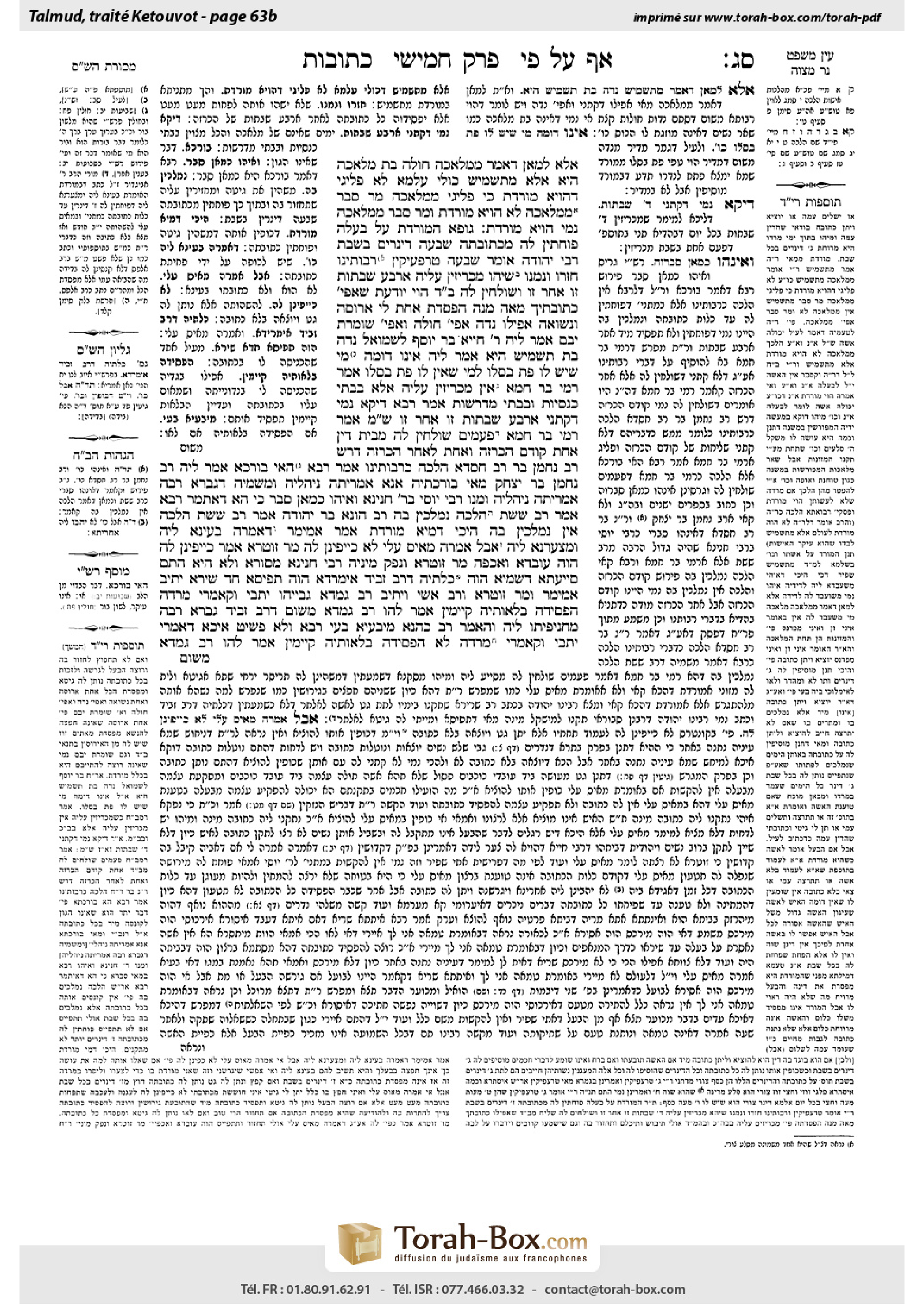
Ketubot 63b: Talmud study for Daf Yomi
Daf Yomi is the daily study of one Talmud folio. Explore 37 tractates with scans, Hebrew text, Sefaria English and AI-generated French translations where annotated.
Passage selection and English or AI-generated French translation are available where the scan has annotations. Daf Study is independent of Torah-Box and Sefaria.
Browse Ketubot · כתובות · All tractatesKetubot 63b text and translations
This page of Ketubot includes the Aramaic text, an English translation and an AI-generated French translation, alongside the scan above.
כתובות ס״ג ב · Aramaic and Hebrew text
אֶלָּא לְמַאן דְּאָמַר מִמְּלָאכָה, חוֹלָה בַּת מְלָאכָה הִיא? אֶלָּא: מִתַּשְׁמִישׁ כּוּלֵּי עָלְמָא לָא פְּלִיגִי דְּהָוְיָא מוֹרֶדֶת. כִּי פְּלִיגִי מִמְּלָאכָה, מָר סָבַר: מִמְּלָאכָה — לָא הָוְיָא מוֹרֶדֶת, וּמָר סָבַר: מִמְּלָאכָה — נָמֵי הָוְיָא מוֹרֶדֶת.
גּוּפָא: הַמּוֹרֶדֶת עַל בַּעֲלָהּ — פּוֹחֲתִין לָהּ מִכְּתוּבָּתָהּ שִׁבְעָה דִּינָרִים בְּשַׁבָּת. רַבִּי יְהוּדָה אוֹמֵר: שִׁבְעָה טַרְפְּעִיקִין. רַבּוֹתֵינוּ חָזְרוּ וְנִמְנוּ, שֶׁיְּהוּ מַכְרִיזִין עָלֶיהָ אַרְבַּע שַׁבָּתוֹת זוֹ אַחַר זוֹ, וְשׁוֹלְחִין לָהּ בֵּית דִּין: הֱוִי יוֹדַעַת שֶׁאֲפִילּוּ כְּתוּבָּתִיךְ מֵאָה מָנֶה הִפְסַדְתְּ. אַחַת לִי אֲרוּסָה וּנְשׂוּאָה, אֲפִילּוּ נִדָּה, אֲפִילּוּ חוֹלָה, וַאֲפִילּוּ שׁוֹמֶרֶת יָבָם.
אֲמַר לֵיהּ רַבִּי חִיָּיא בַּר יוֹסֵף לִשְׁמוּאֵל: נִדָּה בַּת תַּשְׁמִישׁ הִיא? אֲמַר לֵיהּ: אֵינוֹ דּוֹמֶה מִי שֶׁיֵּשׁ לוֹ פַּת בְּסַלּוֹ לְמִי שֶׁאֵין לוֹ פַּת בְּסַלּוֹ.
אָמַר רָמֵי בַּר חָמָא: אֵין מַכְרִיזִין עָלֶיהָ אֶלָּא בְּבָתֵּי כְנֵסִיּוֹת וּבְבָתֵּי מִדְרָשׁוֹת. אָמַר רָבָא: דַּיְקָא נָמֵי, דְּקָתָנֵי: אַרְבַּע שַׁבָּתוֹת זוֹ אַחַר זוֹ. שְׁמַע מִינַּהּ. אָמַר רָמֵי בַּר חָמָא: פַּעֲמַיִם שׁוֹלְחִין לָהּ מִבֵּית דִּין, אַחַת קוֹדֶם הַכְרָזָה, וְאַחַת לְאַחַר הַכְרָזָה.
דָּרַשׁ רַב נַחְמָן בַּר רַב חִסְדָּא: הֲלָכָה כְּרַבּוֹתֵינוּ. אָמַר רָבָא: הַאי בּוּרְכָא. אֲמַר לֵיהּ רַב נַחְמָן בַּר יִצְחָק: מַאי בּוּרְכָתֵיהּ? אֲנָא אַמְרִיתַהּ נִיהֲלֵיהּ, וּמִשְּׁמֵיהּ דְּגַבְרָא רַבָּה אַמְרִיתַהּ נִיהֲלֵיהּ, וּמַנּוּ, רַבִּי יוֹסֵי בְּרַבִּי חֲנִינָא.
וְאִיהוּ כְּמַאן סָבַר? כִּי הָא דְּאִתְּמַר: רָבָא אָמַר רַב שֵׁשֶׁת: הֲלָכָה, נִמְלָכִין בָּהּ. רַב הוּנָא בַּר יְהוּדָה אָמַר רַב שֵׁשֶׁת: הֲלָכָה, אֵין נִמְלָכִין בָּהּ.
הֵיכִי דָּמְיָא מוֹרֶדֶת? אָמַר אַמֵּימָר: דְּאָמְרָה ״בָּעֵינָא לֵיהּ וּמְצַעַרְנָא לֵיהּ״. אֲבָל אָמְרָה ״מְאִיס עֲלַי״ — לָא כָּיְיפִינַן לַהּ. מָר זוּטְרָא אָמַר: כָּיְיפִינַן לָהּ.
הֲוָה עוֹבָדָא וְאַכְפְּיַהּ מָר זוּטְרָא, וּנְפַק מִינֵּיהּ רַבִּי חֲנִינָא מִסּוּרָא. וְלָא הִיא: הָתָם סִיַּיעְתָּא דִשְׁמַיָּא הֲוָה.
כַּלְּתֵיהּ דְּרַב זְבִיד אִימְּרַדָא, הֲוָה תְּפִיסָא חַד שֵׁירָא. יְתֵיב אַמֵּימָר וּמָר זוּטְרָא וְרַב אָשֵׁי, וִיתֵיב רַב גַּמָּדָא גַּבַּיְיהוּ. יָתְבִי וְקָאָמְרִי: מָרְדָה — הִפְסִידָה בְּלָאוֹתֶיהָ קַיָּימִין. אֲמַר לְהוּ רַב גַּמָּדָא: מִשּׁוּם דְּרַב זְבִיד גַּבְרָא רַבָּה, מַחְנִיפִיתוּ לֵיהּ? וְהָאָמַר רַב כָּהֲנָא: מִיבַּעְיָא בָּעֵי רָבָא, וְלָא פְּשִׁיט? אִיכָּא דְּאָמְרִי, יָתְבִי וְקָאָמְרִי, מָרְדָה — לֹא הִפְסִידָה בְּלָאוֹתֶיהָ קַיָּימִין. אֲמַר לְהוּ רַב גַּמָּדָא:
Ketubot 63b · English translation
However, according to the one who says the rebellion is against performing tasks, is an ill woman fit to perform tasks? Since she is ill, she has no obligation to perform tasks and this is not deemed rebellious behavior. Rather, one must explain this as follows: If she rebelled against engaging in marital relations, everyone agrees that she is defined as a rebellious woman. They disagree with regard to one who rebels against performing tasks. One Sage, Rav Huna, holds that one who rebels against performing tasks is not a rebellious woman, and one Sage, Rabbi Yosei, son of Rabbi Ḥanina, holds that one who rebels against performing tasks is also considered a rebellious woman.
§ With regard to the matter itself: A woman who rebels against her husband is fined; we reduce her marriage contract by seven dinars each week, and Rabbi Yehuda says: Seven terapa’ikin. Our Sages went back and were counted again, meaning they voted and decided that instead of deducting a small amount from her marriage contract each week, they would make public announcements about her for four consecutive Shabbatot. And they decided that the court would send messengers to her to inform her: Be aware that even if your marriage contract is worth ten thousand dinars, you will lose it all if you continue your rebellion. If she does not retract her rebellion, she forfeits her entire marriage contract. With regard to this enactment, it is the same to me, meaning the halakha does not change, if she is a betrothed woman or a married woman, and even if she is a menstruating woman, and even if she is ill, and even if she is a widow awaiting her yavam to perform levirate marriage.
Rabbi Ḥiyya bar Yosef said to Shmuel: Is a menstruating woman fit to engage in conjugal relations? He said to him: One who has bread in his basket, i.e., one who knows that he will be able to engage in relations with his wife after her period of menstrual impurity ends, is not comparable to one who does not have bread in his basket.
Rami bar Ḥama said: We make announcements about her only in synagogues and study halls, but not in the street. Rava said: The language of the baraita is also precise, as it teaches: They would make announcements on four consecutive Shabbatot, which are days when no labor is performed and people are not to be found in the streets, but rather in synagogues and study halls. The Gemara summarizes: Conclude from this that this is the case. Rami bar Ḥama said: The court sends people to talk with her twice, once before the announcement and once after the announcement.
Rav Naḥman bar Rav Ḥisda taught with regard to this: The halakha is in accordance with the decision of our Sages. Rava said: This is an absurdity [burkha]. Rav Naḥman bar Yitzḥak said to him: What is absurd about this? I said this to him, and I said it to him in the name of a great man. And who is the great man who ruled this way? Rabbi Yosei, son of Rabbi Ḥanina.
The Gemara asks: And in accordance with whose opinion does Rava hold? The Gemara answers: In accordance with that which was stated: Rava said that Rav Sheshet said: The halakha is that she is consulted in an attempt to convince her to retract her decision, and while doing so deductions are made from her marriage contract. But Rav Huna bar Yehuda said that Rav Sheshet said: The halakha is that we do not consult with her. According to both versions of Rav Sheshet’s ruling, she does not lose her marriage contract immediately but rather it is reduced every week. This is the source for Rava’s opinion.
§ With regard to this halakha, the Gemara asks: What are the circumstances in which the halakha of a rebellious woman applies? Ameimar said: The case is where she says: I want to be married to him, but I am currently refusing him because I want to cause him anguish due to a dispute between us. However, if she said: I am disgusted with him, we do not compel her to remain with him, as one should not be compelled to live with someone who disgusts her. Mar Zutra said: We do compel her to stay with him.
It is related: There was an incident in which a woman rebelled, claiming that she was disgusted with her husband, and Mar Zutra compelled her to stay with him. And from this couple issued Rabbi Ḥanina of Sura. This demonstrates that even such coercion can cause a blessing. However, the Gemara concludes: That is not so. That case should not serve as a precedent, as there the positive outcome was due to heavenly assistance. Ordinarily, nothing good results from conjugal relations that the wife does not desire.
It is related that the daughter-in-law of Rav Zevid rebelled against her husband. She was holding a certain garment in her hands. Ameimar, Mar Zutra, and Rav Ashi were sitting, and Rav Gamda was sitting with them. They sat and said: If a woman rebelled, she lost her right to her worn clothes, meaning she has forfeited the clothes she brought with her for her dowry even if they are still in existence. Rav Gamda said to them: Because Rav Zevid is a great man, are you willing to flatter him with regard to this halakha? Didn’t Rav Kahana say: Rava raises a dilemma about this issue with regard to worn clothes, and he did not resolve it? Yet you reached a decision out of respect for Rav Zevid. This is inappropriate. There are those who say that this incident happened differently, as these three Sages sat and said: If she rebelled, she did not lose her right to her worn clothes. Rav Gamda said to them:
Ketubot 63b · Traduction française (IA)
Cependant, selon celui qui affirme que la rébellion concerne l’accomplissement des tâches, une femme malade est-elle en état d’accomplir des tâches ? Puisqu’elle est malade, elle n’est pas tenue de les accomplir, et son comportement n’est donc pas considéré comme une rébellion. Il faut plutôt expliquer les choses ainsi : si elle s’est rebellée contre les relations conjugales, tous sont d’accord pour dire qu’elle est considérée comme une femme rebelle. Leur désaccord porte sur celle qui se rebelle contre l’accomplissement des tâches. Rav Houna estime que celle qui se rebelle contre l’accomplissement des tâches n’est pas une femme rebelle, tandis que Rabbi Yossei, fils de Rabbi Ḥanina, estime qu’elle est également considérée comme une femme rebelle.
§ À propos de cette question elle-même : une femme qui se rebelle contre son mari est frappée d’une pénalité ; on réduit sa ketouba de sept dinars chaque semaine, et Rabbi Yehouda dit : de sept terapa’ikin. Nos Sages se réunirent de nouveau et procédèrent à un nouveau vote : ils décidèrent qu’au lieu de déduire chaque semaine une petite somme de sa ketouba, on ferait des annonces publiques à son sujet pendant quatre Shabbatot consécutifs. Ils décidèrent que le tribunal lui enverrait des messagers pour l’informer : « Sache que même si ta ketouba vaut dix mille dinars, tu la perdras entièrement si tu persistes dans ta rébellion. » Si elle ne renonce pas à sa rébellion, elle perd la totalité de sa ketouba. Pour ce qui est de cette ordonnance, la halakha ne change pas, qu’il s’agisse d’une femme fiancée ou mariée, même si elle est en période de menstruation, même si elle est malade, ou encore s’il s’agit d’une veuve qui attend que son yavam accomplisse le mariage léviratique.
Rabbi Ḥiyya bar Yosef dit à Shmuel : « Une femme en période de menstruation est-elle en état d’avoir des relations conjugales ? » Il lui répondit : « Celui qui a du pain dans son panier, c’est-à-dire celui qui sait qu’il pourra avoir des relations avec sa femme après la fin de sa période d’impureté menstruelle, n’est pas comparable à celui qui n’a pas de pain dans son panier. »
Rami bar Ḥama dit : on ne fait des annonces à son sujet que dans les synagogues et les maisons d’étude, mais pas dans la rue. Rava dit : la formulation de la baraïta est également précise, car elle enseigne qu’on faisait des annonces pendant quatre Shabbatot consécutifs, jours où l’on ne travaille pas et où les gens ne se trouvent pas dans les rues, mais plutôt dans les synagogues et les maisons d’étude. La Guemara conclut : déduis-en que c’est bien le cas. Rami bar Ḥama dit : le tribunal envoie des personnes lui parler deux fois, une fois avant l’annonce et une fois après.
Rav Naḥman bar Rav Ḥisda enseigna à ce sujet : la halakha est conforme à la décision de nos Sages. Rava dit : « C’est absurde [burkha]. » Rav Naḥman bar Yitzḥak lui dit : « En quoi est-ce absurde ? Je lui ai dit cela, et je le lui ai dit au nom d’un grand homme. » Et quel est le grand homme qui a statué ainsi ? Rabbi Yossei, fils de Rabbi Ḥanina.
La Guemara demande : selon l’opinion de qui Rava statue-t-il ? La Guemara répond : conformément à ce qui a été rapporté : Rava dit que Rav Sheshet a dit que la halakha est qu’on la consulte pour tenter de la convaincre de revenir sur sa décision, et que, pendant ce temps, on déduit des sommes de sa ketouba. Mais Rav Houna bar Yehouda dit que Rav Sheshet a dit que la halakha est qu’on ne la consulte pas. Selon les deux versions de la décision de Rav Sheshet, elle ne perd pas immédiatement sa ketouba ; celle-ci est plutôt réduite chaque semaine. Voilà la source de l’opinion de Rava.
§ À propos de cette halakha, la Guemara demande : dans quelles circonstances la halakha relative à une femme rebelle s’applique-t-elle ? Ameimar dit : « Il s’agit du cas où elle dit : “Je veux être mariée avec lui, mais je le refuse pour le moment parce que je veux le faire souffrir à cause d’un différend entre nous.” Cependant, si elle dit : “Il me répugne”, on ne la contraint pas à rester avec lui, car on ne doit pas contraindre quelqu’un à vivre avec une personne qui lui répugne. » Mar Zutra dit : « On la contraint à rester avec lui. »
Il est rapporté qu’une femme se rebella en déclarant que son mari lui répugnait, et que Mar Zutra la contraignit à rester avec lui. De ce couple naquit Rabbi Ḥanina de Soura. Cela montre que même une telle contrainte peut être à l’origine d’une bénédiction. Cependant, la Guemara conclut : il n’en est pas ainsi. Ce cas ne doit pas servir de précédent, car le résultat positif était dû à l’aide du Ciel. En temps normal, rien de bon ne résulte de relations conjugales que l’épouse ne désire pas.
Il est rapporté que la belle-fille de Rav Zevid se rebella contre son mari. Elle tenait un certain vêtement dans ses mains. Ameimar, Mar Zutra et Rav Ashi étaient assis, et Rav Gamda était assis avec eux. Ils se réunirent et dirent : « Si une femme s’est rebellée, elle perd son droit à ses vêtements usagés », c’est-à-dire qu’elle perd les vêtements qu’elle avait apportés en dot, même s’ils existent encore. Rav Gamda leur dit : « Parce que Rav Zevid est un grand homme, êtes-vous prêts à le flatter au sujet de cette halakha ? Rav Kahana n’a-t-il pas dit que Rava soulève un dilemme à propos de cette question des vêtements usagés, sans le résoudre ? Pourtant, vous êtes parvenus à une décision par égard pour Rav Zevid. Cela ne convient pas. » Certains rapportent cet incident autrement : ces trois Sages se réunirent et dirent : « Si elle s’est rebellée, elle ne perd pas son droit à ses vêtements usagés. » Rav Gamda leur dit :
Traduction française générée par IA à partir de l’édition anglaise de Sefaria. Vérifie toujours un passage avec le texte source.
Text from Sefaria: William Davidson Edition - Vocalized Aramaic (CC BY NC); William Davidson Edition - English (CC BY NC).