Ketubot 64a: Talmud study for Daf Yomi
Daf Yomi is the daily study of one Talmud folio. Explore 37 tractates with scans, Hebrew text, Sefaria English and AI-generated French translations where annotated.
Passage selection and English or AI-generated French translation are available where the scan has annotations. Daf Study is independent of Torah-Box and Sefaria.
Browse Ketubot · כתובות · All tractatesKetubot 64a text and translations
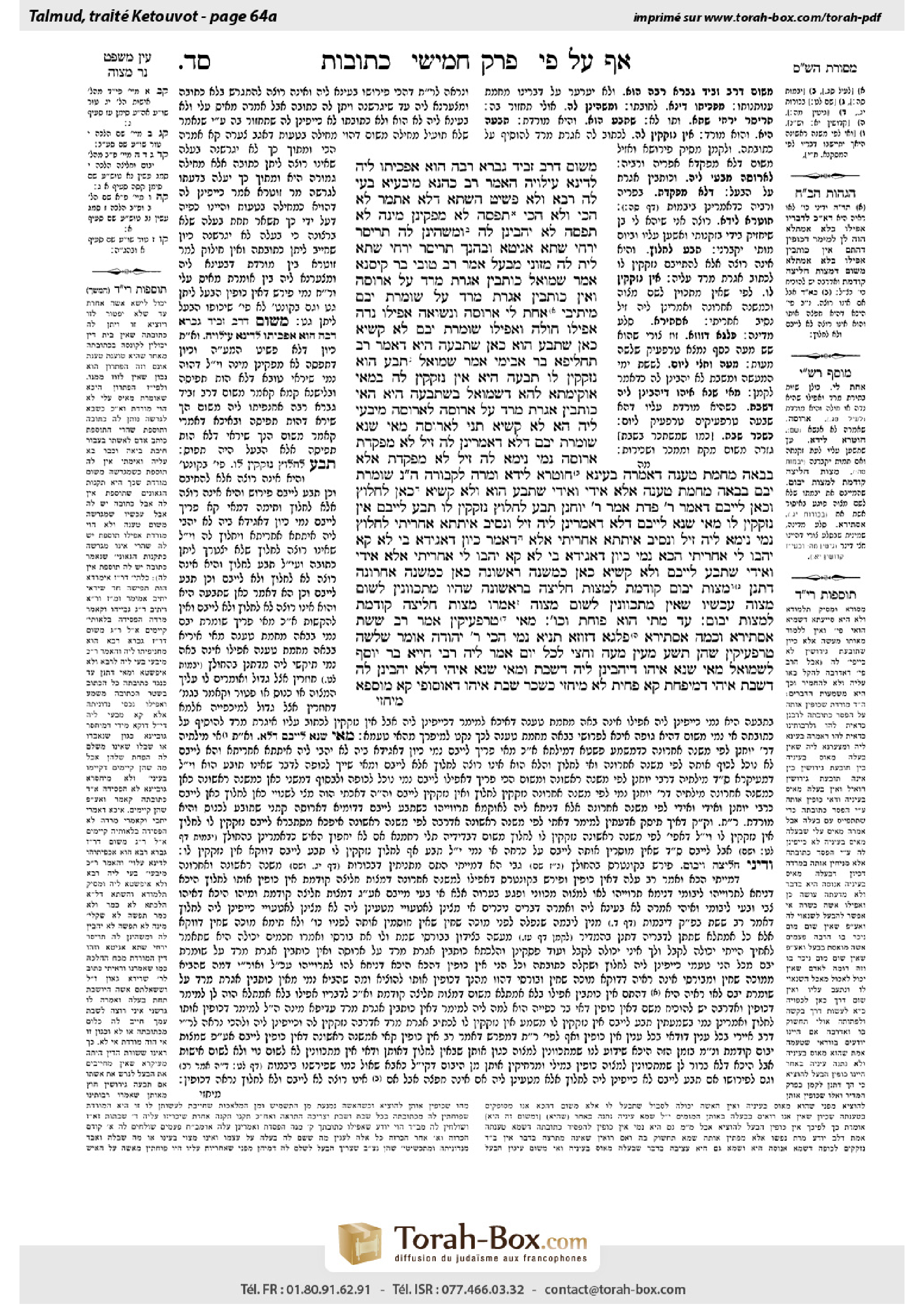
This page of Ketubot includes the Aramaic text, an English translation and an AI-generated French translation, alongside the scan above.
כתובות ס״ד א · Aramaic and Hebrew text
מִשּׁוּם דְּרַב זְבִיד גַּבְרָא רַבָּה הוּא, אָפְכִיתוּ לֵיהּ לְדִינָא עִילָּוֵיהּ? הָאָמַר רַב כָּהֲנָא: מִיבַּעְיָא בָּעֵי לַהּ רָבָא, וְלָא פְּשִׁיט?! הַשְׁתָּא דְּלָא אִתְּמַר לָא הָכִי וְלָא הָכִי, תְּפַסָה — לָא מַפְּקִינַן מִינַּהּ, לָא תְּפַסָה — לָא יָהֲבִינַן לַהּ.
וּמְשַׁהֵינַן לַהּ תְּרֵיסַר יַרְחֵי שַׁתָּא אַגִּיטָּא, וּבְהָנָךְ תְּרֵיסַר יַרְחֵי שַׁתָּא לֵית לַהּ מְזוֹנֵי מִבַּעַל.
אָמַר רַב טוֹבִי בַּר קִיסְנָא אָמַר שְׁמוּאֵל: כּוֹתְבִין אִגֶּרֶת מָרֶד עַל אֲרוּסָה, וְאֵין כּוֹתְבִין אִגֶּרֶת מָרֶד עַל שׁוֹמֶרֶת יָבָם. מֵיתִיבִי: אַחַת לִי אֲרוּסָה וּנְשׂוּאָה, אֲפִילּוּ נִדָּה, אֲפִילּוּ חוֹלָה, וַאֲפִילּוּ שׁוֹמֶרֶת יָבָם!
לָא קַשְׁיָא: כָּאן שֶׁתָּבַע הוּא, כָּאן שֶׁתָּבְעָה הִיא. דְּאָמַר רַב תַּחְלִיפָא בַּר אֲבִימִי אָמַר שְׁמוּאֵל: תָּבַע הוּא — נִזְקָקִין לוֹ. תָּבְעָה הִיא — אֵין נִזְקָקִין לָהּ.
בְּמַאי אוֹקֵימְתַּהּ לְהָא דִּשְׁמוּאֵל — בְּשֶׁתָּבְעָה הִיא, הַאי ״כּוֹתְבִין אִגֶּרֶת מֶרֶד עַל אֲרוּסָה״? ״לַאֲרוּסָה״ מִיבְּעֵי לֵיהּ! הָא לָא קַשְׁיָא, תְּנִי ״לָאֲרוּסָה״.
מַאי שְׁנָא שׁוֹמֶרֶת יָבָם דְּלָא — דְּאָמְרִינַן לַהּ: זִיל, לָא מִפַּקְּדַתְּ, אֲרוּסָה נָמֵי, נֵימָא לַהּ: זִיל, לָא מִפַּקְּדַתְּ! אֶלָּא בְּבָאָה מֵחֲמַת טַעֲנָה, דְּאָמְרָה: בָּעֵינָא חוּטְרָא לִידָא וּמָרָה לִקְבוּרָה.
הָכִי נָמֵי שׁוֹמֶרֶת יָבָם, בְּבָאָה מֵחֲמַת טַעֲנָה?! אֶלָּא, אִידֵּי וְאִידֵּי שֶׁתָּבַע הוּא, וְלָא קַשְׁיָא: כָּאן לַחֲלוֹץ, וְכָאן לְיַיבֵּם. דְּאָמַר רַבִּי פְּדָת אָמַר רַבִּי יוֹחָנָן: תָּבַע לַחְלוֹץ — נִזְקָקִין לוֹ. תָּבַע לְיַיבֵּם — אֵין נִזְקָקִין לוֹ.
מַאי שְׁנָא לְיַיבֵּם דְּלָא, דְּאָמְרִינַן לֵיהּ: זִיל וּנְסֵיב אִיתְּתָא אַחֲרִיתִי. לַחְלוֹץ נָמֵי נֵימָא לֵיהּ: זִיל וּנְסֵיב אִיתְּתָא אַחֲרִיתִי!
אֶלָּא דְּאָמַר: ״כֵּיוָן דַּאֲגִידָא בִּי, לָא קָא יָהֲבוּ לִי אַחֲרִיתִי״.
הָכָא נָמֵי: ״כֵּיוָן דַּאֲגִידָא בִּי, לָא קָא יָהֲבוּ לִי אַחֲרִיתִי״! אֶלָּא אִידֵּי וְאִידֵּי שֶׁתָּבַע לְיַיבֵּם, וְלָא קַשְׁיָא: כָּאן — כְּמִשְׁנָה רִאשׁוֹנָה, כָּאן — כְּמִשְׁנָה אַחֲרוֹנָה.
דִּתְנַן: מִצְוַת יִבּוּם קוֹדֶמֶת לְמִצְוַת חֲלִיצָה — בָּרִאשׁוֹנָה, שֶׁהָיוּ מִתְכַּוְּונִין לְשׁוּם מִצְוָה. עַכְשָׁיו שֶׁאֵין מִתְכַּוְּונִין לְשׁוּם מִצְוָה, אָמְרוּ: מִצְוַת חֲלִיצָה קוֹדֶמֶת לְמִצְוַת יִבּוּם.
עַד מָתַי הוּא פּוֹחֵת וְכוּ׳. מַאי טַרְפְּעִיקִין? אָמַר רַב שֵׁשֶׁת: אִסְתֵּירָא. וְכַמָּה אִסְתֵּירָא — פַּלְגָא דְזוּזָא. תַּנְיָא נָמֵי הָכִי, רַבִּי יְהוּדָה אוֹמֵר: שְׁלֹשָׁה טַרְפְּעִיקִין, שֶׁהֵן תֵּשַׁע מֵעֵין, מָעָה וַחֲצִי לְכׇל יוֹם.
אֲמַר לֵיהּ רַבִּי חִיָּיא בַּר יוֹסֵף לִשְׁמוּאֵל: מַאי שְׁנָא אִיהוּ דְּיָהֲבִינַן לֵיהּ דְּשַׁבָּת. וּמַאי שְׁנָא אִיהִי דְּלָא יָהֲבִינַן לַהּ דְּשַׁבָּת? אִיהִי דְּמִיפְחָת קָא פָחֵית, לָא מִיחֲזֵי כִּשְׂכַר שַׁבָּת, אִיהוּ דְּאוֹסוֹפֵי קָא מוֹסְפָא,
Ketubot 64a · English translation
Because Rav Zevid is a great man, and due to his piety and humility he would not challenge the ruling, you twist the judgment against him? Didn’t Rav Kahana say: Rava raises a dilemma with regard to this issue and did not resolve it, so how did you rule that she may retain her worn clothes? The Gemara summarizes: Now that it was not stated and concluded this way or that way, if she seized an item of her possessions, we do not take it away from her, but if she did not seize it, we do not give it to her.
The Gemara adds another halakha with regard to a rebellious woman: And we delay her bill of divorce for twelve months of the year and do not give her a bill of divorce until then. And during those twelve months of the year she does not receive sustenance from her husband.
§ Rav Tuvi bar Kisna said that Shmuel said: The court writes a letter of rebellion about a betrothed woman who is rebelling against her husband. This letter is a court order to deduct value from the marriage contract. But it does not write a letter of rebellion about a widow awaiting her yavam who does not want to enter into levirate marriage. The Gemara raises an objection from a baraita: It is the same to me if she is a betrothed woman or a married woman, and even if she is a menstruating woman, and even if she is ill, and even if she is a widow awaiting her yavam.
The Gemara answers: This is not difficult, as the contradiction can be resolved in the following way: Here, where there is no distinction between a betrothed woman and a widow awaiting her yavam, it refers to a case where he asked to marry her and she is refusing; there, where there is a distinction, the case is where she asked to marry him and he is refusing. As Rav Taḥalifa bar Avimi said that Shmuel said: If he asked, the court responds to his request and gives her the status of a rebellious woman, but if she asked, it does not respond to her request and does not add to her marriage contract.
The Gemara inquires: In what manner did you establish that which Shmuel said, that one writes a letter of rebellion about a betrothed woman but not about a widow awaiting her yavam? If it is a situation where she asked to marry him and he did not want, then why phrase this: The court writes a letter of rebellion about a betrothed woman, which indicates that the bill is written against her. It should have said instead: Write a letter of rebellion for a betrothed woman, meaning it is written on her behalf against her husband. The Gemara answers: This is not difficult, as the text is imprecise. Teach the statement instead this way: For a betrothed woman.
The Gemara asks: What is different about a widow awaiting her yavam, for whom a letter of rebellion is not written against her husband? Because we say to her: Go away; you are not commanded to procreate. Therefore, although she cannot get married, he cannot be compelled to perform an act that the Torah does not specifically command him to perform. The Gemara challenges this answer: If this is the reasoning, then in the case of a betrothed woman, too, let us say to her: Go away; you are not commanded. Rather, the case where a letter of rebellion is issued must be referring to a woman who comes with a claim, saying: I want a staff in my hand and a hoe for burial, i.e., I want children who will support me in my old age and attend to my burial after my death. This claim is valid, and therefore the court issues a letter of rebellion against the husband.
The Gemara asks: So too here, if she is a widow awaiting her yavam who comes with a claim, why shouldn’t the court listen to her? Rather, the Gemara retracts the explanation that she asked him to marry her. Instead, say that both this and that are discussing situations where he asks her and she rebels, and the question from the baraita on Shmuel’s statement is not difficult. Here, the baraita that said that the court writes a letter of rebellion about a widow awaiting her yavam, is referring to a case where the yavam asked her to perform ḥalitza and she refused. There, Shmuel’s statement that the court does not write it, is referring to a case where he asked to consummate the levirate marriage, as Rabbi Pedat said that Rabbi Yoḥanan said: If the yavam asked her to perform ḥalitza and she refused, the court responds to him. If he asked to perform levirate marriage, the court does not respond to him.
The Gemara asks: What is different with regard to the request to consummate the levirate marriage, that if a woman refuses the court does not write a letter of rebellion against her? Because we say to him: Go and marry another woman. He is not required to marry her specifically, if she does not agree to the marriage. Therefore, her refusal is not deemed rebellion. The Gemara challenges that answer: If so, with regard to a request to perform ḥalitza also, let us say to him: Go and marry another woman. The difference between the two cases is still not clear.
Rather, it must be that the reason is because he says: Since she is attached to me they will not give me another wife. As long as he has not performed ḥalitza, he may have a problem finding another wife, as a potential wife will be concerned that he has a woman attached to him and may eventually enter levirate marriage with him. This is a valid claim, and therefore the court writes a letter of rebellion against her if she refuses ḥalitza.
The Gemara asks: If so, here too, when she refuses a request to consummate the levirate marriage, he may say: Since she is attached to me they will not give me another. Why then doesn’t the court write a letter of rebellion in this case? Rather, one must say that this and that are both discussing a case where he asked to consummate the levirate marriage. And it is not difficult. Here, in the baraita, where the court writes a letter of rebellion, it is in accordance with the first mishna. There, in Shmuel’s statement, where it doesn’t write one, it is in accordance with the ultimate version of the mishna.
As we learned in a mishna (Bekhorot 13a): The mitzva of levirate marriage precedes the mitzva of ḥalitza. This halakha originally applied when people would intend to perform the levirate marriage for the sake of the mitzva. At that time, it was customary to compel a woman to enter levirate marriage. If she refused, the court wrote a letter of rebellion about her. However, now that people do not intend to enter levirate marriage for the sake of the mitzva, but may have other intentions, the Sages said: The mitzva of ḥalitza precedes the mitzva of levirate marriage. Shmuel’s statement that the court does not write a letter of rebellion about a widow awaiting her yavam is in accordance with the ultimate version of the mishna.
§ The mishna asks: Until when does he reduce her marriage contract? And in that context it states that, according to the opinion of Rabbi Yehuda, the sums involved are calculated in terapa’ikin and not in dinars. The Gemara asks: What are terapa’ikin? Rav Sheshet said: An asteira, a small coin. And how much is an asteira? A half of a dinar. This is also taught in a baraita: Rabbi Yehuda says: Three terapa’ikin, which are nine ma’as, a ma’a and a half for each day, multiplied by six for the six days of the week.
Rabbi Ḥiyya bar Yosef said to Shmuel: What is different when she is the one rebelling against him, that we give him compensation for Shabbat, as her marriage contract is reduced by seven dinars a week, which is one dinar per day including Shabbat, and what is different for her that we do not give her compensation for Shabbat but rather only for six days? The Gemara explains: When it is she who is fined and her marriage contract is reduced, it does not appear to be Shabbat wages, money paid for services rendered on Shabbat, which is prohibited. Whereas when it is he who is fined and compelled to add additional money every day to her marriage contract,
Ketubot 64a · Traduction française (IA)
Parce que Rav Zevid est un grand homme et que, par piété et humilité, il n’aurait pas contesté la décision, tu retournes le jugement contre lui ? Rav Kahana n’a-t-il pas dit : « Rava soulève une question à ce sujet et ne la tranche pas » ? Comment as-tu donc décidé qu’elle pouvait garder ses vêtements usés ? La Guemara résume : Puisque la question n’a pas été tranchée dans un sens ou dans l’autre, si elle s’est saisie d’un de ses biens, on ne le lui reprend pas ; mais si elle ne s’en est pas saisie, on ne le lui donne pas.
La Guemara ajoute une autre halakha concernant une femme rebelle : on diffère la remise de son acte de divorce pendant douze mois, et on ne le lui remet pas avant l’expiration de ce délai. Pendant ces douze mois, elle ne reçoit pas non plus de subsistance de son mari.
§ Rav Tuvi bar Kisna a dit au nom de Shmuel : Le tribunal rédige une lettre de rébellion au sujet d’une femme fiancée qui se rebelle contre son mari. Cette lettre constitue une décision judiciaire de déduire une somme de sa ketouba. Mais il ne rédige pas de lettre de rébellion au sujet d’une veuve en attente de son yavam qui ne veut pas entrer en mariage léviratique. La Guemara soulève une objection à partir d’une baraïta : « Peu importe qu’il s’agisse d’une femme fiancée ou d’une femme mariée, et même d’une femme en période de menstruation, d’une femme malade ou d’une veuve en attente de son yavam. »
La Guemara répond : Il n’y a pas de difficulté, car on peut résoudre la contradiction de la manière suivante : ici, là où il n’y a pas de distinction entre une femme fiancée et une veuve en attente de son yavam, il s’agit d’un cas où lui a demandé à l’épouser et où elle refuse ; là, là où il y a une distinction, il s’agit d’un cas où elle a demandé à l’épouser et où lui refuse. En effet, Rav Taḥalifa bar Avimi a dit au nom de Shmuel : S’il en a fait la demande, le tribunal y donne suite et lui attribue le statut de femme rebelle ; mais si elle en a fait la demande, le tribunal n’y donne pas suite et n’ajoute rien à sa ketouba.
La Guemara demande : Dans quelle situation avez-vous compris l’énoncé de Shmuel, selon lequel on rédige une lettre de rébellion au sujet d’une femme fiancée, mais pas au sujet d’une veuve en attente de son yavam ? S’il s’agit d’un cas où elle a demandé à l’épouser et où lui ne le voulait pas, pourquoi formuler ainsi : « Le tribunal rédige une lettre de rébellion au sujet d’une femme fiancée », ce qui indique que la lettre est rédigée contre elle ? Il aurait plutôt fallu dire : « Rédigez une lettre de rébellion pour une femme fiancée », c’est-à-dire que la lettre est rédigée en sa faveur, contre son mari. La Guemara répond : Il n’y a pas de difficulté, car la formulation est imprécise. Il faut plutôt enseigner l’énoncé ainsi : « Pour une femme fiancée. »
La Guemara demande : Qu’est-ce qui distingue une veuve en attente de son yavam, au sujet de laquelle on ne rédige pas de lettre de rébellion contre son mari ? C’est parce qu’on lui dit : « Va-t’en ; tu n’as pas l’obligation de procréer. » Par conséquent, bien qu’elle ne puisse pas se marier, on ne peut pas contraindre son yavam à accomplir un acte que la Torah ne lui ordonne pas explicitement. La Guemara conteste cette réponse : Si telle est la raison, dans le cas d’une femme fiancée aussi, disons-lui : « Va-t’en ; tu n’en as pas l’obligation. » Il faut plutôt que le cas où une lettre de rébellion est rédigée concerne une femme qui présente la revendication suivante : « Je veux une canne à la main et une houe pour ma sépulture », c’est-à-dire qu’elle veut des enfants qui la soutiendront dans sa vieillesse et s’occuperont de son enterrement après sa mort. Cette revendication est valable ; le tribunal rédige donc une lettre de rébellion contre le mari.
La Guemara demande : Ici aussi, si une veuve en attente de son yavam présente cette revendication, pourquoi le tribunal ne l’écouterait-il pas ? La Guemara abandonne plutôt l’explication selon laquelle elle lui avait demandé de l’épouser. Il faut dire que, dans les deux cas, c’est lui qui lui fait la demande et elle se rebelle ; il n’y a donc pas de difficulté entre la baraïta et l’énoncé de Shmuel. Ici, dans la baraïta qui dit que le tribunal rédige une lettre de rébellion au sujet d’une veuve en attente de son yavam, il s’agit d’un cas où le yavam lui a demandé d’effectuer la ḥalitsa et où elle a refusé. Là, dans l’énoncé de Shmuel selon lequel le tribunal ne la rédige pas, il s’agit d’un cas où il lui a demandé de consommer le mariage léviratique, comme l’a dit Rabbi Pedat au nom de Rabbi Yoḥanan : Si le yavam lui a demandé d’effectuer la ḥalitsa et qu’elle a refusé, le tribunal donne suite à sa demande. S’il lui a demandé de contracter le mariage léviratique, le tribunal n’y donne pas suite.
La Guemara demande : Qu’est-ce qui distingue le cas où il demande à consommer le mariage léviratique, si bien que, lorsque la femme refuse, le tribunal ne rédige pas de lettre de rébellion contre elle ? C’est parce qu’on lui dit : « Va épouser une autre femme. » Il n’est pas tenu de l’épouser elle en particulier si elle n’accepte pas le mariage. Son refus n’est donc pas considéré comme une rébellion. La Guemara conteste cette réponse : Si tel est le cas, lorsque la demande porte sur la ḥalitsa aussi, disons-lui : « Va épouser une autre femme. » La différence entre les deux cas n’est toujours pas claire.
Il faut plutôt dire que la raison est qu’il affirme : « Puisqu’elle m’est attachée, ils ne me donneront pas une autre épouse. » Tant qu’il n’a pas effectué la ḥalitsa, il peut avoir du mal à trouver une autre épouse, car une femme susceptible de l’épouser craindra qu’une femme lui soit attachée et qu’il finisse par contracter avec elle un mariage léviratique. Cette revendication est valable ; le tribunal rédige donc une lettre de rébellion contre elle si elle refuse la ḥalitsa.
La Guemara demande : Dans ce cas aussi, lorsqu’elle refuse une demande de consommer le mariage léviratique, il peut dire : « Puisqu’elle m’est attachée, ils ne me donneront pas une autre épouse. » Pourquoi le tribunal ne rédige-t-il donc pas de lettre de rébellion dans ce cas ? Il faut plutôt dire que les deux cas concernent une situation où il lui a demandé de consommer le mariage léviratique. Et il n’y a pas de difficulté : ici, dans la baraïta, où le tribunal rédige une lettre de rébellion, c’est conformément à la première Michna ; là, dans l’énoncé de Shmuel, où il n’en rédige pas, c’est conformément à la version finale de la Michna.
Comme nous l’avons appris dans une Michna (Bekhorot 13a) : « La mitsva du mariage léviratique précède la mitsva de ḥalitsa. » Cette halakha s’appliquait à l’origine, lorsque les gens avaient l’intention de contracter un mariage léviratique pour accomplir la mitsva. À cette époque, il était d’usage de contraindre une femme à entrer en mariage léviratique. Si elle refusait, le tribunal rédigeait une lettre de rébellion à son sujet. Toutefois, désormais, les gens n’ont pas l’intention de contracter un mariage léviratique pour accomplir la mitsva, mais peuvent avoir d’autres intentions ; les Sages ont donc dit : « La mitsva de ḥalitsa précède la mitsva du mariage léviratique. » L’énoncé de Shmuel, selon lequel le tribunal ne rédige pas de lettre de rébellion au sujet d’une veuve en attente de son yavam, est conforme à la version finale de la Michna.
§ La Michna demande : Jusqu’à quand réduit-il sa ketouba ? Dans ce contexte, elle indique que, selon l’opinion de Rabbi Yehuda, les sommes en question sont calculées en terapa’ikin et non en dinars. La Guemara demande : Que sont les terapa’ikin ? Rav Sheshet a dit : Une asteira, une petite pièce. Et combien vaut une asteira ? La moitié d’un dinar. C’est également enseigné dans une baraïta : Rabbi Yehuda dit : « Trois terapa’ikin », soit neuf ma’as, un ma’a et demi par jour, multiplié par six pour les six jours de la semaine.
Rabbi Ḥiyya bar Yosef a dit à Shmuel : Qu’est-ce qui distingue le cas où c’est elle qui se rebelle contre lui, où nous lui accordons une compensation pour le Chabbat, puisque sa ketouba est réduite de sept dinars par semaine, soit un dinar par jour, Chabbat compris, du cas où c’est elle qui ne reçoit pas de compensation pour le Chabbat, mais seulement pour six jours ? La Guemara explique : Lorsque c’est elle qui est frappée d’une amende et que sa ketouba est réduite, cela ne ressemble pas à un salaire du Chabbat, c’est-à-dire à une somme versée pour des services accomplis le Chabbat, ce qui est interdit. En revanche, lorsque c’est lui qui est frappé d’une amende et contraint d’ajouter chaque jour une somme supplémentaire à sa ketouba,
Traduction française générée par IA à partir de l’édition anglaise de Sefaria. Vérifie toujours un passage avec le texte source.
Text from Sefaria: William Davidson Edition - Vocalized Aramaic (CC BY NC); William Davidson Edition - English (CC BY NC).