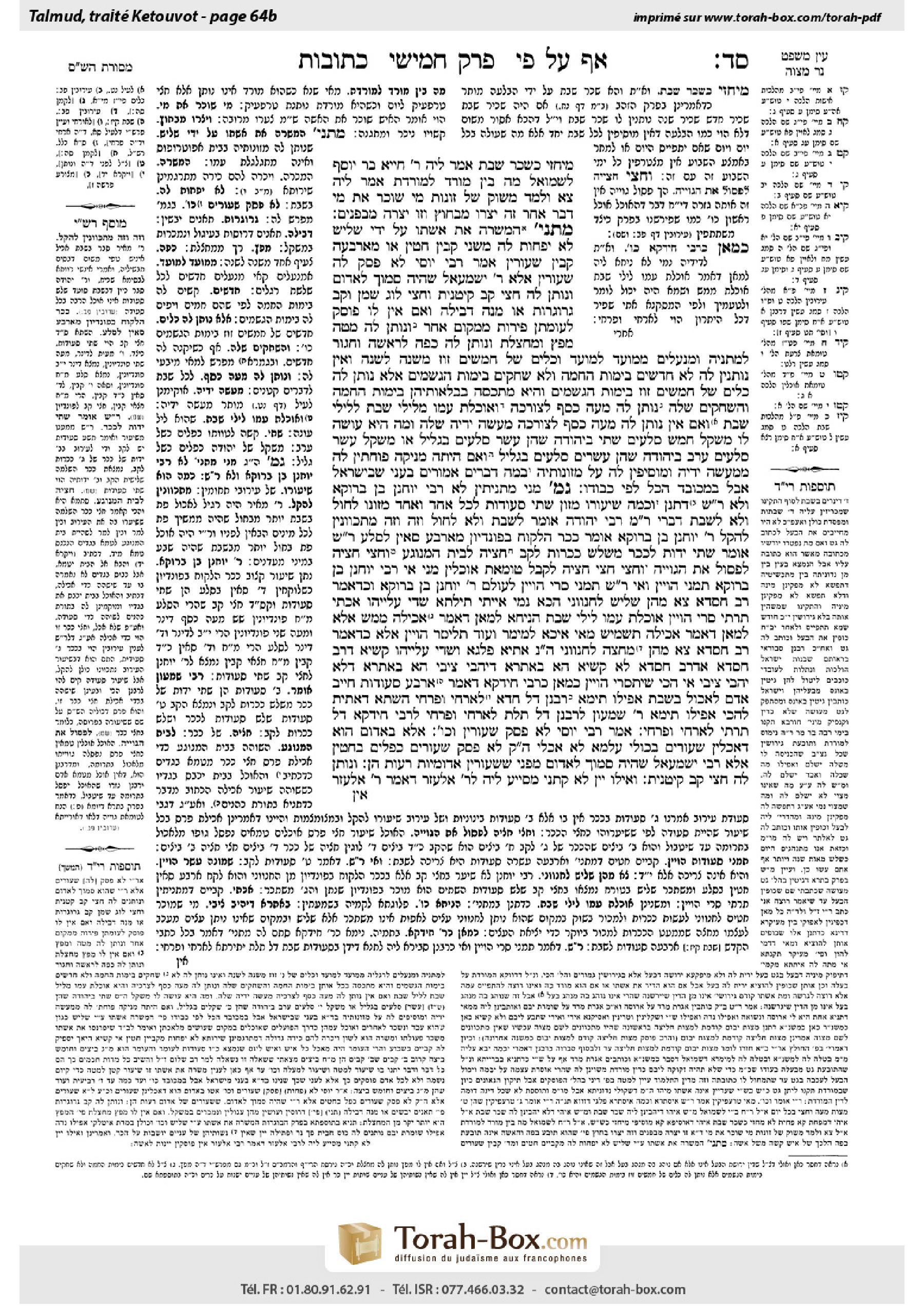
Ketubot 64b: Talmud study for Daf Yomi
Daf Yomi is the daily study of one Talmud folio. Explore 37 tractates with scans, Hebrew text, Sefaria English and AI-generated French translations where annotated.
Passage selection and English or AI-generated French translation are available where the scan has annotations. Daf Study is independent of Torah-Box and Sefaria.
Browse Ketubot · כתובות · All tractatesKetubot 64b text and translations
This page of Ketubot includes the Aramaic text, an English translation and an AI-generated French translation, alongside the scan above.
כתובות ס״ד ב · Aramaic and Hebrew text
מִיחֲזֵי כִּשְׂכַר שַׁבָּת.
אֲמַר לֵיהּ רַבִּי חִיָּיא בַּר יוֹסֵף לִשְׁמוּאֵל: מָה בֵּין מוֹרֵד לְמוֹרֶדֶת? אֲמַר לֵיהּ: צֵא וּלְמַד מִשּׁוּק שֶׁל זוֹנוֹת, מִי שׂוֹכֵר אֶת מִי? דָּבָר אַחֵר: זֶה יִצְרוֹ מִבַּחוּץ, וְזוֹ יִצְרָהּ מִבִּפְנִים.
מַתְנִי׳ הַמַּשְׁרֶה אֶת אִשְׁתּוֹ עַל יְדֵי שָׁלִישׁ — לֹא יִפְחוֹת לָהּ מִשְּׁנֵי קַבִּין חִטִּין, אוֹ מֵאַרְבָּעָה קַבִּין שְׂעוֹרִין. אָמַר רַבִּי יוֹסֵי: לֹא פָּסַק לָהּ שְׂעוֹרִין אֶלָּא רַבִּי יִשְׁמָעֵאל, שֶׁהָיָה סָמוּךְ לֶאֱדוֹם. וְנוֹתֵן לָהּ חֲצִי קַב קִיטְנִית, וַחֲצִי לוֹג שֶׁמֶן, וְקַב גְּרוֹגְרוֹת אוֹ מָנֶה דְּבֵילָה. וְאִם אֵין לוֹ — פּוֹסֵק לְעוּמָּתָן פֵּירוֹת מִמָּקוֹם אַחֵר.
וְנוֹתֵן לָהּ מִטָּה, מַפָּץ וּמַחְצֶלֶת. וְנוֹתֵן לָהּ כִּפָּה לְרֹאשָׁהּ, וַחֲגוֹר לְמׇתְנֶיהָ, וּמִנְעָלִים מִמּוֹעֵד לְמוֹעֵד, וְכֵלִים שֶׁל חֲמִשִּׁים זוּז מִשָּׁנָה לְשָׁנָה. וְאֵין נוֹתְנִין לָהּ לֹא חֲדָשִׁים בִּימוֹת הַחַמָּה, וְלֹא שְׁחָקִים בִּימוֹת הַגְּשָׁמִים. אֶלָּא נוֹתֵן לָהּ כֵּלִים שֶׁל חֲמִשִּׁים זוּז בִּימוֹת הַגְּשָׁמִים, וְהִיא מִתְכַּסָּה בִּבְלָאוֹתֵיהֶן בִּימוֹת הַחַמָּה. וְהַשְּׁחָקִים — שֶׁלָּהּ.
נוֹתֵן לָהּ מָעָה כֶּסֶף לְצוֹרְכָּהּ. וְאוֹכֶלֶת עִמּוֹ מִלֵּילֵי שַׁבָּת לְלֵילֵי שַׁבָּת. וְאִם אֵין נוֹתֵן לָהּ מָעָה כֶּסֶף לְצוֹרְכָּהּ — מַעֲשֵׂה יָדֶיהָ שֶׁלָּהּ.
וּמָה הִיא עוֹשָׂה לוֹ? מִשְׁקַל חָמֵשׁ סְלָעִים שְׁתִי בִּיהוּדָה, שֶׁהֵן עֶשֶׂר סְלָעִים בַּגָּלִיל. אוֹ מִשְׁקַל עֶשֶׂר סְלָעִים עֵרֶב בִּיהוּדָה, שֶׁהֵן עֶשְׂרִים סְלָעִים בַּגָּלִיל. וְאִם הָיְתָה מְנִיקָה — פּוֹחֲתִין לָהּ מִמַּעֲשֵׂה יָדֶיהָ, וּמוֹסִיפִין לָהּ עַל מְזוֹנוֹתֶיהָ. בַּמֶּה דְּבָרִים אֲמוּרִים — בְּעָנִי שֶׁבְּיִשְׂרָאֵל, אֲבָל בִּמְכוּבָּד הַכֹּל לְפִי כְּבוֹדוֹ.
גְּמָ׳ מַנִּי מַתְנִיתִין, לָא רַבִּי יוֹחָנָן בֶּן בְּרוֹקָא, וְלָא רַבִּי שִׁמְעוֹן. דִּתְנַן: וְכַמָּה שִׁיעוּרוֹ — מְזוֹן שְׁתֵּי סְעוּדוֹת לְכׇל אֶחָד וְאֶחָד. מְזוֹנוֹ לַחוֹל וְלֹא לַשַּׁבָּת, דִּבְרֵי רַבִּי מֵאִיר. רַבִּי יְהוּדָה אוֹמֵר: לַשַּׁבָּת וְלֹא לַחוֹל. וְזֶה וָזֶה מִתְכַּוְּונִין לְהָקֵל.
רַבִּי יוֹחָנָן בֶּן בְּרוֹקָא אוֹמֵר: כִּכָּר הַלָּקוּחַ בְּפוּנְדְּיוֹן, מֵאַרְבַּע סְאִין לְסֶלַע. רַבִּי שִׁמְעוֹן אוֹמֵר: שְׁתֵּי יָדוֹת לַכִּכָּר, מִשָּׁלֹשׁ כִּכָּרוֹת לַקַּב.
חֶצְיָהּ — לְבַיִת הַמְנוּגָּע. וַחֲצִי חֶצְיָהּ — לִפְסוֹל אֶת הַגְּוִיָּיה. וַחֲצִי חֲצִי חֶצְיָהּ — לְקַבֵּל טוּמְאַת אוֹכָלִין.
מַנִּי? אִי רַבִּי יוֹחָנָן בֶּן בְּרוֹקָא, תַּמְנֵי הָוְיָין! וְאִי רַבִּי שִׁמְעוֹן, תַּמְנֵי סְרֵי הָוְיָין!
לְעוֹלָם רַבִּי יוֹחָנָן בֶּן בְּרוֹקָא, וְכִדְאָמַר רַב חִסְדָּא: צֵא מֵהֶן שְׁלִישׁ לַחֶנְווֹנִי. הָכָא נָמֵי: אַיְיתִי תִּילְתָּא שְׁדִי עֲלַיְיהוּ. אַכַּתִּי תַּרְתֵּי סְרֵי הָוְיָין! אוֹכֶלֶת עִמּוֹ לֵילֵי שַׁבָּת.
הָנִיחָא לְמַאן דְּאָמַר אֲכִילָה מַמָּשׁ. אֶלָּא לְמַאן דְּאָמַר אֲכִילָה תַּשְׁמִישׁ, מַאי אִיכָּא לְמֵימַר? וְעוֹד, תְּלֵיסַר הָוְיָין! אֶלָּא כִּדְאָמַר רַב חִסְדָּא, צֵא מֵהֶן מֶחֱצָה לַחֶנְווֹנִי. הָכִי נָמֵי אַיְתִי פַּלְגָא וּשְׁדִי עֲלַיְיהוּ.
קַשְׁיָא דְּרַב חִסְדָּא אַדְּרַב חִסְדָּא! לָא קַשְׁיָא: הָא בְּאַתְרָא דְּיָהֲבִי צִיבֵי, הָא בְּאַתְרָא דְּלָא יָהֲבִי צִיבֵי.
אִי הָכִי, שִׁיתַּסְרֵי הָוְיָין. כְּמַאן, כְּרַבִּי חִידְקָא, דְּאָמַר: אַרְבַּע סְעוּדוֹת חַיָּיב אָדָם לֶאֱכוֹל בַּשַּׁבָּת.
אֲפִילּוּ תֵּימָא רַבָּנַן, דַּל חֲדָא לְאָרְחֵי וּפָרְחֵי.
הַשְׁתָּא דְּאָתֵית לְהָכִי, אֲפִילּוּ תֵּימָא רַבִּי שִׁמְעוֹן: לְרַבָּנַן — דַּל תְּלָת לְאָרְחֵי וּפָרְחֵי, לְרַבִּי חִידְקָא — דַּל תַּרְתֵּי לְאָרְחֵי וּפָרְחֵי.
אָמַר רַבִּי יוֹסֵי: לֹא פָּסַק שְׂעוֹרִין וְכוּ׳. אֶלָּא בֶּאֱדוֹם הוּא דְּאָכְלִין שְׂעוֹרִים, בְּכוּלֵּי עָלְמָא לָא אָכְלִי! הָכִי קָאָמַר: לֹא פָּסַק שְׂעוֹרִים כִּפְלַיִם בְּחִטִּין אֶלָּא רַבִּי יִשְׁמָעֵאל שֶׁהָיָה סָמוּךְ לֶאֱדוֹם, מִפְּנֵי שֶׁשְּׂעוֹרִין אֲדוֹמִיּוֹת רָעוֹת הֵן.
וְנוֹתֵן לָהּ חֲצִי קַב קִיטְנִית. וְאִילּוּ יַיִן לָא קָתָנֵי. מְסַיַּיע לֵיהּ לְרַבִּי אֶלְעָזָר, דְּאָמַר רַבִּי אֶלְעָזָר
Ketubot 64b · English translation
it does appear to be Shabbat wages. Consequently, the Sages decreed that he should not give her money for Shabbat.
On the same issue, Rabbi Ḥiyya bar Yosef said to Shmuel: What is the reason for the difference in halakha between a rebellious man and a rebellious woman? According to all opinions, a rebellious wife’s fine is greater than that of a rebellious husband. He said to him: Go and learn from the market of prostitutes. Who hires whose services? Clearly, a man suffers more from lack of sexual intercourse, and therefore the penalty for a rebellious wife is greater. Alternatively, when he desires sexual relations, his inclination is noticeable on the outside, and therefore he feels shame as well as pain. But for her, her inclination is on the inside, and is not obvious.
MISHNA: If someone feeds his wife by means of a third party serving as a trustee, while the husband himself is not living with her for some reason, he may not give her less than two kav of wheat or four kav of barley a week for her sustenance. Rabbi Yosei said: Only Rabbi Yishmael, who was near Edom, allotted her barley. And he must give her half a kav of legumes, and half a log of oil, and a kav of dried figs or the weight of a maneh of fig cakes. And if he does not have these fruits, he must apportion for her a corresponding amount of fruit from elsewhere.
And he must give her a bed, a soft mat, and a hard mat. And he must give her a cap for her head, and a belt for her waist, and new shoes from Festival to Festival, i.e., he must buy her new shoes each Festival. And he must purchase garments for her with a value of fifty dinars from year to year. The mishna comments: And he may not give her new clothes, which tend to be thick and warm, in the summer, nor worn garments in the rainy season, as these are too thin and she will be cold. Rather, he should give her clothes at a value of fifty dinars in the rainy season, and she covers herself with these same worn garments in the summer as well. And the leftover, worn clothes belong to her.
In addition to the above, he must give her another silver ma’a coin for the rest of her needs. And she eats with him from Shabbat evening to Shabbat evening. Although he may provide for her sustenance via a third party throughout the week, on Shabbat evening she has the right to eat together with him. And if he does not give her a silver ma’a coin for her needs, her earnings belong to her.
And what is the fixed amount that she must earn for him? She must spin wool in the weight of five sela of threads of the warp in Judea, which are equivalent to ten sela according to the measurements of the Galilee, or the weight of ten sela of the threads of the woof, which are easier to prepare, in Judea, which are equivalent to twenty sela according to the measurements used in the Galilee. And if she is nursing at the time, the required amount is reduced from her earnings and is added to the sum she receives for her sustenance. In what case is this statement, i.e., all these amounts and measurements, said? With regard to the poorest of Jews, i.e., these are the minimum requirements. However, in the case of a financially prominent man, all the amounts are increased according to his prominence.
GEMARA: Whose opinion is expressed in the mishna? It is not Rabbi Yoḥanan ben Beroka and it is not Rabbi Shimon, as we learned in a mishna (Eiruvin 82b): What is the measure for a joining of Shabbat boundaries [eiruv]? It consists of a quantity of food sufficient for two meals for each and every one of those included in the eiruv. The tanna’im disagree with regard to the definition of these two meals: It is referring to one’s food that he eats on a weekday and not on Shabbat; this is the statement of Rabbi Meir. Rabbi Yehuda says: It is referring to the amount he eats on Shabbat and not on a weekday. And both this Sage, Rabbi Meir, and that Sage, Rabbi Yehuda, intend to be lenient, as Rabbi Meir maintains that people eat more food on Shabbat, whereas Rabbi Yehuda believes that they consume more on a weekday.
Rabbi Yoḥanan ben Beroka says: Food for two meals is the size of a loaf bought with a pundeyon, which is one forty-eighth of a sela, when four se’a of wheat are sold for a sela. According to this calculation, a pundeyon can purchase one-twelfth of a se’a of wheat, which is equivalent to half of a kav, as there are six kav in a se’a. Therefore, according to Rabbi Yoḥanan ben Beroka, one quarter of a kav is sufficient for a single meal. Rabbi Shimon says: Food for two meals is two of three parts of a loaf, when three loaves are prepared from a kav of wheat. According to Rabbi Shimon, therefore, one-ninth of a kav of wheat is sufficient for a meal.
Having discussed the various opinions with regard to the size of a loaf of bread sufficient for a meal, the mishna states that half of this loaf is the amount called a half [peras], a measure relevant for the halakhot of a leprous house. If one enters a house afflicted with leprosy and remains there long enough to eat this amount of food, the clothes he is wearing become ritually impure. And half of its half, one quarter of a loaf this size, is the amount of ritually impure food that renders the body unfit. In other words, impure food of this amount imparts ritual impurity to the body of the eater and disqualifies him by rabbinic law from eating teruma. And half of one half of its half, one-eighth of this loaf, is the minimum measure of food that is susceptible to ritual impurity as food.
After the citing the mishna, the Gemara returns to its question: Who is the author of the mishna here, which says a husband must provide two kav of wheat per week for his wife’s sustenance? If it is Rabbi Yoḥanan ben Beroka, who maintains that one quarter of a kav is sufficient for a single meal, there are only eight meals in two kav, and the wife requires at least fourteen meals for a week, as it was customary to eat two meals each day. And if it is Rabbi Shimon, who holds that one-ninth of a kav is sufficient for a meal, two kav are enough for eighteen meals, and therefore the mishna requires more than she actually needs.
The Gemara answers: Actually, the mishna is in accordance with the opinion of Rabbi Yoḥanan ben Beroka, and this is as Rav Ḥisda said in explanation of Rabbi Yoḥanan ben Beroka’s opinion: Deduct one-third for the grocer’s markup, as he takes one-third as profit. This adds one half to the total cost. Here, too, bring one-third and add it to the total amount of meals that can be provided by two kav of wheat. The Gemara raises a difficulty: Still, after adjusting the calculation by adding an additional half, a measurement known by the term: Outside third, to the amount of meals that can be eaten from two kav of wheat, they are equal to twelve meals. This is still not sufficient, as the wife requires fourteen. The Gemara answers: She eats with him on Shabbat evening. Consequently, this meal is not included in the amount that must be provided through the third party.
The Gemara asks: This works out well according to the one who says that when the mishna is referring to eating, it means literal eating. However, according to the one who says that this eating on Shabbat evening is a euphemism, and it is actually referring to conjugal relations, what can be said? And furthermore, even if the meal on Shabbat evening is omitted, they are still thirteen meals that she requires but she has enough for only twelve. Rather, this is as Rav Ḥisda said, with regard to Rabbi Yoḥanan ben Beroka’s opinion: Deduct one-half for the grocer’s markup. So too here, bring a half and add it to the total amount, which means she has enough for sixteen meals, not eight.
The Gemara asks: This is difficult with regard to one statement of Rav Ḥisda, which seemingly contradicts the other statement of Rav Ḥisda. The Gemara answers: This is not difficult. This statement, that the grocer’s markup adds one-third to the price, is referring to a place where they also give money as a separate payment for the wood required to bake bread. That statement, that the grocer’s markup adds half, is referring to a place where they do not give money for wood, and therefore the markup must be higher to cover those costs.
After reconciling the apparent contradiction between the two statements of Rav Ḥisda, the Gemara returns to the opinion of Rabbi Yoḥanan ben Beroka. If so, according to the above calculation, there are sixteen meals, which is more than a woman requires in a week. The Gemara suggests: In that case, who is the author of the mishna? Is it in accordance with the opinion of Rabbi Ḥidka, who said that a person is obligated to eat four meals on Shabbat? Since two meals are eaten on an ordinary weekday, this results in a total of sixteen meals a week.
The Gemara rejects this suggestion: You can even say that the mishna is in accordance with the opinion of the Rabbis, who maintain that one is obligated to eat only three meals on Shabbat, as you should remove one meal for guests and wayfarers. In other words, the husband cannot give his wife the absolute minimum amount she requires for herself and no more. He must give her enough to provide for the occasional visitor. Consequently, the total sum is somewhat more than was originally assumed.
The Gemara adds: Now that you have arrived at this answer, you can even say that the mishna is in accordance with the opinion of Rabbi Shimon, who maintains that two kav is sufficient for eighteen meals. This can be explained either by saying that Rabbi Shimon agrees with the opinion of the Rabbis, that one eats three meals on Shabbat, if you remove three meals for guests and wayfarers, or that Rabbi Shimon agrees with the opinion of Rabbi Ḥidka, that four meals are eaten on Shabbat, in which case you must remove two meals for guests and wayfarers. In this manner, the mishna can be reconciled with all opinions.
§ The mishna teaches that Rabbi Yosei said: Only Rabbi Yishmael, who was near Edom, allotted her barley. The Gemara asks: But does this indicate that it is only in Edom that they eat barley, whereas in the rest of the world they do not eat barley? This cannot be the case, as barley was eaten by the poor everywhere. The Gemara explains: This is what Rabbi Yosei is saying: Only Rabbi Yishmael, who was near Edom, allotted her a double amount of barley to that of wheat, since Edomite barley is bad, whereas elsewhere the barley is of a higher quality, and therefore the difference between barley and wheat is less marked.
§ The mishna further taught: And he must give her half a kav of legumes as well as oil and fruit. The Gemara comments: And yet wine is not taught in the mishna. This supports the opinion of Rabbi Elazar, as Rabbi Elazar said:
Ketubot 64b · Traduction française (IA)
Il semble bien s’agir d’un salaire pour le Chabbat. Par conséquent, les Sages décrétèrent qu’il ne devait pas lui donner d’argent pour le Chabbat.
Sur cette même question, Rabbi Ḥiyya bar Yosef dit à Shmuel : Quelle est la raison de la différence de halakha entre un mari rebelle et une épouse rebelle ? Selon tous les avis, l’amende imposée à une épouse rebelle est plus élevée que celle imposée à un mari rebelle. Il lui répondit : Va voir le marché des prostituées. Qui paie pour les services de qui ? Il est clair qu’un homme souffre davantage de l’absence de rapports sexuels ; c’est pourquoi la pénalité imposée à une épouse rebelle est plus élevée. Autre explication : quand il désire des rapports sexuels, son désir se manifeste extérieurement ; il éprouve donc de la honte en plus de la souffrance. Chez elle, en revanche, le désir est intérieur et ne se voit pas.
MICHNA : Si quelqu’un assure la subsistance de son épouse par l’intermédiaire d’un tiers agissant comme mandataire, alors que le mari ne vit pas avec elle pour une raison quelconque, il ne peut lui donner moins de deux kav de blé ou de quatre kav d’orge par semaine pour sa subsistance. Rabbi Yosei dit : Seul Rabbi Yishmael, qui vivait près d’Édom, lui attribuait de l’orge. Il doit aussi lui donner un demi-kav de légumineuses, un demi-log d’huile et un kav de figues sèches, ou une quantité de gâteaux de figues pesant une maneh. S’il ne possède pas ces fruits, il doit lui attribuer une quantité équivalente d’autres fruits.
Il doit aussi lui donner un lit, une natte moelleuse et une natte dure. Il doit lui donner une coiffe, une ceinture et des chaussures neuves d’une fête à l’autre, c’est-à-dire qu’il doit lui acheter de nouvelles chaussures à chaque fête. Il doit lui acheter des vêtements d’une valeur de cinquante dinars chaque année. La Michna précise : Il ne doit pas lui donner en été des vêtements neufs, qui ont tendance à être épais et chauds, ni des vêtements usés pendant la saison des pluies, car ils sont trop fins et elle aurait froid. Il doit plutôt lui donner des vêtements d’une valeur de cinquante dinars pendant la saison des pluies ; elle se couvrira également de ces mêmes vêtements usés en été. Les vêtements usés qui restent lui appartiennent.
En plus de ce qui précède, il doit lui donner une pièce d’argent d’un ma’a pour ses autres besoins. Elle prend ses repas avec lui du soir de Chabbat au soir de Chabbat. Bien qu’il puisse assurer sa subsistance par l’intermédiaire d’un tiers pendant la semaine, le soir de Chabbat, elle a le droit de manger avec lui. S’il ne lui donne pas une pièce d’argent d’un ma’a pour ses besoins, ses gains lui appartiennent.
Quelle est la quantité fixe qu’elle doit gagner pour lui ? Elle doit filer de la laine à raison de cinq sela de fils de chaîne en Judée, ce qui équivaut à dix sela selon les mesures de la Galilée, ou à raison de dix sela de fils de trame, plus faciles à préparer, en Judée, ce qui équivaut à vingt sela selon les mesures de la Galilée. Si elle allaite à ce moment-là, la quantité de travail exigée d’elle est réduite, et la somme qu’elle reçoit pour sa subsistance est augmentée d’autant. Dans quel cas cette déclaration, c’est-à-dire tous ces montants et ces mesures, s’applique-t-elle ? Aux Juifs les plus pauvres : il s’agit des exigences minimales. Mais si l’homme est aisé et jouit d’un statut élevé, tous les montants sont augmentés en fonction de son rang.
GUEMARA : De quel avis relève la Michna ? Ce n’est ni celui de Rabbi Yoḥanan ben Beroka ni celui de Rabbi Shimon, comme nous l’avons appris dans une Michna (Eiruvin 82b) : Quelle est la quantité requise pour un érouv des limites du Chabbat [eiruv] ? Il faut une quantité de nourriture suffisante pour deux repas par personne incluse dans l’érouv. Les tannaïm sont en désaccord sur la définition de ces deux repas : il s’agit de la nourriture que l’on mange un jour de semaine, et non le Chabbat ; telle est l’opinion de Rabbi Meir. Rabbi Yehuda dit : Il s’agit de la quantité que l’on mange le Chabbat, et non un jour de semaine. Ces deux Sages, Rabbi Meir et Rabbi Yehuda, cherchent tous deux à adopter une position indulgente : Rabbi Meir estime que l’on mange davantage le Chabbat, tandis que Rabbi Yehuda considère que l’on mange davantage un jour de semaine.
Rabbi Yoḥanan ben Beroka dit : La nourriture pour deux repas correspond à un pain acheté pour un pundeyon, soit un quarante-huitième de sela, lorsque quatre se’a de blé se vendent un sela. Selon ce calcul, un pundeyon permet d’acheter un douzième de se’a de blé, soit un demi-kav, puisqu’un se’a contient six kav. Par conséquent, selon Rabbi Yoḥanan ben Beroka, un quart de kav suffit pour un seul repas. Rabbi Shimon dit : La nourriture pour deux repas correspond aux deux tiers d’un pain, lorsqu’on prépare trois pains avec un kav de blé. Selon Rabbi Shimon, un neuvième de kav de blé suffit donc pour un repas.
Après avoir exposé les différents avis concernant la taille d’un pain suffisant pour un repas, la Michna indique que la moitié de ce pain constitue la quantité appelée un demi-[peras], mesure pertinente pour les halakhot d’une maison atteinte de lèpre. Si quelqu’un entre dans une maison frappée de lèpre et y reste assez longtemps pour manger cette quantité de nourriture, les vêtements qu’il porte deviennent rituellement impurs. La moitié de cette moitié, soit un quart d’un pain de cette taille, est la quantité de nourriture rituellement impure qui rend le corps inapte. Autrement dit, une nourriture impure de cette quantité transmet l’impureté rituelle au corps de celui qui la mange et le rend inapte, selon la loi rabbinique, à consommer de la terouma. La moitié de cette moitié, soit un huitième de ce pain, est la quantité minimale de nourriture susceptible de contracter l’impureté rituelle en tant que nourriture.
Après avoir cité la Michna, la Guemara revient à sa question : qui est l’auteur de la Michna ici, qui dit qu’un mari doit fournir deux kav de blé par semaine pour la subsistance de son épouse ? Si c’est Rabbi Yoḥanan ben Beroka, qui considère qu’un quart de kav suffit pour un repas, deux kav ne permettent que huit repas, alors que l’épouse en a besoin d’au moins quatorze par semaine, puisqu’il était d’usage de prendre deux repas par jour. Et si c’est Rabbi Shimon, qui estime qu’un neuvième de kav suffit pour un repas, deux kav suffisent pour dix-huit repas ; la Michna exige donc davantage que ce dont elle a réellement besoin.
La Guemara répond : En réalité, la Michna suit l’avis de Rabbi Yoḥanan ben Beroka, conformément à ce que Rav Ḥisda a dit pour expliquer cet avis : il faut déduire un tiers pour tenir compte de la marge de l’épicier, qui prend un tiers de bénéfice. Cela ajoute la moitié au coût total. Ici aussi, ajoutez un tiers au nombre total de repas que deux kav de blé permettent de fournir. La Guemara soulève une difficulté : malgré cet ajustement, qui consiste à ajouter une moitié supplémentaire — mesure appelée « tiers extérieur » — au nombre de repas que l’on peut tirer de deux kav de blé, on arrive à douze repas. Cela ne suffit toujours pas, car l’épouse en a besoin de quatorze. La Guemara répond : Elle mange avec lui le soir de Chabbat. Par conséquent, ce repas n’est pas compris dans la quantité qui doit être fournie par l’intermédiaire du tiers.
La Guemara demande : Cela convient selon celui qui dit que, lorsque la Michna parle de manger, elle désigne littéralement le fait de manger. Mais selon celui qui dit que l’expression « manger le soir de Chabbat » est un euphémisme désignant en réalité les relations conjugales, que peut-on répondre ? De plus, même si l’on écarte le repas du soir de Chabbat, elle a encore besoin de treize repas, alors qu’elle n’en a que douze. Il faut plutôt dire que l’explication de Rav Ḥisda concernant l’avis de Rabbi Yoḥanan ben Beroka s’applique ici : il faut déduire la moitié pour tenir compte de la marge de l’épicier. De même ici, ajoutez la moitié au total ; elle a donc de quoi prendre seize repas, et non huit.
La Guemara demande : Une déclaration de Rav Ḥisda semble contredire l’autre. La Guemara répond : Il n’y a pas de difficulté. La déclaration selon laquelle la marge de l’épicier ajoute un tiers au prix concerne un endroit où l’on paie aussi séparément le bois nécessaire à la cuisson du pain. L’autre déclaration, selon laquelle cette marge ajoute la moitié, concerne un endroit où l’on ne paie pas le bois ; la marge doit donc être plus élevée pour couvrir ces dépenses.
Après avoir résolu la contradiction apparente entre les deux déclarations de Rav Ḥisda, la Guemara revient à l’avis de Rabbi Yoḥanan ben Beroka. Si tel est le cas, selon le calcul ci-dessus, cela représente seize repas, soit davantage que ce dont une femme a besoin en une semaine. La Guemara propose : Dans ce cas, qui est l’auteur de la Michna ? Suit-elle l’avis de Rabbi Ḥidka, qui dit qu’une personne est tenue de prendre quatre repas le Chabbat ? Comme on prend deux repas un jour de semaine ordinaire, cela donne un total de seize repas par semaine.
La Guemara rejette cette proposition : On peut même dire que la Michna suit l’avis des Rabbis, qui considèrent qu’on est tenu de prendre seulement trois repas le Chabbat, car il faut retrancher un repas pour les invités et les voyageurs de passage. Autrement dit, le mari ne peut pas donner à son épouse exactement le minimum absolu dont elle a besoin pour elle-même, sans rien ajouter. Il doit lui donner assez pour pourvoir aux besoins d’un visiteur occasionnel. Par conséquent, la quantité totale est un peu supérieure à ce qu’on avait supposé au départ.
La Guemara ajoute : Maintenant que vous êtes parvenus à cette réponse, vous pouvez même dire que la Michna suit l’avis de Rabbi Shimon, qui considère que deux kav suffisent pour dix-huit repas. On peut l’expliquer soit en disant que Rabbi Shimon est d’accord avec l’avis des Rabbis, selon lequel on prend trois repas le Chabbat, auquel cas il faut retrancher trois repas pour les invités et les voyageurs de passage ; soit en disant que Rabbi Shimon est d’accord avec l’avis de Rabbi Ḥidka, selon lequel on prend quatre repas le Chabbat, auquel cas il faut retrancher deux repas pour les invités et les voyageurs de passage. Ainsi, la Michna peut être conciliée avec tous les avis.
§ La Michna enseigne que Rabbi Yosei a dit : Seul Rabbi Yishmael, qui vivait près d’Édom, lui attribuait de l’orge. La Guemara demande : Cela signifie-t-il que l’on ne mange de l’orge qu’en Édom, et pas dans le reste du monde ? Ce ne peut être le cas, puisque les pauvres mangeaient de l’orge partout. La Guemara explique : Voici ce que dit Rabbi Yosei : Seul Rabbi Yishmael, qui vivait près d’Édom, lui attribuait une quantité d’orge double de celle du blé, car l’orge édomite est de mauvaise qualité, tandis qu’ailleurs elle est de meilleure qualité ; la différence entre l’orge et le blé y est donc moins marquée.
§ La Michna enseignait aussi qu’il doit lui donner un demi-kav de légumineuses, ainsi que de l’huile et des fruits. La Guemara fait remarquer : Pourtant, le vin n’est pas mentionné dans la Michna. Cela vient étayer l’avis de Rabbi Elazar, car Rabbi Elazar a dit :
Traduction française générée par IA à partir de l’édition anglaise de Sefaria. Vérifie toujours un passage avec le texte source.
Text from Sefaria: William Davidson Edition - Vocalized Aramaic (CC BY NC); William Davidson Edition - English (CC BY NC).