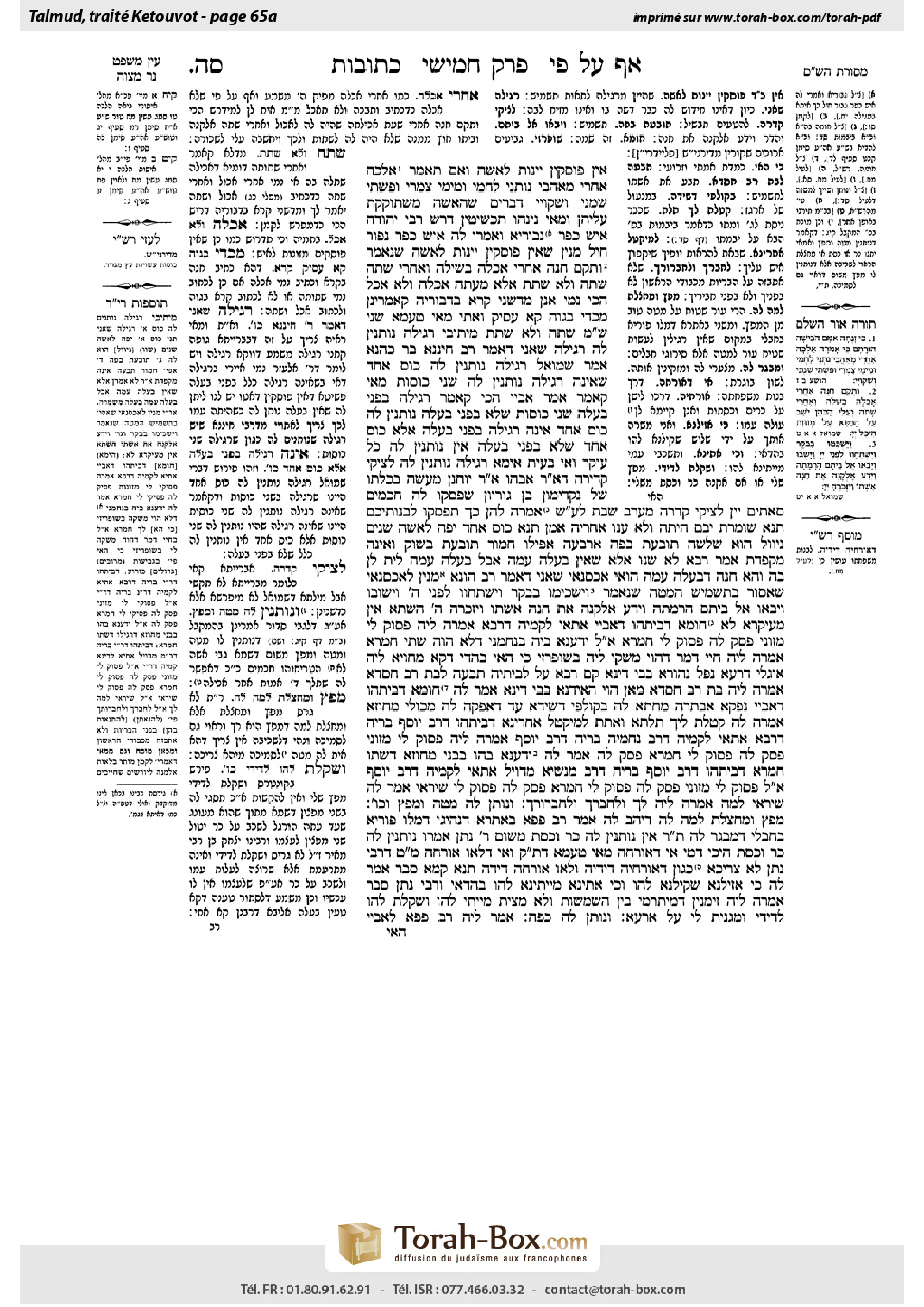
Ketubot 65a: Talmud study for Daf Yomi
Daf Yomi is the daily study of one Talmud folio. Explore 37 tractates with scans, Hebrew text, Sefaria English and AI-generated French translations where annotated.
Passage selection and English or AI-generated French translation are available where the scan has annotations. Daf Study is independent of Torah-Box and Sefaria.
Browse Ketubot · כתובות · All tractatesKetubot 65a text and translations
This page of Ketubot includes the Aramaic text, an English translation and an AI-generated French translation, alongside the scan above.
כתובות ס״ה א · Aramaic and Hebrew text
אֵין פּוֹסְקִין יֵינוֹת לָאִשָּׁה, וְאִם תֹּאמַר: ״אֵלְכָה אַחֲרֵי מְאַהֲבַי נוֹתְנֵי לַחְמִי וּמֵימַי צַמְרִי וּפִשְׁתִּי שַׁמְנִי וְשִׁקּוּיָי״ — דְּבָרִים שֶׁהָאִשָּׁה מִשְׁתּוֹקֶקֶת עֲלֵיהֶן, וּמַאי נִינְהוּ — תַּכְשִׁיטִין.
דָּרֵשׁ רַבִּי יְהוּדָה אִישׁ כְּפַר נְבִירְיָא, וְאָמְרִי לַהּ אִישׁ כְּפַר נְפוֹר חַיִל: מִנַּיִן שֶׁאֵין פּוֹסְקִין יֵינוֹת לָאִשָּׁה — שֶׁנֶּאֱמַר: ״וַתָּקׇם חַנָּה אַחֲרֵי אׇכְלָה בְשִׁילֹה וְאַחֲרֵי שָׁתֹה״. ״שָׁתָה״, וְלֹא ״שָׁתָת״.
אֶלָּא מֵעַתָּה ״אָכְלָה״ וְלֹא ״אׇכְלוֹ״, הָכִי נָמֵי?! אֲנַן מִדְּשַׁנִּי קְרָא בְּדִבּוּרֵיהּ קָאָמְרִינַן. מִכְּדֵי בְּגַוַּהּ קָא עָסֵיק וְאָתֵי, מַאי טַעְמָא שַׁנִּי? שְׁמַע מִינַּהּ ״שָׁתָה״ וְלֹא ״שָׁתָת״.
מֵיתִיבִי: רְגִילָה — נוֹתְנִין לָהּ! רְגִילָה שָׁאנֵי, דְּאָמַר רַב חִינָּנָא בַּר כָּהֲנָא אָמַר שְׁמוּאֵל: רְגִילָה — נוֹתְנִין לָהּ כּוֹס אֶחָד. שֶׁאֵינָהּ רְגִילָה — נוֹתְנִין לָהּ שְׁנֵי כּוֹסוֹת.
מַאי קָאָמַר?! אָמַר אַבָּיֵי, הָכִי קָאָמַר: רְגִילָה, בִּפְנֵי בַּעְלָהּ — שְׁנֵי כּוֹסוֹת, שֶׁלֹּא בִּפְנֵי בַעְלָהּ — נוֹתְנִין לָהּ כּוֹס אֶחָד. אֵינָהּ רְגִילָה, בִּפְנֵי בַעְלָהּ — אֶלָּא כּוֹס אֶחָד, שֶׁלֹּא בִּפְנֵי בַעְלָהּ — אֵין נוֹתְנִין לָהּ כׇּל עִיקָּר.
וְאִי בָּעֵית אֵימָא: רְגִילָה, נוֹתְנִין לָהּ לְצִיקֵי קְדֵירָה. דְּאָמַר רַבִּי אֲבָהוּ אָמַר רַבִּי יוֹחָנָן: מַעֲשֶׂה בְּכַלָּתוֹ שֶׁל נַקְדִּימוֹן בֶּן גּוּרְיוֹן שֶׁפָּסְקוּ לָהּ חֲכָמִים סָאתַיִם יַיִן לְצִיקֵי קְדֵרָה מֵעֶרֶב שַׁבָּת לְעֶרֶב שַׁבָּת. אָמְרָה לָהֶן: כָּךְ תִּפְסְקוּ לִבְנוֹתֵיכֶם. תָּנָא: שׁוֹמֶרֶת יָבָם הָיְתָה, וְלֹא עָנוּ אַחֲרֶיהָ אָמֵן.
תָּנָא: כּוֹס אֶחָד — יָפֶה לָאִשָּׁה. שְׁנַיִם — נִיוּוּל הוּא. שְׁלֹשָׁה — תּוֹבַעַת בַּפֶּה. אַרְבָּעָה — אֲפִילּוּ חֲמוֹר תּוֹבַעַת בַּשּׁוּק וְאֵינָהּ מַקְפֶּדֶת. אָמַר רָבָא: לֹא שָׁנוּ אֶלָּא שֶׁאֵין בַּעְלָהּ עִמָּהּ. אֲבָל בַּעְלָהּ עִמָּהּ, לֵית לַן בַּהּ.
וְהָא חַנָּה, דְּבַעְלָהּ עִמָּהּ הֲוַאי! אַכְסְנַאי שָׁאנֵי. דְּאָמַר רַב הוּנָא: מִנַּיִן לְאַכְסְנַאי שֶׁאָסוּר בְּתַשְׁמִישׁ הַמִּטָּה, שֶׁנֶּאֱמַר: ״וַיַּשְׁכִּימוּ בַבֹּקֶר וַיִּשְׁתַּחֲווּ לִפְנֵי ה׳ וַיָּשׁוּבוּ וַיָּבֹאוּ אֶל בֵּיתָם הָרָמָתָה וַיֵּדַע אֶלְקָנָה אֶת חַנָּה אִשְׁתּוֹ וַיִּזְכְּרֶהָ ה׳״, הַשְׁתָּא — אִין, מֵעִיקָּרָא — לָא.
חוּמָא דְּבֵיתְהוּ דְּאַבָּיֵי אֲתַאי לְקַמֵּיהּ דְּרָבָא, אֲמַרָה לֵיהּ: פְּסוֹק לִי מְזוֹנֵי! פְּסַק לַהּ. פְּסוֹק לִי חַמְרָא! אֲמַר לֵיהּ: יָדַעְנָא בֵּיהּ בְּנַחְמָנִי דְּלָא הֲוָה שָׁתֵי חַמְרָא. אֲמַרָה לֵיהּ: חַיֵּי דְּמָר דַּהֲוָה מַשְׁקֵי לִי בְּשׁוּפְרָזֵי כִּי הַאי. בַּהֲדֵי דְּקָא מַחְוְיָא לֵיהּ אִיגַּלִּי דְּרָעַאּ, נְפַל נְהוֹרָא בְּבֵי דִינָא.
קָם רָבָא, עָל לְבֵיתֵיהּ תַּבְעַהּ לְבַת רַב חִסְדָּא. אֲמַרָה לֵיהּ בַּת רַב חִסְדָּא: מַאן הֲוַי הָאִידָּנָא בְּבֵי דִּינָא? אֲמַר לַהּ: חוּמָא דְּבֵיתְהוּ דְּאַבָּיֵי. נָפְקָא אַבָּתְרַהּ, מָחֲתָא לָהּ בְּקוּלְפֵי דְשִׁידָּא עַד דְּאַפְּקַהּ לַהּ מִכּוּלֵּי מָחוֹזָא. אָמְרָה לַהּ: קְטַלְתְּ לִיךְ תְּלָתָא, וְאָתֵת לְמִיקְטַל אַחֲרִינָא?!
דְּבֵיתְהוּ דְּרַב יוֹסֵף בְּרֵיהּ דְּרָבָא אֲתַאי לְקַמֵּיהּ דְּרַב נְחֶמְיָה בְּרֵיהּ דְּרַב יוֹסֵף. אֲמַרָה לֵיהּ: פְּסוֹק לִי מְזוֹנֵי! פְּסַק לַהּ. פְּסוֹק לִי חַמְרָא! פְּסַק לַהּ. אֲמַר לַהּ: יָדַעְנָא בְּהוּ בִּבְנֵי מָחוֹזָא דְּשָׁתוּ חַמְרָא.
דְּבֵיתְהוּ דְּרַב יוֹסֵף בְּרֵיהּ דְּרַב מְנַשְּׁיָא מִדְּוִיל אֲתַאי לְקַמֵּיהּ דְּרַב יוֹסֵף. אֲמַרָה לֵיהּ: פְּסוֹק לִי מְזוֹנֵי! פְּסַק לַהּ. פְּסוֹק לִי חַמְרָא! פְּסַק לַהּ. פְּסוֹק לִי שִׁירָאֵי! אֲמַר לַהּ: שִׁירָאֵי לְמָה? אֲמַרָה לֵיהּ: לָךְ וּלְחַבְרָךְ וּלְחַבְרוּרָךְ.
וְנוֹתֵן לָהּ מִטָּה וּמַפָּץ וְכוּ׳. מַפָּץ וּמַחְצֶלֶת לְמָה לַהּ דְּיָהֵב לַהּ? אָמַר רַב פָּפָּא: בְּאַתְרָא דִּנְהִיגִי דְּמָלוּ פּוּרְיָא בְּחַבְלֵי, דְּמַבְגַּר לַהּ.
תָּנוּ רַבָּנַן: אֵין נוֹתְנִין לָהּ כַּר וָכֶסֶת. מִשּׁוּם רַבִּי נָתָן אָמְרוּ: נוֹתְנִין לָהּ כַּר וָכֶסֶת. הֵיכִי דָמֵי: אִי דְּאוֹרְחַהּ, מַאי טַעְמָא דְּתַנָּא קַמָּא? וְאִי דְּלָאו אוֹרְחַהּ, מַאי טַעְמָא דְּרַבִּי נָתָן?
לָא צְרִיכָא, כְּגוֹן דְּאוֹרְחֵיהּ דִּידֵיהּ וְלָאו אוֹרְחַהּ דִּידַהּ. תַּנָּא קַמָּא סָבַר, אָמַר לַהּ: כִּי אָזֵילְנָא שָׁקֵילְנָא לְהוּ, וְכִי אָתֵינָא, מַיְיתֵינָא לְהוּ בַּהֲדַאי. וְרַבִּי נָתָן סָבַר: אָמַרָה לֵיהּ: זִימְנִין דְּמִיתְרְמֵי בֵּין הַשְּׁמָשׁוֹת וְלָא מָצֵית מַיְיתֵת לְהוּ, וְשָׁקְלַתְּ לְהוּ לְדִידִי וּמַגְנֵית לִי עַל אַרְעָא.
וְנוֹתֵן לָהּ כִּפָּה. אֲמַר לֵיהּ רַב פָּפָּא לְאַבָּיֵי:
Ketubot 65a · English translation
Wines are not allotted to a wife. And if you say that in the verse: “I will go after my lovers who give me my bread and my water, my wool and my flax, my oil and my drink” (Hosea 2:7), “drink [shikkuyai]” is apparently a reference to wine, which indicates that it is usual for a woman to receive wine, this is invalid, since actually shikkuyai is not referring to wine but rather to items that a woman desires [mishtokeket]. And what are these? Jewelry or other ornaments, not wine.
Rabbi Yehuda of the village of Neviraya, and some say of the village of Nefor Ḥayil, interpreted a verse: From where is it derived that one does not allot wines for a woman? As it is stated: “So Hannah rose up after she had eaten in Shiloh and after he had drunk” (I Samuel 1:9). It states: “He had drunk,” and not: She had drunk. This teaches that although she ate, she did not drink wine.
The Gemara asks: However, if that is so, by the same reasoning, should the phrase “she had eaten,” which is in the feminine, indeed be interpreted to mean that only she ate, and that he did not eat? The Gemara answers: We say this interpretation from the fact that the verse changed its language. Since the verse was already dealing with her, what is the reason that it changed the terminology and did not state: And had drunk, in the feminine? One can learn from this that “he had drunk” means that he drank, but she did not drink.
The Gemara raises an objection from a baraita: If a woman is accustomed to wine, she is given wine. The Gemara explains: If the woman is accustomed to wine it is different, as Rav Ḥinnana bar Kahana said that Shmuel said: If a woman is accustomed to drinking wine, she is given one cup, and if she is not accustomed to wine, she is given two cups.
The Gemara asks: What is Shmuel saying? His statement is the opposite of what one would logically expect. Abaye said: This is what he is saying: If she is accustomed to wine, then in the presence of her husband she is given two cups, and if she is not in the presence of her husband she is given one cup. If she is not accustomed to drinking wine, then in the presence of her husband she is given only one cup, and if she is not in the presence of her husband she is not given wine at all.
And if you wish, say instead: If she is accustomed to wine, she is given wine, but not for drinking, rather for meat pudding [tzikei], made with wine, flour, and leftover meat in a pot. As Rabbi Abbahu said that Rabbi Yoḥanan said: An incident occurred involving the daughter-in-law of Nakdimon ben Guryon, whose husband had died. The Sages apportioned for her from his estate two se’a of wine for pudding, from one Shabbat eve to another. She said to them, as a blessing out of gratitude: So may you apportion for your own daughters an amount as large as this. It was taught: She was a widow waiting for her yavam, and consequently, the Sages did not answer amen after her blessing, as they did not want their daughters to reach her unfortunate state.
It was taught in a baraita: One cup of wine is good for a woman; two cups is a disgrace, as she will start to become drunk; after three cups, she will become lustful and verbally request sexual intercourse, which is unseemly; after four cups of wine, she will even request intercourse from a donkey in the marketplace, as at this stage she is so drunk that she is not particular about with whom she has relations. Rava said: They taught that a woman should not drink much wine only if her husband is not with her. However, if her husband is with her, we have no problem with it. If she feels an urge for intercourse her husband is available.
The Gemara raises a difficulty: But the case of Hannah was one in which her husband was with her, and yet this episode is cited as a source for the halakha that a woman should not drink wine. The Gemara answers: The case of a guest is different, as Rav Huna said: From where is it derived that a guest is prohibited from engaging in conjugal relations? As it is stated: “And they rose up in the morning early, and worshipped before the Lord, and returned, and came to their house to Ramah; and Elkanah knew Hannah his wife; and the Lord remembered her” (I Samuel 1:19). This verse indicates that now, after they returned home, yes, they engaged in relations; at the outset, when they were still in Shiloh, no, they did not. Therefore, Hannah did not drink wine in Shiloh.
The Gemara relates: Abaye’s wife, Ḥoma, came before Rava after Abaye died, as Rava was the local judge. She said to him: Apportion sustenance for me, as I am entitled to be sustained by Abaye’s heirs. Rava apportioned sustenance for her. She subsequently said to him: Apportion wine for me as well. Rava said to her: I know that Naḥmani, i.e., Abaye, did not drink wine. Since you were not accustomed to drinking wine during your husband’s lifetime, you are not entitled to it after his death. She said to him: By the Master’s life, this is not correct. In fact, he would give me wine to drink in cups [shufrazei] as large as this. She gestured with her hands to show how large the cups were. While she was showing him the size of the cups, her arm became uncovered, and she was so beautiful that it was as though a light had shined in the courtroom.
Rava arose, went home, and requested intercourse from his wife, the daughter of Rav Ḥisda. The daughter of Rav Ḥisda said to him: Who was just now in the courtroom? Noticing his unusual behavior, she suspected that there must have been a woman in the court. He said to her: Ḥoma, Abaye’s wife, was there. Upon hearing this, Rava’s wife went after Ḥoma and struck her with the lock of a chest [kulpei deshida] until she drove her out of the entire city of Meḥoza, saying to her: You have already killed three men, as Abaye was your third husband, and now you come to kill another one, my husband Rava? Since you showed him your beauty, he will want to marry you.
The Gemara relates a similar incident: The wife of Rav Yosef, son of Rava, came before Rav Neḥemya, son of Rav Yosef, for judgment. She said to him: Apportion sustenance for me. Rav Neḥemya apportioned a certain amount of sustenance for her. She said to him: Apportion wine for me as well. He apportioned wine for her. He said to her: I know that the residents of Meḥoza are accustomed to drinking wine, and therefore you, too, are entitled to wine, in accordance with the local custom.
Similarly, the wife of Rav Yosef, son of Rav Menashya of D’vil, came before Rav Yosef. She said to him: Apportion sustenance for me. He apportioned sustenance for her. She added: Apportion wine for me. He apportioned wine for her. She continued: Apportion silk garments for me. Rav Yosef said to her: Why do you need silk garments? She said to him: For you, for your friends, and for your friends’ friends. Even as a widow, I should not have to be ashamed in front of you and your colleagues.
§ The mishna taught: And he must give her a bed, a soft mat, and a hard mat. The Gemara asks: Why does he need to give her a soft mat and a hard mat if she already has a bed? Rav Pappa said: The mishna is speaking of a place where it is the custom to fill a bed with ropes. Because these ropes cause her suffering and age [mevager] her, she covers them with a mat, which serves as a kind of mattress upon which she can lie in comfort.
The Sages taught: One does not give a poor woman a pillow and a cushion. In the name of Rabbi Natan, they said: One does give her a pillow and a cushion. The Gemara asks: What are the circumstances? If it is her usual manner to use a pillow and cushion, what is the reason for the opinion of the first tanna that she is not given these items? And if it is not her usual manner, what is the reason for the opinion of Rabbi Natan?
The Gemara answers: No, it is necessary in a case where it is his manner to use a pillow and cushion, but it is not her manner. The first tanna holds that the husband says to her: When I go away from you, I will take my bedding with me, and when I come back I will bring it with me. And Rabbi Natan holds that she can say to him: Sometimes it happens that you arrive at twilight and you are unable to bring it with you, and you will take my bedding and you will make me lie on the ground. Therefore, I require extra pillows and cushions.
§ The mishna further taught: And he must give her a cap, and shoes every Festival, and clothes once a year. Rav Pappa said to Abaye:
Ketubot 65a · Traduction française (IA)
On ne donne pas de vin à une épouse. Et si tu dis que, dans le verset : « Je suivrai mes amants, qui me donnent mon pain et mon eau, ma laine et mon lin, mon huile et ma boisson » (Osée 2,7), le terme « ma boisson » [shikkuyai] désigne apparemment le vin, ce qui indiquerait qu’il est d’usage qu’une femme en reçoive, ce raisonnement ne tient pas : en réalité, shikkuyai ne désigne pas le vin, mais les choses que la femme désire [mishtokeket]. Et quelles sont-elles ? Des bijoux ou d’autres parures, et non du vin.
Rabbi Yehuda, du village de Neviraya — et certains disent du village de Nefor Ḥayil — interpréta un verset : d’où apprend-on qu’on ne donne pas de vin à une femme ? Comme il est dit : « Hannah se leva après avoir mangé à Shilo et après qu’il eut bu » (I Samuel 1,9). Il est dit : « Il eut bu », et non : « Elle eut bu ». Cela enseigne que, bien qu’elle ait mangé, elle ne but pas de vin.
La Guemara demande : Toutefois, si tel est le cas, selon le même raisonnement, l’expression « elle avait mangé », au féminin, devrait être interprétée comme signifiant qu’elle seule avait mangé et que lui n’avait pas mangé. La Guemara répond : Nous tirons cette interprétation du fait que le verset a changé de formulation. Puisqu’il parlait déjà d’elle, pourquoi a-t-il changé de formulation et n’a-t-il pas dit « et elle avait bu », au féminin ? On peut en déduire que « il avait bu » signifie qu’il avait bu, mais qu’elle n’avait pas bu.
La Guemara soulève une objection à partir d’une baraïta : si une femme a l’habitude de boire du vin, on lui en donne. La Guemara explique : le cas d’une femme habituée au vin est différent, car Rav Ḥinnana bar Kahana a dit au nom de Shmuel : si une femme a l’habitude de boire du vin, on lui donne une coupe ; si elle n’a pas l’habitude d’en boire, on lui donne deux coupes.
La Guemara demande : Que veut dire Shmuel ? Sa déclaration est contraire à ce à quoi on pourrait logiquement s’attendre. Abaye dit : Voici ce qu’il veut dire : si elle a l’habitude de boire du vin, on lui donne deux coupes en présence de son mari et une coupe en son absence. Si elle n’a pas l’habitude de boire du vin, on ne lui donne qu’une coupe en présence de son mari, et on ne lui donne pas du tout de vin en son absence.
Et si tu veux, dis plutôt : si elle a l’habitude de boire du vin, on lui en donne, non pas pour le boire, mais pour préparer un mets [tzikei] composé de vin, de farine et de restes de viande cuits dans une marmite. Car Rabbi Abbahu a dit au nom de Rabbi Yoḥanan : un incident eut lieu concernant la belle-fille de Nakdimon ben Guryon, dont le mari était mort. Les Sages lui attribuèrent, sur la succession, deux séa de vin pour préparer ce mets, d’un soir de Shabbat à l’autre. Elle leur dit, en guise de bénédiction pour les remercier : « Puissiez-vous attribuer à vos propres filles une quantité aussi grande que celle-ci. » Il a été enseigné qu’elle était une veuve attendant son yavam ; par conséquent, les Sages ne répondirent pas amen après sa bénédiction, car ils ne voulaient pas que leurs filles connaissent son triste sort.
Il a été enseigné dans une baraïta : une coupe de vin est bonne pour une femme ; deux coupes sont une honte, car elle commencera à s’enivrer ; après trois coupes, elle deviendra lubrique et réclamera verbalement des relations sexuelles, ce qui est inconvenant ; après quatre coupes de vin, elle réclamera même des relations sexuelles à un âne sur la place du marché, car à ce stade elle sera si ivre qu’elle ne fera plus attention à la personne avec qui elle aura des relations. Rava dit : Ils ont enseigné qu’une femme ne doit pas boire beaucoup de vin seulement lorsque son mari n’est pas avec elle. En revanche, si son mari est avec elle, cela ne pose pas de problème : si elle éprouve le désir d’avoir des relations, son mari est là.
La Guemara soulève une difficulté : mais le cas de Hannah est celui où son mari était avec elle, et pourtant cet épisode est cité comme source de la halakha selon laquelle une femme ne doit pas boire de vin. La Guemara répond : le cas d’un hôte est différent, car Rav Huna a dit : d’où apprend-on qu’il est interdit à un hôte d’avoir des relations conjugales ? Comme il est dit : « Ils se levèrent de bon matin, se prosternèrent devant le Seigneur, puis repartirent et arrivèrent chez eux à Rama ; Elqana connut Hannah, sa femme, et le Seigneur se souvint d’elle » (I Samuel 1,19). Ce verset indique qu’ils eurent des relations après leur retour chez eux, mais pas auparavant, lorsqu’ils étaient encore à Shilo. Hannah ne but donc pas de vin à Shilo.
La Guemara rapporte : la femme d’Abaye, Ḥoma, se présenta devant Rava après la mort d’Abaye, car Rava était le juge local. Elle lui dit : « Attribue-moi une pension, car j’ai droit à être entretenue par les héritiers d’Abaye. » Rava lui attribua une pension. Elle lui dit ensuite : « Attribue-moi aussi du vin. » Rava lui répondit : « Je sais que Naḥmani, c’est-à-dire Abaye, ne buvait pas de vin. Puisque tu n’avais pas l’habitude d’en boire du vivant de ton mari, tu n’y as pas droit après sa mort. » Elle lui dit : « Par la vie de mon Maître, ce n’est pas vrai. En réalité, il me donnait du vin à boire dans des coupes [shufrazei] aussi grandes que celle-ci. » Elle lui montra avec les mains la taille des coupes. Tandis qu’elle les lui montrait, son bras se découvrit ; elle était si belle que c’était comme si une lumière avait illuminé la salle du tribunal.
Rava se leva, rentra chez lui et demanda à avoir des relations avec sa femme, la fille de Rav Ḥisda. La fille de Rav Ḥisda lui demanda : « Qui était donc au tribunal à l’instant ? » Remarquant son comportement inhabituel, elle soupçonna qu’une femme s’était trouvée au tribunal. Il lui répondit : « Ḥoma, la femme d’Abaye, était là. » En l’entendant, la femme de Rava poursuivit Ḥoma et la frappa avec la serrure d’un coffre [kulpei deshida], jusqu’à la chasser de toute la ville de Meḥoza, en lui disant : « Tu as déjà tué trois hommes, puisque Abaye était ton troisième mari, et maintenant tu viens en tuer un autre, mon mari Rava ? Après lui avoir montré ta beauté, il voudra t’épouser. »
La Guemara rapporte un incident semblable : la femme de Rav Yosef, fils de Rava, se présenta devant Rav Neḥemya, fils de Rav Yosef, pour un jugement. Elle lui dit : « Attribue-moi une pension. » Rav Neḥemya lui attribua une certaine somme pour son entretien. Elle lui dit : « Attribue-moi aussi du vin. » Il lui en attribua. Il lui dit : « Je sais que les habitants de Meḥoza ont l’habitude de boire du vin ; toi aussi, tu y as donc droit, conformément à la coutume locale. »
De même, la femme de Rav Yosef, fils de Rav Menashya de D’vil, se présenta devant Rav Yosef. Elle lui dit : « Attribue-moi une pension. » Il lui attribua une pension. Elle ajouta : « Attribue-moi du vin. » Il lui en attribua. Elle poursuivit : « Attribue-moi des vêtements de soie. » Rav Yosef lui dit : « Pourquoi as-tu besoin de vêtements de soie ? » Elle lui répondit : « Pour toi, pour tes amis et pour les amis de tes amis. Même veuve, je ne devrais pas avoir à éprouver de la honte devant toi et tes collègues. »
§ La Michna a enseigné : et il doit lui fournir un lit, une natte moelleuse et une natte dure. La Guemara demande : pourquoi doit-il lui fournir une natte moelleuse et une natte dure, si elle a déjà un lit ? Rav Pappa dit : la Michna parle d’un endroit où l’usage est de garnir le lit de cordes. Comme ces cordes la font souffrir et la font vieillir [mevager], elle les recouvre d’une natte, qui lui sert en quelque sorte de matelas et lui permet de s’allonger confortablement.
Les Sages ont enseigné : on ne donne à une femme pauvre ni oreiller ni coussin. Au nom de Rabbi Natan, ils ont dit : on lui donne un oreiller et un coussin. La Guemara demande : dans quelles circonstances ? Si elle a l’habitude d’utiliser un oreiller et un coussin, pourquoi le premier tanna soutient-il qu’on ne lui en donne pas ? Et si elle n’en a pas l’habitude, pourquoi Rabbi Natan soutient-il qu’on lui en donne ?
La Guemara répond : non, cela est nécessaire dans le cas où lui a l’habitude d’utiliser un oreiller et un coussin, mais pas elle. Le premier tanna estime que le mari peut lui dire : « Quand je partirai, je prendrai ma literie avec moi, et à mon retour, je la rapporterai. » Rabbi Natan estime, quant à lui, qu’elle peut lui dire : « Il arrive parfois que tu arrives au crépuscule et que tu ne puisses pas l’emporter avec toi ; tu prendras alors ma literie et tu me feras coucher par terre. J’ai donc besoin d’oreillers et de coussins supplémentaires. »
§ La Michna a également enseigné : et il doit lui fournir une coiffe, des chaussures à chaque fête et des vêtements une fois par an. Rav Pappa dit à Abaye :
Traduction française générée par IA à partir de l’édition anglaise de Sefaria. Vérifie toujours un passage avec le texte source.
Text from Sefaria: William Davidson Edition - Vocalized Aramaic (CC BY NC); William Davidson Edition - English (CC BY NC).