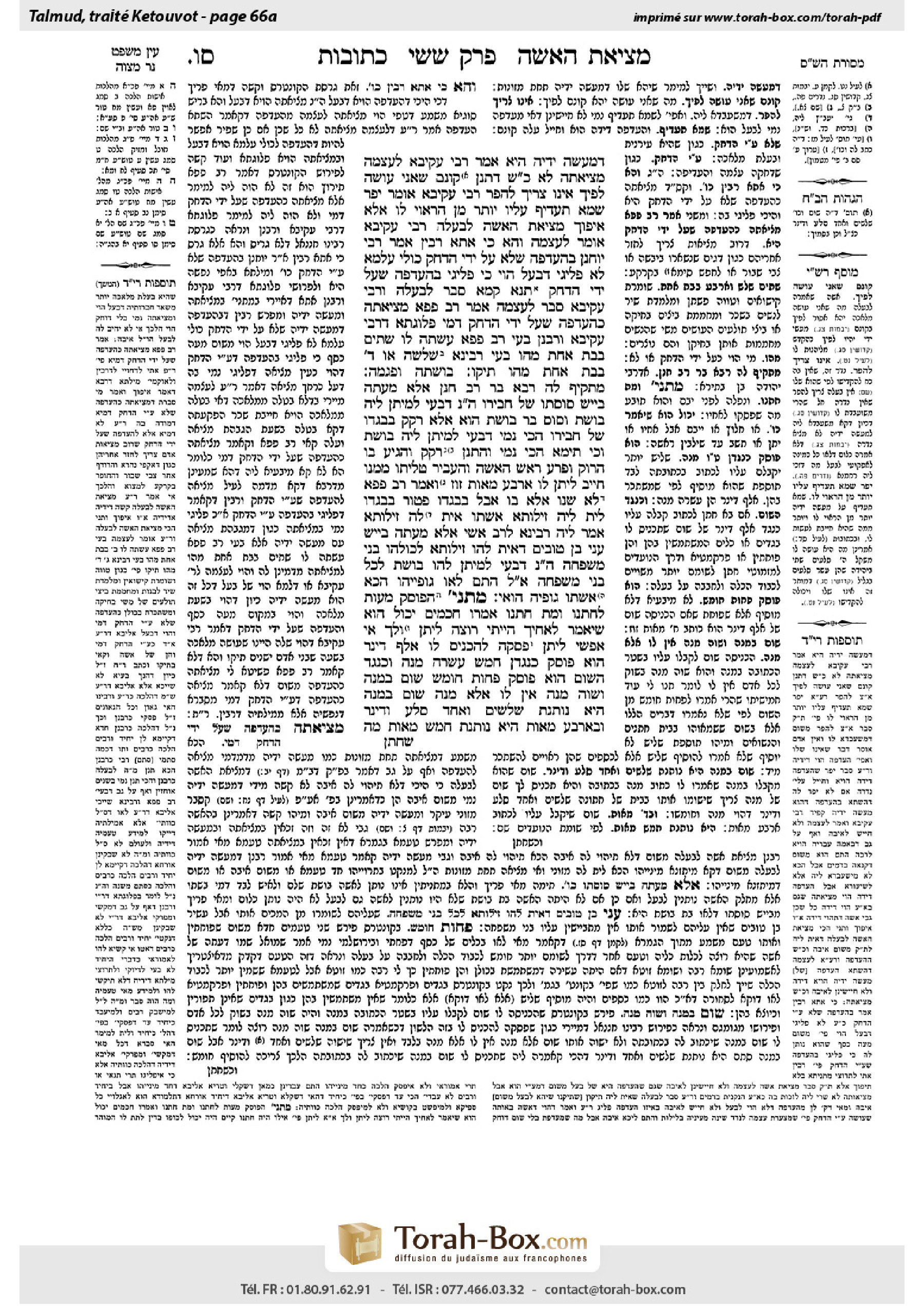
Ketubot 66a: Talmud study for Daf Yomi
Daf Yomi is the daily study of one Talmud folio. Explore 37 tractates with scans, Hebrew text, Sefaria English and AI-generated French translations where annotated.
Passage selection and English or AI-generated French translation are available where the scan has annotations. Daf Study is independent of Torah-Box and Sefaria.
Browse Ketubot · כתובות · All tractatesKetubot 66a text and translations
This page of Ketubot includes the Aramaic text, an English translation and an AI-generated French translation, alongside the scan above.
כתובות ס״ו א · Aramaic and Hebrew text
דְּמַעֲשֵׂה יָדֶיהָ הִיא, אָמַר רַבִּי עֲקִיבָא לְעַצְמָהּ — מְצִיאָתָהּ לֹא כׇּל שֶׁכֵּן?!
דִּתְנַן: ״קֻוֽנָּם שֶׁאֲנִי עוֹשָׂה לְפִיךָ״ — אֵינוֹ צָרִיךְ לְהָפֵר. רַבִּי עֲקִיבָא אוֹמֵר: יָפֵר, שֶׁמָּא תַּעֲדִיף עָלָיו יוֹתֵר מִן הָרָאוּי לוֹ! אֶלָּא אֵיפוֹךְ: מְצִיאַת הָאִשָּׁה לְבַעְלָהּ. רַבִּי עֲקִיבָא אוֹמֵר: לְעַצְמָהּ.
וְהָא כִּי אֲתָא רָבִין, אָמַר רַבִּי יוֹחָנָן: בְּהַעְדָּפָה שֶׁלֹּא עַל יְדֵי הַדְּחָק — כּוּלֵּי עָלְמָא לָא פְּלִיגִי דְּבַעַל הָוֵי. כִּי פְּלִיגִי בְּהַעְדָּפָה שֶׁעַל יְדֵי הַדְּחָק: תַּנָּא קַמָּא סָבַר לְבַעְלָהּ, וְרַבִּי עֲקִיבָא סָבַר לְעַצְמָהּ. אָמַר רַב פָּפָּא: מְצִיאָתָהּ כְּהַעְדָּפָה שֶׁעַל יְדֵי הַדְּחָק דָּמֵי. פְּלוּגְתָּא דְּרַבִּי עֲקִיבָא וְרַבָּנַן.
בָּעֵי רַב פָּפָּא: עָשְׂתָה לוֹ שְׁתַּיִם בְּבַת אַחַת, מַהוּ? בָּעֵי רָבִינָא: שְׁלֹשָׁה אוֹ אַרְבָּעָה בְּבַת אַחַת, מַהוּ? תֵּיקוּ.
בּוֹשְׁתָּהּ וּפְגָמָהּ. מַתְקֵיף לַהּ רָבָא בַּר רַב חָנָן: אֶלָּא מֵעַתָּה, בִּיֵּישׁ סוּסָתוֹ שֶׁל חֲבֵירוֹ, הָכִי נָמֵי דְּבָעֵי לְמִיתַּן לֵיהּ בּוֹשֶׁת? וְסוּס בַּר בּוֹשֶׁת הוּא?! אֶלָּא: רָקַק בְּבִגְדוֹ שֶׁל חֲבֵירוֹ, הָכִי נָמֵי דְּבָעֵי לְמִיתַּן לֵיהּ בּוֹשֶׁת?
וְכִי תֵּימָא הָכִי נָמֵי — וְהָתְנַן: רָקַק וְהִגִּיעַ בּוֹ הָרוֹק, וּפָרַע רֹאשׁ הָאִשָּׁה, וְהֶעֱבִיר טַלִּיתוֹ מִמֶּנּוּ — חַיָּיב לִיתֵּן לוֹ אַרְבַּע מֵאוֹת זוּז. וְאָמַר רַב פָּפָּא: לֹא שָׁנוּ אֶלָּא בּוֹ, אֲבָל בְּבִגְדּוֹ — פָּטוּר! בְּבִגְדּוֹ — לֵית לֵיהּ זִילוּתָא, אִשְׁתּוֹ — אִית לַהּ זִילוּתָא.
אֲמַר לֵיהּ רָבִינָא לְרַב אָשֵׁי: אֶלָּא מֵעַתָּה, בִּיֵּישׁ עָנִי בֶּן טוֹבִים, דְּאִית לְהוּ זִילוּתָא לְכוּלְּהוּ בְּנֵי מִשְׁפָּחָה, הָכִי נָמֵי דְּבָעֵי לְמִיתַּן לְהוּ בּוֹשֶׁת לְכׇל בְּנֵי מִשְׁפָּחָה? אֲמַר לֵיהּ: הָתָם — לָאו גּוּפַיְיהוּ, הָכָא — אִשְׁתּוֹ גּוּפֵיהּ הִיא.
מַתְנִי׳ הַפּוֹסֵק מָעוֹת לַחֲתָנוֹ, וּמֵת חֲתָנוֹ, אָמְרוּ חֲכָמִים: יָכוֹל הוּא שֶׁיֹּאמַר: לְאָחִיךָ הָיִיתִי רוֹצֶה לִיתֵּן, וְלָךְ אִי אֶפְשִׁי לִיתֵּן.
פָּסְקָה לְהַכְנִיס לוֹ אֶלֶף דִּינָר — הוּא פּוֹסֵק כְּנֶגְדָּן חֲמֵשׁ עֶשְׂרֵה מָנֶה, וּכְנֶגֶד הַשּׁוּם הוּא פּוֹסֵק פָּחוֹת חוֹמֶשׁ.
שׁוּם בְּמָנֶה וְשָׁוֶה מָנֶה — אֵין לוֹ אֶלָּא מָנֶה. שׁוּם בְּמָנֶה, הִיא נוֹתֶנֶת שְׁלֹשִׁים וְאֶחָד סֶלַע וְדִינָר. וּבְאַרְבַּע מֵאוֹת, הִיא נוֹתֶנֶת חֲמֵשׁ מֵאוֹת. מַה
Ketubot 66a · English translation
which is categorized as part of her earnings and to which the husband has rights, Rabbi Akiva says the surplus belongs to her, then with regard to lost objects that she found, which are unrelated to her handiwork, do they not all the more so belong to her?
That is Rabbi Akiva’s opinion with regard to surplus, as we learned in a mishna (Nedarim 85a): With regard to a woman who said to her husband: Anything that I produce will be konam, i.e., forbidden like an offering, to your mouth, he need not nullify the vow. The vow never took effect at all because a woman cannot prohibit her husband from items produced by actions that she is obligated to perform for him. Rabbi Akiva says: He should nullify the vow, lest she produce surplus that is more than the amount that is fitting for him, and the vow will take effect on the surplus, which she is not obligated to provide him. According to Rabbi Akiva, any surplus belongs to her. The Gemara answers: Rather, reverse the opinions: Lost objects found by a wife belong to her husband; Rabbi Akiva says: They belong to her.
The Gemara asks: But when Ravin came from Eretz Yisrael, didn’t he say that Rabbi Yoḥanan said: With regard to surplus that is not produced through extraordinary effort, everyone agrees that it is the husband’s. Where they disagree is in a case of surplus that is produced through extraordinary effort. The first tanna holds that the surplus belongs to her husband, and Rabbi Akiva holds that the surplus belongs to her. Apparently, there is no need to reverse the opinions, as Rabbi Akiva acknowledges that there are instances in which surplus belongs to the husband (Rid). The Gemara responds: Rav Pappa said: A lost object found by a wife is comparable to surplus that is produced through extraordinary effort, as this is not a regular occurrence. Therefore, lost objects are subject to the dispute between Rabbi Akiva and the Rabbis.
Rav Pappa raises a dilemma: In a case where she performed two tasks for him simultaneously, what is the halakha; is the status of the earnings the same as surplus produced through exertion? Similarly, Ravina raises a dilemma: In a case where she performed three or four tasks simultaneously, what is the halakha? The dilemmas shall stand unresolved.
§ The mishna states that payments for her humiliation and for her degradation belong to her, but that Rabbi Yehuda ben Beteira holds that the husband receives a portion of the compensation. Rava bar Rav Ḥanan strongly objects to this: If that is so according to Rabbi Yehuda ben Beteira, then if one humiliated another’s horse, is it then the halakha that also such an offender is required to give him payment for humiliation? The Gemara asks: And is a horse subject to humiliation? How is a horse, who suffers no humiliation, comparable to a person, who does suffer from humiliation? Rather, the question is: According to Rabbi Yehuda ben Beteira, if one spat on another’s clothing, is the halakha that also such an offender be required to give him payment for humiliation?
And if you would say that indeed he would be required to pay, but didn’t we learn in a mishna (Bava Kamma 90a): If he spat at another person and the saliva reached him, or if he uncovered a woman’s head, or if he removed his garment from another, he is obligated to give him a payment of four hundred dinars, because of the extreme humiliation that he caused. And Rav Pappa said: They taught that he must pay four hundred dinars only when the spit reached his person. However, if the saliva reached his garment, the one who spat is exempt. Why, then, is one who humiliates a woman required to pay compensation to her husband? The Gemara rejects the comparison: When a person spits on one’s garment, he does not suffer dishonor, but if one’s wife is humiliated, she suffers dishonor, which causes him humiliation.
Ravina said to Rav Ashi: However, if that is so, if one humiliated a poor person of noble descent, where there is dishonor for all members of the family, is the halakha also that he is required to give payment for humiliation to all members of the family? Rav Ashi said to him that there is a distinction between one’s wife and one’s relatives. There, where a relative was humiliated, it is not as if they themselves had suffered the humiliation. Here, since one’s wife is considered his own self, it is as if he himself were humiliated.
MISHNA: In the case of one who pledges to set aside a sum of money for his son-in-law as part of a dowry, and his son-in-law dies before receiving the money, the terms of the dowry do not transfer to the brother, who is now the yavam of the widow. The Sages said: The father-in-law can say to the yavam: To your brother, I wanted to give this money, but to you I do not want to give it.
The mishna addresses another matter. If the woman had pledged to bring in for him one thousand dinars in cash as a dowry, he then pledges, in the marriage contract, that he will give her fifteen hundred dinars against them. That is, he writes in the marriage document that in the event of divorce or his death, he will pay her that greater amount. And against the appraisal of goods such as utensils and other movable items that are included in the dowry, he pledges one-fifth less than the amount of the evaluation. This is because movable property is generally assessed at a value one-fifth higher than the actual value, and he cannot earn any money from these items.
If the appraisal is set at one hundred dinars and the property is actually worth one hundred dinars, then since the appraisal is conducted at market value he has a claim to property worth only one hundred dinars. Likewise, he may not record a decreased sum of property. His recorded appraisal of the movable property that she brings into the marriage is one hundred dinars only when she is giving thirty-one sela and one dinar, equal to 125 dinars. This is because the actual value is one-fifth less than the inflated evaluation, as explained. And similarly, he pledges four hundred dinars against her assets only when she is giving five hundred, based on the inflated assessment of their worth, such that the real value is four hundred dinars. In contrast, what
Ketubot 66a · Traduction française (IA)
qui est considéré comme faisant partie de ses gains et sur lequel le mari a des droits, Rabbi Akiva dit que le surplus lui appartient. Dès lors, concernant les objets perdus qu’elle a trouvés, qui n’ont aucun rapport avec son travail, ne lui appartiennent-ils pas à plus forte raison ?
Telle est l’opinion de Rabbi Akiva concernant le surplus, comme nous l’avons appris dans une Michna (Nedarim 85a) : au sujet d’une femme qui dit à son mari : « Tout ce que je produirai te sera konam, c’est-à-dire interdit comme une offrande », il n’a pas besoin d’annuler le vœu. Celui-ci n’a jamais pris effet, car une femme ne peut interdire à son mari les choses produites par les actes qu’elle est tenue d’accomplir pour lui. Rabbi Akiva dit : Il doit annuler le vœu, de peur qu’elle ne produise un surplus supérieur à la quantité qui lui revient, auquel cas le vœu prendra effet sur ce surplus qu’elle n’est pas tenue de lui fournir. Selon Rabbi Akiva, tout surplus lui appartient. La Guemara répond : Il faut plutôt inverser les opinions : les objets perdus trouvés par une épouse appartiennent à son mari ; Rabbi Akiva dit qu’ils lui appartiennent.
La Guemara demande : Mais lorsque Ravin est venu d’Eretz Israël, n’a-t-il pas dit que Rabbi Yoḥanan avait déclaré : concernant le surplus qui n’est pas produit au prix d’un effort extraordinaire, tous conviennent qu’il appartient au mari ? Leur désaccord porte sur un surplus produit au prix d’un effort extraordinaire. Le premier tanna estime que le surplus appartient au mari, tandis que Rabbi Akiva estime qu’il lui appartient. Apparemment, il n’est pas nécessaire d’inverser les opinions, puisque Rabbi Akiva reconnaît qu’il existe des cas où le surplus appartient au mari (Rid). La Guemara répond : Rav Pappa a dit qu’un objet perdu trouvé par une épouse est comparable à un surplus produit au prix d’un effort extraordinaire, car cela ne se produit pas régulièrement. Par conséquent, les objets perdus relèvent du désaccord entre Rabbi Akiva et les Sages.
Rav Pappa soulève un dilemme : dans le cas où elle accomplit simultanément deux tâches pour lui, quelle est la halakha ? Les gains ont-ils le même statut que le surplus produit au prix d’un effort ? De même, Ravina soulève un dilemme : dans le cas où elle accomplit simultanément trois ou quatre tâches, quelle est la halakha ? Ces dilemmes restent sans réponse.
§ La Michna enseigne que les indemnités pour l’humiliation et l’atteinte à sa dignité lui reviennent, mais que Rabbi Yehuda ben Beteira estime que le mari reçoit une part de l’indemnisation. Rava bar Rav Ḥanan s’y oppose vivement : si tel est le cas selon Rabbi Yehuda ben Beteira, alors, si quelqu’un humilie le cheval d’autrui, la halakha est-elle qu’un tel offenseur doit lui aussi lui verser une indemnité pour humiliation ? La Guemara demande : Un cheval peut-il donc être humilié ? Comment comparer un cheval, qui ne ressent aucune humiliation, à une personne, qui en souffre ? Il faut plutôt demander : selon Rabbi Yehuda ben Beteira, si quelqu’un crache sur le vêtement d’autrui, la halakha est-elle qu’un tel offenseur doit lui aussi lui verser une indemnité pour humiliation ?
Et si tu dis qu’il devrait effectivement être tenu de payer, n’avons-nous pas appris dans une Michna (Bava Kamma 90a) : s’il a craché sur quelqu’un et que la salive l’a atteint, s’il a découvert la tête d’une femme, ou s’il a retiré le vêtement de quelqu’un, il est tenu de lui verser une indemnité de quatre cents dinars, en raison de l’humiliation extrême qu’il lui a causée. Or Rav Pappa a dit : les Sages ont enseigné qu’il doit payer quatre cents dinars uniquement lorsque le crachat a atteint la personne. En revanche, si la salive a atteint son vêtement, celui qui a craché est exempt. Pourquoi, alors, celui qui humilie une femme serait-il tenu de verser une indemnité à son mari ? La Guemara rejette cette comparaison : lorsqu’une personne crache sur le vêtement d’autrui, celui-ci ne subit pas de déshonneur ; mais si l’on humilie l’épouse de quelqu’un, elle subit un déshonneur qui cause aussi l’humiliation de son mari.
Ravina dit à Rav Ashi : Cependant, si tel est le cas, si quelqu’un humilie un pauvre de noble ascendance, déshonorant ainsi tous les membres de sa famille, la halakha est-elle aussi qu’il doit verser une indemnité pour humiliation à chacun des membres de la famille ? Rav Ashi lui répondit qu’il existe une différence entre l’épouse et les proches. Dans ce cas, lorsqu’un proche est humilié, ce n’est pas comme si les autres avaient eux-mêmes subi l’humiliation. Ici, puisque l’épouse est considérée comme faisant un avec son mari, c’est comme si celui-ci avait lui-même été humilié.
MICHNA : Dans le cas d’un homme qui s’engage à réserver une somme d’argent à son gendre au titre de la dot, et où son gendre meurt avant d’avoir reçu l’argent, les conditions de la dot ne sont pas transférées au frère, qui est désormais le yavam de la veuve. Les Sages ont dit : Le beau-père peut dire au yavam : « C’est à ton frère que je voulais donner cet argent, mais à toi, je ne veux pas le donner. »
La Michna traite d’un autre sujet. Si la femme s’est engagée à lui apporter mille dinars en espèces à titre de dot, il s’engage alors, dans la ketouba, à lui donner mille cinq cents dinars en contrepartie. Autrement dit, il écrit dans le document de mariage qu’en cas de divorce ou à sa mort, il lui versera cette somme supérieure. En contrepartie de l’estimation des biens tels que les ustensiles et autres biens meubles compris dans la dot, il s’engage à hauteur d’un cinquième de moins que le montant de l’évaluation. En effet, les biens meubles sont généralement estimés à une valeur supérieure d’un cinquième à leur valeur réelle, et il ne peut tirer aucun bénéfice de ces biens.
Si l’estimation est fixée à cent dinars et que les biens valent réellement cent dinars, alors, puisque l’estimation est faite à la valeur du marché, il a droit à des biens d’une valeur de cent dinars seulement. De même, il ne peut pas inscrire une somme inférieure pour les biens. Il n’inscrit une estimation de cent dinars pour les biens meubles qu’elle apporte au mariage que lorsqu’elle apporte trente et un sela et un dinar, soit l’équivalent de 125 dinars. En effet, comme expliqué, la valeur réelle est inférieure d’un cinquième à l’évaluation majorée. De même, il s’engage à hauteur de quatre cents dinars en contrepartie de ses biens uniquement lorsqu’elle en apporte pour cinq cents dinars, selon l’évaluation majorée de leur valeur, de sorte que leur valeur réelle est de quatre cents dinars. En revanche, ce que
Traduction française générée par IA à partir de l’édition anglaise de Sefaria. Vérifie toujours un passage avec le texte source.
Text from Sefaria: William Davidson Edition - Vocalized Aramaic (CC BY NC); William Davidson Edition - English (CC BY NC).