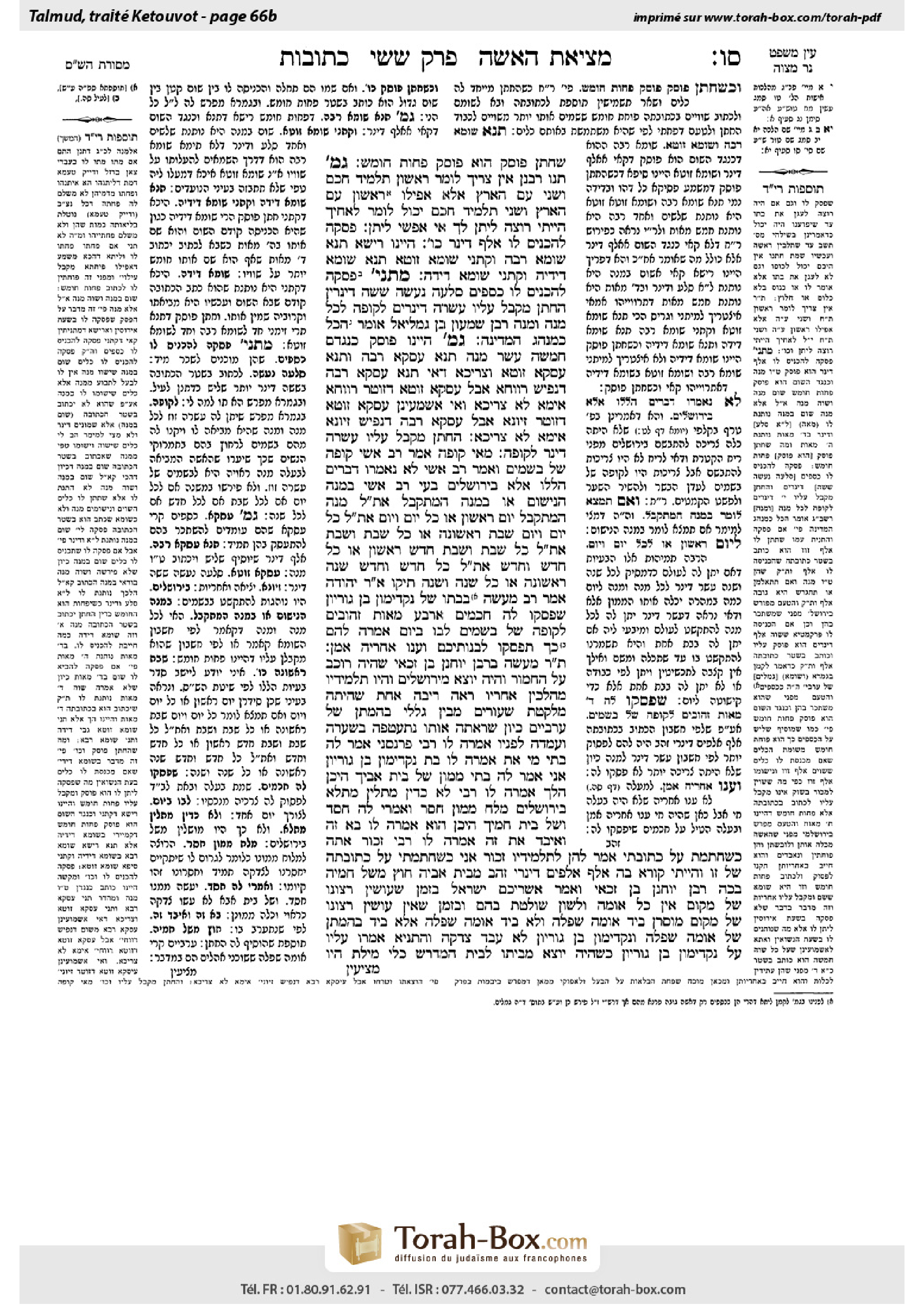
Ketubot 66b: Talmud study for Daf Yomi
Daf Yomi is the daily study of one Talmud folio. Explore 37 tractates with scans, Hebrew text, Sefaria English and AI-generated French translations where annotated.
Passage selection and English or AI-generated French translation are available where the scan has annotations. Daf Study is independent of Torah-Box and Sefaria.
Browse Ketubot · כתובות · All tractatesKetubot 66b text and translations
This page of Ketubot includes the Aramaic text, an English translation and an AI-generated French translation, alongside the scan above.
כתובות ס״ו ב · Aramaic and Hebrew text
שֶּׁחָתָן פּוֹסֵק — הוּא פּוֹסֵק פָּחוֹת חוֹמֶשׁ.
גְּמָ׳ תָּנוּ רַבָּנַן: אֵין צָרִיךְ לוֹמַר רִאשׁוֹן תַּלְמִיד חָכָם וְשֵׁנִי עַם הָאָרֶץ, אֶלָּא אֲפִילּוּ רִאשׁוֹן עַם הָאָרֶץ וְשֵׁנִי תַּלְמִיד חָכָם, יָכוֹל לוֹמַר: לְאָחִיךְ הָיִיתִי רוֹצֶה לִיתֵּן, לְךָ אִי אֶפְשִׁי לִיתֵּן.
פָּסְקָה לְהַכְנִיס לוֹ אֶלֶף דִּינָר כּוּ׳. הַיְינוּ רֵישָׁא! תְּנָא שׁוּמָא רַבָּה וְקָתָנֵי שׁוּמָא זוּטָא. תְּנָא שׁוּמָא דִּידֵיהּ, וְקָתָנֵי שׁוּמָא דִּידַהּ.
מַתְנִי׳ פָּסְקָה לְהַכְנִיס לוֹ כְּסָפִים — סַלְעָהּ נַעֲשֶׂה שִׁשָּׁה דִּינָרִין. הֶחָתָן מְקַבֵּל עָלָיו עֲשָׂרָה דִּינָרִים לַקּוּפָּה לְכׇל מָנֶה וּמָנֶה. רַבָּן שִׁמְעוֹן בֶּן גַּמְלִיאֵל אוֹמֵר: הַכֹּל כְּמִנְהַג הַמְּדִינָה.
גְּמָ׳ הַיְינוּ פּוֹסֵק כְּנֶגְדָּם חֲמִשָּׁה עָשָׂר מָנֶה!
תְּנָא עִסְקָא רַבָּה, וּתְנָא עִסְקָא זוּטָא. וּצְרִיכָא, דְּאִי תְּנָא עִסְקָא רַבָּה — דִּנְפִישׁ רַוְוחָא, אֲבָל עִסְקָא זוּטָא, דְּזוּטַר רַוְוחָא — אֵימָא לָא, צְרִיכָא. וְאִי אַשְׁמְעִינַן עִסְקָא זוּטָא — דְּזוּטַר זִיּוּנָא, אֲבָל עִסְקָא רַבָּה, דִּנְפִישׁ זִיּוּנָא — אֵימָא לָא, צְרִיכָא.
הֶחָתָן מְקַבֵּל עָלָיו עֲשָׂרָה דִּינָר לַקּוּפָּה. מַאי קוּפָּה? אָמַר רַב אָשֵׁי: קוּפָּה שֶׁל בְּשָׂמִים. וְאָמַר רַב אָשֵׁי: לֹא נֶאֶמְרוּ דְּבָרִים הַלָּלוּ אֶלָּא בִּירוּשָׁלַיִם.
בָּעֵי רַב אָשֵׁי: בְּמָנֶה הַנִּישּׁוֹם, אוֹ בְּמָנֶה הַמִּתְקַבֵּל?
אִם תִּמְצָא לוֹמַר מָנֶה הַמִּתְקַבֵּל: יוֹם רִאשׁוֹן, אוֹ כׇּל יוֹם וָיוֹם? אִם תִּמְצָא לוֹמַר כׇּל יוֹם וָיוֹם: שַׁבָּת רִאשׁוֹנָה, אוֹ כׇּל שַׁבָּת וְשַׁבָּת? אִם תִּמְצָא לוֹמַר כׇּל שַׁבָּת וְשַׁבָּת: חֹדֶשׁ רִאשׁוֹן, אוֹ כׇּל חֹדֶשׁ וָחֹדֶשׁ? אִם תִּמְצָא לוֹמַר כׇּל חֹדֶשׁ וָחֹדֶשׁ: שָׁנָה רִאשׁוֹנָה, אוֹ כׇּל שָׁנָה וְשָׁנָה? תֵּיקוּ.
אָמַר רַב יְהוּדָה אָמַר רַב: מַעֲשֶׂה בְּבִתּוֹ שֶׁל נַקְדִּימוֹן בֶּן גּוּרְיוֹן שֶׁפָּסְקוּ לָהּ חֲכָמִים אַרְבַּע מֵאוֹת זְהוּבִים לַקּוּפָּה שֶׁל בְּשָׂמִים לְבוֹ בַּיּוֹם. אָמְרָה לָהֶם: כָּךְ תִּפְסְקוּ לִבְנוֹתֵיכֶם, וְעָנוּ אַחֲרֶיהָ אָמֵן.
תָּנוּ רַבָּנַן: מַעֲשֶׂה בְּרַבָּן יוֹחָנָן בֶּן זַכַּאי שֶׁהָיָה רוֹכֵב עַל הַחֲמוֹר וְהָיָה יוֹצֵא מִירוּשָׁלַיִם, וְהָיוּ תַּלְמִידָיו מְהַלְּכִין אַחֲרָיו. רָאָה רִיבָה אַחַת שֶׁהָיְתָה מְלַקֶּטֶת שְׂעוֹרִים מִבֵּין גֶּלְלֵי בְהֶמְתָּן שֶׁל עַרְבִיִּים. כֵּיוָן שֶׁרָאֲתָה אוֹתוֹ, נִתְעַטְּפָה בִּשְׂעָרָהּ וְעָמְדָה לְפָנָיו.
אָמְרָה לוֹ: רַבִּי, פַּרְנְסֵנִי. אָמַר לָהּ: בִּתִּי, מִי אַתְּ? אָמְרָה לוֹ: בַּת נַקְדִּימוֹן בֶּן גּוּרְיוֹן אֲנִי. אֲמַר לַהּ: בִּתִּי, מָמוֹן שֶׁל בֵּית אָבִיךָ הֵיכָן הָלַךְ? אָמְרָה לוֹ: רַבִּי, לָא כְּדֵין מָתְלִין מַתְלָא בִּירוּשָׁלַיִם: ״מֶלַח מָמוֹן — חֶסֶר״? וְאָמְרִי לַהּ: ״חֶסֶד״. וְשֶׁל בֵּית חָמִיךְ הֵיכָן הוּא? אָמְרָה לוֹ: בָּא זֶה וְאִיבֵּד אֶת זֶה.
אָמְרָה לוֹ: רַבִּי, זָכוּר אַתָּה כְּשֶׁחָתַמְתָּ עַל כְּתוּבָּתִי? אָמַר לָהֶן לְתַלְמִידָיו: זָכוּר אֲנִי כְּשֶׁחָתַמְתִּי עַל כְּתוּבָּתָהּ שֶׁל זוֹ, וְהָיִיתִי קוֹרֵא בָּהּ: אֶלֶף אֲלָפִים דִּינְרֵי זָהָב מִבֵּית אָבִיהָ, חוּץ מִשֶּׁל חָמִיהָ. בָּכָה רַבָּן יוֹחָנָן בֶּן זַכַּאי וְאָמַר: אַשְׁרֵיכֶם יִשְׂרָאֵל, בִּזְמַן שֶׁעוֹשִׂין רְצוֹנוֹ שֶׁל מָקוֹם אֵין כׇּל אוּמָּה וְלָשׁוֹן שׁוֹלֶטֶת בָּהֶם, וּבִזְמַן שֶׁאֵין עוֹשִׂין רְצוֹנוֹ שֶׁל מָקוֹם, מוֹסְרָן בְּיַד אוּמָּה שְׁפָלָה. וְלֹא בְּיַד אוּמָּה שְׁפָלָה, אֶלָּא בְּיַד בְּהֶמְתָּן שֶׁל אוּמָּה שְׁפָלָה.
וְנַקְדִּימוֹן בֶּן גּוּרְיוֹן לָא עֲבַד צְדָקָה? וְהָתַנְיָא: אָמְרוּ עָלָיו עַל נַקְדִּימוֹן בֶּן גּוּרְיוֹן כְּשֶׁהָיָה יוֹצֵא מִבֵּיתוֹ לְבֵית הַמִּדְרָשׁ, כְּלֵי מֵילָת הָיוּ
Ketubot 66b · English translation
the son-in-law pledges according to the amount of the dowry that the bride brings, he pledges one-fifth less in the marriage contract, which is the actual value of the property.
GEMARA: The Gemara cites a baraita to expand upon the mishna’s statement that the father is not required to give the second son-in-law the gift that he promised the first son-in-law, as follows. The Sages taught: Needless to say, this ruling applies when the first is a Torah scholar and the second is an ignoramus, since the father-in-law has a reason to refuse to give the second a dowry like the first. But even if the first is an ignoramus and the second is a Torah scholar, the father-in-law may say: To your brother, I wanted to give this dowry, but to you I do not want to give it, since the obligation incurred was to a specific individual.
The mishna discusses the relationship between the value of the dowry the bride brings in and the amount of money the groom records in the marriage contract, and various examples are illustrated, e.g., if the woman pledged to bring him one thousand dinars. The Gemara asks: These latter examples in the mishna are the same as the first clause of the mishna, and they all illustrate the same financial conditions. Why was it not sufficient to mention only the case of the thousand dinars? The Gemara explains: The tanna teaches about a large appraisal of her substantial property, and he also teaches about a small appraisal in a case where she has minimal property, to illustrate that there is no halakhic difference between them. Similarly, the tanna teaches about the husband’s own appraisal of how to assess how much she must provide, and he also teaches about the wife’s own initial appraisal that she did and the corresponding amount that he must write.
MISHNA: If she pledged to bring him money and not articles to serve as a dowry, her sela, i.e., four dinars, becomes six dinars with respect to the husband’s obligation in the marriage contract. This follows the standard outlined in the previous mishna: The groom increases his obligation by one half since he will profit from this money. Additionally, the groom accepts upon himself to give ten dinars to the account for her needs, for each and every hundred dinars that she brings. Rabban Shimon ben Gamliel says: Everything is in accordance with the regional custom.
GEMARA: Concerning the first clause, that her sela becomes six dinars, the Gemara asks: This is identical to that which was taught in the previous mishna, that if she brings one thousand dinars in her dowry, he pledges against them fifteen hundred dinars. Why does the mishna cite another example to demonstrate the same principle?
The Gemara responds: The tanna taught about large investment capital and taught about small investment capital. And it is necessary to relate to both situations, because if he taught only the case of large capital, which has abundant profit, you might think that only then does the husband add one-half. However, for small capital, which has small profit, you could say that this is not the case. Therefore, it is necessary to also state the principle in this mishna. And conversely, if the tanna had taught us only about small capital, then you might think that because it has little expense, one must add a half. However, with regard to large capital, for which there is abundant expense, you could say that the husband need not add as much. Therefore, it is necessary to state both cases to teach that the husband adds one-half to the sum in any case.
The mishna states that the son-in-law accepts upon himself to give ten dinars to the account. The Gemara asks: What is this account? Rav Ashi said: It is an account for expenses of perfumes and cosmetics. And Rav Ashi said: This statement was said only for women in Jerusalem, where the women are accustomed to using an abundance of perfume.
According to the mishna, the husband must give ten dinars for each and every hundred dinars that she brings. Rav Ashi raises a dilemma: Does this speak of each hundred dinars that are appraised in her dowry, or of each hundred dinars that are accepted by the husband in the marriage contract, which is the appraisal reduced by one-fifth?
If you say that the mishna speaks of each hundred dinars that is accepted, is the intent that he gives a one-time sum only on the first day or on each day? If you say that he gives it every day, does he give it only the first week of marriage or each week? If you say he gives it each week, does he give it only the first month or each month? If you say he gives it each month, does he give it only the first year of marriage or each year? The Gemara does not determine how the calculation must be rendered and with what frequency the husband is required to provide for her cosmetics, and the dilemmas shall stand unresolved.
§ Rav Yehuda said that Rav said: There was an incident involving the daughter of Nakdimon ben Guryon. When the Sages designated for her four hundred gold coins for her account of perfumes, from her late husband’s estate, for use on that same day, she blessed them and said to them: This is how you should also pledge for your own daughters, and they answered after her: Amen.
Apropos the daughter of Nakdimon ben Guryon, the Gemara relates what later became of her: The Sages taught: There was an incident involving Rabban Yoḥanan ben Zakkai. When he was riding on a donkey and leaving Jerusalem, and his students were walking after him to learn from him, he saw a certain young woman who was gathering barley from among the dung of the animals of Arabs. She was so poor that she subsisted on the undigested barley within the dung. When she saw him, she wrapped herself in her hair, as she had nothing else with which to cover herself, and stood before him.
She said to him: My teacher, sustain me. He did not recognize her, so he said to her: My daughter, who are you? She said to him: I am the daughter of Nakdimon ben Guryon. He said to her: My daughter, the money of your father’s household, where did it go? How did you become so poor? She said to him: My teacher, is it not that they say such a proverb in Jerusalem: Salt for money is lacking [ḥaser]? There is nothing with which to preserve it and prevent it from being lost. And some say the proverb asserts that kindness [ḥesed] is salt for money, i.e., using money for acts of kindness preserves it. He continued to ask her: And the money of your father-in-law’s house, which was used properly, for benevolent acts, where is it? She said to him: This one came and destroyed that one; all the money was combined, and it was all lost together.
She said to him: My teacher, do you remember when you signed on my marriage contract? He said to his students: I remember that when I signed on the marriage contract of this woman, and I read in it, it listed a thousand thousands, i.e., one million gold dinars as a dowry from her father’s house, aside from that which was promised her from her father-in-law. Rabban Yoḥanan ben Zakkai cried and said: How fortunate are you, Israel, for when Israel performs the will of the Omnipresent, no nation or tongue can rule over them; and when Israel does not perform the will of the Omnipresent, He delivers them into the hand of a lowly nation. Not only are they delivered into the hand of a lowly nation, but even into the hand of the animals of a lowly nation, as in the pitiful instance of Nakdimon’s daughter.
The recorded incident implies that Nakdimon lost all of his wealth after having failed to use it for acts of kindness. The Gemara asks: And did not Nakdimon ben Guryon perform charity? Isn’t it taught in a baraita: They said about Nakdimon ben Guryon that when he would leave his home to go to the study hall, there were fine woolen garments his attendants would
Ketubot 66b · Traduction française (IA)
Le gendre s’engage en fonction du montant de la dot apportée par la mariée : dans la ketouba, il inscrit un cinquième de moins, ce qui correspond à la valeur réelle des biens.
GUEMARA : La Guemara cite une baraïta pour développer l’affirmation de la Michna selon laquelle le père n’est pas tenu d’accorder au second gendre le cadeau qu’il avait promis au premier. Les Sages ont enseigné : Il va sans dire que cette règle s’applique lorsque le premier est un érudit en Torah et le second un ignorant, puisque le beau-père a une raison de refuser d’accorder au second une dot semblable à celle du premier. Mais même si le premier est un ignorant et le second un érudit en Torah, le beau-père peut dire : « C’est à ton frère que je voulais donner cette dot, mais à toi, je ne veux pas la donner », car l’obligation contractée concernait une personne précise.
La Michna traite du rapport entre la valeur de la dot apportée par la mariée et la somme que le marié inscrit dans la ketouba, et illustre ce rapport par divers exemples, notamment celui d’une femme qui s’engage à lui apporter mille dinars. La Guemara demande : Ces derniers exemples de la Michna ne reviennent-ils pas au même que le cas mentionné dans sa première partie, puisqu’ils illustrent tous les mêmes conditions financières ? Pourquoi ne suffisait-il pas de mentionner le cas des mille dinars ? La Guemara explique : Le tanna enseigne le cas d’une estimation élevée, portant sur des biens de grande valeur, et celui d’une estimation basse, lorsque les biens sont de peu de valeur, pour montrer qu’il n’y a pas de différence halakhique entre les deux. De même, le tanna enseigne le cas où le mari estime lui-même la valeur des biens qu’elle doit apporter, ainsi que celui où la femme a elle-même procédé à une première estimation et le montant correspondant que le mari doit inscrire.
MICHNA : Si elle s’est engagée à lui apporter de l’argent, et non des objets constituant sa dot, son séla, c’est-à-dire quatre dinars, devient six dinars pour le calcul de l’obligation du mari dans la ketouba. Cela suit la règle exposée dans la Michna précédente : le mari augmente son engagement de moitié, puisqu’il tirera profit de cet argent. En outre, le mari s’engage à verser dix dinars pour couvrir ses besoins, pour chaque tranche de cent dinars qu’elle apporte. Rabban Chimon ben Gamliel dit : Tout dépend de la coutume locale.
GUEMARA : À propos de la première clause, selon laquelle son séla devient six dinars, la Guemara demande : N’est-ce pas identique à ce qui a été enseigné dans la Michna précédente, à savoir que si elle apporte mille dinars en dot, il s’engage pour mille cinq cents dinars ? Pourquoi la Michna cite-t-elle un autre exemple pour illustrer le même principe ?
La Guemara répond : Le tanna enseigne le cas d’un capital important et celui d’un petit capital. Il est nécessaire de traiter les deux cas, car si le tanna avait enseigné uniquement celui d’un capital important, qui génère des profits considérables, on aurait pu penser que le mari n’ajoute la moitié que dans ce cas. Mais pour un petit capital, qui génère peu de profits, on aurait pu dire que ce n’est pas le cas. Il est donc nécessaire d’énoncer aussi le principe dans cette Michna. À l’inverse, si le tanna nous avait enseigné uniquement le cas d’un petit capital, on aurait pu penser qu’en raison des faibles dépenses, le mari doit ajouter la moitié. Mais pour un capital important, qui entraîne des dépenses considérables, on aurait pu dire que le mari n’a pas à ajouter autant. Il est donc nécessaire d’énoncer les deux cas, afin d’enseigner que le mari ajoute la moitié à la somme dans tous les cas.
La Michna indique que le gendre s’engage à verser dix dinars sur le compte. La Guemara demande : De quel compte s’agit-il ? Rav Achi dit : Il s’agit d’un compte destiné aux dépenses de parfums et de produits de beauté. Rav Achi dit également : Cette déclaration ne concerne que les femmes de Jérusalem, qui ont l’habitude d’utiliser beaucoup de parfum.
Selon la Michna, le mari doit verser dix dinars pour chaque tranche de cent dinars qu’elle apporte. Rav Achi soulève une question : S’agit-il de chaque tranche de cent dinars estimée dans sa dot, ou de chaque tranche de cent dinars acceptée par le mari dans la ketouba, c’est-à-dire de l’estimation diminuée d’un cinquième ?
Si l’on dit que la Michna parle de chaque tranche de cent dinars acceptée, faut-il comprendre qu’il verse cette somme une seule fois, le premier jour, ou chaque jour ? Si l’on dit qu’il la verse chaque jour, est-ce seulement pendant la première semaine du mariage ou toutes les semaines ? Si l’on dit qu’il la verse toutes les semaines, est-ce seulement pendant le premier mois ou tous les mois ? Si l’on dit qu’il la verse tous les mois, est-ce seulement pendant la première année du mariage ou chaque année ? La Guemara ne tranche ni la manière dont le calcul doit être effectué ni la fréquence à laquelle le mari doit pourvoir aux produits de beauté de son épouse ; ces questions restent sans réponse.
§ Rav Yehouda dit au nom de Rav : Un incident eut lieu au sujet de la fille de Nakdimon ben Guryon. Lorsque les Sages lui attribuèrent, sur la succession de son défunt mari, quatre cents pièces d’or pour ses dépenses de parfums, à utiliser le jour même, elle les bénit et leur dit : « Puissiez-vous vous aussi vous engager ainsi pour vos propres filles ! » Ils lui répondirent : « Amen. »
À propos de la fille de Nakdimon ben Guryon, la Guemara raconte ce qu’il advint d’elle par la suite. Les Sages ont enseigné : Un incident eut lieu au sujet de Rabban Yoḥanan ben Zakkaï. Il quittait Jérusalem à dos d’âne, et ses élèves marchaient derrière lui pour étudier auprès de lui. Il vit une jeune femme qui ramassait de l’orge parmi les excréments des animaux des Arabes. Elle était si pauvre qu’elle se nourrissait de l’orge non digérée qui se trouvait dans les excréments. Lorsqu’elle le vit, elle s’enveloppa de ses cheveux, n’ayant rien d’autre pour se couvrir, et se tint devant lui.
Elle lui dit : « Mon maître, donne-moi de quoi vivre. » Il ne la reconnut pas et lui demanda : « Ma fille, qui es-tu ? » Elle lui répondit : « Je suis la fille de Nakdimon ben Guryon. » Il lui demanda : « Ma fille, où est passé l’argent de la maison de ton père ? Comment es-tu devenue si pauvre ? » Elle lui répondit : « Mon maître, ne dit-on pas à Jérusalem ce proverbe : “Le sel manque à l’argent [ḥaser]” ? Rien ne permet de conserver l’argent et d’éviter qu’il ne se perde. Certains disent que le proverbe affirme que la bonté [ḥesed] est le sel de l’argent, c’est-à-dire que l’argent employé à des actes de bonté est préservé. » Il continua à l’interroger : « Et l’argent de la maison de ton beau-père, qui a été employé comme il convient, à des actes de bienfaisance, où est-il ? » Elle lui répondit : « Celui-ci est venu et a détruit celui-là ; tout l’argent a été réuni, et tout a été perdu ensemble. »
Elle lui dit : « Mon maître, te souviens-tu du moment où tu as signé ma ketouba ? » Il dit à ses élèves : « Je me souviens que, lorsque j’ai signé la ketouba de cette femme et que je l’ai lue, elle mentionnait mille milliers, c’est-à-dire un million de dinars d’or, comme dot provenant de la maison de son père, en plus de ce qui lui avait été promis par son beau-père. » Rabban Yoḥanan ben Zakkaï pleura et dit : « Qu’Israël est heureux ! Lorsque Israël accomplit la volonté de l’Omniprésent, aucune nation ni aucune langue ne peut le dominer ; et lorsqu’Israël n’accomplit pas la volonté de l’Omniprésent, Il le livre aux mains d’une nation méprisable. Il ne le livre pas seulement aux mains d’une nation méprisable, mais même aux mains des animaux d’une nation méprisable, comme dans le pitoyable cas de la fille de Nakdimon. »
L’incident relaté laisse entendre que Nakdimon perdit toute sa richesse après avoir omis de l’employer à des actes de bonté. La Guemara demande : Mais Nakdimon ben Guryon ne pratiquait-il pas la charité ? N’est-il pas enseigné dans une baraïta : On a dit au sujet de Nakdimon ben Guryon que, lorsqu’il quittait sa maison pour se rendre à la maison d’étude, ses serviteurs portaient de beaux vêtements de laine…
Traduction française générée par IA à partir de l’édition anglaise de Sefaria. Vérifie toujours un passage avec le texte source.
Text from Sefaria: William Davidson Edition - Vocalized Aramaic (CC BY NC); William Davidson Edition - English (CC BY NC).