Ketubot 67a: Talmud study for Daf Yomi
Daf Yomi is the daily study of one Talmud folio. Explore 37 tractates with scans, Hebrew text, Sefaria English and AI-generated French translations where annotated.
Passage selection and English or AI-generated French translation are available where the scan has annotations. Daf Study is independent of Torah-Box and Sefaria.
Browse Ketubot · כתובות · All tractatesKetubot 67a text and translations
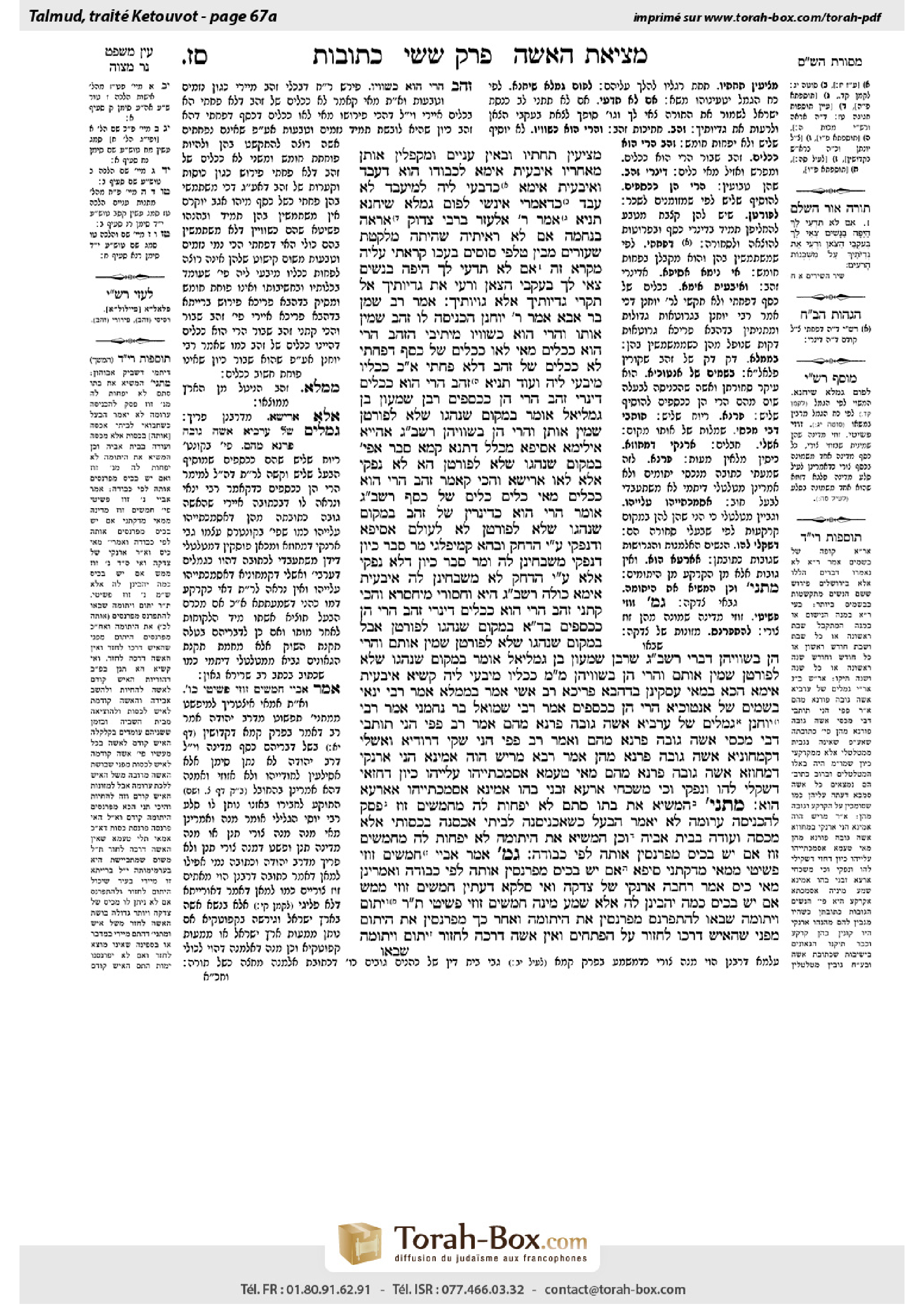
This page of Ketubot includes the Aramaic text, an English translation and an AI-generated French translation, alongside the scan above.
כתובות ס״ז א · Aramaic and Hebrew text
מַצִּיעִין תַּחְתָּיו, וּבָאִין עֲנִיִּים וּמְקַפְּלִין אוֹתָן מֵאַחֲרָיו! אִיבָּעֵית אֵימָא: לִכְבוֹדוֹ הוּא דַּעֲבַד, וְאִיבָּעֵית אֵימָא: כִּדְבָעֵי לֵיהּ לְמִיעְבַּד לָא עֲבַד. כִּדְאָמְרִי אִינָשֵׁי: לְפוּם גַּמְלָא שִׁיחְנָא.
תַּנְיָא: אָמַר רַבִּי אֶלְעָזָר בְּרַבִּי צָדוֹק: אֶרְאֶה בְּנֶחָמָה, אִם לֹא רְאִיתִיהָ שֶׁהָיְתָה מְלַקֶּטֶת שְׂעוֹרִים מִבֵּין טַלְפֵי סוּסִים בְּעַכּוֹ. קָרָאתִי עָלֶיהָ מִקְרָא זֶה: ״אִם לֹא תֵדְעִי לָךְ הַיָּפָה בַּנָּשִׁים צְאִי לָךְ בְּעִקְבֵי הַצֹּאן וּרְעִי אֶת גְּדִיּוֹתַיִךְ״. אַל תִּקְרֵי ״גְּדִיּוֹתַיִךְ״, אֶלָּא ״גְּוִיּוֹתַיִךְ״.
אָמַר רַב שֶׁמֶן בַּר אַבָּא אָמַר רַבִּי יוֹחָנָן: הִכְנִיסָה לוֹ זָהָב — שָׁמִין אוֹתוֹ, וַהֲרֵי הוּא כְּשׇׁוְויוֹ. מֵיתִיבִי: הַזָּהָב הֲרֵי הוּא כְּכֵלִים. מַאי לָאו: כְּכֵלִים שֶׁל כֶּסֶף, דְּפָחֲתִי! לָא, כְּכֵלִים שֶׁל זָהָב, דְּלָא פָּחֲתִי. אִם כֵּן, כְּכֵלָיו מִיבְּעֵי לֵיהּ!
וְעוֹד, תַּנְיָא: זָהָב הֲרֵי הוּא כְּכֵלִים. דִּינְרֵי זָהָב, הֲרֵי הֵן כִּכְסָפִים. רַבָּן שִׁמְעוֹן בֶּן גַּמְלִיאֵל אוֹמֵר: בִּמְקוֹם שֶׁנָּהֲגוּ שֶׁלֹּא לְפוֹרְטָן — שָׁמִין אוֹתָן וַהֲרֵי הֵן בְּשׇׁוְויֵהֶן. רַבָּן שִׁמְעוֹן בֶּן גַּמְלִיאֵל אַהֵיָיא? אִילֵּימָא אַסֵּיפָא, מִכְּלָל דְּתַנָּא קַמָּא סָבַר אֲפִילּוּ בִּמְקוֹם שֶׁנָּהֲגוּ שֶׁלֹּא לְפוֹרְטָן? הָא לָא נָפְקִי!
אֶלָּא לָאו אַרֵישָׁא, וְהָכִי קָאָמַר: זָהָב הֲרֵי הוּא כְּכֵלִים, מַאי כֵּלִים — כֵּלִים שֶׁל כֶּסֶף. רַבָּן שִׁמְעוֹן בֶּן גַּמְלִיאֵל אוֹמֵר: הֲרֵי הוּא כְּדִינָרִין שֶׁל זָהָב, בִּמְקוֹם שֶׁנָּהֲגוּ שֶׁלֹּא לְפוֹרְטָן!
לָא, לְעוֹלָם אַסֵּיפָא, וּדְנָפְקִי עַל יְדֵי הַדְּחָק. וּבְהָא קָמִיפַּלְגִי, מָר סָבַר: כֵּיוָן דְּנָפְקִי, מַשְׁבְּחִינַן לַהּ, וּמָר סָבַר: כֵּיוָן דְּלָא נָפְקִי אֶלָּא עַל יְדֵי הַדְּחָק, לָא מַשְׁבְּחִינַן לַהּ.
אִיבָּעֵית אֵימָא: כּוּלַּהּ רַבָּן שִׁמְעוֹן בֶּן גַּמְלִיאֵל הִיא, וְחַסּוֹרֵי מִיחַסְּרָא, וְהָכִי קָתָנֵי: זָהָב הֲרֵי הוּא כְּכֵלִים, דִּינְרֵי זָהָב הֲרֵי הֵן כִּכְסָפִים. בַּמֶּה דְּבָרִים אֲמוּרִים — בִּמְקוֹם שֶׁנָּהֲגוּ לְפוֹרְטָן. אֲבָל בִּמְקוֹם שֶׁנָּהֲגוּ שֶׁלֹּא לְפוֹרְטָן — שָׁמִין אוֹתָם וַהֲרֵי הֵן בְּשׇׁוְויֵהֶן, דִּבְרֵי רַבָּן שִׁמְעוֹן בֶּן גַּמְלִיאֵל. שֶׁרַבָּן שִׁמְעוֹן בֶּן גַּמְלִיאֵל אוֹמֵר: בִּמְקוֹם שֶׁנָּהֲגוּ שֶׁלֹּא לְפוֹרְטָן, שָׁמִין אוֹתָם וַהֲרֵי הֵן בְּשׇׁוְויֵהֶן.
מִכׇּל מָקוֹם, ״כְּכֵלָיו״ מִיבְּעֵי לֵיהּ! קַשְׁיָא. אִיבָּעֵית אֵימָא: הָכָא בְּמַאי עָסְקִינַן — בְּדַהֲבָא פְּרִיכָא. רַב אָשֵׁי אָמַר: בְּמַמְלָא.
אָמַר רַבִּי יַנַּאי: בְּשָׂמִים שֶׁל אַנְטוֹכְיָא — הֲרֵי הֵן כִּכְסָפִים. אָמַר רַבִּי שְׁמוּאֵל בַּר נַחְמָנִי אָמַר רַבִּי יוֹחָנָן: גְּמַלִּים שֶׁל עַרְבִיָּא — אִשָּׁה גּוֹבָה פֻּרְנָא מֵהֶם.
אָמַר רַב פַּפִּי: הָנֵי תּוֹתְבֵי דְּבֵי מִכְסֵי, אִשָּׁה גּוֹבָה פֻּרְנָא מֵהֶם. וְאָמַר רַב פַּפִּי: הָנֵי שַׂקֵּי דְרוּדְיָא וְאַשְׁלֵי דְקִמְחוֹנְיָא — אִשָּׁה גּוֹבָה פֻּרְנָא מֵהֶן. אָמַר רָבָא, מֵרֵישׁ הֲוָה אָמֵינָא: הָנֵי אַרְנְקֵי דְמָחוֹזָא — אִשָּׁה גּוֹבָה פֻּרְנָא מֵהֶם. מַאי טַעְמָא? אַסְמַכְתַּיְיהוּ עֲלַיְיהוּ. כֵּיוָן דַּחֲזַאי דְּשָׁקְלִי לְהוּ וְנָפְקִי, וְכִי מַשְׁכְּחִי אַרְעָא זָבְנִי בְּהוּ, אָמֵינָא: אַסְמַכְתַּיְיהוּ אַאַרְעָא הוּא.
מַתְנִי׳ הַמַּשִּׂיא אֶת בִּתּוֹ סְתָם — לֹא יִפְחוֹת לָהּ מֵחֲמִשִּׁים זוּז. פָּסַק לְהַכְנִיסָהּ עֲרוּמָּה — לֹא יֹאמַר הַבַּעַל ״כְּשֶׁאַכְנִיסֶנָּה לְבֵיתִי אֲכַסֶּנָּה בִּכְסוּתִי״, אֶלָּא מְכַסָּהּ וְעוֹדָהּ בְּבֵית אָבִיהָ. וְכֵן הַמַּשִּׂיא אֶת הַיְּתוֹמָה — לֹא יִפְחוֹת לָהּ מֵחֲמִשִּׁים זוּז. אִם יֵשׁ בַּכִּיס — מְפַרְנְסִין אוֹתָהּ לְפִי כְּבוֹדָהּ.
גְּמָ׳ אָמַר אַבָּיֵי: חֲמִשִּׁים זוּזֵי פְּשִׁיטֵי. מִמַּאי — מִדְּקָתָנֵי סֵיפָא: אִם יֵשׁ בַּכִּיס — מְפַרְנְסִין אוֹתָהּ לְפִי כְּבוֹדָהּ, וְאָמְרִינַן מַאי כִּיס? אָמַר רַחֲבָה: אַרְנְקִי שֶׁל צְדָקָה. וְאִי סָלְקָא דַּעְתִּין חֲמִשִּׁים זוּזֵי מַמָּשׁ, אִם יֵשׁ בַּכִּיס כַּמָּה יָהֲבִינַן לַהּ? אֶלָּא שְׁמַע מִינַּהּ חֲמִשִּׁים זוּזֵי פְּשִׁיטֵי.
תָּנוּ רַבָּנַן: יָתוֹם וִיתוֹמָה שֶׁבָּאוּ לְהִתְפַּרְנֵס — מְפַרְנְסִין אֶת הַיְּתוֹמָה וְאַחַר כָּךְ מְפַרְנְסִין אֶת הַיָּתוֹם, מִפְּנֵי שֶׁהָאִישׁ דַּרְכּוֹ לַחְזוֹר עַל הַפְּתָחִים, וְאֵין אִשָּׁה דַּרְכָּהּ לַחְזוֹר. יָתוֹם וִיתוֹמָה
Ketubot 67a · English translation
spread underneath him to walk on, and with his blessing, the poor would come and fold them up from behind him for themselves? Clearly he gave abundant charity. The Gemara offers two possible explanations: If you wish, say that he acted that way for his own honor, to demonstrate that he considered the exorbitant expense trivial. And if you wish, say that as he should have done, he did not do. As people say, according to the camel is the burden. The stronger the camel, the heavier the load it must bear. Even if he gave altruistically, Nakdimon ben Guryon did not give as much as he was expected to give.
It is taught in a baraita (Tosefta 5:8) with regard to the daughter of Nakdimon ben Guryon: Rabbi Elazar, son of Rabbi Tzadok, said in the form of an oath: I pray that I will not see the consolation of the Jewish people if I did not see her gathering barley kernels from between the hooves of horses in Akko. I recited this verse about her: “If you know not, O you fairest among women, go your way forth by the footsteps of the flock and feed your kids, beside the shepherds’ tents” (Song of Songs 1:8). Do not read it as “your kids [gediyotayikh]” but rather read it as your bodies [geviyotayikh]. This woman is compelled to follow the sheep to the pastures in order to sustain her own body from the leftovers of their food.
§ The Gemara returns to the topic of how the groom records the bride’s dowry in the marriage contract: Rav Shemen bar Abba said that Rabbi Yoḥanan said: If she brings him gold in her dowry, the court appraises it, and it is recorded in the marriage contract according to its value, without additions or subtractions. The Gemara raises an objection from that which was taught in a baraita: The halakha is that the gold is like utensils and not like cash for purposes of the dowry. The Gemara qualifies its objection: What, is it not that gold is like silver vessels, which diminish, so that they resemble all other goods in the dowry whose values are reduced in the marriage contract? The Gemara responds: No, the intent is that gold is like utensils of gold, which do not diminish. The Gemara asks: If so, the baraita should have stated that gold is like its own utensils, which would demonstrate that gold is appraised according to its true value. Evidently, then, this is not true of gold.
And moreover, one can ask: It is taught in a baraita (Tosefta 6:2) that the halakha is that gold is like utensils and that gold dinars are like silver coins. Rabban Shimon ben Gamliel says: In a place where people were accustomed not to exchange them, the court appraises them, and they are recorded at their appraised worth, no more or less. The Gemara clarifies: To which clause is Rabban Shimon ben Gamliel referring, when he comments that they are not exchanged? If we say he is commenting on the latter clause concerning the gold dinars, by inference it may be understood that the first tanna holds that gold dinars have the same status as cash, even in a place where people were accustomed not to exchange them. But they are not used and do not function as liquid money in a place where they are not exchanged. Why, then, does the husband need to raise the value as though they were functional cash?
Rather, is it not that Rabban Shimon ben Gamliel commented on the first clause of the baraita, and this is what the baraita is saying: The halakha is that gold is like utensils. What is meant by the ambiguous term utensils? Utensils of silver. Rabban Shimon ben Gamliel qualifies this ruling and says: The halakha is that it is like gold dinars, whose value remains constant, in a place where they are accustomed not to exchange it or use it for business. In any event, the opinion of the first tanna in this baraita, that gold is treated like silver utensils, contradicts the previous assertion that gold must have the status of gold utensils, not silver utensils.
The Gemara responds: No, actually it must be that Rabban Shimon ben Gamliel commented on the latter clause of the baraita, which deals with gold dinars, and they are not exchanged because they are used as cash only with difficulty. They are not typically used for business, but they could be used when necessary. And consequently, they disagree about this: One Sage, the first tanna, holds since they are used when necessary, we increase the value of gold dinars for the wife in the dowry, and the husband writes an increased sum in the marriage contract. And one Sage, Rabban Shimon ben Gamliel, holds since they are used for commerce only with difficulty, we do not increase the value of gold dinars for her. According to this interpretation, the first opinion can still subscribe to the notion that gold pieces, like gold utensils, are appraised at their actual value.
If you wish, say instead that the entire baraita is in accordance with the opinion of Rabban Shimon ben Gamliel, and the baraita is incomplete and this is what it is teaching: The halakha is that a piece of gold is like utensils and gold dinars are like money. In what case is this statement said? In a place where the people were accustomed to exchange the dinars. However, in a place where the people were accustomed not to exchange the dinars, the court appraises their worth, and they are recorded at their appraised worth. This is the statement of Rabban Shimon ben Gamliel, as Rabban Shimon ben Gamliel says: In a place where the people were accustomed not to exchange them, the court appraises their worth, and they are recorded at their appraised worth.
The contradiction from this baraita has been resolved, but in any case, a difficulty remains: If the status of gold is similar to that of gold utensils and it is appraised at its actual value, the baraita should have stated that gold is like its own utensils and not simply like any utensils. The Gemara answers: The language is difficult. If you wish, say the following answer instead: With what are we dealing here? With smashed gold fragments. Rav Ashi said: We are dealing with granules of gold. Certainly, then, they are not treated as gold utensils, but the novel element of the baraita is that they have the status of regular utensils and not of gold dinars.
§ Apropos the preceding discussion concerning the appraisal of objects used for commerce, the Gemara cites a series of related comments. Rabbi Yannai said: With regard to spices in Antioch, they are like money. Since in Antioch they would conduct business with spices, they should be treated like cash when a woman brings them in her dowry. Similarly, Rabbi Shmuel bar Naḥmani said that Rabbi Yoḥanan said: Concerning camels in Arabia, a woman may collect the amount of her marriage settlement from them. Since they conduct business using camels in Arabia, the camels are consequently given the status that money has in other places.
Similarly, Rav Pappi said: With regard to those robes in Bei Mikhsei, a woman may collect her marriage settlement from them because they use dresses for commerce. And Rav Pappi said: With regard to these sacks in Rodya and ropes in Kimḥonya, a woman may collect her marriage settlement from them. Rava said: Initially, I would have said that concerning those money pouches [arnakei] in Meḥoza, a woman may collect her marriage settlement from them. What is the reason? They rely on them, and they serve the commercial function served by real estate in other places. Once I saw that they take them and the pouches are used, and when they find land they buy it with them and do not retain them, I said that they too rely on land. The money pouches are used in a fluid manner, but these pouches do not serve the same role served by real estate.
MISHNA: With regard to one who marries off his daughter with the terms of the dowry unspecified, he must not give her less than fifty dinars. If the bride’s father pledged to bring her into the marriage bare, by saying that he refuses to give her anything, the husband should not say: When I bring her into my house, I will clothe her with my clothing, but not beforehand. Rather, he must clothe her while she is yet in her father’s house, and she enters the marriage with the clothing in hand. And similarly, with regard to a charity administrator who marries off an orphan girl, he must not give her less than fifty dinars. If there are sufficient resources in the charity fund, the charities provide even more for her, furnishing a dowry and her other needs according to her dignity.
GEMARA: Abaye said: The fifty dinars mentioned in the mishna is referring to fifty provincial dinars, each of which is worth one-eighth the amount of a standard dinar. From where do I know that this is so? From the fact that the latter clause teaches: If there are sufficient resources in the charity fund, the charities provide more for her, furnishing a dowry and her other needs according to her dignity. And we say: What is this fund? Raḥava said: The charity fund. And if it enters our minds to say that the mishna is referring to fifty actual, i.e., standard, dinars, if there are sufficient resources in the fund, how many standard dinars do we give him? Fifty standard dinars is already a sizable sum to distribute as charity. Rather, conclude from this comment that the mishna is referring to fifty provincial dinars.
The Sages taught: Concerning an orphan boy and an orphan girl who have come and appealed to be supported by the charity fund, the distributors provide for the orphan girl first and afterward they provide for the orphan boy. This is because it is the way of a man to circulate about the entryways to ask for charity, and it is not a woman’s way to circulate for charity. Therefore, her need is greater. Concerning an orphan boy and orphan girl
Ketubot 67a · Traduction française (IA)
étalés sous ses pas pour qu’il marche dessus, et, avec sa bénédiction, les pauvres venaient les ramasser derrière lui pour les emporter ? Il est clair qu’il donnait abondamment à la tsédaka. La Guemara propose deux explications possibles : si tu veux, dis qu’il agissait ainsi pour sa propre gloire, afin de montrer qu’à ses yeux cette dépense exorbitante était insignifiante. Et si tu veux, dis qu’il ne donnait pas autant qu’il aurait dû. Comme le dit le proverbe : la charge est proportionnelle à la force du chameau. Plus le chameau est fort, plus lourde est la charge qu’il doit porter. Même s’il donnait de manière désintéressée, Nakdimon ben Guryon ne donnait pas autant qu’on attendait de lui.
Il est enseigné dans une baraïta (Tosefta 5:8) au sujet de la fille de Nakdimon ben Guryon : Rabbi Elazar, fils de Rabbi Tsadok, dit sous serment : « Puissé-je ne pas voir la consolation du peuple juif si je ne l’ai pas vue ramasser des grains d’orge entre les sabots des chevaux à Akko ! » J’ai récité à son sujet ce verset : « Si tu ne le sais pas, ô la plus belle des femmes, va sur les traces du troupeau et fais paître tes chevreaux près des tentes des bergers » (Cantique des Cantiques 1:8). Ne lis pas « tes chevreaux [gediyotayikh] », mais plutôt « tes corps [geviyotayikh] ». Cette femme est contrainte de suivre les moutons jusqu’aux pâturages afin de nourrir son propre corps des restes de leur nourriture.
§ La Guemara revient à la manière dont le marié inscrit la dot de la mariée dans la ketouba. Rav Shemen bar Abba a dit que Rabbi Yoḥanan a dit : si elle lui apporte de l’or dans sa dot, le tribunal l’évalue et sa valeur est inscrite dans la ketouba, sans augmentation ni diminution. La Guemara soulève une objection à partir de ce qui est enseigné dans une baraïta : la halakha est que l’or est assimilé à des ustensiles et non à de l’argent comptant pour le calcul de la dot. La Guemara précise l’objection : n’est-ce pas à dire que l’or est assimilé à des ustensiles d’argent, dont la valeur diminue, comme celle de tous les autres biens de la dot, dont la valeur est réduite dans la ketouba ? La Guemara répond : non, cela signifie que l’or est assimilé à des ustensiles en or, dont la valeur ne diminue pas. La Guemara demande : dans ce cas, la baraïta aurait dû dire que l’or est assimilé à ses propres ustensiles, ce qui montrerait qu’il est évalué à sa valeur réelle. Il apparaît donc que cela n’est pas vrai de l’or.
En outre, on peut demander : il est enseigné dans une baraïta (Tosefta 6:2) que la halakha est que l’or est assimilé à des ustensiles et que les dinars d’or sont assimilés à des pièces d’argent. Rabban Shimon ben Gamliel dit : dans un endroit où l’on a coutume de ne pas les échanger, le tribunal les évalue et ils sont inscrits à leur valeur estimée, ni plus ni moins. La Guemara précise : à quelle clause Rabban Shimon ben Gamliel se réfère-t-il lorsqu’il commente qu’on ne les échange pas ? Si l’on dit qu’il se réfère à la dernière clause, qui concerne les dinars d’or, on pourrait en déduire que le premier tanna considère les dinars d’or comme de l’argent comptant, même dans un endroit où l’on a coutume de ne pas les échanger. Mais, dans un endroit où ils ne sont pas échangés, ils ne sont pas utilisés et ne servent pas de monnaie courante. Pourquoi, dès lors, le mari devrait-il en augmenter la valeur comme s’il s’agissait d’argent comptant en circulation ?
Mais ne faut-il pas plutôt dire que Rabban Shimon ben Gamliel commentait la première clause de la baraïta, et que celle-ci dit ceci : la halakha est que l’or est assimilé à des ustensiles. Que signifie le terme ambigu « ustensiles » ? Des ustensiles d’argent. Rabban Shimon ben Gamliel précise cette règle et dit : la halakha est que l’or est assimilé à des dinars d’or, dont la valeur reste constante, dans un endroit où l’on a coutume de ne pas les échanger ni de les utiliser pour le commerce. Quoi qu’il en soit, l’avis du premier tanna dans cette baraïta, selon lequel l’or est traité comme des ustensiles d’argent, contredit l’affirmation précédente selon laquelle l’or doit être considéré comme des ustensiles en or, et non comme des ustensiles d’argent.
La Guemara répond : non, en réalité, Rabban Shimon ben Gamliel commentait la dernière clause de la baraïta, qui traite des dinars d’or. Ceux-ci ne sont pas échangés parce qu’ils ne sont utilisés comme argent comptant qu’avec difficulté. Ils ne sont généralement pas utilisés pour le commerce, mais pourraient l’être en cas de besoin. Par conséquent, ils sont en désaccord sur ce point : un Sage, le premier tanna, estime que, puisqu’ils sont utilisés en cas de besoin, on augmente la valeur des dinars d’or dans la dot de l’épouse, et le mari inscrit une somme majorée dans la ketouba. Un autre Sage, Rabban Shimon ben Gamliel, estime que, puisqu’ils ne sont utilisés pour le commerce qu’avec difficulté, on n’augmente pas leur valeur en sa faveur. Selon cette interprétation, le premier avis peut toujours soutenir que les pièces d’or, comme les ustensiles en or, sont évaluées à leur valeur réelle.
Si tu veux, dis plutôt que toute la baraïta est conforme à l’avis de Rabban Shimon ben Gamliel, et qu’elle est incomplète ; voici ce qu’elle enseigne : la halakha est qu’un morceau d’or est assimilé à des ustensiles, et que les dinars d’or sont assimilés à de l’argent. Dans quel cas cette déclaration s’applique-t-elle ? Dans un endroit où les gens ont coutume d’échanger les dinars. En revanche, dans un endroit où les gens ont coutume de ne pas les échanger, le tribunal en évalue la valeur et ils sont inscrits à leur valeur estimée. Telle est la déclaration de Rabban Shimon ben Gamliel, car Rabban Shimon ben Gamliel dit : dans un endroit où les gens ont coutume de ne pas les échanger, le tribunal en évalue la valeur et ils sont inscrits à leur valeur estimée.
La contradiction tirée de cette baraïta a été résolue, mais une difficulté demeure : si l’or est semblable aux ustensiles en or et qu’il est évalué à sa valeur réelle, la baraïta aurait dû dire que l’or est assimilé à ses propres ustensiles, et non simplement à des ustensiles. La Guemara répond : la formulation est difficile. Si tu veux, donne plutôt la réponse suivante : de quoi parlons-nous ici ? De fragments d’or brisés. Rav Ashi dit : nous parlons de granules d’or. Il est donc certain qu’ils ne sont pas traités comme des ustensiles en or ; mais la nouveauté de la baraïta est qu’ils ont le statut d’ustensiles ordinaires, et non celui de dinars d’or.
§ À propos de la discussion précédente concernant l’évaluation des objets utilisés pour le commerce, la Guemara cite une série de remarques connexes. Rabbi Yannai a dit : les épices à Antioche sont assimilées à de l’argent. Puisqu’à Antioche on faisait du commerce avec les épices, elles doivent être traitées comme de l’argent comptant lorsqu’une femme les apporte dans sa dot. De même, Rabbi Shmuel bar Naḥmani a dit que Rabbi Yoḥanan a dit : en Arabie, une femme peut percevoir le montant de sa ketouba sur des chameaux. Puisqu’en Arabie on fait du commerce avec des chameaux, ceux-ci ont donc le statut que l’argent a ailleurs.
De même, Rav Pappi a dit : pour ces robes à Bei Mikhsei, une femme peut percevoir le montant de sa ketouba, car on y fait le commerce des vêtements. Rav Pappi a également dit : pour ces sacs à Rodya et ces cordes à Kimḥonya, une femme peut percevoir le montant de sa ketouba. Rava a dit : au début, j’aurais dit qu’à Meḥoza, une femme peut percevoir le montant de sa ketouba sur ces bourses [arnakei]. Pour quelle raison ? Les gens s’appuient sur elles, et elles remplissent la fonction commerciale que les biens immobiliers remplissent ailleurs. Mais après avoir vu qu’on les emporte et qu’on utilise les bourses, puis que, lorsqu’on trouve des terres, on les achète avec elles au lieu de les conserver, j’ai dit que les gens s’appuient eux aussi sur les terres. Les bourses sont utilisées de manière fluide, mais elles ne remplissent pas le même rôle que les biens immobiliers.
MICHNA : Celui qui marie sa fille sans préciser les conditions de la dot ne doit pas lui donner moins de cinquante dinars. Si le père de la mariée a déclaré qu’il refusait de lui donner quoi que ce soit et qu’il la faisait entrer dans le mariage sans rien, le mari ne doit pas dire : « Quand je la ferai entrer chez moi, je l’habillerai avec mes vêtements, mais pas avant. » Au contraire, il doit l’habiller alors qu’elle se trouve encore dans la maison de son père, et elle entre dans le mariage avec ces vêtements. De même, un administrateur de la tsédaka qui marie une orpheline ne doit pas lui donner moins de cinquante dinars. Si les ressources du fonds de tsédaka sont suffisantes, les responsables de la tsédaka lui fournissent davantage, en lui donnant une dot et les autres choses dont elle a besoin selon son rang.
GUEMARA : Abaye a dit : les cinquante dinars mentionnés dans la Michna sont cinquante dinars provinciaux, dont chacun vaut un huitième d’un dinar standard. D’où est-ce que je sais qu’il en est ainsi ? Du fait que la dernière clause enseigne : si les ressources du fonds de tsédaka sont suffisantes, les responsables de la tsédaka lui fournissent davantage, en lui donnant une dot et les autres choses dont elle a besoin selon son rang. Et nous demandons : de quel fonds s’agit-il ? Raḥava a dit : du fonds de tsédaka. Or, si l’on pouvait penser que la Michna parle de cinquante dinars réels, c’est-à-dire standard, combien de dinars standards donnerait-on si les ressources du fonds étaient suffisantes ? Cinquante dinars standards constituent déjà une somme considérable à distribuer en tsédaka. Il faut donc conclure de cette remarque que la Michna parle de cinquante dinars provinciaux.
Les Sages ont enseigné : lorsqu’un garçon orphelin et une fille orpheline se présentent et demandent à être pris en charge par le fonds de tsédaka, les répartiteurs subviennent d’abord aux besoins de la fille orpheline, puis à ceux du garçon orphelin. En effet, il est dans les habitudes d’un homme d’aller de porte en porte pour demander la tsédaka, tandis qu’il n’est pas dans les habitudes d’une femme de le faire. Son besoin est donc plus grand. Lorsqu’un garçon orphelin et une fille orpheline
Traduction française générée par IA à partir de l’édition anglaise de Sefaria. Vérifie toujours un passage avec le texte source.
Text from Sefaria: William Davidson Edition - Vocalized Aramaic (CC BY NC); William Davidson Edition - English (CC BY NC).