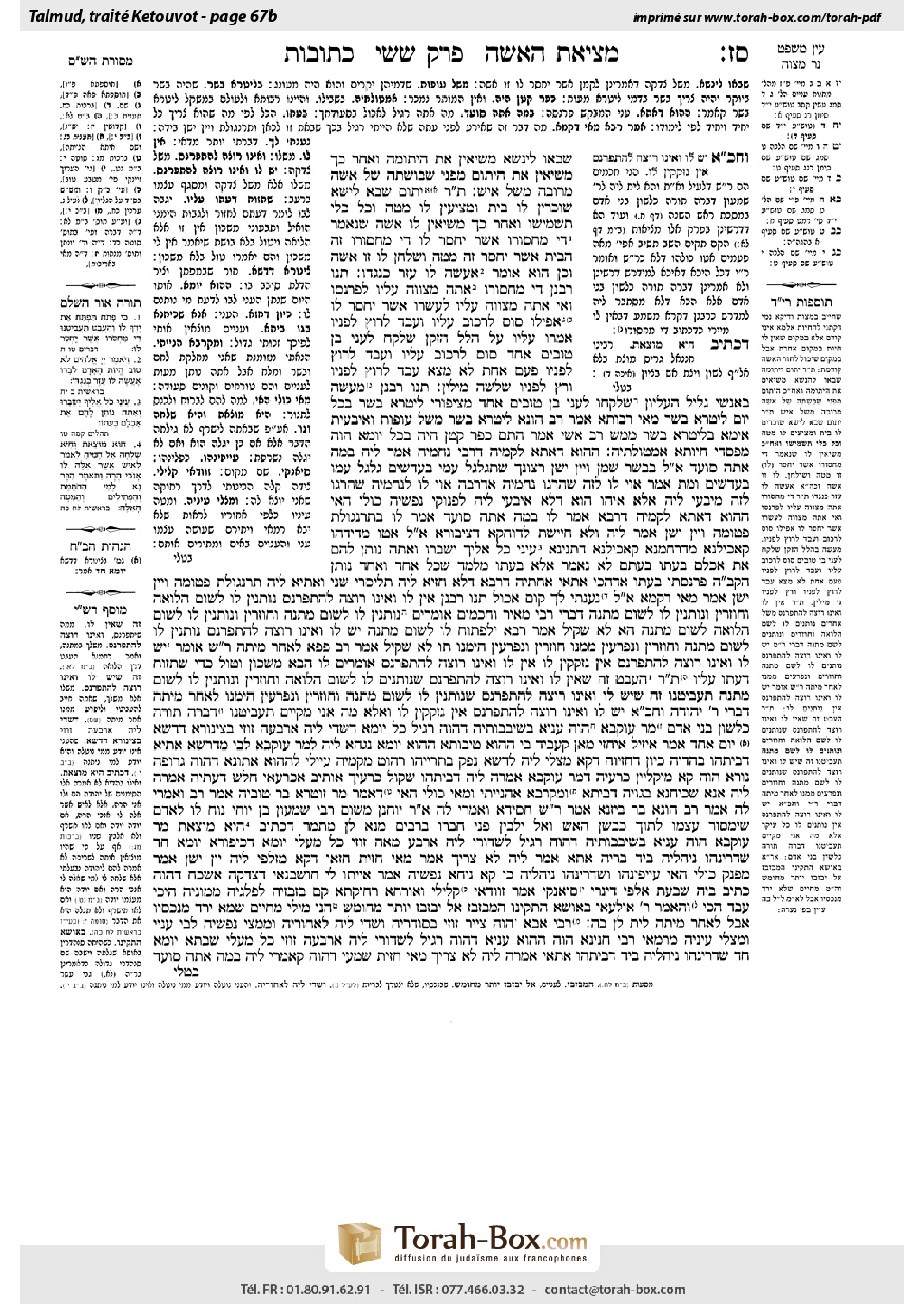
Ketubot 67b: Talmud study for Daf Yomi
Daf Yomi is the daily study of one Talmud folio. Explore 37 tractates with scans, Hebrew text, Sefaria English and AI-generated French translations where annotated.
Passage selection and English or AI-generated French translation are available where the scan has annotations. Daf Study is independent of Torah-Box and Sefaria.
Browse Ketubot · כתובות · All tractatesKetubot 67b text and translations
This page of Ketubot includes the Aramaic text, an English translation and an AI-generated French translation, alongside the scan above.
כתובות ס״ז ב · Aramaic and Hebrew text
שֶׁבָּאוּ לִינָּשֵׂא — מַשִּׂיאִין אֶת הַיְּתוֹמָה וְאַחַר כָּךְ מַשִּׂיאִין אֶת הַיָּתוֹם, מִפְּנֵי שֶׁבּוֹשְׁתָּהּ שֶׁל אִשָּׁה מְרוּבָּה מִשֶּׁל אִישׁ.
תָּנוּ רַבָּנַן: יָתוֹם שֶׁבָּא לִישָּׂא — שׂוֹכְרִין לוֹ בַּיִת, וּמַצִּיעִין לוֹ מִטָּה וְכׇל כְּלֵי תַשְׁמִישׁוֹ, וְאַחַר כָּךְ מַשִּׂיאִין לוֹ אִשָּׁה, שֶׁנֶּאֱמַר: ״דֵּי מַחְסוֹרוֹ אֲשֶׁר יֶחְסַר לוֹ״. ״דֵּי מַחְסוֹרוֹ״ — זֶה הַבַּיִת, ״אֲשֶׁר יֶחְסַר״ — זֶה מִטָּה וְשֻׁלְחָן, ״לוֹ״ — זוֹ אִשָּׁה. וְכֵן הוּא אוֹמֵר: ״אֶעֱשֶׂה לּוֹ עֵזֶר כְּנֶגְדּוֹ״.
תָּנוּ רַבָּנַן: ״דֵּי מַחְסוֹרוֹ״ — אַתָּה מְצֻוֶּוה עָלָיו לְפַרְנְסוֹ, וְאִי אַתָּה מְצֻוֶּוה עָלָיו לְעַשְּׁרוֹ. ״אֲשֶׁר יֶחְסַר לוֹ״ — אֲפִילּוּ סוּס לִרְכּוֹב עָלָיו וְעֶבֶד לָרוּץ לְפָנָיו. אָמְרוּ עָלָיו עַל הִלֵּל הַזָּקֵן שֶׁלָּקַח לְעָנִי בֶּן טוֹבִים אֶחָד סוּס לִרְכּוֹב עָלָיו וְעֶבֶד לָרוּץ לְפָנָיו. פַּעַם אַחַת לֹא מָצָא עֶבֶד לָרוּץ לְפָנָיו, וְרָץ לְפָנָיו שְׁלֹשָׁה מִילִין.
תָּנוּ רַבָּנַן: מַעֲשֶׂה בְּאַנְשֵׁי גָּלִיל הָעֶלְיוֹן שֶׁלָּקְחוּ לְעָנִי בֶּן טוֹבִים אֶחָד מִצִּיפּוֹרִי לִיטְרָא בָּשָׂר בְּכׇל יוֹם. לִיטְרָא בָּשָׂר מַאי רְבוּתָא? אָמַר רַב הוּנָא: לִיטְרָא בָּשָׂר מִשֶּׁל עוֹפוֹת. וְאִיבָּעֵית אֵימָא בְּלִיטְרָא, בָּשָׂר מַמָּשׁ. רַב אָשֵׁי אָמַר: הָתָם כְּפָר קָטָן הָיָה, בְּכׇל יוֹמָא הֲוָה מַפְסְדִי חֵיוְתָא אַמְּטוּלְתֵּיהּ.
הַהוּא דַּאֲתָא לְקַמֵּיהּ דְּרַבִּי נְחֶמְיָה, אָמַר לֵיהּ: בַּמָּה אַתָּה סוֹעֵד? אֲמַר לֵיהּ בְּבָשָׂר שָׁמֵן וְיַיִן יָשָׁן. רְצוֹנְךָ שֶׁתְּגַלְגֵּל עִמִּי בַּעֲדָשִׁים? גִּלְגֵּל עִמּוֹ בַּעֲדָשִׁים וָמֵת. אָמַר: אוֹי לוֹ לְזֶה שֶׁהֲרָגוֹ נְחֶמְיָה. אַדְּרַבָּה, ״אוֹי לוֹ לִנְחֶמְיָה שֶׁהֲרָגוֹ לְזֶה״ מִיבְּעֵי לֵיהּ! אֶלָּא: אִיהוּ הוּא דְּלָא אִיבְּעִי לֵיהּ לְפַנּוֹקֵי נַפְשֵׁיהּ כּוּלֵּי הַאי.
הָהוּא דַּאֲתָא לְקַמֵּיהּ דְּרָבָא, אָמַר לוֹ: בַּמָּה אַתָּה סוֹעֵד? אָמַר לוֹ: בְּתַרְנְגוֹלֶת פְּטוּמָה וְיַיִן יָשָׁן. אֲמַר לֵיהּ: וְלָא חָיְישַׁתְּ לְדוּחְקָא דְּצִיבּוּרָא? אֲמַר לֵיהּ: אַטּוּ מִדִּידְהוּ קָאָכֵילְנָא? מִדְּרַחְמָנָא קָאָכֵילְנָא! דְּתָנֵינָא: ״עֵינֵי כֹל אֵלֶיךָ יְשַׂבֵּרוּ וְאַתָּה נוֹתֵן לָהֶם אֶת אׇכְלָם בְּעִתּוֹ״. ״בְּעִתָּם״ לֹא נֶאֱמַר, אֶלָּא ״בְּעִתּוֹ״ — מְלַמֵּד שֶׁכׇּל אֶחָד וְאֶחָד נוֹתֵן הַקָּדוֹשׁ בָּרוּךְ הוּא פַּרְנָסָתוֹ בְּעִתּוֹ.
אַדְּהָכִי, אֲתַאי אֲחָתֵיהּ דְּרָבָא דְּלָא חָזְיָא לֵיהּ תְּלֵיסְרֵי שְׁנֵי, וְאַתְיָא לֵיהּ תַּרְנְגוֹלֶת פְּטוּמָה וְיַיִן יָשָׁן. אָמַר: מַאי דְּקַמָּא? אֲמַר לֵיהּ: נַעֲנֵתִי לְךָ, קוּם אֱכוֹל.
תָּנוּ רַבָּנַן: אֵין לוֹ וְאֵינוֹ רוֹצֶה לְהִתְפַּרְנֵס — נוֹתְנִין לוֹ לְשׁוּם הַלְוָאָה, וְחוֹזְרִין וְנוֹתְנִין לוֹ לְשׁוּם מַתָּנָה, דִּבְרֵי רַבִּי מֵאִיר. וַחֲכָמִים אוֹמְרִים: נוֹתְנִין לוֹ לְשׁוּם מַתָּנָה, וְחוֹזְרִין וְנוֹתְנִין לוֹ לְשׁוּם הַלְוָאָה. לְשׁוּם מַתָּנָה? הָא לָא שָׁקֵיל! אָמַר רָבָא: לִפְתּוֹחַ לוֹ לְשׁוּם מַתָּנָה.
יֵשׁ לוֹ וְאֵינוֹ רוֹצֶה לְהִתְפַּרְנֵס — נוֹתְנִין לוֹ לְשׁוּם מַתָּנָה, וְחוֹזְרִין וְנִפְרָעִין מִמֶּנּוּ. חוֹזְרִין וְנִפְרָעִין הֵימֶנּוּ, תּוּ לָא שָׁקֵיל! אָמַר רַב פָּפָּא: לְאַחַר מִיתָה. רַבִּי שִׁמְעוֹן אוֹמֵר: יֵשׁ לוֹ וְאֵינוֹ רוֹצֶה לְהִתְפַּרְנֵס — אֵין נִזְקָקִין לוֹ. אֵין לוֹ וְאֵינוֹ רוֹצֶה לְהִתְפַּרְנֵס — אוֹמְרִים לוֹ: הָבֵא מַשְׁכּוֹן וָטוֹל, כְּדֵי שֶׁתָּזוּחַ דַּעְתּוֹ עָלָיו.
תָּנוּ רַבָּנַן: ״הַעֲבֵט״, זֶה שֶׁאֵין לוֹ וְאֵינוֹ רוֹצֶה לְהִתְפַּרְנֵס, שֶׁנּוֹתְנִים לוֹ לְשׁוּם הַלְוָאָה, וְחוֹזְרִין וְנוֹתְנִין לוֹ לְשׁוּם מַתָּנָה. ״תַּעֲבִיטֶנּוּ״, זֶה שֶׁיֵּשׁ לוֹ וְאֵינוֹ רוֹצֶה לְהִתְפַּרְנֵס, שֶׁנּוֹתְנִין לוֹ לְשׁוּם מַתָּנָה, וְחוֹזְרִין וְנִפְרָעִין הֵימֶנּוּ לְאַחַר מִיתָה, דִּבְרֵי רַבִּי יְהוּדָה.
וַחֲכָמִים אוֹמְרִים: יֵשׁ לוֹ וְאֵינוֹ רוֹצֶה לְהִתְפַּרְנֵס — אֵין נִזְקָקִין לוֹ. וְאֶלָּא מָה אֲנִי מְקַיֵּים ״תַּעֲבִיטֶנּוּ״? דִּבְּרָה תוֹרָה כִלְשׁוֹן בְּנֵי אָדָם.
מָר עוּקְבָא הֲוָה עַנְיָא בְּשִׁיבָבוּתֵיהּ דַּהֲוָה רְגִיל כׇּל יוֹמָא דְּשָׁדֵי לֵיהּ אַרְבְּעָה זוּזֵי בְּצִינּוֹרָא דְּדַשָּׁא. (יוֹם אֶחָד) [יוֹמָא חַד] אֲמַר: אֵיזִיל אִיחְזֵי מַאן קָעָבֵיד בִּי הָהוּא טֵיבוּתָא. הָהוּא יוֹמָא נְגַהָא לֵיהּ לְמָר עוּקְבָא לְבֵי מִדְרְשָׁא, אָתְיָא דְּבֵיתְהוּ בַּהֲדֵיהּ.
כֵּיוָן דְּחַזְיֵוהּ דְּקָא מַצְלֵי לֵיהּ לְדַשָּׁא, נְפַק בָּתְרַיְיהוּ. רְהוּט מִקַּמֵּיהּ, עָיְילִי לְהָהוּא אַתּוּנָא דַּהֲוָה גְּרִופָה נוּרָא, הֲוָה קָא מִיקַּלְיָין כַּרְעֵיהּ דְּמָר עוּקְבָא. אֲמַרָה לֵיהּ דְּבֵיתְהוּ: שְׁקוֹל כַּרְעָיךְ אוֹתֵיב אַכַּרְעַאי. חֲלַשׁ דַּעְתֵּיהּ, אֲמַרָה לֵיהּ: אֲנָא שְׁכִיחָנָא בְּגַוֵּיהּ דְּבֵיתָא וּמְקָרְבָא אַהֲנָיָיתִי.
וּמַאי כּוּלֵּי הַאי? דְּאָמַר מָר זוּטְרָא בַּר טוֹבִיָּה אָמַר רַב, וְאָמְרִי לַהּ אָמַר רַב הוּנָא בַּר בִּיזְנָא אָמַר רַבִּי שִׁמְעוֹן חֲסִידָא, וְאָמְרִי לָהּ אָמַר רַבִּי יוֹחָנָן מִשּׁוּם רַבִּי שִׁמְעוֹן בֶּן יוֹחַי: נוֹחַ לוֹ לָאָדָם שֶׁיִּמְסוֹר עַצְמוֹ לְתוֹךְ כִּבְשַׁן הָאֵשׁ, וְאַל יַלְבִּין פְּנֵי חֲבֵרוֹ בָּרַבִּים. מְנָא לַן — מִתָּמָר, דִּכְתִיב: ״הִיא מוּצֵאת״.
מָר עוּקְבָא הֲוָה עַנְיָא בְּשִׁיבָבוּתֵיהּ דַּהֲוָה רְגִיל לְשַׁדּוֹרֵי לֵיהּ אַרְבַּע מְאָה זוּזֵי כׇּל מַעֲלֵי יוֹמָא דְּכִיפּוּרָא. יוֹמָא חַד שַׁדְּרִינְהוּ נִיהֲלֵיהּ בְּיַד בְּרֵיהּ. אֲתָא אֲמַר לֵיהּ: לָא צְרִיךְ. אָמַר מַאי חֲזֵית? חֲזַאי דְּקָא מְזַלְּפִי לֵיהּ יַיִן יָשָׁן. אָמַר: מְפַנַּק כּוּלֵּי הַאי! עַיְיפִינְהוּ וְשַׁדְּרִינְהוּ נִיהֲלֵיהּ.
כִּי קָא נִיחָא נַפְשֵׁיהּ, אֲמַר: אַיְיתוֹ לִי חוּשְׁבְּנַאי דִּצְדָקָה. אַשְׁכַּח דַּהֲוָה כְּתִיב בֵּיהּ שִׁבְעַת אַלְפֵי דִּינָרֵי סְיָאנְקֵי. אֲמַר: זַוְודַאי קַלִּילֵי וְאוֹרְחָא רַחִיקְתָּא. קָם בַּזְבְּזֵיהּ לְפַלְגֵיהּ מָמוֹנֵיהּ. הֵיכִי עֲבַד הָכִי? וְהָאָמַר רַבִּי אִילְעַאי, בְּאוּשָׁא הִתְקִינוּ: הַמְבַזְבֵּז — אַל יְבַזְבֵּז יוֹתֵר מֵחוֹמֶשׁ! הָנֵי מִילֵּי מֵחַיִּים, שֶׁמָּא יֵרֵד מִנְּכָסָיו. אֲבָל לְאַחַר מִיתָה לֵית לַן בַּהּ.
רַבִּי אַבָּא הֲוָה צָיַיר זוּזֵי בְּסוּדָרֵיהּ, וְשָׁדֵי לֵיהּ לַאֲחוֹרֵיהּ, וּמַמְצֵי נַפְשֵׁיהּ לְבֵי עַנְיֵי, וּמַצְלֵי עֵינֵיהּ מֵרַמָּאֵי.
רַבִּי חֲנִינָא הֲוָה הָהוּא עַנְיָא דַּהֲוָה רְגִיל לְשַׁדּוֹרֵי לֵיהּ אַרְבְּעָה זוּזֵי כׇּל מַעֲלֵי שַׁבְּתָא. יוֹמָא חַד שַׁדְּרִינְהוּ נִיהֲלֵיהּ בְּיַד דְּבֵיתְהוּ, אֲתַאי אֲמַרָה לֵיהּ: לָא צְרִיךְ. מַאי חֲזֵית? שְׁמַעִי דַּהֲוֹה קָאָמְרִי לֵיהּ: בַּמָּה אַתָּה סוֹעֵד,
Ketubot 67b · English translation
who have come to appeal to the charity fund to be married off, the administrators marry off the orphan girl first and afterward they marry off the orphan boy, because the humiliation of a woman who is not married is greater than that of an unmarried man.
The Sages taught: Concerning an orphan boy who has come to marry, the community tries its utmost to provide for all of his needs. The charities rent a house for him, arrange for him a bed and all his utensils, and thereafter they marry him a wife, as it is stated: “But you shall surely open your hand to him, and shall surely lend him sufficient for his deficiency in that which is deficient for him” (Deuteronomy 15:8). With regard to the phrase “sufficient for his deficiency,” this is referring to the house. “Which is deficient”; this is referring to a bed and table. “For him [lo]”; this is referring to a wife. And similarly the verse states: “I will make him [lo] a helpmate for him” (Genesis 2:18), when God created a wife for Adam.
Concerning this issue, the Sages taught: “Sufficient for his deficiency”; this teaches that you are commanded with respect to the pauper to support him, but you are not commanded with respect to him to make him wealthy, as the obligation encompasses only that which he lacks, as indicated by the word deficient. However, the verse also states: “Which is deficient for him”; this includes even a horse upon which to ride and a servant to run in front of him for the sake of his stature, if necessary. For someone accustomed to these advantages, their absences constitute a true deficiency, not an extravagant indulgence. The Gemara relates: They said about Hillel the Elder that he obtained for a poor person of noble descent a horse upon which to ride and a servant to run in front of him. One time he did not find a servant to run in front of him, and Hillel himself ran in front of him for three mil, to fulfill the dictate “which is deficient for him.”
The Sages taught: There was an incident involving the people of the Upper Galilee, who bought for a poor person of noble descent from the city of Tzippori a litra of meat every day. The Gemara asks: If they provided him with the reasonable ration of a litra of meat, what is the novelty in this incident? Why does it bear repeating? Rav Huna said: It was a litra of meat of poultry, which is very expensive. And if you wish, say instead that for the weight of a litra of coins, they bought him actual red meat. The price of ordinary meat was so expensive that they had to pay the exorbitant price of a litra of coins. Rav Ashi said they did not spend a litra of coins for him. Rather, there, in the Galilee, it was a small village, and every day they would lose an entire animal just for him. They would slaughter an animal daily, simply to provide him with fresh meat, although there was otherwise no market for such a plentiful supply of meat in the village.
The Gemara relates another incident concerning charity. A certain person came before Rabbi Neḥemya to request charity. He said to him: On what do you normally dine? He said to him: I usually dine on fatty meat and aged wine. Rabbi Neḥemya asked him: Is it your wish to belittle yourself and partake together with me in a meal of lentils, which is my regular food? He partook with him of lentils, and he died, since he was not accustomed to this food. Rabbi Neḥemya said: Woe to this one who was killed by Neḥemya. The Gemara wonders: On the contrary, Rabbi Neḥemya should have said: Woe to Neḥemya who killed this one. The Gemara responds: Rather, Rabbi Neḥemya meant that it was he, the pauper, who should not have pampered himself so much. The poor man was to blame for his own death. His excessive indulgence rendered him incapable of digesting simple foods such as lentils.
The Gemara relates another story. A certain person came before Rava to request charity. He said to him: On what do you normally dine? He said to him: On a fattened hen and aged wine. He said to him: And were you not concerned for causing a burden to the community by expecting such opulent foods? He said to him: Is that to say that it is from their funds that I eat? I eat from the support of the Merciful One. This would seem to be a reasonable argument, as we already learned that in the verse “the eyes of all wait for You, and You give them their food in its time” (Psalms 145:15), the phrase: At their time, is not stated, rather “in its time.” This teaches that the Holy One, Blessed be He, gives each and every one his personally appropriate sustenance at its proper time, and the community is merely His agent in discharging His will. Therefore, the man is justified in maintaining his standard.
In the meantime, while they were talking, Rava’s sister, who had not seen him for thirteen years, came. And as a gift, she brought him a fattened hen and aged wine. Rava said to himself: What is this that happened in front of me that suddenly I am brought food that I do not usually eat? He then understood that this was a providential response to what he had earlier said to the man. Rava said to him: I have responded [na’aneti] to your contention. Arise and eat.
§ The Sages taught: If an individual does not have sufficient means of support and does not want to be supported from charity funds, the charities provide him funds as a loan in a dignified manner, and then they go back and give the funds to him as a gift; this is the statement of Rabbi Meir. And the Rabbis say: They give him funds as a gift, and then they go back and give the funds to him as a loan. The Gemara wonders about the Rabbis’ ruling: How can we give it as a gift? After all, he does not want to take it as a gift. The Gemara answers that Rava said: The Rabbis’ instruction is to begin discussions with him by offering the assistance as a gift. If he refuses, the charities give it to him as a loan, but they treat it as a gift and refrain from attempting to collect a debt.
If he has sufficient funds of his own but does not want to support himself by his own funds without the assistance of charity, the charities give him aid as a gift, and then they go back and collect the debt from him. The Gemara asks: How can the administrators of the fund go back and collect from him? Would their efforts not be in vain, as subsequently he would not take their support, knowing that he would still have to pay for it? Rav Pappa said: The charities collect the accrued debt from his estate only after his death. The baraita continues: Rabbi Shimon says, disputing the opinion of the Rabbis: If he has sufficient funds and does not want to be supported by his own means, they do not get involved with him, as the community is not obligated to support him. If he does not have and does not want to be supported from charity, the charities say to him: Bring collateral and take a loan, so that his mindset should be raised for him, with the false impression that he is not receiving a handout.
The Gemara cites a dispute related to the previous discussions. The Sages taught in a baraita with regard to the double expression in the Torah: “You shall open your hand to him [ha’avet ta’avitenu]” (Deuteronomy 15:8). “Ha’avet”; this is referring to one who does not have funds and does not want to be supported by charity. The policy is that the charities provide him funds as a loan and go back and give the funds to him as a gift. “Ta’avitenu”; this is referring to one who has means and does not want to support himself. The policy is that the charities provide money as a gift, and then they go back and collect from his estate after his death. This is the statement of Rabbi Yehuda.
The baraita continues: And the Rabbis say: If he has money and does not want to support himself, they do not get involved with him. The baraita asks: How then do I uphold the double expression “ha’avet ta’avitenu”? The baraita answers: The Torah spoke in the language of men, and the double form does not have halakhic significance.
The Gemara recounts another incident related to charity. Mar Ukva had a pauper in his neighborhood, and Mar Ukva was accustomed every day to toss four dinars for him into the slot adjacent to the hinge of the door. One day the poor person said: I will go and see who is doing this service for me. That day Mar Ukva was delayed in the study hall, and his wife came with him to distribute the charity.
When the people in the poor man’s house saw that someone was turning the door, the pauper went out after them to see who it was. Mar Ukva and his wife ran away from before him so that he would not determine their identity, and they entered a certain furnace whose fire was already raked over and tempered but was still burning. Mar Ukva’s legs were being singed, and his wife said to him: Raise your legs and set them on my legs, which are not burned. Understanding that only his wife was spared from burns, because she was more worthy, Mar Ukva became distraught. By way of explanation, she said to him: I am normally found inside the house, and when I give charity, my assistance is ready and immediate, insofar as I distribute actual food items. Since you distribute money, which is not as readily helpful, my aid is greater than yours.
The Gemara asks: And what is all this? Why did they go to such extreme lengths to avoid being discovered? The Gemara answers: It is as Mar Zutra bar Toviya said that Rav said, and some say that Rav Huna bar Bizna said that Rabbi Shimon Ḥasida said, and some say that Rabbi Yoḥanan said in the name of Rabbi Shimon ben Yoḥai: It is preferable for a person to deliver himself into a fiery furnace so that he not whiten the face of, i.e., embarrass, his friend in public. From where do we derive this? From the conduct of Tamar, as it is written: “And Judah said: Bring her forth, and let her be burnt. When she was brought forth, she sent to her father-in-law, saying: By the man, whose these are, am I with child” (Genesis 38:24–25). Although Tamar was taken to be executed by burning, she privately and directly appealed to Judah, rather than publicly identifying him as the father of her unborn children and causing him embarrassment.
The Gemara relates another incident involving Mar Ukva. Mar Ukva had another pauper in his neighborhood, and Mar Ukva was accustomed to send to him four hundred dinars every year on the eve of Yom Kippur. One day he sent the money to him by the hand of his son. The son returned and said to him: The poor individual does not need the charity. Mar Ukva said: What did you see that prompted you to say this? He said to him: I saw them spilling old wine on the ground for him, to give the room a pleasant smell. Mar Ukva said: If he is pampered this much and requires even this luxury, then he needs even more money. He doubled the funds and sent them to him.
When Mar Ukva was dying, he said: Bring me my charity records. He found that it was written there that he had given seven thousand fine, siankei, i.e., gold, dinars, to charity. He said: My provisions are light, and the way is far. This meager sum is insufficient for me to merit the World-to-Come. He got up and spent half of his remaining money on charity. The Gemara asks: How did he do this? But didn’t Rabbi Ilai say: In Usha they instituted: One who spends money on charity, he should not spend more than one-fifth of his money for this purpose. The Gemara answers: This restriction on giving too much charity applies only while he is alive, because perhaps he will descend from his holdings and become destitute. Therefore, for his own financial security, he should never distribute more than one-fifth. But after death, we have no problem with it. One need not save money in his estate anymore.
The Gemara recounts more stories related to charity. Rabbi Abba would wrap coins in his scarf and toss the money behind him over his shoulder. And he would place himself at the homes of the poor without being seen, so the poor could receive the aid without being embarrassed. And he would incline his eyes just enough so he could safeguard the handouts from swindlers who might take the money dishonestly.
Rabbi Ḥanina knew a certain pauper and was accustomed to send to him four dinars on every Shabbat eve. One day he sent it in the hand of his wife. She came back home and said to him: The man does not need charity. Rabbi Ḥanina asked her: What did you see that prompted you to say this? She said to him: I heard them saying to him inside the house: With what do you normally dine:
Ketubot 67b · Traduction française (IA)
qui sont venus solliciter le fonds de bienfaisance afin de se marier, les administrateurs marient d’abord l’orpheline, puis l’orphelin, car l’humiliation d’une femme non mariée est plus grande que celle d’un homme célibataire.
Les Sages ont enseigné : Lorsqu’un orphelin qui souhaite se marier se présente, la communauté s’efforce de pourvoir à tous ses besoins. Les responsables de la bienfaisance lui louent une maison, lui procurent un lit et tous les ustensiles nécessaires, puis lui trouvent une épouse, comme il est dit : « Tu lui ouvriras largement ta main et tu lui prêteras suffisamment pour répondre à son manque, à ce qui lui fait défaut » (Deutéronome 15, 8). L’expression « suffisamment pour répondre à son manque » désigne la maison. « À ce qui lui fait défaut » désigne un lit et une table. « Pour lui [lo] » désigne une épouse. De même, le verset dit : « Je lui [lo] ferai une aide qui lui corresponde » (Genèse 2, 18), lorsque Dieu créa une épouse pour Adam.
À ce sujet, les Sages ont enseigné : « Suffisamment pour répondre à son manque » enseigne que vous avez l’obligation de subvenir aux besoins du pauvre, mais non de l’enrichir, puisque l’obligation ne porte que sur ce qui lui manque, comme l’indique le mot « manque ». Toutefois, le verset dit aussi : « À ce qui lui fait défaut » ; cela inclut même un cheval sur lequel monter et un serviteur qui court devant lui, pour préserver son rang, si cela est nécessaire. Pour quelqu’un qui est habitué à ces avantages, leur absence constitue un véritable manque, et non un luxe extravagant. La Guemara rapporte : On disait de Hillel l’Ancien qu’il avait obtenu pour un pauvre de noble naissance un cheval sur lequel monter et un serviteur qui courait devant lui. Un jour, ne trouvant pas de serviteur pour courir devant lui, Hillel courut lui-même devant lui sur trois mil, afin de satisfaire à l’exigence « à ce qui lui fait défaut ».
Les Sages ont enseigné : Un incident eut lieu parmi les habitants de la Haute-Galilée, qui achetaient chaque jour une litra de viande pour un pauvre de noble naissance de la ville de Tsippori. La Guemara demande : S’ils lui fournissaient une ration raisonnable d’une litra de viande, quelle est la nouveauté de cet incident ? Pourquoi le rapporter ? Rav Houna répondit : Il s’agissait d’une litra de viande de volaille, qui coûte très cher. Et si tu veux, dis plutôt qu’ils achetaient pour lui de la véritable viande rouge pour le prix d’une litra de pièces de monnaie. La viande ordinaire coûtait si cher qu’ils devaient payer le prix exorbitant d’une litra de pièces. Rav Achi dit qu’ils ne dépensaient pas pour lui une litra de pièces. Là-bas, en Galilée, il s’agissait plutôt d’un petit village, et chaque jour, on perdait une bête entière uniquement pour lui. Ils abattaient une bête chaque jour simplement pour lui fournir de la viande fraîche, alors qu’il n’y avait autrement pas de marché dans le village pour écouler une telle quantité de viande.
La Guemara rapporte un autre incident au sujet de la bienfaisance. Un homme se présenta devant Rabbi Neḥemya pour demander l’aumône. Celui-ci lui demanda : « De quoi te nourris-tu habituellement ? » Il lui répondit : « Je mange habituellement de la viande grasse et du vin vieux. » Rabbi Neḥemya lui demanda : « Veux-tu t’abaisser et partager avec moi un repas de lentilles, qui est mon ordinaire ? » Il partagea avec lui un repas de lentilles et mourut, car il n’était pas habitué à cette nourriture. Rabbi Neḥemya dit : « Malheur à celui qui a été tué par Neḥemya. » La Guemara s’étonne : Au contraire, Rabbi Neḥemya aurait dû dire : « Malheur à Neḥemya qui a tué cet homme. » La Guemara répond : Rabbi Neḥemya voulait plutôt dire que c’était le pauvre, et non lui, qui n’aurait pas dû tant se gâter. Le pauvre était responsable de sa propre mort. Ses excès l’avaient rendu incapable de digérer des aliments simples comme les lentilles.
La Guemara rapporte une autre histoire. Un homme se présenta devant Rava pour demander l’aumône. Celui-ci lui demanda : « De quoi te nourris-tu habituellement ? » Il lui répondit : « D’une poule engraissée et de vin vieux. » Rava lui demanda : « Ne crains-tu donc pas d’être à la charge de la communauté en réclamant des mets aussi luxueux ? » Il lui répondit : « Est-ce à dire que je mange de leurs fonds ? Je mange grâce au soutien du Miséricordieux. » Cet argument semble raisonnable, car nous avons déjà appris que dans le verset « Les yeux de tous espèrent en toi, et tu leur donnes leur nourriture en son temps » (Psaumes 145, 15), il n’est pas dit « en leurs temps », mais « en son temps ». Cela enseigne que le Saint, béni soit-Il, donne à chacun sa subsistance personnelle appropriée au moment voulu, et que la communauté n’est que Son agent pour accomplir Sa volonté. L’homme est donc justifié de maintenir son train de vie.
Pendant qu’ils parlaient, la sœur de Rava, qu’il n’avait pas vue depuis treize ans, arriva. En cadeau, elle lui apporta une poule engraissée et du vin vieux. Rava se dit : « Qu’est-ce donc qui vient de m’arriver, pour que l’on m’apporte soudain des aliments que je ne mange pas habituellement ? » Il comprit alors qu’il s’agissait d’une réponse providentielle à ce qu’il avait dit auparavant à l’homme. Rava lui dit : « J’ai répondu [na’aneti] à ton argument. Lève-toi et mange. »
§ Les Sages ont enseigné : Si quelqu’un n’a pas de quoi subvenir à ses besoins et ne veut pas être entretenu par les fonds de bienfaisance, les responsables de la bienfaisance lui fournissent des fonds sous forme de prêt, de façon à préserver sa dignité, puis ils les lui donnent en cadeau ; telle est la déclaration de Rabbi Meïr. Les Rabbins disent : Ils lui donnent d’abord les fonds en cadeau, puis les lui donnent sous forme de prêt. La Guemara s’interroge sur la décision des Rabbins : comment peut-on lui donner cela en cadeau, puisqu’il ne veut pas l’accepter comme cadeau ? La Guemara répond que Rava a dit : Les Rabbins prescrivent de commencer par lui proposer l’aide comme un cadeau. S’il refuse, les responsables de la bienfaisance la lui donnent sous forme de prêt, mais la traitent comme un cadeau et s’abstiennent d’essayer de recouvrer la dette.
S’il a suffisamment de ressources personnelles, mais ne veut pas subvenir à ses besoins avec ses propres fonds sans l’aide de la bienfaisance, les responsables de la bienfaisance lui apportent une aide sous forme de cadeau, puis reviennent ensuite recouvrer la dette auprès de lui. La Guemara demande : Comment les administrateurs du fonds peuvent-ils revenir la recouvrer ? Leurs efforts ne seraient-ils pas vains, puisqu’ensuite il refuserait leur aide, sachant qu’il devrait tout de même la rembourser ? Rav Pappa dit : Les responsables de la bienfaisance recouvrent la dette accumulée sur sa succession, seulement après sa mort. La baraïta poursuit : Rabbi Shimon, contestant l’avis des Rabbins, dit : S’il a suffisamment de ressources et ne veut pas subvenir à ses besoins par ses propres moyens, ils ne s’occupent pas de lui, car la communauté n’est pas tenue de le soutenir. S’il n’en a pas et ne veut pas être entretenu par la bienfaisance, les responsables de la bienfaisance lui disent : « Donne un gage et prends un prêt », afin de lui remonter le moral en lui laissant croire qu’il ne reçoit pas une aumône.
La Guemara cite une controverse liée aux discussions précédentes. Les Sages ont enseigné dans une baraïta au sujet de la double expression de la Torah : « Tu lui ouvriras largement ta main [ha’avet ta’avitenu] » (Deutéronome 15, 8). « Ha’avet » désigne celui qui n’a pas de ressources et ne veut pas être entretenu par la bienfaisance. La règle est que les responsables de la bienfaisance lui fournissent des fonds sous forme de prêt, puis les lui donnent en cadeau. « Ta’avitenu » désigne celui qui a des ressources, mais ne veut pas subvenir à ses besoins. La règle est que les responsables de la bienfaisance lui donnent de l’argent en cadeau, puis le récupèrent sur sa succession après sa mort. Telle est la déclaration de Rabbi Yehouda.
La baraïta poursuit : Les Rabbins disent que s’il a de l’argent et ne veut pas subvenir à ses besoins, ils ne s’occupent pas de lui. La baraïta demande : Comment faut-il alors comprendre la double expression « ha’avet ta’avitenu » ? La baraïta répond : La Torah s’est exprimée dans le langage des hommes, et la forme redoublée n’a pas de portée halakhique.
La Guemara rapporte un autre incident lié à la bienfaisance. Mar Ukva avait un pauvre dans son voisinage et avait l’habitude de déposer chaque jour quatre dinars pour lui dans la fente située près du gond de la porte. Un jour, le pauvre se dit : « Je vais découvrir qui accomplit ce geste pour moi. » Ce jour-là, Mar Ukva fut retenu à la maison d’étude, et sa femme vint avec lui pour distribuer l’aumône.
Lorsque les gens de la maison du pauvre virent que quelqu’un faisait tourner la porte, le pauvre sortit derrière eux pour voir qui c’était. Mar Ukva et sa femme s’enfuirent devant lui afin qu’il ne découvre pas leur identité, et entrèrent dans un four dont le feu avait déjà été écarté et atténué, mais qui brûlait encore. Les jambes de Mar Ukva commençaient à brûler, et sa femme lui dit : « Lève les jambes et pose-les sur les miennes, qui ne sont pas brûlées. » Comprenant que seule sa femme avait été épargnée des brûlures, parce qu’elle en était plus digne, Mar Ukva fut abattu. Elle lui expliqua : « Moi, je suis habituellement à la maison, et quand je donne l’aumône, mon aide est prête et immédiate, puisque je distribue des aliments. Toi, tu distribues de l’argent, qui est moins immédiatement utile ; mon aide est donc plus grande que la tienne. »
La Guemara demande : « Mais pourquoi tout cela ? Pourquoi sont-ils allés jusqu’à de telles extrémités pour éviter d’être reconnus ? » La Guemara répond : C’est comme l’a dit Mar Zutra bar Toviya au nom de Rav — et certains disent que Rav Huna bar Bizna l’a dit au nom de Rabbi Shimon Ḥasida, et d’autres que Rabbi Yoḥanan l’a dit au nom de Rabbi Shimon ben Yoḥai : « Il est préférable qu’une personne se jette dans une fournaise ardente plutôt que de faire blanchir le visage de son prochain », c’est-à-dire de l’humilier en public. D’où le déduisons-nous ? De la conduite de Tamar, car il est écrit : « Yehouda dit : Faites-la sortir et qu’elle soit brûlée. Comme on la faisait sortir, elle envoya dire à son beau-père : C’est de l’homme à qui appartiennent ces objets que je suis enceinte » (Genèse 38, 24-25). Bien que Tamar ait été conduite à l’exécution par le feu, elle s’adressa à Yehouda en privé et directement, plutôt que de l’identifier publiquement comme le père de ses enfants à naître et de l’humilier.
La Guemara rapporte un autre incident concernant Mar Ukva. Mar Ukva avait un autre pauvre dans son voisinage et avait l’habitude de lui envoyer quatre cents dinars chaque année, la veille de Yom Kippour. Un jour, il lui envoya l’argent par l’intermédiaire de son fils. Celui-ci revint et lui dit : « Cet homme n’a pas besoin d’aumône. » Mar Ukva lui demanda : « Qu’as-tu vu qui t’a amené à dire cela ? » Il lui répondit : « Je les ai vus répandre du vin vieux sur le sol pour lui, afin de parfumer agréablement la pièce. » Mar Ukva dit : « S’il est à ce point choyé et a besoin même de ce luxe, alors il a besoin d’encore plus d’argent. » Il doubla la somme et la lui envoya.
Alors que Mar Ukva était mourant, il dit : « Apportez-moi les comptes de mes dons à la bienfaisance. » Il constata qu’il y était écrit qu’il avait donné à la bienfaisance sept mille dinars fins, siankei, c’est-à-dire en or. Il dit : « Mes provisions sont légères et le chemin est long. » Cette somme dérisoire ne suffit pas à me faire mériter le Monde futur. Il se leva et dépensa la moitié de l’argent qu’il lui restait en bienfaisance. La Guemara demande : Comment a-t-il pu faire cela ? Rabbi Ilai n’a-t-il pas dit : « À Ousha, on a institué que celui qui dépense de l’argent pour la bienfaisance ne doit pas y consacrer plus d’un cinquième de ses biens » ? La Guemara répond : Cette restriction sur les dons trop généreux ne s’applique que de son vivant, car il pourrait perdre ses biens et tomber dans la pauvreté. Pour assurer sa propre sécurité financière, il ne doit donc jamais distribuer plus d’un cinquième. Mais après la mort, cela ne pose pas de problème. Il n’est plus nécessaire d’épargner de l’argent dans sa succession.
La Guemara rapporte d’autres histoires liées à la bienfaisance. Rabbi Abba enveloppait des pièces dans son écharpe et les jetait derrière lui, par-dessus son épaule. Il se postait devant les maisons des pauvres sans se faire voir, afin que ceux-ci puissent recevoir l’aide sans être humiliés. Il baissait légèrement les yeux, juste assez pour surveiller les dons et empêcher des imposteurs de prendre l’argent malhonnêtement.
Rabbi Ḥanina connaissait un pauvre et avait l’habitude de lui envoyer quatre dinars chaque veille de Chabbat. Un jour, il les lui envoya par l’intermédiaire de sa femme. Elle revint à la maison et lui dit : « Cet homme n’a pas besoin d’aumône. » Rabbi Ḥanina lui demanda : « Qu’as-tu vu qui t’a amenée à dire cela ? » Elle lui répondit : « Je les ai entendus lui dire dans la maison : De quoi te nourris-tu habituellement ? »
Traduction française générée par IA à partir de l’édition anglaise de Sefaria. Vérifie toujours un passage avec le texte source.
Text from Sefaria: William Davidson Edition - Vocalized Aramaic (CC BY NC); William Davidson Edition - English (CC BY NC).