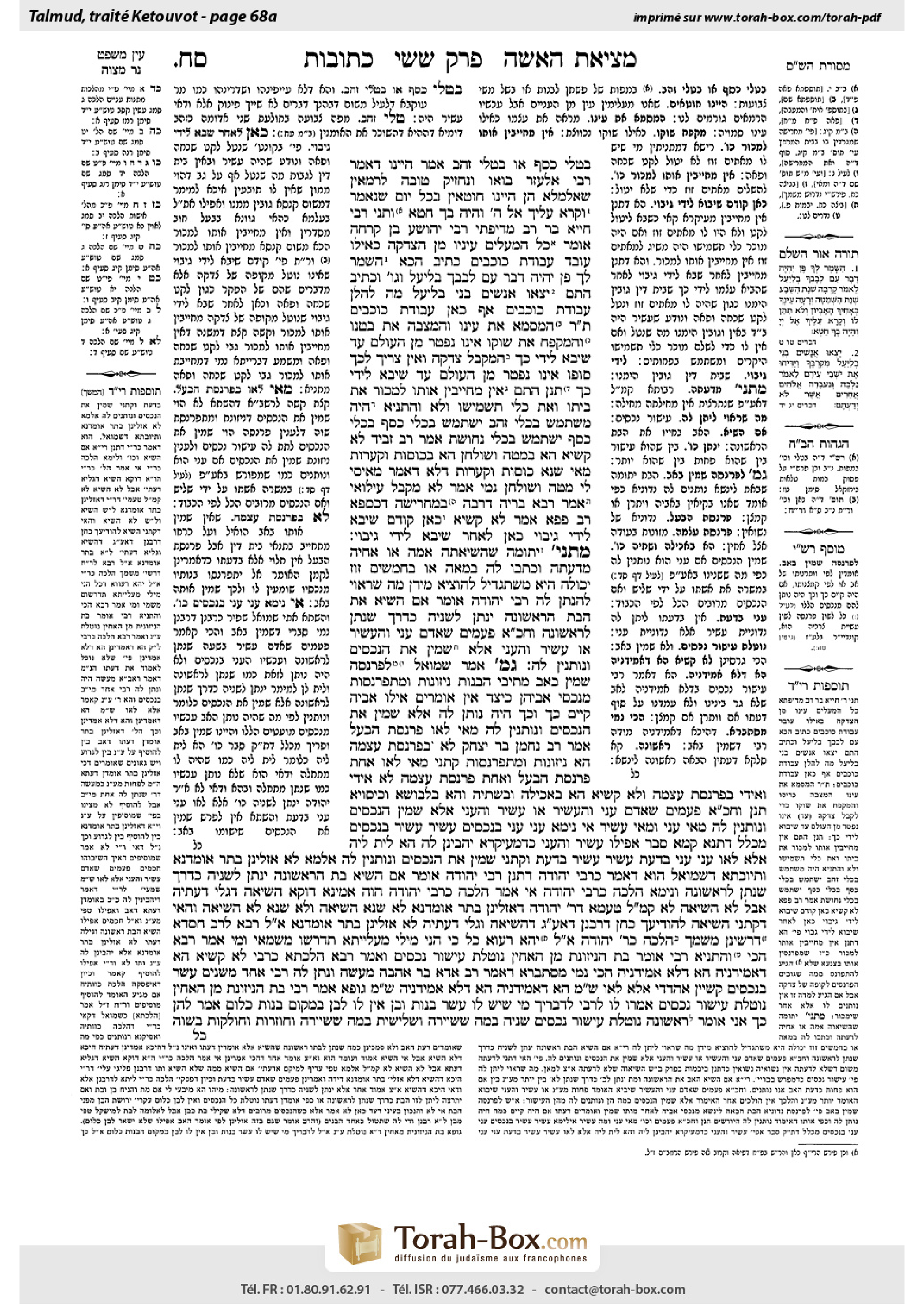
Ketubot 68a: Talmud study for Daf Yomi
Daf Yomi is the daily study of one Talmud folio. Explore 37 tractates with scans, Hebrew text, Sefaria English and AI-generated French translations where annotated.
Passage selection and English or AI-generated French translation are available where the scan has annotations. Daf Study is independent of Torah-Box and Sefaria.
Browse Ketubot · כתובות · All tractatesKetubot 68a text and translations
This page of Ketubot includes the Aramaic text, an English translation and an AI-generated French translation, alongside the scan above.
כתובות ס״ח א · Aramaic and Hebrew text
בִּטְלֵי כֶסֶף אוֹ בִּטְלֵי זָהָב? אָמַר: הַיְינוּ דְּאָמַר רַבִּי אֶלְעָזָר: בּוֹאוּ וְנַחֲזִיק טוֹבָה לָרַמָּאִין, שֶׁאִלְמָלֵא הֵן, הָיִינוּ חוֹטְאִין בְּכׇל יוֹם, שֶׁנֶּאֱמַר: ״וְקָרָא עָלֶיךָ אֶל ה׳ וְהָיָה בְךָ חֵטְא״.
וְתָנֵי רַבִּי חִיָּיא בַּר רַב מִדִּיפְתִּי, רַבִּי יְהוֹשֻׁעַ בֶּן קׇרְחָה אוֹמֵר: כׇּל הַמַּעֲלִים עֵינָיו מִן הַצְּדָקָה — כְּאִילּוּ עוֹבֵד עֲבוֹדָה זָרָה. כְּתִיב הָכָא: ״הִשָּׁמֶר לְךָ פֶּן יִהְיֶה דָבָר עִם לְבָבְךָ בְלִיַּעַל וְגוֹ׳״, וּכְתִיב הָתָם: ״יָצְאוּ אֲנָשִׁים בְּנֵי בְלִיַּעַל״. מָה לְהַלָּן עֲבוֹדָה זָרָה, אַף כָּאן עֲבוֹדָה זָרָה.
תָּנוּ רַבָּנַן: הַמְסַמֵּא אֶת עֵינוֹ וְהַמַּצְבֶּה אֶת בִּטְנוֹ, וְהַמְקַפֵּחַ אֶת שׁוֹקוֹ — אֵינוֹ נִפְטָר מִן הָעוֹלָם עַד שֶׁיָּבֹא לִידֵי כָךְ. הַמְקַבֵּל צְדָקָה וְאֵין צָרִיךְ לְכָךְ — סוֹפוֹ אֵינוֹ נִפְטָר מִן הָעוֹלָם עַד שֶׁיָּבֹא לִידֵי כָךְ.
תְּנַן הָתָם: אֵין מְחַיְּיבִין אוֹתוֹ לִמְכּוֹר אֶת בֵּיתוֹ וְאֶת כְּלֵי תַשְׁמִישׁוֹ. וְלָא? וְהָתַנְיָא: הָיָה מִשְׁתַּמֵּשׁ בִּכְלֵי זָהָב — יִשְׁתַּמֵּשׁ בִּכְלֵי כֶסֶף, בִּכְלֵי כֶסֶף — יִשְׁתַּמֵּשׁ בִּכְלֵי נְחוֹשֶׁת!
אָמַר רַב זְבִיד לָא קַשְׁיָא: הָא — בְּמִטָּה וְשׁוּלְחָן, הָא — בְּכוֹסוֹת וּקְעָרוֹת. מַאי שְׁנָא כּוֹסוֹת וּקְעָרוֹת דְּלָא — דְּאָמַר: מְאִיסִי לִי. מִטָּה וְשׁוּלְחָן נָמֵי, אָמַר: לָא מְקַבַּל עִילָּוַאי. אָמַר רָבָא בְּרֵיהּ דְּרַבָּה: בְּמַחֲרֵישָׁה דְכַסְפָּא.
רַב פָּפָּא אָמַר, לָא קַשְׁיָא: כָּאן — קוֹדֶם שֶׁיָּבֹא לִידֵי גִיבּוּי. כָּאן — לְאַחַר שֶׁיָּבֹא לִידֵי גִיבּוּי.
מַתְנִי׳ יְתוֹמָה שֶׁהִשִּׂיאַתָּה אִמָּהּ אוֹ אַחֶיהָ מִדַּעְתָּהּ, וְכָתְבוּ לָהּ בְּמֵאָה אוֹ בַּחֲמִשִּׁים זוּז — יְכוֹלָה הִיא מִשֶּׁתַּגְדִּיל לְהוֹצִיא מִיָּדָן מַה שֶּׁרָאוּי לְהִנָּתֵן לָהּ.
רַבִּי יְהוּדָה אוֹמֵר: אִם הִשִּׂיא אֶת הַבַּת הָרִאשׁוֹנָה — יִנָּתֵן לַשְּׁנִיָּה כְּדֶרֶךְ שֶׁנָּתַן לָרִאשׁוֹנָה. וַחֲכָמִים אוֹמְרִים: פְּעָמִים שֶׁאָדָם עָנִי וְהֶעֱשִׁיר, אוֹ עָשִׁיר וְהֶעֱנִי. אֶלָּא שָׁמִין אֶת הַנְּכָסִים וְנוֹתְנִין לָהּ.
גְּמָ׳ אָמַר שְׁמוּאֵל: לְפַרְנָסָה — שָׁמִין בָּאָב. מֵתִיבִי: הַבָּנוֹת נִיזּוֹנוֹת וּמִתְפַּרְנְסוֹת מִנִּכְסֵי אֲבִיהֶן. כֵּיצַד? אֵין אוֹמְרִים אִילּוּ אָבִיהָ קַיָּים, כָּךְ וְכָךְ הָיָה נוֹתֵן לָהּ. אֶלָּא שָׁמִין אֶת הַנְּכָסִים וְנוֹתְנִין לַהּ. מַאי לָאו: פַּרְנָסַת הַבַּעַל? אָמַר רַב נַחְמָן בַּר יִצְחָק: לֹא, בְּפַרְנָסַת עַצְמָהּ.
הָא נִיזּוֹנוֹת וּמִתְפַּרְנְסוֹת קָתָנֵי, מַאי לָאו: אַחַת — פַּרְנָסַת הַבַּעַל, וְאַחַת — פַּרְנָסַת עַצְמָהּ?! לָא, אִידִי וְאִידִי בְּפַרְנָסַת עַצְמָהּ, וְלָא קַשְׁיָא: הָא — בַּאֲכִילָה וּבִשְׁתִיָּה, וְהָא — בִּלְבוּשָׁא וְכִיסּוּיָא.
תְּנַן, וַחֲכָמִים אוֹמְרִים: פְּעָמִים שֶׁאָדָם עָנִי וְהֶעֱשִׁיר אוֹ עָשִׁיר וְהֶעֱנִי, אֶלָּא שָׁמִין הַנְּכָסִים וְנוֹתְנִין לָהּ. מַאי ״עָנִי״, וּמַאי ״עָשִׁיר״? אִי נֵימָא ״עָנִי״ — עָנִי בִּנְכָסִים, ״עָשִׁיר״ — עָשִׁיר בִּנְכָסִים, מִכְּלָל דְּתַנָּא קַמָּא סָבַר אֲפִילּוּ עָשִׁיר וְהֶעֱנִי כִּדְמֵעִיקָּרָא יָהֲבִינַן לַהּ — הָא לֵית לֵיהּ?
אֶלָּא לָאו ״עָנִי״ — עָנִי בְּדַעַת, ״עָשִׁיר״ — עָשִׁיר בְּדַעַת, וְקָתָנֵי: שָׁמִין אֶת הַנְּכָסִים וְנוֹתְנִין לָהּ, אַלְמָא לָא אָזְלִינַן בָּתַר אוּמְדָּנָא, וּתְיוּבְתָּא דִּשְׁמוּאֵל! הוּא דְּאָמַר כְּרַבִּי יְהוּדָה. דִּתְנַן, רַבִּי יְהוּדָה אוֹמֵר: אִם הִשִּׂיא בַּת הָרִאשׁוֹנָה — יִנָּתֵן לַשְּׁנִיָּה כְּדֶרֶךְ שֶׁנָּתַן לָרִאשׁוֹנָה.
וְנֵימָא: הֲלָכָה כְּרַבִּי יְהוּדָה! אִי אָמַר הֲלָכָה כְּרַבִּי יְהוּדָה, הֲוָה אָמֵינָא דַּוְקָא הִשִּׂיאָהּ, דְּגַלִּי דַּעְתֵּיהּ. אֲבָל לֹא הִשִּׂיאָהּ — לָא! קָא מַשְׁמַע לַן טַעְמָא דְּרַבִּי יְהוּדָה דְּאָזְלִינַן בָּתַר אוּמְדָּנָא, לָא שְׁנָא הִשִּׂיאָהּ וְלָא שְׁנָא לֹא הִשִּׂיאָהּ.
וְהַאי דְּקָתָנֵי ״הִשִּׂיאָהּ״ — לְהוֹדִיעֲךָ כֹּחָן דְּרַבָּנַן, דְּאַף עַל גַּב דְּהִשִּׂיאָהּ וְגַלִּי דַּעְתֵּיהּ, לָא אָזְלִינַן בָּתַר אוּמְדָּנָא.
אֲמַר לֵיהּ רָבָא לְרַב חִסְדָּא: דָּרְשִׁינַן מִשְּׁמָךְ הֲלָכָה כְּרַבִּי יְהוּדָה. אֲמַר לֵיהּ: יְהֵא רַעֲוָא כֹּל כִּי הָנֵי מִילֵּי מְעַלְּיָיתָא תִּדְרְשׁוּ מִשְּׁמַאי.
וּמִי אָמַר רָבָא הָכִי? וְהָתַנְיָא, רַבִּי אוֹמֵר: בַּת הַנִּיזּוֹנֶת מִן הָאַחִין — נוֹטֶלֶת עִישּׂוּר נְכָסִים. וְאָמַר רָבָא: הִלְכְתָא כְּרַבִּי! לָא קַשְׁיָא הָא — דַּאֲמֵידְנֵיהּ, הָא — דְּלָא אֲמֵידְנֵיהּ.
הָכִי נָמֵי מִסְתַּבְּרָא, דְּאָמַר רַב אַדָּא בַּר אַהֲבָה: מַעֲשֶׂה וְנָתַן לָהּ רַבִּי אֶחָד מִשְּׁנֵים עָשָׂר בַּנְּכָסִים! קַשְׁיָין אַהֲדָדֵי. אֶלָּא לָאו שְׁמַע מִינַּהּ: הָא — דַּאֲמֵידְנֵיהּ, הָא — דְּלָא אֲמֵידְנֵיהּ. שְׁמַע מִינַּהּ.
גּוּפָא, אָמַר רַבִּי: בַּת הַנִּיזּוֹנֶת מִן הָאַחִין נוֹטֶלֶת עִישּׂוּר נְכָסִים. אָמְרוּ לוֹ לְרַבִּי: לִדְבָרֶיךָ, מִי שֶׁיֵּשׁ לוֹ עֶשֶׂר בָּנוֹת וּבֵן, אֵין לוֹ לַבֵּן בִּמְקוֹם בָּנוֹת כְּלוּם!
אָמַר לָהֶן, כָּךְ אֲנִי אוֹמֵר: רִאשׁוֹנָה נוֹטֶלֶת עִישּׂוּר נְכָסִים, שְׁנִיָּה — בַּמֶּה שֶׁשִּׁיְּירָה, וּשְׁלִישִׁית — בַּמֶּה שֶׁשִּׁיְּירָה. וְחוֹזְרוֹת וְחוֹלְקוֹת בְּשָׁוֶה.
Ketubot 68a · English translation
Silver, i.e., white, tablecloths [telei] or gold, i.e., colored, tablecloths? Clearly, then, they are not entitled to charity. Rabbi Ḥanina said: This is what Rabbi Elazar said: Come and let us appreciate the swindlers who ask for charity that they do not need, because were it not for them, who command our attention and receive our charity, we would be sinning every day in failing to properly support the truly poor, as it is stated: “Beware that there be not a base thought in your heart, saying: The seventh year, the year of release, is at hand; and your eye be evil against your needy brother, and you will not give him; and he cry to the Lord against you, and it be sin in you” (Deuteronomy 15:9). Because the swindlers take our money in the name of charity, we have an excuse of sorts for failing to fully meet the needs of the truly poor.
And Rabbi Ḥiyya bar Rav of Difti taught: Rabbi Yehoshua ben Korḥa says: With regard to anyone who averts his eyes from the obligation to give charity, it is as if he engages in idol worship. It is written here concerning charity: “Beware that there be not a base [beliya’al] thought in your heart…and you will not give him” (Deuteronomy 15:9), and it is written there concerning idolatry: “Certain base [beliya’al] fellows have gone out” (Deuteronomy 13:14). Just as there, in the latter verse, the word “base [beliya’al]” is referring to idol worship, so too here, this expression indicates a sin on the scale of idol worship.
The Gemara cites a baraita relating to swindlers who collect charity. The Sages taught: One who falsely blinds his eye, and one who bloats his stomach as if he were sick, and one who falsely crushes [mekape’aḥ] his leg, in order to benefit dishonestly from charity, will not depart from the world before he comes to this same plight, and he will truly suffer from the ailment that he feigned. More generally, one who receives charity and does not need it, his end will be that he will not depart from the world before he comes to this state of actually needing charity.
§ We learned in a mishna elsewhere (Pe’a 8:8): Who is entitled to receive charity? Whoever has less than two hundred dinars. However, the administrators of the charities do not require him to sell his house and his accessories to reach the threshold of two hundred dinars. For the purposes of charity, his wealth is calculated based on cash alone. The Gemara asks: And do we not insist that he sell property? But isn’t it taught in a baraita: If he was accustomed to use gold wares, he should now use silver wares. If he was accustomed to use silver wares, he should now use copper wares. This indicates that he is required to sell at least some of his possessions.
Rav Zevid said: This is not difficult. This source, which requires him to sell wares and lower his standard of living, speaks of a bed and a table, and that source, which does not require him to sell his accessories, speaks of his cups and plates. The Gemara asks: What is different about cups and plates, that he is not required to sell them? It is because he says: The cheaper ones are disgusting to me, and I cannot eat with them. The Gemara asks further: If so, with regard to a bed and a table he may also say: I do not accept these lesser wares upon myself, as they are uncomfortable for me. What is the difference between the furnishings and the dishes? Rava, son of Rabba, said: There is no difference; he need not sell furnishings either. The baraita requiring him to sell his property speaks of a silver comb on his table or another comparable novelty or decorative item. Such articles must be sold, but necessities, even luxurious or high quality ones, need not be sold.
The Gemara offers an alternative resolution to the contradiction concerning the requirement to sell property. Rav Pappa said: This is not difficult. Here, the source that does not require him to sell property describes circumstances before he comes to the point of collecting charity. There, the source that requires him to sell property addresses a case that may arise after he comes to the point of collecting charity. If he has more than two hundred dinars and nevertheless collects charity, the court will reclaim from him the charity he has collected. In the event that he does not have enough cash to pay, he is required to sell his property of any type and downgrade to lesser items.
MISHNA: With regard to a minor orphan girl whose mother or brothers married her off, even with her consent to a small dowry, she retains her rights to a proper dowry. And thus, if they wrote for her a dowry of one hundred or of fifty dinars, she may, upon reaching majority, exact from her mother, or brothers, or their respective estates the sum of money that is fit to be given to her as a dowry, which is one-tenth of the family’s estate. Even if she agreed to forgo part of this sum as a minor, she may collect it as an adult.
Rabbi Yehuda says: If the father married off the first daughter before he died, a dowry should be given to the second daughter in the same manner that he gave one to the first daughter. And the Rabbis say: There is no ready standard, since sometimes a person is poor and then becomes wealthy, or a person is wealthy and then becomes poor, so a family’s allowance for dowries is subject to change. Rather, the court appraises the property and gives her the appropriate sum.
GEMARA: Shmuel said: With respect to her support in the form of the dowry, the court evaluates what she should be given based on the circumstances of the father and gives her the amount that he would have given. The Gemara raises an objection: We have learned: The daughters are sustained and supported from the property of their father. How so? We do not speculate on the basis of his social standing and his previous experience and say: If her father were still alive, he would give her such and such amount. Rather, the court appraises the total worth of the property and gives her a portion of it, without a subjective estimate based on the father. The Gemara analyzes this baraita: What, is it not that the word support is referring to support for the husband, which is the dowry? The Gemara responds: Rav Naḥman bar Yitzḥak said: No, it is referring to her own support and the food she receives. That allowance is calculated without considering the father’s practices, but the question of the dowry is still unresolved.
The Gemara asks: But the cited source teaches: They are sustained and supported, which indicates two separate allowances. What, is it not that one term is referring to support for the husband in the form of the dowry and one term is referring to her own support? The Gemara answers: No, this one and that one both refer to her own support for her personal needs. And the use of two terms is not difficult, because this term, sustained, is referring to allowance for eating and drinking, and that term, supported, is referring to clothing and other covering.
We learned in the mishna: And the Rabbis say: Sometimes a person is poor and becomes wealthy, or a person is wealthy and becomes poor, and a family’s allowance for dowries is subject to change. Rather, the court appraises the property and gives her the appropriate sum. The Gemara analyzes this opinion: What is meant by the term poor, and what is meant by the term wealthy? If we say that poor is referring to one who is poor in property, and wealthy is referring to one who is wealthy in property, if so, by inference it seems that the first tanna holds that even if the father was wealthy and then became poor, we give the second daughter a dowry that is like the dowry that he provided originally to the first daughter. But how could we assign such a sum when he does not have enough in the estate?
Rather, is it not that poor means poor in mindset, i.e., he spends his money thriftily as though he were poor, and that wealthy means wealthy in mindset, i.e., he spends money liberally as though he were wealthy? And nevertheless the mishna teaches that even if the father changes his approach to spending, the court appraises the property and gives the dowry to her. Apparently, then, we do not follow the assessment of the father’s intentions but rather give a fixed sum, and this is a conclusive refutation of the opinion of Shmuel. The Gemara dismisses the refutation: Shmuel has said his opinion in accordance with the opinion of Rabbi Yehuda, as we learned in the mishna: Rabbi Yehuda says: If the father married off the first daughter, a dowry should be given to the second in the same manner that he gave to the first. According to this opinion, the court does assess the father’s tendencies in determining the dowry for the second daughter.
The Gemara asks: And let Shmuel say explicitly that the halakha is in accordance with the opinion of Rabbi Yehuda. Why did he not do so? The Gemara responds: If he had said that the halakha is in accordance with the opinion of Rabbi Yehuda, I would have said that this is specifically when he marries off the first daughter, as he revealed his mind concerning the proper sum of a dowry, but if he did not marry her off before he died, then the court does not assess his disposition to determine the proper amount. Since, however, Shmuel did not merely say that he accepts the opinion of Rabbi Yehuda, he teaches us that the reason behind Rabbi Yehuda’s opinion is that we follow the assessment of what the father would have done. It is no different if he married a daughter off, and it is no different if he did not marry one off.
And that which the mishna teaches in Rabbi Yehuda’s opinion: He married off the first daughter, this is to convey to you the far-reaching nature of the dissenting opinion of the Rabbis, who hold that although the father married the first daughter off and revealed his mind with respect to dowries, we still do not follow an assessment of how much the father would have given to the second daughter.
Rava said to Rav Ḥisda: We teach in your name that the halakha is in accordance with the opinion of Rabbi Yehuda in this matter. He said to him: May it be God’s will that you will teach in my name all proper statements such as this. Rav Ḥisda agreed with the quote attributed to him.
The Gemara asks: And did Rava actually say this, that the halakha follows Rabbi Yehuda? But isn’t it taught in a baraita: Rabbi Yehuda HaNasi says: With regard to an orphan daughter who is sustained from the inheritance held by her brothers, she takes one-tenth of the estate for her dowry. And Rava said with regard to that baraita: The halakha is in accordance with the opinion of Rabbi Yehuda HaNasi. Evidently, Rava rejects Rabbi Yehuda’s opinion concerning approximating the father’s intent. The Gemara answers: This is not difficult. In this instance, Rava adopts Rabbi Yehuda’s opinion because we assessed the father and understood his mindset. In that instance, Rava rules that she should be given one-tenth because we did not assess the father and his mindset could not be determined.
The Gemara notes: So too, it is reasonable, as Rav Adda bar Ahava said: There was an incident, and Rabbi Yehuda HaNasi gave an orphan one-twelfth of her late father’s property for her dowry. Ostensibly, these amoraic statements are difficult, as they contradict each other. Which portion of the estate did Rabbi Yehuda HaNasi determine should be given for a dowry, one-tenth or one-twelfth? Rather, isn’t it correct to conclude from the discrepancy that the respective circumstances were different? In this ruling, in which Rabbi Yehuda HaNasi gave one-twelfth, it was because we assessed the father, and we knew that to be his intention. In that ruling, he ruled that she should receive the standard one-tenth because we didn’t assess the father and could not determine his intentions. The Gemara accepts the proof: Conclude from this that the matter does depend on the ability to properly assess the father’s intent.
§ The Gemara returns to discuss the matter itself. Rabbi Yehuda HaNasi said: With regard to an orphan daughter who is sustained from the inheritance held by her brothers, she takes one-tenth of the estate for her dowry. They said to Rabbi Yehuda HaNasi: According to your opinion, in the case of one who has ten daughters and a son, the son does not have anything where there are daughters, as each daughter receives one-tenth of the estate. What becomes of the son’s biblically mandated inheritance?
Rabbi Yehuda HaNasi said to them: This is what I say: The first daughter to marry takes one-tenth of the estate; the second takes one-tenth of what the first left, rather than one-tenth of the original estate; and the third takes one-tenth of what the second left; and then they later redistribute the portions equally, so that each daughter receives the same amount. In this way, the son retains a portion of the inheritance.
Ketubot 68a · Traduction française (IA)
Des nappes en argent, c’est-à-dire blanches [telei], ou des nappes en or, c’est-à-dire colorées ? Il est donc clair qu’elles n’ont pas droit à la charité. Rabbi Ḥanina dit : Voici ce que Rabbi Elazar a dit : Venez et apprécions les escrocs qui demandent une aide charitable dont ils n’ont pas besoin, car sans eux, qui captent notre attention et reçoivent notre charité, nous pécherions chaque jour en ne subvenant pas correctement aux besoins des véritables pauvres, comme il est dit : « Prends garde qu’il n’y ait dans ton cœur une pensée vile, disant : La septième année, l’année de la remise, approche ; que ton œil ne soit pas mauvais envers ton frère indigent et que tu ne lui donnes rien, de peur qu’il ne crie vers le Seigneur contre toi et que cela ne devienne un péché pour toi » (Deutéronome 15, 9). Puisque les escrocs prennent notre argent au nom de la charité, nous avons en quelque sorte une excuse pour ne pas répondre pleinement aux besoins des véritables pauvres.
Et Rabbi Ḥiyya bar Rav de Difti enseignait : Rabbi Yehoshua ben Korḥa dit : Quiconque détourne les yeux de l’obligation de donner la charité, c’est comme s’il pratiquait l’idolâtrie. Au sujet de la charité, il est écrit ici : « Prends garde qu’il n’y ait dans ton cœur une pensée vile [beliya’al]… et que tu ne lui donnes rien » (Deutéronome 15, 9), et, au sujet de l’idolâtrie, il est écrit là : « Des hommes vils [beliya’al] sont sortis » (Deutéronome 13, 14). De même que là, dans ce dernier verset, le terme « vile [beliya’al] » renvoie à l’idolâtrie, de même ici, cette expression indique un péché de l’ampleur de l’idolâtrie.
La Guemara cite une baraïta au sujet des escrocs qui recueillent la charité. Les Sages ont enseigné : Celui qui feint d’être aveugle d’un œil, celui qui se gonfle le ventre comme s’il était malade, et celui qui feint d’avoir une jambe écrasée [mekape’aḥ], afin de profiter frauduleusement de la charité, ne quittera pas ce monde avant de se retrouver dans cette même situation et de souffrir réellement de l’infirmité qu’il simulait. Plus généralement, celui qui reçoit la charité alors qu’il n’en a pas besoin finira par ne pas quitter ce monde avant de se retrouver dans une situation où il aura véritablement besoin de charité.
§ Nous avons appris dans une Michna ailleurs (Pe’a 8, 8) : Qui a droit à la charité ? Quiconque possède moins de deux cents dinars. Toutefois, les administrateurs des caisses de charité ne l’obligent pas à vendre sa maison et ses biens mobiliers pour atteindre le seuil de deux cents dinars. Pour déterminer son droit à la charité, sa fortune est évaluée d’après son argent liquide seulement. La Guemara demande : Mais n’exige-t-on pas qu’il vende des biens ? N’est-il pas enseigné dans une baraïta : S’il avait l’habitude d’utiliser des objets en or, qu’il utilise désormais des objets en argent. S’il avait l’habitude d’utiliser des objets en argent, qu’il utilise désormais des objets en cuivre. Cela indique qu’il doit vendre au moins une partie de ses biens.
Rav Zevid dit : Ce n’est pas difficile. La source qui exige qu’il vende des objets et réduise son train de vie parle d’un lit et d’une table, tandis que la source qui ne l’oblige pas à vendre ses biens parle de ses gobelets et de ses assiettes. La Guemara demande : Pourquoi n’est-il pas obligé de vendre ses gobelets et ses assiettes ? C’est parce qu’il dit : « Les modèles moins chers me dégoûtent, et je ne peux pas manger avec. » La Guemara demande encore : Dans ce cas, à propos d’un lit et d’une table, ne peut-il pas également dire : « Je n’accepte pas pour moi ces objets de moindre qualité, car ils sont inconfortables » ? Quelle différence y a-t-il entre le mobilier et la vaisselle ? Rava, fils de Rabba, dit : Il n’y a aucune différence ; il n’est pas non plus obligé de vendre son mobilier. La baraïta qui exige qu’il vende ses biens parle d’un peigne en argent posé sur sa table ou d’un autre objet comparable, insolite ou décoratif. De tels articles doivent être vendus, mais les objets nécessaires, même luxueux ou de grande qualité, n’ont pas à être vendus.
La Guemara propose une autre résolution de la contradiction concernant l’obligation de vendre ses biens. Rav Pappa dit : Ce n’est pas difficile. Ici, la source qui ne l’oblige pas à vendre ses biens décrit la situation avant qu’il en arrive à demander la charité. Là, la source qui l’oblige à vendre ses biens traite d’un cas qui peut se présenter après qu’il en est arrivé à demander la charité. S’il possède plus de deux cents dinars et demande néanmoins la charité, le tribunal lui reprend ce qu’il a reçu. S’il n’a pas assez d’argent liquide pour rembourser, il doit vendre ses biens, quels qu’ils soient, et se contenter d’objets de moindre qualité.
MICHNA : Une fille mineure orpheline que sa mère ou ses frères ont mariée, même si elle a consenti à recevoir une petite dot, conserve son droit à une dot convenable. Ainsi, si on lui a inscrit une dot de cent ou de cinquante dinars, elle peut, lorsqu’elle atteint sa majorité, réclamer à sa mère, à ses frères ou à leurs successions respectives la somme qui convient pour sa dot, soit un dixième des biens de la famille. Même si, étant mineure, elle a accepté de renoncer à une partie de cette somme, elle peut la réclamer une fois adulte.
Rabbi Yehuda dit : Si le père a marié sa première fille avant de mourir, il faut donner à la deuxième fille une dot du même montant que celle qu’il a donnée à la première. Et les Sages disent : Il n’existe pas de règle fixe, car parfois une personne est pauvre puis s’enrichit, ou bien elle est riche puis s’appauvrit ; la somme qu’une famille consacre aux dots peut donc changer. Le tribunal évalue plutôt les biens et lui donne la somme qui convient.
GUEMARA : Shmuel dit : Pour déterminer le montant de sa dot, le tribunal évalue ce qu’il convient de lui donner en fonction de la situation du père et lui attribue le montant que celui-ci lui aurait donné. La Guemara soulève une objection : Nous avons appris : Les filles sont entretenues et pourvues de leurs besoins sur les biens de leur père. Comment cela ? Nous ne conjecturons pas, en nous fondant sur son statut social et son expérience passée, que, si son père était encore en vie, il lui donnerait telle ou telle somme. Le tribunal évalue plutôt la valeur totale des biens et lui en attribue une part, sans estimation subjective fondée sur le père. La Guemara analyse cette baraïta : Le terme « pourvues de leurs besoins » ne désigne-t-il pas ce qui est accordé au mari, c’est-à-dire la dot ? La Guemara répond : Rav Naḥman bar Yitzḥak dit : Non, cela désigne son propre entretien et la nourriture qu’elle reçoit. Cette allocation est calculée sans tenir compte des habitudes du père, mais la question de la dot reste sans réponse.
La Guemara demande : Mais la source citée enseigne qu’elles sont « entretenues et pourvues de leurs besoins », ce qui indique deux allocations distinctes. L’un des termes ne désigne-t-il pas ce qui est accordé au mari sous forme de dot, et l’autre son propre entretien ? La Guemara répond : Non, les deux termes désignent son propre entretien, pour ses besoins personnels. L’emploi de deux termes ne pose pas de difficulté, car le terme « entretenues » désigne l’allocation pour la nourriture et les boissons, tandis que le terme « pourvues de leurs besoins » désigne les vêtements et les autres articles destinés à la couvrir.
Nous avons appris dans la Michna : Et les Sages disent : Parfois une personne est pauvre puis s’enrichit, ou elle est riche puis s’appauvrit, et la somme qu’une famille consacre aux dots peut changer. Le tribunal évalue plutôt les biens et lui donne la somme qui convient. La Guemara analyse cette opinion : Que désignent les termes « pauvre » et « riche » ? Si nous disons que « pauvre » désigne celui qui possède peu de biens, et « riche » celui qui en possède beaucoup, il semble alors, par déduction, que le premier tanna soutient que, même si le père était riche puis s’est appauvri, nous donnons à la deuxième fille une dot égale à celle qu’il avait initialement donnée à la première. Mais comment pourrions-nous attribuer une telle somme alors que la succession ne contient pas assez de biens ?
Ne faut-il pas plutôt comprendre que « pauvre » désigne celui qui a un état d’esprit de pauvre, c’est-à-dire qu’il dépense son argent avec parcimonie, comme s’il était pauvre, et que « riche » désigne celui qui a un état d’esprit de riche, c’est-à-dire qu’il dépense largement, comme s’il était riche ? Pourtant, la Michna enseigne que même si le père change sa manière de dépenser, le tribunal évalue les biens et donne la dot à la fille. Il apparaît donc que nous ne tenons pas compte de l’évaluation des intentions du père, mais attribuons plutôt une somme fixe ; cela réfute de manière décisive l’opinion de Shmuel. La Guemara écarte cette réfutation : Shmuel a exprimé son opinion conformément à celle de Rabbi Yehuda, comme nous l’avons appris dans la Michna : Rabbi Yehuda dit : Si le père a marié sa première fille, il faut donner à la deuxième une dot du même montant que celle qu’il a donnée à la première. Selon cette opinion, le tribunal évalue bien les habitudes du père pour déterminer la dot de la deuxième fille.
La Guemara demande : Pourquoi Shmuel n’a-t-il pas dit explicitement que la halakha est conforme à l’opinion de Rabbi Yehuda ? La Guemara répond : S’il avait dit que la halakha est conforme à l’opinion de Rabbi Yehuda, j’aurais pensé que cela ne s’applique que lorsque le père a marié sa première fille, puisqu’il a alors révélé ce qu’il estime être le montant convenable d’une dot ; mais que, s’il ne l’a pas mariée avant de mourir, le tribunal n’évalue pas ses dispositions pour déterminer le montant convenable. Or, puisque Shmuel ne s’est pas contenté de dire qu’il adopte l’opinion de Rabbi Yehuda, il nous enseigne que la raison de l’opinion de Rabbi Yehuda est que nous nous fondons sur l’évaluation de ce que le père aurait fait. Qu’il ait marié une fille ou non, cela ne fait aucune différence.
Et lorsque la Michna enseigne, au sujet de l’opinion de Rabbi Yehuda : « Il a marié sa première fille », c’est pour vous faire comprendre toute la portée de l’opinion divergente des Sages : ils soutiennent que, même si le père a marié sa première fille et révélé ainsi son avis concernant les dots, nous ne nous fondons toujours pas sur une estimation de ce qu’il aurait donné à sa deuxième fille.
Rava dit à Rav Ḥisda : Nous enseignons en ton nom que la halakha est conforme à l’opinion de Rabbi Yehuda sur cette question. Rav Ḥisda lui répondit : Puisse Dieu faire que tu enseignes en mon nom toutes les déclarations justes de ce genre. Rav Ḥisda approuva ainsi l’affirmation qui lui était attribuée.
La Guemara demande : Rava a-t-il réellement dit que la halakha suit Rabbi Yehuda ? N’est-il pas enseigné dans une baraïta : Rabbi Yehuda HaNasi dit : Une fille orpheline qui est entretenue à partir de l’héritage détenu par ses frères reçoit un dixième des biens pour sa dot. Et Rava a dit au sujet de cette baraïta que la halakha est conforme à l’opinion de Rabbi Yehuda HaNasi. Il apparaît donc que Rava rejette l’opinion de Rabbi Yehuda consistant à évaluer l’intention du père. La Guemara répond : Ce n’est pas difficile. Dans ce cas-ci, Rava adopte l’opinion de Rabbi Yehuda parce que nous avons évalué le père et compris ses dispositions. Dans cet autre cas, Rava statue qu’elle doit recevoir un dixième parce que nous n’avons pas évalué le père et que ses dispositions ne pouvaient pas être déterminées.
La Guemara relève : Cela est également raisonnable, car Rav Adda bar Ahava a dit : Un jour, Rabbi Yehuda HaNasi donna à une orpheline un douzième des biens de son père défunt pour sa dot. Apparemment, ces déclarations des amoraïm sont difficiles, puisqu’elles se contredisent. Quelle part des biens Rabbi Yehuda HaNasi a-t-il décidé d’accorder pour une dot : un dixième ou un douzième ? Ne faut-il pas plutôt conclure de cette divergence que les circonstances étaient différentes ? Dans la décision où Rabbi Yehuda HaNasi accorda un douzième, c’était parce que nous avions évalué le père et savions que telle était son intention. Dans l’autre décision, il statua qu’elle devait recevoir le dixième habituel, parce que nous n’avions pas évalué le père et ne pouvions pas déterminer ses intentions. La Guemara accepte la preuve : Concluez-en que la question dépend bien de la possibilité d’évaluer correctement l’intention du père.
§ La Guemara revient à la discussion elle-même. Rabbi Yehuda HaNasi dit : Une fille orpheline qui est entretenue à partir de l’héritage détenu par ses frères reçoit un dixième des biens pour sa dot. On dit à Rabbi Yehuda HaNasi : Selon ton opinion, dans le cas d’un homme qui a dix filles et un fils, le fils ne reçoit rien dès lors qu’il y a des filles, puisque chacune reçoit un dixième des biens. Qu’advient-il de l’héritage du fils, prescrit par la Torah ?
Rabbi Yehuda HaNasi leur dit : Voici ce que je dis : la première fille qui se marie prend un dixième des biens ; la deuxième prend un dixième de ce qui reste après la première, et non un dixième des biens d’origine ; la troisième prend un dixième de ce qui reste après la deuxième ; puis, par la suite, elles redistribuent les parts à égalité, de sorte que chaque fille reçoit la même somme. Ainsi, le fils conserve une part de l’héritage.
Traduction française générée par IA à partir de l’édition anglaise de Sefaria. Vérifie toujours un passage avec le texte source.
Text from Sefaria: William Davidson Edition - Vocalized Aramaic (CC BY NC); William Davidson Edition - English (CC BY NC).