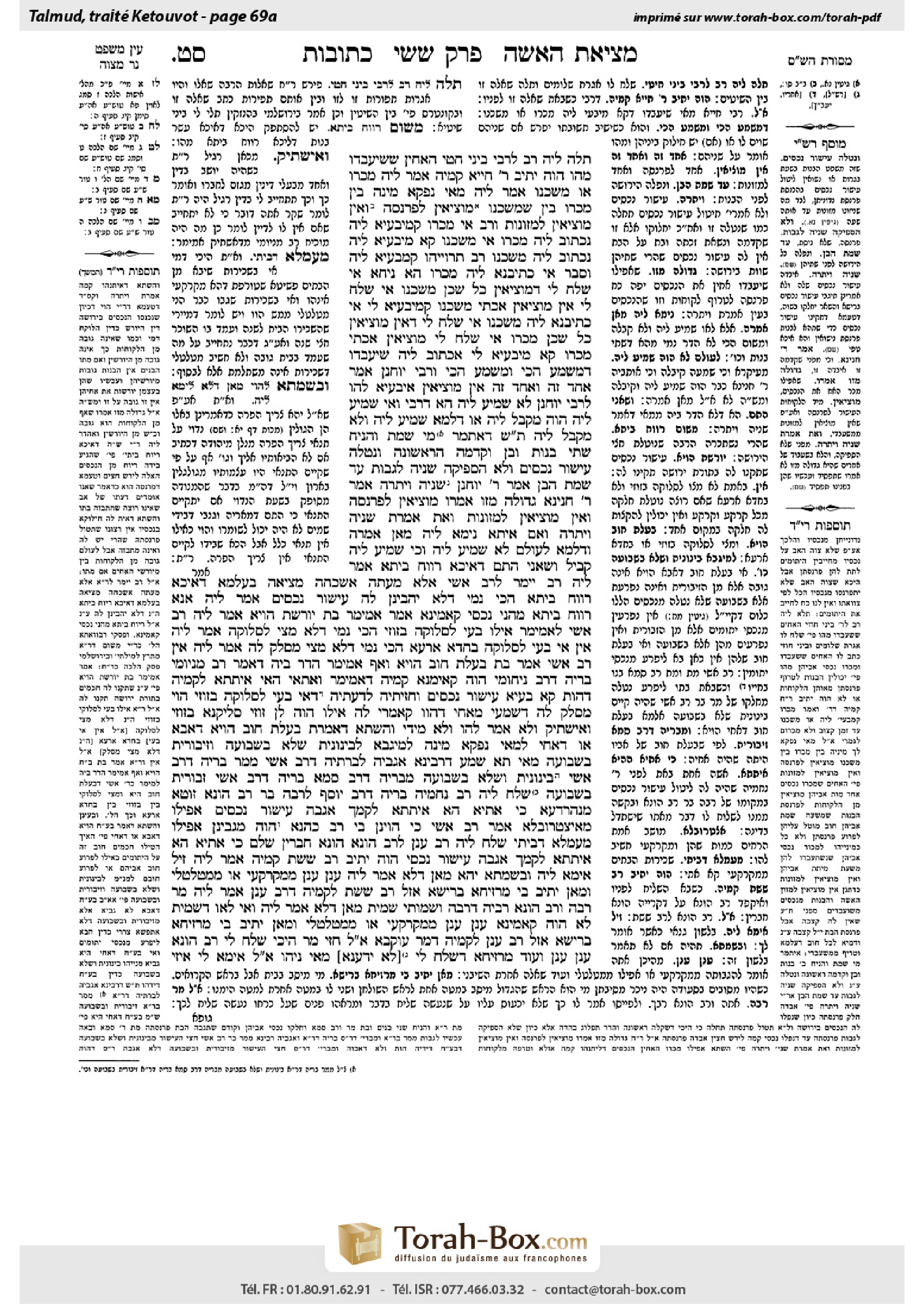
Ketubot 69a: Talmud study for Daf Yomi
Daf Yomi is the daily study of one Talmud folio. Explore 37 tractates with scans, Hebrew text, Sefaria English and AI-generated French translations where annotated.
Passage selection and English or AI-generated French translation are available where the scan has annotations. Daf Study is independent of Torah-Box and Sefaria.
Browse Ketubot · כתובות · All tractatesKetubot 69a text and translations
This page of Ketubot includes the Aramaic text, an English translation and an AI-generated French translation, alongside the scan above.
כתובות ס״ט א · Aramaic and Hebrew text
תְּלָה לֵיהּ רַב לְרַבִּי בֵּינֵי חִטֵּי: הָאַחִין שֶׁשִּׁיעְבְּדוּ, מַהוּ? הֲוָה יָתֵיב רַבִּי חִיָּיא קַמֵּיהּ. אֲמַר לֵיהּ: מָכְרוּ אוֹ מִשְׁכְּנוּ? אֲמַר לֵיהּ: מַאי נָפְקָא מִינַּהּ? בֵּין מָכְרוּ בֵּין שֶׁמִּשְׁכְּנוּ — מוֹצִיאִין לְפַרְנָסָה וְאֵין מוֹצִיאִין לִמְזוֹנוֹת!
וְרַב, אִי מָכְרוּ קָמִיבַּעְיָא לֵיהּ, נִכְתּוֹב לֵיהּ מָכְרוּ? אִי מִשְׁכְּנוּ קָא מִיבַּעְיָא לֵיהּ, נִכְתּוֹב לֵיהּ מִשְׁכְּנוּ?!
רַב תַּרְוַיְיהוּ קָמִבַּעְיָא לֵיהּ וְסָבַר: אִי כָּתֵיבְנָא לֵיהּ מָכְרוּ, הָא נִיחָא אִי שָׁלַח לִי דְּמוֹצִיאִין — כׇּל שֶׁכֵּן מִשְׁכְּנוּ. אִי שָׁלַח לִי אֵין מוֹצִיאִין — אַכַּתִּי מִשְׁכְּנוּ קָמִיבַּעְיָא לִי.
אִי כָּתֵיבְנָא לֵיהּ מִשְׁכְּנוּ, אִי שָׁלַח לִי דְּאֵין מוֹצִיאִין — כׇּל שֶׁכֵּן מָכְרוּ. אִי שָׁלַח לִי מוֹצִיאִין, אַכַּתִּי מָכְרוּ קָא מִיבַּעְיָא לִי. אֶכְתּוֹב לֵיהּ שִׁיעְבְּדוּ, דְּמַשְׁמַע הָכִי וּמַשְׁמַע הָכִי.
וְרַבִּי יוֹחָנָן אָמַר: אֶחָד זֶה וְאֶחָד זֶה אֵין מוֹצִיאִין. אִיבַּעְיָא לְהוּ: לְרַבִּי יוֹחָנָן, לָא שְׁמִיעַ לֵיהּ הָא דְּרַבִּי, וְאִי שְׁמִיעַ לֵיהּ הֲוָה מְקַבֵּל לֵיהּ, אוֹ דִלְמָא: שְׁמִיעַ לֵיהּ וְלָא מְקַבֵּל לֵיהּ?
תָּא שְׁמַע, דְּאִתְּמַר: מִי שֶׁמֵּת וְהִנִּיחַ שְׁתֵּי בָּנוֹת וּבֵן, וְקָדְמָה הָרִאשׁוֹנָה וְנָטְלָה עִישּׂוּר נְכָסִים, וְלֹא הִסְפִּיקָה שְׁנִיָּה לִגְבּוֹת עַד שֶׁמֵּת הַבֵּן,
אָמַר רַבִּי יוֹחָנָן: שְׁנִיָּה וִיתְּרָה. אָמַר רַבִּי חֲנִינָא, גְּדוֹלָה מִזּוֹ אָמְרוּ: מוֹצִיאִין לְפַרְנָסָה וְאֵין מוֹצִיאִין לִמְזוֹנוֹת, וְאַתְּ אָמְרַתְּ שְׁנִיָּה וִיתְּרָה?!
וְאִם אִיתָא, נֵימָא לֵיהּ: מַאן אַמְרַהּ? וְדִלְמָא לְעוֹלָם לָא שְׁמִיעַ לֵיהּ, וְכִי שְׁמִיעַ לֵיהּ — קַבֵּיל, וְשָׁאנֵי הָתָם, דְּאִיכָּא רְוַוח בֵּיתָא.
אֲמַר לֵיהּ רַב יֵימַר לְרַב אָשֵׁי: אֶלָּא מֵעַתָּה, אַשְׁכְּחָה מְצִיאָה בְּעָלְמָא, דְּאִיכָּא רְוַוח בֵּיתָא — הָכִי נָמֵי דְּלָא יָהֲבִינַן לַהּ עִישּׂוּר נְכָסִים?! אֲמַר לֵיהּ: אֲנָא רְוַוח בֵּיתָא מֵהָנֵי נִכְסֵי קָאָמֵינָא.
אָמַר אַמֵּימָר: בַּת יוֹרֶשֶׁת הָוְיָא. אֲמַר לֵיהּ רַב אָשֵׁי לְאַמֵּימָר: אִילּוּ בָּעֵי לְסַלּוֹקַהּ בְּזוּזֵי, הָכִי נָמֵי דְּלָא מָצֵי לְסַלּוֹקַהּ? אֲמַר לֵיהּ: אִין. אִי בָּעֵי לְסַלּוֹקַהּ בַּחֲדָא אַרְעָא, הָכִי נָמֵי דְּלָא מָצֵי מְסַלֵּק לַהּ? אֲמַר לֵיהּ: אִין.
רַב אָשֵׁי אָמַר: בַּת — בַּעֲלַת חוֹב הָוְיָא. וְאַף אַמֵּימָר הֲדַר בֵּיהּ, דְּאָמַר רַב מִנְיוֹמֵי בְּרֵיהּ דְּרַב נִיחוּמִי: הֲוָה קָאֵימְנָא קַמֵּיהּ דְּאַמֵּימָר, וַאֲתַאי הַאי אִיתְּתָא לְקַמֵּיהּ, דַּהֲוָת קָא בָּעֲיָא עִישּׂוּר נְכָסִים. וַחֲזֵיתֵיהּ לְדַעְתֵּיהּ דְּאִי בָּעֵי לְסַלּוֹקַהּ בְּזוּזֵי הֲוָה מְסַלֵּק לַהּ. דְּשָׁמְעִי מֵאַחֵי דַּהֲווֹ קָאָמְרִי לַהּ: אִילּוּ הֲוָה לַן זוּזֵי, סַלֵּיקְנָא בְּזוּזֵי וְאִישְׁתִּיק, וְלָא אֲמַר לְהוּ וְלָא מִידֵּי.
וְהַשְׁתָּא דְּאָמְרַתְּ בַּעֲלַת חוֹב הָוְיָא: דְּאַבָּא אוֹ דְאַחֵי? לְמַאי נָפְקָא מִינַּהּ? לְמִיגְבֵּא לְבֵינוֹנִית שֶׁלֹּא בִּשְׁבוּעָה, וְזִיבּוּרִית בִּשְׁבוּעָה.
מַאי? תָּא שְׁמַע דְּרָבִינָא אַגְבְּיַהּ לְבַרְתֵּיהּ דְּרַב אָשֵׁי מִמָּר בְּרֵיהּ דְּרַב אָשֵׁי בֵּינוֹנִית, וְשֶׁלֹּא בִּשְׁבוּעָה. מִבְּרֵיהּ דְּרַב סַמָּא בְּרֵיהּ דְּרַב אָשֵׁי זִבּוּרִית, בִּשְׁבוּעָה.
שְׁלַח לֵיהּ רַב נְחֶמְיָה בְּרֵיהּ דְּרַב יוֹסֵף לְרַבָּה בַּר רַב הוּנָא זוּטָא מִנְּהַרְדְּעָא: כִּי אָתְיָא הָא אִיתְּתָא לְקַמָּךְ, אַגְבְּיַהּ עִישּׂוּר נִכְסֵי אֲפִילּוּ מֵאִיצְטְרוֹבְלָא. אָמַר רַב אָשֵׁי: כִּי הֲוֵינַן בֵּי רַב כָּהֲנָא, הֲוָה מַגְבֵּינַן אֲפִילּוּ מֵעַמְלָא דְבֵיתֵי.
שְׁלַח לֵיהּ רַב עָנָן לְרַב הוּנָא: הוּנָא חַבְרִין, שְׁלָם! כִּי אָתְיָא הָא אִיתְּתָא לְקַמָּךְ אַגְבְּיַהּ עִישּׂוּר נִכְסֵי. הֲוָה יָתֵיב רַב שֵׁשֶׁת קַמֵּיהּ, אֲמַר לֵיהּ: זִיל אֵימָא לֵיהּ: וּבְשַׁמְתָּא יְהֵא מַאן דְּלָא אָמַר לֵיהּ: ״עָנָן עָנָן! מִמְּקַרְקְעֵי אוֹ מִמִּטַּלְטְלִי?״ וּ״מַאן יָתֵיב בֵּי מַרְזֵיחָא בְּרֵישָׁא?״
אֲזַל רַב שֵׁשֶׁת לְקַמֵּיהּ דְּרַב עָנָן, אֲמַר לֵיהּ: מָר רַבָּה, וְרַב הוּנָא רַבֵּיהּ דְּרַבָּה, וְשַׁמּוֹתֵי שַׁמֵּית מַאן דְּלָא אָמַר לֵיהּ, וְאִי לָאו דְּשַׁמֵּית, לָא הֲוָה קָאָמֵינָא: ״עָנָן, עָנָן, מִמְּקַרְקְעֵי אוֹ מִמִּטַּלְטְלִי? וּמַאן יָתֵיב בֵּי מַרְזֵיחָא בְּרֵישָׁא?״
אֲזַל רַב עָנָן לְקַמֵּיהּ דְּמָר עוּקְבָא, אֲמַר לֵיהּ: חֲזִי מָר הֵיכִי שְׁלַח לִי רַב הוּנָא ״עָנָן עָנָן״, וְעוֹד ״מַרְזֵיחָא״ דִּשְׁלַח לִי [לָא יָדַעְנָא] מַאי נִיהוּ. אֲמַר לֵיהּ: אִימָּא לִי אִיזִי
Ketubot 69a · English translation
§ Rav attached the following question for Rabbi Yehuda HaNasi between the lines of a letter he sent him: With respect to brothers who mortgaged a certain property, what is the halakha? Is this property subject to seizure, if need be, for the benefit of the daughters’ dowries? Rabbi Ḥiyya was sitting before Rabbi Yehuda HaNasi when the letter arrived. He said to him: What is meant in the question? Did they sell the property or did they pledge it as a guarantee, so that it has not yet been transferred? Rabbi Yehuda HaNasi, said to him: What difference does it make? Whether they sold it or pledged it, the court may appropriate the property for support for the daughters’ dowries, but the court may not appropriate it for their sustenance.
The Gemara asks: And as for Rav himself, if he is raising a dilemma about a case in which they sold the property, let him write explicitly that he is asking about an instance in which they sold the property. And if he is raising a dilemma about a case in which they pledged the property, let him write explicitly that he is asking about an instance in which they pledged the property. Why does Rav instead employ an ambiguous term?
The Gemara answers: Rav was raising a dilemma about both cases and thought: If I write to him that they sold the property, then it works out well if he sends back to me the ruling that the court may appropriate the sold property for the daughters’ dowries. In that case, I would also understand that all the more so, if the brothers merely pledged the property, the court would appropriate it for the dowry. But if he sends to me the reply that the court does not appropriate sold property, still the case in which they pledged the property will be a dilemma for me.
Alternatively, if I write to him that the brothers pledged it, then if he sends to me the response that the court does not appropriate it, I can infer that all the more so if the brothers sold it we do not collect from the buyer. And if he sends me the response that the court does appropriate the land for the daughters’ dowries, still the case in which they sold the property will be a dilemma for me. Therefore, I will write to him that they mortgaged it, which implies this meaning and it implies that one, and in this way I will receive a complete answer to my question.
And Rabbi Yoḥanan said: Whether it is this or whether it is that, the court does not appropriate assigned or sold properties for either the support or sustenance of the daughters. A dilemma was raised before them: Is it that Rabbi Yoḥanan did not hear this ruling of Rabbi Yehuda HaNasi, but had he heard it, he would have accepted it? Or, perhaps, is it that even if he had heard it, he would not have accepted it?
The Gemara proposes an answer, indicated by a dispute of amora’im: Come and hear a proof, as it was stated that amora’im disputed a certain case. The Sages debated the halakha with regard to one who died and left behind two daughters and a son, and the first daughter advanced and took one-tenth of the estate for her dowry, but the second daughter did not have enough time to collect her one-tenth before the son died. When the daughters divide the remaining assets, are they divided equally, or does the second daughter receive a slightly larger sum, commensurate with an additional portion earmarked for the dowry that she has not yet collected?
Rabbi Yoḥanan said: The second daughter forfeited her right to an equal one-tenth of the estate for a dowry. No specific funds are separated from the estate as a dowry before the inheritance is divided equally among the daughters. Rabbi Ḥanina said: The Sages said something even greater than this with respect to her support: The court appropriates liened property for support, but it does not appropriate it for sustenance. And yet would you, Rabbi Yoḥanan, say that the second daughter forfeited her right to collect even when the property is not liened? It cannot be that her support is diminished merely because of her brother’s death.
The Gemara understands that there is evidence within the exchange that Rabbi Yoḥanan knew Rabbi Yehuda HaNasi’s opinion and nevertheless ruled against it. And if it is so, that Rabbi Yoḥanan never heard the ruling of Rabbi Yehuda HaNasi, then let Rabbi Yoḥanan say to Rabbi Ḥanina: Who stated that, that property is appropriated for the dowry? Rather, Rabbi Yoḥanan must have known and rejected Rabbi Yehuda HaNasi’s ruling. The Gemara rejects the proof: And perhaps he actually did not hear it; but had he heard it, he would have accepted it. And Rabbi Yoḥanan ruled as he did because it is different there, in the case in which the son died, since there is abundance in the house. Since the second daughter receives half of all the inheritance, she is not concerned about the one-tenth of the estate.
Rav Yeimar said to Rav Ashi: If that is so, according to that logic, then if she had found a generic lost object, as there is abundance in the house due to the value of the newly found article, so too would we not give her one-tenth of the estate? Since finding a lost object, or similarly, being independently wealthy, does not actually change her right to collect her full dowry, it stands to reason that she should collect the full dowry even when she inherits half of the remaining estate. He said to him: I would say this is true of abundance in the house that comes from these properties of the estate. Because the matter depends upon her share of the inheritance, when she commands a sizeable portion of the inheritance, she does not quibble over the one-tenth of the inheritance earmarked for her dowry. However, if she has other resources unrelated to the inheritance, her independent wealth cannot diminish her share of the inheritance with respect to the dowry.
§ With regard to the fundamental right of daughters to receive the support of the dowry from the estate, Ameimar said: A daughter is considered an inheritor. Rav Ashi said to Ameimar: According to your opinion, if another inheritor wants to remove her from among the inheritors by giving her money instead of inherited property, is he indeed unable to remove her? May she insist on receiving actual property from the estate for the purpose of her dowry? He said to him: Yes, she may insist on inherited property. Rav Ashi continued to ask Ameimar: If he wants to remove her by giving her one specific piece of land, is he also unable to remove her, since, as an inheritor, she has the right to collect portions of all the property? He said to him: Yes, he is limited in this way. She may insist on her right to inherit from the entire property.
In contrast to Ameimar, Rav Ashi said: A daughter is legally considered a creditor with regard to the inheritance, and the inheritors may insist that they will provide her support by any means, without giving her a share of the actual inheritance. The Gemara notes: And even Ameimar retracted his opinion that she is an inheritor, as Rav Minyumi, son of Rav Niḥumi, said: I was standing in front of Ameimar, and this woman came before him, as she was asking for one-tenth of her father’s estate. And I saw that his opinion was that if the inheritor wants to remove her by giving her money, he may remove her, as I heard from the woman’s brothers that they were saying to her: If we had sufficient money, we would pay your claims and remove you with our own money. And Ameimar was silent and did not say anything to them. Since Ameimar did not object to their suggestion in principle, evidently he agreed that her status was that of a creditor, who may be repaid in cash.
The Gemara comments: And now that you have reached a conclusion and said that the daughter is functionally a creditor, is she a creditor of the father or of the brothers? The Gemara asks: With regard to what halakha is there a practical difference? Either way, as the father has died, she receives her support from the estate. The Gemara answers: There is a difference with respect to collecting intermediate-quality land without an oath and inferior-quality land with an oath. If she is the father’s creditor, she may collect from the estate only the inferior-quality land with an oath. If, however, she is the brothers’ direct creditor, she may collect her claim in the same manner as standard creditors, collecting intermediate-quality land without an oath.
What is the halakha? Whose creditor is she? The Gemara responds: Come and hear a proof, as Ravina provided one-tenth of the estate for the daughter of Rav Ashi from two sources. From Mar, son of Rav Ashi, Ravina gave her intermediate-quality land without an oath. He collected another portion of the property from the orphan son of Rav Sama, son of Rav Ashi, who was an inheritor of the same estate from his grandfather. This portion was provided of inferior-quality land, with an oath. Since, with regard to the property that Rav Ashi’s daughter was collecting from an orphan, Ravina required an oath and allowed her to collect only low-grade land, it appears that Ravina treated the daughter as the creditor of the sons and not of the father.
The Gemara records a number of related incidents. Rav Neḥemya, son of Rav Yosef, sent a message to Rabba bar Rav Huna the Small, of Neharde’a: When this woman bearing this letter comes before you, provide her one-tenth of her father’s estate, providing a percentage even of the land upon which sits the millstone [itzterubela], as this is also real estate. Rav Ashi said: When we were students in Rav Kahana’s house, we would collect the one-tenth of the estate for the dowry even from the income from the rental fees for houses in the estate. Since this money is earned from the real estate itself, it too is considered in calculating the appropriate dowry.
The Gemara recounts an interaction between Rav Anan and Rav Huna. Rav Anan sent the following letter to Rav Huna: Huna, our friend, we wish you peace. When this woman bearing this letter comes before you, provide her one-tenth of her father’s estate. Rav Sheshet was sitting before him, and Rav Huna said to him: Go and say to Rav Anan my reply. Knowing that Rav Sheshet may be hesitant to relay the sharp language of the reply, Rav Huna cautioned him: And whoever does not say to him my exact words is in a state of excommunication: Anan, Anan, should the one-tenth be provided from real estate or from movable property? And, incidentally, tell me who sits at the head in the house of a marzeiḥa?
Rav Sheshet went before Rav Anan and reverentially said to him, addressing him in the third person: My Master is a teacher, but Rav Huna is the teacher of the teacher. Moreover, he readily excommunicates whoever does not say to him, i.e., to you, my teacher, his precise message, and if it were not that he would excommunicate me, I would not say his words: Anan, Anan, should the one-tenth be provided from real estate or from movable property? And, incidentally, tell me who sits at the head in the house of a marzeiḥa?
Rav Anan went before Mar Ukva to consult with him about Rav Huna’s reply. He said to him: Let the Master see how Rav Huna sent me an offensive message, addressing me as Anan, Anan. Moreover, with regard to this word marzeiḥa in the letter that he sent me, I do not know what it is. Mar Ukva said to him: Say to me, my friend [izi],
Ketubot 69a · Traduction française (IA)
§ Rav glissa la question suivante entre les lignes d’une lettre qu’il envoya à Rabbi Yehuda HaNassi : Quel est le statut d’un bien que des frères ont hypothéqué ? Peut-on, si nécessaire, le saisir au profit des dots des filles ? Rabbi Ḥiyya était assis devant Rabbi Yehuda HaNassi lorsque la lettre arriva. Il lui dit : Que signifie la question ? L’ont-ils vendu ou l’ont-ils donné en garantie, de sorte qu’il n’a pas encore été transféré ? Rabbi Yehuda HaNassi lui répondit : Quelle différence cela fait-il ? Qu’ils l’aient vendu ou donné en garantie, le tribunal peut saisir le bien pour financer les dots des filles, mais il ne peut pas le saisir pour leur entretien.
La Guemara demande : Quant à Rav lui-même, s’il s’interroge sur un cas où les frères ont vendu le bien, qu’il écrive explicitement qu’il pose sa question à propos d’un bien vendu. Et s’il s’interroge sur un cas où ils ont donné le bien en garantie, qu’il écrive explicitement qu’il pose sa question à propos d’un bien donné en garantie. Pourquoi Rav emploie-t-il plutôt un terme ambigu ?
La Guemara répond : Rav s’interrogeait sur les deux cas et se disait : Si je lui écris que les frères ont vendu le bien et qu’il me répond que le tribunal peut saisir le bien vendu pour financer les dots des filles, cela convient ; je comprendrai aussi, a fortiori, que si les frères ont simplement donné le bien en garantie, le tribunal peut le saisir pour financer la dot. Mais s’il me répond que le tribunal ne saisit pas un bien vendu, le cas où les frères ont donné le bien en garantie restera encore une question pour moi.
Autrement, si je lui écris que les frères ont donné le bien en garantie et qu’il me répond que le tribunal ne le saisit pas, je peux en déduire qu’a fortiori, si les frères l’ont vendu, nous ne recouvrons rien auprès de l’acheteur. Et s’il me répond que le tribunal saisit le bien pour financer les dots des filles, le cas où les frères ont vendu le bien restera encore une question pour moi. Je vais donc lui écrire qu’ils l’ont hypothéqué, expression qui peut avoir l’un ou l’autre sens ; ainsi, je recevrai une réponse complète à ma question.
Et Rabbi Yoḥanan dit : Que les frères aient fait l’un ou l’autre, le tribunal ne saisit ni les biens grevés d’une charge ni les biens vendus, que ce soit pour financer les dots des filles ou pour leur entretien. Une question fut soulevée devant eux : Rabbi Yoḥanan n’avait-il pas entendu cette décision de Rabbi Yehuda HaNassi, mais l’aurait-il acceptée s’il l’avait entendue ? Ou bien, peut-être, ne l’aurait-il pas acceptée même s’il l’avait entendue ?
La Guemara propose une réponse, suggérée par une controverse entre amoraïm : Viens et entends une preuve, car on rapporte que des amoraïm ont débattu d’un cas. Les Sages discutèrent de la halakha concernant un homme qui mourut en laissant deux filles et un fils : l’aînée préleva d’abord un dixième de la succession pour sa dot, mais la cadette n’eut pas le temps de prélever son dixième avant que le fils ne meure. Lorsque les filles se partagent les biens restants, le partage se fait-il à parts égales, ou la cadette reçoit-elle une somme un peu plus importante, correspondant à une part supplémentaire destinée à sa dot, qu’elle n’a pas encore prélevée ?
Rabbi Yoḥanan dit : La cadette a perdu son droit à un dixième égal de la succession pour sa dot. Aucun fonds précis n’est mis de côté dans la succession pour les dots avant que l’héritage soit partagé à parts égales entre les filles. Rabbi Ḥanina dit : Les Sages ont énoncé une règle encore plus favorable à son égard au sujet de son entretien : le tribunal saisit les biens grevés d’une charge pour financer son entretien, mais ne les saisit pas pour sa subsistance. Et pourtant, Rabbi Yoḥanan, dirais-tu que la cadette a perdu son droit au prélèvement même lorsque le bien n’est pas grevé d’une charge ? Il est impossible que son entretien soit réduit simplement parce que son frère est mort.
La Guemara comprend que cet échange prouve que Rabbi Yoḥanan connaissait l’opinion de Rabbi Yehuda HaNassi et qu’il a néanmoins statué contre elle. En effet, si Rabbi Yoḥanan n’avait jamais entendu la décision de Rabbi Yehuda HaNassi, qu’il réponde donc à Rabbi Ḥanina : Qui a dit que ce bien devait être saisi pour la dot ? Rabbi Yoḥanan devait donc connaître et rejeter la décision de Rabbi Yehuda HaNassi. La Guemara rejette cette preuve : Peut-être ne l’avait-il effectivement pas entendue ; mais s’il l’avait entendue, il l’aurait acceptée. Rabbi Yoḥanan a statué ainsi parce que le cas est différent ici, puisque le fils est mort alors qu’il y avait abondance dans la maison. Comme la cadette reçoit la moitié de toute la succession, elle ne tient pas au dixième de la succession.
Rav Yeimar dit à Rav Ashi : Si tel est le raisonnement, alors, si elle avait trouvé un objet perdu quelconque, la maison aurait aussi connu l’abondance grâce à la valeur de l’objet nouvellement trouvé ; ne lui donnerions-nous pas non plus un dixième de la succession ? Puisque le fait de trouver un objet perdu, ou d’être riche indépendamment, ne modifie pas réellement son droit à percevoir l’intégralité de sa dot, il est logique qu’elle perçoive l’intégralité de sa dot même lorsqu’elle hérite de la moitié de la succession restante. Il lui répondit : Je dirais que cela vaut pour l’abondance dans la maison qui provient des biens de la succession. Puisque la question dépend de sa part d’héritage, lorsqu’elle reçoit une part importante de la succession, elle ne réclame pas en plus le dixième destiné à sa dot. En revanche, si elle dispose d’autres ressources sans rapport avec l’héritage, sa richesse personnelle ne peut réduire sa part de la succession au titre de la dot.
§ Au sujet du droit fondamental des filles à recevoir de la succession le financement de leur dot, Ameimar dit : Une fille est considérée comme une héritière. Rav Ashi dit à Ameimar : Selon ton opinion, si un autre héritier veut l’écarter des autres héritiers en lui donnant de l’argent à la place de biens hérités, peut-il donc le faire ? Peut-elle exiger de recevoir des biens de la succession pour sa dot ? Il lui répondit : Oui, elle peut exiger des biens hérités. Rav Ashi poursuivit ses questions à Ameimar : S’il veut l’écarter en lui donnant une parcelle de terre précise, peut-il également le faire, alors qu’en tant qu’héritière, elle a le droit de prélever une part sur l’ensemble des biens ? Il lui répondit : Oui, il est limité de cette manière. Elle peut faire valoir son droit à hériter de l’ensemble des biens.
À l’inverse d’Ameimar, Rav Ashi dit : Juridiquement, une fille est considérée comme une créancière de la succession, et les héritiers peuvent s’acquitter de leur obligation envers elle par n’importe quel moyen, sans lui donner une part de l’héritage lui-même. La Guemara relève : Ameimar lui-même revint également sur son opinion selon laquelle elle est une héritière, car Rav Minyumi, fils de Rav Niḥumi, dit : Je me tenais devant Ameimar lorsqu’une femme se présenta à lui pour demander un dixième de la succession de son père. Je vis qu’il estimait que si l’héritier voulait l’écarter en lui donnant de l’argent, il pouvait le faire, car j’entendis les frères de cette femme lui dire : Si nous avions assez d’argent, nous réglerions tes prétentions et te dédommagerions avec notre propre argent. Ameimar garda le silence et ne leur dit rien. Puisqu’il ne s’opposa pas par principe à leur proposition, il est évident qu’il convenait que son statut était celui d’une créancière, qui peut être remboursée en espèces.
La Guemara ajoute : Maintenant que l’on est parvenu à la conclusion que la fille est, en pratique, une créancière, est-elle la créancière de son père ou de ses frères ? La Guemara demande : Quelle halakha concrète cela change-t-il ? Dans les deux cas, puisque le père est mort, elle reçoit son entretien sur la succession. La Guemara répond : La différence concerne le recouvrement de terres de qualité moyenne sans serment, ou de terres de qualité inférieure avec serment. Si elle est la créancière de son père, elle ne peut recouvrer sur la succession que des terres de qualité inférieure, avec serment. Mais si les frères sont ses débiteurs directs, elle peut recouvrer sa créance comme les créanciers ordinaires : des terres de qualité moyenne, sans serment.
Quelle est la halakha ? De qui est-elle la créancière ? La Guemara répond : Viens et entends une preuve, car Ravina accorda à la fille de Rav Ashi son dixième de la succession en prélevant sur deux sources. À Mar, fils de Rav Ashi, Ravina prit des terres de qualité moyenne, sans serment, pour les lui donner. Il recouvra une autre partie des biens auprès du fils orphelin de Rav Sama, fils de Rav Ashi, qui avait hérité de son grand-père d’une part de la même succession. Cette partie fut fournie sous forme de terres de qualité inférieure, avec serment. Puisque, pour les biens que la fille de Rav Ashi recouvrait auprès d’un orphelin, Ravina exigea un serment et ne lui permit de recouvrer que des terres de qualité inférieure, il semble que Ravina considérait la fille comme la créancière des fils, et non du père.
La Guemara rapporte plusieurs récits liés à cette question. Rav Neḥemya, fils de Rav Yosef, envoya un message à Rabba bar Rav Huna le Petit, de Neharde’a : Lorsque cette femme, porteuse de cette lettre, se présentera devant toi, donne-lui un dixième de la succession de son père, en incluant dans le calcul même le terrain sur lequel se trouve la meule [itzterubela], car il s’agit lui aussi d’un bien immobilier. Rav Ashi dit : Lorsque nous étions étudiants chez Rav Kahana, nous prélevions le dixième destiné à la dot sur les revenus des loyers des maisons de la succession. Puisque cet argent provient des biens immobiliers eux-mêmes, il entre lui aussi dans le calcul de la dot appropriée.
La Guemara raconte un échange entre Rav Anan et Rav Huna. Rav Anan envoya la lettre suivante à Rav Huna : Huna, notre ami, nous te souhaitons la paix. Lorsque cette femme, porteuse de cette lettre, se présentera devant toi, donne-lui un dixième de la succession de son père. Rav Sheshet était assis devant lui, et Rav Huna lui dit : Va transmettre ma réponse à Rav Anan. Sachant que Rav Sheshet pourrait hésiter à rapporter le ton cinglant de sa réponse, Rav Huna le prévint : Quiconque ne lui répétera pas exactement mes paroles sera mis au ban : Anan, Anan, faut-il fournir le dixième en biens immobiliers ou en biens meubles ? Et, au passage, dis-moi qui siège à la tête dans la maison d’un marzeiḥa ?
Rav Sheshet se rendit auprès de Rav Anan et lui parla respectueusement, à la troisième personne : Mon maître est un maître, mais Rav Huna est le maître du maître. De plus, il met volontiers au ban quiconque ne lui répète pas, c’est-à-dire à vous, mon maître, son message exact ; et, s’il ne m’avait pas menacé de me mettre au ban, je ne vous aurais pas répété ses paroles : Anan, Anan, faut-il fournir le dixième en biens immobiliers ou en biens meubles ? Et, au passage, dis-moi qui siège à la tête dans la maison d’un marzeiḥa ?
Rav Anan se rendit auprès de Mar Ukva pour le consulter au sujet de la réponse de Rav Huna. Il lui dit : Que le Maître voie le message offensant que Rav Huna m’a envoyé, en m’appelant « Anan, Anan ». De plus, concernant le mot marzeiḥa dans la lettre qu’il m’a envoyée, je ne sais pas ce qu’il signifie. Mar Ukva lui dit : Dis-moi, mon ami [izi],
Traduction française générée par IA à partir de l’édition anglaise de Sefaria. Vérifie toujours un passage avec le texte source.
Text from Sefaria: William Davidson Edition - Vocalized Aramaic (CC BY NC); William Davidson Edition - English (CC BY NC).