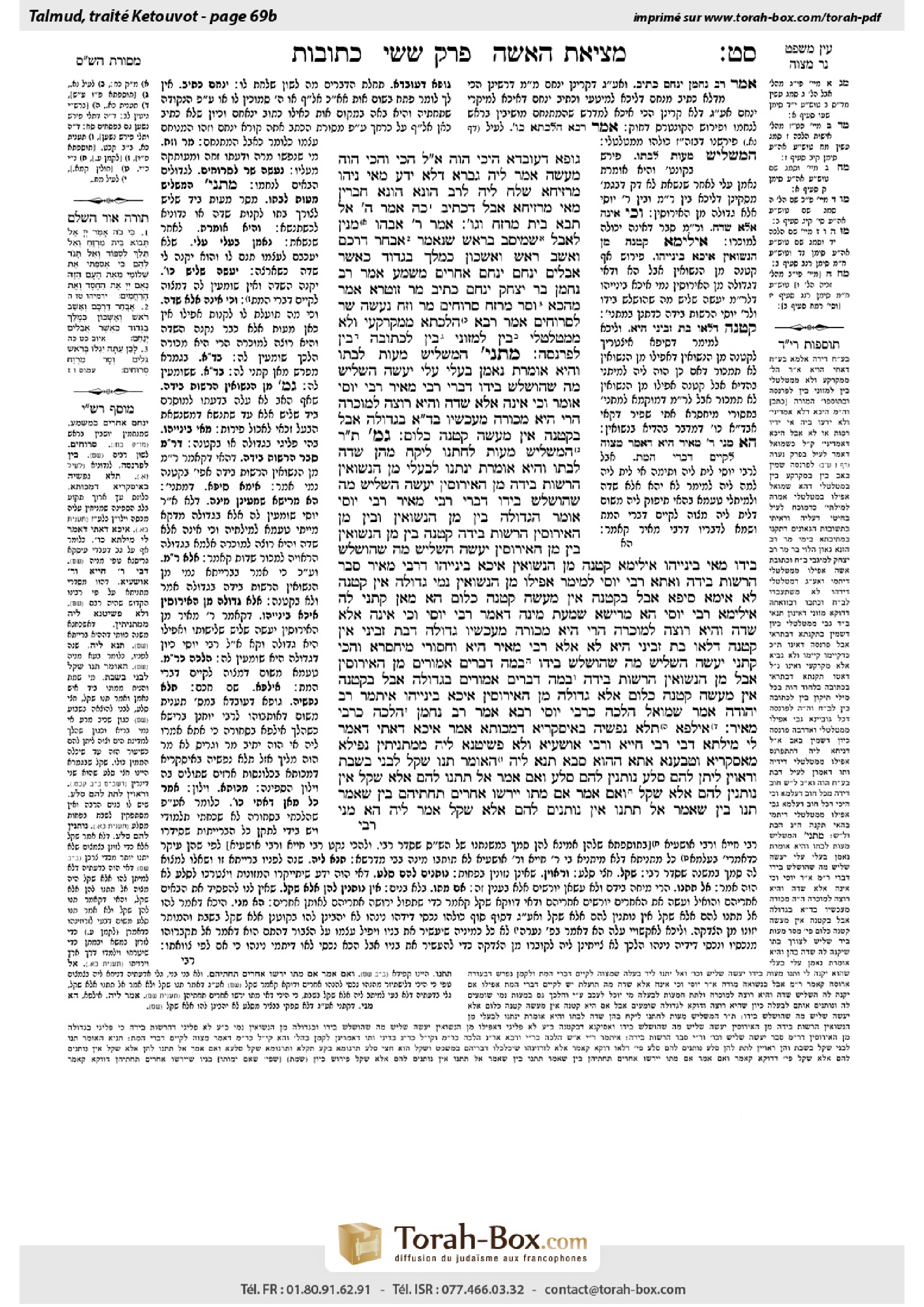
Ketubot 69b: Talmud study for Daf Yomi
Daf Yomi is the daily study of one Talmud folio. Explore 37 tractates with scans, Hebrew text, Sefaria English and AI-generated French translations where annotated.
Passage selection and English or AI-generated French translation are available where the scan has annotations. Daf Study is independent of Torah-Box and Sefaria.
Browse Ketubot · כתובות · All tractatesKetubot 69b text and translations
This page of Ketubot includes the Aramaic text, an English translation and an AI-generated French translation, alongside the scan above.
כתובות ס״ט ב · Aramaic and Hebrew text
גּוּפָא דְעוֹבָדָא הֵיכִי הֲוָה? אֲמַר לֵיהּ: הָכִי וְהָכִי הֲוָה מַעֲשֶׂה. אֲמַר לֵיהּ: גַּבְרָא דְּלָא יָדַע מַאי נִיהוּ ״מַרְזֵיחָא״, שָׁלַח לֵיהּ לְרַב הוּנָא ״הוּנָא חַבְרִין״?! מַאי ״מַרְזֵיחָא״ — אֵבֶל, דִּכְתִיב: ״כֹּה אָמַר ה׳ אַל תָּבֹא בֵּית מַרְזֵחַ וְגוֹ׳״.
אָמַר רַבִּי אֲבָהוּ: מִנַּיִן לָאָבֵל שֶׁמֵּיסֵב בָּרֹאשׁ — שֶׁנֶּאֱמַר: ״אֶבְחַר דַּרְכָּם וְאֵשֵׁב רֹאשׁ וְאֶשְׁכּוֹן כְּמֶלֶךְ בַּגְּדוּד כַּאֲשֶׁר אֲבֵלִים יְנַחֵם״. יְנַחֵם אֲחֵרִים מַשְׁמַע! אָמַר רַב נַחְמָן בַּר יִצְחָק: ״יִנָּחֵם״ כְּתִיב.
מָר זוּטְרָא אָמַר, מֵהָכָא: ״וְסָר מִרְזַח סְרוּחִים״. מַר וָזַח — נַעֲשֶׂה שַׂר לִסְרוּחִים.
אָמַר רָבָא, הִלְכְתָא: מִמְּקַרְקְעֵי וְלָא מִמִּטַּלְטְלִי, בֵּין לִמְזוֹנֵי, בֵּין לִכְתוּבָּה, בֵּין לְפַרְנָסָה.
מַתְנִי׳ הַמַּשְׁלִישׁ מָעוֹת לְבִתּוֹ, וְהִיא אוֹמֶרֶת: נֶאֱמָן בַּעְלִי עָלַי — יַעֲשֶׂה הַשָּׁלִישׁ מַה שֶּׁהוּשְׁלַשׁ בְּיָדוֹ, דִּבְרֵי רַבִּי מֵאִיר. רַבִּי יוֹסֵי אוֹמֵר: וְכִי אֵינָהּ אֶלָּא שָׂדֶה, וְהִיא רוֹצָה לְמוֹכְרָהּ, הֲרֵי הִיא מְכוּרָה מֵעַכְשָׁיו. בַּמֶּה דְּבָרִים אֲמוּרִים: בִּגְדוֹלָה. אֲבָל בִּקְטַנָּה — אֵין מַעֲשֵׂה קְטַנָּה כְּלוּם.
גְּמָ׳ תָּנוּ רַבָּנַן: הַמַּשְׁלִישׁ מָעוֹת לַחֲתָנוֹ לִיקַּח מֵהֶן שָׂדֶה לְבִתּוֹ, וְהִיא אוֹמֶרֶת: יִנָּתְנוּ לְבַעְלִי, מִן הַנִּשּׂוּאִין — הָרְשׁוּת בְּיָדָהּ, מִן הָאֵירוּסִין — יַעֲשֶׂה הַשָּׁלִישׁ מַה שֶּׁהוּשְׁלַשׁ בְּיָדוֹ, דִּבְרֵי רַבִּי מֵאִיר. רַבִּי יוֹסֵי אוֹמֵר: הַגְּדוֹלָה, בֵּין מִן הַנִּשּׂוּאִין וּבֵין מִן הָאֵירוּסִין — הָרְשׁוּת בְּיָדָהּ. קְטַנָּה, בֵּין מִן הַנִּשּׂוּאִין בֵּין מִן הָאֵירוּסִין — יַעֲשֶׂה הַשָּׁלִישׁ מַה שֶּׁהוּשְׁלַשׁ בְּיָדוֹ.
מַאי בֵּינַיְיהוּ? אִילֵימָא קְטַנָּה מִן הַנִּשּׂוּאִין אִיכָּא בֵּינַיְיהוּ, דְּרַבִּי מֵאִיר סָבַר הָרְשׁוּת בְּיָדָהּ, וַאֲתָא רַבִּי יוֹסֵי לְמֵימַר אֲפִילּוּ מִן הַנִּשּׂוּאִין נָמֵי: גְּדוֹלָה אִין, קְטַנָּה לָא.
אֵימָא סֵיפָא: אֲבָל בִּקְטַנָּה — אֵין מַעֲשֵׂה קְטַנָּה כְּלוּם. הָא מַאן קָתָנֵי לַהּ? אִילֵּימָא רַבִּי יוֹסֵי, הָא מֵרֵישָׁא שָׁמְעַתְּ מִינַּהּ, דְּאָמַר רַבִּי יוֹסֵי: וְכִי אֵינָהּ אֶלָּא שָׂדֶה וְהִיא רוֹצָה לְמוֹכְרָהּ, הֲרֵי הִיא מְכוּרָה מֵעַכְשָׁיו. גְּדוֹלָה דְּבַת זְבִינֵי — אִין, קְטַנָּה דְּלָאו בַּת זְבִינֵי הִיא — לָא!
אֶלָּא רַבִּי מֵאִיר הִיא, וְחַסּוֹרֵי מִיחַסְּרָא וְהָכִי קָתָנֵי: יַעֲשֶׂה הַשָּׁלִישׁ מַה שֶּׁהוּשְׁלַשׁ בְּיָדוֹ. בַּמֶּה דְּבָרִים אֲמוּרִים — מִן הָאֵירוּסִין, אֲבָל מִן הַנִּשּׂוּאִין — הָרְשׁוּת בְּיָדָהּ. בַּמֶּה דְּבָרִים אֲמוּרִים — בִּגְדוֹלָה, אֲבָל בִּקְטַנָּה — אֵין מַעֲשֵׂה קְטַנָּה כְּלוּם. אֶלָּא גְּדוֹלָה מִן הָאֵירוּסִין אִיכָּא בֵּינַיְיהוּ.
אִיתְּמַר, רַב יְהוּדָה אָמַר שְׁמוּאֵל: הֲלָכָה כְּרַבִּי יוֹסֵי, רָבָא אָמַר רַב נַחְמָן: הֲלָכָה כְּרַבִּי מֵאִיר.
אִילְפָא תְּלָא נַפְשֵׁיהּ בְּאִיסְקַרְיָא דְּמָכוּתָא, אֲמַר: אִיכָּא דְּאָתֵי דְּאָמַר לִי מִילְּתָא דְּבֵי רַבִּי חִיָּיא וְרַבִּי אוֹשַׁעְיָא וְלָא פָּשֵׁיטְנָא לֵיהּ מִמַּתְנִיתִין, נָפֵילְנָא מֵאִסְקַרְיָא וְטָבַעְנָא.
אֲתָא הָהוּא סָבָא תְּנָא לֵיהּ: הָאוֹמֵר ״תְּנוּ שֶׁקֶל לְבָנַי בְּשַׁבָּת״, וּרְאוּיִן לִיתֵּן לָהֶם סֶלַע — נוֹתְנִין לָהֶם סֶלַע. וְאִם אָמַר ״אַל תִּתְּנוּ לָהֶם אֶלָּא שֶׁקֶל״ — אֵין נוֹתְנִין לָהֶם אֶלָּא שֶׁקֶל. וְאִם אָמַר ״אִם מֵתוּ יִירְשׁוּ אֲחֵרִים תַּחְתֵּיהֶם״, בֵּין שֶׁאָמַר ״תְּנוּ״, בֵּין שֶׁאָמַר ״אַל תִּתְּנוּ״ — אֵין נוֹתְנִים לָהֶם אֶלָּא שֶׁקֶל.
אֲמַר לֵיהּ: הָא מַנִּי?
Ketubot 69b · English translation
how the incident itself happened. What are the particulars of your exchange that brought about this end result? He said to him: Such and such was the incident, and Rav Anan related the details to Mar Ukva. He said to him: A man who does not know what a marzeiḥa is sends a letter to Rav Huna addressing him as Huna, our friend? It is not your place to take such liberties in your correspondence with him, and Rav Huna was justifiably offended. The Gemara explains: What is a marzeiḥa? A mourner, as it is written: “For so says the Lord: Enter not into the house of mourning [marze’aḥ], neither go to lament, neither bemoan them” (Jeremiah 16:5).
Rabbi Abbahu said concerning the same topic: From where is it derived that a mourner sits at the head? As it is stated: “I chose out their way, and sat as chief, and dwelt as a king in the army, as one that would comfort [yenaḥem] the mourners” (Job 29:25). The Gemara challenges the proof: The word yenaḥem implies one comforting others and not the mourner being comforted. Rav Naḥman bar Yitzḥak said: Since it is written without vowels, the word can be read as if it were written “would be comforted [yinnaḥem],” which describes the mourner who is being comforted.
Mar Zutra said: That the mourner sits at the head may be derived from here: “And the revelry [mirzaḥ] of those who stretched themselves shall pass away [sar]” (Amos 6:7). The word mirzaḥ may alternatively be read as two distinct words: Bitter [mar] and flustered [zaḥ], and the word sar has a homonym that means ruler. Read this way, the verse indicates: One who is bitter and flustered, i.e., the mourner, is made the ruler of those who sit, i.e., the visitors who come to comfort him and sit with him. Therefore, he sits at the head.
The Gemara reports the conclusion of the earlier discussion: Rava said: The halakha is that one may collect from the inheritors from real estate and not from movable property, whether for sustenance, whether for the marriage contract, or whether for support, referring to the dowry.
MISHNA: With regard to one who transfers money by means of a third party for his daughter to purchase a field after she marries, is the daughter allowed to assert control over the money? If she says after she marries: My husband is trustworthy for me, so give him the money to buy the property for me, her wishes are not honored. The third party should execute the agency that was entrusted in his power; this is the statement of Rabbi Meir. Rabbi Yosei says: The daughter has authority: And were it only a field and she wanted to sell it, it could be sold immediately. Just as she would have authority to control the field, she may control the money assigned for her. The mishna qualifies: In what case is this statement said? With respect to an adult woman. But with respect to a minor girl, any action of a minor girl is nothing from a legal standpoint; a minor would have no authority in this matter.
GEMARA: The Sages taught in the Tosefta (6:9): In the case of one who transfers money by means of a third party for his son-in-law, in order to purchase with it a field for his daughter, and she says: Let the money be given directly to my husband to invest as he sees fit, whether or not the court heeds her depends upon the circumstances. If she makes her appeal from the beginning of the marriage and onward, she has the authority to dictate the terms. If she makes her appeal from the time of the betrothal until the marriage, the third party should execute the agency that was entrusted in his power; this is the statement of Rabbi Meir. Rabbi Yosei says: With respect to the adult woman, whether the statement is from the marriage or from the betrothal, she has authority. In the case of a minor girl, whether from the time of the marriage or from the betrothal, the third party should execute the agency that was entrusted in his power.
The Gemara clarifies: In the dispute between Rabbi Meir and Rabbi Yosei, what is the practical difference between them? If we say: The practical difference between them pertains to the authority of a minor girl from the time of the marriage and onward, as Rabbi Meir holds she has authority, and Rabbi Yosei comes to say that also, even from the time of the marriage, yes, an adult woman may dictate terms, but a minor girl may not, this answer is untenable.
The Gemara explains: Say the latter clause of the mishna: But with respect to a minor girl, any action of a minor girl is nothing. But who teaches this? If we say it is Rabbi Yosei, but you already learn this principle from the first clause, as Rabbi Yosei said: And were it only a field and she wanted to sell it, it could be sold immediately. This is true of adults: In the case of an adult woman, who is capable of selling, yes, her sale is valid. However, in the case a minor girl, who is not capable of selling, no, her sale is invalid.
Rather, the latter clause is the opinion of Rabbi Meir. And the mishna is incomplete and this is what it is teaching: The third party should execute the agency that was entrusted in his power. In what case is this statement said? From the betrothal. However, from the marriage she has the authority to dictate terms. In what case is this statement said? For an adult woman. However, for a minor girl, any action of a minor girl is nothing. Rabbi Meir agrees that a minor does not have the authority to transfer the money to her husband. What, then, is the practical difference between them? Rather, the practical difference between them is with regard to an adult woman from the time of betrothal until the marriage. Rabbi Meir holds that before marriage, she does not have the authority, and Rabbi Yosei holds that she does.
It was stated that the matter was debated by amora’im: Rav Yehuda said that Shmuel said: The halakha is in accordance with the opinion of Rabbi Yosei. Rava said that Rav Naḥman said: The halakha is in accordance with the opinion of Rabbi Meir.
§ Once, it was decided to appoint Rabbi Yoḥanan to be head of the yeshiva over another candidate, the Sage Ilfa, because the latter was not in the vicinity. Suspecting that some would interpret this appointment as a sign that he was less qualified than Rabbi Yoḥanan, Ilfa suspended himself from the mast [iskarya] of a ship [makhuta]. He said: If there is someone who comes, who tells me a matter taught in a baraita of the school of Rabbi Ḥiyya and Rabbi Oshaya, and I do not resolve it and demonstrate that the same teaching can be derived from a mishna, I will fall from the mast and drown.
A certain older man came and taught before him (Tosefta 6:10): With regard to one who says upon his deathbed: Give a shekel to my sons for each week, the court assesses the sons’ needs. And if it is appropriate that the court gives them a sela, which is worth two shekels, the court gives them a sela. Had the father known they would need the additional money, he would not have begrudged them. But if he said: Give them only a shekel, the court gives them only a shekel. Because their father spoke explicitly, there is no room to question his intentions. If they need more, they should take charitable aid. And if he said: If they die without inheritors, others should inherit in their stead, then whether he said: Give a shekel or whether he said: Don’t give more than a shekel, the court gives them only a shekel, since it is clear that he wants the inheritance to be doled out in such a way that it will remain intact for whoever will receive it. The older man asked Ilfa where this halakha is indicated in the Mishna.
Ilfa said to him: In accordance with whose opinion is this baraita?
Ketubot 69b · Traduction française (IA)
Comment l’incident lui-même s’est-il produit ? Quels sont les détails de l’échange qui a abouti à ce résultat ? Il lui répondit : Voici ce qui s’est passé. Rav Anan en rapporta les détails à Mar Ukva. Celui-ci lui dit : « Un homme qui ne sait pas ce qu’est un marzeiḥa écrit à Rav Huna en s’adressant à lui ainsi : “Huna, notre ami” ? Tu n’as pas à prendre de telles libertés dans ta correspondance avec lui, et Rav Huna a été à juste titre offensé. » La Guemara explique : Qu’est-ce qu’un marzeiḥa ? Un endeuillé, comme il est écrit : « Car ainsi parle le Seigneur : N’entre pas dans la maison de deuil [marze’aḥ], ne va pas te lamenter, ne prends pas le deuil pour eux » (Jérémie 16:5).
Rabbi Abbahou dit à ce propos : D’où déduit-on que l’endeuillé s’assoit à la place d’honneur ? Comme il est dit : « Je choisissais leur chemin, je siégeais en chef et demeurais comme un roi au milieu de son armée, comme celui qui console [yenaḥem] les endeuillés » (Job 29:25). La Guemara conteste cette preuve : Le terme yenaḥem désigne celui qui console autrui, et non l’endeuillé qui est consolé. Rav Naḥman bar Yitzḥak dit : Puisque le mot est écrit sans voyelles, on peut le lire comme s’il était écrit « serait consolé [yinnaḥem] », ce qui désigne l’endeuillé qui reçoit des consolations.
Mar Zutra dit : On peut déduire que l’endeuillé s’assoit à la place d’honneur du verset suivant : « La réjouissance [mirzaḥ] de ceux qui s’étendaient prendra fin [sar] » (Amos 6:7). Le mot mirzaḥ peut aussi se lire comme deux mots distincts : amer [mar] et troublé [zaḥ] ; et le mot sar a un homonyme qui signifie « dirigeant ». Selon cette lecture, le verset indique que celui qui est amer et troublé, c’est-à-dire l’endeuillé, est fait dirigeant de ceux qui sont assis, c’est-à-dire des visiteurs venus le consoler et s’asseoir auprès de lui. C’est pourquoi il s’assoit à la place d’honneur.
La Guemara rapporte la conclusion de la discussion précédente : Rava dit que la halakha est qu’on peut recouvrer auprès des héritiers sur des biens immobiliers, mais pas sur des biens mobiliers, qu’il s’agisse de la subsistance, de la kétouba ou de l’entretien, c’est-à-dire de la dot.
Michna : Lorsqu’un homme remet de l’argent à un tiers afin qu’après son mariage sa fille puisse acheter un champ, la fille peut-elle disposer de cet argent ? Si, après son mariage, elle dit : « Mon mari est digne de confiance à mes yeux ; donne-lui donc l’argent pour qu’il m’achète le bien », on ne donne pas suite à sa demande. Le tiers doit exécuter le mandat qui lui a été confié ; telle est l’opinion de Rabbi Meïr. Rabbi Yossé dit : La fille en a le droit. Même s’il ne s’agissait que d’un champ et qu’elle voulait le vendre, elle pourrait le vendre immédiatement. De même qu’elle aurait le droit de disposer du champ, elle peut disposer de l’argent qui lui est destiné. La Michna précise : Dans quel cas cette règle s’applique-t-elle ? À une femme majeure. Mais dans le cas d’une fille mineure, tout acte d’une mineure est juridiquement nul ; une mineure n’a aucun droit en la matière.
Guemara : Les Sages ont enseigné dans la Tossefta (6:9) : Lorsqu’un homme remet de l’argent à un tiers pour son gendre, afin que celui-ci achète avec cet argent un champ pour sa fille, et que cette dernière dit : « Que l’argent soit remis directement à mon mari, afin qu’il l’investisse comme il l’entend », la décision de suivre ou non sa volonté dépend des circonstances. Si elle formule sa demande à partir du début du mariage, elle a le droit d’en fixer les modalités. Si elle formule sa demande entre les fiançailles et le mariage, le tiers doit exécuter le mandat qui lui a été confié ; telle est l’opinion de Rabbi Meïr. Rabbi Yossé dit : Pour une femme majeure, qu’elle formule sa demande pendant le mariage ou pendant les fiançailles, elle en a le droit. Dans le cas d’une fille mineure, qu’elle formule sa demande après le mariage ou pendant les fiançailles, le tiers doit exécuter le mandat qui lui a été confié.
La Guemara précise : Dans le désaccord entre Rabbi Meïr et Rabbi Yossé, quelle est la différence pratique entre eux ? Si l’on dit que la différence porte sur le droit d’une fille mineure à partir du mariage, Rabbi Meïr estimant qu’elle en a le droit, tandis que Rabbi Yossé entend enseigner que, même à partir du mariage, oui, une femme majeure peut en fixer les modalités, mais une fille mineure ne le peut pas, cette réponse n’est pas recevable.
La Guemara explique : Considérons la dernière clause de la Michna : « Mais dans le cas d’une fille mineure, tout acte d’une mineure est juridiquement nul. » Mais qui enseigne cela ? Si l’on dit que c’est Rabbi Yossé, ce principe ressort déjà de la première clause, puisque Rabbi Yossé a dit : « Même s’il ne s’agissait que d’un champ et qu’elle voulait le vendre, elle pourrait le vendre immédiatement. » Cela vaut pour les adultes : dans le cas d’une femme majeure, qui est capable de vendre, oui, sa vente est valide. En revanche, dans le cas d’une fille mineure, qui n’est pas capable de vendre, non, sa vente est invalide.
Il faut donc dire que la dernière clause exprime l’opinion de Rabbi Meïr, et que la Michna est incomplète. Voici ce qu’elle enseigne : Le tiers doit exécuter le mandat qui lui a été confié. Dans quel cas cette règle s’applique-t-elle ? À partir des fiançailles. Mais à partir du mariage, elle a le droit d’en fixer les modalités. Dans quel cas cette règle s’applique-t-elle ? Pour une femme majeure. Mais, pour une fille mineure, tout acte d’une mineure est juridiquement nul. Rabbi Meïr reconnaît qu’une mineure n’a pas le droit de transférer l’argent à son mari. Quelle est donc la différence pratique entre eux ? La différence porte plutôt sur le cas d’une femme majeure entre les fiançailles et le mariage : Rabbi Meïr estime qu’avant le mariage, elle n’en a pas le droit, tandis que Rabbi Yossé estime qu’elle l’a.
Il a été rapporté que les amoraïm ont débattu de cette question : Rav Yehouda a dit au nom de Shmouel que la halakha suit l’opinion de Rabbi Yossé. Rava a dit au nom de Rav Naḥman que la halakha suit l’opinion de Rabbi Meïr.
§ Un jour, on décida de nommer Rabbi Yoḥanan à la tête de la yéchiva plutôt que l’autre candidat, le sage Ilfa, car celui-ci ne se trouvait pas dans les environs. Soupçonnant que certains interpréteraient cette nomination comme le signe qu’il était moins qualifié que Rabbi Yoḥanan, Ilfa se suspendit au mât [iskarya] d’un bateau [makhuta]. Il dit : « Si quelqu’un vient et me cite un enseignement d’une baraïta de l’école de Rabbi Ḥiyya et de Rabbi Oshaya, et que je ne parviens pas à le résoudre ni à montrer que ce même enseignement peut être déduit d’une Michna, alors je tomberai du mât et me noierai. »
Un vieil homme vint et lui enseigna (Tossefta 6:10) : À propos de celui qui, sur son lit de mort, dit : « Donnez à mes fils un chékel par semaine », le tribunal évalue les besoins des fils. S’il convient de leur donner un séla, qui vaut deux chékalim, le tribunal leur donne un séla. Si leur père avait su qu’ils auraient besoin de cet argent supplémentaire, il ne le leur aurait pas refusé. Mais s’il a dit : « Donnez-leur seulement un chékel », le tribunal ne leur donne qu’un chékel. Puisque leur père s’est exprimé explicitement, il n’y a pas lieu de s’interroger sur ses intentions. S’ils ont besoin de davantage, qu’ils reçoivent une aide charitable. Et s’il a dit : « S’ils meurent sans héritiers, que d’autres héritent à leur place », alors, qu’il ait dit « Donnez un chékel » ou « Ne donnez pas plus d’un chékel », le tribunal ne leur donne qu’un chékel, car il est clair qu’il veut que l’héritage soit distribué de manière à demeurer intact pour ceux qui le recevront. Le vieil homme demanda à Ilfa où cette halakha est indiquée dans la Michna.
Ilfa lui dit : « Selon l’opinion de qui cette baraïta est-elle ? »
Traduction française générée par IA à partir de l’édition anglaise de Sefaria. Vérifie toujours un passage avec le texte source.
Text from Sefaria: William Davidson Edition - Vocalized Aramaic (CC BY NC); William Davidson Edition - English (CC BY NC).