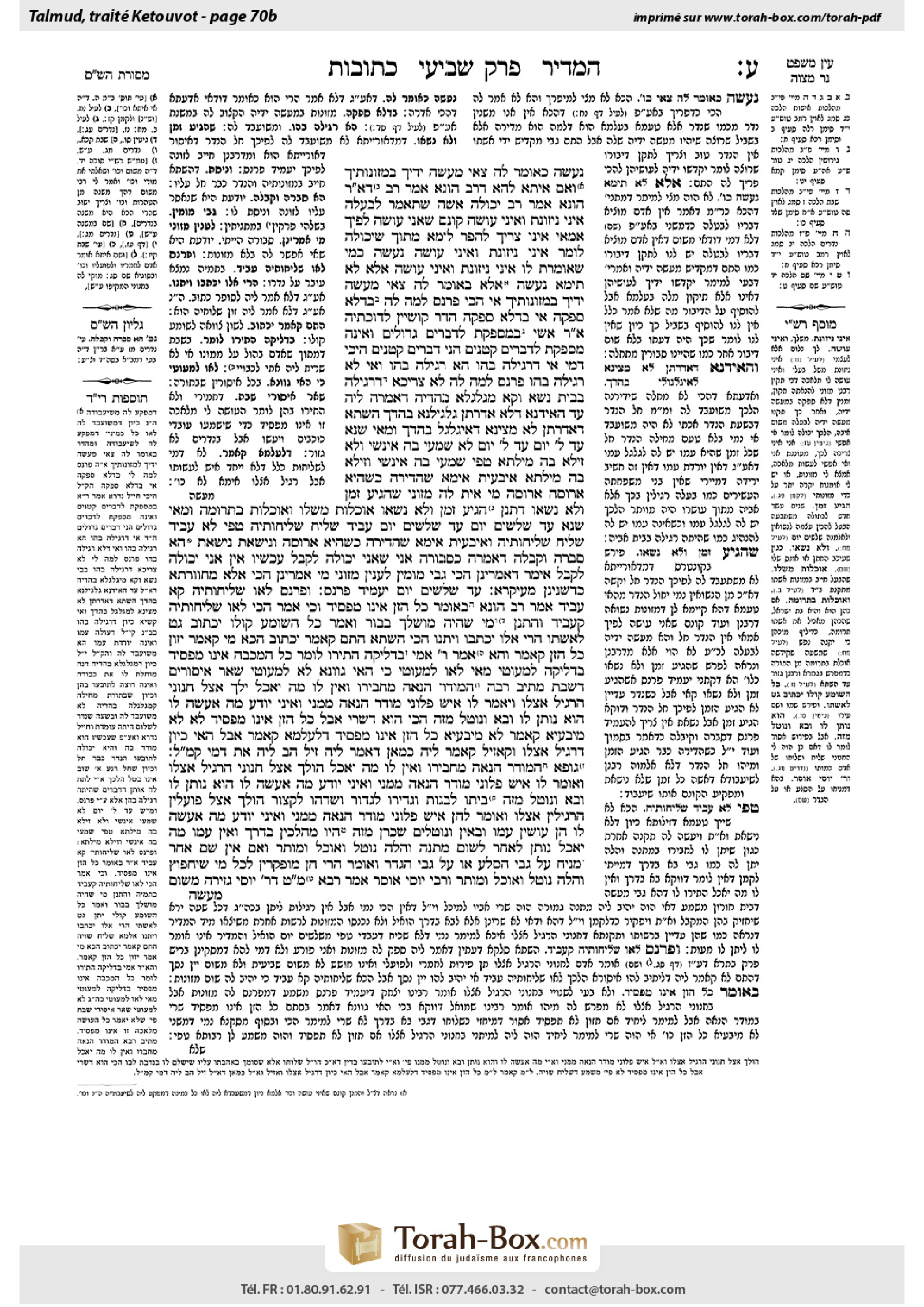
Ketubot 70b: Talmud study for Daf Yomi
Daf Yomi is the daily study of one Talmud folio. Explore 37 tractates with scans, Hebrew text, Sefaria English and AI-generated French translations where annotated.
Passage selection and English or AI-generated French translation are available where the scan has annotations. Daf Study is independent of Torah-Box and Sefaria.
Browse Ketubot · כתובות · All tractatesKetubot 70b text and translations
This page of Ketubot includes the Aramaic text, an English translation and an AI-generated French translation, alongside the scan above.
כתובות ע׳ ב · Aramaic and Hebrew text
נַעֲשָׂה כְּאוֹמֵר לָהּ ״צְאִי מַעֲשֵׂה יָדַיִךְ בִּמְזוֹנוֹתַיִךְ״. וְאִם אִיתַהּ לְהָא דְּרַב הוּנָא אָמַר רַב, דְּאָמַר רַב הוּנָא אָמַר רַב: יְכוֹלָה אִשָּׁה שֶׁתֹּאמַר לְבַעְלָהּ ״אֵינִי נִיזּוֹנֶת וְאֵינִי עוֹשָׂה״, ״קוּנָּם שֶׁאֲנִי עוֹשָׂה לְפִיךָ״, אַמַּאי אֵינוֹ צָרִיךְ לְהָפֵר? לֵימָא: מִתּוֹךְ שֶׁיְּכוֹלָה לוֹמַר ״אֵינִי נִיזּוֹנֶת וְאֵינִי עוֹשָׂה״, נַעֲשֶׂה כְּמִי שֶׁאוֹמֶרֶת לוֹ: ״אֵינִי נִיזּוֹנֶת וְאֵינִי עוֹשָׂה״.
אֶלָּא, לָא תֵּימָא ״נַעֲשֶׂה״, אֶלָּא בְּאוֹמֵר לָהּ: ״צְאִי מַעֲשֵׂה יָדַיִךְ בִּמְזוֹנוֹתַיִךְ״.
אִי הָכִי פַּרְנָס לְמָה לַהּ? בִּדְלָא סָפְקָה: אִי בִּדְלָא סָפְקָה — הֲדַר קוּשְׁיַין לְדוּכְתֵּיהּ? אָמַר רַב אָשֵׁי: בְּמַסְפֶּקֶת לִדְבָרִים גְּדוֹלִים, וְאֵינָהּ מַסְפֶּקֶת לִדְבָרִים קְטַנִּים.
הָנֵי דְּבָרִים קְטַנִּים, הֵיכִי דָמֵי? אִי דִּרְגִילָה בְּהוּ — הָא רְגִילָה בְּהוּ! וְאִי לָא רְגִילָה בְּהוּ — פַּרְנָס לְמָה לַהּ? לָא צְרִיכָא: דִּרְגִילָה בְּבֵית נָשָׁא, וְקָא מְגַלְגְּלָא בַּהֲדֵיהּ, דְּאָמְרָה לֵיהּ: עַד הָאִידָּנָא דְּלָא אַדַּרְתַּן — גַּלְגֵּילְנָא בַּהֲדָךְ, הַשְׁתָּא דְּאַדַּרְתַּן — לָא מָצֵינָא דֶּאֱיגַלְגֵּל בַּהֲדָךְ.
וּמַאי שְׁנָא עַד שְׁלֹשִׁים יוֹם? עַד שְׁלֹשִׁים יוֹם לֹא שָׁמְעִי בַּהּ אִינָשֵׁי וְלָא זִילָא בַּהּ מִילְּתָא, טְפֵי — שָׁמְעִי בַּהּ אִינָשֵׁי וְזִילָא בַּהּ מִילְּתָא.
אִיבָּעֵית אֵימָא שֶׁהִדִּירָהּ כְּשֶׁהִיא אֲרוּסָה, אֲרוּסָה מִי אִית לַהּ מְזוֹנֵי? שֶׁהִגִּיעַ זְמַן וְלֹא נִשְּׂאוּ. דִּתְנַן: הִגִּיעַ זְמַן וְלֹא נִשְּׂאוּ — אוֹכְלוֹת מִשֶּׁלּוֹ וְאוֹכְלוֹת בִּתְרוּמָה.
וּמַאי שְׁנָא עַד שְׁלֹשִׁים יוֹם? עַד שְׁלֹשִׁים יוֹם עָבֵיד שָׁלִיחַ שְׁלִיחוּתֵיהּ, טְפֵי — לָא עָבֵיד שָׁלִיחַ שְׁלִיחוּתֵיהּ.
וְאִיבָּעֵית אֵימָא שֶׁהִדִּירָהּ כְּשֶׁהִיא אֲרוּסָה וְנִישֵּׂאת, נִישֵּׂאת — הָא סְבַרָה וְקַבִּילָה! דְּאָמְרָה: כִּסְבוּרָה אֲנִי שֶׁאֲנִי יְכוֹלָה לְקַבֵּל, עַכְשָׁיו אֵין אֲנִי יְכוֹלָה לְקַבֵּל.
אֵימַר דְּאָמְרִינַן הָכִי גַּבֵּי מוּמִין, לְעִנְיַן מְזוֹנֵי מִי אָמְרִינַן הָכִי? אֶלָּא מְחַוַּורְתָּא כִּדְשַׁנִּינַן מֵעִיקָּרָא.
עַד שְׁלֹשִׁים יוֹם יַעֲמִיד פַּרְנָס. וּפַרְנָס לָאו שְׁלִיחוּתֵיהּ קָא עָבֵיד? אָמַר רַב הוּנָא, בְּאוֹמֵר: ״כׇּל הַזָּן אֵינוֹ מַפְסִיד״.
וְכִי אָמַר הָכִי לָאו שְׁלִיחוּתֵיהּ קָעָבֵיד? וְהָתְנַן: מִי שֶׁהָיָה מוּשְׁלָךְ בְּבוֹר, וְאָמַר: ״כׇּל הַשּׁוֹמֵעַ קוֹלוֹ יִכְתּוֹב גֵּט לְאִשְׁתּוֹ״ — הֲרֵי אֵלּוּ יִכְתְּבוּ וְיִתְּנוּ!
הָכִי הַשְׁתָּא?! הָתָם קָאָמַר ״יִכְתּוֹב״, הָכָא מִי קָאָמַר ״יָזוּן״? ״כׇּל הַזָּן״ קָאָמַר!
וְהָא אָמַר רַבִּי אַמֵּי: בִּדְלֵיקָה הִתִּירוּ לוֹמַר: ״כׇּל הַמְכַבֶּה אֵינוֹ מַפְסִיד״. בִּדְלֵיקָה לְמַעוֹטֵי מַאי? לָאו לְמַעוֹטֵי כִּי הַאי גַוְונָא?! לָא, לְמַעוֹטֵי שְׁאָר אִיסּוּרִים דְּשַׁבָּת.
מֵתִיב רַבָּה: הַמּוּדָּר הֲנָאָה מֵחֲבֵירוֹ, וְאֵין לוֹ מַה יֹּאכַל — יֵלֵךְ אֵצֶל חֶנְוָנִי הָרָגִיל אֶצְלוֹ, וְיֹאמַר לוֹ: ״אִישׁ פְּלוֹנִי מוּדָּר הֲנָאָה מִמֶּנִּי, וְאֵינִי יוֹדֵעַ מָה אֶעֱשֶׂה לוֹ״. הוּא נוֹתֵן לוֹ, וּבָא וְנוֹטֵל מִזֶּה. הָכִי הוּא דִּשְׁרֵי, אֲבָל ״כׇּל הַזָּן אֵינוֹ מַפְסִיד״ — לָא!
לָא מִיבַּעְיָא קָאָמַר: לָא מִיבַּעְיָא ״כׇּל הַזָּן אֵינוֹ מַפְסִיד״ — דִּלְעָלְמָא קָאָמַר, אֲבָל הַאי, כֵּיוָן דְּרָגִיל אֶצְלוֹ וְקָאָזֵיל קָאָמַר לֵיהּ, כְּמַאן דְּאָמַר לֵיהּ זִיל, ״הַב לֵיהּ אַתְּ״ דָּמֵי — קָא מַשְׁמַע לַן.
גּוּפָא: הַמּוּדָּר הֲנָאָה מֵחֲבֵירוֹ וְאֵין לוֹ מַה יֹּאכַל, הוֹלֵךְ אֵצֶל חֶנְוָנִי הָרָגִיל אֶצְלוֹ, וְאוֹמֵר לוֹ: ״אִישׁ פְּלוֹנִי מוּדָּר הֲנָאָה מִמֶּנִּי, וְאֵינִי יוֹדֵעַ מָה אֶעֱשֶׂה לוֹ״. הוּא נוֹתֵן לוֹ, וּבָא וְנוֹטֵל מִזֶּה. בֵּיתוֹ לִבְנוֹת, וּגְדֵירוֹ לִגְדּוֹר, וְשָׂדֵהוּ לִקְצוֹר — הוֹלֵךְ אֵצֶל פּוֹעֲלִין הָרְגִילִין אֶצְלוֹ, וְאוֹמֵר לָהֶן: ״אִישׁ פְּלוֹנִי מוּדָּר הֲנָאָה מִמֶּנִּי וְאֵינִי יוֹדֵעַ מָה אֶעֱשֶׂה לוֹ״. הֵן עוֹשִׂין עִמּוֹ, וּבָאִין וְנוֹטְלִים שְׂכָרָן מִזֶּה.
הָיוּ מְהַלְּכִין בַּדֶּרֶךְ, וְאֵין עִמּוֹ מַה יֹּאכַל — נוֹתֵן לְאַחֵר לְשׁוּם מַתָּנָה, וְהַלָּה נוֹטֵל וְאוֹכֵל, וּמוּתָּר. וְאִם אֵין שָׁם אַחֵר — מַנִּיחַ עַל גַּבֵּי הַסֶּלַע אוֹ עַל גַּבֵּי הַגָּדֵר, וְאוֹמֵר: ״הֲרֵי הֵן מוּפְקָרִין לְכׇל מִי שֶׁיַּחְפּוֹץ״, וְהַלָּה נוֹטֵל וְאוֹכֵל, וּמוּתָּר. וְרַבִּי יוֹסֵי אוֹסֵר. אָמַר רָבָא: מַאי טַעְמָא דְּרַבִּי יוֹסֵי — גְּזֵירָה מִשּׁוּם
Ketubot 70b · English translation
it is considered as though he were in fact saying to her: Spend your earnings to sustain yourself. The Gemara raises a difficulty: And if it is so, i.e., that the halakha is in accordance with that statement that Rav Huna said that Rav said, as Rav Huna said that Rav said: A wife may say to her husband: I will not be sustained by you and, in turn, I will not work, i.e., you will not keep my earnings, then when she says: That which I perform for the benefit of your mouth will be forbidden like an offering [konam], why does he not need to nullify the vow? Here too, let us say: Since she is able to say: I will not be sustained by you and I will not work, it is considered as though she were in fact saying to him by her vow: I will not be sustained by you and I will not work, and he should therefore have to nullify the vow.
Rather, the Gemara retracts its previous interpretation in favor of the following: Do not say it is considered as though he said to her: Spend your earnings to sustain yourself. Rather, the mishna is referring to a case where he explicitly says to her: Spend your earnings to sustain yourself.
The Gemara raises a difficulty: If so, if he provided for her sustenance by instructing her to spend her own earnings, why does she require a trustee? The Gemara answers: This is referring to a situation where the amount she earns is not enough for her needs. Therefore, the husband must appoint a trustee to provide the balance. The Gemara asks: If it is a case where the amount she earns is not enough for her needs, our difficulty is restored to its place: How can he prohibit her from benefiting from him if he is under a prior obligation to provide for her? Rav Ashi said: The mishna is referring to a case where her earnings are enough for large things, i.e., her basic requirements, but not enough for small things.
The Gemara asks: With regard to these small things for which her earnings are not enough, what are the circumstances? If the discussion involves a case where she is accustomed to them, then she is accustomed to them and they are equivalent to all other necessities, which he must provide. And if she is not accustomed to them, why does she require a trustee? The Gemara answers: No, it is necessary in a case where she was accustomed to such small provisions in her father’s house, but she agreed to marry him and lower her lifestyle, and she had, until now, abided the lesser lifestyle and remained with him. For she says to him: Until now, when you did not vow to render it prohibited for me to benefit from you, I abided the lesser lifestyle and remained with you. However, now that you have vowed, I can no longer abide the lesser lifestyle and remain with you, and therefore I wish to revert to the conditions of my father’s house.
The Gemara poses a question: And what is different about the time period mentioned in the mishna: Up to thirty days? The Gemara answers: If up to thirty days have passed, this is a short enough amount of time that people do not hear about her, and the matter of her receiving her sustenance through an intermediary is therefore not demeaning for her. However, if the vow lasts longer than this, people do hear about her, and the matter is demeaning for her. The husband must therefore decide if he wants to divorce her or sustain her in the appropriate fashion.
The Gemara suggests an alternative answer: If you wish, say that the husband is under no obligation to sustain her because the case discussed in the mishna was where he vowed and obligated her when she was still a betrothed woman, and therefore he was not yet duty-bound to provide her with sustenance. The Gemara is puzzled by this explanation: Does a betrothed woman have any right to sustenance from her husband at all? The Gemara answers: The circumstance referred to is when the arranged time for the marriage had arrived and they had not yet gotten married. As we learned in a mishna (57a): If the time arrived and they had not yet gotten married, such women may eat food from his property, and if their husbands were priests they may partake of teruma.
The Gemara asks: But if so, what is different if the vow will remain in effect for up to thirty days or longer? The Gemara answers: For up to thirty days, the agent will carry out his agency effectively and take proper care of her needs. If the vow lasts longer, the agent will not fully carry out his agency but will begin to neglect her, until she cannot bear the situation any longer.
And if you wish, say that he vowed and obligated her when she was still a betrothed woman and she subsequently married him, and therefore he is obligated to provide her sustenance. The Gemara is puzzled: If she married him after his vow, she considered the matter and accepted it upon herself. Why then is he forced to divorce her? The Gemara answers: The case is when she says: I thought that I could accept this manner of living, but now I see that I cannot accept it.
The Gemara raises a difficulty: You can say that we say so, that if either the husband or the wife suffers from a physical blemish, the other can demand a divorce even after agreeing to the marriage under these conditions. This is with regard to blemishes, but with regard to sustenance can we say so? Rather, it is clear as we initially answered: The mishna discusses either a case where he told her to support herself from her own earnings and she had accepted a lower standard of living while she was with him, or a case where he took the vow when she was betrothed, and now the appointed time for the marriage has arrived and they have not yet gotten married.
§ The mishna states that if his vow will remain in effect for up to thirty days he must appoint a trustee to provide sustenance to his wife. The Gemara is puzzled by this ruling: And does a trustee not perform the husband’s agency? If through his vow he has rendered it prohibited for her to derive benefit from him, how can he provide for her through the trustee? An action performed by an agent is considered to have been performed by the principal. Rav Huna said: The trustee discussed in the mishna was not actually appointed as an agent. Rather, the mishna is referring to one who says in general terms: Whoever sustains my wife will not lose out. Thus, anyone who complies does so of his own choice, although the husband will later compensate him. Therefore, the wife is not benefiting directly from the husband.
The Gemara poses a question: And when a husband says this, is the one who responds not performing the husband’s agency? But didn’t we learn in a mishna (Gittin 66a): With regard to one who was cast into a pit and said that whoever hears his voice should write a bill of divorce for his wife, saying this out of concern that he might not be rescued and that she would not be able to remarry or would be required to enter into levirate marriage, those who heard him should write and give her a bill of divorce? This ruling indicates that they are considered his agents based on his instructions, as otherwise they would not be able to write a bill of divorce on his behalf. The similarly formulated statement here should therefore also endow the trustee with the status of an agent.
The Gemara refutes this claim: How can these cases be compared? There, in the case of a bill of divorce, he says that whoever hears his voice should write a bill of divorce, which is a command, and therefore those who hear him are considered his agents. Here, however, does he say that anyone should sustain his wife? He merely says: Whoever sustains her will not lose out, which is a general statement.
The Gemara raises a difficulty: But Rabbi Ami said: In the case of a fire that broke out on Shabbat, the Sages permitted him to say in the presence of gentiles: Whoever extinguishes this fire will not lose out. From this it can be inferred that the phrase: In the case of a fire, comes to exclude what? Does it not exclude a case like this? It would seem that it was only in the case of a fire, when there are several extenuating factors, that the Sages permitted the use of such an expression without treating it as the appointment of an agent. The Gemara refutes this: No, this ruling serves to exclude other prohibitions of Shabbat.
Rabba raised an objection from a mishna (Nedarim 43a): In the case of one prohibited by a vow from deriving benefit from another because of a vow the other took, and he does not have anything to eat, if the one who made the vow wants to help him but is unable to do so due to the vow, he may go to a storekeeper with whom he is familiar and say to him: So-and-so is prohibited by a vow from deriving benefit from me, and I do not know what I can do for him. The storekeeper subsequently gives food to him, and later comes and takes payment from this person who approached him. Rabba infers: This method of indirectly hinting is what is permitted, but he may not say: Whoever sustains the man will not lose out, as a declaration of that kind would make the storekeeper his agent.
The Gemara refutes this claim: The tanna is speaking utilizing the style of: It is not necessary, and he means the following: It is not necessary to say that he is permitted to say in general terms: Whoever sustains so-and-so will not lose out, as by doing so he is speaking to everyone and therefore does not appoint a specific agent. But this storekeeper, since the one who took the oath is familiar with him and he goes and says this to him, might be considered like the one who said to him: Go, give him yourself. The mishna therefore teaches us that since the one who made the vow did not issue an explicit command, the storekeeper is not considered his agent.
§ Since it mentioned the above case, the Gemara returns to discuss the matter itself: In the case of one prohibited by a vow from deriving benefit from another because of a vow the other took, and he does not have anything to eat, the one who took the vow may go to a storekeeper with whom he is familiar and say to him: So-and-so is prohibited by a vow from deriving benefit from me, and I do not know what I can do for him. The storekeeper gives food to him, and later comes and takes payment from this one who approached him. Similarly, if the subject of the vow needed someone to build his house, or to erect his fence, or to reap his field, and the one who took the vow wants to help him, he should go to workers with whom he is familiar and say to them: So-and-so is prohibited by a vow from deriving benefit from me, and I do not know what I can do for him. They subsequently perform work for the subject of the vow, and they come and take their wages from this person who spoke to them.
If the two were walking along the way, and the one prohibited from benefiting from the other does not have anything with him to eat, the one who took the vow may give food to a different person as a gift, and this one takes it and eats, and this arrangement is permitted, as he did not give the food directly to him. And if there is no other person there apart from the two of them, he should place the items on a rock or on a fence and say: They are hereby declared ownerless for anyone who wants them, and this one takes the food items and eats them, and this too is permitted. But Rabbi Yosei prohibits this practice. Rava said: What is the reason for this ruling of Rabbi Yosei? It is a rabbinic decree due to
Ketubot 70b · Traduction française (IA)
C’est considéré comme s’il lui disait en fait : « Dépense tes gains pour subvenir à tes besoins. » La Guemara soulève une difficulté : Et s’il en est ainsi, c’est-à-dire si la halakha suit cette déclaration de Rav Houna au nom de Rav — car Rav Houna a dit au nom de Rav : Une épouse peut dire à son mari : « Je ne veux pas que tu subviennes à mes besoins et, en contrepartie, je ne travaillerai pas », c’est-à-dire que tu ne percevras pas mes gains —, lorsqu’elle dit : « Ce que je fais pour ta bouche me sera interdit comme une offrande [konam] », pourquoi n’a-t-il pas besoin d’annuler le vœu ? Ici aussi, disons que, puisqu’elle peut dire : « Je ne veux pas que tu subviennes à mes besoins et je ne travaillerai pas », il est considéré comme si elle lui disait en fait, par son vœu : « Je ne veux pas que tu subviennes à mes besoins et je ne travaillerai pas » ; il devrait donc devoir annuler le vœu.
La Guemara abandonne plutôt son interprétation précédente et propose la suivante : Ne dis pas qu’il est considéré comme s’il lui avait dit : « Dépense tes gains pour subvenir à tes besoins. » La Michna parle plutôt d’un cas où il lui dit explicitement : « Dépense tes gains pour subvenir à tes besoins. »
La Guemara soulève une difficulté : Si tel est le cas, s’il subvient à ses besoins en lui disant de dépenser ses propres gains, pourquoi a-t-elle besoin d’un intendant ? La Guemara répond : Il s’agit d’une situation où ses gains ne suffisent pas à couvrir ses besoins. Le mari doit donc nommer un intendant pour fournir le complément. La Guemara demande : Si ses gains ne suffisent pas à couvrir ses besoins, la difficulté se pose de nouveau : comment peut-il lui interdire de tirer bénéfice de lui alors qu’il est tenu de subvenir à ses besoins ? Rav Achi dit : La Michna parle d’un cas où ses gains suffisent pour les besoins essentiels, mais pas pour les besoins secondaires.
La Guemara demande : Pour ces besoins secondaires que ses gains ne suffisent pas à couvrir, quelle est la situation ? Si elle est habituée à en bénéficier, alors ils équivalent à tous les autres besoins essentiels qu’il doit lui fournir. Et si elle n’y est pas habituée, pourquoi a-t-elle besoin d’un intendant ? La Guemara répond : Non, cela est nécessaire dans le cas où elle était habituée à ces petites dépenses dans la maison de son père, mais a accepté de l’épouser et de réduire son train de vie ; jusqu’à présent, elle s’était accommodée de ce mode de vie plus modeste et était restée avec lui. Elle lui dit en effet : « Jusqu’à présent, alors que tu ne m’avais pas interdit par un vœu de tirer bénéfice de toi, je me suis accommodée de ce train de vie plus modeste et je suis restée avec toi. Mais maintenant que tu as fait ce vœu, je ne peux plus m’en accommoder ni rester avec toi ; je souhaite donc retrouver les conditions de vie de la maison de mon père. »
La Guemara pose une question : Pourquoi la Michna mentionne-t-elle précisément la période allant jusqu’à trente jours ? La Guemara répond : Si le délai ne dépasse pas trente jours, la période est assez courte pour que les gens n’entendent pas parler de sa situation ; le fait qu’elle reçoive sa subsistance par l’intermédiaire d’un tiers n’est donc pas déshonorant pour elle. Mais si le vœu dure plus longtemps, les gens en entendent parler, et cela est déshonorant pour elle. Le mari doit donc décider s’il veut divorcer d’elle ou subvenir à ses besoins de manière appropriée.
La Guemara propose une autre réponse : Si tu le souhaites, dis que le mari n’est pas tenu de subvenir à ses besoins, car le cas évoqué dans la Michna est celui où il a fait le vœu et lui a imposé cette obligation alors qu’elle était encore fiancée ; il n’était donc pas encore tenu de subvenir à ses besoins. La Guemara s’étonne de cette explication : Une fiancée a-t-elle le moindre droit de recevoir de son mari de quoi subvenir à ses besoins ? La Guemara répond : Il s’agit du cas où la date fixée pour le mariage était arrivée, mais où ils ne s’étaient pas encore mariés. En effet, nous avons appris dans une Michna (57a) : Si la date est arrivée et qu’ils ne se sont pas encore mariés, ces femmes peuvent se nourrir des biens de leur mari et, si leurs maris sont des prêtres, elles peuvent consommer de la terouma.
La Guemara demande : Mais alors, quelle différence y a-t-il entre un vœu qui demeure en vigueur jusqu’à trente jours et un vœu qui dure plus longtemps ? La Guemara répond : Jusqu’à trente jours, l’intendant s’acquittera convenablement de sa mission et veillera correctement à ses besoins. Si le vœu dure plus longtemps, l’intendant ne s’acquittera pas pleinement de sa mission et commencera à la négliger, jusqu’à ce qu’elle ne puisse plus supporter la situation.
Et si tu le souhaites, dis qu’il a fait le vœu et lui a imposé cette obligation alors qu’elle était encore fiancée, puis qu’elle l’a épousé ; il est donc tenu de subvenir à ses besoins. La Guemara s’étonne : Si elle l’a épousé après son vœu, elle a réfléchi à la situation et l’a acceptée. Pourquoi devrait-il alors être contraint de divorcer d’elle ? La Guemara répond : Il s’agit du cas où elle dit : « Je pensais pouvoir accepter ce mode de vie, mais je vois maintenant que je ne peux pas l’accepter. »
La Guemara soulève une difficulté : On peut dire cela, à savoir que si le mari ou la femme souffre d’un défaut physique, l’autre peut exiger le divorce même après avoir accepté le mariage dans ces conditions. Cela concerne les défauts physiques ; peut-on en dire autant de la subsistance ? Il est donc clair que la réponse initiale était correcte : la Michna traite soit d’un cas où il lui a dit de subvenir à ses besoins avec ses propres gains et où elle avait accepté un niveau de vie inférieur tant qu’elle vivait avec lui, soit d’un cas où il a fait le vœu alors qu’elle était fiancée et où la date fixée pour le mariage est maintenant arrivée, mais où ils ne se sont pas encore mariés.
§ La Michna indique que si son vœu demeure en vigueur jusqu’à trente jours, il doit nommer un intendant pour subvenir aux besoins de son épouse. La Guemara s’étonne de cette règle : L’intendant n’agit-il pas comme le mandataire du mari ? S’il lui a interdit, par son vœu, de tirer bénéfice de lui, comment peut-il subvenir à ses besoins par l’intermédiaire de l’intendant ? Un acte accompli par un mandataire est considéré comme ayant été accompli par le mandant. Rav Houna dit : L’intendant dont parle la Michna n’a pas réellement été désigné comme mandataire. La Michna parle plutôt d’un homme qui dit en termes généraux : « Quiconque subvient aux besoins de mon épouse n’y perdra pas. » Ainsi, quiconque agit le fait de son propre chef, même si le mari le dédommagera par la suite. L’épouse ne tire donc pas directement bénéfice du mari.
La Guemara pose une question : Et lorsqu’un mari dit cela, celui qui répond à son appel n’agit-il pas comme son mandataire ? Pourtant, n’avons-nous pas appris dans une Michna (Gittin 66a) : À propos d’un homme tombé dans une fosse et qui dit que quiconque entend sa voix doit écrire un acte de divorce pour son épouse — il le dit par crainte de ne pas être secouru, auquel cas elle ne pourrait pas se remarier ou devrait entrer en lévirat —, ceux qui l’ont entendu doivent écrire et lui remettre un acte de divorce. Cette règle indique qu’ils sont considérés comme ses mandataires sur la base de ses instructions, car autrement ils ne pourraient pas rédiger un acte de divorce en son nom. La déclaration formulée de la même manière ici devrait donc, elle aussi, conférer à l’intendant le statut de mandataire.
La Guemara réfute cette affirmation : Comment comparer ces cas ? Là, dans le cas de l’acte de divorce, il dit que quiconque entend sa voix doit écrire un acte de divorce : c’est un ordre, et ceux qui l’entendent sont donc considérés comme ses mandataires. Ici, en revanche, dit-il que quelqu’un doit subvenir aux besoins de son épouse ? Il dit seulement : « Quiconque subvient à ses besoins n’y perdra pas », ce qui est une déclaration générale.
La Guemara soulève une difficulté : Pourtant, Rabbi Ami a dit : Dans le cas d’un incendie qui s’est déclaré pendant Chabbat, les Sages ont permis de dire en présence de non-Juifs : « Quiconque éteint cet incendie n’y perdra pas. » On peut en déduire que l’expression « dans le cas d’un incendie » vise à exclure quoi ? Ne vise-t-elle pas un cas comme celui-ci ? Il semblerait que ce ne soit que dans le cas d’un incendie, où plusieurs circonstances atténuantes sont réunies, que les Sages ont permis d’employer une telle formule sans considérer qu’elle vaut désignation d’un mandataire. La Guemara réfute cette interprétation : Non, cette règle vise à exclure les autres interdictions de Chabbat.
Rabba soulève une objection à partir d’une Michna (Nedarim 43a) : Dans le cas d’un homme à qui le vœu d’un autre interdit de tirer bénéfice de ce dernier et qui n’a rien à manger, si celui qui a fait le vœu veut l’aider mais ne le peut pas à cause de ce vœu, il peut aller trouver un boutiquier qu’il connaît et lui dire : « Untel a l’interdiction, en vertu d’un vœu, de tirer bénéfice de moi, et je ne sais pas ce que je peux faire pour lui. » Le boutiquier lui donne alors de la nourriture, puis vient se faire payer par celui qui s’était adressé à lui. Rabba en déduit que seule cette manière de faire une allusion indirecte est permise, mais qu’il ne peut pas dire : « Quiconque subvient aux besoins de cet homme n’y perdra pas », car une déclaration de ce genre ferait du boutiquier son mandataire.
La Guemara réfute cette affirmation : Le tanna s’exprime selon la formule « il n’est pas nécessaire », et veut dire ceci : Il n’est pas nécessaire de préciser qu’il lui est permis de dire en termes généraux : « Quiconque subvient aux besoins d’Untel n’y perdra pas », car il s’adresse ainsi à tout le monde et ne désigne donc aucun mandataire en particulier. Mais ce boutiquier, puisque celui qui a fait le vœu le connaît et va lui parler, pourrait être considéré comme si celui-ci lui avait dit : « Va, donne-lui toi-même. » La Michna nous enseigne donc que, comme celui qui a fait le vœu n’a pas donné d’ordre explicite, le boutiquier n’est pas considéré comme son mandataire.
§ Puisqu’elle a mentionné le cas précédent, la Guemara revient à l’examen du sujet lui-même : Dans le cas d’un homme à qui le vœu d’un autre interdit de tirer bénéfice de ce dernier et qui n’a rien à manger, celui qui a fait le vœu peut aller trouver un boutiquier qu’il connaît et lui dire : « Untel a l’interdiction, en vertu d’un vœu, de tirer bénéfice de moi, et je ne sais pas ce que je peux faire pour lui. » Le boutiquier lui donne de la nourriture, puis vient se faire payer par celui qui s’était adressé à lui. De même, si la personne visée par le vœu a besoin que quelqu’un construise sa maison, érige sa clôture ou moissonne son champ, et que celui qui a fait le vœu souhaite l’aider, il doit aller trouver des ouvriers qu’il connaît et leur dire : « Untel a l’interdiction, en vertu d’un vœu, de tirer bénéfice de moi, et je ne sais pas ce que je peux faire pour lui. » Les ouvriers effectuent alors le travail pour la personne visée par le vœu, puis viennent réclamer leur salaire à celui qui leur a parlé.
Si les deux hommes marchent en chemin et que celui à qui il est interdit de tirer bénéfice de l’autre n’a rien à manger avec lui, celui qui a fait le vœu peut offrir de la nourriture à une autre personne ; celle-ci la prend et la mange, et cet arrangement est permis, car la nourriture ne lui a pas été donnée directement. Et s’il n’y a personne d’autre que les deux hommes, il doit déposer les aliments sur un rocher ou sur une clôture et dire : « Ils sont désormais sans propriétaire, pour quiconque les veut. » L’autre prend alors les aliments et les mange, ce qui est également permis. Mais Rabbi Yosei interdit cette pratique. Rava dit : Quelle est la raison de cette règle de Rabbi Yosei ? Il s’agit d’un décret rabbinique motivé par
Traduction française générée par IA à partir de l’édition anglaise de Sefaria. Vérifie toujours un passage avec le texte source.
Text from Sefaria: William Davidson Edition - Vocalized Aramaic (CC BY NC); William Davidson Edition - English (CC BY NC).