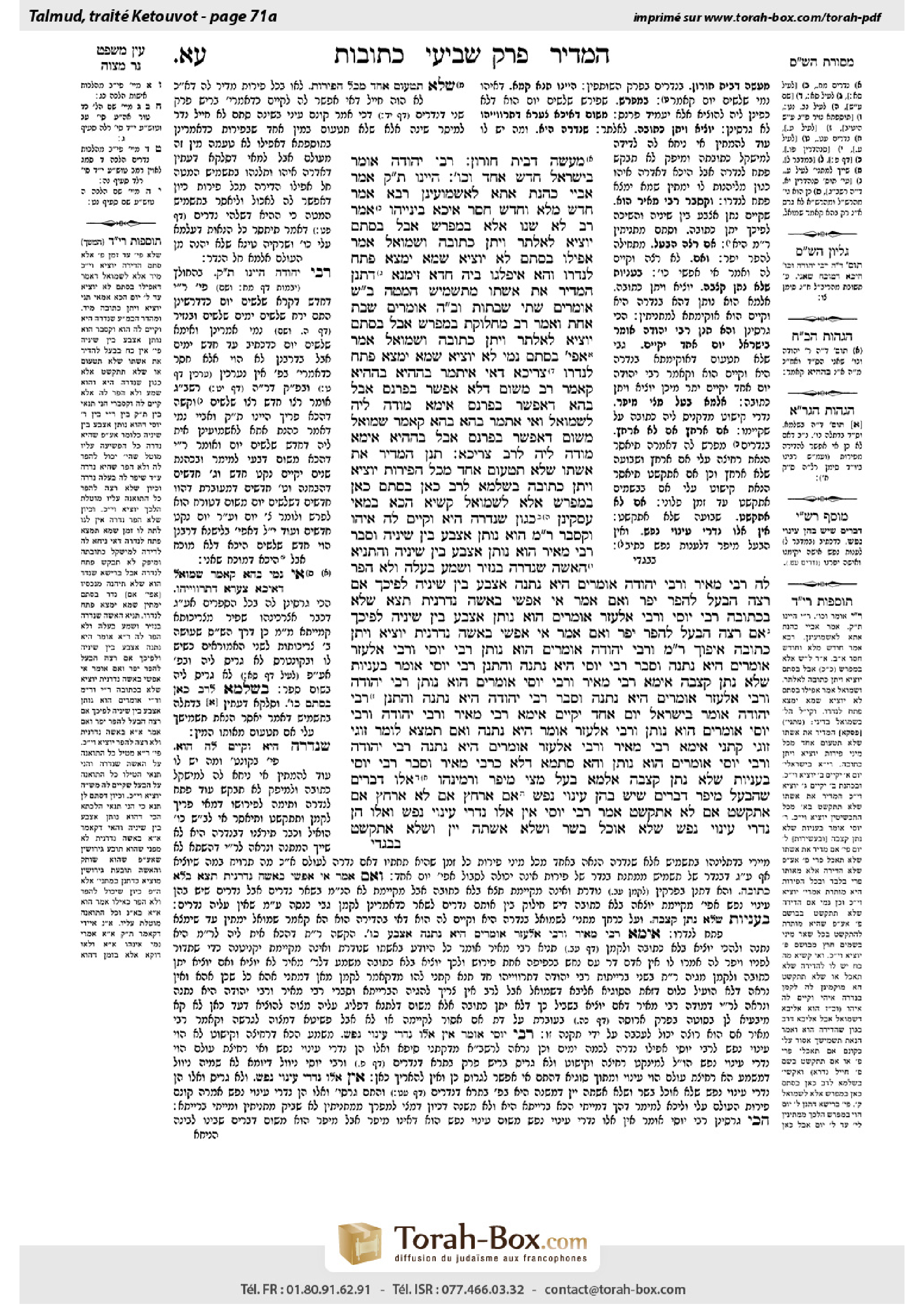
Ketubot 71a: Talmud study for Daf Yomi
Daf Yomi is the daily study of one Talmud folio. Explore 37 tractates with scans, Hebrew text, Sefaria English and AI-generated French translations where annotated.
Passage selection and English or AI-generated French translation are available where the scan has annotations. Daf Study is independent of Torah-Box and Sefaria.
Browse Ketubot · כתובות · All tractatesKetubot 71a text and translations
This page of Ketubot includes the Aramaic text, an English translation and an AI-generated French translation, alongside the scan above.
כתובות ע״א א · Aramaic and Hebrew text
מַעֲשֶׂה דְּבֵית חוֹרוֹן.
רַבִּי יְהוּדָה אוֹמֵר: בְּיִשְׂרָאֵל חֹדֶשׁ אֶחָד וְכוּ׳. הַיְינוּ תַּנָּא קַמָּא? אָמַר אַבָּיֵי: כֹּהֶנֶת אֲתָא לְאַשְׁמוֹעִינַן. רָבָא אָמַר: חֹדֶשׁ מָלֵא וְחֹדֶשׁ חָסֵר אִיכָּא בֵּינַיְיהוּ.
אָמַר רַב: לֹא שָׁנוּ אֶלָּא בִּמְפָרֵשׁ, אֲבָל בִּסְתָם — יוֹצִיא לְאַלְתַּר וְיִתֵּן כְּתוּבָּה. וּשְׁמוּאֵל אָמַר: אֲפִילּוּ בִּסְתָם לֹא יוֹצִיא, שֶׁמָּא יִמְצָא פֶּתַח לְנִדְרוֹ.
וְהָא אִיפְּלִגוּ בַּיהּ חֲדָא זִימְנָא, דִּתְנַן: הַמַּדִּיר אֶת אִשְׁתּוֹ מִתַּשְׁמִישׁ הַמִּטָּה, בֵּית שַׁמַּאי אוֹמְרִים: שְׁתֵּי שַׁבָּתוֹת. — וּבֵית הִלֵּל אוֹמְרִים: שַׁבָּת אַחַת. וְאָמַר רַב: מַחְלוֹקֶת בִּמְפָרֵשׁ, אֲבָל בִּסְתָם — יוֹצִיא לְאַלְתַּר וְיִתֵּן כְּתוּבָּה. וּשְׁמוּאֵל אָמַר: אֲפִילּוּ בִּסְתָם נָמֵי לֹא יוֹצִיא, שֶׁמָּא יִמְצָא פֶּתַח לְנִדְרוֹ.
צְרִיכָא, דְּאִי אִיתְּמַר בְּהָהִיא: בְּהָהִיא קָאָמַר רַב — מִשּׁוּם דְּלָא אֶפְשָׁר בְּפַרְנָס, אֲבָל בְּהָא, דְּאֶפְשָׁר בְּפַרְנָס — אֵימָא מוֹדֶה לֵיהּ לִשְׁמוּאֵל. וְאִי אִתְּמַר בְּהָא: בְּהָא קָאָמַר שְׁמוּאֵל — מִשּׁוּם דְּאֶפְשָׁר בְּפַרְנָס, אֲבָל בְּהַהִיא, אֵימָא מוֹדֶה לֵיהּ לְרַב — צְרִיכָא.
תְּנַן: הַמַּדִּיר אֶת אִשְׁתּוֹ שֶׁלֹּא תִּטְעוֹם אֶחָד מִכׇּל הַפֵּירוֹת — יוֹצִיא וְיִתֵּן כְּתוּבָּה. בִּשְׁלָמָא לְרַב: כָּאן בִּסְתָם, כָּאן בִּמְפָרֵשׁ. אֶלָּא לִשְׁמוּאֵל קַשְׁיָא!
הָכָא בְּמַאי עָסְקִינַן — כְּגוֹן שֶׁנָּדְרָה הִיא, וְקִיֵּים לָהּ אִיהוּ. וְקָסָבַר רַבִּי מֵאִיר, הוּא נוֹתֵן אֶצְבַּע בֵּין שִׁינֶּיהָ.
וְסָבַר רַבִּי מֵאִיר הוּא נוֹתֵן אֶצְבַּע בֵּין שִׁינֶּיהָ? וְהָתַנְיָא: הָאִשָּׁה שֶׁנָּדְרָה בְּנָזִיר, וְשָׁמַע בַּעְלָהּ וְלֹא הֵפֵר לָהּ, רַבִּי מֵאִיר וְרַבִּי יְהוּדָה אוֹמְרִים: הִיא נָתְנָה אֶצְבַּע בֵּין שִׁינֶּיהָ, לְפִיכָךְ אִם רָצָה הַבַּעַל לְהָפֵר — יָפֵר. וְאִם אָמַר אִי אֶפְשִׁי בְּאִשָּׁה נַדְרָנִית — תֵּצֵא שֶׁלֹּא בִּכְתוּבָּה.
רַבִּי יוֹסֵי וְרַבִּי אֶלְעָזָר אוֹמְרִים: הוּא נוֹתֵן אֶצְבַּע בֵּין שִׁינֶּיהָ, לְפִיכָךְ אִם רָצָה הַבַּעַל לְהָפֵר — יָפֵר. וְאִם אָמַר: אִי אֶפְשִׁי בְּאִשָּׁה נַדְרָנִית — יוֹצִיא וְיִתֵּן כְּתוּבָּה! אֵיפוֹךְ, רַבִּי מֵאִיר וְרַבִּי יְהוּדָה אוֹמְרִים: הוּא נוֹתֵן, רַבִּי יוֹסֵי וְרַבִּי אֶלְעָזָר אוֹמְרִים: הִיא נָתְנָה.
וְסָבַר רַבִּי יוֹסֵי הִיא נָתְנָה? וְהָתְנַן: רַבִּי יוֹסֵי אוֹמֵר: בַּעֲנִיּוּת שֶׁלֹּא נָתַן קִצְבָה!
אֵימָא, רַבִּי מֵאִיר וְרַבִּי יוֹסֵי אוֹמְרִים: הוּא נוֹתֵן, רַבִּי יְהוּדָה וְרַבִּי אֶלְעָזָר אוֹמְרִים: הִיא נָתְנָה. וְסָבַר רַבִּי יְהוּדָה הִיא נָתְנָה? וְהָתְנַן, רַבִּי יְהוּדָה אוֹמֵר: בְּיִשְׂרָאֵל יוֹם אֶחָד — יְקַיֵּים!
אֵימָא, רַבִּי מֵאִיר וְרַבִּי יְהוּדָה וְרַבִּי יוֹסֵי אוֹמְרִים: הוּא נוֹתֵן, וְרַבִּי אֶלְעָזָר אוֹמֵר: הִיא נָתְנָה. וְאִם תִּמְצָא לוֹמַר זוּגֵי זוּגֵי קָתָנֵי, אֵימָא, רַבִּי מֵאִיר וְרַבִּי אֶלְעָזָר אוֹמְרִים: הִיא נָתְנָה, רַבִּי יְהוּדָה וְרַבִּי יוֹסֵי אוֹמְרִים: הוּא נוֹתֵן. וְהָא סְתָמָא דְּלָא כְּרַבִּי מֵאִיר.
וְסָבַר רַבִּי יוֹסֵי בַּעֲנִיּוּת שֶׁלֹּא נָתַן קִצְבָה, אַלְמָא בַּעַל מָצֵי מֵיפַר? וּרְמִינְהוּ: אֵלּוּ דְּבָרִים שֶׁהַבַּעַל מֵיפֵר: דְּבָרִים שֶׁיֵּשׁ בָּהֶן עִינּוּי נֶפֶשׁ, ״אִם אֶרְחַץ״, ״אִם לֹא אֶרְחַץ״. ״אִם אֶתְקַשֵּׁט״, ״אִם לֹא אֶתְקַשֵּׁט״. אָמַר רַבִּי יוֹסֵי: אֵין אֵלּוּ נִדְרֵי עִינּוּי נֶפֶשׁ, וְאֵלּוּ הֵן נִדְרֵי עִינּוּי נֶפֶשׁ: ״שֶׁלֹּא אוֹכַל בָּשָׂר״, וְ״שֶׁלֹּא אֶשְׁתֶּה יַיִן״, וְ״שֶׁלֹּא אֶתְקַשֵּׁט
Ketubot 71a · English translation
the incident of Beit Ḥoron, where an individual had vowed to prohibit his father from deriving benefit from him, and then in order to allow his father to come to the celebration of his son’s wedding, he gave all of his property to someone else as a gift. The recipient of the property was concerned that the vow would be transgressed by the father, so he consecrated the son’s property and declared that if he was not empowered to do so, then the original transfer of property as a gift would not be valid. Consequently, in the present case, the Sages are unconcerned by the artifice performed, while Rabbi Yosei is concerned with such artifice and therefore prohibits it.
§ It was taught in the mishna: Rabbi Yehuda says: If the husband is an Israelite, then if his vow will remain in effect for up to one month, he may maintain her as his wife; and if it will be two months, he must divorce her and give her the payment of her marriage contract. But if he is a priest, then he is given extra time: If the vow will remain in effect for up to two months, he may maintain her, and if it will be three months, he must divorce her and give her the payment of her marriage contract. The Gemara is puzzled by Rabbi Yehuda’s statement with regard to an Israelite: This is the same as the opinion of the first tanna. Abaye said: Concerning an Israelite, Rabbi Yehuda in fact does not disagree with the first tanna, but he comes to teach us that the halakha is different for the wife of a priest. Rava said: The practical difference between them is a full thirty-day month and a deficient month with twenty-nine days: The first tanna requires exactly thirty days, while Rabbi Yehuda requires one month, whether it is a full month or a deficient one.
Rav said: With regard to the thirty-day time frame, where the Sages established that a husband supports his wife through a trustee, they taught this only with regard to a case where he specifies a limited time during which the vow will be in effect. But if he vows without specification of an end point, he must divorce her immediately and give her the payment of her marriage contract. And Shmuel said: Even if he vowed without specification, he should not divorce her immediately, as perhaps he will discover an opening enabling the dissolution of his vow.
The Gemara asks: But they have already disagreed about this issue one time with regard to a similar situation, as we learned in a mishna (61b): With regard to one who vows and obligates his wife, prohibiting her from engaging in marital relations with him, Beit Shammai say: If the vow will remain in effect for up to two weeks, he may maintain her as a wife, and Beit Hillel say the limit is one week. And with regard to this dispute, Rav said: The dispute is in a case where he specifies, but in the case of an unspecified vow, he must divorce her immediately and give her the payment of her marriage contract. And Shmuel said: Even in the case of an unspecified vow he also should not divorce her immediately, as perhaps he will discover an opening enabling the dissolution of his vow. If so, why does this dispute need to be repeated?
The Gemara answers: It is necessary to state it twice, as, if it was stated only in that case, i.e., that of a vow rendering it prohibited for her to engage in sexual intercourse with him, then one may have said that in that case Rav says he must divorce her immediately, because it is impossible to compensate for the vow through a trustee. But in this case, where the vow rendered it prohibited for her to benefit from his property, for which it is possible to compensate through a trustee, we would say that he concedes to Shmuel that he should not divorce her immediately. And conversely, if it were stated in this case, i.e., that of a vow concerning sustenance, then one may have said in this case that Shmuel says he should not divorce her because it is possible to compensate for the vow through a trustee, but in that case, where he vows to prohibit her from engaging in marital relations with him, one would say he concedes to Rav that he must divorce her immediately. Therefore, it is necessary to record the dispute twice.
We learned in the continuation of the mishna: One who vows and obligates his wife, requiring her not to taste a particular type of produce, must divorce her and give her the payment of her marriage contract. Granted that according to Rav, there is no contradiction between the two clauses of the mishna. It can be said that here it is referring to an unspecified vow, so he must divorce her immediately, and there, in the first clause, it is referring to a case where he specifies a time limit. But according to Shmuel, it is difficult.
The Gemara answers: Here we are dealing with a case where she vowed to prohibit herself from tasting the produce, and he ratified it for her and did not dissolve the vow. Since she made the vow, she certainly will not search for a way to dissolve it. Therefore, he must divorce her immediately. And Rabbi Meir, who is presumed to be the author of an unattributed opinion in a mishna, holds that when he ratifies her vow, he is putting his finger between her teeth, causing her to bite him, i.e., he is causing the vow to be in effect. If so, it is his responsibility, and he therefore must give her the payment of her marriage contract when he divorces her.
The Gemara asks: And does Rabbi Meir hold that in this case he is putting his finger between her teeth, i.e., he is causing the vow to be in effect? But isn’t it taught in a baraita: A woman who vowed, prohibiting herself from benefiting from items that are prohibited to a nazirite, and her husband heard and did not nullify it, Rabbi Meir and Rabbi Yehuda say: She already put her finger between her own teeth, i.e., she caused the vow to remain in effect. Therefore, if the husband wishes to nullify this vow, he may nullify it. And if he said: I do not want a vowing wife, she can be divorced without the payment of the marriage contract.
Rabbi Yosei and Rabbi Elazar say: By deciding not to nullify the vow, he is putting his finger between her teeth, i.e., he is causing the vow to be in effect, and therefore if the husband wishes to nullify the vow, he may nullify it. And if he said: I do not want a vowing wife, he must divorce her and give her the payment of her marriage contract. The Gemara answers: Reverse the opinions. Rabbi Meir and Rabbi Yehuda say: He is putting his finger between her teeth. Rabbi Yosei and Rabbi Elazar say: She put her finger between her own teeth.
The Gemara asks: And does Rabbi Yosei hold that she put her finger between her own teeth? But didn’t we learn in the mishna: One who vows and obligates his wife, requiring her not to adorn herself with a particular type of perfume, and Rabbi Yosei says: For poor women, when he did not establish a set amount of time for the vow, he must divorce her and give her the payment of her marriage contract? According to the final explanation given by Shmuel, the mishna is referring to a case where the wife vowed and the husband ratified it, indicating that Rabbi Yosei also agrees that it is the husband’s responsibility, and therefore he must give her the payment of her marriage contract.
The Gemara answers: Say that the text of the baraita should read as follows: Rabbi Meir and Rabbi Yosei say: He is putting his finger between her teeth; Rabbi Yehuda and Rabbi Elazar say: She put her finger between her own teeth. This way, there is no contradiction between statements attributed to either Rabbi Meir or Rabbi Yosei. The Gemara asks further: And does Rabbi Yehuda hold that she put her finger between her own teeth? But didn’t we learn in the mishna that Rabbi Yehuda says: For an Israelite, if the vow is in effect for one day he may maintain her as his wife, but if the vow is in effect for two days he must divorce her and give her the payment of the marriage contract? According to the explanation that the mishna is referring to a case where she vowed and he ratified it, it would appear that Rabbi Yehuda also agrees that he is putting his finger between her teeth.
The Gemara answers: Say the text of the dispute should read as follows: Rabbi Meir and Rabbi Yehuda and Rabbi Yosei say he is putting his finger between her teeth, and Rabbi Elazar says she put her finger between her own teeth. And if you say the opinions of the tanna’im listed in the baraita are taught in pairs, and therefore it cannot be that three of them share the same opinion, say: Rabbi Meir and Rabbi Elazar say she put her finger between her own teeth, while Rabbi Yehuda and Rabbi Yosei say he is putting his finger between her teeth. And this particular unattributed opinion is not in accordance with the opinion of Rabbi Meir.
Since the mishna has been explained as a case where the wife vowed and her husband ratified it, the Gemara asks about a different issue: And does Rabbi Yosei hold, for poor women, that when he did not establish a set amount of time for the vow he must divorce her? This means that apparently, a husband can nullify a wife’s vow not to adorn herself. And the Gemara raises a contradiction from a different mishna (Nedarim 79a): These are the cases of a wife’s vow that the husband may nullify: Cases of vows that involve affliction, such as when the woman says: If I bathe, I forbid myself to benefit from it; or if she says: If I do not bathe, i.e., she vows not to bathe at all; or she vows: If I adorn myself; or vows: If I do not adorn myself, all of which cause her to suffer. Rabbi Yosei said: These are not vows of affliction, which the husband may nullify, but rather, these, i.e., the following, are vows of affliction: Such as when she vows that I will not eat meat, or that I will not drink wine, or even that I will not adorn myself
Ketubot 71a · Traduction française (IA)
l’incident de Beit Ḥoron, où un homme avait fait le vœu d’interdire à son père de tirer profit de lui. Puis, afin de permettre à son père d’assister à la célébration du mariage de son fils, il donna tous ses biens à quelqu’un d’autre. Le bénéficiaire des biens craignit que le père ne transgresse le vœu ; il consacra donc les biens du fils et déclara que, s’il n’était pas habilité à le faire, le transfert initial des biens à titre de don serait nul. Par conséquent, dans le cas présent, les Sages ne se préoccupent pas de l’artifice employé, tandis que Rabbi Yosei s’en préoccupe et l’interdit donc.
§ Il a été enseigné dans la Michna : Rabbi Yehuda dit : Si le mari est un Israélite, lorsque son vœu reste en vigueur pendant un mois au plus, il peut la garder pour épouse ; si le vœu doit durer deux mois, il doit divorcer et lui verser la somme prévue par sa ketouba. Mais s’il est prêtre, on lui accorde un délai supplémentaire : si le vœu reste en vigueur pendant deux mois au plus, il peut la garder ; s’il doit durer trois mois, il doit divorcer et lui verser la somme prévue par sa ketouba. La Guemara s’interroge sur la déclaration de Rabbi Yehuda concernant un Israélite : c’est la même opinion que celle du premier tanna. Abaye dit : Dans le cas d’un Israélite, Rabbi Yehuda ne diverge effectivement pas du premier tanna ; il vient plutôt nous enseigner que la halakha est différente pour l’épouse d’un prêtre. Rava dit : La différence pratique entre eux concerne un mois entier de trente jours et un mois incomplet de vingt-neuf jours : le premier tanna exige exactement trente jours, tandis que Rabbi Yehuda exige un mois, qu’il soit entier ou incomplet.
Rav dit : Quant au délai de trente jours, durant lequel les Sages ont établi que le mari entretient sa femme par l’intermédiaire d’un mandataire, cette règle n’a été enseignée que dans le cas où il précise une durée limitée pendant laquelle le vœu sera en vigueur. Mais s’il fait un vœu sans en préciser le terme, il doit immédiatement divorcer et lui verser la somme prévue par sa ketouba. Shmuel dit : Même s’il a fait un vœu sans en préciser le terme, il ne doit pas divorcer immédiatement, car il pourrait trouver un motif permettant de faire annuler son vœu.
La Guemara demande : Mais ils ont déjà divergé une fois sur cette question, dans une situation semblable, comme nous l’avons appris dans une Michna (61b) : À propos de celui qui fait un vœu et impose à sa femme de s’abstenir de relations conjugales avec lui, Beit Shammai disent : Si le vœu reste en vigueur pendant deux semaines au plus, il peut la garder pour épouse ; Beit Hillel disent que la limite est d’une semaine. À propos de cette controverse, Rav dit : Le désaccord porte sur le cas où il précise une durée ; mais s’il fait un vœu sans en préciser la durée, il doit immédiatement divorcer et lui verser la somme prévue par sa ketouba. Shmuel dit : Même dans le cas d’un vœu dont la durée n’est pas précisée, il ne doit pas divorcer immédiatement, car il pourrait trouver un motif permettant de faire annuler son vœu. Dès lors, pourquoi faut-il rapporter à nouveau cette controverse ?
La Guemara répond : Il est nécessaire de rapporter cette controverse deux fois. En effet, si elle avait été rapportée uniquement dans le cas d’un vœu lui interdisant d’avoir des relations sexuelles avec lui, on aurait pu penser que Rav estime qu’il doit divorcer immédiatement, parce qu’il est impossible de compenser les effets du vœu par l’intermédiaire d’un mandataire. Mais dans le cas présent, où le vœu lui interdit de tirer profit de ses biens et où une compensation par l’intermédiaire d’un mandataire est possible, on aurait pu penser qu’il concède à Shmuel qu’il ne doit pas divorcer immédiatement. À l’inverse, si la controverse avait été rapportée uniquement dans le cas présent, celui d’un vœu portant sur la subsistance, on aurait pu penser que Shmuel estime qu’il ne doit pas divorcer parce qu’il est possible de compenser les effets du vœu par l’intermédiaire d’un mandataire ; mais dans l’autre cas, où il fait le vœu de lui interdire les relations conjugales avec lui, on aurait pu penser qu’il concède à Rav qu’il doit divorcer immédiatement. Il est donc nécessaire de rapporter la controverse deux fois.
Nous avons appris dans la suite de la Michna : Celui qui fait un vœu et impose à sa femme de ne pas goûter une certaine espèce de produit doit divorcer et lui verser la somme prévue par sa ketouba. Selon Rav, il n’y a certes pas de contradiction entre les deux clauses de la Michna. On peut dire qu’ici, il s’agit d’un vœu dont la durée n’est pas précisée, et qu’il doit donc divorcer immédiatement ; là, dans la première clause, il s’agit d’un cas où il a fixé une durée. Mais selon Shmuel, la difficulté demeure.
La Guemara répond : Ici, nous sommes dans le cas où elle a fait le vœu de s’interdire de goûter le produit, et où il l’a ratifié sans annuler le vœu. Puisque c’est elle qui a fait le vœu, elle ne cherchera certainement pas un moyen de l’annuler. Il doit donc divorcer immédiatement. Rabbi Meir, qui est réputé être l’auteur d’une opinion anonyme dans une Michna, considère qu’en ratifiant son vœu, il met son doigt entre ses dents et la fait mordre, c’est-à-dire qu’il est la cause du maintien du vœu. Si tel est le cas, la responsabilité lui incombe ; il doit donc lui verser la somme prévue par sa ketouba lorsqu’il divorce.
La Guemara demande : Rabbi Meir considère-t-il vraiment que, dans ce cas, il met son doigt entre ses dents, c’est-à-dire qu’il est la cause du maintien du vœu ? Mais n’est-il pas enseigné dans une baraïta : Une femme a fait le vœu de s’interdire de tirer profit des choses interdites à un nazir, et son mari l’a entendu sans l’annuler. Rabbi Meir et Rabbi Yehuda disent : C’est elle qui a mis son doigt entre ses dents, c’est-à-dire qu’elle est la cause du maintien du vœu. Par conséquent, si le mari souhaite annuler ce vœu, il peut le faire. Et s’il dit : « Je ne veux pas d’une épouse qui fait des vœux », il peut divorcer sans lui verser la somme prévue par sa ketouba.
Rabbi Yosei et Rabbi Elazar disent : En décidant de ne pas annuler le vœu, il met son doigt entre ses dents, c’est-à-dire qu’il est la cause du maintien du vœu ; par conséquent, si le mari souhaite annuler le vœu, il peut le faire. Et s’il dit : « Je ne veux pas d’une épouse qui fait des vœux », il doit divorcer et lui verser la somme prévue par sa ketouba. La Guemara répond : Inversez les opinions. Rabbi Meir et Rabbi Yehuda disent : C’est lui qui met son doigt entre ses dents. Rabbi Yosei et Rabbi Elazar disent : C’est elle qui a mis son doigt entre ses propres dents.
La Guemara demande : Rabbi Yosei considère-t-il vraiment qu’elle a mis son doigt entre ses propres dents ? Mais n’avons-nous pas appris dans la Michna : Celui qui fait un vœu et impose à sa femme de ne pas se parfumer avec une certaine sorte de parfum ; Rabbi Yosei dit : Pour les femmes pauvres, s’il n’a pas fixé de durée déterminée au vœu, il doit divorcer et lui verser la somme prévue par sa ketouba. Selon l’explication finale de Shmuel, la Michna traite d’un cas où l’épouse a fait le vœu et où le mari l’a ratifié. Cela indique que Rabbi Yosei aussi reconnaît que la responsabilité incombe au mari et qu’il doit donc lui verser la somme prévue par sa ketouba.
La Guemara répond : Il faut lire le texte de la baraïta ainsi : Rabbi Meir et Rabbi Yosei disent : C’est lui qui met son doigt entre ses dents ; Rabbi Yehuda et Rabbi Elazar disent : C’est elle qui a mis son doigt entre ses propres dents. Ainsi, il n’y a pas de contradiction entre les propos attribués à Rabbi Meir, ni entre ceux attribués à Rabbi Yosei. La Guemara demande ensuite : Rabbi Yehuda considère-t-il vraiment qu’elle a mis son doigt entre ses propres dents ? Mais n’avons-nous pas appris dans la Michna que Rabbi Yehuda dit : Pour un Israélite, si le vœu est en vigueur pendant un jour, il peut la garder pour épouse ; mais s’il est en vigueur pendant deux jours, il doit divorcer et lui verser la somme prévue par la ketouba ? Selon l’explication selon laquelle la Michna traite d’un cas où elle a fait le vœu et où il l’a ratifié, il semblerait que Rabbi Yehuda aussi reconnaisse que c’est lui qui met son doigt entre ses dents.
La Guemara répond : Il faut lire le texte de la controverse ainsi : Rabbi Meir, Rabbi Yehuda et Rabbi Yosei disent que c’est lui qui met son doigt entre ses dents, tandis que Rabbi Elazar dit que c’est elle qui a mis son doigt entre ses propres dents. Et si tu dis que les opinions des tanaïm énumérés dans la baraïta sont enseignées par paires, et qu’il est donc impossible que trois d’entre eux partagent la même opinion, dis plutôt : Rabbi Meir et Rabbi Elazar disent que c’est elle qui a mis son doigt entre ses propres dents, tandis que Rabbi Yehuda et Rabbi Yosei disent que c’est lui qui met son doigt entre ses dents. Cette opinion anonyme particulière n’est alors pas conforme à celle de Rabbi Meir.
Puisque la Michna a été expliquée comme traitant d’un cas où l’épouse a fait le vœu et où son mari l’a ratifié, la Guemara pose une question sur un autre sujet : Rabbi Yosei considère-t-il que, pour les femmes pauvres, si le mari n’a pas fixé de durée déterminée au vœu, il doit divorcer ? Cela signifie apparemment qu’un mari peut annuler le vœu de sa femme de ne pas se parer. La Guemara soulève une contradiction à partir d’une autre Michna (Nedarim 79a) : Voici les cas de vœux d’une épouse que son mari peut annuler : les vœux qui impliquent une affliction, par exemple lorsqu’une femme dit : « Si je me baigne, je m’interdis d’en tirer profit » ; ou lorsqu’elle dit : « Si je ne me baigne pas », c’est-à-dire qu’elle fait le vœu de ne jamais se baigner ; ou lorsqu’elle fait le vœu : « Si je me pare » ; ou encore : « Si je ne me pare pas », car tous ces vœux la font souffrir. Rabbi Yosei dit : Ce ne sont pas là des vœux d’affliction que le mari peut annuler ; les vœux d’affliction sont plutôt les suivants : lorsqu’elle fait le vœu de ne pas manger de viande, de ne pas boire de vin, ou même de ne pas se parer.
Traduction française générée par IA à partir de l’édition anglaise de Sefaria. Vérifie toujours un passage avec le texte source.
Text from Sefaria: William Davidson Edition - Vocalized Aramaic (CC BY NC); William Davidson Edition - English (CC BY NC).