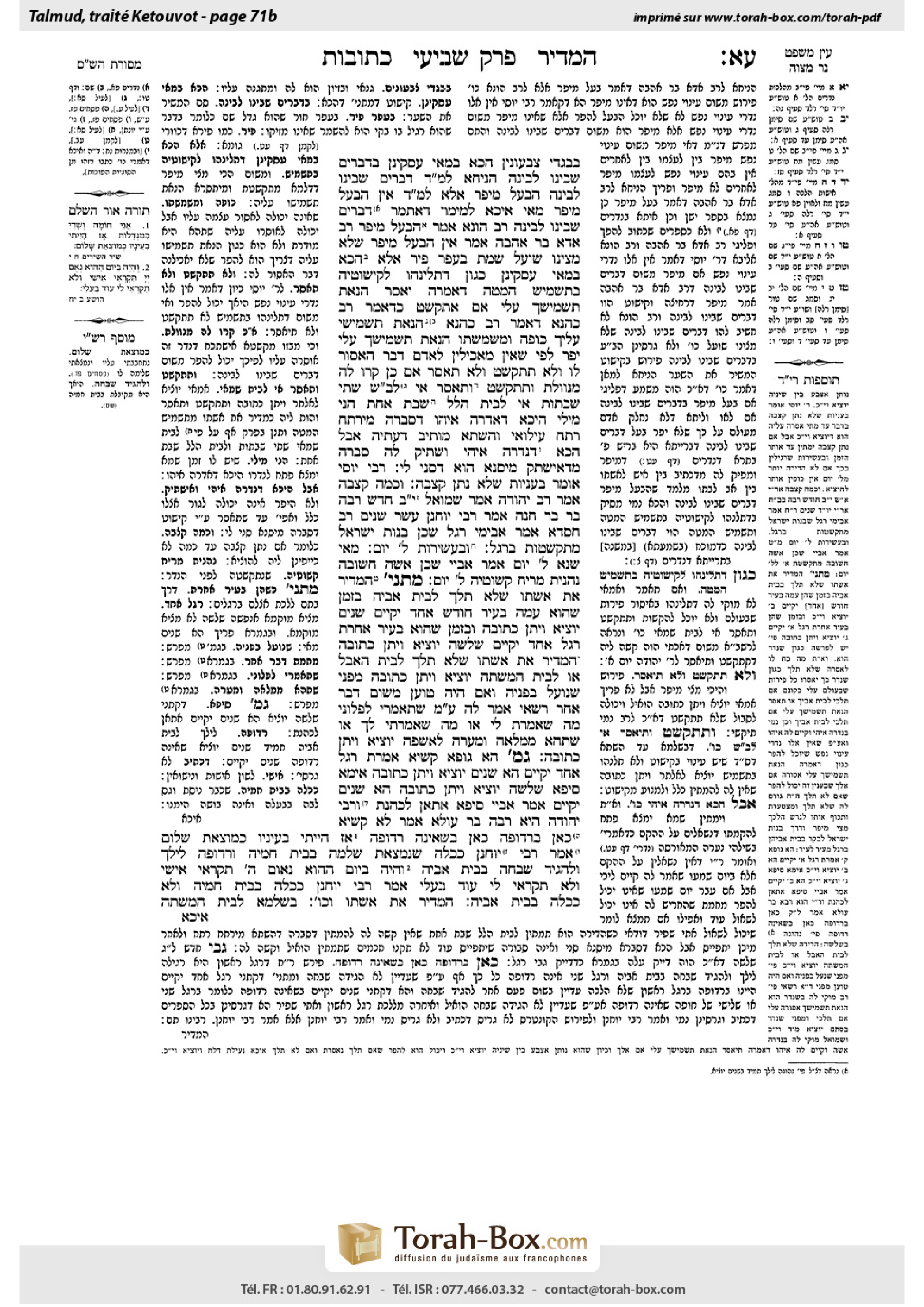
Ketubot 71b: Talmud study for Daf Yomi
Daf Yomi is the daily study of one Talmud folio. Explore 37 tractates with scans, Hebrew text, Sefaria English and AI-generated French translations where annotated.
Passage selection and English or AI-generated French translation are available where the scan has annotations. Daf Study is independent of Torah-Box and Sefaria.
Browse Ketubot · כתובות · All tractatesKetubot 71b text and translations
This page of Ketubot includes the Aramaic text, an English translation and an AI-generated French translation, alongside the scan above.
כתובות ע״א ב · Aramaic and Hebrew text
בְּבִגְדֵי צִבְעוֹנִין״! הָכָא בְּמַאי עָסְקִינַן — בִּדְבָרִים שֶׁבֵּינוֹ לְבֵינָהּ.
הָנִיחָא לְמַאן דְּאָמַר דְּבָרִים שֶׁבֵּינוֹ לְבֵינָהּ הַבַּעַל מֵיפֵר. אֶלָּא לְמַאן דְּאָמַר אֵין הַבַּעַל מֵיפֵר, מַאי אִיכָּא לְמֵימַר? דְּאִתְּמַר: דְּבָרִים שֶׁבֵּינוֹ לְבֵינָהּ, רַב הוּנָא אָמַר: הַבַּעַל מֵיפֵר, רַב אַדָּא בַּר אַהֲבָה אָמַר: אֵין הַבַּעַל מֵיפֵר, שֶׁלֹּא מָצִינוּ שׁוּעָל שֶׁמֵּת בַּעֲפַר פִּיר.
אֶלָּא הָכָא בְּמַאי עָסְקִינַן — כְּגוֹן דִּתְלָ[תַ]נְהוּ לְקִישּׁוּטֶיהָ בְּתַשְׁמִישׁ הַמִּטָּה, דְּאָמְרָה: ״יֵאָסֵר הֲנָאַת תַּשְׁמִישְׁךָ עָלַי אִם אֶתְקַשֵּׁט״, כִּדְאָמַר רַב כָּהֲנָא.
דְּאָמַר רַב כָּהֲנָא: ״הֲנָאַת תַּשְׁמִישִׁי עָלֶיךָ״ — כּוֹפָהּ וּמְשַׁמַּשְׁתּוֹ. ״הֲנָאַת תַּשְׁמִישְׁךָ עָלַי״ — יָפֵר, לְפִי שֶׁאֵין מַאֲכִילִין לָאָדָם דָּבָר הָאָסוּר לוֹ.
וְלֹא תִּתְקַשֵּׁט וְלֹא תֵּאָסֵר! אִם כֵּן קָרוּ לַהּ ״מְנֻוֶּולֶת״.
וְתִתְקַשֵּׁט וְתֵאָסֵר, אִי לְבֵית שַׁמַּאי שְׁתֵּי שַׁבָּתוֹת, אִי לְבֵית הִלֵּל שַׁבָּת אַחַת! הָנֵי מִילֵּי הֵיכָא דְּאַדְּרַהּ אִיהוּ, דְּסָבְרָה: מִירְתָּח רָתַח עִילָּוַאי וְהַשְׁתָּא מוֹתֵיב דַּעְתֵּיהּ. אֲבָל הָכָא, דִּנְדַרָה אִיהִי וְשָׁתֵיק לַהּ, סָבְרָה מִדְּאִישְׁתִּיק — מִיסְנָא הוּא דְּסָנֵי לִי.
רַבִּי יוֹסֵי אוֹמֵר: בַּעֲנִיּוּת שֶׁלֹּא נָתַן קִצְבָה. וְכַמָּה קִצְבָה? אָמַר רַב יְהוּדָה אָמַר שְׁמוּאֵל: שְׁנֵים עָשָׂר חֹדֶשׁ. רַבָּה בַּר בַּר חָנָה אָמַר רַבִּי יוֹחָנָן: עֶשֶׂר שָׁנִים. רַב חִסְדָּא אָמַר אֲבִימִי: רֶגֶל, שֶׁכֵּן בְּנוֹת יִשְׂרָאֵל מִתְקַשְּׁטוֹת בָּרֶגֶל.
וּבַעֲשִׁירוּת שְׁלֹשִׁים יוֹם. מַאי שְׁנָא שְׁלֹשִׁים יוֹם? אָמַר אַבָּיֵי: שֶׁכֵּן אִשָּׁה חֲשׁוּבָה נֶהֱנֵית מֵרֵיחַ קִשּׁוּטֶיהָ שְׁלֹשִׁים יוֹם.
מַתְנִי׳ הַמַּדִּיר אֶת אִשְׁתּוֹ שֶׁלֹּא תֵּלֵךְ לְבֵית אָבִיהָ, בִּזְמַן שֶׁהוּא עִמָּהּ בָּעִיר — חוֹדֶשׁ אֶחָד יְקַיֵּים, שְׁנַיִם יוֹצִיא וְיִתֵּן כְּתוּבָּה. וּבִזְמַן שֶׁהוּא בְּעִיר אַחֶרֶת — רֶגֶל אֶחָד יְקַיֵּים, שְׁלֹשָׁה — יוֹצִיא וְיִתֵּן כְּתוּבָּה.
הַמַּדִּיר אֶת אִשְׁתּוֹ שֶׁלֹּא תֵּלֵךְ לְבֵית הָאֵבֶל אוֹ לְבֵית הַמִּשְׁתֶּה — יוֹצִיא וְיִתֵּן כְּתוּבָּה, מִפְּנֵי שֶׁנּוֹעֵל בְּפָנֶיהָ. וְאִם הָיָה טוֹעֵן מִשּׁוּם דָּבָר אַחֵר — רַשַּׁאי.
אָמַר לָהּ: ״עַל מְנָת שֶׁתֹּאמְרִי לִפְלוֹנִי מַה שֶּׁאָמַרְתָּ לִי״, אוֹ: ״מַה שֶּׁאָמַרְתִּי לָךְ״, אוֹ שֶׁתְּהֵא מְמַלְּאָה וּמְעָרָה לָאַשְׁפָּה — יוֹצִיא וְיִתֵּן כְּתוּבָּה.
גְּמָ׳ הָא גּוּפַהּ קַשְׁיָא: אָמְרַתְּ רֶגֶל אֶחָד יְקַיֵּים. הָא שְׁנַיִם — יוֹצִיא וְיִתֵּן כְּתוּבָּה. אֵימָא סֵיפָא: שְׁלֹשָׁה — יוֹצִיא וְיִתֵּן כְּתוּבָּה. הָא שְׁנַיִם — יְקַיֵּים.
אָמַר אַבָּיֵי: סֵיפָא אֲתָאן לְכֹהֶנֶת, וְרַבִּי יְהוּדָה הִיא. רַבָּה בַּר עוּלָּא אָמַר, לָא קַשְׁיָא: כָּאן בִּרְדוּפָה, כָּאן בְּשֶׁאֵינָהּ רְדוּפָה.
״אָז הָיִיתִי בְעֵינָיו כְּמוֹצְאֵת שָׁלוֹם״, אָמַר רַבִּי יוֹחָנָן: כְּכַלָּה שֶׁנִּמְצֵאת שְׁלֵמָה בְּבֵית חָמִיהָ, וּרְדוּפָה לֵילֵךְ וּלְהַגִּיד שִׁבְחָהּ בְּבֵית אָבִיהָ.
״וְהָיָה בַּיּוֹם הַהוּא נְאוּם ה׳ תִּקְרְאִי אִישִׁי וְלֹא תִקְרְאִי לִי עוֹד בַּעְלִי״, אָמַר רַבִּי יוֹחָנָן: כְּכַלָּה בְּבֵית חָמִיהָ, וְלֹא כְּכַלָּה בְּבֵית אָבִיהָ.
הַמַּדִּיר אֶת אִשְׁתּוֹ וְכוּ׳. בִּשְׁלָמָא לְבֵית הַמִּשְׁתֶּה
Ketubot 71b · English translation
with colored garments, as not wearing colored garments can cause shame to her as well as to her husband. But vows that affect her alone are not considered vows of affliction. The Gemara answers: Here we are dealing with a case where she vowed not to adorn herself with regard to matters that are between him and her, meaning that she vowed not to use a substance that removes her pubic hair. This is considered a matter between him and her, since the hair could interfere with sexual intercourse.
The Gemara asks: This works out well according to the one who said the husband can nullify his wife’s vow if it relates to matters that are between him and her, i.e., that disrupt normal, intimate relations between them. But according to the one who said the husband cannot nullify such vows, what can be said? The amora’im had a dispute concerning this question, as it is stated: With regard to vows related to matters that are between him and her, such as the example above, Rav Huna said that the husband can nullify his wife’s vow, while Rav Adda bar Ahava said the husband cannot nullify his wife’s vow, since it does not interfere with sexual intercourse between them. Rav Adda bar Ahava explains his opinion with an analogy: Since we have not found a fox that died in the dirt of a hole where it lives, so too here, although she grows her pubic hair, he will not be harmed by it, since he is familiar with her body.
Rather, with what are we dealing here? With a case where through her vow she made sexual intercourse contingent upon her adornment, as she said: The pleasure of intercourse with you is forbidden to me if I adorn myself, as Rav Kahana said that such language qualifies as matters between him and her, and a husband can nullify such a vow.
As Rav Kahana said: If the woman says to her husband: The pleasure of intercourse with me is forbidden to you, he may nevertheless compel her through legal and financial measures to fulfill her marital obligations and have sexual intercourse with him, since she does not have the power to render herself forbidden to him by a vow, due to her prior marital obligations. But if she says: The pleasure of intercourse with you is forbidden to me, this vow is valid but he may nullify it. Although she is obligated by the terms of the marriage to cohabit with him, she does not directly contravene her obligation but rather prohibits herself from deriving pleasure from sexual intercourse. Therefore, her husband may not compel her to engage in intercourse in violation of her vow, since one cannot feed a person an object which is forbidden to him. Instead, he may nullify it if he wishes.
The Gemara asks: And even if she creates this contingency by vowing that the pleasure of sexual intercourse will be forbidden to her if she adorns herself, let her not adorn herself and she will not be forbidden. Since the prohibition against intercourse created through her vow may never go into effect, the husband should not be able to nullify the vow, because a vow against adornment alone is not subject to the husband’s nullification. The Gemara answers: If so, they will call her repulsive when she does not adorn herself, and she cannot endure the embarrassment of such a situation. Therefore, it is assumed that she will eventually adorn herself at some point.
The Gemara asks: And let her adorn herself and be prohibited from engaging in sexual intercourse, and he can still maintain her. As was stated concerning one who prohibits himself from cohabiting with his wife, if according to the opinion of Beit Shammai, he may maintain her for two weeks; if according to the opinion of Beit Hillel, for one week. Why then did they require him to divorce her immediately? The Gemara answers: This applies only where he took a vow to render intercourse with her prohibited, as she thinks: He vowed because he is angry with me, but now he will calm down and dissolve the vow. But here, as the mishna is explained as a case where she vows and he is silent and does not nullify it, she thinks: Since he is silent, this means he despises me, and consequently she desires a divorce.
§ The mishna states that Rabbi Yosei says: For poor women, he must divorce her when he did not establish a set amount of time for the vow to remain in effect. The Gemara asks: And how long is this set amount of time? He is allowed to maintain her as a wife if he did set a time, but certainly there is a limit. This halakha would not apply in a case of a long period of time. Rav Yehuda said that Shmuel said: Twelve months. Rabba bar bar Ḥanna said that Rabbi Yoḥanan said: Ten years. Rav Ḥisda said that Avimi said: A pilgrim Festival, meaning until the next one of the three Festivals, since Jewish women adorn themselves on the pilgrim Festival. If his vow remains in effect beyond the Festival, it is considered as if he did not set a time limit, and he must divorce her.
And for wealthy women, Rabbi Yosei said the limit is thirty days. The Gemara asks: What is different about thirty days specifically? Abaye said: Because an important and wealthy woman enjoys the scent of her adornments that she put on previously for up to thirty days, and after that time she feels that she is repulsive.
MISHNA: With regard to one who vows and obligates his wife not to go to her father’s house, when her father is with her in the same city, if the vow is to be in effect up to one month, he may maintain her as his wife. If the vow is for two months, he must divorce her and give her the payment of her marriage contract. And when her father is in a different city, if the vow is to be in effect until at most one pilgrim Festival, i.e., until the next pilgrim Festival, he may maintain her as his wife. Although the wife often visits her parents during the Festival, she is capable of refraining one time. For three Festivals, however, he must divorce her and give her the payment of her marriage contract.
Additionally, one who vows and obligates his wife not to go to a house of mourning to console the mourners, or to a house of feasting for a wedding, must divorce her and give her the payment of her marriage contract. Why is this so? Because it is as if he were locking a door in front of her. And if he claimed he did so due to something else, meaning he is concerned about inappropriate conduct there, he is permitted to do so.
If he said to her: The vow will be void on condition that you tell so-and-so what you told me, or what I told you, or on condition that she fill something up and pour it into the refuse, he must divorce her and give her the payment of her marriage contract. The Gemara will explain all of these cases thoroughly.
GEMARA: Concerning the first clause in the mishna, the Gemara asks: This mishna itself is difficult: You said on one hand that if the vow will be in effect for one pilgrim Festival he may maintain her as his wife, from which it may be deduced that if he forbade her from going to her father’s house for two Festivals, he must divorce her and give her the payment of her marriage contract. But say the latter clause: For three Festivals he must divorce her and give her the payment of her marriage contract, from which it may be deduced that if the vow will be in effect for two Festivals, he may maintain her as his wife. Thus, the inferences from the first and latter clauses are contradictory.
Abaye said: In the latter clause, we have come to a case concerning the wife of a priest, with regard to whom more time is allowed before a divorce is required, since her husband may not remarry her afterward. And this is the opinion of Rabbi Yehuda, who distinguished in the previous mishna between the wives of an Israelite and those of a priest. Rabba bar Ulla said: It is not difficult, and can be explained in a different way: Here, in the first clause, it is referring to a woman who is eager and enthusiastic to return regularly to her father’s home, and if her husband prohibits her from doing so for more than one Festival it will cause her significant distress; while there, in the latter clause, it is referring to a woman who is not eager. Consequently, he must divorce her only if the vow will last for three Festivals.
Once the Gemara has mentioned the idea of a woman who is eager to return to her father’s house, it discusses another context where a similar idea is mentioned. Concerning the verse “Then I was in his eyes as one that found peace” (Song of Songs 8:10), Rabbi Yoḥanan said: The meaning is: Like a bride who is considered perfect in her father-in-law’s house, and is eager to go and relate her praise in her father’s house, to tell how many complimentary things were said about her by her husband’s family.
Similarly, concerning the verse “And it shall be on that day, says the Lord, that you will call Me: My Husband [Ishi], and you will no longer call Me: My Master [Ba’ali]” (Hosea 2:18), Rabbi Yoḥanan said: The meaning is: Like a bride in her father-in-law’s house after she has already lived with her husband, whom she is consequently not ashamed to call her marriage partner, and not like a betrothed bride still in her father’s house, who simply refers to her groom as: My master.
§ The mishna states: One who vows and obligates his wife not to go to a house of mourning or to a house of feasting for a wedding, must divorce her and give her the payment of her marriage contract, because it is as if he were locking a door in front of her. The Gemara asks: Granted, when he forbids her from going to a house of feasting,
Ketubot 71b · Traduction française (IA)
de porter des vêtements colorés, car ne pas en porter peut faire honte aussi bien à elle qu’à son mari. Mais les vœux qui ne la concernent qu’elle ne sont pas considérés comme des vœux d’affliction. La Guemara répond : Il s’agit ici d’un cas où elle a fait vœu de ne pas se parer dans un domaine qui les concerne tous les deux, c’est-à-dire qu’elle a fait vœu de ne pas utiliser une substance qui élimine les poils pubiens. Cela concerne tous les deux, car ces poils pourraient gêner les rapports sexuels.
La Guemara demande : Cela convient selon celui qui dit que le mari peut annuler le vœu de sa femme lorsqu’il concerne un domaine qui les concerne tous les deux, c’est-à-dire lorsqu’il perturbe leurs relations intimes normales. Mais que peut-on répondre selon celui qui dit que le mari ne peut pas annuler de tels vœux ? Les amoraïm étaient en désaccord sur cette question, comme il est rapporté : concernant les vœux relatifs aux domaines qui les concernent tous les deux, tels que dans l’exemple ci-dessus, Rav Houna a dit que le mari peut annuler le vœu de sa femme, tandis que Rav Adda bar Ahava a dit qu’il ne le peut pas, puisque cela ne gêne pas leurs rapports sexuels. Rav Adda bar Ahava explique son opinion par une analogie : De même que nous n’avons pas trouvé de renard mort dans la terre d’un terrier où il vit, de même ici, bien qu’elle laisse pousser ses poils pubiens, il n’en subira aucun tort, car il connaît bien son corps.
Mais alors, de quel cas s’agit-il ici ? D’un cas où, par son vœu, elle a rendu les rapports sexuels dépendants de sa parure, en disant : « Le plaisir des rapports sexuels avec toi m’est interdit si je me pare », car Rav Kahana a dit qu’une telle formulation relève des domaines qui les concernent tous les deux et que le mari peut annuler un tel vœu.
Car Rav Kahana a dit : Si une femme dit à son mari : « Le plaisir des rapports sexuels avec moi t’est interdit », il peut néanmoins la contraindre, par des mesures juridiques et financières, à remplir ses obligations conjugales et à avoir des rapports sexuels avec lui, puisqu’elle n’a pas le pouvoir de se rendre interdite à lui par un vœu, en raison de ses obligations conjugales antérieures. Mais si elle dit : « Le plaisir des rapports sexuels avec toi m’est interdit », ce vœu est valide, mais il peut l’annuler. Bien qu’elle soit tenue, selon les termes du mariage, d’avoir des rapports avec lui, elle ne contrevient pas directement à son obligation ; elle s’interdit plutôt de tirer plaisir des rapports sexuels. Son mari ne peut donc pas la contraindre à avoir des rapports en violation de son vœu, car on ne peut pas faire consommer à une personne un objet qui lui est interdit. Il peut plutôt annuler le vœu, s’il le souhaite.
La Guemara demande : Même si elle crée cette condition en faisant vœu que le plaisir des rapports sexuels lui soit interdit si elle se pare, qu’elle ne se pare pas, et l’interdiction ne s’appliquera pas. Puisque l’interdiction des rapports sexuels créée par son vœu risque de ne jamais entrer en vigueur, le mari ne devrait pas pouvoir annuler le vœu, car un vœu portant uniquement sur le fait de ne pas se parer ne peut pas être annulé par le mari. La Guemara répond : Dans ce cas, on la traitera de répugnante si elle ne se pare pas, et elle ne peut supporter une telle humiliation. On suppose donc qu’elle finira par se parer à un moment donné.
La Guemara demande : Qu’elle se pare donc et soit interdite d’avoir des rapports sexuels ; il peut tout de même la garder. Comme on l’a enseigné au sujet de celui qui s’interdit d’avoir des rapports avec sa femme : selon l’opinion de Beit Shammaï, il peut la garder deux semaines ; selon celle de Beit Hillel, une semaine. Pourquoi lui a-t-on donc imposé de la répudier immédiatement ? La Guemara répond : Cela ne s’applique que lorsqu’il a fait vœu d’interdire les rapports sexuels avec elle, car elle pense : « Il a fait ce vœu parce qu’il est en colère contre moi, mais il va se calmer et le faire annuler. » Mais ici, puisque la Michna est expliquée comme un cas où elle fait un vœu et où il garde le silence sans l’annuler, elle pense : « S’il garde le silence, c’est qu’il me méprise » ; elle souhaite par conséquent être répudiée.
§ La Michna enseigne que Rabbi Yossei dit : Dans le cas des femmes pauvres, il doit la répudier lorsqu’il n’a pas fixé de durée pour le vœu. La Guemara demande : Quelle est cette durée ? Il peut la garder comme épouse s’il en a fixé une, mais il y a certainement une limite ; cette halakha ne saurait s’appliquer à une période très longue. Rav Yehouda a dit au nom de Chmouel : douze mois. Rabba bar bar Ḥanna a dit au nom de Rabbi Yoḥanan : dix ans. Rav Ḥisda a dit au nom d’Avimi : une fête de pèlerinage, c’est-à-dire jusqu’à la prochaine des trois fêtes de pèlerinage, car les femmes juives se parent à l’occasion de ces fêtes. Si son vœu reste en vigueur au-delà de la fête, c’est comme s’il n’avait fixé aucune limite de durée, et il doit la répudier.
Quant aux femmes riches, Rabbi Yossei a fixé la limite à trente jours. La Guemara demande : Pourquoi précisément trente jours ? Abayé a dit : Parce qu’une femme importante et riche apprécie pendant trente jours le parfum des parures qu’elle a portées auparavant ; passé ce délai, elle se sent répugnante.
MICHNA : Lorsqu’un homme fait vœu et impose à sa femme de ne pas aller chez son père, si celui-ci se trouve dans la même ville qu’elle et que le vœu doit rester en vigueur pendant un mois, il peut la garder comme épouse. Si le vœu doit durer deux mois, il doit la répudier et lui verser le montant de sa ketouba. Lorsque son père se trouve dans une autre ville, si le vœu doit durer au plus jusqu’à une fête de pèlerinage, c’est-à-dire jusqu’à la prochaine fête de pèlerinage, il peut la garder comme épouse. Bien que l’épouse rende souvent visite à ses parents pendant la fête, elle peut s’en abstenir une fois. Mais si le vœu doit durer trois fêtes de pèlerinage, il doit la répudier et lui verser le montant de sa ketouba.
De plus, celui qui fait vœu et impose à sa femme de ne pas se rendre dans une maison de deuil pour réconforter les endeuillés, ni dans une maison où l’on donne un banquet de mariage, doit la répudier et lui verser le montant de sa ketouba. Pourquoi ? Parce que c’est comme s’il lui fermait une porte. S’il affirme l’avoir fait pour une autre raison, c’est-à-dire parce qu’il craint une conduite inconvenante en ces lieux, il en a le droit.
S’il lui a dit : « Le vœu sera annulé à condition que tu racontes à untel ce que tu m’as dit, ou ce que je t’ai dit, ou à condition qu’elle remplisse quelque chose et le verse dans les ordures », il doit la répudier et lui verser le montant de sa ketouba. La Guemara expliquera en détail tous ces cas.
GUEMARA : À propos de la première partie de la Michna, la Guemara demande : La Michna elle-même présente une difficulté : d’un côté, il est dit que si le vœu reste en vigueur jusqu’à une fête de pèlerinage, il peut la garder comme épouse ; on peut en déduire que s’il lui interdit d’aller chez son père pendant deux fêtes de pèlerinage, il doit la répudier et lui verser le montant de sa ketouba. Mais la partie suivante dit : Pour trois fêtes de pèlerinage, il doit la répudier et lui verser le montant de sa ketouba ; on peut en déduire que si le vœu reste en vigueur pendant deux fêtes de pèlerinage, il peut la garder comme épouse. Les déductions tirées de la première partie et de la partie suivante sont donc contradictoires.
Abayé a dit : Dans la partie suivante, il s’agit de l’épouse d’un prêtre ; un délai plus long est accordé avant que le mari ne soit tenu de la répudier, car il ne pourra pas l’épouser de nouveau par la suite. Telle est l’opinion de Rabbi Yehouda, qui a distingué dans la Michna précédente les épouses d’un Israélite de celles d’un prêtre. Rabba bar Oulla a dit : Il n’y a pas de difficulté, et cela peut s’expliquer autrement : ici, dans la première partie, il s’agit d’une femme qui a hâte et tient à retourner régulièrement chez son père ; si son mari le lui interdit pendant plus d’une fête, cela lui causera une grande détresse. Là, dans la partie suivante, il s’agit d’une femme qui n’y tient pas autant. Il ne doit donc la répudier que si le vœu dure trois fêtes de pèlerinage.
Puisque la Guemara a évoqué l’idée d’une femme qui a hâte de retourner chez son père, elle aborde un autre contexte où l’on trouve une idée semblable. À propos du verset : « J’étais alors à ses yeux comme celle qui a trouvé la paix » (Cantique des Cantiques 8, 10), Rabbi Yoḥanan a dit que le sens est le suivant : comme une mariée considérée comme parfaite dans la maison de son beau-père, qui a hâte d’aller raconter ses louanges dans la maison de son père, afin de dire combien de compliments sa belle-famille a faits à son sujet.
De même, à propos du verset : « En ce jour-là, dit le Seigneur, tu m’appelleras : Mon époux [Ishi], et tu ne m’appelleras plus : Mon maître [Ba’ali] » (Osée 2, 18), Rabbi Yoḥanan a dit que le sens est le suivant : comme une mariée dans la maison de son beau-père après avoir déjà vécu avec son mari, si bien qu’elle n’a pas honte de l’appeler son époux ; et non comme une mariée encore fiancée, qui se trouve toujours dans la maison de son père et désigne simplement son futur époux comme « mon maître ».
§ La Michna enseigne : Celui qui fait vœu et impose à sa femme de ne pas se rendre dans une maison de deuil ou dans une maison où l’on donne un banquet de mariage doit la répudier et lui verser le montant de sa ketouba, car c’est comme s’il lui fermait une porte. La Guemara demande : Cela se comprend lorsqu’il lui interdit de se rendre dans une maison où l’on donne un banquet,
Traduction française générée par IA à partir de l’édition anglaise de Sefaria. Vérifie toujours un passage avec le texte source.
Text from Sefaria: William Davidson Edition - Vocalized Aramaic (CC BY NC); William Davidson Edition - English (CC BY NC).