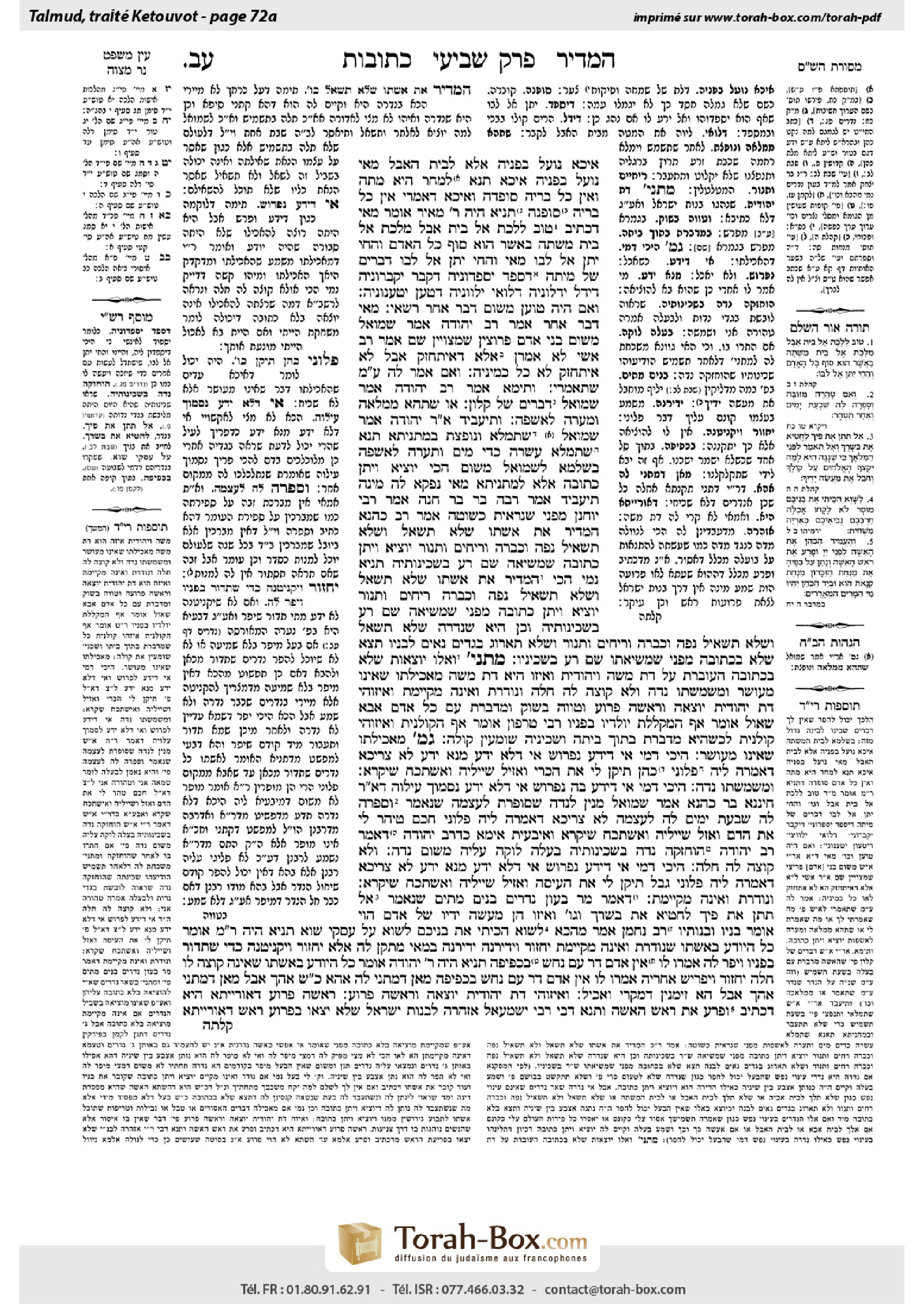
Ketubot 72a: Talmud study for Daf Yomi
Daf Yomi is the daily study of one Talmud folio. Explore 37 tractates with scans, Hebrew text, Sefaria English and AI-generated French translations where annotated.
Passage selection and English or AI-generated French translation are available where the scan has annotations. Daf Study is independent of Torah-Box and Sefaria.
Browse Ketubot · כתובות · All tractatesKetubot 72a text and translations
This page of Ketubot includes the Aramaic text, an English translation and an AI-generated French translation, alongside the scan above.
כתובות ע״ב א · Aramaic and Hebrew text
אִיכָּא נוֹעֵל בְּפָנֶיהָ, אֶלָּא לְבֵית הָאֵבֶל מַאי נוֹעֵל בְּפָנֶיהָ אִיכָּא? תָּנָא: לְמָחָר הִיא מֵתָה וְאֵין כׇּל בְּרִיָּה סוֹפְדָהּ. וְאִיכָּא דְּאָמְרִי: אֵין כׇּל בְּרִיָּה סוֹפְנָהּ.
תַּנְיָא, הָיָה רַבִּי מֵאִיר אוֹמֵר: מַאי דִּכְתִיב ״טוֹב לָלֶכֶת אֶל בֵּית אֵבֶל מִלֶּכֶת אֶל בֵּית מִשְׁתֶּה בַּאֲשֶׁר הוּא סוֹף כׇּל הָאָדָם וְהַחַי יִתֵּן אֶל לִבּוֹ״, מַאי ״וְהַחַי יִתֵּן אֶל לִבּוֹ״? דְּבָרִים שֶׁל מִיתָה: דְּ[יִ]סְפֹּד — יִסְפְּדוּנֵיהּ, דְּ[יִ]קְבַּר — יִקְבְּרוּנֵיהּ, דִּידַל — יְדַלּוּנֵיהּ, דִּ[י]לַוֵּאי — יְלַוּוֹנֵיהּ, דְּ[יִ]טְעֹן — יִטְעֲנוּנֵיהּ.
וְאִם הָיָה טוֹעֵן מִשּׁוּם דָּבָר אַחֵר — רַשַּׁאי. מַאי ״דָּבָר אַחֵר״? אָמַר רַב יְהוּדָה אָמַר שְׁמוּאֵל: מִשּׁוּם בְּנֵי אָדָם פְּרוּצִין שֶׁמְּצוּיִין שָׁם. אָמַר רַב אָשֵׁי: לָא אֲמַרַן אֶלָּא דְּאִיתַּחְזַק, אֲבָל לָא אִיתַּחְזַק — לֹא כָּל כְּמִינֵּיהּ.
וְאִם אָמַר לָהּ עַל מְנָת שֶׁתֹּאמְרִי. וְתֵימָא? אָמַר רַב יְהוּדָה אָמַר שְׁמוּאֵל: דְּבָרִים שֶׁל קָלוֹן.
אוֹ שֶׁתְּהֵא מְמַלְּאָה וּמְעָרָה לְאַשְׁפָּה. וְתִיעְבֵּיד! אָמַר רַב יְהוּדָה אָמַר שְׁמוּאֵל: שֶׁתְּמַלֵּא וְנוֹפֶצֶת. בְּמַתְנִיתָא תַּנָּא: שֶׁתְּמַלֵּא עֲשָׂרָה כַּדֵּי מַיִם וּתְעָרֶה לְאַשְׁפָּה.
בִּשְׁלָמָא לִשְׁמוּאֵל — מִשּׁוּם הָכִי יוֹצִיא וְיִתֵּן כְּתוּבָּה. אֶלָּא לְמַתְנִיתָא מַאי נָפְקָא לַהּ מִינַּהּ? תִּיעְבֵּיד! אָמַר רַבָּה בַּר בַּר חָנָה אָמַר רַבִּי יוֹחָנָן: מִפְּנֵי שֶׁנִּרְאִיתָ כְּשׁוֹטֶה.
אָמַר רַב כָּהֲנָא: הַמַּדִּיר אֶת אִשְׁתּוֹ שֶׁלֹּא תִּשְׁאַל וְשֶׁלֹּא תַּשְׁאִיל נָפָה וּכְבָרָה וְרֵיחַיִם וְתַנּוּר — יוֹצִיא וְיִתֵּן כְּתוּבָּה. שֶׁמַּשִּׂיאָהּ שֵׁם רַע בִּשְׁכֵינוֹתֶיהָ.
תַּנְיָא נָמֵי הָכִי: הַמַּדִּיר אֶת אִשְׁתּוֹ שֶׁלֹּא תִּשְׁאַל וְשֶׁלֹּא תַּשְׁאִיל נָפָה וּכְבָרָה רֵיחַיִם וְתַנּוּר — יוֹצִיא וְיִתֵּן כְּתוּבָּה, מִפְּנֵי שֶׁמַּשִּׂיאָהּ שֵׁם רַע בִּשְׁכֵינוֹתֶיהָ. וְכֵן הִיא שֶׁנָּדְרָה שֶׁלֹּא תִּשְׁאַל וְשֶׁלֹּא תַּשְׁאִיל נָפָה וּכְבָרָה וְרֵיחַיִם וְתַנּוּר, וְשֶׁלֹּא תֶּאֱרוֹג בְּגָדִים נָאִים לְבָנָיו — תֵּצֵא שֶׁלֹּא בִּכְתוּבָּה, מִפְּנֵי שֶׁמַּשִּׂיאָתוֹ שֵׁם רַע בִּשְׁכֵינָיו.
מַתְנִי׳ וְאֵלּוּ יוֹצְאוֹת שֶׁלֹּא בִּכְתוּבָּה — הָעוֹבֶרֶת עַל דָּת מֹשֶׁה וִיהוּדִית. וְאֵיזוֹ הִיא דָּת מֹשֶׁה? מַאֲכִילָתוֹ שֶׁאֵינוֹ מְעוּשָּׂר, וּמְשַׁמַּשְׁתּוֹ נִדָּה, וְלֹא קוֹצָה לָהּ חַלָּה, וְנוֹדֶרֶת וְאֵינָהּ מְקַיֶּימֶת.
וְאֵיזוֹהִי דָּת יְהוּדִית? יוֹצְאָה וְרֹאשָׁהּ פָּרוּעַ, וְטוֹוֶה בְּשׁוּק, וּמְדַבֶּרֶת עִם כָּל אָדָם. אַבָּא שָׁאוּל אוֹמֵר: אַף הַמְקַלֶּלֶת יוֹלְדָיו בְּפָנָיו. רַבִּי טַרְפוֹן אוֹמֵר: אַף הַקּוֹלָנִית. וְאֵיזוֹהִי קוֹלָנִית? לִכְשֶׁהִיא מְדַבֶּרֶת בְּתוֹךְ בֵּיתָהּ וּשְׁכֵינֶיהָ שׁוֹמְעִין קוֹלָהּ.
גְּמָ׳ מַאֲכִילָתוֹ שֶׁאֵינוֹ מְעוּשָּׂר, הֵיכִי דָמֵי? אִי דְּיָדַע — נִפְרוֹשׁ. אִי דְּלָא יָדַע — מְנָא יָדַע? לָא צְרִיכָא, דְּאָמְרָה לֵיהּ ״פְּלוֹנִי כֹּהֵן תִּיקֵּן לִי אֶת הַכְּרִי״, וְאָזֵיל שַׁיְילֵיהּ, וְאִשְׁתְּכַח שִׁיקְרָא.
וּמְשַׁמַּשְׁתּוֹ נִדָּה. הֵיכִי דָמֵי? אִי דְּיָדַע בָּהּ — נִפְרוֹשׁ, אִי דְּלָא יָדַע — נִסְמוֹךְ עִילָּוַהּ. דְּאָמַר רַב חִינָּנָא בַּר כָּהֲנָא אָמַר שְׁמוּאֵל: מִנַּיִן לְנִדָּה שֶׁסּוֹפֶרֶת לְעַצְמָהּ — שֶׁנֶּאֱמַר: ״וְסָפְרָה לָּהּ שִׁבְעַת יָמִים״, ״לָהּ״ — לְעַצְמָהּ!
לָא צְרִיכָא, דְּאָמְרָה לֵיהּ: פְּלוֹנִי חָכָם טִיהֵר לִי אֶת הַדָּם, וַאֲזַל שַׁיְילֵיהּ, וְאִשְׁתְּכַח שִׁיקְרָא. וְאִיבָּעֵית אֵימָא כִּדְרַב יְהוּדָה, דְּאָמַר רַב יְהוּדָה: הוּחְזְקָה נִדָּה בִּשְׁכֵינוֹתֶיהָ — בַּעְלָהּ לוֹקֶה עָלֶיהָ מִשּׁוּם נִדָּה.
וְלֹא קוֹצָה לָהּ חַלָּה. הֵיכִי דָמֵי? אִי דְּיָדַע — נִפְרוֹשׁ, אִי דְּלָא יָדַע — מְנָא יָדַע? לָא צְרִיכָא, דְּאָמְרָה לֵיהּ: פְּלוֹנִי גַּבָּל תִּיקֵּן לִי אֶת הָעִיסָּה, וְאָזֵיל שַׁיְילֵיהּ, וְאִשְׁתְּכַח שִׁיקְרָא.
וְנוֹדֶרֶת וְאֵינָהּ מְקַיֶּימֶת. דְּאָמַר מָר: בַּעֲוֹן נְדָרִים בָּנִים מֵתִים, שֶׁנֶּאֱמַר: ״אַל תִּתֵּן אֶת פִּיךָ לַחֲטִיא אֶת בְּשָׂרֶךָ וְגוֹ׳״. וְאֵיזוֹ הֵן מַעֲשֵׂה יָדָיו שֶׁל אָדָם — הֱוֵי אוֹמֵר בָּנָיו וּבְנוֹתָיו. רַב נַחְמָן אָמַר מֵהָכָא: ״לַשָּׁוְא הִכֵּיתִי אֶת בְּנֵיכֶם״, ״לַשָּׁוְא״ — עַל עִסְקֵי שָׁוְא.
תַּנְיָא, הָיָה רַבִּי מֵאִיר אוֹמֵר: כׇּל הַיּוֹדֵעַ בְּאִשְׁתּוֹ שֶׁנּוֹדֶרֶת וְאֵינָהּ מְקַיֶּימֶת — יַחְזוֹר וְיַדִּירֶנָּה. יַדִּירֶנָּה?! בְּמַאי מְתַקֵּן לַהּ? אֶלָּא: יַחְזוֹר וְיַקְנִיטֶנָּה, כְּדֵי שֶׁתִּדּוֹר בְּפָנָיו וְיָפֵר לָהּ. אָמְרוּ לוֹ: אֵין אָדָם דָּר עִם נָחָשׁ בִּכְפִיפָה.
תַּנְיָא, הָיָה רַבִּי יְהוּדָה אוֹמֵר: כׇּל הַיּוֹדֵעַ בְּאִשְׁתּוֹ שֶׁאֵינָהּ קוֹצֶה לוֹ חַלָּה — יַחְזוֹר וְיַפְרִישׁ אַחֲרֶיהָ. אָמְרוּ לוֹ: אֵין אָדָם דָּר עִם נָחָשׁ בִּכְפִיפָה.
מַאן דְּמַתְנֵי לַהּ אַהָא, כׇּל שֶׁכֵּן אַהָךְ. אֲבָל מַאן דְּמַתְנֵי אַהָךְ, אֲבָל הָא — זִימְנִין דְּמִקְּרֵי וְאָכֵיל.
וְאֵיזוֹהִי דָּת יְהוּדִית? יוֹצְאָה וְרֹאשָׁהּ פָּרוּעַ. רֹאשָׁהּ פָּרוּעַ דְּאוֹרָיְיתָא הִיא, דִּכְתִיב: ״וּפָרַע אֶת רֹאשׁ הָאִשָּׁה״, וְתָנָא דְּבֵי רַבִּי יִשְׁמָעֵאל: אַזְהָרָה לִבְנוֹת יִשְׂרָאֵל שֶׁלֹּא יֵצְאוּ בִּפְרוּעַ רֹאשׁ! דְּאוֹרָיְיתָא —
Ketubot 72a · English translation
there is effectively an act of locking a door in front of her by withholding from her any possibility of rejoicing, but when he forbids her from going to a house of mourning, what locking of a door in front of her is there? He taught: In the future she too will die, and no person will eulogize her or take care of her, just as she did not do so for others. And some say: No person will value her or pay attention to her, since a person who does not visit the sick or console mourners cuts himself off from others.
Similarly, it is taught in a baraita: Rabbi Meir used to say: What is the meaning of that which is written: “It is better to go to a house of mourning than to go to a house of feasting, since that is the end of all men, and the living will take it to heart” (Ecclesiastes 7:2)? What does “and the living will take it to heart” mean? It means that they will take matters relating to death to heart, realizing that they too will eventually die. He who eulogizes others, people will eulogize him; he who buries someone, people will bury him; he who lifts others to bring them to burial, people will similarly lift him to bring him to burial; he who escorts others out for burial, people will similarly escort him; he who carries others, others will carry him. Therefore, one who does not come to a house of mourning to comfort the bereaved will himself not be treated with proper dignity when he dies.
§ The mishna stated: And if he claimed he forbade her due to something else, he is permitted to do so. The Gemara asks: What is meant by something else? Rav Yehuda said that Shmuel said: He claims he did so due to promiscuous individuals that are commonly found there, and he does not want his wife to be among them. Rav Ashi said: We said that he may forbid her only with regard to a case where a presumption has been established that promiscuous people frequent this location, but if no such presumption has been established, it is not in his power to say he is concerned about it.
§ The mishna stated: And if he said to her: The vow will be void on condition that you tell so-and-so what you told me, or what I told you, he must divorce her and give her the payment of her marriage contract. The Gemara asks: And let her say it. Why shouldn’t she simply comply with his wishes? Rav Yehuda said that Shmuel said: It is referring to degrading matters, meaning intimate conversations between husband and wife, which she is ashamed to relate in the presence of others.
The mishna stated: Or he said the vow will be void on condition that she fill something up and pour it into the refuse. The Gemara asks: And let her do it. Rav Yehuda said that Shmuel said: The mishna’s intention is that he demanded that she fill herself up and then shake herself out. This is a euphemistic way of saying that the husband wants her to take measures to prevent herself from becoming pregnant, and she is permitted to protest this. It was taught in a baraita: The case is that he told her to fill up ten jugs of water and pour them into the refuse, a task that involves pointless effort and appears foolish.
The Gemara asks: Granted that according to Shmuel, who explains that the mishna is referring to a case where the husband insists that she not become pregnant, due to that reason he must divorce her and give her the payment of her marriage contract. But according to the baraita, which explains that he simply wants her to engage in pointless work, what difference does it make to her? Let her do it. Rabba bar bar Ḥanna said that Rabbi Yoḥanan said: Because she would appear insane if she were to perform pointless actions, she may therefore demand a divorce.
Rav Kahana said: One who vows and obligates his wife not to borrow or not to lend utensils that people generally lend, such as a sifter, or a sieve, or a mill, or an oven, must divorce her and give her the payment of her marriage contract, since by making such rules he causes her to develop a bad reputation among her neighbors, who will suspect her of stinginess or haughtiness.
The Gemara notes: That opinion is also taught in a baraita: One who vows and obligates his wife not to borrow or not to lend a sifter, or a sieve, or a mill, or an oven, must divorce her and give her the payment of her marriage contract, since he causes her to develop a bad reputation among her neighbors. And similarly, if it is she who vowed not to borrow or not to lend a sifter, or a sieve, or a mill, or an oven, or that she will not weave nice garments for his children, she may be divorced without payment of her marriage contract. This too is because she causes him to develop a bad reputation among his neighbors, as they will link her behavior to him and think that he instructed her to act this way.
MISHNA: And these are examples of women who may be divorced without payment of their marriage contract: A woman who violates the precepts of Moses, i.e., halakha, or the precepts of Jewish women, i.e., custom. The Mishna explains: And who is categorized as a woman who violates the precepts of Moses? This includes cases such as when she feeds him food that has not been tithed, or she engages in sexual intercourse with him while she has the legal status of a menstruating woman, or she does not separate a portion of dough to be given to a priest [ḥalla], or she vows and does not fulfill her vows.
And who is considered a woman who violates the precepts of Jewish women? One who, for example, goes out of her house, and her head, i.e., her hair, is uncovered; or she spins wool in the public marketplace; or she speaks with every man she encounters. Abba Shaul says: Also one who curses his, i.e., her husband’s, parents in his presence. Rabbi Tarfon says: Also a loud woman. And who is defined as a loud woman? When she speaks inside her house and her neighbors hear her voice.
GEMARA: The mishna stated: She feeds him food that has not been tithed. The Gemara attempts to clarify: What are the circumstances of the case under discussion? If he knows that the food is untithed, he should abstain and not eat it. And if he does not know that the food is untithed, then how does he know that she in fact fed him such food, so that he can divorce her? The Gemara responds: No, it is necessary when she tells him: So-and-so the priest rectified the pile of grain for me by tithing it, and he then went and asked the priest whether he did so, and it was found to be a lie. It is therefore clear that she did not tithe the food before she served it to him.
§ The mishna stated: Or she engages in sexual intercourse with him while she has the status of a menstruating woman. The Gemara asks: What are the circumstances? If he knows about her that she is a menstruating woman, he should abstain. And if he does not know, then he should rely on her. Because Rav Ḥinnana bar Kahana said that Shmuel said: From where is it derived that a menstruating woman can count the days for herself, and that she is trusted to testify that she did so? As it is stated: “Then she shall count to herself seven days” (Leviticus 15:28). “To herself” means by herself, and she may be trusted that she did so. If so, why can’t the husband trust his wife that she is not a menstruating woman?
The Gemara answers: No, it is necessary when she tells him: So-and-so the Sage purified the blood for me by ruling that it did not qualify as menstrual blood, and he went and asked him, and it was found that her claim was a lie. And if you wish, say instead that this is similar to that which Rav Yehuda said, as Rav Yehuda stated: If she is known by her neighbors to be a menstruating woman, her husband is flogged if he has relations with her, due to the prohibition against cohabiting with a menstruating woman. In this case, she was known by her neighbors to be a menstruating woman, but she had not told her husband. She then engaged in sexual intercourse with him, and he subsequently discovered her status from her neighbors.
§ The mishna stated: Or she does not separate ḥalla. The Gemara asks: What are the circumstances? If he knows that she did not separate ḥalla, he should abstain. If he does not know, then how does he know about it afterward in order to divorce her? The Gemara answers: No, it is necessary when she tells him: So-and-so the kneader rectified the dough for me by separating ḥalla, and he went and asked him, and it was found that her claim was a lie.
§ The mishna also stated: Or she vows and does not fulfill her vows. The Gemara clarifies the reason for this, as it is different from the other cases in the mishna, where she causes her husband to violate a prohibition. In this case it is only she who violates a prohibition. As the Master said: Due to the sin of unfulfilled vows, children die, as it is stated: “It is better not to vow than to vow and not pay. Do not allow your mouth to bring your flesh to sin…why should the Lord become angry at your voice and destroy the work of your hands?” (Ecclesiastes 5:4–5). And what is the work of a person’s hands? You must say it is referring to his sons and his daughters. Rav Naḥman said: A proof to the above idea may be brought from here: “In vain I smote your children” (Jeremiah 2:30). The phrase “in vain” means: For matters caused by vain words, meaning that you took a vow and did not fulfill it.
It is taught in a baraita that Rabbi Meir used to say: Anyone who knows concerning his wife that she vows and does not fulfill her vows should return and vow to obligate her. The Gemara wonders: He should vow and obligate her? How will he rectify it for her by doing this? Rather, the intention is he should return and provoke her, so that she will vow in his presence and he can then nullify it for her. They said to him: This solution is not effective, because a person does not reside in a basket [kefifa], i.e., in close quarters, with a snake, since this is extremely dangerous. Similarly, he cannot constantly prevent her from taking vows, so it would be preferable that he divorce her.
It is taught in a baraita similar to the previous one that Rabbi Yehuda used to say: Anyone who knows concerning his wife that she does not separate ḥalla for him should go back and separate it after she is finished. They said to him: This solution is not effective, since a person does not reside in a basket with a snake.
The Gemara discusses the two applications of the idea that a husband should try to correct his wife’s misdeeds: He who teaches it with regard to this, the case of ḥalla, all the more so would teach it for that, the case of vows, which are not a daily occurrence. But he who teaches it with regard to that, i.e., the case of vows, teaches it only in that case, but in this case of ḥalla, sometimes he will happen to eat untithed produce; and Rabbi Meir holds that he cannot always be careful enough to ensure that ḥalla was taken.
§ The mishna stated: And who is considered a woman who violates the precepts of Jewish women? One who goes out and her head is uncovered. The Gemara asks: The prohibition against a woman going out with her head uncovered is not merely a custom of Jewish women. Rather, it is by Torah law, as it is written with regard to a woman suspected by her husband of having been unfaithful: “And he shall uncover the head of the woman” (Numbers 5:18). And the school of Rabbi Yishmael taught: From here there is a warning to Jewish women not to go out with an uncovered head, since if the Torah states that a woman suspected of adultery must have her head uncovered, this indicates that a married woman must generally cover her head. The Gemara explains: By Torah law,
Ketubot 72a · Traduction française (IA)
En effet, en la privant de toute possibilité de se réjouir, il lui ferme pour ainsi dire une porte au nez. Mais lorsqu’il lui interdit de se rendre dans une maison de deuil, en quoi lui ferme-t-il une porte au nez ? Il enseignait : À l’avenir, elle aussi mourra, et personne ne prononcera son éloge funèbre ni ne s’occupera d’elle, tout comme elle ne l’a pas fait pour les autres. Certains disent : Personne ne l’estimera ni ne lui prêtera attention, car celui qui ne rend pas visite aux malades ni ne console les endeuillés se coupe des autres.
De même, il est enseigné dans une baraïta : Rabbi Meïr disait : Quel est le sens de ce qui est écrit : « Mieux vaut aller dans une maison de deuil que d’aller dans une maison de festin, car telle est la fin de tout homme, et le vivant le prendra à cœur » (Ecclésiaste 7, 2) ? Que signifie « et le vivant le prendra à cœur » ? Cela signifie qu’ils prendront à cœur les questions relatives à la mort, en comprenant qu’eux aussi finiront par mourir. Celui qui prononce l’éloge funèbre d’autrui verra les gens prononcer le sien ; celui qui enterre quelqu’un sera enterré par les gens ; celui qui soulève quelqu’un pour le porter jusqu’à sa sépulture sera de même soulevé par les gens pour être porté jusqu’à sa sépulture ; celui qui accompagne quelqu’un jusqu’à sa sépulture sera de même accompagné par les gens ; celui qui porte quelqu’un sera porté par les autres. Par conséquent, celui qui ne se rend pas dans une maison de deuil pour réconforter les endeuillés ne sera lui-même pas traité avec les égards qui conviennent lorsqu’il mourra.
§ La Michna énonçait : Et s’il prétend qu’il le lui a interdit pour une autre raison, il peut le faire. La Guemara demande : Que signifie « pour une autre raison » ? Rav Yehouda a dit au nom de Chmouel : Il prétend l’avoir fait en raison des personnes de mœurs légères qui fréquentent cet endroit, et ne veut pas que son épouse se trouve parmi elles. Rav Achi a dit : Nous avons dit qu’il peut le lui interdire uniquement lorsqu’il est établi que des personnes de mœurs légères fréquentent cet endroit ; mais si cela n’est pas établi, il ne peut pas prétendre qu’il s’en inquiète.
§ La Michna énonçait : Et s’il lui dit : « Le vœu sera annulé à condition que tu dises à untel ce que tu m’as dit, ou ce que je t’ai dit », il doit divorcer d’elle et lui verser le montant de sa ketouba. La Guemara demande : Qu’elle le dise, alors ! Pourquoi ne ferait-elle pas simplement ce qu’il veut ? Rav Yehouda a dit au nom de Chmouel : Il s’agit de propos dégradants, c’est-à-dire de conversations intimes entre époux, qu’elle a honte de rapporter devant d’autres.
La Michna énonçait : Ou bien il a dit que le vœu serait annulé à condition qu’elle remplisse quelque chose et le verse dans les ordures. La Guemara demande : Qu’elle le fasse, alors ! Rav Yehouda a dit au nom de Chmouel : La Michna veut dire qu’il lui a demandé de se remplir puis de se vider en se secouant. C’est une façon euphémistique de dire que le mari veut qu’elle prenne des mesures pour éviter de tomber enceinte, ce à quoi elle est autorisée à s’opposer. Il est enseigné dans une baraïta : Il s’agit du cas où il lui a demandé de remplir dix cruches d’eau et de les verser dans les ordures, une tâche qui exige un effort inutile et paraît insensée.
La Guemara demande : Il est compréhensible que, selon Chmouel, qui explique que la Michna traite du cas où le mari insiste pour qu’elle ne tombe pas enceinte, elle puisse, pour cette raison, exiger le divorce et recevoir le montant de sa ketouba. Mais selon la baraïta, qui explique qu’il veut simplement qu’elle accomplisse un travail inutile, en quoi cela la dérange-t-il ? Qu’elle le fasse ! Rabba bar bar Ḥanna a dit au nom de Rabbi Yoḥanan : Comme elle aurait l’air folle si elle accomplissait des actes inutiles, elle peut donc demander le divorce.
Rav Kahana a dit : Celui qui fait jurer son épouse de ne pas emprunter ou de ne pas prêter des ustensiles que les gens se prêtent habituellement, comme un tamis à farine, une passoire, un moulin ou un four, doit divorcer d’elle et lui verser le montant de sa ketouba, car, en établissant de telles règles, il lui donne mauvaise réputation auprès de ses voisines, qui la soupçonneront d’être avare ou hautaine.
La Guemara relève : Cette opinion est également enseignée dans une baraïta : Celui qui fait jurer son épouse de ne pas emprunter ou de ne pas prêter un tamis à farine, une passoire, un moulin ou un four doit divorcer d’elle et lui verser le montant de sa ketouba, car il lui donne mauvaise réputation auprès de ses voisines. De même, si c’est elle qui a fait le vœu de ne pas emprunter ou de ne pas prêter un tamis à farine, une passoire, un moulin ou un four, ou de ne pas tisser de beaux vêtements pour ses enfants à lui, elle peut être répudiée sans recevoir le montant de sa ketouba. Là aussi, c’est parce qu’elle lui donne mauvaise réputation auprès de ses voisins, qui lui attribueront ce comportement et penseront qu’il lui a ordonné d’agir ainsi.
Michna : Voici des exemples de femmes qui peuvent être répudiées sans recevoir le montant de leur ketouba : une femme qui transgresse les préceptes de Moïse, c’est-à-dire la halakha, ou les préceptes des femmes juives, c’est-à-dire la coutume. La Michna précise : Qui est considérée comme une femme qui transgresse les préceptes de Moïse ? Cela comprend notamment le cas où elle lui donne à manger des aliments dont la première dîme n’a pas été prélevée, où elle a des relations sexuelles avec lui alors qu’elle a le statut juridique d’une femme menstruée, où elle ne prélève pas une portion de pâte destinée à être donnée à un prêtre [ḥalla], ou encore où elle fait des vœux sans les accomplir.
Et qui est considérée comme une femme qui transgresse les préceptes des femmes juives ? Celle qui, par exemple, sort de chez elle sans se couvrir la tête, c’est-à-dire les cheveux ; ou qui file de la laine sur la place publique ; ou qui parle avec chaque homme qu’elle rencontre. Abba Shaoul dit : Il en va de même de celle qui maudit les parents de son mari en sa présence. Rabbi Tarfon dit : Il en va de même d’une femme bruyante. Et qu’est-ce qu’une femme bruyante ? Celle qui parle chez elle au point que ses voisines entendent sa voix.
Guemara : La Michna énonçait : Elle lui donne à manger des aliments dont la première dîme n’a pas été prélevée. La Guemara cherche à préciser : Dans quelles circonstances le cas discuté se présente-t-il ? S’il sait que les aliments n’ont pas été soumis à la dîme, il doit s’abstenir de les manger. Et s’il ne le sait pas, comment sait-il qu’elle lui a effectivement donné de tels aliments, de sorte qu’il puisse divorcer d’elle ? La Guemara répond : Non, il s’agit du cas où elle lui dit : « Untel, le prêtre, a prélevé les dîmes sur le tas de céréales pour moi », puis il va demander au prêtre s’il l’a fait, et il s’avère qu’elle a menti. Il est donc clair qu’elle n’a pas prélevé les dîmes sur les aliments avant de les lui servir.
§ La Michna énonçait : Ou bien elle a des relations sexuelles avec lui alors qu’elle a le statut d’une femme menstruée. La Guemara demande : Dans quelles circonstances ? S’il sait qu’elle est menstruée, il doit s’abstenir. Et s’il ne le sait pas, il doit se fier à elle. Car Rav Ḥinnana bar Kahana a dit au nom de Chmouel : D’où apprend-on qu’une femme menstruée peut compter elle-même les jours et qu’on la croit lorsqu’elle témoigne l’avoir fait ? Comme il est dit : « Elle comptera pour elle-même sept jours » (Lévitique 15, 28). « Pour elle-même » signifie qu’elle compte elle-même, et on peut la croire lorsqu’elle dit l’avoir fait. Dans ce cas, pourquoi le mari ne peut-il pas croire son épouse lorsqu’elle lui dit qu’elle n’est pas menstruée ?
La Guemara répond : Non, il s’agit du cas où elle lui dit : « Untel, le Sage, a déclaré mon sang pur en statuant qu’il ne s’agissait pas de sang menstruel », puis il va demander à ce Sage, et découvre que ce qu’elle prétendait était un mensonge. Et si tu le souhaites, dis plutôt que cela ressemble à ce que Rav Yehouda a dit, car Rav Yehouda a déclaré : Si ses voisines savent qu’elle est menstruée, son mari est fouetté s’il a des relations avec elle, en raison de l’interdiction d’avoir des relations avec une femme menstruée. Dans ce cas, ses voisines savaient qu’elle était menstruée, mais elle ne l’avait pas dit à son mari. Elle a ensuite eu des relations sexuelles avec lui, puis il a découvert son statut auprès de ses voisines.
§ La Michna énonçait : Ou bien elle ne prélève pas la ḥalla. La Guemara demande : Dans quelles circonstances ? S’il sait qu’elle n’a pas prélevé la ḥalla, il doit s’abstenir. S’il ne le sait pas, comment l’apprend-il ensuite, afin de divorcer d’elle ? La Guemara répond : Non, il s’agit du cas où elle lui dit : « Untel, le pétrisseur, a prélevé la ḥalla de la pâte pour moi », puis il va le lui demander et découvre que ce qu’elle prétendait était un mensonge.
§ La Michna énonçait également : Ou bien elle fait des vœux sans les accomplir. La Guemara en précise la raison, car ce cas diffère des autres cas de la Michna, où elle amène son mari à transgresser une interdiction. Ici, elle seule transgresse une interdiction. Car le Maître a dit : À cause du péché des vœux non accomplis, des enfants meurent, comme il est dit : « Mieux vaut ne pas faire de vœu que d’en faire un et de ne pas l’acquitter. Ne laisse pas ta bouche entraîner ta chair dans le péché… Pourquoi Dieu s’irriterait-il contre ta voix et détruirait-il l’œuvre de tes mains ? » (Ecclésiaste 5, 4-5). Et quelle est l’œuvre des mains d’une personne ? Il faut dire qu’il s’agit de ses fils et de ses filles. Rav Naḥman a dit : On peut apporter à l’idée précédente une preuve tirée d’ici : « C’est en vain que j’ai frappé vos enfants » (Jérémie 2, 30). L’expression « en vain » signifie : pour des paroles vaines, c’est-à-dire parce que tu as fait un vœu sans l’accomplir.
Il est enseigné dans une baraïta que Rabbi Meïr disait : Quiconque sait que son épouse fait des vœux sans les accomplir doit revenir à la charge et lui faire faire un vœu. La Guemara s’étonne : Il doit lui faire faire un vœu ? Comment cela pourrait-il remédier à la situation ? Il faut plutôt comprendre qu’il doit revenir à la charge et la provoquer, afin qu’elle fasse un vœu en sa présence et qu’il puisse ensuite l’annuler pour elle. On lui répondit : Cette solution n’est pas efficace, car personne ne vit dans un panier [kefifa], c’est-à-dire dans des quartiers exigus, avec un serpent, tant cela est dangereux. De même, il ne peut pas constamment l’empêcher de faire des vœux ; il serait donc préférable qu’il divorce d’elle.
Une baraïta similaire à la précédente enseigne que Rabbi Yehouda disait : Quiconque sait que son épouse ne prélève pas la ḥalla pour lui doit revenir après qu’elle a terminé et prélever lui-même la ḥalla. On lui répondit : Cette solution n’est pas efficace, car personne ne vit dans un panier avec un serpent.
La Guemara examine les deux applications de l’idée selon laquelle un mari devrait s’efforcer de corriger les fautes de son épouse : celui qui l’enseigne à propos de ceci, le cas de la ḥalla, l’enseignerait a fortiori à propos de cela, le cas des vœux, qui ne se présentent pas tous les jours. Mais celui qui l’enseigne à propos de cela, c’est-à-dire le cas des vœux, ne l’enseigne que dans ce cas ; en revanche, dans le cas de la ḥalla, il peut arriver qu’il mange des aliments dont la dîme n’a pas été prélevée, et Rabbi Meïr estime qu’il ne peut pas toujours veiller suffisamment à ce que la ḥalla ait été prélevée.
§ La Michna énonçait : Et qui est considérée comme une femme qui transgresse les préceptes des femmes juives ? Celle qui sort sans se couvrir la tête. La Guemara demande : L’interdiction faite à une femme de sortir la tête découverte n’est pas simplement une coutume des femmes juives. Elle relève plutôt de la Torah, comme il est écrit au sujet d’une femme que son mari soupçonne d’infidélité : « Il découvrira la tête de la femme » (Nombres 5, 18). Et l’école de Rabbi Yishmaël enseignait : C’est de là que l’on tire une mise en garde adressée aux femmes juives de ne pas sortir la tête découverte, car si la Torah dit qu’une femme soupçonnée d’adultère doit avoir la tête découverte, cela indique qu’une femme mariée doit généralement se couvrir la tête. La Guemara explique : Selon la Torah,
Traduction française générée par IA à partir de l’édition anglaise de Sefaria. Vérifie toujours un passage avec le texte source.
Text from Sefaria: William Davidson Edition - Vocalized Aramaic (CC BY NC); William Davidson Edition - English (CC BY NC).