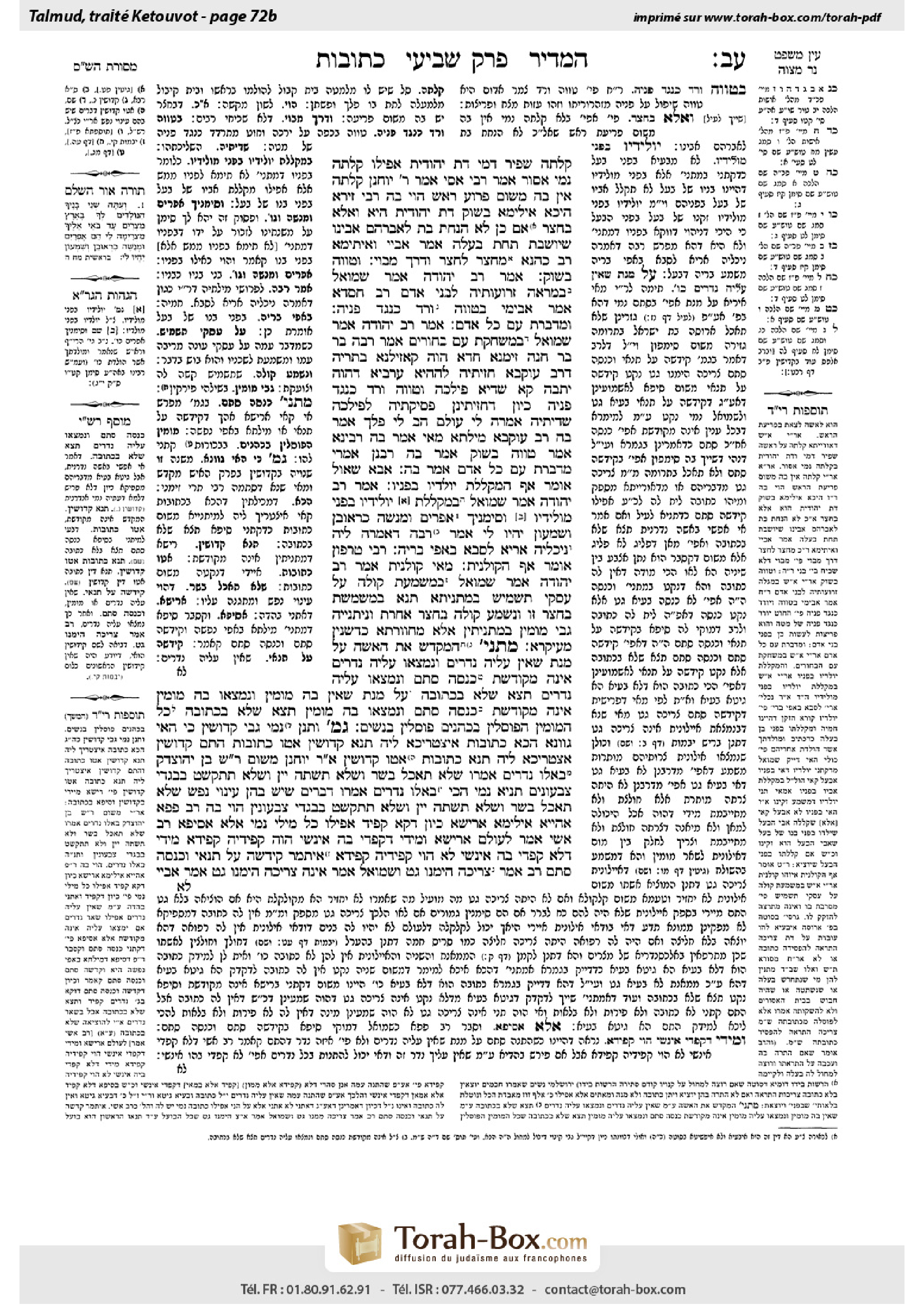
Ketubot 72b: Talmud study for Daf Yomi
Daf Yomi is the daily study of one Talmud folio. Explore 37 tractates with scans, Hebrew text, Sefaria English and AI-generated French translations where annotated.
Passage selection and English or AI-generated French translation are available where the scan has annotations. Daf Study is independent of Torah-Box and Sefaria.
Browse Ketubot · כתובות · All tractatesKetubot 72b text and translations
This page of Ketubot includes the Aramaic text, an English translation and an AI-generated French translation, alongside the scan above.
כתובות ע״ב ב · Aramaic and Hebrew text
קַלְתָּהּ שַׁפִּיר דָּמֵי, דָּת יְהוּדִית — אֲפִילּוּ קַלְתָּהּ נָמֵי אָסוּר.
אָמַר רַבִּי אַסִּי אָמַר רַבִּי יוֹחָנָן: קַלְתָּהּ, אֵין בָּהּ מִשּׁוּם פְּרוּעַ רֹאשׁ. הָוֵי בַּהּ רַבִּי זֵירָא: הֵיכָא? אִילֵּימָא בְּשׁוּק — דָּת יְהוּדִית הִיא! וְאֶלָּא בֶּחָצֵר — אִם כֵּן לֹא הִנַּחְתָּ בַּת לְאַבְרָהָם אָבִינוּ שֶׁיּוֹשֶׁבֶת תַּחַת בַּעְלָהּ! אָמַר אַבָּיֵי וְאִיתֵּימָא רַב כָּהֲנָא: מֵחָצֵר לְחָצֵר וְדֶרֶךְ מָבוֹי.
וְטוֹוֶה בַּשּׁוֹק. אָמַר רַב יְהוּדָה אָמַר שְׁמוּאֵל: בְּמַרְאָה זְרוֹעוֹתֶיהָ לִבְנֵי אָדָם. רַב חִסְדָּא אָמַר אֲבִימִי: בְּטוֹוֶה וְרַד כְּנֶגֶד פָּנֶיהָ, וּמְדַבֶּרֶת עִם כׇּל אָדָם. אָמַר רַב יְהוּדָה אָמַר שְׁמוּאֵל: בִּמְשַׂחֶקֶת עִם בַּחוּרִים.
אָמַר רַבָּה בַּר בַּר חָנָה: זִימְנָא חֲדָא הֲוָה קָאָזֵילְנָא בָּתְרֵיהּ דְּרַב עוּקְבָא, חֲזִיתֵיהּ לְהַהִיא עַרְבָיָא דַּהֲוָה יָתְבָה קָא שָׁדְיָא פִּילְכַּהּ, וְטוֹוֶה וְרַד כְּנֶגֶד פָּנֶיהָ. כֵּיוָן דַּחֲזֵיתִינַן, פְּסַיקְתֵּיהּ לְפִילְכַּהּ שְׁדֵיתֵיהּ. אֲמַרָה לִי: עוּלָם, הַב לִי פֶּלֶךְ. אָמַר בַּהּ רַב עוּקְבָא מִילְּתָא. מַאי אָמַר בָּהּ? רָבִינָא אָמַר: ״טוֹוָה בַּשּׁוּק״ אָמַר בַּהּ. רַבָּנַן אָמְרִי: ״מְדַבֶּרֶת עִם כׇּל אָדָם״ אָמַר בָּהּ.
אַבָּא שָׁאוּל אוֹמֵר: אַף הַמְקַלֶּלֶת יוֹלְדָיו בְּפָנָיו. אָמַר רַב יְהוּדָה אָמַר שְׁמוּאֵל: בִּמְקַלֶּלֶת יוֹלְידָיו בִּפְנֵי מוֹלָידָיו. וְסִימָנָיךְ: ״אֶפְרַיִם וּמְנַשֶּׁה כִּרְאוּבֵן וְשִׁמְעוֹן יִהְיוּ לִי״. אָמַר רַבָּה: דְּאָמְרָה לֵיהּ ״נֵיכְלֵיהּ אַרְיָא לְסָבָא בְּאַפֵּי בְּרֵיהּ״.
רַבִּי טַרְפוֹן אוֹמֵר: אַף הַקּוֹלָנִית. מַאי ״קוֹלָנִית״? אָמַר רַב יְהוּדָה אָמַר שְׁמוּאֵל: בְּמַשְׁמַעַת קוֹלָהּ עַל עִסְקֵי תַּשְׁמִישׁ. בְּמַתְנִיתָא תָּנָא: בִּמְשַׁמֶּשֶׁת בְּחָצֵר זוֹ וְנִשְׁמַע קוֹלָהּ בְּחָצֵר אַחֶרֶת.
וְנִיתְנְיַיהּ גַּבֵּי מוּמִין בְּמַתְנִיתִין! אֶלָּא מְחַוַּורְתָּא כִּדְשַׁנִּין מֵעִיקָּרָא.
מַתְנִי׳ הַמִּקְדָּשׁ אֶת הָאִשָּׁה עַל מְנָת שֶׁאֵין עָלֶיהָ נְדָרִים, וְנִמְצְאוּ עָלֶיהָ נְדָרִים — אֵינָהּ מְקוּדֶּשֶׁת, כְּנָסָהּ סְתָם וְנִמְצְאוּ עָלֶיהָ נְדָרִים — תֵּצֵא שֶׁלֹּא בִּכְתוּבָּה.
עַל מְנָת שֶׁאֵין בָּהּ מוּמִין וְנִמְצְאוּ בָּהּ מוּמִין — אֵינָהּ מְקוּדֶּשֶׁת. כְּנָסָהּ סְתָם וְנִמְצְאוּ בָּהּ מוּמִין — תֵּצֵא שֶׁלֹּא בִּכְתוּבָּה. כֹּל הַמּוּמִין הַפּוֹסְלִין בַּכֹּהֲנִים — פּוֹסְלִין בְּנָשִׁים.
גְּמָ׳ וּתְנַן נָמֵי גַּבֵּי קִדּוּשִׁין כִּי הַאי גַוְונָא! הָכָא — כְּתוּבּוֹת אִיצְטְרִיכָא לֵיהּ, תַּנָּא קִדּוּשִׁין אַטּוּ כְּתוּבּוֹת. הָתָם — קִדּוּשִׁין אִצְטְרִיכָא לֵיהּ, תְּנָא כְּתוּבּוֹת אַטּוּ קִדּוּשִׁין.
אָמַר רַבִּי יוֹחָנָן מִשּׁוּם רַבִּי שִׁמְעוֹן בֶּן יְהוֹצָדָק: בְּאֵלּוּ נְדָרִים אָמְרוּ — שֶׁלֹּא תֹּאכַל בָּשָׂר, וְשֶׁלֹּא תִּשְׁתֶּה יַיִן, וְשֶׁלֹּא תִּתְקַשֵּׁט בְּבִגְדֵי צִבְעוֹנִים. תַּנְיָא נָמֵי הָכִי: בְּאֵלּוּ נְדָרִים אָמְרוּ — דְּבָרִים שֶׁיֵּשׁ בָּהֶן עִינּוּי נֶפֶשׁ: שֶׁלֹּא תֹּאכַל בָּשָׂר, וְשֶׁלֹּא תִּשְׁתֶּה יַיִן, וְשֶׁלֹּא תִּתְקַשֵּׁט בְּבִגְדֵי צִבְעוֹנִין.
הָוֵי בַּהּ רַב פָּפָּא: אַהֵיָיא? אִילֵּימָא אַרֵישָׁא: כֵּיוָן דְּקָא קָפֵיד — אֲפִילּוּ כֹּל מִילֵּי נָמֵי! אֶלָּא אַסֵּיפָא.
רַב אָשֵׁי אָמַר: לְעוֹלָם אַרֵישָׁא, וּמִידִּי דְּקָפְדִי בַּהּ אִינָשֵׁי — הֲוָה קְפִידֵיהּ קְפִידָא. מִידֵּי דְּלָא קָפְדִי בַּהּ אִינָשֵׁי — לָא הָוֵי קְפִידֵיהּ קְפִידָא.
אִיתְּמַר: קִידְּשָׁה עַל תְּנַאי וּכְנָסָהּ סְתָם, רַב אָמַר: צְרִיכָה הֵימֶנּוּ גֵּט. וּשְׁמוּאֵל אָמַר: אֵינָהּ צְרִיכָה הֵימֶנּוּ גֵּט. אָמַר אַבָּיֵי:
Ketubot 72b · English translation
if she covers her head with her basket [kilta], it seems well and is sufficient. But by precepts of Jewish women, i.e., custom, even if her head is covered by her basket this is also prohibited; she requires a substantial head covering.
Rabbi Asi said that Rabbi Yoḥanan said: If she covers her head with her basket, there is no violation of the prohibition against having an uncovered head. Rabbi Zeira discussed it: Where is the woman that Rabbi Yoḥanan is referring to? If we say he means that she appears this way in the marketplace, this is a violation of precepts of Jewish women, as explained previously. And if you say rather that he means she appears this way in her own courtyard, if so, you have not allowed any daughter of our father Abraham to remain with her husband, since most women are not careful to cover their heads completely inside their own courtyards. Abaye said, and some say that Rav Kahana said: Rabbi Yoḥanan is referring to when she walks from one courtyard to another courtyard or via an alleyway. Although these places are not considered public areas, strangers may still be present in them.
§ And the mishna stated that a woman violates Jewish custom if she spins wool in the marketplace. Rav Yehuda said that Shmuel said: This means that she reveals her arms to people by raising her sleeves as she spins. Rav Ḥisda said that Avimi said: It is referring to when she spins with a red [vered] thread opposite her face to highlight her beauty, which entails an element of promiscuity. The mishna also stated another violation of Jewish custom: Or she speaks with every man she encounters. Rav Yehuda said that Shmuel said: This means that she flirts with young men.
Rabba bar bar Ḥanna said: One time I was walking behind Rav Ukva. I saw an Arab woman who was sitting, casting her spindle, and spinning a red thread opposite her face. Once she saw us, she tore the spindle from the thread and threw it down. She said to me: Young man, give me the spindle. Rav Ukva made a comment about her, noting that she provided an example of one of the types of promiscuity mentioned in the mishna. The Gemara asks: What did he say about her? Which one of the cases in the mishna did he mention? Ravina said: He said about her that she was an example of a woman who licentiously spins in the marketplace. The Rabbis said: He said about her that she was an example of a woman who licentiously speaks with every man.
§ The mishna stated: Abba Shaul says: Also a woman who curses her husband’s parents in his presence violates the precepts of Jewish women. Rav Yehuda said that Shmuel said: Even when she curses his parents in the presence of his children and not in his presence she is considered one who violates Jewish custom. And your mnemonic is “Ephraim and Manasseh will be to me like Reuben and Simeon” (Genesis 48:5), which teaches that grandchildren have the status of children. Cursing one’s husband’s parents in front of his children is tantamount to doing so in front of the husband himself. Rabba said: An example is that she said in the presence of her husband’s son: May a lion devour your grandfather.
§ The mishna stated: Rabbi Tarfon says: Also a loud woman. The Gemara asks: What is the definition of a loud woman? Rav Yehuda said that Shmuel said: She is considered loud when she raises her voice about matters relating to intercourse, i.e., she quarrels and fights with her husband about it loudly enough that the neighbors overhear, causing him embarrassment. It was taught in a baraita: When she engages in intercourse in this courtyard and she screams from pain, and therefore her voice is heard in another courtyard.
The Gemara asks: But if so, then this should be taught together with the blemishes in the mishna at the end of the chapter, where it lists cases of women who may be divorced without payment of their marriage contract due to a physical blemish, as opposed to the mishna here, which discusses immodest conduct. Rather, it is clear as we initially answered, that a loud woman is so defined due to immodest behavior.
MISHNA: In the case of one who betroths a woman on condition that there are no vows incumbent upon her, and it was subsequently discovered that there are vows incumbent upon her, she is not betrothed. This is because if the condition is not fulfilled, the betrothal is nullified. If he married her without specification and it was subsequently discovered that vows were incumbent upon her, she may be divorced without payment of her marriage contract, since he discovered a deficiency about which she had not initially informed him. However, this does not invalidate the betrothal, since he did not make any explicit condition.
If he betrothed her on condition that she has no blemishes, and it was subsequently discovered that she did have blemishes, she is not betrothed. But if he married her without specification, and it was subsequently discovered that she had blemishes, she may be divorced without payment of her marriage contract. The mishna clarifies what qualifies as a blemish: All of the blemishes that are listed in tractate Bekhorot involving significant physical deformities that disqualify priests from service similarly disqualify betrothal of women, as a mistaken transaction.
GEMARA: The Gemara comments: And we learned a mishna (Kiddushin 50a) also concerning betrothal just like this case. The mishna there is essentially identical to the mishna here, so why must it be repeated? The Gemara explains: Here, it was necessary for the tanna to mention these halakhot in the context of marriage contracts, which is the topic of this tractate. Therefore, he taught the halakha of betrothal due to the halakha of marriage contracts. There, in Kiddushin, it was necessary for him to mention the halakha of betrothal, so he taught about marriage contracts due to betrothal.
Rabbi Yoḥanan said in the name of Rabbi Shimon ben Yehotzadak: These are the vows they spoke about in the mishna that are considered grounds for divorce without payment of the marriage contract: A vow that she will not eat meat or that she will not drink wine or that she will not adorn herself with colored garments. That opinion is also taught in a baraita: These are the vows they spoke about: Matters that involve affliction, such as that she will not eat meat, or that she will not drink wine, or that she will not adorn herself with colored garments.
Rav Pappa discussed it: To which statement in the mishna is this referring? If we say it is referring to the first clause of the mishna, where one betroths a woman on condition that there are no vows incumbent upon her, then since he demonstrated that he is particular about vows, even vows concerning any other matters, including insignificant ones, should also be included. Since he stipulated a condition and it was not fulfilled, the betrothal is invalid. Rather, one must conclude that it is referring to the latter clause of the mishna, about one who marries a woman without stipulation and then discovers that vows were incumbent upon her. In such a case the mishna says she may be divorced without payment of her marriage contract. However, it does not say this for all vows, but only for vows concerning matters of significant affliction.
Rav Ashi said: Actually, one can explain that it is referring to the first clause of the mishna, where he stipulates that the marriage is conditional on the assumption that she has no vows incumbent upon her, and that the point is that for a vow concerning a matter about which people are ordinarily particular, his insistence is considered legitimate insistence, and is effective to invalidate the betrothal. But with regard to a vow concerning a matter about which people are generally not particular, his insistence is not considered insistence, and such a vow is not considered a violation of the condition. Consequently, the betrothal is valid.
§ It was stated that the Sages had a dispute concerning the following question: If he betrothed her conditionally, such as that she had no vows incumbent upon her, and he subsequently married her without specification, and then it was discovered that the condition had not been fulfilled, Rav said: Although he may divorce her without payment of her marriage contract, the betrothal is not nullified, and therefore she requires a bill of divorce from him. And Shmuel said: The betrothal was invalid from the outset, and therefore she does not require a bill of divorce from him. Abaye said:
Ketubot 72b · Traduction française (IA)
Si elle se couvre la tête avec son panier [kilta], cela semble convenable et suffit. Mais selon les usages des femmes juives, c’est-à-dire la coutume, même si son panier lui couvre la tête, cela reste interdit : elle doit se couvrir la tête de manière plus complète.
Rabbi Asi a dit au nom de Rabbi Yoḥanan : Si elle se couvre la tête avec son panier, elle ne transgresse pas l’interdiction d’avoir la tête découverte. Rabbi Zeira s’interroge à ce sujet : De quelle femme Rabbi Yoḥanan parle-t-il ? Si l’on suppose qu’il parle d’une femme qui se montre ainsi au marché, cela constitue une transgression des usages des femmes juives, comme cela a été expliqué précédemment. Et si l’on suppose plutôt qu’il parle d’une femme qui se montre ainsi dans sa propre cour, alors on n’autoriserait aucune fille de notre père Abraham à rester avec son mari, puisque la plupart des femmes ne veillent pas à se couvrir complètement la tête dans leur propre cour. Abaye a dit — et certains disent que c’est Rav Kahana qui l’a dit — que Rabbi Yoḥanan parle d’une femme qui passe d’une cour à une autre ou emprunte une ruelle. Bien que ces endroits ne soient pas considérés comme des lieux publics, des étrangers peuvent néanmoins s’y trouver.
§ La Michna indiquait qu’une femme transgresse la coutume juive si elle file de la laine au marché. Rav Yehouda a dit au nom de Chmouel : Cela signifie qu’en remontant ses manches pendant qu’elle file, elle découvre ses bras aux passants. Rav Ḥisda a dit au nom d’Avimi : Il s’agit d’une femme qui file avec un fil rouge [vered] devant son visage afin de mettre en valeur sa beauté, ce qui comporte un élément de promiscuité. La Michna mentionnait également une autre transgression de la coutume juive : parler avec chaque homme qu’elle rencontre. Rav Yehouda a dit au nom de Chmouel : Cela signifie qu’elle flirte avec de jeunes hommes.
Rabba bar bar Ḥanna a dit : Un jour, je marchais derrière Rav Ukva. J’ai vu une femme arabe assise, qui lançait son fuseau et filait un fil rouge devant son visage. Dès qu’elle nous a aperçus, elle a arraché le fuseau du fil et l’a jeté à terre. Elle m’a dit : « Jeune homme, donne-moi le fuseau. » Rav Ukva fit une remarque à son sujet, notant qu’elle illustrait l’un des types de comportement licencieux mentionnés dans la Michna. La Guemara demande : Qu’a-t-il dit à son sujet ? Quel cas de la Michna a-t-il mentionné ? Ravina a dit : Il a dit qu’elle était un exemple de femme qui file de manière licencieuse au marché. Les Sages ont dit : Il a dit qu’elle était un exemple de femme qui parle de manière licencieuse avec chaque homme.
§ La Michna indiquait : Abba Chaoul dit qu’une femme qui maudit les parents de son mari en sa présence transgresse également les usages des femmes juives. Rav Yehouda a dit au nom de Chmouel : Même si elle maudit ses parents en présence de ses enfants, et non en sa présence à lui, elle est considérée comme transgressant la coutume juive. Le moyen mnémotechnique est : « Éphraïm et Manassé seront pour moi comme Ruben et Siméon » (Genèse 48,5), ce qui enseigne que les petits-enfants ont le statut d’enfants. Maudire les parents de son mari devant ses enfants revient à le faire devant le mari lui-même. Rabba a dit : Un exemple serait qu’elle dise en présence du fils de son mari : « Puisse un lion dévorer ton grand-père. »
§ La Michna indiquait : Rabbi Tarfon dit qu’il en va de même d’une femme bruyante. La Guemara demande : Qu’entend-on par « femme bruyante » ? Rav Yehouda a dit au nom de Chmouel : Elle est considérée comme bruyante lorsqu’elle élève la voix au sujet des relations conjugales, c’est-à-dire qu’elle se querelle bruyamment avec son mari à ce propos, au point que les voisins l’entendent, ce qui le met dans l’embarras. Il a été enseigné dans une baraïta : Il s’agit d’une femme qui a des relations sexuelles dans cette cour et crie de douleur, de sorte que sa voix s’entend dans une autre cour.
La Guemara demande : Mais dans ce cas, cela devrait être enseigné avec les défauts mentionnés dans la Michna à la fin du chapitre, où sont énumérés les cas de femmes qui peuvent être divorcées sans recevoir le montant de leur ketouba en raison d’un défaut physique, plutôt qu’avec la Michna ici, qui traite d’un comportement indécent. Il est donc clair que la réponse donnée initialement est la bonne : une femme est considérée comme bruyante en raison d’un comportement indécent.
MICHNA : Dans le cas d’un homme qui se fiance avec une femme à la condition qu’elle n’ait aucun vœu à respecter, si l’on découvre par la suite qu’elle a des vœux à respecter, elle n’est pas fiancée. En effet, si la condition n’est pas remplie, les fiançailles sont annulées. S’il l’a épousée sans préciser de condition et que l’on découvre ensuite qu’elle avait des vœux à respecter, il peut divorcer d’elle sans lui verser le montant de sa ketouba, puisqu’il a découvert un défaut qu’elle ne lui avait pas révélé au départ. Cela n’annule toutefois pas les fiançailles, car il n’avait posé aucune condition explicite.
S’il s’est fiancé avec elle à la condition qu’elle n’ait aucun défaut et que l’on découvre par la suite qu’elle en avait, elle n’est pas fiancée. Mais s’il l’a épousée sans préciser de condition et que l’on découvre ensuite qu’elle avait des défauts, il peut divorcer d’elle sans lui verser le montant de sa ketouba. La Michna précise ce qui constitue un défaut : tous les défauts énumérés dans le traité Bekhorot, qui sont des difformités physiques importantes disqualifiant les prêtres pour le service, invalident de même les fiançailles d’une femme, comme dans le cas d’une transaction fondée sur une erreur.
GUEMARA : La Guemara fait remarquer que nous avons également appris une Michna (Kiddouchin 50a) sur les fiançailles, identique à celle-ci. La Michna de là-bas étant pour l’essentiel identique à celle-ci, pourquoi faut-il la répéter ? La Guemara explique : Ici, le tanna devait mentionner ces halakhot dans le contexte des contrats de mariage, qui constituent le sujet de ce traité. Il a donc enseigné la halakha des fiançailles à propos de celle des contrats de mariage. Là-bas, dans Kiddouchin, il devait mentionner la halakha des fiançailles ; il a donc enseigné celle des contrats de mariage à propos des fiançailles.
Rabbi Yoḥanan a dit au nom de Rabbi Shimon ben Yehotzadak : Voici les vœux dont parle la Michna, qui constituent un motif de divorce sans versement de la ketouba : le vœu de ne pas manger de viande, de ne pas boire de vin ou de ne pas se parer de vêtements colorés. Cette opinion est également enseignée dans une baraïta : Voici les vœux dont ils parlaient : des sujets qui entraînent une souffrance, comme le fait de ne pas manger de viande, de ne pas boire de vin ou de ne pas se parer de vêtements colorés.
Rav Pappa s’interroge à ce sujet : À quelle déclaration de la Michna cela se rapporte-t-il ? Si l’on suppose qu’il s’agit de la première partie de la Michna, où un homme se fiance avec une femme à la condition qu’elle n’ait aucun vœu à respecter, alors, puisqu’il a montré qu’il attache de l’importance aux vœux, même ceux portant sur d’autres sujets, y compris insignifiants, devraient également être inclus. Puisqu’il a posé une condition et qu’elle n’a pas été remplie, les fiançailles sont invalides. Il faut donc conclure qu’il s’agit de la dernière partie de la Michna, à propos de celui qui épouse une femme sans poser de condition, puis découvre qu’elle avait des vœux à respecter. Dans un tel cas, la Michna dit qu’il peut divorcer d’elle sans lui verser le montant de sa ketouba. Toutefois, elle ne le dit pas pour tous les vœux, mais seulement pour ceux qui concernent des sujets causant une souffrance importante.
Rav Ashi a dit : En réalité, on peut expliquer que cela se rapporte à la première partie de la Michna, où il pose comme condition qu’elle n’ait aucun vœu à respecter, et que le point est le suivant : pour un vœu portant sur un sujet auquel les gens attachent habituellement de l’importance, son insistance est considérée comme légitime et suffit à invalider les fiançailles. Mais pour un vœu portant sur un sujet auquel les gens n’attachent généralement pas d’importance, son insistance n’est pas considérée comme telle, et ce vœu n’est pas considéré comme une violation de la condition. Par conséquent, les fiançailles sont valides.
§ Il a été rapporté que les Sages sont en désaccord sur la question suivante : s’il s’est fiancé avec elle sous condition, par exemple qu’elle n’ait aucun vœu à respecter, puis l’a épousée sans préciser de condition, et que l’on découvre alors que la condition n’avait pas été remplie, Rav a dit : Bien qu’il puisse divorcer d’elle sans lui verser le montant de sa ketouba, les fiançailles ne sont pas annulées et elle doit donc recevoir de lui un acte de divorce. Et Chmouel a dit : Les fiançailles étaient invalides dès le départ ; elle n’a donc pas besoin de recevoir de lui un acte de divorce. Abaye a dit :
Traduction française générée par IA à partir de l’édition anglaise de Sefaria. Vérifie toujours un passage avec le texte source.
Text from Sefaria: William Davidson Edition - Vocalized Aramaic (CC BY NC); William Davidson Edition - English (CC BY NC).