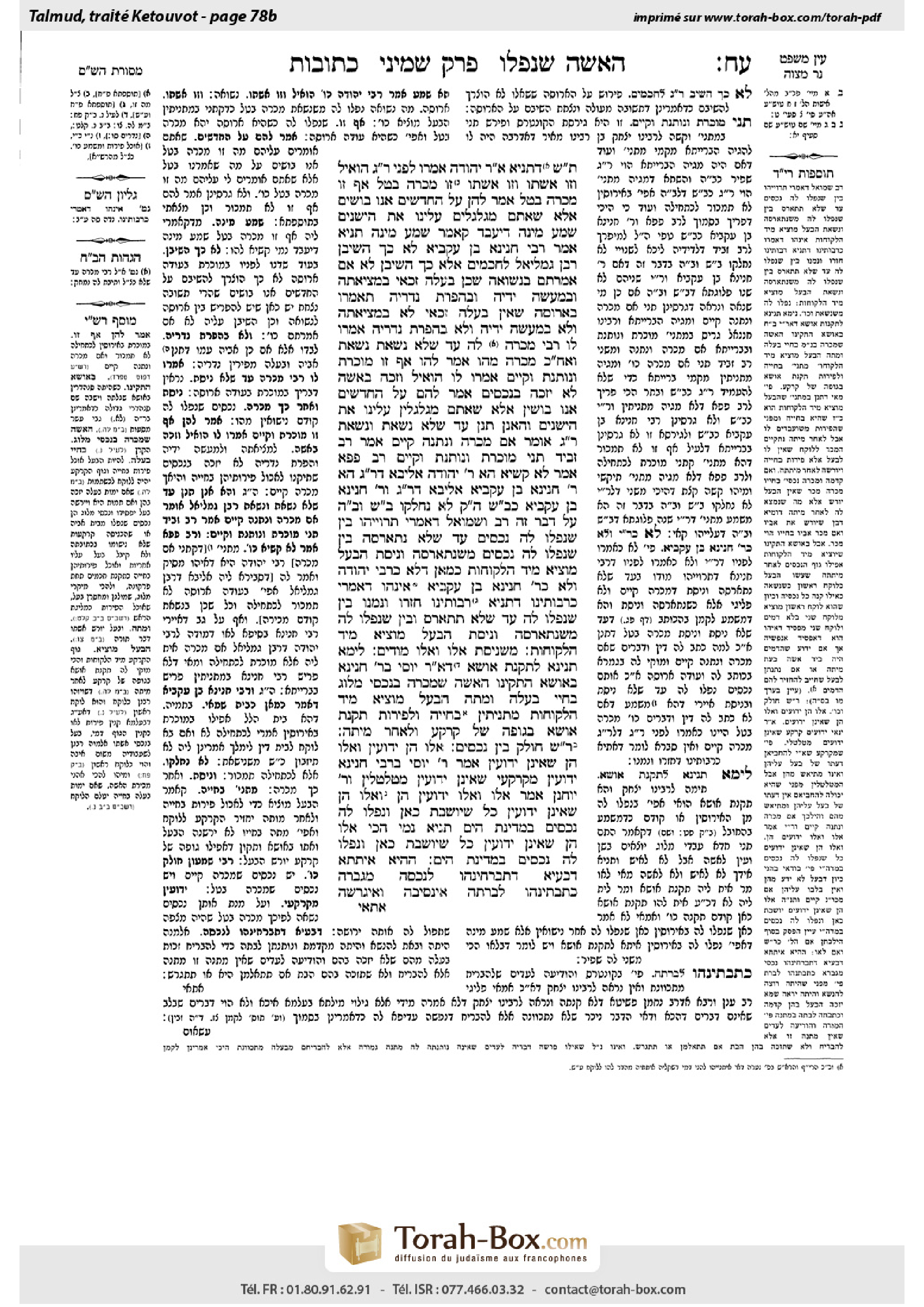
Ketubot 78b: Talmud study for Daf Yomi
Daf Yomi is the daily study of one Talmud folio. Explore 37 tractates with scans, Hebrew text, Sefaria English and AI-generated French translations where annotated.
Passage selection and English or AI-generated French translation are available where the scan has annotations. Daf Study is independent of Torah-Box and Sefaria.
Browse Ketubot · כתובות · All tractatesKetubot 78b text and translations
This page of Ketubot includes the Aramaic text, an English translation and an AI-generated French translation, alongside the scan above.
כתובות ע״ח ב · Aramaic and Hebrew text
תָּא שְׁמַע, דְּתַנְיָא, אָמַר רַבִּי יְהוּדָה: אָמְרוּ לִפְנֵי רַבָּן גַּמְלִיאֵל: הוֹאִיל וְזוֹ אִשְׁתּוֹ וְזוֹ אִשְׁתּוֹ — זוֹ מִכְרָהּ בָּטֵל, אַף זוֹ מִכְרָהּ בָּטֵל! אָמַר לָהֶן: עַל הַחֲדָשִׁים אָנוּ בּוֹשִׁים, אֶלָּא שֶׁאַתֶּם מְגַלְגְּלִים עָלֵינוּ אֶת הַיְּשָׁנִים? שְׁמַע מִינַּהּ דִּיעֲבַד קָאָמַר: שְׁמַע מִינַּהּ.
תַּנְיָא, אָמַר רַבִּי חֲנִינָא בֶּן עֲקַבְיָא: לֹא כָּךְ הֱשִׁיבָן רַבָּן גַּמְלִיאֵל לַחֲכָמִים, אֶלָּא כָּךְ הֱשִׁיבָן: לֹא אִם אֲמַרְתֶּם בִּנְשׂוּאָה — שֶׁכֵּן בַּעְלָהּ זַכַּאי בִּמְצִיאָתָהּ וּבְמַעֲשֵׂה יָדֶיהָ וּבַהֲפָרַת נְדָרֶיהָ, תֹּאמְרוּ בַּאֲרוּסָה שֶׁאֵין בַּעְלָהּ זַכַּאי לֹא בִּמְצִיאָתָהּ וְלֹא בְּמַעֲשֵׂה יָדֶיהָ וְלֹא בַּהֲפָרַת נְדָרֶיהָ!
אָמְרוּ לוֹ: רַבִּי, מָכְרָה לָהּ עַד שֶׁלֹּא נִשֵּׂאת, נִשֵּׂאת וְאַחַר כָּךְ מָכְרָה, מַהוּ? אֲמַר לְהוּ: אַף זוֹ מוֹכֶרֶת וְנוֹתֶנֶת וְקַיָּים. אָמְרוּ לוֹ: הוֹאִיל וְזָכָה בָּאִשָּׁה, לֹא יִזְכֶּה בַּנְּכָסִים?! אָמַר לָהֶם: עַל הַחֲדָשִׁים אָנוּ בּוֹשִׁין, אֶלָּא שֶׁאַתֶּם מְגַלְגְּלִין עָלֵינוּ אֶת הַיְּשָׁנִים?!
וְהָאֲנַן תְּנַן: עַד שֶׁלֹּא נִשֵּׂאת וְנִשֵּׂאת, רַבָּן גַּמְלִיאֵל אוֹמֵר: אִם מָכְרָה וְנָתְנָה — קַיָּים.
אָמַר רַב זְבִיד, תְּנִי: מוֹכֶרֶת וְנוֹתֶנֶת וְקַיָּים. רַב פָּפָּא אָמַר, לָא קַשְׁיָא: הָא רַבִּי יְהוּדָה אַלִּיבָּא דְּרַבָּן גַּמְלִיאֵל, הָא רַבִּי חֲנִינָא בֶּן עֲקַבְיָא אַלִּיבָּא דְּרַבָּן גַּמְלִיאֵל. וְרַבִּי חֲנִינָא בֶּן עֲקַבְיָא כְּבֵית שַׁמַּאי? הָכִי קָאָמַר: לֹא נֶחְלְקוּ בֵּית שַׁמַּאי וּבֵית הִלֵּל עַל דָּבָר זֶה.
רַב וּשְׁמוּאֵל דְּאָמְרִי תַּרְוַיְיהוּ: בֵּין שֶׁנָּפְלוּ לָהּ נְכָסִים עַד שֶׁלֹּא נִתְאָרְסָה, בֵּין שֶׁנָּפְלוּ לָהּ נְכָסִים מִשֶּׁנִּתְאָרְסָה, וְנִיסֵּת — הַבַּעַל מוֹצִיא מִיַּד הַלָּקוֹחוֹת.
כְּמַאן? דְּלֹא כְּרַבִּי יְהוּדָה וְלֹא כְּרַבִּי חֲנִינָא בֶּן עֲקַבְיָא! אִינְהוּ דְּאָמְרִי כְּרַבּוֹתֵינוּ. דְּתַנְיָא, רַבּוֹתֵינוּ חָזְרוּ וְנִמְנוּ: בֵּין שֶׁנָּפְלוּ לָהּ עַד שֶׁלֹּא תִּתְאָרֵס, וּבֵין שֶׁנָּפְלוּ לָהּ מִשֶּׁנִּתְאָרְסָה וְנִיסֵּת — הַבַּעַל מוֹצִיא מִיַּד הַלָּקוֹחוֹת.
מִשֶּׁנִּיסֵּת אֵלּוּ וְאֵלּוּ מוֹדִים. לֵימָא תְּנֵינָא לְתַקָּנַת אוּשָׁא? דְּאָמַר רַבִּי יוֹסֵי בְּרַבִּי חֲנִינָא, בְּאוּשָׁא הִתְקִינוּ: הָאִשָּׁה שֶׁמָּכְרָה בְּנִכְסֵי מְלוֹג בְּחַיֵּי בַּעְלָהּ וּמֵתָה — הַבַּעַל מוֹצִיא מִיַּד הַלָּקוֹחוֹת.
מַתְנִיתִין — בְּחַיֶּיהָ וּלְפֵירוֹת, תַּקָּנַת אוּשָׁא — בְּגוּפָהּ שֶׁל קַרְקַע וּלְאַחַר מִיתָה.
רַבִּי שִׁמְעוֹן חוֹלֵק בֵּין נְכָסִים. אֵלּוּ הֵן יְדוּעִין וְאֵלּוּ הֵן שֶׁאֵינָן יְדוּעִין? אָמַר רַבִּי יוֹסֵי בְּרַבִּי חֲנִינָא: יְדוּעִין — מְקַרְקְעֵי. שֶׁאֵינָן יְדוּעִין — מִטַּלְטְלִין. וְרַבִּי יוֹחָנָן אָמַר: אֵלּוּ וָאֵלּוּ יְדוּעִין הֵן. וְאֵלּוּ הֵן שֶׁאֵינָן יְדוּעִין — כֹּל שֶׁיּוֹשֶׁבֶת כָּאן וְנָפְלוּ לָהּ נְכָסִים בִּמְדִינַת הַיָּם.
תַּנְיָא נָמֵי הָכִי: אֵלּוּ הֵן שֶׁאֵינָן יְדוּעִין — כֹּל שֶׁיּוֹשֶׁבֶת כָּאן וְנָפְלוּ לָהּ נְכָסִים בִּמְדִינַת הַיָּם.
הָהִיא אִיתְּתָא דְּבָעֲיָא דְּתַבְרְחִינְהוּ לְנִכְסַהּ מִגַּבְרַהּ, כְּתַבְתִּינְהוּ לִבְרַתַּהּ. אִינְּסִיבָה וְאִיגָּרַשָׁה.
Ketubot 78b · English translation
The Gemara replies: Come and hear an answer to this question, as it is taught in a baraita: Rabbi Yehuda said that they said before Rabban Gamliel: Since this one, when she is fully married, is legally his wife, and that one, when she is merely betrothed, is legally his wife, therefore, just as for this married one her sale is void, so too, for this betrothed one her sale should be void. Rabban Gamliel said to them: With regard to the new property, which she inherited after marriage, we are ashamed of this ruling, while you seek to impose upon us the same ruling even with regard to the old property that she owned beforehand? Learn from this that Rabbi Yehuda stated his question with regard to the halakha of a case brought after the fact, as they claim that the sale should be void. The Gemara concludes: Indeed, learn from this that it is so.
It is taught in a baraita: Rabbi Ḥanina ben Akavya said that Rabban Gamliel did not respond to the Sages in that manner. Rather, this is what he replied to them: No, if you said that the sale is void with regard to a married woman, concerning whom the husband has many rights, as her husband is entitled to items she has found and to her earnings and to the right to nullify her vows, will you say the same with regard to a betrothed woman, whose husband is not entitled to items she has found, nor to her earnings, nor to the right of nullification of her vows?
The Sages said to him: My teacher, this reasoning is accepted if she sold it for herself before she was married, but if she was married and afterward sold the property she had earlier inherited, what is the halakha? Rabban Gamliel said to them: Even this one may sell the property and give it away, and her action is valid. They said to him: Since he acquired the woman, will he not acquire the property? He said to them: With regard to the new property she inherited later we are ashamed, and now you impose upon us the old property?
The Gemara raises a difficulty: But didn’t we learn in the mishna: If she inherited property before she was married and was later married, Rabban Gamliel says: If she sold it or gave the property away, the transaction is valid. The wording of the baraita, in contrast, indicates that she may sell or give the property away ab initio.
Rav Zevid said: Teach the text of the mishna as follows: She may sell and give away the property, and her transaction is valid. Rav Pappa stated another answer: This is not difficult, as this mishna is consistent with the opinion of Rabbi Yehuda according to the opinion of Rabban Gamliel, but that baraita is consistent with the opinion of Rabbi Ḥanina ben Akavya according to the opinion of Rabban Gamliel. The Gemara poses a question: If so, then apparently Rabbi Ḥanina ben Akavya agrees with Beit Shammai, as Beit Hillel maintain that she may not sell the property ab initio even while she is betrothed; yet it is well known that the halakha is ruled in accordance with the opinion of Beit Hillel. The Gemara answers: This is what Rabbi Ḥanina is saying: Beit Shammai and Beit Hillel did not disagree with regard to this matter of property that a woman inherited before marriage, as they agree she may sell it ab initio.
The Gemara cites the opinions of Rav and Shmuel, who both say: Whether property was bequeathed to her before she was betrothed, or whether property was bequeathed to her after she was betrothed and she was then married, and after her marriage she sold it or gave it away, the husband may repossess the property from the purchasers.
The Gemara asks: According to whose opinion was this stated? It is not in accordance with the opinion of Rabbi Yehuda and not in accordance with the opinion of Rabbi Ḥanina ben Akavya, who both maintain that the sale is valid. The Gemara answers: They, i.e., Rav and Shmuel, say so, in accordance with the opinion of our Rabbis. As it is taught in a baraita: Our Rabbis returned and voted after discussing this issue and decided that whether property was bequeathed to her before she was betrothed, or whether property was bequeathed to her after she was betrothed and she was subsequently married, the husband may repossess it from the purchasers.
§ It was taught in the mishna that if she inherited the property after she was married, both these, Beit Shammai, and those, Beit Hillel, agree that the husband may repossess it from the buyers. The Gemara comments: Let us say that we already learned in the mishna about the rabbinic ordinance instituted in Usha. As Rabbi Yosei, son of Rabbi Ḥanina, said: In Usha they instituted an ordinance that in the case of a woman who sold her usufruct property, i.e., property that she alone owns and her husband benefits only from the dividends, in her husband’s lifetime and then died, the husband repossesses it from the purchasers. This appears to be the same halakha stated by the mishna.
The Gemara responds: This is not so, as the mishna is discussing the husband’s claim during her lifetime, and it is referring only to the value of the produce that the husband collects from the purchasers if she sold the land during their marriage, as the produce of usufruct property belongs to him but the land itself remains fully in the possession of the buyer. The ordinance of Usha, in contrast, applies even to the land itself, and even after the death of his wife he may repossess it because he inherits it.
§ The mishna further taught that Rabbi Shimon distinguishes between property that is known to the husband and property that is unknown to him. The Gemara asks: Which properties are deemed known and which properties are deemed unknown? Rabbi Yosei, son of Rabbi Ḥanina, said: Property that is known is referring to land, which cannot be concealed. The husband knew that she would inherit it, and he married her with the intention of using its produce. Property that is unknown is referring to movable property. And Rabbi Yoḥanan said: Both these, land, and those, movable property, are deemed known property. And these are unknown properties: They are properties in any case where she resides here and property was bequeathed to her overseas. Since the husband did not consider this property when marrying her, the sale is binding after the fact.
The Gemara comments: That opinion is also taught in a baraita. The baraita states: These are unknown properties: They are properties in any case where she resides here and property was bequeathed to her overseas.
The Gemara relates: There was a certain woman who was about to remarry after she was divorced or widowed, who sought to distance the rights to her property from her future husband. She therefore wrote a document stipulating that her property be given as a gift to her daughter before marriage. Ultimately, the mother was married and then divorced. She wanted her daughter to return the property, and her daughter claimed that it was given to her as a gift.
Ketubot 78b · Traduction française (IA)
La Guemara répond : Viens et entends une réponse à cette question, comme il est enseigné dans une baraïta : Rabbi Yehuda dit qu’ils dirent devant Rabban Gamliel : Puisque celle-ci, lorsqu’elle est pleinement mariée, est légalement son épouse, et que celle-là, lorsqu’elle est seulement fiancée, est légalement son épouse, de même que la vente de cette femme mariée est nulle, la vente de cette femme fiancée devrait elle aussi être nulle. Rabban Gamliel leur dit : Pour les biens nouveaux, dont elle a hérité après son mariage, nous avons honte de cette décision, et vous cherchez à nous imposer la même décision même pour les biens anciens qu’elle possédait auparavant ? Apprends de là que Rabbi Yehuda a posé sa question au sujet de la halakha dans un cas présenté après coup, puisqu’ils soutiennent que la vente devrait être nulle. La Guemara conclut : En effet, apprends de là qu’il en est ainsi.
Il est enseigné dans une baraïta : Rabbi Ḥanina ben Akavya dit que Rabban Gamliel ne répondit pas aux Sages de cette manière. Il leur répondit plutôt ainsi : Non. Si vous avez dit que la vente est nulle dans le cas d’une femme mariée, à propos de laquelle le mari détient de nombreux droits — car il a droit aux objets qu’elle trouve, à ses revenus et à l’annulation de ses vœux —, direz-vous la même chose d’une femme fiancée, dont le mari n’a droit ni aux objets qu’elle trouve, ni à ses revenus, ni au droit d’annuler ses vœux ?
Les Sages lui dirent : Mon maître, ce raisonnement est recevable si elle a vendu le bien pour elle-même avant d’être mariée ; mais si elle s’est mariée, puis a vendu le bien dont elle avait hérité auparavant, quelle est la halakha ? Rabban Gamliel leur dit : Même celle-ci peut vendre le bien et le donner, et son acte est valide. Ils lui dirent : Puisqu’il a acquis la femme, n’acquiert-il pas aussi le bien ? Il leur dit : Pour les biens nouveaux dont elle a hérité par la suite, nous avons honte, et maintenant vous nous imposez les biens anciens ?
La Guemara soulève une difficulté : Mais n’avons-nous pas appris dans la Michna : Si elle a hérité d’un bien avant d’être mariée, puis s’est mariée, Rabban Gamliel dit : Si elle l’a vendu ou donné, la transaction est valide. En revanche, la formulation de la baraïta indique qu’elle peut vendre ou donner le bien a priori.
Rav Zevid dit : Enseigne le texte de la Michna ainsi : Elle peut vendre le bien et le donner, et sa transaction est valide. Rav Pappa donne une autre réponse : Il n’y a pas de difficulté, car cette Michna est conforme à l’opinion de Rabbi Yehuda selon Rabban Gamliel, tandis que cette baraïta est conforme à l’opinion de Rabbi Ḥanina ben Akavya selon Rabban Gamliel. La Guemara pose une question : Si tel est le cas, il apparaît que Rabbi Ḥanina ben Akavya est d’accord avec Beit Shammai, puisque Beit Hillel soutiennent qu’elle ne peut pas vendre le bien a priori, même lorsqu’elle est fiancée ; or il est bien connu que la halakha est tranchée conformément à l’opinion de Beit Hillel. La Guemara répond : Voici ce que dit Rabbi Ḥanina : Beit Shammai et Beit Hillel n’étaient pas en désaccord sur cette question des biens dont une femme a hérité avant le mariage, car ils conviennent qu’elle peut les vendre a priori.
La Guemara rapporte les opinions de Rav et de Shmuel, qui disent tous deux : Que les biens lui aient été transmis par héritage avant ses fiançailles, ou qu’ils lui aient été transmis par héritage après ses fiançailles et qu’elle se soit ensuite mariée, si elle les a vendus ou donnés après son mariage, le mari peut les reprendre aux acquéreurs.
La Guemara demande : Selon quelle opinion cela a-t-il été dit ? Ce n’est conforme ni à l’opinion de Rabbi Yehuda ni à celle de Rabbi Ḥanina ben Akavya, qui soutiennent tous deux que la vente est valide. La Guemara répond : Rav et Shmuel disent cela conformément à l’opinion de nos Rabbins. Car il est enseigné dans une baraïta : Nos Rabbins se réunirent de nouveau et votèrent après avoir débattu de cette question ; ils décidèrent que, que les biens lui aient été transmis par héritage avant ses fiançailles ou qu’ils lui aient été transmis par héritage après ses fiançailles, puis qu’elle se soit mariée, le mari peut les reprendre aux acquéreurs.
§ Il a été enseigné dans la Michna que si elle a hérité des biens après son mariage, ceux-ci, Beit Shammai, comme ceux-là, Beit Hillel, conviennent que le mari peut les reprendre aux acquéreurs. La Guemara fait remarquer : Peut-on dire que nous avons déjà appris dans la Michna l’ordonnance rabbinique instituée à Ousha ? En effet, Rabbi Yosei, fils de Rabbi Ḥanina, a dit : À Ousha, ils ont institué une ordonnance selon laquelle, dans le cas d’une femme qui a vendu ses biens soumis à l’usufruit — c’est-à-dire des biens qui lui appartiennent à elle seule et dont son mari ne perçoit que les fruits — du vivant de son mari, puis est morte, le mari les reprend aux acquéreurs. Cela semble être la même halakha que celle énoncée par la Michna.
La Guemara répond : Il n’en est pas ainsi, car la Michna traite du droit de revendication du mari du vivant de sa femme et ne concerne que la valeur des fruits que le mari perçoit auprès des acquéreurs si elle a vendu le terrain pendant leur mariage ; en effet, les fruits des biens soumis à l’usufruit lui appartiennent, mais le terrain lui-même reste entièrement en possession de l’acheteur. L’ordonnance d’Ousha, en revanche, s’applique même au terrain lui-même ; même après la mort de sa femme, il peut le reprendre, car il en hérite.
§ La Michna enseignait également que Rabbi Shimon distingue entre les biens connus du mari et ceux qui lui sont inconnus. La Guemara demande : Quels biens sont considérés comme connus et quels biens sont considérés comme inconnus ? Rabbi Yosei, fils de Rabbi Ḥanina, dit : Les biens connus désignent les terrains, qui ne peuvent être dissimulés. Le mari savait qu’elle en hériterait et l’a épousée dans l’intention d’en percevoir les fruits. Les biens inconnus désignent les biens mobiliers. Rabbi Yoḥanan dit : Ceux-ci, les terrains, comme ceux-là, les biens mobiliers, sont considérés comme des biens connus. Et voici les biens inconnus : ce sont ceux dont elle hérite à l’étranger alors qu’elle réside ici. Puisque le mari n’a pas tenu compte de ces biens en l’épousant, la vente est valable après coup.
La Guemara fait remarquer que cette opinion est également enseignée dans une baraïta. La baraïta énonce : Voici les biens inconnus : ce sont ceux dont elle hérite à l’étranger alors qu’elle réside ici.
La Guemara rapporte : Une femme qui allait se remarier après avoir divorcé ou être devenue veuve cherchait à soustraire ses biens aux droits de son futur mari. Elle rédigea donc un acte stipulant que ses biens seraient donnés à sa fille avant le mariage. Finalement, la mère se maria, puis divorça. Elle voulut que sa fille lui restitue les biens, mais sa fille soutint qu’ils lui avaient été donnés en cadeau.
Traduction française générée par IA à partir de l’édition anglaise de Sefaria. Vérifie toujours un passage avec le texte source.
Text from Sefaria: William Davidson Edition - Vocalized Aramaic (CC BY NC); William Davidson Edition - English (CC BY NC).