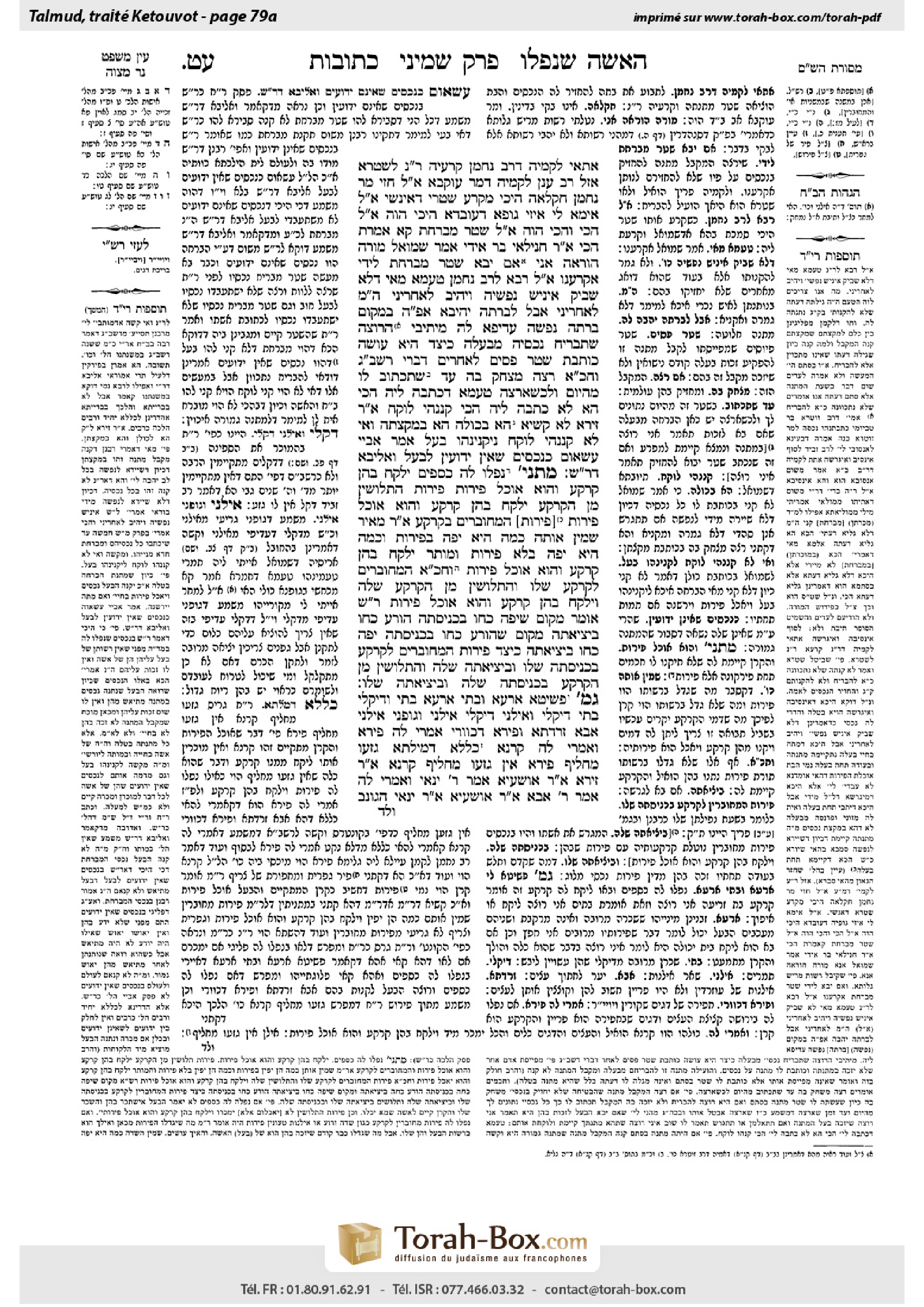
Ketubot 79a: Talmud study for Daf Yomi
Daf Yomi is the daily study of one Talmud folio. Explore 37 tractates with scans, Hebrew text, Sefaria English and AI-generated French translations where annotated.
Passage selection and English or AI-generated French translation are available where the scan has annotations. Daf Study is independent of Torah-Box and Sefaria.
Browse Ketubot · כתובות · All tractatesKetubot 79a text and translations
This page of Ketubot includes the Aramaic text, an English translation and an AI-generated French translation, alongside the scan above.
כתובות ע״ט א · Aramaic and Hebrew text
אֲתַאי לְקַמֵּיהּ דְּרַב נַחְמָן, קַרְעֵיהּ רַב נַחְמָן לִשְׁטָרָא. אֲזַל רַב עָנָן לְקַמֵּיהּ דְּמָר עוּקְבָא, אֲמַר לֵיהּ: חֲזִי מָר נַחְמָן חַקְלָאָה הֵיכִי מְקָרַע שְׁטָרֵי דְאִינָשֵׁי. אֲמַר לֵיהּ: אֵימָא לִי אִיזִי, גּוּפָא דְעוֹבָדָא הֵיכִי הֲוָה?
אֲמַר לֵיהּ: הָכִי וְהָכִי הֲוָה. אֲמַר לֵיהּ: שְׁטַר מַבְרַחַת קָא אָמְרַתְּ? הָכִי אָמַר רַב חֲנִילַאי בַּר אִידִי אָמַר שְׁמוּאֵל: מוֹרֶה הוֹרָאָה אֲנִי: אִם יָבֹא שְׁטַר מַבְרַחַת לְיָדִי — אֶקְרָעֶנּוּ.
אֲמַר לֵיהּ רָבָא לְרַב נַחְמָן: טַעְמָא מַאי? דְּלָא שָׁבֵיק אִינִישׁ נַפְשֵׁיהּ וְיָהֵיב לְאַחֲרִינֵי. הָנֵי מִילֵּי לְאַחֲרִינֵי, אֲבָל לִבְרַתַּהּ יָהֲיבָא! אֲפִילּוּ הָכִי: בִּמְקוֹם בְּרַתַּהּ, נַפְשָׁהּ עֲדִיפָא לַהּ.
מֵיתִיבִי: הָרוֹצָה שֶׁתַּבְרִיחַ נְכָסֶיהָ מִבַּעְלָהּ, כֵּיצַד הִיא עוֹשָׂה? כּוֹתֶבֶת שְׁטַר פַּסִּים לַאֲחֵרִים, דִּבְרֵי רַבָּן שִׁמְעוֹן בֶּן גַּמְלִיאֵל.
וַחֲכָמִים אוֹמְרִים: רָצָה — מְצַחֵק בָּהּ. עַד שֶׁתִּכְתּוֹב לוֹ מֵהַיּוֹם וְלִכְשֶׁאֶרְצֶה.
טַעְמָא דְּכָתְבָה לֵיהּ הָכִי, הָא לָא כָּתְבָה לֵיהּ הָכִי — קְנַנְהִי לוֹקֵחַ!
אָמַר רַבִּי זֵירָא, לָא קַשְׁיָא: הָא — בְּכוּלַּהּ, הָא — בְּמִקְצָתַהּ.
וְאִי לָא קְנַנְהִי לוֹקֵחַ — נִיקְנִינְהוּ בַּעַל! אָמַר אַבָּיֵי: עֲשָׂאוּם כִּנְכָסִים שֶׁאֵין יְדוּעִין לַבַּעַל, וְאַלִּיבָּא דְּרַבִּי שִׁמְעוֹן.
מַתְנִי׳ נָפְלוּ לָהּ כְּסָפִים — יִלָּקַח בָּהֶן קַרְקַע, וְהוּא אוֹכֵל פֵּירוֹת. פֵּירוֹת הַתְּלוּשִׁין מִן הַקַּרְקַע — יִלָּקַח בָּהֶן קַרְקַע, וְהוּא אוֹכֵל פֵּירוֹת.
[פֵּירוֹת] הַמְחוּבָּרִים בַּקַּרְקַע? אָמַר רַבִּי מֵאִיר: שָׁמִין אוֹתָהּ כַּמָּה הִיא יָפָה בְּפֵירוֹת וְכַמָּה הִיא יָפָה בְּלֹא פֵּירוֹת, וּמוֹתַר — יִלָּקַח בָּהֶן קַרְקַע, וְהוּא אוֹכֵל פֵּירוֹת. וַחֲכָמִים אוֹמְרִים: הַמְחוּבָּרִים לַקַּרְקַע — שֶׁלּוֹ, וְהַתְּלוּשִׁין מִן הַקַּרְקַע — שֶׁלָּהּ, וְיִלָּקַח בָּהֶן קַרְקַע, וְהוּא אוֹכֵל פֵּירוֹת.
רַבִּי שִׁמְעוֹן אוֹמֵר: מְקוֹם שֶׁיִּפָּה כֹּחוֹ בִּכְנִיסָתָהּ — הוֹרַע כֹּחוֹ בִּיצִיאָתָהּ. מְקוֹם שֶׁהוֹרַע כֹּחוֹ בִּכְנִיסָתָהּ — יִפָּה כֹּחוֹ בִּיצִיאָתָהּ. כֵּיצַד? פֵּירוֹת הַמְחוּבָּרִים לַקַּרְקַע, בִּכְנִיסָתָהּ — שֶׁלּוֹ, וּבִיצִיאָתָהּ — שֶׁלָּהּ. וְהַתְּלוּשִׁין מִן הַקַּרְקַע, בִּכְנִיסָתָהּ — שֶׁלָּהּ, וּבִיצִיאָתָהּ — שֶׁלּוֹ.
גְּמָ׳ פְּשִׁיטָא: אַרְעָא וּבָתֵּי — אַרְעָא. בָּתֵּי וְדִיקְלֵי — בָּתֵּי. דִּיקְלֵי וְאִילָנֵי — דִּיקְלֵי. אִילָנֵי וְגוּפְנֵי — אִילָנֵי.
אִבָּא, זַרְדְּתָא, וּפִירָא דְכַוְורֵי, אָמְרִי לַהּ פֵּירָא וְאָמְרִי לַהּ קַרְנָא. כְּלָלָא דְּמִילְּתָא: גִּזְעוֹ מַחְלִיף — פֵּירָא, אֵין גִּזְעוֹ מַחְלִיף — קַרְנָא.
אָמַר רַבִּי זֵירָא אָמַר רַבִּי אוֹשַׁעְיָא אָמַר רַבִּי יַנַּאי, וְאָמְרִי לַהּ, אָמַר רַבִּי אַבָּא אָמַר רַבִּי אוֹשַׁעְיָא אָמַר רַבִּי יַנַּאי: הַגּוֹנֵב
Ketubot 79a · English translation
The mother came before Rav Naḥman for judgment. Rav Naḥman tore the document, accepting her claim that she did not intend to transfer ownership of her property. Rav Anan went before Mar Ukva, the Exilarch, and said to him: Let the Master observe Naḥman the farmer, how he tears people’s documents. Rav Anan was upset that Rav Naḥman destroyed a legitimate document. Mar Ukva said to him: Tell me, please, what was the actual incident?
Rav Anan said to Mar Ukva: This and that transpired; i.e., he apprised him of all the details. Mar Ukva said to him: Are you saying it was a document of evasion? This is what Rav Ḥanilai bar Idi said that Shmuel said: I am an authority who issues rulings and have issued the following directive: If a document of evasion comes to my hand, I will tear it, as it is clear that it was not intended for the actual transfer of property but merely to distance it from someone else.
After seeing Rav Naḥman tear the document, Rava said to Rav Naḥman: What is the reason for your actions? Is it that you assume that it was not a wholehearted gift because a person does not abandon his own interests and give a gift to others? That applies only when it is given to others who are strangers, but to her daughter a mother would give property wholeheartedly. Rav Naḥman replied: Even so, where her interests clash with those of her daughter, her own interests are preferable to her, and therefore she did not intend to waive her rights.
The Gemara raises an objection: With regard to one who seeks to distance her property from her husband, how does she proceed? She writes in a document of agreement that her property should be given to others, who agree not to acquire the property. This document prevents her husband from gaining access to her property. This is the statement of Rabban Shimon ben Gamliel.
And the Rabbis say: This solution is flawed, because if the recipient wishes, he can deceive her and retain the property by virtue of the valid document in his possession. That possibility cannot be avoided until she writes to him in the document that the gift is granted from today and the gift is in effect only while I still wish to give it. In that case, if the one to whom she gave the gift comes to take possession of it, she can say that she no longer wants to give the gift and can thereby invalidate the document.
The Gemara infers: The reason she can ultimately retain her property is due to the fact that she wrote this to him; but if she did not write this to him, the purchaser has acquired it. This indicates that a document of evasion is legally valid.
Rabbi Zeira said: This is not difficult, as this, the ruling that the document of evasion is void, is in a case where the document was written about all of the property, as clearly a person does not give away all his property as a gift and leave himself with nothing. Conversely, that ruling that the document is not canceled is in a case where the document was written about only part of the property, and therefore a clause must be added ensuring that the recipient cannot retain possession of the gift.
The Gemara raises a difficulty: And in the case where the document is invalid because all of the property was included, if the purchaser does not acquire the property, the husband should acquire it. Abaye said: The Sages rendered this property given as a gift like property that is unknown to the husband, and this is in accordance with the opinion of Rabbi Shimon in the mishna that if she sold such property after her marriage, the sale is valid. Therefore, the husband does not have access to the property.
MISHNA: If money was bequeathed to a woman as an inheritance while she was married, land is acquired with it, and the husband consumes the produce of the land while the principal remains hers. If she inherited produce that is detached from the ground, it is considered like money; therefore, land is acquired with it and he consumes the produce of the land.
With regard to produce that is attached to the ground, Rabbi Meir says: One evaluates how much the land is worth with the produce, and how much it is worth without the produce, and the difference between these sums is the surplus value that belongs to the woman. Land is then acquired with the surplus and he consumes the produce. And the Rabbis say: That which is attached to the ground is his, as he is entitled to the produce from her property and he may therefore eat from it. And that which is detached from the ground is hers, like all other money she brings to the marriage, and land is acquired with it and he consumes the produce.
Rabbi Shimon says: In a case where his right is superior upon her entrance to the marriage, his right is inferior upon her exit if he divorces her. Conversely, in a case where his right is inferior upon her entrance, his right is superior upon her exit. How so? With regard to produce that is attached to the ground, if she married while owning such produce, upon her entrance it is his, in accordance with the opinion of the Rabbis, and upon her exit, when he divorces her, it is hers, as it is considered part of her property. But in the case of produce that is detached from the ground, upon her entrance it is hers, and if such produce is detached before their divorce, upon her exit it is his, as he was already entitled to all the produce of her property.
GEMARA: The Gemara observes that in the cases in the mishna where land is bought with the money, it is obvious that if one spouse proposes acquiring land and the other proposes buying houses, they must buy land, because it is a more secure purchase. If the decision is between houses and palm trees, they should acquire houses. If the decision is between palm trees or other types of trees, they should buy palm trees. If the decision is between regular trees or grapevines, they should purchase trees. The principle is that they acquire that which lasts longer and will not deteriorate over time.
If the wife inherited a forest [abba] of hawthorn [zeradeta] trees, whose produce is inferior, or a fishpond, their status is a matter of dispute: Some say they are considered like produce, and some say they are like the principal, as they do not replenish themselves but eventually wear out. The principle of the matter is as follows: Any tree or plant whose trunk renews itself and grows again after it is cut is considered produce, whereas any tree or plant whose trunk does not renew itself is considered part of the principal.
Rabbi Zeira said that Rabbi Oshaya said that Rabbi Yannai said, and some say Rabbi Abba said that Rabbi Oshaya said that Rabbi Yannai said: One who steals
Ketubot 79a · Traduction française (IA)
La mère se présenta devant Rav Naḥman pour un jugement. Rav Naḥman déchira le document, acceptant sa déclaration selon laquelle elle n’avait pas eu l’intention de transférer la propriété de ses biens. Rav Anan se rendit auprès de Mar Ukva, l’Exilarque, et lui dit : « Que le Maître regarde Naḥman le paysan, qui déchire les documents des gens ! » Rav Anan était contrarié que Rav Naḥman ait détruit un document valide. Mar Ukva lui dit : « Dis-moi, je te prie, ce qui s’est réellement passé. »
Rav Anan dit à Mar Ukva : « Voici ce qui s’est passé » ; autrement dit, il lui exposa tous les détails. Mar Ukva lui dit : « Tu veux dire que c’était un document de dissimulation ? » C’est ce que Rav Ḥanilai bar Idi a dit au nom de Shmuel : « Je suis une autorité qui rend des décisions, et j’ai édicté la directive suivante : si un document de dissimulation me parvient, je le déchirerai, car il est évident qu’il n’était pas destiné à transférer réellement un bien, mais seulement à le soustraire à quelqu’un d’autre. »
Après avoir vu Rav Naḥman déchirer le document, Rava lui dit : « Pourquoi as-tu agi ainsi ? Est-ce parce que tu supposes qu’il ne s’agissait pas d’un don consenti de plein gré, car une personne ne renonce pas à ses propres intérêts pour faire un don à autrui ? Cela ne s’applique que lorsqu’elle donne à des étrangers ; mais une mère ferait un don de plein gré à sa fille. » Rav Naḥman répondit : « Même ainsi, lorsque ses intérêts entrent en conflit avec ceux de sa fille, elle préfère ses propres intérêts ; elle n’avait donc pas l’intention de renoncer à ses droits. »
La Guemara soulève une objection : lorsqu’une femme cherche à soustraire ses biens à son mari, comment procède-t-elle ? Elle rédige un document d’entente stipulant que ses biens doivent être remis à d’autres personnes, lesquelles acceptent de ne pas les acquérir. Ce document empêche son mari d’avoir accès à ses biens. Telle est l’opinion de Rabban Shimon ben Gamliel.
Et les Sages disent : cette solution est défectueuse, car si le bénéficiaire le souhaite, il peut la tromper et conserver les biens en vertu du document valide qu’il détient. On ne peut éviter cette éventualité qu’en inscrivant dans le document que le don lui est accordé dès aujourd’hui, mais qu’il ne prend effet que tant que je souhaite encore le faire. Dans ce cas, si le bénéficiaire vient prendre possession du don, elle peut dire qu’elle ne souhaite plus le lui faire et ainsi invalider le document.
La Guemara en déduit que la raison pour laquelle elle peut finalement conserver ses biens est qu’elle lui a écrit cette clause ; mais si elle ne la lui avait pas écrite, l’acquéreur les aurait acquis. Cela indique qu’un document de dissimulation est juridiquement valide.
Rabbi Zeira dit : Cela n’est pas difficile, car ici, la décision selon laquelle le document de dissimulation est nul concerne le cas où le document portait sur tous les biens ; il est en effet évident qu’une personne ne donne pas tous ses biens et ne se laisse rien. En revanche, la décision selon laquelle le document n’est pas annulé concerne le cas où il ne portait que sur une partie des biens ; il faut donc ajouter une clause garantissant que le bénéficiaire ne puisse pas conserver le don.
La Guemara soulève une difficulté : dans le cas où le document est invalide parce qu’il portait sur tous les biens, si l’acquéreur ne les acquiert pas, le mari devrait les acquérir. Abaye dit : Les Sages ont assimilé ces biens donnés en cadeau à des biens dont le mari ignore l’existence, conformément à l’opinion de Rabbi Shimon dans la Michna, selon laquelle, si elle a vendu de tels biens après son mariage, la vente est valide. Le mari n’a donc pas accès à ces biens.
MICHNA : Si une femme reçoit de l’argent en héritage pendant son mariage, on achète un terrain avec cet argent, et le mari perçoit les revenus du terrain tandis que le capital reste à elle. Si elle hérite de produits détachés du sol, ils sont considérés comme de l’argent ; on achète donc un terrain avec eux, et le mari en perçoit les revenus.
Concernant les produits encore attachés au sol, Rabbi Meïr dit : on évalue la valeur du terrain avec les produits, puis sa valeur sans les produits ; la différence entre ces montants constitue la plus-value qui revient à la femme. On achète ensuite un terrain avec cette plus-value, et le mari en perçoit les revenus. Les Sages disent : ce qui est attaché au sol lui appartient, puisqu’il a droit aux produits de ses biens et peut donc les consommer. Ce qui est détaché du sol lui appartient, comme tout autre argent qu’elle apporte au mariage ; on achète un terrain avec cet argent, et le mari en perçoit les revenus.
Rabbi Shimon dit : lorsque le droit du mari est supérieur au moment où elle entre dans le mariage, il devient inférieur au moment où elle en sort, s’il la divorce. À l’inverse, lorsque son droit est inférieur au moment où elle entre dans le mariage, il devient supérieur au moment où elle en sort. Comment cela ? Concernant les produits attachés au sol, si elle s’est mariée alors qu’elle possédait de tels produits, ceux-ci lui appartiennent dès son entrée dans le mariage, conformément à l’opinion des Sages, et à sa sortie, lorsqu’il la divorce, ils lui appartiennent également, car ils sont considérés comme faisant partie de ses biens. En revanche, concernant les produits détachés du sol, ils lui appartiennent dès son entrée dans le mariage ; mais si de tels produits sont détachés avant leur divorce, ils lui appartiennent au moment de sa sortie, puisqu’il avait déjà droit à tous les produits de ses biens.
GUEMARA : La Guemara fait remarquer que, dans les cas de la Michna où l’on achète un terrain avec l’argent, il va de soi que si l’un des époux propose d’acheter un terrain et l’autre des maisons, ils doivent acheter un terrain, car c’est un investissement plus sûr. S’ils doivent choisir entre des maisons et des palmiers, ils doivent acheter des maisons. S’ils doivent choisir entre des palmiers et d’autres sortes d’arbres, ils doivent acheter des palmiers. S’ils doivent choisir entre des arbres ordinaires et des vignes, ils doivent acheter des arbres. Le principe est qu’ils acquièrent ce qui dure le plus longtemps et ne se détériore pas avec le temps.
Si la femme a hérité d’une forêt [abba] d’aubépines [zeradeta], dont les fruits sont de qualité inférieure, ou d’un vivier à poissons, leur statut fait l’objet d’un désaccord : certains disent qu’ils sont considérés comme des produits, d’autres qu’ils sont comme le capital, car ils ne se renouvellent pas et finissent par s’épuiser. Voici le principe : tout arbre ou toute plante dont le tronc se renouvelle et repousse après avoir été coupé est considéré comme un produit ; tout arbre ou toute plante dont le tronc ne se renouvelle pas est considéré comme faisant partie du capital.
Rabbi Zeira a dit au nom de Rabbi Oshaya, qui l’a dit au nom de Rabbi Yannai ; certains disent que Rabbi Abba l’a dit au nom de Rabbi Oshaya, qui l’a dit au nom de Rabbi Yannai : celui qui vole
Traduction française générée par IA à partir de l’édition anglaise de Sefaria. Vérifie toujours un passage avec le texte source.
Text from Sefaria: William Davidson Edition - Vocalized Aramaic (CC BY NC); William Davidson Edition - English (CC BY NC).