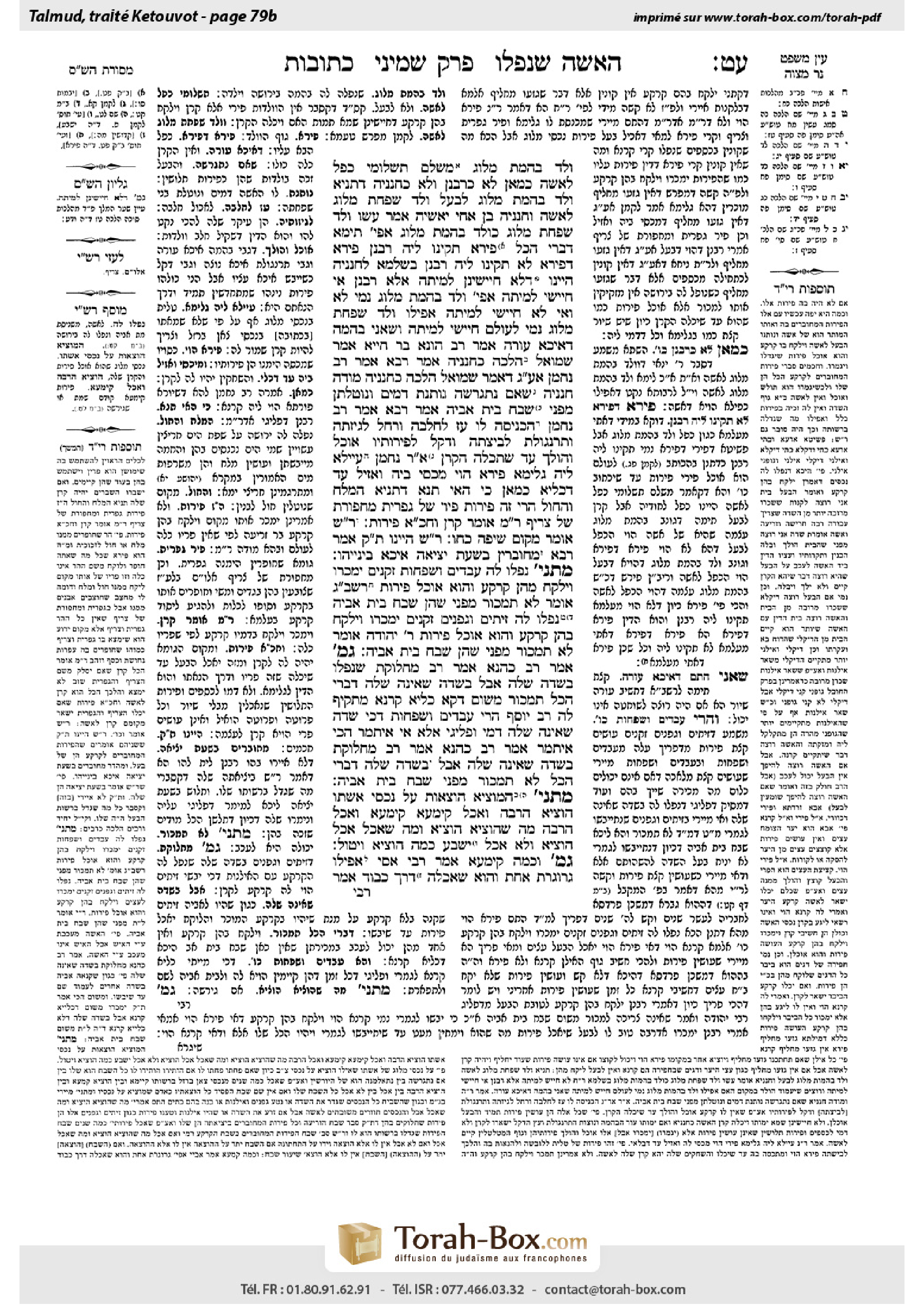
Ketubot 79b: Talmud study for Daf Yomi
Daf Yomi is the daily study of one Talmud folio. Explore 37 tractates with scans, Hebrew text, Sefaria English and AI-generated French translations where annotated.
Passage selection and English or AI-generated French translation are available where the scan has annotations. Daf Study is independent of Torah-Box and Sefaria.
Browse Ketubot · כתובות · All tractatesKetubot 79b text and translations
This page of Ketubot includes the Aramaic text, an English translation and an AI-generated French translation, alongside the scan above.
כתובות ע״ט ב · Aramaic and Hebrew text
וְלַד בֶּהֱמַת מְלוֹג — מְשַׁלֵּם תַּשְׁלוּמֵי כֶפֶל לָאִשָּׁה.
כְּמַאן? לָא כְּרַבָּנַן וְלָא כַּחֲנַנְיָה! דְּתַנְיָא: וְלַד בֶּהֱמַת מְלוֹג לְבַעַל, וְלַד שִׁפְחַת מְלוֹג לָאִשָּׁה, וַחֲנַנְיָה בֶּן אֲחִי יֹאשִׁיָּה אָמַר: עָשׂוּ וְלַד שִׁפְחַת מְלוֹג כִּוְלַד בֶּהֱמַת מְלוֹג.
אֲפִילּוּ תֵּימָא דִּבְרֵי הַכֹּל: פֵּירָא תַּקִּינוּ לֵיה רַבָּנַן, פֵּירָא דְפֵירָא לָא תַּקִּינוּ לֵיה רַבָּנַן.
בִּשְׁלָמָא לַחֲנַנְיָה — הַיְינוּ דְּלָא חָיְישִׁינַן לְמִיתָה.
אֶלָּא רַבָּנַן אִי חָיְישִׁי לְמִיתָה — אֲפִילּוּ וְלַד בֶּהֱמַת מְלוֹג נָמֵי לָא. וְאִי לָא חָיְישִׁי לְמִיתָה — אֲפִילּוּ וְלַד שִׁפְחַת מְלוֹג נָמֵי?
לְעוֹלָם חָיְישִׁי לְמִיתָה, וְשָׁאנֵי בְּהֵמָה דְּאִיכָּא עוֹרָהּ.
אָמַר רַב הוּנָא בַּר חִיָּיא אָמַר שְׁמוּאֵל: הֲלָכָה כַּחֲנַנְיָה. אָמַר רָבָא אָמַר רַב נַחְמָן: אַף עַל גַּב דְּאָמַר שְׁמוּאֵל הֲלָכָה כַּחֲנַנְיָה, מוֹדֶה חֲנַנְיָה שֶׁאִם נִתְגָּרְשָׁה — נוֹתֶנֶת דָּמִים וְנוֹטַלְתָּן, מִפְּנֵי שֶׁבַח בֵּית אָבִיהָ.
אָמַר רָבָא אָמַר רַב נַחְמָן: הִכְנִיסָה לוֹ עֵז לַחֲלָבָהּ וְרָחֵל לְגִיזָּתָהּ, וְתַרְנְגוֹלֶת לְבֵיצָתָהּ, וְדֶקֶל לְפֵירוֹתָיו — אוֹכֵל וְהוֹלֵךְ עַד שֶׁתִּכְלֶה הַקֶּרֶן. אָמַר רַב נַחְמָן: עַיִּילָא לֵיהּ גְּלִימָא — פֵּירָא הָוֵי, מִכַּסֵּי בֵּיהּ וְאָזֵיל עַד דְּכָלְיָא.
כְּמַאן? כִּי הַאי תַּנָּא, דְּתַנְיָא: הַמֶּלַח וְהַחוֹל — הֲרֵי זֶה פֵּירוֹת. פִּיר שֶׁל גׇּפְרִית, מַחְפּוֹרֶת שֶׁל צָרִיף, רַבִּי מֵאִיר אוֹמֵר: קֶרֶן. וַחֲכָמִים אוֹמְרִים: פֵּירוֹת.
רַבִּי שִׁמְעוֹן אוֹמֵר מָקוֹם שֶׁיִּפָּה כֹּחוֹ. רַבִּי שִׁמְעוֹן הַיְינוּ תַּנָּא קַמָּא? אָמַר רָבָא: מְחוּבָּרִין בִּשְׁעַת יְצִיאָה אִיכָּא בֵּינַיְיהוּ.
מַתְנִי׳ נָפְלוּ לָהּ עֲבָדִים וּשְׁפָחוֹת זְקֵנִים — יִמָּכְרוּ, וְיִלָּקַח מֵהֶן קַרְקַע, וְהוּא אוֹכֵל פֵּירוֹת. רַבָּן שִׁמְעוֹן בֶּן גַּמְלִיאֵל אוֹמֵר: לֹא תִּמְכּוֹר, מִפְּנֵי שֶׁהֵן שֶׁבַח בֵּית אָבִיהָ. נָפְלוּ לָהּ זֵיתִים וּגְפָנִים זְקֵנִים — יִמָּכְרוּ, וְיִלָּקַח בָּהֶן קַרְקַע, וְהוּא אוֹכֵל פֵּירוֹת. רַבִּי יְהוּדָה אוֹמֵר: לֹא תִּמְכּוֹר, מִפְּנֵי שֶׁהֵן שֶׁבַח בֵּית אָבִיהָ.
גְּמָ׳ אָמַר רַב כָּהֲנָא אָמַר רַב: מַחְלוֹקֶת שֶׁנָּפְלוּ בְּשָׂדֶה שֶׁלָּהּ, אֲבָל בְּשָׂדֶה שֶׁאֵינָהּ שֶׁלָּהּ — דִּבְרֵי הַכֹּל תִּמְכּוֹר, מִשּׁוּם דְּקָא כָלְיָא קַרְנָא.
מַתְקֵיף לַהּ רַב יוֹסֵף: הֲרֵי עֲבָדִים וּשְׁפָחוֹת, דְּכִי שָׂדֶה שֶׁאֵינָהּ שֶׁלָּהּ דָּמֵי, וּפְלִיגִי! אֶלָּא אִי אִיתְּמַר הָכִי אִיתְּמַר: אָמַר רַב כָּהֲנָא אָמַר רַב: מַחֲלוֹקֶת בְּשָׂדֶה שֶׁאֵינָהּ שֶׁלָּהּ, אֲבָל בְּשָׂדֶה שֶׁלָּהּ — דִּבְרֵי הַכֹּל לֹא תִּמְכּוֹר, מִפְּנֵי שֶׁבַח בֵּית אָבִיהָ.
מַתְנִי׳ הַמּוֹצִיא הוֹצָאוֹת עַל נִכְסֵי אִשְׁתּוֹ, הוֹצִיא הַרְבֵּה וְאָכַל קִימְעָא, קִימְעָא וְאָכַל הַרְבֵּה — מַה שֶּׁהוֹצִיא הוֹצִיא, וּמַה שֶּׁאָכַל אָכַל. הוֹצִיא וְלֹא אָכַל — יִשָּׁבַע כַּמָּה הוֹצִיא, וְיִטּוֹל.
גְּמָ׳ וְכַמָּה קִימְעָא? אָמַר רַבִּי אַסִּי: אֲפִילּוּ גְּרוֹגֶרֶת אַחַת, וְהוּא שֶׁאֲכָלָהּ דֶּרֶךְ כָּבוֹד. אָמַר
Ketubot 79b · English translation
the offspring of an animal of a woman’s usufruct property must pay payment of double the principal to the woman. Apparently this ruling is based on the assumption that the offspring is not treated as the produce of her property but as the principal, which belongs to the woman.
The Gemara asks: In accordance with whose opinion was this halakha stated? It is not in accordance with the opinion of the Rabbis, and not in accordance with that of Ḥananya. The Gemara explains the dispute alluded to here: As it is taught in a baraita: The offspring of a usufruct animal belongs to the husband, whereas the child of a usufruct maidservant belongs to the wife. And Ḥananya, son of Yoshiya’s brother, said: They made the status of the child of a usufruct maidservant like that of the offspring of a usufruct animal, which belongs to the husband. Both opinions in the baraita agree that the offspring of a usufruct animal belongs to the husband. Why, then, must the thief pay the double payment to the woman?
The Gemara answers: You can even say that all agree with Rabbi Yannai’s ruling, as there is a difference between the general use of property and the double payment. This is because the Sages instituted for the husband to consume the produce, but the Sages did not institute for him to consume the produce of the produce. The double payment does not have the status of the offspring itself but of produce resulting from its theft, which is considered the produce of the produce and therefore is given to the woman.
The Gemara asks: Granted, according to Ḥananya, who equates the halakha of a maidservant’s child to that of an animal’s offspring, this is because we are not concerned about the death of the mother. Therefore, the mother is the principal while its offspring is considered the produce.
But according to the Rabbis, if they are concerned about the death of the mother, and this is why a maidservant’s child belongs to the wife, even the offspring of a usufruct animal should not have the status of produce either. Rather, it should have the status of principal, because if the usufruct animal dies the woman will be left with nothing. Therefore, the offspring should be viewed as a replacement for its mother. And if they are not concerned about the death of the mother, even the child of a usufruct maidservant should also belong to the husband as the produce of her property. Why, then, do they distinguish between these two cases?
The Gemara answers: Actually, the Rabbis are concerned about death, but the halakha of an animal is different, as there is still its hide, which remains after death. Therefore, the principal is not entirely lost even if the animal dies.
Rav Huna bar Ḥiyya said that Shmuel said: The halakha is in accordance with the opinion of Ḥananya that the child of a maidservant belongs to the husband. Rava said that Rav Naḥman said: Although Shmuel said that the halakha is in accordance with the opinion of Ḥananya, Ḥananya concedes that if the woman was divorced, she pays money and takes the children of her maidservants, because they are assets of her paternal family, and it is unfitting for the children of her family’s slaves to belong to someone else.
Rava said that Rav Naḥman said: If she brought in to the marriage for him a goat for its milk, or a sheep for its shearings, or a hen for its eggs, or a palm tree for its produce, the husband continues to consume the produce until the principal is consumed, and there is no concern that the woman will remain with nothing of value. Similarly, Rav Naḥman said: If she brought in for him a cloak as her usufruct property, it is produce, and he may cover himself with it until it is consumed.
The Gemara comments: In accordance with whose opinion is this ruling? It is in accordance with this tanna, as it is taught in a baraita: If a wife’s usufruct property includes a location on the shore from which salt and sand are extracted, this extract is deemed produce. As for a quarry of sulfur or a mine of alum, Rabbi Meir says: These are deemed principal, as the mine contains a finite amount of substance, and the Rabbis say: Extractions from such locations are produce, while the location of the mine is the principal. Rav Naḥman’s ruling that the cloak is deemed produce is in accordance with the opinion of the Rabbis that the extractions are deemed produce.
§ The mishna stated that Rabbi Shimon says: In a case where his right is superior upon her entrance, his right is inferior upon her exit if he divorces her. Conversely, in the case where his right is inferior upon her entrance, his right is superior upon her exit. The Gemara asks: The statement of Rabbi Shimon is identical to that of the first tanna, i.e., the Rabbis. Why, then, are both necessary? Rava said: The practical difference between them is the status of produce that was attached at the time of her departure from the marriage. The Rabbis, who did not directly address this issue, maintain that it belongs to him, whereas Rabbi Shimon says it belongs to her.
MISHNA: If elderly slaves or maidservants were bequeathed to her, they are sold and land is acquired with them, and the husband consumes the produce of the land. Rabban Shimon ben Gamliel says: She need not sell these slaves and maidservants, because they are assets of her paternal family, and it would be shameful to the family if they were sold to others. Likewise, if old olive trees or grapevines were bequeathed to her, they are sold and land is acquired with them, and he consumes the produce. Rabbi Yehuda says: She need not sell them, because they are assets of her paternal family.
GEMARA: Rav Kahana said that Rav said: This dispute concerning olive trees and grapevines is referring to a case when they were bequeathed to her in her field, as they are assets of her paternal family, and therefore Rabbi Yehuda rules that she need not sell them. But if she received them in a field that is not hers, everyone agrees that she must sell them because the principal will be consumed. Since these trees will not yield much produce, they will eventually be uprooted, and transitory property is not included in the category of assets of her paternal family.
Rav Yosef objects to this: But elderly slaves and maidservants are considered like a field that is not hers, as nothing will remain of the principal, and yet Rabban Shimon ben Gamliel and the first tanna disagree over this case. The Gemara retracts: Rather, if the above statement of Rav Kahana was stated, it was stated as follows: Rav Kahana said that Rav said: This dispute with regard to olive trees and vines is referring to when they are located in a field that is not hers, but if they are located in her field, everyone agrees that she need not sell them, because they are assets of her paternal family.
MISHNA: With regard to one who pays expenditures for his wife’s property in an effort to improve it, if he paid a large amount in expenditures and ate only a small amount of produce before he divorced her, or if he paid a small amount in expenditures and ate a large quantity of produce, that which he spent he has spent, and that which he ate he has eaten. Therefore, none of it need be returned. However, if he paid expenditures for the property and did not eat any part of it, he takes an oath with regard to how much he paid and then takes his expenditures.
GEMARA: The Gemara asks: And how much is a small amount? Rabbi Asi said: It is even one dried fig, provided he ate it in a dignified manner befitting the owner of the produce and did not eat it by snatching the produce. It was said
Ketubot 79b · Traduction française (IA)
La descendance d’un animal faisant partie des biens en usufruit d’une femme oblige le voleur à verser à la femme le double du principal. Il semble que cette décision repose sur l’hypothèse que la descendance n’est pas considérée comme le produit de ses biens, mais comme le principal, qui appartient à la femme.
La Guemara demande : Selon l’opinion de qui cette halakha a-t-elle été énoncée ? Elle ne correspond ni à l’opinion des Rabbins ni à celle de Ḥananya. La Guemara explique la controverse à laquelle il est fait allusion ici : comme il est enseigné dans une baraïta : La descendance d’un animal en usufruit appartient au mari, tandis que l’enfant d’une servante en usufruit appartient à la femme. Et Ḥananya, fils du frère de Yoshiya, a dit : Ils ont assimilé le statut de l’enfant d’une servante en usufruit à celui de la descendance d’un animal en usufruit, qui appartient au mari. Les deux opinions de la baraïta s’accordent à dire que la descendance d’un animal en usufruit appartient au mari. Pourquoi, dès lors, le voleur doit-il verser le double à la femme ?
La Guemara répond : On peut même dire que tous s’accordent avec la décision de Rabbi Yannai, car il y a une différence entre l’usage général des biens et le double paiement. En effet, les Sages ont institué que le mari consomme le produit, mais ils n’ont pas institué qu’il consomme le produit du produit. Le double paiement n’a pas le statut de la descendance elle-même, mais celui d’un produit résultant de son vol ; il est considéré comme le produit du produit et revient donc à la femme.
La Guemara demande : Certes, selon Ḥananya, qui assimile la halakha de l’enfant d’une servante à celle de la descendance d’un animal, c’est parce que nous ne nous soucions pas de la mort de la mère. Par conséquent, la mère constitue le principal, tandis que sa descendance est considérée comme le produit.
Mais selon les Rabbins, s’ils se soucient de la mort de la mère, et si c’est pour cette raison que l’enfant d’une servante appartient à la femme, la descendance d’un animal en usufruit ne devrait pas non plus avoir le statut de produit. Elle devrait plutôt avoir celui du principal, car si l’animal en usufruit meurt, la femme ne conservera rien. La descendance devrait donc être considérée comme un remplacement de sa mère. Et s’ils ne se soucient pas de la mort de la mère, l’enfant d’une servante en usufruit devrait lui aussi appartenir au mari, en tant que produit de ses biens. Pourquoi, dès lors, distinguent-ils ces deux cas ?
La Guemara répond : En réalité, les Rabbins se soucient de la mort, mais le cas de l’animal est différent, car il reste sa peau après sa mort. Par conséquent, le principal n’est pas entièrement perdu, même si l’animal meurt.
Rav Houna bar Ḥiyya a dit au nom de Chmouel : La halakha suit l’opinion de Ḥananya, selon laquelle l’enfant d’une servante appartient au mari. Rava a dit au nom de Rav Naḥman : Bien que Chmouel ait dit que la halakha suit l’opinion de Ḥananya, Ḥananya reconnaît que si la femme a été divorcée, elle verse de l’argent et reprend les enfants de ses servantes, car ce sont des biens de sa famille paternelle, et il ne convient pas que les enfants des esclaves de sa famille appartiennent à quelqu’un d’autre.
Rava a dit au nom de Rav Naḥman : Si elle lui a apporté en mariage une chèvre pour son lait, une brebis pour sa laine, une poule pour ses œufs ou un palmier pour ses fruits, le mari continue à consommer le produit jusqu’à ce que le principal soit épuisé, sans craindre que la femme ne se retrouve privée de tout bien de valeur. De même, Rav Naḥman a dit : Si elle lui a apporté un manteau comme bien en usufruit, celui-ci est considéré comme un produit, et il peut s’en couvrir jusqu’à ce qu’il soit usé.
La Guemara fait remarquer : Selon l’opinion de quel tanna cette décision a-t-elle été rendue ? Elle suit l’opinion de ce tanna, comme il est enseigné dans une baraïta : Si les biens en usufruit d’une épouse comprennent un endroit au bord de la mer où l’on extrait du sel et du sable, les matières extraites sont considérées comme un produit. Quant à une carrière de soufre ou une mine d’alun, Rabbi Meïr dit : Ces éléments sont considérés comme le principal, car la mine contient une quantité limitée de matière ; et les Rabbins disent : Les matières extraites de ces endroits sont un produit, tandis que le site de la mine constitue le principal. La décision de Rav Naḥman, selon laquelle le manteau est considéré comme un produit, suit l’opinion des Rabbins, selon laquelle les matières extraites sont considérées comme un produit.
§ La Michna énonce que Rabbi Shimon dit : Lorsque son droit est supérieur au moment où elle entre dans le mariage, son droit est inférieur au moment où elle en sort, si son mari la divorce. Inversement, lorsque son droit est inférieur au moment où elle entre dans le mariage, son droit est supérieur au moment où elle en sort. La Guemara demande : La déclaration de Rabbi Shimon est identique à celle du premier tanna, c’est-à-dire les Rabbins. Pourquoi faut-il donc les deux ? Rava a dit : La différence pratique entre eux concerne le statut des produits encore attachés au sol au moment où elle quitte le mariage. Les Rabbins, qui n’ont pas abordé directement cette question, estiment qu’ils lui appartiennent, tandis que Rabbi Shimon dit qu’ils appartiennent à la femme.
Michna : Si des esclaves ou des servantes âgés lui ont été légués, ils sont vendus et des terres sont acquises avec leur prix ; le mari consomme le produit de ces terres. Rabban Shimon ben Gamliel dit : Elle n’a pas besoin de vendre ces esclaves et ces servantes, car ce sont des biens de sa famille paternelle, et il serait honteux pour la famille qu’ils soient vendus à d’autres. De même, si de vieux oliviers ou des vignes lui ont été légués, ils sont vendus et des terres sont acquises avec leur prix, et le mari en consomme le produit. Rabbi Yehuda dit : Elle n’a pas besoin de les vendre, car ce sont des biens de sa famille paternelle.
Guemara : Rav Kahana a dit au nom de Rav : La controverse concernant les oliviers et les vignes porte sur le cas où ils lui ont été légués dans son champ, puisqu’ils sont des biens de sa famille paternelle ; Rabbi Yehuda décide donc qu’elle n’a pas besoin de les vendre. Mais s’ils lui ont été légués dans un champ qui ne lui appartient pas, tous s’accordent à dire qu’elle doit les vendre, car le principal sera épuisé. Comme ces arbres ne produiront pas beaucoup, ils finiront par être déracinés, et un bien temporaire n’entre pas dans la catégorie des biens de sa famille paternelle.
Rav Yossef objecte : Mais les esclaves et les servantes âgés sont considérés comme se trouvant dans un champ qui ne lui appartient pas, puisque rien ne restera du principal ; pourtant, Rabban Shimon ben Gamliel et le premier tanna sont en désaccord à leur sujet. La Guemara revient sur ce qui précède : Il faut plutôt dire que, si la déclaration de Rav Kahana a été rapportée, elle l’a été sous la forme suivante : Rav Kahana a dit au nom de Rav : Cette controverse concernant les oliviers et les vignes porte sur le cas où ils se trouvent dans un champ qui ne lui appartient pas ; mais s’ils se trouvent dans son champ, tous s’accordent à dire qu’elle n’a pas besoin de les vendre, car ils sont des biens de sa famille paternelle.
Michna : Si un homme engage des dépenses pour améliorer les biens de son épouse et qu’il a engagé des dépenses importantes mais n’a consommé qu’une petite quantité de produit avant de la divorcer, ou qu’il a engagé peu de dépenses mais consommé une grande quantité de produit, ce qu’il a dépensé est dépensé et ce qu’il a consommé est consommé. Rien ne doit donc être restitué. Toutefois, s’il a engagé des dépenses pour ces biens sans en consommer quoi que ce soit, il prête serment quant au montant dépensé, puis récupère ses dépenses.
Guemara : La Guemara demande : Et qu’est-ce qu’une petite quantité ? Rabbi Assi a dit : Même une seule figue sèche, à condition qu’il l’ait consommée avec la dignité qui convient au propriétaire du produit, et non en la prenant à la dérobée. Il a été dit
Traduction française générée par IA à partir de l’édition anglaise de Sefaria. Vérifie toujours un passage avec le texte source.
Text from Sefaria: William Davidson Edition - Vocalized Aramaic (CC BY NC); William Davidson Edition - English (CC BY NC).