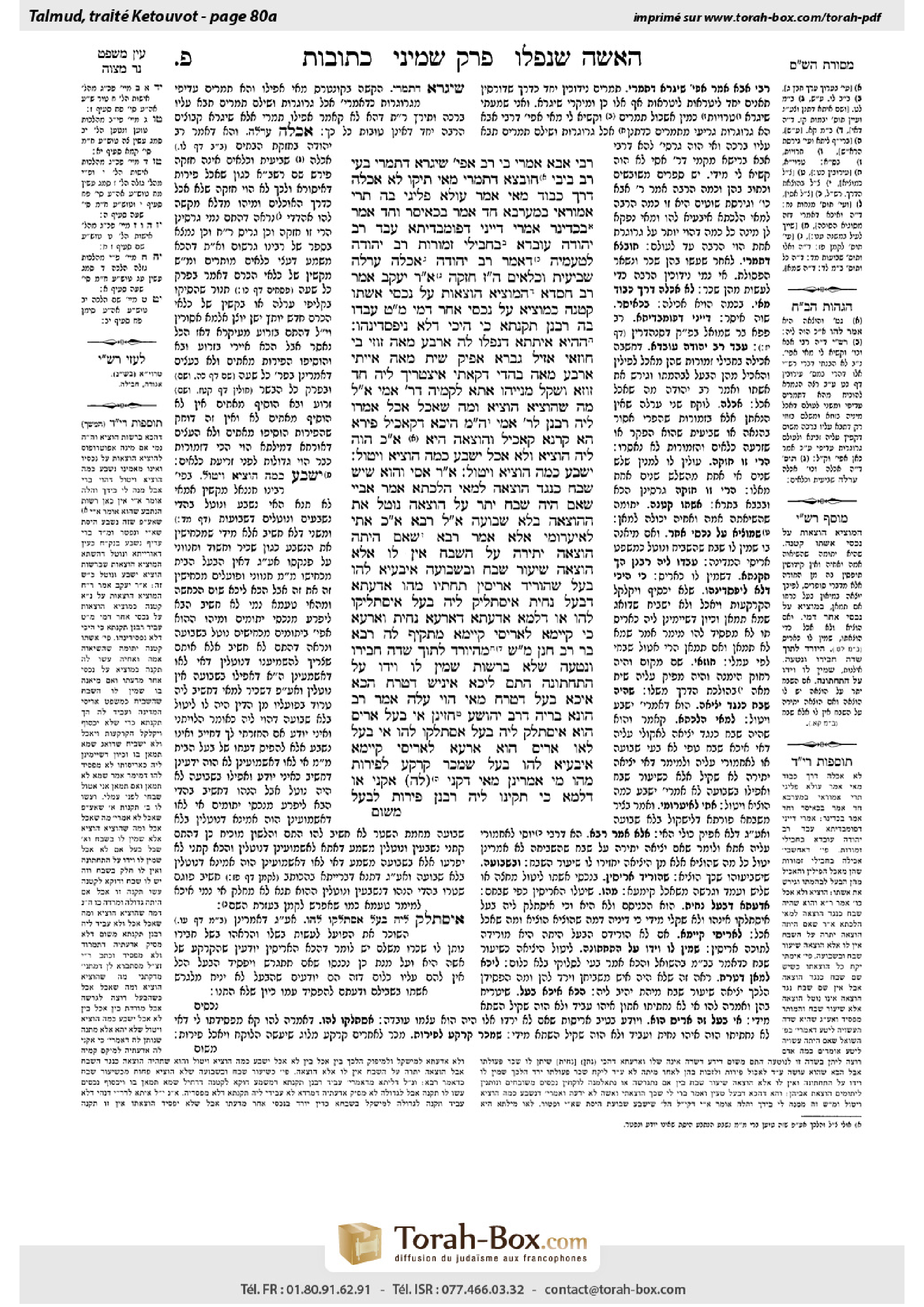
Ketubot 80a: Talmud study for Daf Yomi
Daf Yomi is the daily study of one Talmud folio. Explore 37 tractates with scans, Hebrew text, Sefaria English and AI-generated French translations where annotated.
Passage selection and English or AI-generated French translation are available where the scan has annotations. Daf Study is independent of Torah-Box and Sefaria.
Browse Ketubot · כתובות · All tractatesKetubot 80a text and translations
This page of Ketubot includes the Aramaic text, an English translation and an AI-generated French translation, alongside the scan above.
כתובות פ׳ א · Aramaic and Hebrew text
רַבִּי אַבָּא, אָמְרִי בֵּי רַב: אֲפִילּוּ שִׁיגְרָא דְתַמְרֵי. בָּעֵי רַב בִּיבִי: חוּבְצָא דְתַמְרֵי מַאי? תֵּיקוּ.
לָא אָכְלָה דֶּרֶךְ כָּבוֹד מַאי? אָמַר עוּלָּא: פְּלִיגִי בַּהּ תְּרֵי אָמוֹרָאֵי בְּמַעְרְבָא, חַד אָמַר: בִּכְאִיסָּר, וְחַד אָמַר: בִּכְדִינָר.
אָמְרִי דַּיָּינֵי דְּפוּמְבְּדִיתָא: עֲבַד רַב יְהוּדָה עוֹבָדָא בַּחֲבִילֵי זְמוֹרוֹת. רַב יְהוּדָה לְטַעְמֵיהּ, דְּאָמַר רַב יְהוּדָה: אֲכָלָהּ עׇרְלָה, שְׁבִיעִית, וְכִלְאַיִם — הֲרֵי זוֹ חֲזָקָה.
אָמַר רַב יַעֲקֹב אָמַר רַב חִסְדָּא: הַמּוֹצִיא הוֹצָאוֹת עַל נִכְסֵי אִשְׁתּוֹ קְטַנָּה — כְּמוֹצִיא עַל נִכְסֵי אַחֵר דָּמֵי. מַאי טַעְמָא — עֲבַדוּ בַּהּ רַבָּנַן תַּקַּנְתָּא, כִּי הֵיכִי דְּלָא נִיפְסְדִינְהוּ.
הָהִיא אִיתְּתָא דִּנְפַלוּ לַהּ אַרְבַּע מְאָה זוּזֵי בֵּי חוֹזָאֵי, אֲזַל גַּבְרָא אַפֵּיק שֵׁית מְאָה אַיְיתַי אַרְבַּע מְאָה. בַּהֲדֵי דְּקָאָתֵי, אִיצְטְרִיךְ לֵיהּ חַד זוּזָא וּשְׁקַל מִנַּיְיהוּ. אֲתָא לְקַמֵּיהּ דְּרַבִּי אַמֵּי, אֲמַר לֵיהּ: מַה שֶּׁהוֹצִיא — הוֹצִיא, וּמַה שֶּׁאָכַל — אָכַל.
אֲמַרוּ לֵיהּ רַבָּנַן לְרַבִּי אַמֵּי: הָנֵי מִילֵּי הֵיכָא דְּקָאָכֵיל פֵּירָא, הָא קַרְנָא קָאָכֵיל וְהוֹצָאָה הִיא. אִם כֵּן, הָוֵה לֵיהּ הוֹצִיא וְלֹא אָכַל, יִשָּׁבַע כַּמָּה הוֹצִיא, וְיִטּוֹל.
יִשָּׁבַע כַּמָּה הוֹצִיא וְיִטּוֹל. אָמַר רַבִּי אַסִּי: וְהוּא שֶׁיֵּשׁ שֶׁבַח כְּנֶגֶד הוֹצָאָה. לְמַאי הִלְכְתָא? אָמַר אַבָּיֵי: שֶׁאִם הָיָה שֶׁבַח יָתֵר עַל הוֹצָאָה — נוֹטֵל אֶת הַהוֹצָאָה בְּלֹא שְׁבוּעָה.
אֲמַר לֵיהּ רָבָא: אִם כֵּן, אָתֵי לְאִיעָרוֹמֵי! אֶלָּא אָמַר רָבָא: שֶׁאִם הָיְתָה הוֹצָאָה יְתֵירָה עַל הַשֶּׁבַח — אֵין לוֹ אֶלָּא הוֹצָאָה שִׁיעוּר שֶׁבַח, וּבִשְׁבוּעָה.
אִיבַּעְיָא לְהוּ: בַּעַל שֶׁהוֹרִיד אֲרִיסִין תַּחְתָּיו, מַהוּ? אַדַּעְתָּא דְבַעַל נָחֵית. אִיסְתַּלַּיק לֵיהּ בַּעַל, אִיסְתַּלַּיקוּ לְהוּ. אוֹ דִלְמָא: אַדַּעְתָּא דְאַרְעָא נָחֵית, וְאַרְעָא כִּי קָיְימָא — לַאֲרִיסֵי קָיְימָא?
מַתְקֵיף לַהּ רָבָא בַּר רַב חָנָן: מַאי שְׁנָא מֵהַיּוֹרֵד לְתוֹךְ שְׂדֵה חֲבֵירוֹ וּנְטָעָהּ שֶׁלֹּא בִּרְשׁוּת, שָׁמִין לוֹ, וְיָדוֹ עַל הַתַּחְתּוֹנָה?
הָתָם לֵיכָּא אִינִישׁ דְּטָרַח, הָכָא אִיכָּא בַּעַל דְּטָרַח.
מַאי הָוֵי עֲלַהּ? אָמַר רַב הוּנָא בְּרֵיהּ דְּרַב יְהוֹשֻׁעַ: חָזֵינַן אִי בַּעַל אָרִיס הוּא — אִיסְתַּלַּק לֵיהּ בַּעַל, אִסְתַּלַּקוּ לְהוּ. אִי בַּעַל לָאו אָרִיס הוּא, אַרְעָא לַאֲרִיסֵי קָיְימָא.
אִיבַּעְיָא לְהוּ: בַּעַל שֶׁמָּכַר קַרְקַע לְפֵירוֹת, מַהוּ? מִי אָמְרִינַן מַאי דְּקָנֵי (לַהּ) אַקְנִי, אוֹ דִלְמָא: כִּי תַּקִּינוּ לֵיה רַבָּנַן פֵּירוֹת לְבַעַל —
Ketubot 80a · English translation
by Rabbi Abba that in the school of Rav they say: It is even a cluster of dates stuck together. Rav Beivai asks: If one ate dough made of dates, what is the halakha? Is this considered dignified consumption? The Gemara concludes: The question shall stand unresolved.
The Gemara asks: If he did not eat it in a dignified manner, what is the halakha? How much must he eat to be deemed a proper act of consumption? Ulla said: Two amora’im in the West, i.e., Eretz Yisrael, disagree about this matter. One said: He ate the amount of an issar, and one said: He ate the measure of a dinar.
The judges of Pumbedita say: Rav Yehuda took action in a case of a bundle of branches. A husband took them from his wife’s property and fed them to his animals, and Rav Yehuda ruled that this was treated as consumption of her property. The Gemara comments: Rav Yehuda conforms to his line of reasoning. As Rav Yehuda said: If one took possession of a plot of land and consumed some of the produce of its trees that was forbidden due to the prohibition against eating the fruit of a tree during the first three years after its planting [orla] or produce of the seventh year, or a forbidden mixture of diverse kinds, this is considered taking possession of the land, as he was allowed to benefit from the permitted branches.
§ Rav Yaakov said that Rav Ḥisda said: With regard to one who outlays expenditures for the property of his wife who is a minor girl and was married off by her mother or brothers, he is considered like one who outlays expenditures for the property of someone else. Therefore, if she performed refusal upon reaching maturity, thereby annulling the marriage, he takes the value of the improvement. What is the reason for this? The Sages enacted this ordinance in order that he should not let her property depreciate. If he is not guaranteed reimbursement for his expenses if she refuses him as her husband, he will not attend to the upkeep of her property, causing its value to decline.
The Gemara relates: There was a certain woman who had four hundred dinars bequeathed to her in Bei Ḥozai, a remote location in Babylonia. The man, her husband, went and took with him six hundred of his own dinars for travel expenses and brought back with him four hundred. While he was coming back he required one dinar, which he took from the money he had collected. He came before Rabbi Ami for a ruling. Rabbi Ami said to him: That which he spent he has spent, and that which he ate he has eaten. He has benefited from one dinar of her money and spent six hundred of his own, and neither amount can be claimed.
The Rabbis said to Rabbi Ami: This applies only where he consumes the produce of his wife’s property, but this one ate from the principal, and it is merely expenditures. He replied: If so, this is a case of one who pays expenditures and did not eat, and the halakha is that in such a case he takes an oath with regard to how much he paid and then takes that amount.
§ The mishna states: He takes an oath with regard to how much he spent and takes this sum. Rabbi Asi said: And this applies only if there is enhancement to the property corresponding to his expense. The Gemara asks: With regard to what halakha was this stated? Is this a stringency for the husband that if the value of enhancement is less he may not reclaim all his expenses, or is it a leniency that if the value is greater he need not take an oath? Abaye said: It means that if the value of enhancement was greater than the expense, he takes the expense without an oath.
Rava said to him: If so, he will come to deceive, as he can always say that he spent slightly less than the value of the enhancement and thereby receive this amount without having to take an oath. Rather, Rava said: It means that if the expense was greater than the enhancement, he has rights to reclaim the expense only up to the amount of the enhancement, but no more, and even this amount he can claim only by an oath.
A dilemma was raised before the Sages: With regard to a husband who engaged sharecroppers to work his wife’s property in his stead, what is the halakha? Does a sharecropper begin work on the land with the intention to work for the husband, so that if the husband departs the property, e.g., if he divorces his wife, they too depart as sharecroppers and do not receive their share of the profits from the land? Or perhaps a sharecropper begins work with the intention to work the land, and the land, as it stands, stands to be worked by sharecroppers? Since their involvement is directly with the land, it makes no difference who hired them, and they would stay on the land.
Rava bar Rav Ḥanan objects to this line of inquiry: In what way is this case different from that of one who entered the field of another and planted it without permission? In such a situation one evaluates his expenses for him and the value of his enhancement of the field, and he is at a disadvantage. Therefore, he always receives the smaller sum, whether it is equal to his expenses or the enhancement of the property. In this case too, even if the sharecroppers are viewed as unauthorized occupiers of the land, why shouldn’t they be treated like one who entered another’s field without permission and receive at least the smaller sum?
The Gemara answers: The two cases are not comparable: There, when one enters another’s land, there is no one else that will exert himself for it, and therefore it is reasonable that the one who invested in this property should at least be compensated for the lesser value. However, here, there is a husband who exerts himself for the land. Since the sharecroppers act in his stead, they are entitled to remain on the land only as long as he is present.
The Gemara asks: What conclusion was reached about it, i.e., the original question? Rav Huna, son of Rav Yehoshua, said: We examine the matter: If this husband is a sharecropper himself and possesses sufficient knowledge of working the land to perform the task himself, then when the husband departs from the property they too depart, as they are taking his place. If the husband is not a sharecropper, the land is ready for sharecroppers, as the husband would not have performed the work himself. Since the wife was in need of sharecroppers, they are not considered to have acted on behalf of the husband and do not forfeit their share.
A dilemma was raised before the Sages: With regard to a husband who sold his wife’s land for produce, i.e., rights to the produce were sold to one who agrees to work the land in exchange, what is the halakha? Do we say: That which belongs to the husband he has transferred to others, and therefore the sale of the produce is valid, or perhaps the principle is that when the Sages instituted that the produce goes to the husband,
Ketubot 80a · Traduction française (IA)
Selon Rabbi Abba, dans l’école de Rav, on dit qu’il peut même s’agir d’une grappe de dattes collées entre elles. Rav Beivai demande : Quel est le halakha si l’on a mangé une pâte faite de dattes ? Cela est-il considéré comme une consommation digne ? La Guemara conclut : La question reste sans réponse.
La Guemara demande : Quel est le halakha si on ne l’a pas consommé d’une manière digne ? Quelle quantité faut-il manger pour que cela soit considéré comme une consommation convenable ? Oulla dit : Deux amoraïm d’Occident, c’est-à-dire d’Eretz Israël, sont en désaccord à ce sujet. L’un dit qu’il a mangé l’équivalent d’un issar, et l’autre, l’équivalent d’un dinar.
Les juges de Poumbedita disent que Rav Yehouda a statué dans une affaire concernant un fagot de branches. Un mari les a prises dans les biens de sa femme et les a données à manger à ses animaux, et Rav Yehouda a jugé que cela équivalait à consommer les biens de celle-ci. La Guemara commente : Rav Yehouda est cohérent avec sa position. En effet, Rav Yehouda a dit : Si quelqu’un prend possession d’un terrain et consomme une partie des produits de ses arbres qui sont interdits en raison de l’interdiction de manger les fruits d’un arbre pendant les trois premières années suivant sa plantation [orla], ou des produits de la septième année, ou encore un mélange interdit d’espèces différentes, cela est considéré comme une prise de possession du terrain, puisqu’il pouvait tirer profit des branches permises.
§ Rav Yaakov a dit au nom de Rav Ḥisda : Celui qui engage des dépenses pour les biens de sa femme, une mineure que sa mère ou ses frères ont mariée, est considéré comme quelqu’un qui engage des dépenses pour les biens d’autrui. Par conséquent, si elle exerce son refus à sa majorité, annulant ainsi le mariage, il reçoit la valeur de l’amélioration. Pour quelle raison ? Les Sages ont institué cette règle afin qu’il ne laisse pas les biens se déprécier. S’il n’était pas assuré d’être remboursé de ses dépenses au cas où elle le refuserait comme mari, il ne veillerait pas à l’entretien de ses biens, ce qui en ferait baisser la valeur.
La Guemara rapporte : Une femme avait reçu en héritage quatre cents dinars à Bei Ḥozai, une région reculée de Babylonie. Son mari s’y rendit en emportant six cents de ses propres dinars pour couvrir les frais du voyage, et en revint avec quatre cents dinars. Sur le chemin du retour, il eut besoin d’un dinar, qu’il prit sur l’argent qu’il avait rapporté. Il se présenta devant Rabbi Ami pour obtenir une décision. Rabbi Ami lui dit : Ce qu’il a dépensé est dépensé, et ce qu’il a mangé est mangé. Il a tiré profit d’un dinar de l’argent de sa femme et dépensé six cents dinars de son propre argent ; il ne peut réclamer ni l’un ni l’autre montant.
Les Rabbins dirent à Rabbi Ami : Cela ne s’applique que lorsqu’il consomme les produits des biens de sa femme ; mais cet homme a puisé dans le capital, et il ne s’agit que de dépenses. Il leur répondit : Dans ce cas, c’est une situation où quelqu’un a engagé des dépenses sans rien consommer, et la halakha est qu’il prête serment au sujet du montant qu’il a payé, puis reçoit cette somme.
§ La Michna enseigne : Il prête serment au sujet du montant de ses dépenses et reçoit cette somme. Rabbi Asi dit : Cela ne s’applique que si l’amélioration des biens correspond à ses dépenses. La Guemara demande : À quelle halakha cela se rapporte-t-il ? S’agit-il d’une rigueur pour le mari, de sorte que, si la valeur de l’amélioration est inférieure, il ne puisse pas récupérer toutes ses dépenses, ou d’un allègement, de sorte que, si cette valeur est supérieure, il n’ait pas à prêter serment ? Abayé dit : Cela signifie que, si la valeur de l’amélioration est supérieure à ses dépenses, il reçoit le montant de ses dépenses sans prêter serment.
Rava lui dit : Dans ce cas, il pourrait tricher, car il pourrait toujours prétendre avoir dépensé un peu moins que la valeur de l’amélioration et ainsi recevoir cette somme sans prêter serment. Rava dit plutôt : Cela signifie que, si ses dépenses sont supérieures à la valeur de l’amélioration, il ne peut récupérer ses dépenses qu’à hauteur de cette valeur, et pas davantage ; et même cette somme, il ne peut la réclamer qu’en prêtant serment.
Une question fut posée aux Sages : Quel est le halakha concernant un mari qui a engagé des métayers pour exploiter les biens de sa femme à sa place ? Le métayer commence-t-il à travailler la terre dans l’intention de travailler pour le mari, de sorte que, si le mari quitte ces biens, par exemple s’il divorce de sa femme, les métayers partent eux aussi et ne reçoivent pas leur part des profits de la terre ? Ou bien le métayer commence-t-il à travailler dans l’intention d’exploiter la terre, celle-ci étant destinée, dans son état actuel, à être exploitée par des métayers ? Puisqu’ils travaillent directement la terre, peu importe qui les a engagés, et ils resteraient sur place.
Rava bar Rav Ḥanan objecte à cette question : En quoi cette situation diffère-t-elle de celle où quelqu’un entre dans le champ d’autrui et le plante sans autorisation ? Dans un tel cas, on évalue ses dépenses ainsi que la valeur de l’amélioration du champ, et il est désavantagé. Il reçoit donc toujours la somme la plus faible, qu’il s’agisse de ses dépenses ou de la valeur de l’amélioration des biens. Ici aussi, même si l’on considère les métayers comme des occupants du terrain sans autorisation, pourquoi ne pas les traiter comme quelqu’un qui est entré dans le champ d’autrui sans autorisation et leur accorder au moins la somme la plus faible ?
La Guemara répond : Les deux cas ne sont pas comparables. Dans le premier cas, lorsqu’une personne entre sur le terrain d’autrui, personne d’autre ne ferait d’efforts pour le cultiver ; il est donc raisonnable que celui qui a investi dans ce bien soit au moins indemnisé à hauteur de la valeur la plus faible. Ici, en revanche, le mari fait des efforts pour la terre. Puisque les métayers agissent à sa place, ils ne peuvent rester sur la terre que tant qu’il y est lui-même.
La Guemara demande : Quelle conclusion a-t-on tirée à ce sujet, c’est-à-dire quant à la question initiale ? Rav Houna, fils de Rav Yehoshoua, dit : Nous examinons la situation. Si ce mari est lui-même métayer et possède assez de connaissances pour exploiter la terre lui-même, alors, lorsque le mari quitte les biens, les métayers partent eux aussi, puisqu’ils prennent sa place. Si le mari n’est pas métayer, la terre est destinée à être exploitée par des métayers, car le mari n’aurait pas fait le travail lui-même. Puisque la femme avait besoin de métayers, on ne considère pas qu’ils aient agi pour le compte du mari, et ils ne perdent pas leur part.
Une question fut posée aux Sages : Quel est le halakha concernant un mari qui a vendu les droits sur les produits de la terre de sa femme, c’est-à-dire les droits sur ces produits ont été vendus à quelqu’un qui accepte d’exploiter la terre en échange ? Disons-nous : Ce qui appartenait au mari, il l’a transféré à d’autres, et la vente des produits est donc valide ; ou bien le principe est-il que, lorsque les Sages ont institué que les produits reviennent au mari,
Traduction française générée par IA à partir de l’édition anglaise de Sefaria. Vérifie toujours un passage avec le texte source.
Text from Sefaria: William Davidson Edition - Vocalized Aramaic (CC BY NC); William Davidson Edition - English (CC BY NC).