Ketubot 80b: Talmud study for Daf Yomi
Daf Yomi is the daily study of one Talmud folio. Explore 37 tractates with scans, Hebrew text, Sefaria English and AI-generated French translations where annotated.
Passage selection and English or AI-generated French translation are available where the scan has annotations. Daf Study is independent of Torah-Box and Sefaria.
Browse Ketubot · כתובות · All tractatesKetubot 80b text and translations
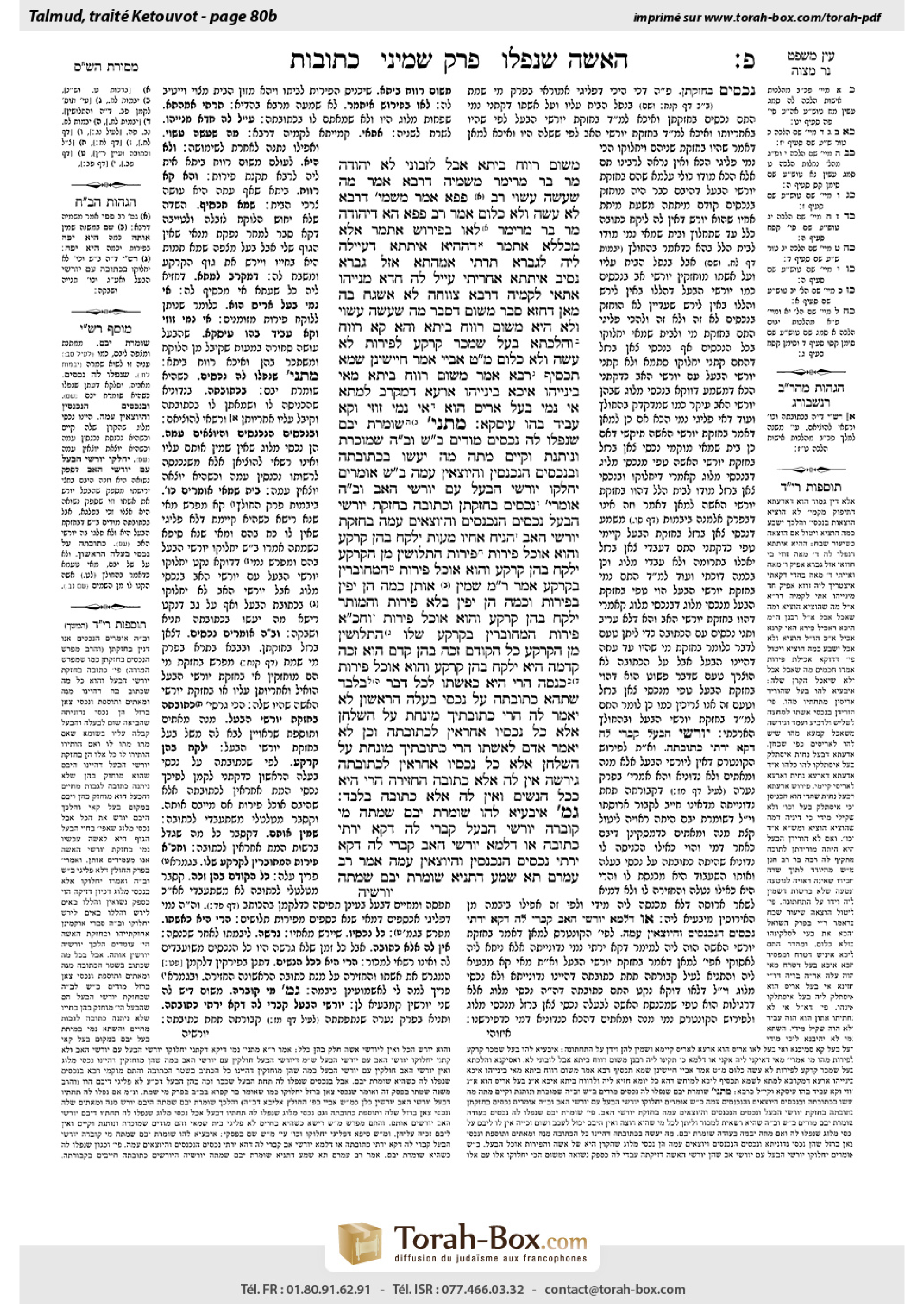
This page of Ketubot includes the Aramaic text, an English translation and an AI-generated French translation, alongside the scan above.
כתובות פ׳ ב · Aramaic and Hebrew text
מִשּׁוּם רְוַוח בֵּיתָא, אֲבָל לְזַבּוֹנֵי — לָא? יְהוּדָה מָר בַּר מָרִימָר מִשְּׁמֵיהּ דְּרָבָא אָמַר: מַה שֶּׁעָשָׂה, עָשׂוּי. רַב פָּפָּא אָמַר מִשְּׁמֵיהּ דְּרָבָא: לֹא עָשָׂה וְלֹא כְלוּם.
אָמַר רַב פָּפָּא: הָא דִּיהוּדָה מָר בַּר מָרִימָר לָאו בְּפֵירוּשׁ אִתְּמַר, אֶלָּא מִכְּלָלָא אִתְּמַר. דְּהָהִיא אִיתְּתָא דְּעַיִּילָה לֵיהּ לְגַבְרַאּ תַּרְתֵּי אַמְהָתָא, אֲזַל גַּבְרָא נְסֵיב אִיתְּתָא אַחֲרִיתִי, עַיֵּיל לַהּ חֲדָא מִנַּיְיהוּ.
אֲתַאי לְקַמֵּיהּ דְּרָבָא, צְוַוחָה, לָא אַשְׁגַּח בַּהּ. מַאן דַּחֲזָא סָבַר מִשּׁוּם דְּסָבַר מַה שֶּׁעָשָׂה עָשׂוּי. וְלָא הִיא, מִשּׁוּם רְוַוח בֵּיתָא — וְהָא קָא רָוַוח.
וְהִלְכְתָא: בַּעַל שֶׁמָּכַר קַרְקַע לְפֵירוֹת — לֹא עָשָׂה וְלֹא כְּלוּם. מַאי טַעְמָא? אַבָּיֵי אָמַר: חָיְישִׁינַן שֶׁמָּא תַּכְסִיף. רָבָא אָמַר: מִשּׁוּם רְוַוח בֵּיתָא.
מַאי בֵּינַיְיהוּ? אִיכָּא בֵּינַיְיהוּ אַרְעָא דִּמְקָרְבָא לְמָתָא, אִי נָמֵי: בַּעַל אָרִיס הוּא. אִי נָמֵי, זוּזֵי וְקָא עָבֵיד בְּהוּ עִיסְקָא.
מַתְנִי׳ שׁוֹמֶרֶת יָבָם שֶׁנָּפְלוּ לָהּ נְכָסִים — מוֹדִים בֵּית שַׁמַּאי וּבֵית הִלֵּל שֶׁמּוֹכֶרֶת וְנוֹתֶנֶת וְקַיָּים.
מֵתָה, מָה יַעֲשׂוּ בִּכְתוּבָּתָהּ וּבִנְכָסִים הַנִּכְנָסִין וְהַיּוֹצְאִין עִמָּהּ? בֵּית שַׁמַּאי אוֹמְרִים: יַחְלְקוּ יוֹרְשֵׁי הַבַּעַל עִם יוֹרְשֵׁי הָאָב. וּבֵית הִלֵּל אוֹמְרִים: נְכָסִים בְּחֶזְקָתָן, וּכְתוּבָּה בְּחֶזְקַת יוֹרְשֵׁי הַבַּעַל. נְכָסִים הַנִּכְנָסִים וְהַיּוֹצְאִים עִמָּהּ — בְּחֶזְקַת יוֹרְשֵׁי הָאָב.
הִנִּיחַ אָחִיו מָעוֹת — יִלָּקַח בָּהֶן קַרְקַע, וְהוּא אוֹכֵל פֵּירוֹת. פֵּירוֹת הַתְּלוּשִׁין מִן הַקַּרְקַע — יִלָּקַח בָּהֶן קַרְקַע, וְהוּא אוֹכֵל פֵּירוֹת.
הַמְחוּבָּרִין בַּקַּרְקַע, אָמַר רַבִּי מֵאִיר: שָׁמִין אוֹתָן כַּמָּה הֵן יָפִין בְּפֵירוֹת, וְכַמָּה הֵן יָפִין בְּלֹא פֵּירוֹת, וְהַמּוֹתָר — יִלָּקַח בָּהֶן קַרְקַע, וְהוּא אוֹכֵל פֵּירוֹת.
וַחֲכָמִים אוֹמְרִים: פֵּירוֹת הַמְחוּבָּרִין בַּקַּרְקַע — שֶׁלּוֹ. הַתְּלוּשִׁין מִן הַקַּרְקַע — כׇּל הַקּוֹדֵם זָכָה בָּהֶן. קָדַם הוּא — זָכָה, קָדְמָה הִיא — יִלָּקַח בָּהֶן קַרְקַע וְהוּא אוֹכֵל פֵּירוֹת.
כְּנָסָהּ, הֲרֵי הִיא כְּאִשְׁתּוֹ לְכׇל דָּבָר. בִּלְבַד שֶׁתְּהֵא כְּתוּבָּתָהּ עַל נִכְסֵי בַּעְלָהּ הָרִאשׁוֹן.
לֹא יֹאמַר לָהּ ״הֲרֵי כְּתוּבָּתִיךְ מוּנַּחַת עַל הַשֻּׁלְחָן״, אֶלָּא כׇּל נְכָסָיו אַחְרָאִין לִכְתוּבָּתָהּ. וְכֵן: לֹא יֹאמַר אָדָם לְאִשְׁתּוֹ ״הֲרֵי כְּתוּבָּתִיךְ מוּנַּחַת עַל הַשֻּׁלְחָן״, אֶלָּא כׇּל נְכָסָיו אַחְרָאִין לִכְתוּבָּתָהּ.
גֵּירְשָׁהּ — אֵין לָהּ אֶלָּא כְּתוּבָּה. הֶחְזִירָה — הֲרֵי הִיא כְּכׇל הַנָּשִׁים, וְאֵין לָהּ אֶלָּא כְּתוּבָּה בִּלְבָד.
גְּמָ׳ אִיבַּעְיָא לְהוּ: שׁוֹמֶרֶת יָבָם שֶׁמֵּתָה, מִי קוֹבְרָהּ? יוֹרְשֵׁי הַבַּעַל קָבְרִי לַהּ דְּקָא יָרְתִי כְּתוּבָּה, אוֹ דִלְמָא יוֹרְשֵׁי הָאָב קָבְרִי לַהּ, דְּקָא יָרְתִי נְכָסִים הַנִּכְנָסִין וְהַיּוֹצְאִין עִמָּהּ? אָמַר רַב עַמְרָם: תָּא שְׁמַע, דְּתַנְיָא: שׁוֹמֶרֶת יָבָם שֶׁמֵּתָה —
Ketubot 80b · English translation
they did so for the gain of the house, as more food is available when he brings produce home, but in order for him to sell it they did not institute their decree? Two opinions were stated with regard to this issue: Yehuda Mar bar Mareimar said in the name of Rava: What he did is done, i.e., takes effect. Rav Pappa said in the name of Rava: He did not do anything.
Rav Pappa said: This statement of Yehuda Mar bar Mareimar was not stated explicitly in Rava’s name. Rather, it was stated from an inference based on an incident that occurred in which a certain woman brought in for her husband two maidservants as part of her dowry. The man went and married another woman in addition to the first. He subsequently brought in to the second wife one of the maidservants to attend to her needs.
The first wife came before Rava and cried about the injustice done to her, but Rava took no notice of her, claiming she had no right to complain. He who observed this incident thought that Rava ruled this way because he holds that what he did is done, i.e., takes effect, and a husband may sell his wife’s usufruct property and use its produce as he sees fit. But that is not so, as the Sages instituted the ordinance that a husband owns the rights to the produce of his wife’s property for the gain of the house, and here the house does gain from his action, as the maidservant also performs work for the house.
The Gemara concludes: And the halakha is that a husband who sold land for produce did not do anything. The Gemara asks: What is the rationale for this ruling? Abaye said: We are concerned that perhaps the land itself will deteriorate over time, as the purchaser has acquired only its produce and has no incentive to take proper care of the land. Rava said: This is because there is no gain of the house here.
The Gemara asks: What is the practical difference between these two explanations? The Gemara explains: The practical difference between them is, e.g., land that is close to the town, as one can check at any time whether the land is being cared for properly. Alternatively, the difference involves a husband who is a sharecropper and works the land himself but sold the rights of the produce to someone else. As a sharecropper, the husband retains part of the produce and will also ensure that the land does not deteriorate. Alternatively, the difference concerns a husband who receives money for the produce and does business with it, which provides gain for the house.
MISHNA: When a married man dies childless, his brother, the yavam, is obligated to perform levirate marriage or release the widow, the yevama, through a ceremony known as ḥalitza. With regard to a widow waiting for her yavam who had property bequeathed to her, Beit Shammai and Beit Hillel agree that she may sell or give this property away, and the transaction is valid.
If this woman died, what should they do with her marriage contract and with the property that comes and goes with her, i.e., her usufruct property? Beit Shammai say: Since she was not yet remarried, the husband’s heirs, such as his brothers or father, divide the property with her father’s heirs. And Beit Hillel say: The property retains its previous ownership status, and therefore the marriage contract is in the possession of the husband’s heirs, as they are responsible for its payment. As for the property that comes and goes with her, it is in the possession of the heirs of the woman’s father, as it belongs to the woman.
If his deceased brother left money as part of his estate, land to be used as a lien on her marriage contract is acquired with it, and the yavam consumes the produce. Similarly, if the deceased brother left produce that is detached from the ground, land is acquired with it and the yavam consumes the produce.
If he left behind produce that is attached to the ground, Rabbi Meir says: One evaluates the properties to determine how much they are worth with the produce, and how much they are worth without the produce. And as for the surplus, which is the value of the produce, land is acquired with it and the yavam consumes the produce.
And the Rabbis say: Produce that is attached to the ground is his. Therefore, it is not used in the purchase of land, but the yavam may eat it. As for the produce that is detached from the ground, which is not mortgaged to her marriage contract, whoever takes possession first has acquired it. If the yavam takes possession of the property first, he has acquired it and may use it as he wishes, but if she is first, land is acquired with it and he consumes the produce.
After the yavam has married her, her legal status is that of his wife in every sense, except that the responsibility for payment of her marriage contract is carried out through mortgaging the property of her first husband, not that of the yavam.
Therefore, the yavam may not say to her: Your marriage contract is placed on the table. He may not set aside a designated sum of money for this payment. Rather, all of the first husband’s property is mortgaged for her marriage contract as long as he has not divorced her. And similarly, in general a man may not say to his wife: Your marriage contract is placed on the table. Rather, all his property is mortgaged for her marriage contract.
If the yavam divorced her after performing levirate marriage, she has only her marriage contract, as she does not retain any rights to the rest of her first husband’s property. If he subsequently remarried her, she is like all women, and she has nothing but her marriage contract. In this case, the property of her first husband is no longer pledged for the payment of her marriage contract.
GEMARA: A dilemma was raised before the Sages: In the case of a widow awaiting her yavam who dies, who buries her? Who is obligated to bear the expenses of her burial? Must the husband’s heirs bury her, as they inherit the marriage contract, or perhaps her father’s heirs are obligated to bury her, as they inherit the property that comes and goes with her? Rav Amram said: Come and hear a solution. As it is taught in a baraita: In the case of a widow waiting for her yavam who dies,
Ketubot 80b · Traduction française (IA)
Ils ont institué cette règle dans l’intérêt du foyer, car il y a davantage de nourriture lorsque le mari rapporte des produits à la maison ; mais ils ne l’ont pas instituée pour lui permettre de les vendre. Deux opinions ont été rapportées à ce sujet : Yehuda Mar bar Mareimar a dit au nom de Rava : Ce qu’il a fait prend effet. Rav Pappa a dit au nom de Rava : Il n’a rien fait.
Rav Pappa a dit : Cette déclaration de Yehuda Mar bar Mareimar n’a pas été rapportée explicitement au nom de Rava. Elle a plutôt été déduite d’un incident survenu : une certaine femme avait apporté en dot à son mari deux servantes. L’homme alla ensuite épouser une autre femme, en plus de la première. Par la suite, il plaça auprès de sa seconde épouse l’une des servantes pour répondre à ses besoins.
La première épouse se présenta devant Rava et se plaignit de l’injustice qui lui avait été faite, mais Rava ne prêta aucune attention à sa plainte, estimant qu’elle n’avait pas le droit de se plaindre. Celui qui observa cet incident pensa que Rava avait tranché ainsi parce qu’il estimait que l’acte du mari prenait effet et qu’un mari pouvait vendre les biens usufruitiers de sa femme et utiliser les produits comme bon lui semblait. Mais ce n’est pas le cas : les Sages ont institué que le mari détient les droits sur les produits des biens de sa femme dans l’intérêt du foyer, et ici le foyer tire bien profit de son acte, puisque la servante travaille aussi pour le foyer.
La Guemara conclut : La halakha est qu’un mari qui a vendu un terrain pour en céder les produits n’a rien fait. La Guemara demande : Quel est le fondement de cette décision ? Abaye dit : Nous craignons que le terrain lui-même ne se détériore avec le temps, car l’acheteur n’a acquis que les produits et n’a aucune raison de bien entretenir le terrain. Rava dit : C’est parce qu’ici, le foyer n’en tire aucun profit.
La Guemara demande : Quelle est la différence pratique entre ces deux explications ? La Guemara répond : La différence pratique apparaît, par exemple, dans le cas d’un terrain proche de la ville, puisqu’on peut vérifier à tout moment s’il est bien entretenu. Autre cas : un mari qui est métayer et cultive lui-même le terrain, mais qui a vendu à quelqu’un d’autre les droits sur les produits. En tant que métayer, le mari conserve une part des produits et veille également à ce que le terrain ne se détériore pas. Autre cas encore : un mari qui reçoit de l’argent pour les produits et le fait fructifier dans des affaires, ce qui profite au foyer.
MICHNA : Lorsqu’un homme marié meurt sans enfant, son frère, le yavam, est tenu de contracter un mariage léviratique ou de libérer la veuve, la yevama, par une cérémonie appelée ḥalitza. À propos d’une veuve qui attend son yavam et à qui des biens ont été légués, Beit Shammaï et Beit Hillel conviennent qu’elle peut vendre ces biens ou les donner, et que la transaction est valide.
Si cette femme meurt, que fait-on de sa ketouba et des biens qui entrent et sortent avec elle, c’est-à-dire ses biens usufruitiers ? Beit Shammaï disent : Puisqu’elle ne s’était pas encore remariée, les héritiers du mari, tels que ses frères ou son père, partagent les biens avec les héritiers du père de la femme. Beit Hillel disent : Les biens conservent leur statut de propriété antérieur ; la ketouba revient donc aux héritiers du mari, puisqu’ils sont tenus de la payer. Quant aux biens qui entrent et sortent avec elle, ils reviennent aux héritiers du père de la femme, puisqu’ils appartiennent à celle-ci.
Si son frère défunt a laissé de l’argent dans sa succession, on acquiert avec cet argent un terrain qui servira de garantie à sa ketouba, et le yavam en consomme les produits. De même, si le frère défunt a laissé des produits détachés du sol, on acquiert avec eux un terrain, et le yavam en consomme les produits.
S’il a laissé des produits encore attachés au sol, Rabbi Meïr dit : On évalue les biens afin de déterminer leur valeur avec les produits et leur valeur sans les produits. Quant à l’excédent, c’est-à-dire à la valeur des produits, on acquiert un terrain avec cette somme, et le yavam en consomme les produits.
Et les Sages disent : Les produits attachés au sol lui appartiennent. Ils ne servent donc pas à acheter un terrain, mais le yavam peut les consommer. Quant aux produits détachés du sol, qui ne sont pas grevés en garantie de sa ketouba, celui qui s’en empare le premier les acquiert. Si le yavam prend possession des produits le premier, il les acquiert et peut en disposer comme il le souhaite ; mais si elle est la première à s’en emparer, on acquiert un terrain avec eux, et le yavam en consomme les produits.
Après que le yavam l’a épousée, elle a à tous égards le statut de son épouse, à ceci près que le paiement de sa ketouba est garanti par les biens de son premier mari, et non par ceux du yavam.
Le yavam ne peut donc pas lui dire : « Ta ketouba est déposée sur la table. » Il ne peut pas mettre de côté une somme déterminée pour ce paiement. Au contraire, tous les biens du premier mari sont grevés en garantie de sa ketouba tant qu’il ne l’a pas répudiée. De même, en règle générale, un homme ne peut pas dire à sa femme : « Ta ketouba est déposée sur la table. » Au contraire, tous ses biens sont grevés en garantie de sa ketouba.
Si le yavam l’a répudiée après avoir contracté avec elle le mariage léviratique, elle n’a droit qu’à sa ketouba, car elle ne conserve aucun droit sur le reste des biens de son premier mari. S’il l’a ensuite épousée de nouveau, elle est comme toutes les femmes et n’a droit qu’à sa ketouba. Dans ce cas, les biens de son premier mari ne sont plus grevés en garantie du paiement de sa ketouba.
GUEMARA : Les Sages ont soulevé une question : Dans le cas d’une veuve qui attend son yavam et qui meurt, qui l’enterre ? Qui est tenu de prendre en charge les frais de son enterrement ? Les héritiers du mari doivent-ils l’enterrer, puisqu’ils héritent de la ketouba, ou bien les héritiers de son père sont-ils tenus de l’enterrer, puisqu’ils héritent des biens qui entrent et sortent avec elle ? Rav Amram dit : Venez et entendez une solution, car il est enseigné dans une baraïta : Dans le cas d’une veuve qui attend son yavam et qui meurt,
Traduction française générée par IA à partir de l’édition anglaise de Sefaria. Vérifie toujours un passage avec le texte source.
Text from Sefaria: William Davidson Edition - Vocalized Aramaic (CC BY NC); William Davidson Edition - English (CC BY NC).