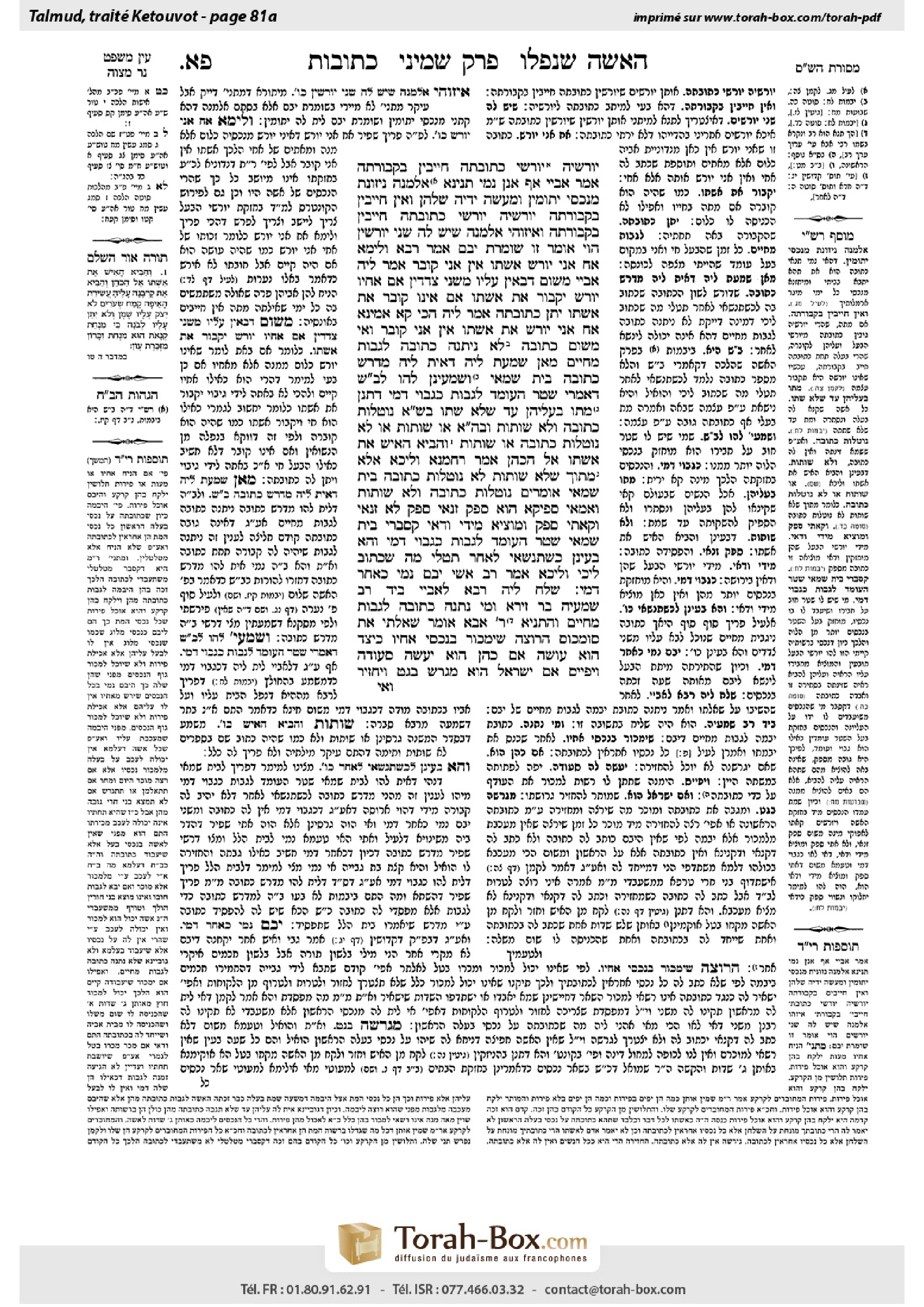
Ketubot 81a: Talmud study for Daf Yomi
Daf Yomi is the daily study of one Talmud folio. Explore 37 tractates with scans, Hebrew text, Sefaria English and AI-generated French translations where annotated.
Passage selection and English or AI-generated French translation are available where the scan has annotations. Daf Study is independent of Torah-Box and Sefaria.
Browse Ketubot · כתובות · All tractatesKetubot 81a text and translations
This page of Ketubot includes the Aramaic text, an English translation and an AI-generated French translation, alongside the scan above.
כתובות פ״א א · Aramaic and Hebrew text
יוֹרְשֶׁיהָ יוֹרְשֵׁי כְּתוּבָּתָהּ חַיָּיבִין בִּקְבוּרָתָהּ. אָמַר אַבָּיֵי, אַף אֲנַן נָמֵי תְּנֵינָא: אַלְמָנָה נִיזּוֹנֶת מִנִּכְסֵי יְתוֹמִין, וּמַעֲשֵׂה יָדֶיהָ שֶׁלָּהֶן, וְאֵין חַיָּיבִין בִּקְבוּרָתָהּ. יוֹרְשֶׁיהָ יוֹרְשֵׁי כְתוּבָּתָהּ חַיָּיבִין בִּקְבוּרָתָהּ, וְאֵיזוֹהִי אַלְמָנָה שֶׁיֵּשׁ לָהּ שְׁנֵי יוֹרְשִׁין? הֱוֵי אוֹמֵר: זוֹ שׁוֹמֶרֶת יָבָם.
אָמַר רָבָא, וְלֵימָא: אָח אֲנִי יוֹרֵשׁ. אִשְׁתּוֹ אֵין אֲנִי קוֹבֵר. אֲמַר לֵיהּ אַבָּיֵי: מִשּׁוּם דְּבָאִין עָלָיו מִשְּׁנֵי צְדָדִין: אִם אָחִיו יוֹרֵשׁ — יִקְבּוֹר אֶת אִשְׁתּוֹ. אִם אֵינוֹ קוֹבֵר אֶת אִשְׁתּוֹ — יִתֵּן כְּתוּבָּתָהּ.
אֲמַר לֵיהּ, הָכִי קָא אָמֵינָא: אָח אֲנִי יוֹרֵשׁ, אֶת אִשְׁתּוֹ אֵין אֲנִי קוֹבֵר. וְאִי מִשּׁוּם כְּתוּבָּה — לֹא נִיתְּנָה כְּתוּבָּה לִגָּבוֹת מֵחַיִּים.
מַאן שָׁמְעַתְּ לֵיהּ דְּאִית לֵיהּ מִדְרַשׁ כְּתוּבָּה — בֵּית שַׁמַּאי. וְשָׁמְעִינַן לְהוּ לְבֵית שַׁמַּאי דְּאָמְרִי: שְׁטָר הָעוֹמֵד לִגְבּוֹת כְּגָבוּי דָּמֵי!
דִּתְנַן: מֵתוּ בַּעֲלֵיהֶן עַד שֶׁלֹּא שָׁתוּ — בֵּית שַׁמַּאי אוֹמְרִים: נוֹטְלוֹת כְּתוּבָה וְלֹא שׁוֹתוֹת, וּבֵית הִלֵּל אוֹמְרִים: אוֹ שׁוֹתוֹת אוֹ לֹא נוֹטְלוֹת כְּתוּבָה.
אוֹ שׁוֹתוֹת?! ״וְהֵבִיא הָאִישׁ אֶת אִשְׁתּוֹ אֶל הַכֹּהֵן״ אָמַר רַחֲמָנָא, וְלֵיכָּא! אֶלָּא: מִתּוֹךְ שֶׁלֹּא שׁוֹתוֹת — לֹא נוֹטְלוֹת כְּתוּבָה.
בֵּית שַׁמַּאי אוֹמְרִים: נוֹטְלוֹת כְּתוּבָה וְלֹא שׁוֹתוֹת. וְאַמַּאי? סְפֵיקָא הוּא: סָפֵק זַנַּאי סָפֵק לָא זַנַּאי — וְקָאָתֵי סָפֵק וּמוֹצִיא מִידֵי וַדַּאי.
קָסָבְרִי בֵּית שַׁמַּאי: שְׁטָר הָעוֹמֵד לִגְבּוֹת — כְּגָבוּי דָּמֵי.
וְהָא בָּעֵינַן: ״כְּשֶׁתִּנָּשְׂאִי לְאַחֵר תִּטְּלִי מַה שֶּׁכָּתוּב לִיכִי״, וְלֵיכָּא?
אָמַר רַב אָשֵׁי: יָבָם נָמֵי כְּאַחֵר דָּמֵי.
שְׁלַח לֵיהּ רָבָא לְאַבָּיֵי בְּיַד רַב שְׁמַעְיָה בַּר זֵירָא: וּמִי נִתְּנָה כְּתוּבָּה לִגָּבוֹת מֵחַיִּים?
וְהָתַנְיָא, רַבִּי אַבָּא אוֹמֵר, שָׁאַלְתִּי אֶת סוֹמְכוֹס: הָרוֹצֶה שֶׁיִּמְכּוֹר בְּנִכְסֵי אָחִיו, כֵּיצַד הוּא עוֹשֶׂה? אִם כֹּהֵן הוּא — יַעֲשֶׂה סְעוּדָה וִיפַיֵּיס. אִם יִשְׂרָאֵל הוּא — מְגָרֵשׁ בְּגֵט וְיַחְזִיר.
Ketubot 81a · English translation
her heirs, i.e., the heirs of her marriage contract, are obligated in her burial. This indicates that her husband’s heirs, who inherit her marriage contract, must attend to her burial. Abaye said: We too learn in a mishna (95b): A widow is sustained from the property of the orphans, and her earnings are theirs, and they are not obligated in her burial. Instead, her heirs, the heirs of her marriage contract, are obligated in her burial. And who is the widow who has two sets of heirs, necessitating the ruling that only the heirs of her marriage contract are obligated in her burial? You must say that this is a widow waiting for her yavam, as the yavam inherits her marriage contract.
Rava said: But let the yavam say: I inherit my brother, and I am therefore entitled to this marriage contract as my brother’s heir, while his wife I am not obligated to bury, as I have no connection to her. Abaye said to him: This claim is not valid because they come upon him from two sides, by force of two complementary claims: If he inherits his brother he should inherit his duties as well as his rights, and he should bury his wife. If he does not bury his wife, as he does not wish to take his brother’s place, he should give her marriage contract to her.
Rava said to him: I say as follows: The yavam claims that I inherit my brother, and his wife I will not bury, as this is not my responsibility. And if the brother should be responsible due to her marriage contract, a marriage contract cannot be collected during the husband’s lifetime but only after his death. The yavam is the first husband’s replacement, as he is prepared to perform levirate marriage with the woman, and therefore she is not entitled to her marriage contract, which means he is also not obligated to bury her. This assumption that a marriage contract may not be claimed during the husband’s lifetime is derived from a close reading of the wording of the marriage contract, which states: When you may marry another you may claim this marriage contract, which indicates that if the woman is unable to marry another man because her husband is still alive she is not entitled to her marriage contract.
The Gemara asks: Who did you hear who is of the opinion that one expounds the marriage contract and infers halakhot from its exact language, like expositions from the Torah? It is the opinion of Beit Shammai, and yet we have heard that Beit Shammai say a document that is ready to be collected is considered collected. Here too, it should be considered as though she had already claimed her marriage contract, and he cannot claim to be acting as his brother’s heir.
The proof of this is as we learned in a mishna (Sota 24a): If the husbands of women suspected of being unfaithful died before their wives drank from the bitter waters in accordance with the halakha of a sota, and it was never established whether they had engaged in relations with another man, Beit Shammai say: They take the marriage contract and do not drink, and Beit Hillel say: Either they drink or they do not take the marriage contract.
The Gemara digresses to express puzzlement at the wording of this mishna: Either they drink? How can they drink the bitter waters? The Merciful One states: “Then shall the man bring his wife to the priest” (Numbers 5:15), and there is no way to fulfill that verse after the husband has died. Rather, Beit Hillel’s ruling should be understood as follows: Since they do not drink, as they have no husband who can compel them to drink the waters, they do not take the marriage contract, in case they were in fact unfaithful.
That mishna stated that Beit Shammai say: They take the marriage contract and do not drink. But why do they collect the marriage contract? It is a case of uncertainty: Perhaps she committed adultery; perhaps she did not commit adultery. If she was unfaithful she is not entitled to the marriage contract, and yet, although her position cannot be verified, Beit Shammai maintain that her uncertain claim comes and supersedes the certain claim of the heirs, as they are certainly the rightful heirs of their father.
It must therefore be concluded that Beit Shammai maintain: A document that is ready to be collected is considered collected. Consequently, the sum of the marriage contract is already considered in the woman’s possession, which means that when the heirs do not wish to pay the sum of the marriage contract they are actually trying to claim money due to an uncertainty.
The Gemara questions the earlier statement that the marriage contract may not be collected during the husband’s lifetime due to the exposition of the language of the document: But even if the language of a marriage contract is not expounded, the simple meaning of its words indicates that she may not claim it during the lifetime of the yavam, as we require the fulfillment of the clause: When you may marry another you may take that which is written to you, and this is not the case here, as the yevama may not marry anyone else before she takes part in ḥalitza. How, then, can the two claims come upon him, as Abaye suggested?
Rav Ashi said: The yavam is also considered like another man, and it is as though she were about to marry another. Therefore, she is entitled to the marriage contract.
The above discussion took place when Abaye and Rava were learning this halakha together. Sometime later, Rava sent Abaye the following related difficulty by way of Rav Shemaya bar Zeira: And can the marriage contract of a yevama be collected during his lifetime?
But isn’t it taught in a baraita: Rabbi Abba says: I asked Sumakhos: With regard to a yavam who wants to sell his brother’s property but is unable to do so because all his brother’s possessions are mortgaged to the yevama, how can he proceed? He replied: If he is a priest, who is prohibited from remarrying his divorced wife, he should prepare a feast for his wife after yibbum has been performed, and during the feast he should persuade her to allow him to sell the late brother’s property. If he is a regular Israelite, who may remarry his divorced wife, he can divorce her with a bill of divorce, at which point he is obligated to pay her only the sum of her marriage contract, and the rest of the property is then no longer mortgaged for it. While they are divorced he may sell the property and subsequently remarry her.
Ketubot 81a · Traduction française (IA)
Ses héritiers, c’est-à-dire les héritiers de sa kétouba, sont tenus de pourvoir à son enterrement. Cela indique que les héritiers de son mari, qui héritent de sa kétouba, doivent s’occuper de son enterrement. Abayé dit : « Nous aussi, nous l’apprenons d’une Michna (95b) : Une veuve est entretenue sur les biens des orphelins, et ses revenus leur appartiennent, mais ils ne sont pas tenus de pourvoir à son enterrement. Ce sont plutôt ses héritiers, les héritiers de sa kétouba, qui sont tenus de pourvoir à son enterrement. » Et quelle est la veuve qui a deux catégories d’héritiers, ce qui nécessite de préciser que seuls les héritiers de sa kétouba sont tenus de pourvoir à son enterrement ? Il faut dire qu’il s’agit d’une veuve qui attend son yavam, car le yavam hérite de sa kétouba.
Rava dit : « Mais que le yavam dise : “J’hérite de mon frère, et j’ai donc droit à cette kétouba en tant qu’héritier de mon frère, mais je ne suis pas tenu d’enterrer sa femme, car je n’ai aucun lien avec elle.” » Abayé lui dit : « Cette prétention n’est pas recevable, car deux arguments complémentaires s’opposent à lui : s’il hérite de son frère, il doit hériter aussi bien de ses obligations que de ses droits, et il doit enterrer sa femme. S’il ne l’enterre pas, parce qu’il ne veut pas prendre la place de son frère, il doit lui remettre sa kétouba. »
Rava lui dit : « Voici ce que je réponds : le yavam prétend : “J’hérite de mon frère, mais je n’enterrerai pas sa femme, car cela ne relève pas de ma responsabilité.” Et si l’on soutient que le frère doit en être responsable en raison de sa kétouba, une kétouba ne peut être réclamée du vivant du mari, mais seulement après sa mort. Le yavam remplace le premier mari, puisqu’il est prêt à contracter un mariage léviratique avec la femme ; celle-ci n’a donc pas droit à sa kétouba, ce qui signifie qu’il n’est pas non plus tenu de l’enterrer. Cette présomption selon laquelle une kétouba ne peut être réclamée du vivant du mari découle d’une lecture attentive de la formulation de la kétouba, qui stipule : “Lorsque tu pourras épouser un autre homme, tu pourras réclamer cette kétouba.” Cela indique que si la femme ne peut épouser un autre homme parce que son mari est encore vivant, elle n’a pas droit à sa kétouba. »
La Guemara demande : « Qui as-tu entendu soutenir qu’on interprète la kétouba et qu’on déduit des halakhot de sa formulation exacte, comme on le fait par l’exégèse de la Torah ? C’est l’opinion de Beit Chammaï ; et pourtant, nous avons appris que Beit Chammaï disent qu’un document qui est prêt à être recouvré est considéré comme déjà recouvré. Ici aussi, il faudrait considérer qu’elle a déjà réclamé sa kétouba, et il ne peut prétendre agir en tant qu’héritier de son frère. »
La preuve en est ce que nous avons appris dans une Michna (Sota 24a) : « Si les maris de femmes soupçonnées d’infidélité sont morts avant que leurs épouses aient bu les eaux amères conformément à la halakha de la sota, et qu’il n’a jamais été établi qu’elles avaient eu des relations avec un autre homme, Beit Chammaï disent : “Elles perçoivent la kétouba et ne boivent pas”, et Beit Hillel disent : “Ou bien elles boivent, ou bien elles ne perçoivent pas la kétouba.” »
La Guemara interrompt la discussion pour exprimer son étonnement devant la formulation de cette Michna : « Ou bien elles boivent » ? Comment pourraient-elles boire les eaux amères ? Le Miséricordieux dit : « Alors l’homme conduira sa femme auprès du prêtre » (Nombres 5:15), et ce verset ne peut être accompli après la mort du mari. Il faut plutôt comprendre ainsi la décision de Beit Hillel : puisqu’elles ne boivent pas, car elles n’ont pas de mari qui puisse les contraindre à boire les eaux, elles ne perçoivent pas la kétouba, au cas où elles auraient effectivement été infidèles.
Cette Michna indiquait que Beit Chammaï disent : « Elles perçoivent la kétouba et ne boivent pas. » Mais pourquoi perçoivent-elles la kétouba ? Il s’agit d’un cas d’incertitude : peut-être a-t-elle commis un adultère, peut-être n’en a-t-elle pas commis. Si elle a été infidèle, elle n’a pas droit à la kétouba ; pourtant, bien que sa situation ne puisse être vérifiée, Beit Chammaï estiment que sa prétention incertaine prévaut sur la prétention certaine des héritiers, puisqu’ils sont certainement les héritiers légitimes de leur père.
Il faut donc conclure que Beit Chammaï estiment qu’un document qui est prêt à être recouvré est considéré comme déjà recouvré. Par conséquent, la somme de la kétouba est déjà considérée comme étant en possession de la femme, ce qui signifie que, lorsque les héritiers refusent de payer cette somme, ils tentent en réalité de réclamer de l’argent dans une situation d’incertitude.
La Guemara remet en question l’affirmation précédente selon laquelle la kétouba ne peut être réclamée du vivant du mari, au motif qu’on interprète la formulation du document : « Mais même si l’on n’interprète pas la formulation d’une kétouba, le sens simple de ses termes indique qu’elle ne peut la réclamer du vivant du yavam, car il faut que soit remplie la clause : “Lorsque tu pourras épouser un autre homme, tu pourras prendre ce qui t’a été écrit.” Or ce n’est pas le cas ici, puisque la yevama ne peut épouser personne d’autre avant d’avoir pris part à la ḥalitsa. Comment, dès lors, les deux arguments peuvent-ils s’opposer à lui, comme l’a suggéré Abayé ? »
Rav Achi dit : « Le yavam est lui aussi considéré comme un autre homme, et c’est comme si elle était sur le point d’épouser un autre homme. Elle a donc droit à la kétouba. »
La discussion ci-dessus a eu lieu lorsqu’Abayé et Rava étudiaient ensemble cette halakha. Quelque temps plus tard, Rava transmit à Abayé, par l’intermédiaire de Rav Shemaya bar Zeira, la difficulté connexe suivante : « La kétouba d’une yevama peut-elle donc être réclamée du vivant du yavam ? »
Mais n’est-il pas enseigné dans une baraïta : Rabbi Abba dit : « J’ai demandé à Soumakhos : “Concernant un yavam qui veut vendre les biens de son frère, mais ne le peut pas parce que tous les biens de son frère sont grevés en faveur de la yevama, comment peut-il procéder ?” Il répondit : “S’il est prêtre, à qui il est interdit de reprendre pour épouse sa femme divorcée, qu’il prépare un banquet pour sa femme après l’accomplissement du yibbum et que, pendant le banquet, il la persuade de l’autoriser à vendre les biens de son frère défunt. S’il est un Israélite ordinaire, qui peut reprendre pour épouse sa femme divorcée, il peut lui remettre un acte de divorce ; à ce moment-là, il n’est tenu de lui verser que le montant de sa kétouba, et le reste des biens cesse alors d’être grevé en garantie de celle-ci. Pendant qu’ils sont divorcés, il peut vendre les biens, puis l’épouser de nouveau.” »
Traduction française générée par IA à partir de l’édition anglaise de Sefaria. Vérifie toujours un passage avec le texte source.
Text from Sefaria: William Davidson Edition - Vocalized Aramaic (CC BY NC); William Davidson Edition - English (CC BY NC).