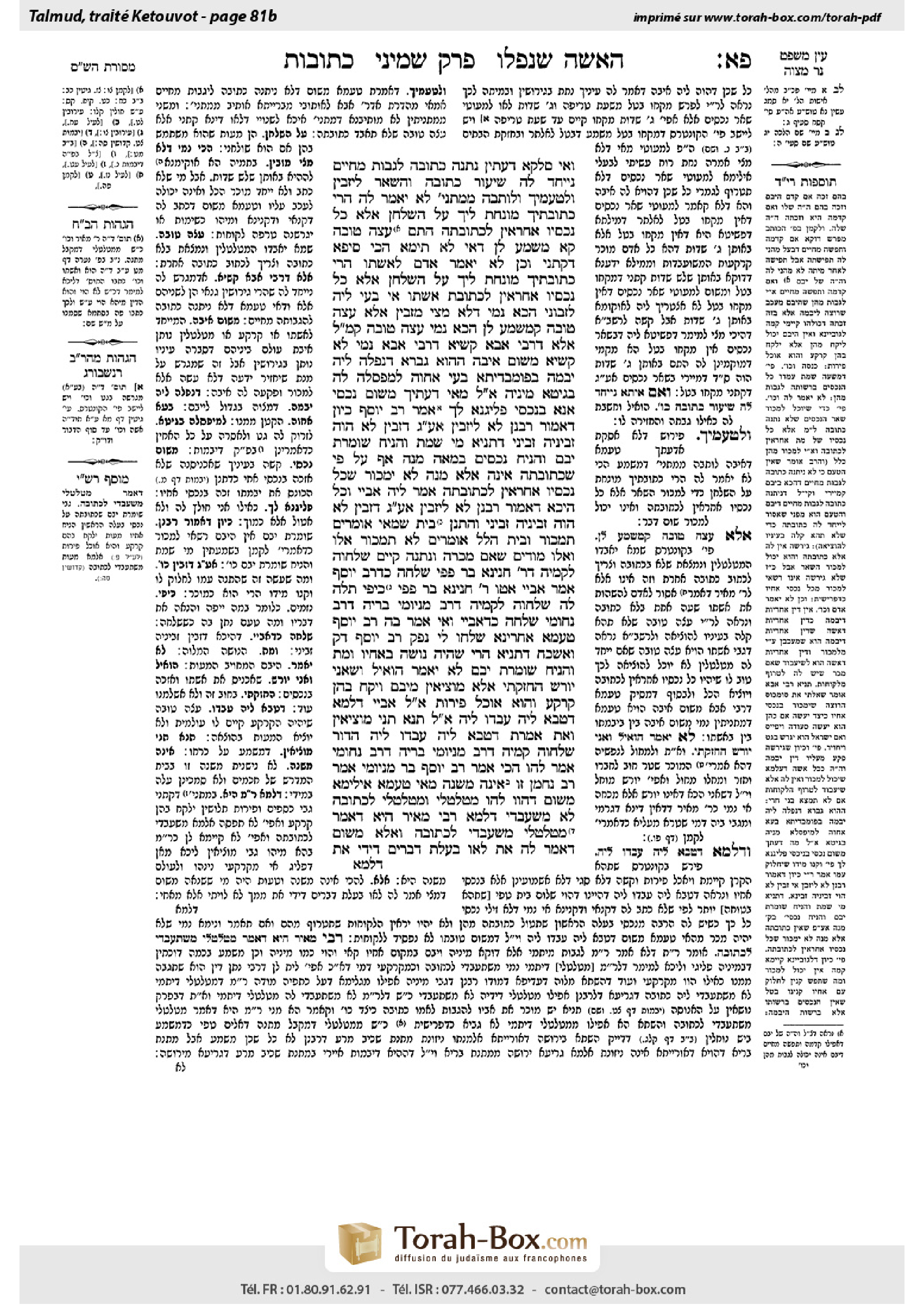
Ketubot 81b: Talmud study for Daf Yomi
Daf Yomi is the daily study of one Talmud folio. Explore 37 tractates with scans, Hebrew text, Sefaria English and AI-generated French translations where annotated.
Passage selection and English or AI-generated French translation are available where the scan has annotations. Daf Study is independent of Torah-Box and Sefaria.
Browse Ketubot · כתובות · All tractatesKetubot 81b text and translations
This page of Ketubot includes the Aramaic text, an English translation and an AI-generated French translation, alongside the scan above.
כתובות פ״א ב · Aramaic and Hebrew text
וְאִי סָלְקָא דַּעְתִּין נִתְּנָה כְּתוּבָּה לִגָּבוֹת מֵחַיִּים, נְיַיחֵד לַהּ שִׁיעוּר כְּתוּבָּה, וְהַשְּׁאָר לִיזַבֵּין! וּלְטַעְמָיךְ, וְלוֹתְבַהּ מִמַּתְנִיתִין: לֹא יֹאמַר לָהּ הֲרֵי כְּתוּבָּתִיךְ מוּנַּחַת לִיךְ עַל הַשֻּׁלְחָן, אֶלָּא כׇּל נְכָסָיו אַחְרָאִין לִכְתוּבָּתָהּ?!
הָתָם עֵצָה טוֹבָה קָא מַשְׁמַע לַן. דְּאִי לָא תֵּימָא הָכִי, סֵיפָא דְּקָתָנֵי: וְכֵן לֹא יֹאמַר אָדָם לְאִשְׁתּוֹ ״הֲרֵי כְּתוּבָּתִיךְ מוּנַּחַת לִיךְ עַל הַשֻּׁלְחָן״, אֶלָּא כׇּל נְכָסָיו אַחְרָאִין לִכְתוּבַּת אִשְׁתּוֹ — אִי בָּעֵי לֵיהּ לְזַבּוֹנֵי, הָכָא נָמֵי דְּלָא מָצֵי מְזַבֵּין?! אֶלָּא עֵצָה טוֹבָה קָמַשְׁמַע לַן, הָכָא נָמֵי עֵצָה טוֹבָה קָא מַשְׁמַע לַן,
אֶלָּא, דְּרַבִּי אַבָּא קַשְׁיָא? דְּרַבִּי אַבָּא נָמֵי לָא קַשְׁיָא, מִשּׁוּם אֵיבָה.
הָהוּא גַּבְרָא דִּנְפַלָה לֵיהּ יְבָמָה בְּפוּמְבְּדִיתָא, בָּעֵי אֲחוּהּ לְמִפְסְלַהּ (לַהּ) בְּגִיטָּא מִינֵּיהּ.
אֲמַר לֵיהּ: מַאי דַּעְתָּיךְ — מִשּׁוּם נִכְסֵי? אֲנָא בְּנִכְסֵי פָּלֵיגְנָא לָךְ.
אָמַר רַב יוֹסֵף: כֵּיוָן דַּאֲמוּר רַבָּנַן לָא לִיזַבֵּין, אַף עַל גַּב דְּזַבֵּין — לָא הֲוָה זְבִינֵיהּ זְבִינֵי. דְּתַנְיָא: מִי שֶׁמֵּת וְהִנִּיחַ שׁוֹמֶרֶת יָבָם, וְהִנִּיחַ נְכָסִים בְּמֵאָה מָנֶה, אַף עַל פִּי שֶׁכְּתוּבָּתָהּ אֵינָהּ אֶלָּא מָנֶה — לֹא יִמְכּוֹר, שֶׁכׇּל נְכָסָיו אַחְרָאִין לִכְתוּבָּתָהּ.
אֲמַר לֵיהּ אַבָּיֵי: וְכׇל הֵיכָא דַּאֲמוּר רַבָּנַן לָא לִיזַבֵּין — אַף עַל גַּב דְּזַבֵּין לָא הֲוָה זְבִינֵיהּ זְבִינֵי? וְהָתְנַן: בֵּית שַׁמַּאי אוֹמְרִים תִּמְכּוֹר, וּבֵית הִלֵּל אוֹמְרִים לֹא תִּמְכּוֹר, אֵלּוּ וְאֵלּוּ מוֹדִים שֶׁאִם מָכְרָה וְנָתְנָה — קַיָּים. שַׁלְחוּהָ לְקַמֵּיהּ דְּרַבִּי חֲנִינָא בַּר פַּפֵּי, שַׁלְחַהּ: כִּדְרַב יוֹסֵף.
אָמַר אַבָּיֵי: אַטּוּ רַבִּי חֲנִינָא בַּר פַּפֵּי כִּיפֵי תְּלָה לַהּ? שַׁלְחוּהָ לְקַמֵּיהּ דְּרַב מִנְיוֹמֵי בְּרֵיהּ דְּרַב נְחוּמִי, שַׁלְחַהּ: כִּדְאַבָּיֵי, וְאִי אָמַר בַּהּ רַב יוֹסֵף טַעְמָא אַחֲרִינָא שִׁלְחוּ לִי.
נְפַק רַב יוֹסֵף דָּק וְאַשְׁכַּח דְּתַנְיָא: הֲרֵי שֶׁהָיָה נוֹשֶׁה בְּאָחִיו, וּמֵת וְהִנִּיחַ שׁוֹמֶרֶת יָבָם, לֹא יֹאמַר: הוֹאִיל וְשֶׁאֲנִי יוֹרֵשׁ — הֶחְזַקְתִּי, אֶלָּא מוֹצִיאִין מִיָּבָם, וְיִקַּח בָּהֶן קַרְקַע וְהוּא אוֹכֵל פֵּירוֹת.
אֲמַר לֵיהּ אַבָּיֵי: דִּלְמָא דְּטָבָא לֵיהּ עֲבַדוּ לֵיהּ. אֲמַר לֵיהּ: תַּנָּא תָּנֵי מוֹצִיאִין, וְאַתְּ אָמְרַתְּ דְּטָבָא לֵיהּ עֲבַדוּ לֵיהּ?
הֲדוּר שַׁלְחוּהָ קַמֵּיהּ דְּרַב מִנְיוֹמֵי בְּרֵיהּ דְּרַב נְחוּמִי. אֲמַר לְהוּ: הָכִי אָמַר רַב יוֹסֵף בַּר מִנְיוֹמֵי אָמַר רַב נַחְמָן: זוֹ אֵינָהּ מִשְׁנָה.
מַאי טַעְמָא? אִילֵּימָא מִשּׁוּם דְּהָווּ לְהוּ מִטַּלְטְלִי, וּמִטַּלְטְלִי לִכְתוּבָּה לָא מְשַׁעְבְּדִי — דִּלְמָא רַבִּי מֵאִיר הִיא, דְּאָמַר: מִטַּלְטְלִי מְשַׁעְבְּדִי לִכְתוּבָּה.
וְאֶלָּא — מִשּׁוּם דְּאָמַר לַהּ: אַתְּ לָאו בַּעֲלַת דְּבָרִים דִּידִי אַתְּ.
Ketubot 81b · English translation
And if it enters our mind that a marriage contract can be collected during his lifetime, why is all this necessary? Let him set aside for her part of the property that corresponds to the amount of the marriage contract, and the rest let him sell. Abaye replied: And according to your reasoning, rather than asking this question based on a baraita, let him raise this difficulty from the mishna, which teaches that he may not say to her: Your marriage contract is placed on the table for you. Rather, all his property is mortgaged for her marriage contract. Why can’t he designate property equivalent to the sum of her marriage contract and sell the rest?
The Gemara answers: The tanna in the mishna there teaches us good advice, i.e., that one should not do so ab initio, so as to ensure that the amount set aside for her marriage contract is not lost, which would necessitate writing a new marriage contract. However, it should not be inferred from the mishna that it is prohibited to do so. As, if you do not say so, that it is merely good advice, consider the latter clause of the mishna, which teaches: And similarly, a man may not say to his wife: Your marriage contract is placed on the table. Rather, all his property is mortgaged for her marriage contract. If he wants to sell, here too, may he not sell? Rather, in that case the tanna teaches us good advice, and therefore here too, with regard to a yevama, he teaches us good advice.
The Gemara asks: But if so, the question is raised once again, as the statement of Rabbi Abba said in the name of Sumakhos is difficult. Why is it necessary for the husband to divorce his wife when he can set aside the sum of her marriage contract? The Gemara answers: That teaching of Rabbi Abba is also not difficult, as the reason one may not do so is not that he cannot designate a sum as her marriage contract but due to enmity. If he were to set aside a certain portion for her marriage contract, she would perceive this as a sign that he desires to be rid of her. If he divorces and remarries her, she would realize it is only a ploy to allow him to sell the property and does not indicate his desire to divorce her.
The Gemara relates: A certain man had a yevama who happened before him for levirate marriage in the city of Pumbedita. His brother wanted to disqualify her from him by means of a bill of divorce, as the halakha is that if one of the potential yevamin gives the yevama a bill of divorce she may no longer enter into levirate marriage with the others.
The brother who wished to perform levirate marriage said to him: What is your opinion? Why are you doing this? Is it due to the property, as you are jealous that his property will belong to me, in accordance with the halakha that the brother who performs levirate marriage inherits the late brother’s property, whereas if the yevama receives ḥalitza or a bill of divorce all the brothers share the inheritance equally? I will divide the property with you. Upon hearing this, the brother consented to him performing levirate marriage. However, when he married the woman, the husband refused to give his brother anything, and the case came before the court.
Rav Yosef said: Since the Sages have said that one may not sell the property of a widow waiting for her yavam before marrying her, although he sold it, his sale is not a valid sale. So too, his promise to give half the property to his brother, which is equivalent to a sale in this case, is of no consequence. As it is taught in a baraita: With regard to one who died and left a widow waiting for her yavam and also left behind property worth the value of one hundred maneh, equivalent to ten thousand dinars, although her marriage contract is worth only one maneh, or one hundred dinars, the yavam may not sell any part of his possessions, as all of his property is mortgaged for her marriage contract. The Sages prohibited him from selling it. Therefore, if he did so the transaction is void.
Abaye said to Rav Yosef: And anywhere that the Sages said that one may not sell, is it the halakha that although he sold, his sale is no sale? But didn’t we learn in the mishna (78a) with regard to a betrothed woman selling property: Beit Shammai say: She may sell, and Beit Hillel say: She may not sell; both these, Beit Shammai, and those, Beit Hillel, agree that if she sold it or gave it away, the transaction is valid? Evidently, even Beit Hillel agree that despite the violation of the Sages’ injunction, the sale is valid. Abaye therefore rejects Rav Yosef’s ruling. They sent this problem before Rabbi Ḥanina bar Pappi, who sent back the following reply: The halakha is in accordance with the opinion of Rav Yosef.
Abaye said in response: Is that to say that Rabbi Ḥanina bar Pappi has hung jewelry upon it, i.e., this ruling? His blunt declaration that the halakha is in accordance with Rav Yosef’s opinion without a logical explanation adds nothing to the discussion, and his decision should be rejected. They sent this inquiry before Rav Minyumi, son of Rav Naḥumi, who sent back the following written reply: The halakha is in accordance with the opinion of Abaye, but if Rav Yosef states a different reason for it, send his reasoning to me and I will reconsider the matter.
Rav Yosef went, examined the mishnayot carefully, and found the following source for his opinion. As it is taught in a baraita: If one claimed money from his brother that he had previously lent him, and then the lender died and left behind a widow waiting for her yavam, then the yavam who borrowed money may not say: Since I inherit my brother’s property by means of the yevama, I may also take possession of the debt, and I do not have to restore it to the other brothers. Rather, one appropriates the sum of the debt from the yavam, and he purchases land with it for the woman’s marriage contract, and he eats the produce. This serves as proof for Rav Yosef’s opinion that a yavam may not sell his brother’s property or take possession of a debt he owed his brother.
Abaye said to him: Perhaps they did for him that which is good for him. In other words, the baraita that states that one should purchase land and eat the produce is merely good advice to prevent the money from being lost. Rav Yosef said to him: The tanna teaches: One appropriates, i.e., against his will, and you say that they did for him that which is good for him? The language indicates that this is an obligation, not a matter of advice.
They once again sent this question before Rav Minyumi, son of Rav Naḥumi. He said to them: So said Rav Yosef bar Minyumi that Rav Naḥman said: This baraita is not a mishna and therefore is not authoritative. Consequently, no proof may be adduced from it.
The Gemara inquires: What is the reason that this baraita is rejected? If we say it is because the money he owes is considered movable property, as it is not present, and movable property is not mortgaged to a marriage contract, as only land can be mortgaged for this purpose, such an argument does not negate the baraita. Perhaps it is in accordance with the opinion of Rabbi Meir, who said that movable property is mortgaged to a marriage contract.
Rather, the reason for doubting the reliability of the baraita is because he says to her: You are not my litigant. There is no legal dispute between the man and the yevama. He claims that she is not a party to this suit, as he owes money to his late brother. Therefore, she cannot claim the money from him by arguing that it is mortgaged for her marriage contract.
Ketubot 81b · Traduction française (IA)
Et s’il nous venait à l’esprit que la ketouba peut être recouvrée du vivant du mari, pourquoi tout cela serait-il nécessaire ? Qu’il lui réserve une partie des biens correspondant au montant de la ketouba, et qu’il vende le reste. Abayé répondit : Selon votre raisonnement, au lieu de poser cette question à partir d’une baraïta, soulevez cette difficulté à partir de la Michna, qui enseigne qu’il ne peut pas lui dire : « Ta ketouba est déposée sur la table pour toi. » Au contraire, tous ses biens sont grevés en garantie de sa ketouba. Pourquoi ne peut-il pas réserver des biens équivalant au montant de sa ketouba et vendre le reste ?
La Guemara répond : Le tanna de cette Michna nous enseigne un bon conseil, à savoir qu’il vaut mieux ne pas agir ainsi d’emblée, afin d’éviter que la somme réservée pour sa ketouba ne soit perdue, ce qui nécessiterait d’en rédiger une nouvelle. Toutefois, il ne faut pas déduire de la Michna que cela est interdit. En effet, si vous ne l’admettez pas et qu’il ne s’agit pas seulement d’un bon conseil, considérez la dernière partie de la Michna, qui enseigne : De même, un homme ne peut pas dire à sa femme : « Ta ketouba est déposée sur la table pour toi. » Au contraire, tous ses biens sont grevés en garantie de sa ketouba. S’il veut vendre, là aussi, ne peut-il pas vendre ? Dans ce cas également, le tanna nous enseigne un bon conseil ; par conséquent, ici aussi, au sujet d’une yevama, il nous enseigne un bon conseil.
La Guemara demande : Mais dans ce cas, la question se pose de nouveau, car l’enseignement de Rabbi Abba au nom de Soumakhos pose problème. Pourquoi le mari doit-il divorcer de sa femme alors qu’il peut réserver le montant de sa ketouba ? La Guemara répond : Cet enseignement de Rabbi Abba ne présente pas non plus de difficulté, car la raison pour laquelle il ne peut pas agir ainsi n’est pas qu’il lui est impossible de désigner une somme comme garantie de sa ketouba, mais qu’il y aurait de l’animosité. S’il réservait une certaine part de ses biens pour sa ketouba, elle y verrait le signe qu’il désire se débarrasser d’elle. S’il divorce puis l’épouse de nouveau, elle comprendrait que ce n’est qu’un stratagème lui permettant de vendre ses biens, et que cela ne témoigne pas de son désir de divorcer.
La Guemara rapporte : Un homme avait une yevama qui s’était présentée à lui pour le lévirat dans la ville de Poumbedita. Son frère voulut l’empêcher de l’épouser en lui remettant un acte de divorce, car selon la halakha, si l’un des frères susceptibles d’accomplir le lévirat remet un acte de divorce à la yevama, celle-ci ne peut plus contracter le lévirat avec les autres.
Le frère qui souhaitait accomplir le lévirat lui dit : « Quelle est ton intention ? Pourquoi fais-tu cela ? Est-ce à cause des biens, parce que tu es jaloux que les biens de notre frère me reviennent, conformément à la halakha selon laquelle le frère qui accomplit le lévirat hérite des biens du frère défunt, tandis que si la yevama reçoit la ḥalitsa ou un acte de divorce, tous les frères se partagent l’héritage à parts égales ? Je partagerai les biens avec toi. » En l’entendant, le frère consentit à ce qu’il accomplisse le lévirat. Cependant, une fois qu’il eut épousé la femme, le mari refusa de donner quoi que ce soit à son frère, et l’affaire fut portée devant le tribunal.
Rav Yossef dit : Puisque les Sages ont dit qu’on ne peut pas vendre les biens d’une veuve qui attend son yavam avant de l’épouser, même s’il les a vendus, la vente est nulle. De même, sa promesse de donner la moitié des biens à son frère, ce qui équivaut ici à une vente, est sans effet. En effet, il est enseigné dans une baraïta : Si un homme est mort en laissant une veuve qui attend son yavam, ainsi que des biens d’une valeur de cent maneh, soit dix mille dinars, même si sa ketouba ne vaut qu’un maneh, soit cent dinars, le yavam ne peut vendre aucune partie de ses biens, car tous ses biens sont grevés en garantie de sa ketouba. Les Sages lui ont interdit de les vendre. Par conséquent, s’il l’a fait, la transaction est nulle.
Abayé dit à Rav Yossef : Partout où les Sages ont dit qu’on ne peut pas vendre, la halakha est-elle que, même s’il a vendu, la vente est nulle ? N’avons-nous pas appris dans la Michna (78a), au sujet d’une femme fiancée qui vend des biens : Beit Chammaï disent qu’elle peut vendre, et Beit Hillel disent qu’elle ne peut pas vendre ; mais les uns comme les autres, Beit Chammaï et Beit Hillel, conviennent que si elle les a vendus ou donnés, la transaction est valide ? Il ressort donc que même Beit Hillel conviennent que, malgré la violation de l’interdiction des Sages, la vente est valide. Abayé rejette donc la décision de Rav Yossef. On soumit cette question à Rabbi Ḥanina bar Pappi, qui répondit : La halakha suit l’opinion de Rav Yossef.
Abayé répondit : Faut-il donc comprendre que Rabbi Ḥanina bar Pappi a orné cet arrêt d’un bijou ? Sa déclaration catégorique selon laquelle la halakha suit l’opinion de Rav Yossef, sans explication logique, n’ajoute rien à la discussion, et sa décision doit être rejetée. On soumit cette question à Rav Minyumi, fils de Rav Naḥoumi, qui répondit par écrit : La halakha suit l’opinion d’Abayé ; mais si Rav Yossef avance un autre raisonnement, envoyez-le-moi et je réexaminerai la question.
Rav Yossef partit, examina attentivement les Michnayot et trouva la source suivante à l’appui de son opinion. En effet, il est enseigné dans une baraïta : Si quelqu’un réclame à son frère de l’argent qu’il lui avait auparavant prêté, puis que le prêteur meurt en laissant une veuve qui attend son yavam, le yavam qui a emprunté de l’argent ne peut pas dire : « Puisque j’hérite des biens de mon frère grâce à la yevama, je peux aussi prendre possession de la créance et je n’ai pas à la restituer aux autres frères. » Au contraire, on prélève au yavam le montant de la créance, on achète avec cette somme un terrain pour la ketouba de la femme, et il en perçoit les fruits. Cela prouve l’opinion de Rav Yossef, selon laquelle un yavam ne peut ni vendre les biens de son frère ni prendre possession d’une créance que celui-ci détenait sur lui.
Abayé lui dit : Peut-être ont-ils agi dans son intérêt. Autrement dit, la baraïta qui prescrit d’acheter un terrain et d’en percevoir les fruits ne donne qu’un bon conseil, afin d’éviter que l’argent ne soit perdu. Rav Yossef lui dit : Le tanna enseigne : « On prélève », c’est-à-dire contre son gré, et toi, tu dis qu’ils ont agi dans son intérêt ? Cette formulation indique qu’il s’agit d’une obligation, et non d’un simple conseil.
On soumit de nouveau cette question à Rav Minyumi, fils de Rav Naḥoumi. Il leur dit : Rav Yossef bar Minyumi a dit au nom de Rav Naḥman : Cette baraïta n’est pas une Michna et ne fait donc pas autorité. On ne peut, par conséquent, en tirer aucune preuve.
La Guemara demande : Pourquoi cette baraïta est-elle rejetée ? Si l’on dit que c’est parce que l’argent qu’il doit est considéré comme un bien meuble, puisqu’il n’est pas présent, et que les biens meubles ne sont pas grevés en garantie d’une ketouba, car seuls les biens fonciers peuvent servir de garantie à cette fin, cet argument ne réfute pas la baraïta. Peut-être suit-elle l’opinion de Rabbi Meïr, qui a dit que les biens meubles sont grevés en garantie d’une ketouba.
Au contraire, la raison de douter de la fiabilité de la baraïta est qu’il lui dit : « Tu n’es pas ma partie adverse. » Il n’y a pas de litige juridique entre l’homme et la yevama. Il soutient qu’elle n’est pas partie à cette affaire, puisqu’il doit de l’argent à son frère défunt. Elle ne peut donc pas lui réclamer cet argent en faisant valoir qu’il est grevé en garantie de sa ketouba.
Traduction française générée par IA à partir de l’édition anglaise de Sefaria. Vérifie toujours un passage avec le texte source.
Text from Sefaria: William Davidson Edition - Vocalized Aramaic (CC BY NC); William Davidson Edition - English (CC BY NC).