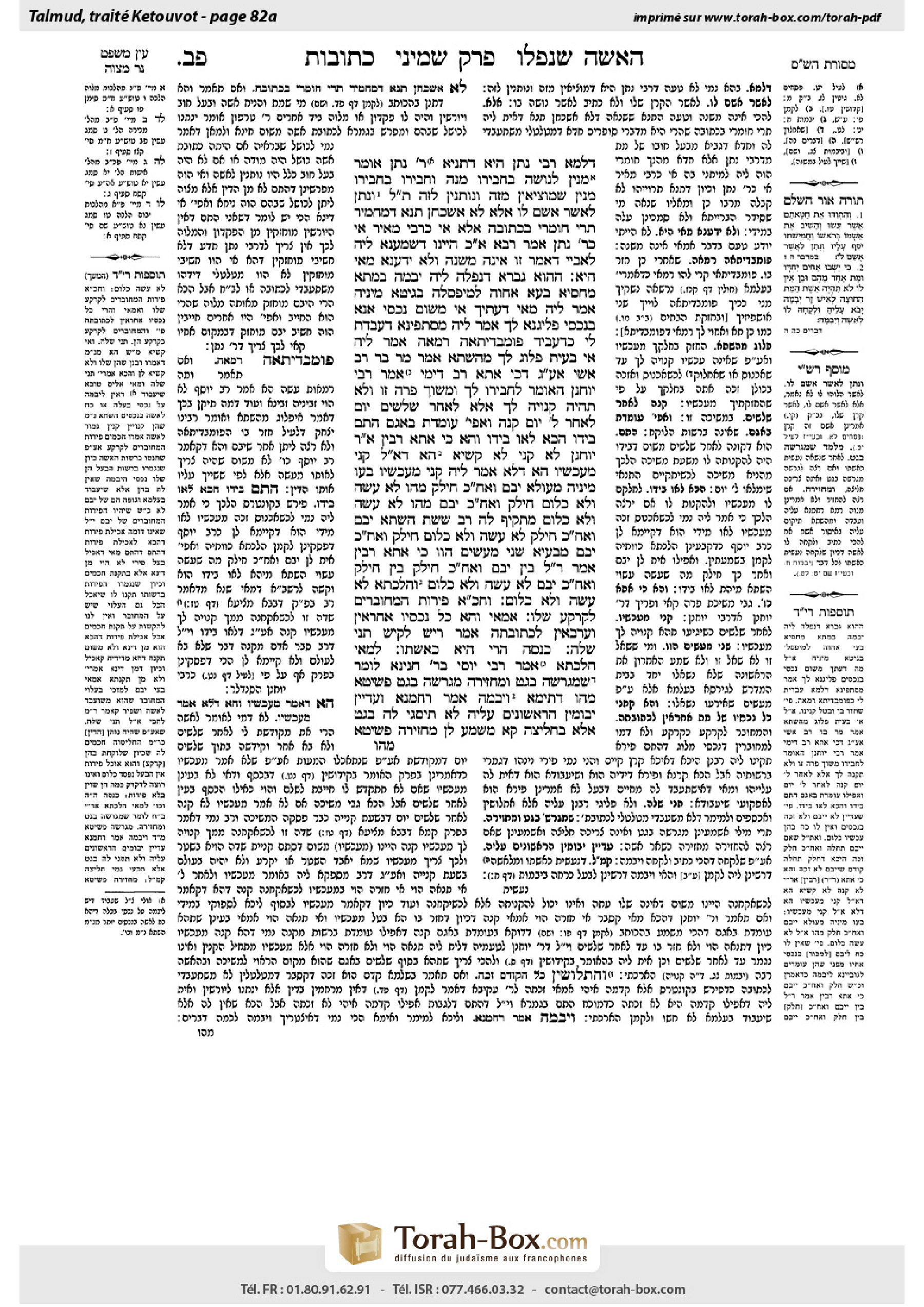
Ketubot 82a: Talmud study for Daf Yomi
Daf Yomi is the daily study of one Talmud folio. Explore 37 tractates with scans, Hebrew text, Sefaria English and AI-generated French translations where annotated.
Passage selection and English or AI-generated French translation are available where the scan has annotations. Daf Study is independent of Torah-Box and Sefaria.
Browse Ketubot · כתובות · All tractatesKetubot 82a text and translations
This page of Ketubot includes the Aramaic text, an English translation and an AI-generated French translation, alongside the scan above.
כתובות פ״ב א · Aramaic and Hebrew text
דִּלְמָא רַבִּי נָתָן הִיא. דְּתַנְיָא, רַבִּי נָתָן אוֹמֵר: מִנַּיִן לַנּוֹשֶׁה בַּחֲבֵירוֹ מָנֶה, וַחֲבֵירוֹ בַּחֲבֵירוֹ, מִנַּיִן שֶׁמּוֹצִיאִין מִזֶּה וְנוֹתְנִין לָזֶה — תַּלְמוּד לוֹמַר: ״וְנָתַן לַאֲשֶׁר אָשַׁם לוֹ״.
אֶלָּא: לָא אַשְׁכְּחַן תַּנָּא דְּמַחְמִיר תְּרֵי חוּמְרֵי בִּכְתוּבָּה, אֶלָּא אִי כְּרַבִּי מֵאִיר אִי כְּרַבִּי נָתָן.
אָמַר רָבָא: אִם כֵּן, הַיְינוּ דִּשְׁמַעְנָא לֵיהּ לְאַבָּיֵי דְּאָמַר: ״זוֹ אֵינָהּ מִשְׁנָה״, וְלָא יָדַעְנָא מַאי הִיא.
הָהוּא גַּבְרָא דִּנְפַלָה לֵיהּ יְבָמָה בְּמָתָא מַחְסֵיָא. בְּעָא אֲחוּהּ לְמִיפְסְלַהּ בְּגִיטָּא מִינֵּיהּ. אֲמַר לֵיהּ: מַאי דַּעְתָּיךְ, אִי מִשּׁוּם נִכְסֵי — אֲנָא בְּנִכְסֵי פָּלֵיגְנָא לָךְ. אֲמַר לֵיהּ: מִסְתְּפֵינָא דְּעָבְדַתְּ לִי כְּדַעֲבַיד פּוּמְבְּדִיתָאָה רַמָּאָה. אֲמַר לֵיהּ: אִי בָּעֵית — פְּלוֹג לָךְ מֵהַשְׁתָּא.
אָמַר מָר בַּר רַב אָשֵׁי: אַף עַל גַּב דְּכִי אֲתָא רַב דִּימִי, אָמַר רַבִּי יוֹחָנָן: הָאוֹמֵר לַחֲבֵירוֹ ״לֵךְ וּמְשׁוֹךְ פָּרָה זוֹ וְלֹא תִּהְיֶה קְנוּיָה לְךָ אֶלָּא לְאַחַר שְׁלֹשִׁים יוֹם״, לְאַחַר שְׁלֹשִׁים יוֹם קָנָה, וַאֲפִילּוּ עוֹמֶדֶת בַּאֲגַם.
הָתָם — בְּיָדוֹ, הָכָא — לָאו בְּיָדוֹ.
וְהָא כִּי אֲתָא רָבִין, אָמַר רַבִּי יוֹחָנָן: לָא קָנֵי! לָא קַשְׁיָא: הָא דַּאֲמַר לֵיהּ ״קְנֵי מֵעַכְשָׁיו״, הָא דְּלָא אֲמַר לֵיהּ ״קְנֵי מֵעַכְשָׁיו״.
בְּעוֹ מִינֵּיהּ מֵעוּלָּא: יִבֵּם וְאַחַר כָּךְ חִילֵּק, מַהוּ? לֹא עָשָׂה וְלֹא כְלוּם. חִילֵּק וְאַחַר כָּךְ יִבֵּם, מַהוּ? לֹא עָשָׂה וְלֹא כְלוּם.
מַתְקֵיף לַהּ רַב שֵׁשֶׁת: הַשְׁתָּא יִבֵּם וְאַחַר כָּךְ חִילֵּק, לֹא עָשָׂה וְלֹא כְלוּם, חִילֵּק וְאַחַר כָּךְ יִבֵּם מִבַּעְיָא?! שְׁנֵי מַעֲשִׂים הֲווֹ.
כִּי אֲתָא רָבִין, אָמַר רֵישׁ לָקִישׁ: בֵּין יִבֵּם וְאַחַר כָּךְ חִילֵּק, בֵּין חִילֵּק וְאַחַר כָּךְ יִבֵּם — לֹא עָשָׂה וְלֹא כְלוּם. וְהִלְכְתָא: לֹא עָשָׂה וְלֹא כְלוּם.
וַחֲכָמִים אוֹמְרִים: פֵּירוֹת הַמְחוּבָּרִים לַקַּרְקַע — שֶׁלּוֹ. אַמַּאי? וְהָא כׇּל נְכָסָיו אַחְרָאִין וְעַרְבָאִין לִכְתוּבָּתָהּ! אָמַר רֵישׁ לָקִישׁ: תְּנִי — שֶׁלָּהּ.
כְּנָסָהּ — הֲרֵי הִיא כְּאִשְׁתּוֹ. לְמַאי הִלְכְתָא? אָמַר רַבִּי יוֹסֵי בְּרַבִּי חֲנִינָא: לוֹמַר שֶׁמְּגָרְשָׁהּ בְּגֵט וּמַחְזִירָהּ. מְגָרְשָׁהּ בְּגֵט פְּשִׁיטָא?
מַהוּ דְּתֵימָא: ״וְיִבְּמָהּ״ אָמַר רַחֲמָנָא, וַעֲדַיִין יִבּוּמִין הָרִאשׁוֹנִים עָלֶיהָ. לָא תִּיסְגֵּי לַהּ בְּגֵט אֶלָּא בַּחֲלִיצָה, קָא מַשְׁמַע לַן.
מַחְזִירָהּ: פְּשִׁיטָא!
Ketubot 82a · English translation
However, this still does not prove conclusively that the baraita is corrupt, as perhaps it is the opinion of Rabbi Natan. As it is taught in a baraita that Rabbi Natan says: From where is it derived that in the case of one who claims one hundred dinars of another, and the other claims money of another, that one appropriates the money from this one, the last borrower, and gives it to this one, the first lender, without each party claiming the money from the one with whom he did business? The verse states: “And he shall give it to him in respect of whom he has been guilty” (Numbers 5:7). The words “whom he has been guilty” are expounded to mean that the borrower pays the one who is owed by his creditor, since the borrower is a party to this case despite the fact that he never incurred direct liability to him. It is possible to explain the baraita cited by Rav Yosef based on this reasoning as well.
Rather, a different justification exists for rejecting the baraita: We have not found a tanna who is stringent with these two stringencies with regard to a marriage contract. Rather, one rules either in accordance with the opinion of Rabbi Meir that movable property is mortgaged for a marriage contract, or in accordance with the opinion of Rabbi Natan. No one accepts both of these stringencies, and yet this baraita can be explained only by a combination of the two opinions. It must therefore be rejected as non-authoritative.
Rava said: If so, that is the meaning of that which I heard from Abaye, who said: This is not a mishna, and I did not know what it is. Rava initially did not understand why the teaching should be dismissed, but he subsequently realized what Abaye was saying.
The Gemara relates a similar incident: There was a certain man who had a yevama happen before him for levirate marriage in the town of Mata Meḥasya, and his brother wanted to disqualify her from him by means of a bill of divorce. The man said to his brother: What is your opinion? Why are you doing this? If you are doing this due to the property of the dead brother, I will divide the property with you. The brother said to him: I am scared that you will do to me like the swindler from Pumbedita did, in the above story, when the man from Pumbedita promised he would share the inheritance and later retracted. The man said to him: If you wish, divide it for yourself from now. I am prepared for you to take the property already, although the acquisition will take effect only after I marry the yevama.
Mar bar Rav Ashi said that although when Rav Dimi came from Eretz Yisrael he said that Rabbi Yoḥanan said: In the case of one who says to another: Go and pull this cow and it will be acquired for you only after thirty days, after thirty days he has acquired it through the act of pulling, and this is the halakha even if at the end of the thirty days the cow was standing in a meadow, i.e., a distant place that does not belong to the one acquiring the cow. This indicates that the present act of pulling is effective for later. Despite this halakha, Mar bar Rav Ashi claims that a difference exists between that case and the one currently under discussion.
Mar bar Rav Ashi elaborates: There, with regard to the cow, it is in the seller’s power to transfer ownership at the present time, when the instruction to pull the cow is given, and therefore he can delay the acquisition. Here, however, it is not in his power to divide up the property, as he has yet to perform levirate marriage and the brother’s property does not belong to him. Consequently, he cannot transfer its ownership at the present time.
The Gemara asks: But when Ravin came from Eretz Yisrael he said that Rabbi Yoḥanan said: If one is instructed to pull a cow, but the acquisition will take effect only after thirty days, he has not acquired it. This contradicts Rabbi Yoḥanan’s own ruling. The Gemara answers: This is not difficult, as this case, when one acquires it, is referring to a situation when he says to him: Acquire it from now, so that once thirty days have passed it should belong to him retroactively, but that case, when one does not acquire it, is when he did not say to him: Acquire it from now. If the acquisition does not take effect now, it cannot take effect later.
They inquired of Ulla: If the yavam performed levirate marriage with the woman and afterward divided the property he promised to share with his brother, what is the halakha? He replied: He has done nothing. They further asked: If he divided the property and afterward performed levirate marriage, what is the halakha? He once again responded: He has done nothing.
Rav Sheshet objects to this version of the discussion: Now if, when he performed levirate marriage and afterward divided the property when it was in his possession, Ulla answered that he has done nothing, then in a case where he divided it and afterward performed levirate marriage, is it necessary to inquire as to the halakha? It is obvious that such an action is of no consequence. The Gemara answers: Ulla was not asked these two questions on the same occasion. Rather, there were two incidents in which people raised these issues before Ulla, and he answered each inquiry separately.
When Ravin came from Eretz Yisrael he said that Reish Lakish said: Whether he performed levirate marriage and afterward divided the property, or whether he divided the property and afterward performed levirate marriage, he has done nothing. The Gemara concludes: And the practical halakha is that he has done nothing.
§ The mishna states: And the Rabbis say: Produce that is attached to the ground is his. The Gemara asks: Why is this so? Doesn’t all of his property serve as a guarantee and security for her marriage contract? Reish Lakish said: Emend the text and teach: Produce that is attached to the ground is hers.
The mishna further stated that if he married her, she is like his regular wife. The Gemara asks: With regard to what halakha was this stated? Rabbi Yosei, son of Rabbi Ḥanina, said: The mishna means to say that he divorces her with a bill of divorce and that he may remarry her afterward without violating a prohibition. The Gemara asks: The halakha that he divorces her with a bill of divorce is obvious; how else can he divorce her?
The Gemara explains: It is necessary to state this lest you say that since the Merciful One states in the Torah: “And he will take her to him to be his wife and consummate the levirate marriage” (Deuteronomy 25:5), and here the status of the first levirate marriage is still upon her, this would mean that it should not suffice for her to leave by a bill of divorce, but rather she can leave him only by performing ḥalitza as well. The tanna therefore teaches us that ḥalitza is not required, as once he has married her she is like any other woman, who can be divorced by a bill of divorce alone.
The Gemara asks with regard to the second part of the interpretation of Rabbi Yosei, son of Rabbi Ḥanina, that he may remarry her: It is obvious that he may remarry her if the couple chooses to do so.
Ketubot 82a · Traduction française (IA)
Toutefois, cela ne prouve toujours pas de manière concluante que la baraïta est erronée, car il se peut qu’elle reflète l’opinion de Rabbi Natan. En effet, il est enseigné dans une baraïta que Rabbi Natan dit : D’où déduit-on que, lorsqu’un homme réclame cent dinars à un autre, et que celui-ci réclame de l’argent à un tiers, on saisit l’argent de ce dernier, le débiteur final, pour le remettre au premier, le créancier initial, sans que chacun réclame l’argent à la personne avec laquelle il a traité ? Le verset dit : « Il le lui restituera, à celui envers qui il s’est rendu coupable » (Nombres 5,7). Les mots « envers qui il s’est rendu coupable » sont interprétés comme signifiant que l’emprunteur paie celui envers qui son créancier est redevable, puisque l’emprunteur est partie à cette affaire, bien qu’il ne soit jamais devenu directement son débiteur. Il est également possible d’expliquer la baraïta citée par Rav Yosef selon ce raisonnement.
On rejette plutôt cette baraïta pour une autre raison : nous n’avons trouvé aucun tanna qui applique ces deux rigueurs en matière de contrat de mariage. On statue plutôt soit conformément à l’opinion de Rabbi Meïr, selon laquelle les biens mobiliers garantissent le paiement du contrat de mariage, soit conformément à l’opinion de Rabbi Natan. Personne n’adopte ces deux rigueurs à la fois, alors que cette baraïta ne peut s’expliquer que par la combinaison de ces deux opinions. Il faut donc la rejeter comme ne faisant pas autorité.
Rava dit : « Si c’est ainsi, voilà donc ce que signifiait ce que j’avais entendu d’Abaye, qui avait dit : “Ceci n’est pas une Michna”, et je ne savais pas ce qu’il voulait dire. » Au départ, Rava ne comprenait pas pourquoi cet enseignement devait être écarté, mais il comprit ensuite ce qu’Abaye voulait dire.
La Guemara rapporte un cas semblable : un homme avait une yevama qui s’était présentée à lui pour le lévirat dans la ville de Mata Meḥasya, et son frère voulait l’empêcher de l’épouser au moyen d’un acte de divorce. L’homme dit à son frère : « Quelle est ton intention ? Pourquoi fais-tu cela ? Si tu le fais à cause des biens de notre frère défunt, je partagerai les biens avec toi. » Son frère lui dit : « J’ai peur que tu ne me fasses comme le filou de Pumbedita dans l’histoire précédente, lorsque l’homme de Pumbedita avait promis de partager l’héritage, puis s’était rétracté. » L’homme lui dit : « Si tu le souhaites, prends dès maintenant ta part. Je suis prêt à ce que tu prennes les biens dès à présent, bien que l’acquisition ne prenne effet qu’après que j’aurai épousé la yevama. »
Mar bar Rav Ashi dit que, bien que Rav Dimi, en arrivant de la terre d’Israël, ait rapporté que Rabbi Yoḥanan avait dit : « Lorsqu’un homme dit à un autre : “Va tirer cette vache, et elle ne sera acquise par toi qu’au bout de trente jours”, celui-ci l’acquiert au bout de trente jours par l’acte de tirer, même si, à l’expiration de ces trente jours, la vache se trouve dans un pré, c’est-à-dire dans un endroit éloigné qui n’appartient pas à celui qui l’acquiert. » Cela indique que l’acte de tirer accompli maintenant peut produire ses effets plus tard. Malgré cette halakha, Mar bar Rav Ashi affirme qu’il existe une différence entre ce cas et celui qui est discuté ici.
Mar bar Rav Ashi précise : dans le cas de la vache, le vendeur a le pouvoir d’en transférer la propriété au moment présent, lorsqu’il donne l’ordre de tirer la vache ; il peut donc différer l’acquisition. Ici, en revanche, il n’a pas le pouvoir de partager les biens, puisqu’il n’a pas encore accompli le lévirat et que les biens de son frère ne lui appartiennent pas. Par conséquent, il ne peut pas en transférer la propriété au moment présent.
La Guemara demande : Mais lorsque Ravin arriva de la terre d’Israël, il rapporta que Rabbi Yoḥanan avait dit : « Si l’on reçoit l’ordre de tirer une vache, mais que l’acquisition ne prend effet qu’au bout de trente jours, on ne l’a pas acquise. » Cela contredit la décision de Rabbi Yoḥanan lui-même. La Guemara répond : Il n’y a pas de difficulté, car le cas où l’on acquiert la vache concerne une situation où il lui dit : « Acquiers-la dès maintenant », de sorte qu’au bout de trente jours elle lui appartienne rétroactivement ; tandis que le cas où l’on ne l’acquiert pas est celui où il ne lui a pas dit : « Acquiers-la dès maintenant. » Si l’acquisition ne prend pas effet maintenant, elle ne peut prendre effet plus tard.
On demanda à Ulla : si le yavam a accompli le lévirat avec la femme, puis a partagé les biens qu’il avait promis de partager avec son frère, quelle est la halakha ? Il répondit : cela ne produit aucun effet. On lui demanda également : s’il a partagé les biens, puis accompli le lévirat, quelle est la halakha ? Il répondit de nouveau : cela ne produit aucun effet.
Rav Sheshet objecte à cette version de la discussion : si, lorsqu’il a accompli le lévirat puis partagé les biens alors qu’ils étaient en sa possession, Ulla a répondu que cela ne produit aucun effet, est-il nécessaire de demander quelle est la halakha dans le cas où il les a partagés avant d’accomplir le lévirat ? Il est évident qu’un tel acte est sans conséquence. La Guemara répond : ces deux questions n’ont pas été posées à Ulla à la même occasion. Il y eut plutôt deux incidents au cours desquels on souleva ces questions devant Ulla, et il répondit séparément à chacune.
Lorsque Ravin arriva de la terre d’Israël, il rapporta que Reish Lakish avait dit : qu’il ait accompli le lévirat puis partagé les biens, ou qu’il ait partagé les biens puis accompli le lévirat, cela ne produit aucun effet. La Guemara conclut : la halakha pratique est que cela ne produit aucun effet.
§ La Michna enseigne : « Et les Sages disent : les produits attachés au sol lui appartiennent. » La Guemara demande : Pourquoi en est-il ainsi ? Tous ses biens ne servent-ils pas de garantie pour le paiement de son contrat de mariage ? Reish Lakish dit : Corrige le texte et enseigne : « Les produits attachés au sol lui appartiennent à elle. »
La Michna ajoute que, s’il l’a épousée, elle est comme son épouse ordinaire. La Guemara demande : À propos de quelle halakha cela a-t-il été énoncé ? Rabbi Yosei, fils de Rabbi Ḥanina, dit : la Michna veut dire qu’il la répudie au moyen d’un acte de divorce et qu’il peut ensuite l’épouser de nouveau sans enfreindre d’interdit. La Guemara demande : Il est évident qu’il la répudie au moyen d’un acte de divorce ; comment pourrait-il la répudier autrement ?
La Guemara explique : Il était nécessaire de l’enseigner, de peur que tu ne dises que, puisque le Miséricordieux dit dans la Torah : « Il la prendra pour épouse et accomplira le lévirat avec elle » (Deutéronome 25,5), et que le statut du premier lévirat subsiste encore dans son cas, elle ne puisse pas être libérée par un acte de divorce, mais seulement si elle accomplit également la ḥalitsa. Le tanna nous enseigne donc que la ḥalitsa n’est pas requise : dès lors qu’il l’a épousée, elle est comme toute autre femme, qui peut être répudiée par un acte de divorce seul.
La Guemara pose une question au sujet de la seconde partie de l’interprétation de Rabbi Yosei, fils de Rabbi Ḥanina, selon laquelle il peut l’épouser de nouveau : il est évident qu’il peut l’épouser de nouveau si le couple le souhaite.
Traduction française générée par IA à partir de l’édition anglaise de Sefaria. Vérifie toujours un passage avec le texte source.
Text from Sefaria: William Davidson Edition - Vocalized Aramaic (CC BY NC); William Davidson Edition - English (CC BY NC).