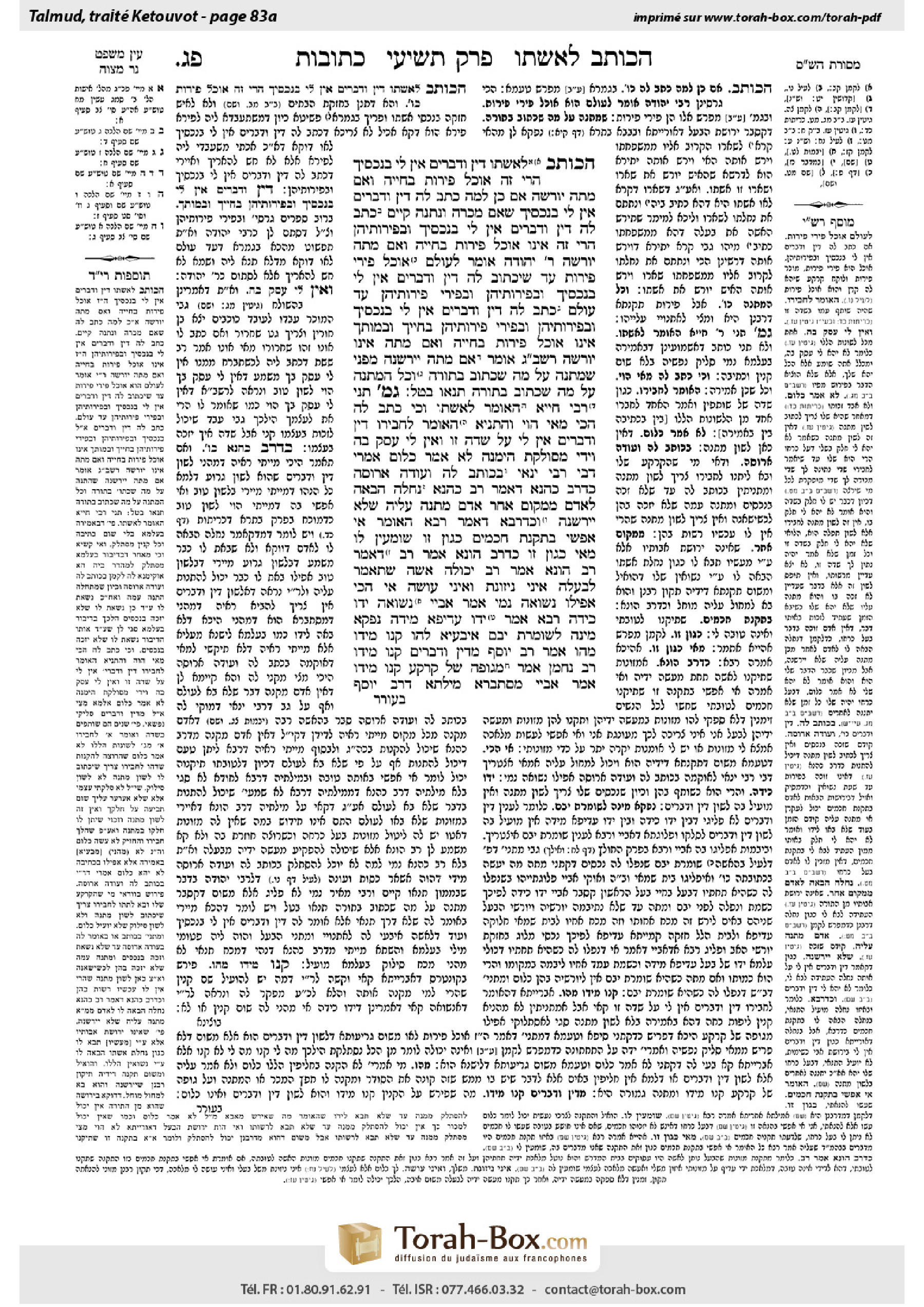
Ketubot 83a: Talmud study for Daf Yomi
Daf Yomi is the daily study of one Talmud folio. Explore 37 tractates with scans, Hebrew text, Sefaria English and AI-generated French translations where annotated.
Passage selection and English or AI-generated French translation are available where the scan has annotations. Daf Study is independent of Torah-Box and Sefaria.
Browse Ketubot · כתובות · All tractatesKetubot 83a text and translations
This page of Ketubot includes the Aramaic text, an English translation and an AI-generated French translation, alongside the scan above.
כתובות פ״ג א · Aramaic and Hebrew text
הַכּוֹתֵב לְאִשְׁתּוֹ: ״דִּין וּדְבָרִים אֵין לִי בִּנְכָסַיִךְ״ — הֲרֵי זֶה אוֹכֵל פֵּרוֹת בְּחַיֶּיהָ, וְאִם מֵתָה יוֹרְשָׁהּ. אִם כֵּן, לָמָּה כָּתַב לָהּ ״דִּין וּדְבָרִים אֵין לִי בִּנְכָסַיִךְ״? שֶׁאִם מָכְרָה וְנָתְנָה — קַיָּים.
כָּתַב לָהּ ״דִּין וּדְבָרִים אֵין לִי בִּנְכָסַיִךְ וּבְפֵירוֹתֵיהֶן״ — הֲרֵי זֶה אֵינוֹ אוֹכֵל פֵּרוֹת בְּחַיֶּיהָ, וְאִם מֵתָה — יוֹרְשָׁהּ. רַבִּי יְהוּדָה אוֹמֵר: לְעוֹלָם אוֹכֵל פֵּירֵי פֵירוֹת. עַד שֶׁיִּכְתּוֹב לַהּ ״דִּין וּדְבָרִים אֵין לִי בִּנְכָסַיִךְ וּבְפֵירוֹתֵיהֶן וּבְפֵירֵי פֵירוֹתֵיהֶן עַד עוֹלָם״.
כָּתַב לַהּ ״דִּין וּדְבָרִים אֵין לִי בִּנְכָסַיִךְ וּבְפֵירוֹתֵיהֶן וּבְפֵירֵי פֵירוֹתֵיהֶן בְּחַיַּיִךְ וּבְמוֹתֵךְ״ — אֵינוֹ אוֹכֵל פֵּירוֹת בְּחַיֶּיהָ, וְאִם מֵתָה — אֵינוֹ יוֹרְשָׁהּ. רַבָּן שִׁמְעוֹן בֶּן גַּמְלִיאֵל אוֹמֵר: אִם מֵתָה — יִירָשֶׁנָּה, מִפְּנֵי שֶׁמַּתְנֶה עַל מַה שֶּׁכָּתוּב בַּתּוֹרָה, וְכׇל הַמַּתְנֶה עַל מַה שֶּׁכָּתוּב בַּתּוֹרָה — תְּנָאוֹ בָּטֵל.
גְּמָ׳ תָּנֵי רַבִּי חִיָּיא: ״הָאוֹמֵר לְאִשְׁתּוֹ״.
וְכִי כְּתַב לַהּ הָכִי, מַאי הָוֵי? וְהָתַנְיָא: הָאוֹמֵר לַחֲבֵירוֹ ״דִּין וּדְבָרִים אֵין לִי עַל שָׂדֶה זוֹ״, ״וְאֵין לִי עֵסֶק בָּהּ״, ״וְיָדַי מְסוּלָּקֹת הֵימֶנָּה״ — לֹא אָמַר כְּלוּם!
אָמְרִי דְּבֵי רַבִּי יַנַּאי: בְּכוֹתֵב לָהּ וְעוֹדָהּ אֲרוּסָה, כִּדְרַב כָּהֲנָא. דְּאָמַר רַב כָּהֲנָא: נַחֲלָה הַבָּאָה לְאָדָם מִמָּקוֹם אַחֵר — אָדָם מַתְנֶה עָלֶיהָ שֶׁלֹּא יִירָשֶׁנָּה, וְכִדְרָבָא. דְּאָמַר רָבָא: הָאוֹמֵר ״אִי אֶפְשִׁי בְּתַקָּנַת חֲכָמִים כְּגוֹן זוֹ״ — שׁוֹמְעִין לוֹ.
מַאי ״כְּגוֹן זוֹ״? כִּדְרַב הוּנָא אָמַר רַב. דְּאָמַר רַב הוּנָא אָמַר רַב: יְכוֹלָה אִשָּׁה שֶׁתֹּאמַר לְבַעְלָהּ ״אֵינִי נִיזּוֹנֶת וְאֵינִי עוֹשָׂה״.
אִי הָכִי, אֲפִילּוּ נְשׂוּאָה נָמֵי?
אָמַר אַבָּיֵי: נְשׂוּאָה — יָדוֹ כְּיָדָהּ. רָבָא אָמַר: יָדוֹ עֲדִיפָא מִיָּדָהּ. נָפְקָא מִינַּהּ לְשׁוֹמֶרֶת יָבָם.
אִיבַּעְיָא לְהוּ: קָנוּ מִיָּדוֹ, מַהוּ? אָמַר רַב יוֹסֵף: מִדִּין וּדְבָרִים קָנוּ מִיָּדוֹ. רַב נַחְמָן אָמַר: מִגּוּפָהּ שֶׁל קַרְקַע קָנוּ מִיָּדוֹ. אָמַר אַבָּיֵי: מִסְתַּבְּרָא מִילְּתָא דְּרַב יוֹסֵף
Ketubot 83a · English translation
MISHNA: One who writes for his wife in a document the declaration: I have no legal dealings or involvement with your property, thereby relinquishing his rights to her possessions, may nevertheless consume the produce of her property in her lifetime. And if she dies before him, he inherits from her. If this is so, if he still retains his rights, why would he write for her: I have no legal dealings or involvement with your property? The result of this declaration is that if she sold or gave away her property, the transaction is binding, and he cannot claim it.
If he writes for her: I have no legal dealings or involvement with your property or with its produce, he may not consume the produce of her property during her lifetime, but if she dies he still retains the right to inherit from her. Rabbi Yehuda says: He always consumes the produce of the produce. Although he has waived his rights to consume the produce itself, it becomes her usufruct property, whose yield belongs to him. He remains entitled to the produce of the produce until he writes for her: I have no legal dealings or involvement with your property, or with its produce, or with the produce of its produce forever.
If he writes for her: I have no legal dealings or involvement with your property or with its produce, or with the produce of its produce, in your lifetime and after your death, he may not consume the produce of her property in her lifetime. And if she dies, he does not inherit from her. Rabban Shimon ben Gamliel says: If she dies, he does inherit from her, because he stipulates counter to that which is written in the Torah. According to Rabban Shimon ben Gamliel, a husband inherits from his wife by Torah law, and whoever stipulates counter to that which is written in the Torah, his stipulation is void.
GEMARA: Rabbi Ḥiyya taught in a baraita: One who says to his wife; he did not teach: One who writes for his wife, as the mishna stated. This indicates that this condition can be stated verbally and does not need to be written in a contract.
The Gemara asks about the ruling of the mishna: And if he wrote this to her, what of it? How does such a stipulation, written or otherwise, take effect? But isn’t it taught in a baraita: One who says, whether verbally or by written communication, to another person with whom he shares property: I have no legal dealings or involvement with this field, or I have no dealings with it, or my hands are removed from it, has not said anything? This is because statements that waive rights without transferring them to another have no legal standing.
The Sages from the school of Rabbi Yannai say: The mishna is referring to one who writes such a statement for her while she is still betrothed. Since the property was not yet in the husband’s possession when he wrote this condition, he was able to forgo any rights that he would later receive. This is in accordance with the opinion of Rav Kahana, as Rav Kahana said: Concerning an inheritance that comes to a person from another place, i.e., he did not inherit it directly but rather through his wife or by means of a gift, the person can stipulate with regard to it that he will not inherit it. In this case, his statement is effective, although one cannot waive a right one already has. And this ruling is in accordance with the opinion of Rava, as Rava said: With regard to one who says: I do not want to avail myself of an ordinance of the Sages that was instituted for my benefit, such as this one, one listens to him.
The Gemara asks: What is meant by: Such as this one? The Gemara explains: Rava is referring to that statement of Rav Huna, who said that Rav said a certain ruling. As Rav Huna said that Rav said that a woman is able say to her husband: I will not be sustained by you and, in turn, I will not work, i.e., you will not keep my earnings. The Sages instituted that a husband must provide sustenance for his wife, and in exchange is entitled to her wages. Since this was instituted for the benefit of the wife, she is able to opt out of this arrangement. Similarly, the husband may opt out of the arrangement granting him the right to the produce of his wife’s land.
The Gemara asks: If that is so, and Rava’s opinion that one can waive a right instituted by the Sages for his own benefit is accepted, then even if he relinquished his rights to his wife’s property once she was already married, his stipulation should also be valid. Why, then, was it necessary for Rabbi Yannai to explain that the stipulation in the mishna was made only in the case of a betrothed woman?
Abaye said: In the case of a married woman, his hand, i.e., his right to the property, is like her hand. Since the husband is considered a partner in her property, he cannot forfeit his ownership by declaration. Rava said: If they are married, his hand is preferable to her hand, i.e., he has more rights to her property than she does. The Gemara comments: The practical difference between the opinions of Rava and Abaye concerns the case of a widow awaiting her brother-in-law [yavam] to perform levirate marriage. If the husband’s rights are greater than the wife’s, then the rights of the yavam can be judged to be at least equal to that of the wife. If the husband and wife have equal rights in her property, then the rights of the yavam are inferior to the wife’s.
A dilemma was raised before the Sages: What is the halakha if one not only wrote a declaration relinquishing his rights to his partner’s property, but they also performed an act of acquisition transferring the rights from him? Rav Yosef said: They acquired from him only his promise of: I have no legal dealings or involvement with your property. Therefore, the transaction is no more effective than the promise itself. Rav Naḥman said: The transaction is effective and they acquired the land itself from him. Abaye said: The statement of Rav Yosef is reasonable
Ketubot 83a · Traduction française (IA)
MICHNA : Celui qui écrit à sa femme, dans un document : « Je n’ai aucun droit ni aucune prétention sur tes biens », renonçant ainsi à ses droits sur ses biens, peut néanmoins percevoir les fruits de ses biens du vivant de sa femme. Et si elle meurt avant lui, il hérite d’elle. Si tel est le cas, s’il conserve encore ses droits, pourquoi lui écrit-il : « Je n’ai aucun droit ni aucune prétention sur tes biens » ? Cette déclaration a pour effet que, si elle vend ses biens ou les donne, la transaction est valide et il ne peut pas les revendiquer.
S’il lui écrit : « Je n’ai aucun droit ni aucune prétention sur tes biens ni sur leurs fruits », il ne peut pas percevoir les fruits de ses biens du vivant de sa femme, mais, si elle meurt, il conserve le droit d’hériter d’elle. Rabbi Yehouda dit : Il perçoit toujours les fruits des fruits. Bien qu’il ait renoncé à son droit de percevoir les fruits eux-mêmes, ceux-ci deviennent des biens dont il perçoit l’usufruit. Il conserve son droit aux fruits des fruits jusqu’à ce qu’il lui écrive : « Je n’ai aucun droit ni aucune prétention sur tes biens, ni sur leurs fruits, ni sur les fruits de leurs fruits, à jamais. »
S’il lui écrit : « Je n’ai aucun droit ni aucune prétention sur tes biens, ni sur leurs fruits, ni sur les fruits de leurs fruits, de ton vivant et après ta mort », il ne peut pas percevoir les fruits de ses biens du vivant de sa femme. Et si elle meurt, il n’hérite pas d’elle. Rabban Chimon ben Gamliel dit : Si elle meurt, il hérite bien d’elle, car il pose une condition contraire à ce qui est écrit dans la Torah. Selon Rabban Chimon ben Gamliel, le mari hérite de sa femme en vertu de la Torah, et toute personne qui pose une condition contraire à ce qui est écrit dans la Torah voit sa condition annulée.
GUEMARA : Rabbi Ḥiyya enseigna dans une baraïta : « Celui qui dit à sa femme… » Il n’enseigna pas : « Celui qui écrit à sa femme », comme le dit la Michna. Cela indique que cette condition peut être formulée oralement et ne doit pas nécessairement être écrite dans un contrat.
La Guemara interroge sur la décision de la Michna : « Et s’il lui a écrit cela, qu’en est-il ? » Comment une telle condition, écrite ou non, peut-elle prendre effet ? N’est-il pas enseigné dans une baraïta : Celui qui dit, oralement ou par écrit, à une autre personne avec laquelle il partage des biens : « Je n’ai aucun droit ni aucune prétention sur ce champ », ou : « Je n’ai aucun droit sur lui », ou : « Je m’en retire », n’a rien dit ? En effet, les déclarations par lesquelles on renonce à des droits sans les transférer à quelqu’un d’autre n’ont aucune valeur juridique.
Les Sages de l’école de Rabbi Yannai disent : La Michna parle de celui qui lui écrit une telle déclaration alors qu’elle est encore fiancée. Puisque les biens n’étaient pas encore en possession du mari lorsqu’il a formulé cette condition, il pouvait renoncer à tous les droits qu’il obtiendrait par la suite. Cela concorde avec l’opinion de Rav Kahana, car Rav Kahana a dit : Concernant un héritage qui revient à une personne d’une autre manière, c’est-à-dire qu’elle n’en hérite pas directement, mais par l’intermédiaire de sa femme ou au moyen d’un don, elle peut stipuler qu’elle n’en héritera pas. Dans ce cas, sa déclaration est effective, bien qu’on ne puisse pas renoncer à un droit dont on dispose déjà. Cette décision concorde avec l’opinion de Rava, car Rava a dit : Celui qui dit : « Je ne veux pas bénéficier d’une ordonnance des Sages instituée en ma faveur », comme celle-ci, on l’écoute.
La Guemara demande : Que signifie « comme celle-ci » ? La Guemara explique : Rava fait référence à la déclaration de Rav Houna, qui rapporta une certaine décision au nom de Rav. Rav Houna a dit que Rav a dit qu’une femme peut dire à son mari : « Je ne veux pas que tu pourvoies à mon entretien et, en contrepartie, je ne travaillerai pas », c’est-à-dire que tu ne percevras pas mes gains. Les Sages ont institué que le mari doit assurer l’entretien de sa femme et qu’en contrepartie, il a droit à ses gains. Puisque cette disposition a été instituée en faveur de la femme, elle peut choisir de ne pas en bénéficier. De même, le mari peut renoncer à la disposition qui lui accorde le droit aux fruits des terres de sa femme.
La Guemara demande : Si tel est le cas, et si l’on accepte l’opinion de Rava selon laquelle on peut renoncer à un droit institué par les Sages en sa propre faveur, alors, même s’il renonçait à ses droits sur les biens de sa femme après leur mariage, sa condition devrait également être valable. Pourquoi Rabbi Yannai a-t-il donc dû expliquer que la condition de la Michna n’était formulée que dans le cas d’une femme fiancée ?
Abayé dit : Dans le cas d’une femme mariée, sa main, c’est-à-dire son droit sur les biens, est comme la main de celle-ci. Puisque le mari est considéré comme associé à ses biens, il ne peut pas renoncer à ses droits de propriété par une déclaration. Rava dit : S’ils sont mariés, sa main l’emporte sur la sienne, c’est-à-dire qu’il a davantage de droits sur ses biens qu’elle. La Guemara relève : La différence pratique entre les opinions de Rava et d’Abayé concerne le cas d’une veuve qui attend que son beau-frère [yavam] accomplisse le mariage léviratique. Si les droits du mari sont supérieurs à ceux de sa femme, on peut considérer que les droits du yavam sont au moins égaux à ceux de la femme. Si le mari et la femme ont des droits égaux sur ses biens, les droits du yavam sont alors inférieurs à ceux de la femme.
Les Sages soulevèrent la question suivante : Quelle est la halakha si, en plus d’écrire une déclaration par laquelle il renonce à ses droits sur les biens de sa partenaire, ils accomplissent également un acte d’acquisition transférant ces droits ? Rav Yossef dit : On a acquis de lui uniquement sa promesse : « Je n’ai aucun droit ni aucune prétention sur tes biens. » La transaction n’a donc pas plus d’effet que la promesse elle-même. Rav Naḥman dit : La transaction est effective et ils ont acquis de lui le terrain lui-même. Abayé dit : La déclaration de Rav Yossef est raisonnable.
Traduction française générée par IA à partir de l’édition anglaise de Sefaria. Vérifie toujours un passage avec le texte source.
Text from Sefaria: William Davidson Edition - Vocalized Aramaic (CC BY NC); William Davidson Edition - English (CC BY NC).