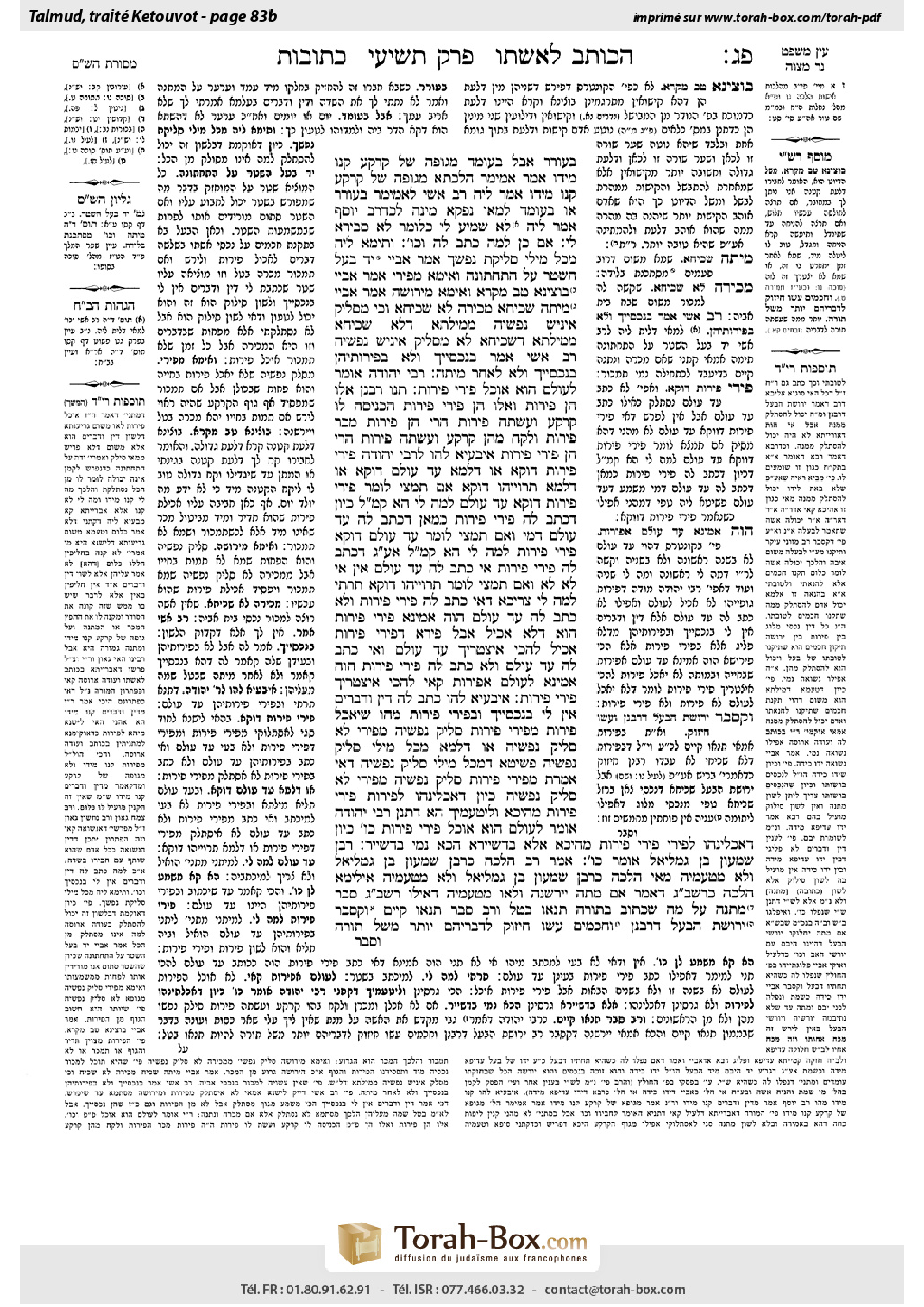
Ketubot 83b: Talmud study for Daf Yomi
Daf Yomi is the daily study of one Talmud folio. Explore 37 tractates with scans, Hebrew text, Sefaria English and AI-generated French translations where annotated.
Passage selection and English or AI-generated French translation are available where the scan has annotations. Daf Study is independent of Torah-Box and Sefaria.
Browse Ketubot · כתובות · All tractatesKetubot 83b text and translations
This page of Ketubot includes the Aramaic text, an English translation and an AI-generated French translation, alongside the scan above.
כתובות פ״ג ב · Aramaic and Hebrew text
בְּעוֹרֵר. אֲבָל בְּעוֹמֵד, מִגּוּפָהּ שֶׁל קַרְקַע קָנוּ מִיָּדוֹ.
אָמַר אַמֵּימָר: הִלְכְתָא, מִגּוּפָהּ שֶׁל קַרְקַע קָנוּ מִיָּדוֹ. אֲמַר לֵיהּ רַב אָשֵׁי לְאַמֵּימָר: בְּעוֹרֵר אוֹ בְּעוֹמֵד? לְמַאי נָפְקָא מִינַּהּ, לְכִדְרַב יוֹסֵף. אֲמַר לֵיהּ: לָא שְׁמִיעַ לִי. כְּלוֹמַר: לָא סְבִירָא לִי.
אִם כֵּן לָמָּה כָּתַב לָהּ וְכוּ׳. וְתֵימָא לֵיהּ: מִכׇּל מִילֵּי סַלֵּיקְתְּ נַפְשָׁךְ! אָמַר אַבָּיֵי: יַד בַּעַל הַשְּׁטָר עַל הַתַּחְתּוֹנָה.
וְאֵימָא מִפֵּירֵי? אָמַר אַבָּיֵי: ״בּוּצִינָא טָב מִקָּרָא״.
וְאֵימָא מִיְּרוּשָּׁה! אָמַר אַבָּיֵי: מִיתָה שְׁכִיחָא, מְכִירָה לָא שְׁכִיחָא. וְכִי מְסַלֵּיק אִינִישׁ נַפְשֵׁיהּ מִמִּילְּתָא דְּלָא שְׁכִיחָא, מִמִּילְּתָא דִּשְׁכִיחָא לָא מְסַלֵּיק אִינִישׁ נַפְשֵׁיהּ. רַב אָשֵׁי אָמַר, ״בִּנְכָסַיִיךְ״ — וְלֹא בְּפֵירוֹתֵיהֶן, ״בִּנְכָסַיִיךְ״ — וְלֹא לְאַחַר מִיתָה.
רַבִּי יְהוּדָה אוֹמֵר: לְעוֹלָם הוּא אוֹכֵל פֵּירֵי פֵירוֹת. תָּנוּ רַבָּנַן: אֵלּוּ הֵן פֵּירוֹת וְאֵלּוּ הֵן פֵּירֵי פֵירוֹת? הִכְנִיסָה לוֹ קַרְקַע וְעָשְׂתָה פֵּירוֹת — הֲרֵי הֵן פֵּירוֹת. מָכַר פֵּירוֹת וְלָקַח מֵהֶן קַרְקַע וְעָשְׂתָה פֵּירוֹת — הֲרֵי הֵן פֵּירֵי פֵירוֹת.
אִיבַּעְיָא לְהוּ: לְרַבִּי יְהוּדָה ״פֵּירֵי פֵירוֹת״ דַּוְקָא, אוֹ דִלְמָא ״עַד עוֹלָם״ דַּוְקָא, אוֹ דִלְמָא תַּרְוַיְיהוּ דַּוְקָא?
אִם תִּמְצֵי לוֹמַר ״פֵּירֵי פֵירוֹת״ דַּוְקָא, ״עַד עוֹלָם״ לְמָה לִי? הָא קָא מַשְׁמַע לַן: כֵּיוָן דִּכְתַב לַהּ ״פֵּירֵי פֵירוֹת״, כְּמַאן דִּכְתַב לַהּ ״עַד עוֹלָם״ דָּמֵי.
וְאִם תִּמְצֵי לוֹמַר ״עַד עוֹלָם״ דַּוְקָא, ״פֵּירֵי פֵירוֹת״ לְמָה לִי? הָא קָא מַשְׁמַע לַן: אַף עַל גַּב דִּכְתַב לַהּ ״פֵּירֵי פֵירוֹת״, אִי כְּתַב לַהּ ״עַד עוֹלָם״ — אִין, אִי לָא — לָא.
וְאִם תִּמְצֵי לוֹמַר תַּרְוַיְיהוּ דַּוְקָא, תַּרְתֵּי לְמָה לִי? צְרִיכָא, דְּאִי כְּתַב לַהּ ״פֵּירֵי פֵירוֹת״, וְלֹא כְּתַב לָהּ ״עַד עוֹלָם״, הֲוָה אָמֵינָא: פֵּירֵי פֵירוֹת הוּא דְּלָא אָכֵיל, אֲבָל פֵּירָא דְּפֵירֵי פֵירוֹת — אָכֵיל, לְהָכִי אִיצְטְרִיךְ ״עַד עוֹלָם״. וְאִי כְּתַב לַהּ ״עַד עוֹלָם״, וְלָא כְּתַב לָהּ ״פֵּירֵי פֵירוֹת״, הֲוָה אָמֵינָא: לְעוֹלָם אַפֵּירוֹת קָאֵי, לְהָכִי אִיצְטְרִיךְ ״פֵּירֵי פֵירוֹת״.
אִיבַּעְיָא לְהוּ, כָּתַב לָהּ: ״דִּין וּדְבָרִים אֵין לִי בִּנְכָסַיִיךְ וּבְפֵירֵי פֵירוֹת״, מַהוּ שֶׁיֹּאכַל פֵּירוֹת? מִפֵּירֵי פֵירוֹת סַלֵּיק נַפְשֵׁיהּ, מִפֵּירֵי לָא סַלֵּיק נַפְשֵׁיהּ, אוֹ דִלְמָא: מִכֹּל מִילֵּי סַלֵּיק נַפְשֵׁיהּ?
פְּשִׁיטָא דְּמִכֹּל מִילֵּי סַלֵּיק נַפְשֵׁיהּ. דְּאִי אָמְרַתְּ מִפֵּירֵי פֵירוֹת סַלֵּיק נַפְשֵׁיהּ, מִפֵּירֵי לָא סַלֵּיק נַפְשֵׁיהּ: כֵּיוָן דְּאַכְלִינְהוּ לְפֵירוֹת — פֵּירֵי פֵירוֹת מֵהֵיכָא?
וְלִיטַעְמָיךְ — הָא דִּתְנַן, רַבִּי יְהוּדָה אוֹמֵר: לְעוֹלָם הוּא אוֹכֵל פֵּירֵי פֵירוֹת כּוּ׳. כֵּיוָן דְּאַכְלִינְהוּ לְפֵירֵי, פֵּירֵי פֵירוֹת מֵהֵיכָא? אֶלָּא בִּדְשַׁיַּירָא, הָכָא נָמֵי בִּדְשַׁיַּיר.
רַבָּן שִׁמְעוֹן בֶּן גַּמְלִיאֵל אוֹמֵר כּוּ׳. אָמַר רַב: הֲלָכָה כְּרַבָּן שִׁמְעוֹן בֶּן גַּמְלִיאֵל, וְלָא מִטַּעְמֵיהּ.
מַאי הֲלָכָה כְּרַבָּן שִׁמְעוֹן בֶּן גַּמְלִיאֵל וְלָא מִטַּעְמֵיהּ? אִילֵּימָא הֲלָכָה כְּרַבָּן שִׁמְעוֹן בֶּן גַּמְלִיאֵל, דְּאָמַר: אִם מֵתָה יִירָשֶׁנָּה, וְלָאו מִטַּעְמֵיהּ, דְּאִילּוּ רַבָּן שִׁמְעוֹן בֶּן גַּמְלִיאֵל סָבַר: מַתְנֶה עַל מַה שֶּׁכָּתוּב בַּתּוֹרָה — תְּנָאוֹ בָּטֵל, וְרַב סָבַר: תְּנָאוֹ קַיָּים, וְקָסָבַר: יְרוּשַּׁת הַבַּעַל דְּרַבָּנַן, וַחֲכָמִים עָשׂוּ חִיזּוּק לְדִבְרֵיהֶם יוֹתֵר מִשֶּׁל תּוֹרָה.
Ketubot 83b · English translation
in the case of one who immediately objects when the other comes to claim the portion he was promised, saying that he wrote what he did only in order to avoid a quarrel. However, in the case of one who waits while the other takes possession of the land before regretting his decision and requesting its return, the halakha is that one acquired from him the land itself, as he cannot retract his statement at this late stage.
Ameimar said: The halakha is that one acquired from him the land itself. Rav Ashi said to Ameimar: Do you mean to teach this halakha with regard to one who immediately objects or with regard to one who waits? The Gemara comments: With regard to what opinion is there a practical difference? There is a difference according to Abaye’s explanation of the opinion of Rav Yosef. However, according to Rav Naḥman, in either case the other retains possession of the land. Ameimar said to him: I did not hear about Abaye’s explanation of the opinion of Rav Yosef. That is to say, I do not hold in accordance with it. I do not distinguish between these two cases.
§ The mishna taught that if a husband says: I have no claim to your property, then he has not relinquished his right to benefit from the produce of the property or to inherit from his wife. The mishna asks: If this is so, and he still retains his rights, why would he write for her: I have no legal dealings or involvement with your property, and explains that his statement grants her permission to sell the property if she so wishes? The Gemara asks: And why does the wife not say to him: You removed yourself from everything? He wrote a general statement, which could be understood as a renouncement of all of his rights. Abaye said: There is a principle that the owner of the document is at a disadvantage. A document is always interpreted as narrowly as possible, to impose only the most limited obligations. Therefore, in this case, the husband is assumed to have relinquished only some of his rights.
The Gemara asks: And if this is so, why not say that the husband has merely withdrawn his rights from the produce? A gift or sale of the entire land is a significant matter, certainly in relation to the minor value of its produce. Why, then, is his statement not understood as a renunciation of his rights to the produce? Abaye said: There is a proverb that a cucumber in one’s possession is better than a gourd one will have only later. There is an assumption that the husband’s current access to the produce is more important to him than the future ability to sell the field.
The Gemara continues to inquire: And why not say that the husband has withdrawn his rights from the inheritance? This is the least important right of the husband, as he might die before her. Abaye said: Death is common, whereas a sale is not common, as one does not usually sell one’s ancestors’ inheritance. And when a person removes himself, it is assumed that he does so from an uncommon matter. However, a person does not remove himself from something that is common. Rav Ashi said a different reason: The wording of the document is: I have no claim to your property, indicating: But I am not relinquishing my claim to its produce. Similarly, the statement: To your property, means during your lifetime, indicating: But I am not relinquishing my claim to it after your death.
§ The mishna taught that if a husband wrote: To your property and to its produce, he may not eat the produce. However, Rabbi Yehuda says: He always consumes the produce of the produce. The Sages taught with regard to the statement of Rabbi Yehuda: Which is considered the produce, and which is considered the produce of the produce? If she brought into the marriage for her husband land that produced produce, this is produce. If he sold the produce and purchased land from their sale, and this land produced produce, this is the produce of the produce.
A dilemma was raised before the Sages: According to Rabbi Yehuda, who maintains that the husband renounces his rights to his wife’s property by writing: To their produce and the produce of the produce forever, is it specifically the phrase produce of the produce that makes his statement effective, and it is sufficient if he writes only this phrase? Or, perhaps he must specifically write forever, and that alone is sufficient. Or perhaps it is effective only if he specifically writes both of the statements.
The Gemara elaborates: If you say that it is specifically the phrase produce of the produce that makes the statement of the husband effective, why do I need the mishna to include the word forever? The Gemara suggests: This word teaches us that since he wrote to her: Produce of the produce, it is considered as though he wrote to her the term forever, but it does not matter if in practice he omitted this word.
Conversely, the Gemara asks: And if you say that he must specifically write the word forever, why do I need the mishna to include the phrase: Produce of the produce? The Gemara suggests: This phrase teaches us that although he wrote to her: Produce of the produce, if he also wrote to her the word forever, then yes, he has renounced his rights. However, if he did not write this, then he has not withdrawn his rights from her property, and he may consume the produce of the produce of the produce.
And if you say that it is effective only if he specifically writes both of the statements, why do I need two expressions? The Gemara answers: It is necessary to include both phrases, for if he had written for her only: Produce of the produce, and not written for her: Forever, I would say that it is the produce of the produce that he may not consume, but the produce of the produce of the produce he may consume. For this reason, it was necessary to also write forever. And if he had written for her only: Forever, and had not written for her: Produce of the produce, I would say that forever is referring to the produce, i.e., the husband permanently relinquishes his claim to the produce itself, but he retains his right to the produce of the produce. For this reason, it was also necessary to specify produce of the produce.
A dilemma was raised before the Sages: If the husband wrote to his wife: I have no claim to your property or to the produce of your produce, what is the halakha with regard to the possibility that he may consume the produce itself? Has he removed himself from the produce of the produce, but from the produce itself, which he failed to mention, he has not removed himself? Or perhaps he has removed himself from all matters, as the produce of the produce includes the produce itself?
The Gemara answers: It is obvious that he has removed himself from all matters, for if you say that he has removed himself only from the produce of the produce, while from the produce itself he has not removed himself, since he consumes the produce, from where will there be produce of the produce?
The Gemara answers: But according to your reasoning, the same question could be asked about the case discussed in the mishna, as we learned in the mishna: Rabbi Yehuda says: He always consumes the produce of the produce, until he writes for her: Or to their produce, or to the produce of their produce forever. This indicates that if he did not write: To their produce, he would be allowed to consume the produce, just not the produce of the produce. Here too, it could be asked: Since he consumes the produce, from where will he have produce of the produce? Rather, it must be that this is referring to one who left over some of the produce, which he used to purchase land, of whose produce he consumes. If so, here too, this is a case of one who left over some of the produce, from which he acquired land, and it is the produce of this land to which he has no rights. The dilemma is left unresolved.
§ The mishna taught: Rabban Shimon ben Gamliel says: Even if he wrote: I have no claim to your property, or to its produce, or to the produce of its produce, in your lifetime and after your death, he nevertheless inherits from her. This is because his condition is void, as it runs counter to what is written in the Torah. Rav said: The halakha is in accordance with the opinion of Rabban Shimon ben Gamliel that a husband inherits from his wife, but not because of his line of reasoning.
The Gemara asks: What is the meaning of this statement: The halakha is in accordance with the opinion of Rabban Shimon ben Gamliel, but not because of his line of reasoning? What does Rav mean? If we say that Rav agrees that the halakha is in accordance with the opinion of Rabban Shimon ben Gamliel, who said that if she dies he inherits from her, but Rav maintains this opinion not because of Rabban Shimon ben Gamliel’s line of reasoning, as Rabban Shimon ben Gamliel holds that if one stipulates counter to that which is written in the Torah, his condition is void, and then Rav must hold that his condition is valid. But that is not so. Rav accepts Rabban Shimon ben Gamliel’s conclusion, for he holds that the inheritance of a husband is by rabbinic law, and for this reason his condition is void, as the Sages reinforced their pronouncements with greater severity than those of Torah law and decreed that the inheritance of a husband cannot be canceled in any manner.
Ketubot 83b · Traduction française (IA)
dans le cas de celui qui proteste immédiatement lorsque l’autre vient réclamer la part qui lui a été promise, en disant qu’il n’a écrit cela que pour éviter une dispute. En revanche, si celui-ci attend que l’autre prenne possession du terrain avant de regretter sa décision et d’en demander la restitution, la halakha est que l’autre a acquis le terrain lui-même, car il ne peut plus revenir sur sa déclaration à ce stade.
Ameimar a dit : La halakha est que l’autre a acquis le terrain lui-même. Rav Ashi dit à Ameimar : Entends-tu enseigner cette halakha à propos de celui qui proteste immédiatement, ou de celui qui attend ? La Guemara commente : Selon quelle opinion y a-t-il une différence pratique ? Il y en a une selon l’explication qu’Abayé donne de l’opinion de Rav Yossef. En revanche, selon Rav Naḥman, dans les deux cas, l’autre conserve la possession du terrain. Ameimar lui dit : Je n’avais pas entendu l’explication qu’Abayé donne de l’opinion de Rav Yossef. Autrement dit, je ne la suis pas. Je ne distingue pas entre ces deux cas.
§ La Michna enseigne que si un mari déclare : « Je ne revendique aucun droit sur tes biens », il n’a renoncé ni à son droit de tirer profit des fruits de ces biens ni à son droit d’hériter de son épouse. La Michna demande : Si tel est le cas et qu’il conserve ses droits, pourquoi écrit-il pour elle : « Je n’ai aucun rapport juridique ni aucune implication dans tes biens » ? La Michna explique que cette déclaration lui donne la permission de vendre les biens si elle le souhaite. La Guemara demande : Pourquoi l’épouse ne lui dit-elle pas : « Tu t’es retiré de tout » ? Il a écrit une déclaration générale, qui pourrait être comprise comme une renonciation à tous ses droits. Abayé dit : Il existe un principe selon lequel le détenteur de l’acte est désavantagé. Un acte s’interprète toujours de la manière la plus restrictive, de sorte qu’il n’impose que les obligations les plus limitées. Par conséquent, dans ce cas, on considère que le mari n’a renoncé qu’à certains de ses droits.
La Guemara demande : Si tel est le cas, pourquoi ne pas dire que le mari a simplement renoncé à ses droits sur les fruits ? Un don ou une vente de l’ensemble du terrain est une affaire importante, surtout au regard de la faible valeur des fruits. Pourquoi, alors, ne comprend-on pas sa déclaration comme une renonciation à ses droits sur les fruits ? Abayé dit : Un proverbe dit qu’un concombre que l’on a en sa possession vaut mieux qu’une courge que l’on n’aura que plus tard. On présume que l’accès actuel du mari aux fruits lui importe davantage que la possibilité de vendre le champ à l’avenir.
La Guemara poursuit son enquête : Pourquoi ne pas dire que le mari a renoncé à ses droits sur l’héritage ? C’est le droit qui importe le moins au mari, puisqu’il peut mourir avant elle. Abayé dit : La mort est chose courante, tandis qu’une vente ne l’est pas, car on ne vend généralement pas l’héritage de ses ancêtres. Lorsqu’une personne renonce à un droit, on présume qu’elle le fait à propos d’une chose inhabituelle. En revanche, elle ne renonce pas à une chose courante. Rav Ashi donne une autre raison : La formulation de l’acte est : « Je ne revendique aucun droit sur tes biens », ce qui indique : « Mais je ne renonce pas à mon droit sur leurs fruits. » De même, l’expression « sur tes biens » signifie « de ton vivant », ce qui indique : « Mais je ne renonce pas à mon droit sur eux après ta mort. »
§ La Michna enseigne que si un mari a écrit : « Sur tes biens et sur leurs fruits », il ne peut pas consommer les fruits. Rabbi Yehouda dit toutefois : « Il consomme toujours les fruits des fruits. » Les Sages ont enseigné au sujet de la déclaration de Rabbi Yehouda : Qu’est-ce qui est considéré comme les fruits, et qu’est-ce qui est considéré comme les fruits des fruits ? Si elle a apporté dans le mariage un terrain qui produit des fruits, ces fruits sont les fruits. S’il a vendu les fruits et acheté un terrain avec le produit de la vente, et que ce terrain a produit des fruits, ceux-ci sont les fruits des fruits.
Un dilemme fut soulevé devant les Sages : Selon Rabbi Yehouda, qui soutient que le mari renonce à ses droits sur les biens de son épouse en écrivant : « Sur leurs fruits et les fruits de leurs fruits, à jamais », est-ce précisément l’expression « les fruits des fruits » qui rend sa déclaration effective, de sorte qu’il suffit qu’il écrive cette seule expression ? Ou bien doit-il précisément écrire « à jamais », et cette seule expression suffit-elle ? Ou bien sa déclaration n’est-elle effective que s’il écrit expressément les deux expressions ?
La Guemara développe : Si tu dis que c’est précisément l’expression « les fruits des fruits » qui rend la déclaration du mari effective, pourquoi la Michna doit-elle inclure le mot « à jamais » ? La Guemara propose : Ce mot nous enseigne que, puisqu’il lui a écrit « les fruits des fruits », c’est comme s’il lui avait écrit « à jamais », même s’il a omis ce mot dans l’acte.
Inversement, la Guemara demande : Si tu dis qu’il doit précisément écrire le mot « à jamais », pourquoi la Michna doit-elle inclure l’expression « les fruits des fruits » ? La Guemara propose : Cette expression nous enseigne que, même s’il lui a écrit « les fruits des fruits », il ne renonce à ses droits que s’il lui a aussi écrit « à jamais ». S’il ne l’a pas écrit, il n’a pas renoncé à ses droits sur ses biens et peut consommer les fruits des fruits des fruits.
Et si tu dis que sa déclaration n’est effective que s’il écrit expressément les deux expressions, pourquoi faut-il les deux ? La Guemara répond : Il est nécessaire d’inclure les deux expressions, car s’il lui avait écrit seulement « les fruits des fruits », sans écrire « à jamais », j’aurais dit qu’il ne peut pas consommer les fruits des fruits, mais qu’il peut consommer les fruits des fruits des fruits. C’est pourquoi il était nécessaire d’écrire aussi « à jamais ». Et s’il lui avait écrit seulement « à jamais », sans écrire « les fruits des fruits », j’aurais dit que « à jamais » se rapporte aux fruits, c’est-à-dire que le mari renonce définitivement à son droit sur les fruits eux-mêmes, mais conserve son droit sur les fruits des fruits. C’est pourquoi il était également nécessaire de préciser « les fruits des fruits ».
Un dilemme fut soulevé devant les Sages : Si le mari a écrit à son épouse : « Je ne revendique aucun droit sur tes biens ni sur les fruits de tes fruits », quelle est la halakha quant à la possibilité pour lui de consommer les fruits eux-mêmes ? S’est-il démis de ses droits sur les fruits des fruits, mais pas de ses droits sur les fruits eux-mêmes, qu’il n’a pas mentionnés ? Ou bien s’est-il démis de ses droits sur tout, puisque l’expression « les fruits des fruits » inclut les fruits eux-mêmes ?
La Guemara répond : Il est évident qu’il s’est démis de ses droits sur tout. Car si tu dis qu’il s’est démis uniquement de ses droits sur les fruits des fruits, mais pas de ses droits sur les fruits eux-mêmes, alors, puisqu’il consomme les fruits, d’où viendront les fruits des fruits ?
La Guemara répond : Mais selon ton raisonnement, la même question pourrait être posée au sujet du cas abordé dans la Michna, car nous avons appris dans la Michna : Rabbi Yehouda dit : « Il consomme toujours les fruits des fruits, jusqu’à ce qu’il lui écrive : “Ou sur leurs fruits, ou sur les fruits de leurs fruits, à jamais.” » Cela indique que s’il n’a pas écrit « sur leurs fruits », il serait autorisé à consommer les fruits, mais pas les fruits des fruits. Ici aussi, on pourrait demander : Puisqu’il consomme les fruits, d’où lui viendront les fruits des fruits ? Il faut plutôt dire qu’il s’agit de quelqu’un qui a mis de côté une partie des fruits et s’en est servi pour acheter un terrain, dont il consomme les fruits. Si tel est le cas, ici aussi, il s’agit de quelqu’un qui a mis de côté une partie des fruits pour acquérir un terrain, et il n’a aucun droit sur les fruits de ce terrain. Le dilemme reste sans réponse.
§ La Michna enseigne : Rabban Shimon ben Gamliel dit : « Même s’il a écrit : “Je ne revendique aucun droit sur tes biens, sur leurs fruits ni sur les fruits de leurs fruits, de ton vivant et après ta mort”, il hérite néanmoins d’elle. » En effet, sa condition est nulle, car elle va à l’encontre de ce qui est écrit dans la Torah. Rav a dit : La halakha suit l’opinion de Rabban Shimon ben Gamliel, selon laquelle un mari hérite de son épouse, mais pas pour la raison qu’il avance.
La Guemara demande : Que signifie cette déclaration : « La halakha suit l’opinion de Rabban Shimon ben Gamliel, mais pas pour la raison qu’il avance » ? Que veut dire Rav ? Si l’on dit que Rav convient que la halakha suit l’opinion de Rabban Shimon ben Gamliel, qui dit que si elle meurt, il hérite d’elle, mais que Rav soutient cette opinion pour une autre raison que celle de Rabban Shimon ben Gamliel — car celui-ci soutient que lorsqu’on stipule une condition contraire à ce qui est écrit dans la Torah, cette condition est nulle —, alors Rav devrait nécessairement tenir que la condition est valable. Mais ce n’est pas le cas. Rav accepte la conclusion de Rabban Shimon ben Gamliel, car il soutient que l’héritage du mari relève du droit rabbinique et que sa condition est donc nulle : les Sages ont donné à leurs dispositions une force plus contraignante qu’aux lois de la Torah et ont décrété que l’héritage du mari ne peut être annulé d’aucune manière.
Traduction française générée par IA à partir de l’édition anglaise de Sefaria. Vérifie toujours un passage avec le texte source.
Text from Sefaria: William Davidson Edition - Vocalized Aramaic (CC BY NC); William Davidson Edition - English (CC BY NC).