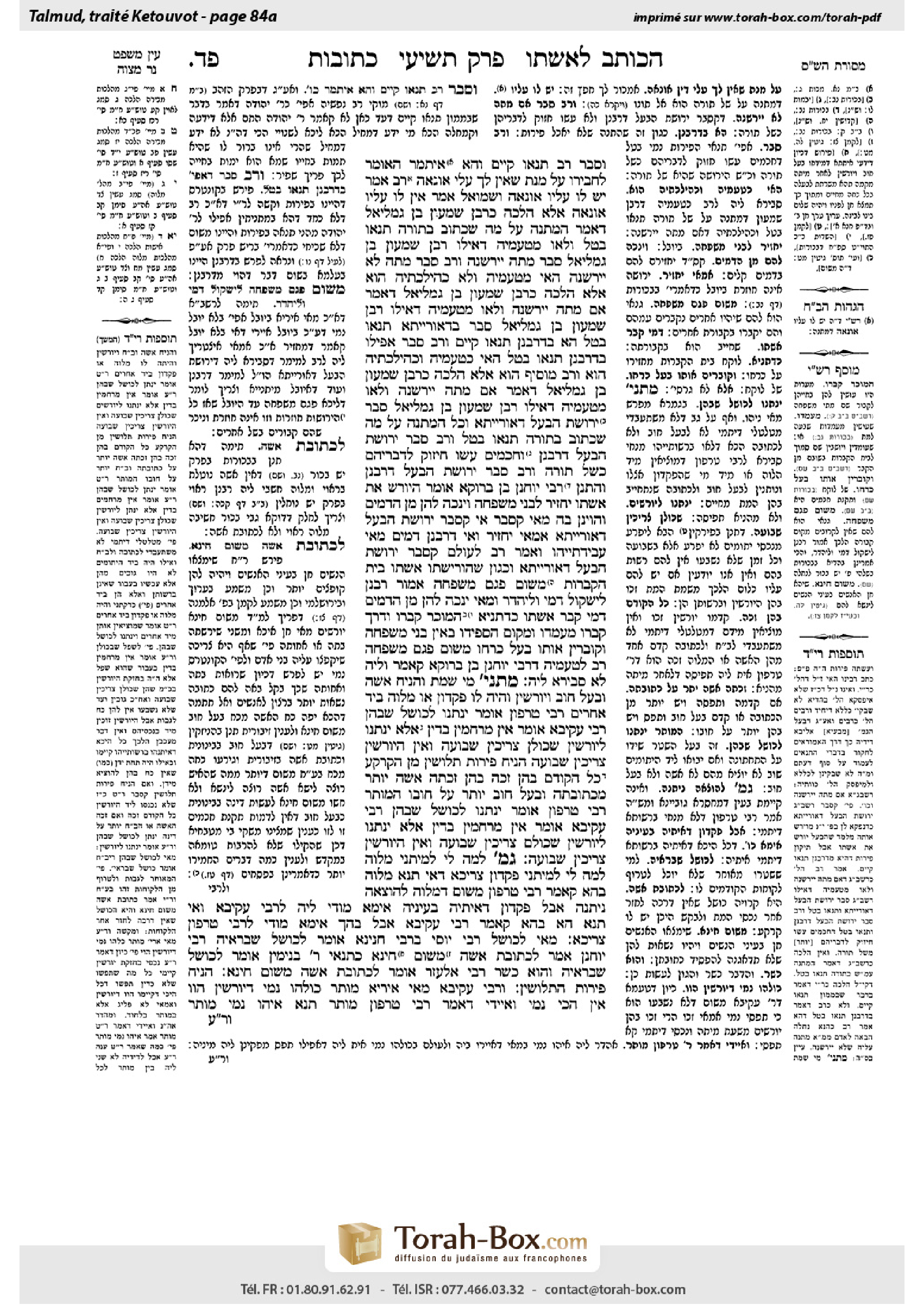
Ketubot 84a: Talmud study for Daf Yomi
Daf Yomi is the daily study of one Talmud folio. Explore 37 tractates with scans, Hebrew text, Sefaria English and AI-generated French translations where annotated.
Passage selection and English or AI-generated French translation are available where the scan has annotations. Daf Study is independent of Torah-Box and Sefaria.
Browse Ketubot · כתובות · All tractatesKetubot 84a text and translations
This page of Ketubot includes the Aramaic text, an English translation and an AI-generated French translation, alongside the scan above.
כתובות פ״ד א · Aramaic and Hebrew text
וְסָבַר רַב תְּנָאוֹ קַיָּים? וְהָא אִיתְּמַר: הָאוֹמֵר לַחֲבֵירוֹ עַל מְנָת שֶׁאֵין לְךָ עָלַי אוֹנָאָה, רַב אָמַר: יֵשׁ לוֹ עָלָיו אוֹנָאָה. וּשְׁמוּאֵל אָמַר: אֵין לוֹ עָלָיו אוֹנָאָה.
אֶלָּא: הֲלָכָה כְּרַבָּן שִׁמְעוֹן בֶּן גַּמְלִיאֵל דְּאָמַר: הַמַּתְנֶה עַל מַה שֶּׁכָּתוּב בַּתּוֹרָה — תְּנָאוֹ בָּטֵל, וְלָאו מִטַּעְמֵיהּ, דְּאִילּוּ רַבָּן שִׁמְעוֹן בֶּן גַּמְלִיאֵל סָבַר: מֵתָה — יִירָשֶׁנָּה, וְרַב סָבַר: מֵתָה — לֹא יִירָשֶׁנָּה.
הַאי מִטַּעְמֵיהּ וְלָא כְּהִילְכְתֵיהּ הוּא!
אֶלָּא: הֲלָכָה כְּרַבָּן שִׁמְעוֹן בֶּן גַּמְלִיאֵל דְּאָמַר אִם מֵתָה יִירָשֶׁנָּה, וְלָאו מִטַּעְמֵיהּ, דְּאִילּוּ רַבָּן שִׁמְעוֹן בֶּן גַּמְלִיאֵל סָבַר בִּדְאוֹרָיְיתָא תְּנָאוֹ בָּטֵל — הָא בִּדְרַבָּנַן תְּנָאוֹ קַיָּים. וְרַב סָבַר אֲפִילּוּ בִּדְרַבָּנַן — תְּנָאוֹ בָּטֵל.
הַאי כְּטַעְמֵיהּ וּכְהִילְכְתֵיהּ הוּא, וְרַב מוֹסִיף הוּא!
אֶלָּא: הֲלָכָה כְּרַבָּן שִׁמְעוֹן בֶּן גַּמְלִיאֵל דְּאָמַר אִם מֵתָה יִירָשֶׁנָּה, וְלָאו מִטַּעְמֵיהּ, דְּאִילּוּ רַבָּן שִׁמְעוֹן בֶּן גַּמְלִיאֵל סָבַר יְרוּשַּׁת הַבַּעַל דְּאוֹרָיְיתָא, וְכׇל הַמַּתְנֶה עַל מַה שֶּׁכָּתוּב בַּתּוֹרָה — תְּנָאוֹ בָּטֵל. וְרַב סָבַר: יְרוּשַּׁת הַבַּעַל דְּרַבָּנַן, וַחֲכָמִים עָשׂוּ חִיזּוּק לְדִבְרֵיהֶם כְּשֶׁל תּוֹרָה.
וְרַב סָבַר יְרוּשַּׁת הַבַּעַל דְּרַבָּנַן? וְהָתְנַן, רַבִּי יוֹחָנָן בֶּן בְּרוֹקָא אוֹמֵר: הַיּוֹרֵשׁ אֶת אִשְׁתּוֹ, יַחְזִיר לִבְנֵי מִשְׁפָּחָה, וִינַכֶּה לָהֶן מִן הַדָּמִים.
וְהָוֵינַן בַּהּ: מַאי קָסָבַר? אִי קָסָבַר יְרוּשַּׁת הַבַּעַל דְּאוֹרָיְיתָא, אַמַּאי יַחְזִיר? וְאִי דְּרַבָּנַן, דָּמִים מַאי עֲבִידְתַּיְיהוּ?
וְאָמַר רַב: לְעוֹלָם קָסָבַר יְרוּשַּׁת הַבַּעַל דְּאוֹרָיְיתָא, וּכְגוֹן שֶׁהוֹרִישַׁתּוּ אִשְׁתּוֹ בֵּית הַקְּבָרוֹת, מִשּׁוּם פְּגַם מִשְׁפָּחָה אֲמוּר רַבָּנַן לִישְׁקוֹל דְּמֵי וְלַיהְדַּר.
וּמַאי ״יְנַכֶּה לָהֶן מִן הַדָּמִים״ — דְּמֵי קֶבֶר אִשְׁתּוֹ. כִּדְתַנְיָא: הַמּוֹכֵר קִבְרוֹ, וְדֶרֶךְ קִבְרוֹ, מַעֲמָדוֹ, וּמְקוֹם הֶסְפֵּידוֹ — בָּאִין בְּנֵי מִשְׁפָּחָה וְקוֹבְרִין אוֹתוֹ בְּעַל כׇּרְחוֹ, מִשּׁוּם פְּגַם מִשְׁפָּחָה!
רַב לְטַעְמֵיהּ דְּרַבִּי יוֹחָנָן בֶּן בְּרוֹקָא קָאָמַר, וְלֵיהּ לָא סְבִירָא לֵיהּ.
מַתְנִי׳ מִי שֶׁמֵּת וְהִנִּיחַ אִשָּׁה וּבַעַל חוֹב וְיוֹרְשִׁין, וְהָיָה לוֹ פִּקָּדוֹן אוֹ מִלְוָה בְּיַד אֲחֵרִים, רַבִּי טַרְפוֹן אוֹמֵר: יִנָּתְנוּ לַכּוֹשֵׁל שֶׁבָּהֶן. רַבִּי עֲקִיבָא אוֹמֵר: אֵין מְרַחֲמִין בַּדִּין, אֶלָּא יִנָּתְנוּ לַיּוֹרְשִׁין. שֶׁכּוּלָּן צְרִיכִין שְׁבוּעָה, וְאֵין הַיּוֹרְשִׁין צְרִיכִין שְׁבוּעָה.
הִנִּיחַ פֵּירוֹת תְּלוּשִׁין מִן הַקַּרְקַע, כׇּל הַקּוֹדֵם בָּהֶן — זָכָה בָּהֶן. זָכְתָה אִשָּׁה יוֹתֵר מִכְּתוּבָּתָהּ, וּבַעַל חוֹב יוֹתֵר עַל חוֹבוֹ, הַמּוֹתָר — רַבִּי טַרְפוֹן אוֹמֵר: יִנָּתְנוּ לַכּוֹשֵׁל שֶׁבָּהֶן. רַבִּי עֲקִיבָא אוֹמֵר: אֵין מְרַחֲמִין בַּדִּין, אֶלָּא יִנָּתְנוּ לַיּוֹרְשִׁין. שֶׁכּוּלָּם צְרִיכִין שְׁבוּעָה, וְאֵין הַיּוֹרְשִׁין צְרִיכִין שְׁבוּעָה.
גְּמָ׳ לְמָה לִי לְמִיתְנֵי מִלְוָה, לָמָּה לִי לְמִיתְנֵי פִּקָּדוֹן? צְרִיכָא, דְּאִי תְּנָא מִלְוָה, בְּהָא קָאָמַר רַבִּי טַרְפוֹן, מִשּׁוּם דְּמִלְוָה לְהוֹצָאָה נִיתְּנָה. אֲבָל פִּקָּדוֹן, דְּאִיתֵיהּ בְּעֵינֵיהּ — אֵימָא מוֹדֵי לֵיהּ לְרַבִּי עֲקִיבָא.
וְאִי תְּנָא הָא, בְּהָא קָאָמַר רַבִּי עֲקִיבָא, אֲבָל בְּהָךְ — אֵימָא מוֹדֵי לְרַבִּי טַרְפוֹן, צְרִיכָא.
מַאי ״לַכּוֹשֵׁל״? רַבִּי יוֹסֵי בְּרַבִּי חֲנִינָא אוֹמֵר: לַכּוֹשֵׁל שֶׁבִּרְאָיָה. רַבִּי יוֹחָנָן אָמַר: לִכְתוּבַּת אִשָּׁה, מִשּׁוּם חִינָּא.
כְּתַנָּאֵי, רַבִּי בִּנְיָמִין אוֹמֵר: לַכּוֹשֵׁל שֶׁבִּרְאָיָה, וְהוּא כָּשֵׁר. רַבִּי אֶלְעָזָר אוֹמֵר: לִכְתוּבַּת אִשָּׁה, מִשּׁוּם חִינָּא.
הִנִּיחַ פֵּירוֹת הַתְּלוּשִׁין. וְרַבִּי עֲקִיבָא, מַאי אִירְיָא מוֹתָר? כּוּלְּהוּ נָמֵי דְּיוֹרְשִׁין הָווּ? אִין הָכִי נָמֵי, וְאַיְּידֵי דְּאָמַר רַבִּי טַרְפוֹן מוֹתָר, תְּנָא אִיהוּ נָמֵי מוֹתָר.
Ketubot 84a · English translation
The Gemara asks: And does Rav actually hold that if one stipulates counter to Torah law, his condition is valid? But it was stated: One who says to another: I am selling this to you on the condition that you have no claim of fraud against me, i.e., though there is a prohibition against fraud by Torah law, the purchaser agrees to forgo his right to register a complaint on this basis. Rav said: He does have the right to a claim of fraud against him, and therefore the seller must reimburse the purchaser, as he cannot abrogate the Torah prohibition “And you shall not wrong one another” (Leviticus 25:17). And Shmuel said: He does not have the right to a claim of fraud against him. It is evident from here that according to Rav, one cannot make a stipulation that contradicts Torah law.
Rather, Rav said: The halakha is in accordance with the opinion of Rabban Shimon ben Gamliel, who said: One who stipulates counter to that which is written in the Torah, his condition is void, but not because of his line of reasoning. As Rabban Shimon ben Gamliel holds that if the wife died, he inherits from her, and Rav holds that if she died he does not inherit from her.
The Gemara asks: If this is what Rav meant, he should have said the opposite of what he said. This statement would be because of his line of reasoning but not in accordance with his halakha, whereas Rav said that the halakha is in accordance with the opinion of Rabban Shimon ben Gamliel but not because of his line of reasoning.
Rather, Rav said: The halakha is in accordance with the opinion of Rabban Shimon ben Gamliel, who said that if she died he inherits from her, but not because of his line of reasoning. As Rabban Shimon ben Gamliel holds that in a case where one stipulated counter to Torah law his condition is void, indicating that in a case where his stipulation was counter to rabbinic law his condition is valid; and Rav holds that even in a case where one stipulated counter to rabbinic law, his condition is void.
The Gemara asks: This statement would be in accordance with his line of reasoning and in accordance with his halakha, and Rav is merely adding a detail to the halakha of Rabban Shimon ben Gamliel.
Rather, Rav said: The halakha is in accordance with the opinion of Rabban Shimon ben Gamliel, who said that if she died he inherits from her, but not because of his line of reasoning. As Rabban Shimon ben Gamliel holds that the inheritance of a husband is by Torah law, and whoever stipulates counter to that which is written in the Torah, his condition is void; and Rav holds that the inheritance of a husband is by rabbinic law, but his stipulation is nevertheless void, as the Sages reinforced their pronouncements with the severity of Torah law and ruled that their laws cannot be abrogated.
The Gemara asks: And does Rav hold that the inheritance of a husband is by rabbinic law? But didn’t we learn in a mishna (Bekhorot 52b) that Rabbi Yoḥanan ben Beroka says: One who inherits from his wife must return the property to her family members in the Jubilee Year and deduct for them part of the monetary value of the property? He can claim only part, but not all, of the property’s value from the wife’s relatives.
And we discussed this halakha: What does Rabbi Yoḥanan ben Beroka hold? If he holds that the inheritance of a husband is by Torah law, why must he return the property to his wife’s relatives? An inheritance is not given back in the Jubilee Year. And if he holds that the inheritance is by rabbinic law, what is the purpose of the money that he receives from his wife’s relatives in exchange for the land? By Torah law, the property belongs to the woman’s family and they should not have to pay him anything.
And Rav said: Actually, he holds that the inheritance of a husband is by Torah law, and he is discussing a case where his wife bequeathed to him her family’s graveyard. Due to the need to avoid a family flaw, i.e., harm to the family name if the wife’s family would have to be buried in plots belonging to others, the Sages said that he should take compensation from them and return the graveyard to them.
The Gemara continues: And what is the meaning of: And deduct for them part of the monetary value of the property? This is referring to the monetary value of his wife’s grave. A husband is obligated to pay for his wife’s burial, and therefore he must deduct the value of her burial plot from the value of the field. As it is taught in a baraita that there are halakhot connected with burial to uphold family honor: In the case of one who sells his grave, or the path to his grave, or the place where visitors would stand to comfort the mourners, or the place of his eulogies, the members of his family may come and bury him in his ancestral plot against the purchaser’s wishes due to the need to avoid a family flaw, i.e., harm to the family name if a member of their family had to be buried in a graveyard of strangers. In any case, it is evident from here that Rav believes that the inheritance of a husband is by Torah law, in contrast to what the Gemara had said earlier.
The Gemara answers: This is not proof that Rav himself is of the opinion that the inheritance of a husband is by Torah law, as Rav spoke in accordance with the reasoning of Rabbi Yoḥanan ben Beroka. In other words, he was explaining the reason for the ruling of the tanna, but he himself does not hold accordingly.
MISHNA: With regard to one who died and left behind a wife, and a creditor to whom he owed money, and heirs, all of whom claim payment from his property, and he had a deposit or a loan in the possession of others, Rabbi Tarfon says: The deposit or the loan will be given to the weakest one of them, i.e., the one most in need of the money. Rabbi Akiva says: One is not merciful in judgment. If the halakha is that it belongs to one party, one follows the halakha and leaves aside considerations of mercy. Rather, the halakha is that the money will be given to the heirs, as all people who wish to exact payment from orphans require an oath before they collect their debt, but the heirs do not require an oath. They therefore have a more absolute right than the others to their father’s property.
If the deceased left behind produce that was detached from the ground, whoever first took possession of them as compensation for what was owed, whether the creditor, the wife, or the heirs, acquired the produce. If the wife acquired this produce and it was worth more than the payment of her marriage contract, or the creditor acquired this produce and it was worth more than the value of his debt, what should be done with the surplus? Rabbi Tarfon says: It will be given to the weakest one of them, either the creditor or the wife, depending on the circumstances. Rabbi Akiva says: One is not merciful in judgment. Rather, it will be given to the heirs, as all people who wish to exact payment from orphans require an oath before they collect their debt, but the heirs do not require an oath.
GEMARA: The Gemara asks about the wording of the mishna: Why do I need the tanna to teach this halakha in the case of a loan, and why do I need him to teach it in the case of a deposit? Either example alone would have sufficed. The Gemara explains: It is necessary to teach the halakha in both cases, for if he had taught the halakha only in the case of a loan, one could have said: In that case Rabbi Tarfon says what he says due to the fact that a loan is given to be spent. Since there is no already existing property here, but only an obligation to pay back the loan, it can be given to the weakest party. However, in the case of a deposit, which exists in its pure, unadulterated form and not just as an obligation, one might say that he concedes to Rabbi Akiva that it belongs to the heirs.
And conversely, if the tanna had taught that halakha only in the case of a deposit, one could have said that in that case Rabbi Akiva says his ruling that the deposit belongs to the heirs. However, in this case of a loan, one could say that he concedes to Rabbi Tarfon that the loan is given to the weakest party. It is therefore necessary for the halakha to be taught in both cases.
The mishna taught that according to Rabbi Tarfon, the money should be given to the weakest party. The Gemara asks: What is the meaning of: To the weakest? Rabbi Yosei, son of Rabbi Ḥanina, says: It means that the money is given to the one whose proof is the weakest, i.e., the one with the latest date on the document attesting to the debt. His document is the weakest, as one can collect from property that was sold by the deceased only if it was sold subsequent to his incurring the debt. Therefore, the others can collect from property that has been sold before the date listed on his document. Rabbi Yoḥanan says: It is referring to the wife’s marriage contract. The Sages instituted halakhot in marriage contracts that were to the advantage of women and to make them feel more secure in their marriages, due to the fact that they wanted men to find favor in the eyes of women.
The Gemara comments: This discussion is like a dispute between tanna’im: Rabbi Binyamin says: The money is given to the one whose proof is the weakest, and this is the proper way to act. Rabbi Elazar says: It is referring to the wife’s marriage contract, due to the fact that they wanted men to find favor with women.
§ The mishna taught that if the husband left behind produce that was detached, the claimant who first seizes it acquires it, and there is a dispute as to what should be done with the surplus. The Gemara asks: And according to Rabbi Akiva, why discuss specifically this case of the surplus? All of the produce, not only the surplus, also belongs to the heirs, as he holds that the entire property goes to the heirs, even if the others took possession of it first. The Gemara answers: Yes, it is indeed so. Certainly Rabbi Akiva does not distinguish between a deposit and detached produce, but since Rabbi Tarfon spoke of a surplus, he also taught his halakha with regard to a surplus. However, according to Rabbi Akiva, the halakha is the same with regard to detached produce.
Ketubot 84a · Traduction française (IA)
La Guemara demande : Rav tient-il réellement que, si quelqu’un stipule une condition contraire à la Torah, celle-ci est valable ? Pourtant, il a été enseigné : Celui qui dit à un autre : « Je te vends ceci à condition que tu ne puisses pas invoquer la fraude à mon encontre », c’est-à-dire que, bien que la Torah interdise la fraude, l’acheteur accepte de renoncer à son droit de porter plainte à ce titre. Rav a dit : Il peut invoquer la fraude à son encontre, et le vendeur doit donc rembourser l’acheteur, car il ne peut écarter l’interdiction de la Torah : « Vous ne vous léseriez pas l’un l’autre » (Lévitique 25, 17). Et Shmuel a dit : Il ne peut pas invoquer la fraude à son encontre. Il ressort de là que, selon Rav, on ne peut pas stipuler une condition contraire à la Torah.
Rav a plutôt dit : La halakha est conforme à l’opinion de Rabban Shimon ben Gamliel, qui a dit : Celui qui stipule une condition contraire à ce qui est écrit dans la Torah voit sa condition annulée, mais pas pour la raison qu’il avance. En effet, Rabban Shimon ben Gamliel tient que, si l’épouse meurt, le mari hérite d’elle, tandis que Rav tient que, si elle meurt, il n’hérite pas d’elle.
La Guemara demande : Si telle était l’intention de Rav, il aurait dû dire le contraire de ce qu’il a dit. Il aurait alors dit que la halakha est conforme à son raisonnement, mais non à sa halakha, alors que Rav a dit que la halakha est conforme à l’opinion de Rabban Shimon ben Gamliel, mais non à son raisonnement.
Rav a plutôt dit : La halakha est conforme à l’opinion de Rabban Shimon ben Gamliel, qui a dit que, si elle meurt, le mari hérite d’elle, mais pas pour la raison qu’il avance. En effet, Rabban Shimon ben Gamliel tient que, lorsqu’une personne stipule une condition contraire à la Torah, celle-ci est nulle, ce qui indique que, lorsqu’une stipulation est contraire à la loi rabbinique, elle est valable ; tandis que Rav tient que, même lorsqu’une personne stipule une condition contraire à la loi rabbinique, celle-ci est nulle.
La Guemara demande : Cette déclaration serait conforme à son raisonnement et à sa halakha, et Rav ne ferait qu’ajouter une précision à la halakha de Rabban Shimon ben Gamliel.
Rav a plutôt dit : La halakha est conforme à l’opinion de Rabban Shimon ben Gamliel, qui a dit que, si elle meurt, le mari hérite d’elle, mais pas pour la raison qu’il avance. En effet, Rabban Shimon ben Gamliel tient que l’héritage du mari relève de la Torah et que toute personne qui stipule une condition contraire à ce qui est écrit dans la Torah voit sa condition annulée ; tandis que Rav tient que l’héritage du mari relève de la loi rabbinique, mais que sa stipulation est néanmoins nulle, car les Sages ont renforcé leurs décrets en leur conférant la rigueur de la loi de la Torah et ont statué que leurs lois ne peuvent pas être écartées.
La Guemara demande : Rav tient-il que l’héritage du mari relève de la loi rabbinique ? Pourtant, n’avons-nous pas appris dans une Michna (Bekhorot 52b) que Rabbi Yoḥanan ben Beroka dit : Celui qui hérite de son épouse doit restituer les biens à ses proches lors de l’année du Jubilé et leur déduire une partie de la valeur monétaire des biens ? Il ne peut réclamer aux proches de son épouse qu’une partie de la valeur des biens, et non leur valeur entière.
Et nous avons discuté cette halakha : Quelle est l’opinion de Rabbi Yoḥanan ben Beroka ? S’il tient que l’héritage du mari relève de la Torah, pourquoi doit-il restituer les biens aux proches de son épouse ? Un héritage n’est pas restitué lors de l’année du Jubilé. Et s’il tient que l’héritage relève de la loi rabbinique, à quoi sert l’argent qu’il reçoit des proches de son épouse en échange du terrain ? Selon la Torah, les biens appartiennent à la famille de la femme et celle-ci ne devrait rien avoir à lui payer.
Et Rav a dit : En réalité, Rabbi Yoḥanan ben Beroka tient que l’héritage du mari relève de la Torah, et il parle d’un cas où l’épouse lui a légué le cimetière de sa famille. Afin d’éviter une atteinte à l’honneur de la famille, c’est-à-dire de préserver son nom si la famille de l’épouse devait être enterrée dans des tombes appartenant à d’autres, les Sages ont dit que le mari devait recevoir une compensation de leur part et leur restituer le cimetière.
La Guemara poursuit : Que signifie : « Et leur déduire une partie de la valeur monétaire des biens » ? Cela désigne la valeur monétaire de la tombe de son épouse. Un mari est tenu de payer l’enterrement de son épouse ; il doit donc déduire la valeur de sa tombe de celle du champ. En effet, il est enseigné dans une baraïta qu’il existe des halakhot relatives à l’enterrement destinées à préserver l’honneur de la famille : dans le cas de celui qui vend sa tombe, le chemin menant à sa tombe, l’emplacement où les visiteurs se tiennent pour réconforter les endeuillés ou encore l’emplacement de ses éloges funèbres, les membres de sa famille peuvent venir l’enterrer dans le caveau ancestral contre le gré de l’acheteur, afin d’éviter une atteinte à l’honneur de la famille, c’est-à-dire que son nom soit terni si l’un de ses membres devait être enterré dans le cimetière d’étrangers. Quoi qu’il en soit, il ressort de là que Rav estime que l’héritage du mari relève de la Torah, contrairement à ce que la Guemara avait dit précédemment.
La Guemara répond : Cela ne prouve pas que Rav lui-même estime que l’héritage du mari relève de la Torah, car Rav parlait selon le raisonnement de Rabbi Yoḥanan ben Beroka. Autrement dit, il expliquait la raison de la décision du tanna, mais il ne partage pas lui-même cette opinion.
MICHNA : À propos de celui qui est mort en laissant une épouse, un créancier auquel il devait de l’argent et des héritiers, qui réclament tous un paiement sur ses biens, et qui avait un dépôt ou un prêt entre les mains d’autres personnes, Rabbi Tarfon dit : Le dépôt ou le prêt sera remis au plus faible d’entre eux, c’est-à-dire à celui qui a le plus besoin de cet argent. Rabbi Akiva dit : On ne fait pas preuve de compassion dans le jugement. Si, selon la halakha, le bien revient à une partie, on suit la halakha et l’on écarte les considérations de compassion. La halakha est plutôt que l’argent sera remis aux héritiers, car toute personne qui veut recouvrer une créance sur des orphelins doit prêter serment avant d’être payée, tandis que les héritiers n’ont pas à prêter serment. Ils ont donc un droit plus incontestable que les autres sur les biens de leur père.
Si le défunt a laissé des produits détachés du sol, celui qui s’en est emparé le premier en compensation de ce qui lui était dû — qu’il s’agisse du créancier, de l’épouse ou des héritiers — en a acquis la propriété. Si l’épouse a acquis ces produits et qu’ils valent plus que le montant de sa ketouba, ou si le créancier les a acquis et qu’ils valent plus que le montant de sa créance, que faut-il faire du surplus ? Rabbi Tarfon dit : Il sera remis au plus faible d’entre eux, soit au créancier, soit à l’épouse, selon les circonstances. Rabbi Akiva dit : On ne fait pas preuve de compassion dans le jugement. Il sera plutôt remis aux héritiers, car toute personne qui veut recouvrer une créance sur des orphelins doit prêter serment avant d’être payée, tandis que les héritiers n’ont pas à prêter serment.
GUEMARA : La Guemara s’interroge sur la formulation de la Michna : Pourquoi le tanna devait-il enseigner cette halakha dans le cas d’un prêt, et pourquoi devait-il l’enseigner dans le cas d’un dépôt ? Un seul exemple aurait suffi. La Guemara explique : Il était nécessaire de l’enseigner dans les deux cas, car si la halakha avait été enseignée uniquement dans le cas d’un prêt, on aurait pu dire que Rabbi Tarfon se prononce ainsi parce qu’un prêt est destiné à être dépensé. Puisqu’il n’y a ici aucun bien déjà existant, mais seulement une obligation de rembourser le prêt, celui-ci peut être remis à la partie la plus faible. Cependant, dans le cas d’un dépôt, qui existe dans son état intact et non sous la forme d’une simple obligation, on aurait pu dire qu’il admet, comme Rabbi Akiva, qu’il revient aux héritiers.
À l’inverse, si le tanna n’avait enseigné cette halakha que dans le cas d’un dépôt, on aurait pu dire que Rabbi Akiva ne se prononce ainsi, en attribuant le dépôt aux héritiers, que dans ce cas. Mais, dans le cas d’un prêt, on aurait pu dire qu’il admet, comme Rabbi Tarfon, que le prêt revient à la partie la plus faible. Il était donc nécessaire d’enseigner la halakha dans les deux cas.
La Michna a enseigné que, selon Rabbi Tarfon, l’argent doit être remis à la partie la plus faible. La Guemara demande : Que signifie « au plus faible » ? Rabbi Yosei, fils de Rabbi Ḥanina, dit : Cela signifie que l’argent est remis à celui dont la preuve est la plus faible, c’est-à-dire à celui dont le document attestant la dette porte la date la plus récente. Son document est le moins solide, car on ne peut recouvrer une créance sur des biens vendus par le défunt que si la vente a eu lieu après la naissance de sa dette. Les autres peuvent donc recouvrer leur créance sur des biens vendus avant la date inscrite sur son document. Rabbi Yoḥanan dit : Cela désigne la ketouba de l’épouse. Les Sages ont institué des dispositions relatives aux ketoubot qui favorisaient les femmes et devaient les rassurer dans leur mariage, parce qu’ils voulaient que les hommes trouvent grâce aux yeux des femmes.
La Guemara fait remarquer : Cette discussion correspond à une controverse entre tannaïm : Rabbi Binyamin dit : L’argent est remis à celui dont la preuve est la plus faible, et c’est la manière correcte d’agir. Rabbi Elazar dit : Cela désigne la ketouba de l’épouse, parce qu’ils voulaient que les hommes trouvent grâce aux yeux des femmes.
§ La Michna a enseigné que, si le mari a laissé des produits détachés du sol, le demandeur qui s’en empare le premier en acquiert la propriété, et qu’il existe une controverse sur ce qu’il faut faire du surplus. La Guemara demande : Selon Rabbi Akiva, pourquoi parler précisément du surplus ? Tous les produits, et pas seulement le surplus, reviennent aux héritiers, puisqu’il tient que l’ensemble des biens revient aux héritiers, même si les autres s’en sont emparés les premiers. La Guemara répond : Oui, c’est bien le cas. Rabbi Akiva ne distingue effectivement pas un dépôt des produits détachés du sol ; toutefois, puisque Rabbi Tarfon a parlé d’un surplus, il a lui aussi enseigné sa halakha à propos d’un surplus. Selon Rabbi Akiva, cependant, la même halakha s’applique aux produits détachés du sol.
Traduction française générée par IA à partir de l’édition anglaise de Sefaria. Vérifie toujours un passage avec le texte source.
Text from Sefaria: William Davidson Edition - Vocalized Aramaic (CC BY NC); William Davidson Edition - English (CC BY NC).