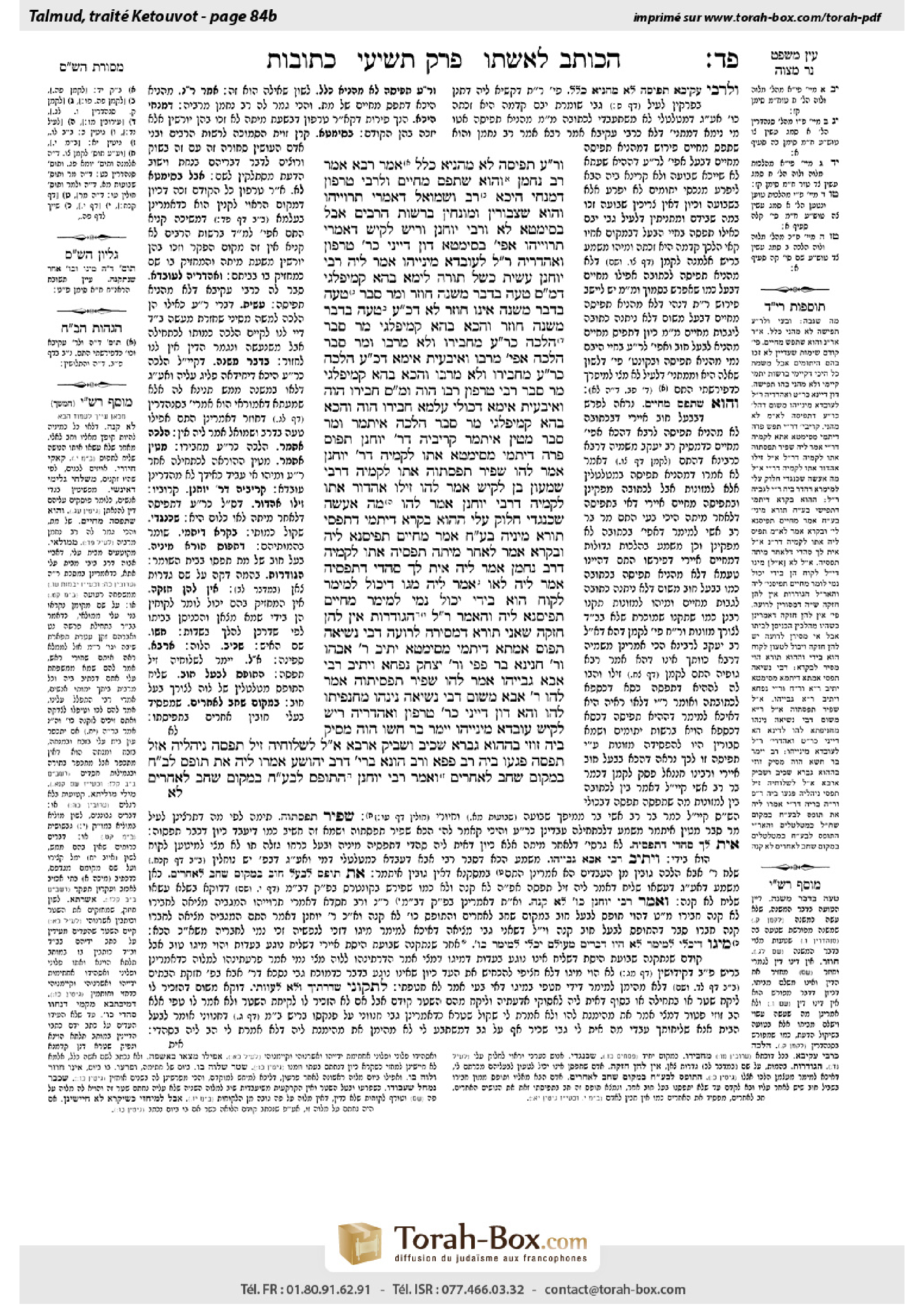
Ketubot 84b: Talmud study for Daf Yomi
Daf Yomi is the daily study of one Talmud folio. Explore 37 tractates with scans, Hebrew text, Sefaria English and AI-generated French translations where annotated.
Passage selection and English or AI-generated French translation are available where the scan has annotations. Daf Study is independent of Torah-Box and Sefaria.
Browse Ketubot · כתובות · All tractatesKetubot 84b text and translations
This page of Ketubot includes the Aramaic text, an English translation and an AI-generated French translation, alongside the scan above.
כתובות פ״ד ב · Aramaic and Hebrew text
וְרַבִּי עֲקִיבָא, תְּפִיסָה לָא מַהְנְיָא כְּלָל? אָמַר רָבָא אָמַר רַב נַחְמָן: וְהוּא שֶׁתָּפַס מֵחַיִּים.
וּלְרַבִּי טַרְפוֹן, דְּמַנְּחִי הֵיכָא? רַב וּשְׁמוּאֵל דְּאָמְרִי תַּרְוַיְיהוּ: וְהוּא שֶׁצְּבוּרִין וּמוּנָּחִין בִּרְשׁוּת הָרַבִּים, אֲבָל בְּסִימְטָא — לֹא. וְרַבִּי יוֹחָנָן וְרֵישׁ לָקִישׁ דְּאָמְרִי תַּרְוַיְיהוּ: אֲפִילּוּ בְּסִימְטָא.
דּוּן דַּיָּינֵי כְּרַבִּי טַרְפוֹן, וְאַהְדְּרֵיהּ רֵישׁ לָקִישׁ לְעוֹבָדָא מִינַּיְיהוּ. אֲמַר לֵיהּ רַבִּי יוֹחָנָן: עָשִׂיתָ כְּשֶׁל תּוֹרָה.
לֵימָא בְּהָא קָמִיפַּלְגִי: דְּמָר סָבַר טָעָה בִּדְבַר מִשְׁנָה חוֹזֵר, וּמָר סָבַר טָעָה בִּדְבַר מִשְׁנָה אֵינוֹ חוֹזֵר?
לָא, דְּכוּלֵּי עָלְמָא טָעָה בִּדְבַר מִשְׁנָה חוֹזֵר. וְהָכָא בְּהָא קָמִיפַּלְגִי: מָר סָבַר הֲלָכָה כְּרַבִּי עֲקִיבָא מֵחֲבֵירוֹ וְלֹא מֵרַבּוֹ, וּמָר סָבַר הֲלָכָה אֲפִילּוּ מֵרַבּוֹ.
וְאִיבָּעֵית אֵימָא: דְּכוּלֵּי עָלְמָא הֲלָכָה כְּרַבִּי עֲקִיבָא מֵחֲבֵירוֹ וְלֹא מֵרַבּוֹ. וְהָכָא בְּהָא קָמִיפַּלְגִי: מָר סָבַר רַבִּי טַרְפוֹן רַבּוֹ הֲוָה, וּמָר סָבַר חֲבֵירוֹ הֲוָה.
וְאִיבָּעֵית אֵימָא: דְּכוּלֵּי עָלְמָא חֲבֵירוֹ הֲוָה, וְהָכָא בְּהָא קָמִיפַּלְגִי: מָר סָבַר הֲלָכָה אִיתְּמַר, וּמָר סָבַר מַטִּין אִיתְּמַר.
קָרִיבֵיהּ דְּרַבִּי יוֹחָנָן תְּפוּס פָּרָה דְיַתְמֵי מִסִּימְטָא. אֲתוֹ לְקַמֵּיהּ דְּרַבִּי יוֹחָנָן, אֲמַר לְהוּ: שַׁפִּיר תְּפַסְתּוּהָ. אֲתוֹ לְקַמֵּיהּ דְּרַבִּי שִׁמְעוֹן בֶּן לָקִישׁ, אָמַר לְהוּ: זִילוּ אַהְדּוּר. אֲתוֹ לְקַמֵּיהּ דְּרַבִּי יוֹחָנָן. אֲמַר לְהוּ: מָה אֶעֱשֶׂה? שֶׁכְּנֶגְדִּי חָלוּק עָלַי.
הָהוּא בַּקָּרָא דְיַתְמֵי דְּתָפְסִי תּוֹרָא מִינֵּיהּ. בַּעַל חוֹב אָמַר: מֵחַיִּים תְּפֵיסְנָא לֵיהּ. וּבַקָּרָא אָמַר: לְאַחַר מִיתָה תַּפְסֵיהּ. אֲתוֹ לְקַמֵּיהּ דְּרַב נַחְמָן. אֲמַר לֵיהּ: אִית לְךָ סָהֲדֵי דְּתַפְסֵיהּ? אֲמַר לֵיהּ: לָאו. אֲמַר לֵיהּ: מִגּוֹ דְּיָכוֹל לְמֵימַר ״לָקוּחַ הוּא בְּיָדִי״, יָכוֹל נָמֵי לְמֵימַר ״מֵחַיִּים תְּפֵיסְנָא לֵיהּ״.
וְהָאָמַר רֵישׁ לָקִישׁ: הַגּוֹדְרוֹת אֵין לָהֶן חֲזָקָה! שָׁאנֵי תּוֹרָא דִּמְסִירָה לְרוֹעֶה.
דְּבֵי נְשִׂיאָה תְּפוּס אַמְתָא דְיַתְמֵי מִסִּימְטָא. יְתֵיב רַבִּי אֲבָהוּ וְרַבִּי חֲנִינָא בַּר פַּפִּי וְרַבִּי יִצְחָק נַפָּחָא, וִיתֵיב רַבִּי אַבָּא גַּבַּיְיהוּ. אֲמַר לְהוּ: שַׁפִּיר תָּפְסִיתוּהָ. אֲמַר לְהוּ רַבִּי אַבָּא: מִשּׁוּם דְּבֵי נְשִׂיאָה נִינְהוּ מְחַנְּפִיתוּ לְהוּ? וְהָא דּוּן דַּיָּינֵי כְּרַבִּי טַרְפוֹן, וְאַהְדְּרֵיהּ רֵישׁ לָקִישׁ עוֹבָדָא מִינַּיְיהוּ.
יֵימַר בַּר חָשׁוּ הֲוָה מַסֵּיק בֵּיהּ זוּזֵי בְּהָהוּא גַּבְרָא, שְׁכֵיב וּשְׁבַק אַרְבָּא. אֲמַר לֵיהּ לִשְׁלוּחֵיהּ: זִיל, תְּפַסָה נִיהֲלִי. אֲזַל תַּפְסַהּ. פְּגַעוּ בֵּיהּ רַב פָּפָּא וְרַב הוּנָא בְּרֵיהּ דְּרַב יְהוֹשֻׁעַ, אֲמַרוּ לֵיהּ: אַתְּ תּוֹפֵס לְבַעַל חוֹב בְּמָקוֹם שֶׁחָב לַאֲחֵרִים. וְאָמַר רַבִּי יוֹחָנָן: הַתּוֹפֵס לְבַעַל חוֹב בְּמָקוֹם שֶׁחָב לַאֲחֵרִים
Ketubot 84b · English translation
The Gemara asks: And according to Rabbi Akiva, is the seizure of a debtor’s assets by a creditor, though there are others who have a more immediate right to the assets, not effective at all? Rava said that Rav Naḥman said: And this, that Rabbi Akiva agrees that the seizure of assets is effective, is the case provided that one seized the property from the debtor while he was alive. However, after his death the assets belong to the heirs.
The Gemara asks: And according to Rabbi Tarfon, who holds that whoever first takes possession of the produce has acquired it, where was this produce placed? The Gemara presents a dispute: There is the opinion of Rav and Shmuel, who both say: And this, that whoever first takes possession of the produce has acquired it, is the halakha provided that the produce is arranged in a pile and placed in the public domain. Since the public domain is not a suitable location for an act of acquisition, anyone can take the produce and acquire it. However, if it is situated in an alley [simta], a place adjacent to the public domain that is rarely frequented by the public, the produce does not belong to the first one who obtains it. Because an acquisition can be performed in an alley, any items that had belonged to the deceased are immediately acquired by the heirs. And there is the opinion of Rabbi Yoḥanan and Reish Lakish, who both say: Even if one seizes produce left in an alley, he acquires it.
The Gemara relates: There were judges who judged a case of this kind in accordance with the opinion of Rabbi Tarfon, and Reish Lakish reversed their action. He dismissed the judges’ decision and restored the money to the heirs, in accordance with the opinion of Rabbi Akiva. Rabbi Yoḥanan criticized his ruling and said to him: You acted in this case like one acts with regard to a ruling of Torah law, where any incorrect action taken by the court must be corrected.
The Gemara suggests: Let us say that they disagree about this: That one Sage, Reish Lakish, holds that if one erred in a matter that appears in the Mishna, the decision is revoked. And one Sage, Rabbi Yoḥanan, holds that if one erred in a matter that appears in the Mishna, the decision is not revoked.
The Gemara refutes this suggestion: No, it can be explained that according to everyone, where the judge erred in a matter that appears in the Mishna, the decision is revoked, and here they disagree about this: One Sage, Rabbi Yoḥanan, holds that the halakha is in accordance with the opinion of Rabbi Akiva in his disputes with his colleague, but not in his disputes with his teacher, and Rabbi Tarfon was Rabbi Akiva’s teacher. And one Sage, Reish Lakish, holds that the halakha is in accordance with the opinion of Rabbi Akiva even in his disputes with his teacher.
And if you wish, say instead that everyone agrees that the halakha is in accordance with the opinion of Rabbi Akiva in his disputes with his colleague but not in his disputes with his teacher. And here they disagree about this: One Sage, Rabbi Yoḥanan, holds that Rabbi Tarfon was Rabbi Akiva’s teacher, and one Sage, Reish Lakish, holds that Rabbi Tarfon was his colleague.
And if you wish, say instead that everyone agrees that Rabbi Tarfon was Rabbi Akiva’s colleague, and here they disagree about this: One Sage, Reish Lakish, holds that the principle that the law is in accordance with the opinion of Rabbi Akiva was stated as the halakha. And one Sage, Rabbi Yoḥanan, holds that what was stated was that one is inclined to follow the opinion of Rabbi Akiva. Therefore, although Rabbi Akiva’s opinion is followed ab initio, the halakha was never established conclusively in accordance with it. As such, if judges went against the principle that the halakha follows Rabbi Akiva in opposition to his colleague, the Sages do not revoke their decision.
The Gemara relates: The relatives of Rabbi Yoḥanan seized a cow of orphans from an alley because the orphans’ father owed them money. They came before Rabbi Yoḥanan for judgment, and he said to them: It is well that you seized the cow and it is yours, in accordance with the ruling of Rabbi Tarfon. They subsequently came before Rabbi Shimon ben Lakish, who said to them: Go and return the cow to the orphans. They again came before Rabbi Yoḥanan, complaining that Reish Lakish had told them they must give back the cow, in opposition to Rabbi Yoḥanan’s ruling. He said to them: What can I do, as one whose stature corresponds to my stature disagrees with me, and I cannot dismiss his opinion.
The Gemara relates another incident: There was a certain herdsman caring for the cattle of orphans from whom a creditor seized an ox as payment for a debt of the orphans’ father. The creditor said: I seized it from the herdsman while the debtor was still alive. In such a case, the action is effective even according to Rabbi Akiva, as stated earlier. And the herdsman said: He seized it after the debtor’s death. They came before Rav Naḥman for a ruling. Rav Naḥman said to the herdsman: Do you have witnesses that he seized the ox from you? He said to him: No. Rav Naḥman said to him: In that case, since the claimant can say: It is in my possession because it was purchased by me, as there is no proof that he gained possession of the ox unlawfully, he can also say: I seized it from the herdsman while the deceased was still alive.
The Gemara asks: But didn’t Reish Lakish say that moving livestock, e.g., sheep and oxen, provide no presumption of ownership to whoever is in possession of them? Since they wander from place to place, a person cannot claim that his mere possession of livestock demonstrates ownership, because it may have wandered into his property on its own. The Gemara answers: An ox is different from other livestock, as it is handed over to a shepherd, who does not let it wander off. Consequently, possession of an ox does establish a presumption of ownership.
The Gemara relates another incident: The members of the house of the prince of Eretz Yisrael seized hold of a maidservant of orphans in an alley, as payment for a debt owed to them by the orphans’ father. Rabbi Abbahu and Rabbi Ḥanina bar Pappi and Rabbi Yitzḥak Nappaḥa were sitting as judges, and Rabbi Abba was sitting with them. Rabbi Abbahu said to them: It is well that you seized the maidservant. Rabbi Abba said to the judges: Just because they are members of the house of the prince, will you curry favor with them by rendering an incorrect verdict? Isn’t it the halakha that there were judges who judged a case of this kind in accordance with the opinion of Rabbi Tarfon, and Reish Lakish reversed their action, indicating that the halakha is not in accordance with the opinion of Rabbi Tarfon?
The Gemara relates another incident: A man called Yeimar bar Ḥashu was owed money by a certain man who died and left behind a boat. Yeimar bar Ḥashu said to his agent: Go and seize the boat for me. The agent went and seized it. Rav Pappa and Rav Huna, son of Rav Yehoshua, encountered him. They said to him: You are seizing assets for a creditor in a situation where your action will cause a disadvantage for others, as the debtor owed money to other people as well. And Rabbi Yoḥanan said that one who seizes assets for a creditor in a situation that will result in a disadvantage for others
Ketubot 84b · Traduction française (IA)
La Guemara demande : Selon Rabbi Akiva, la saisie des biens d’un débiteur par un créancier, alors même que d’autres ont un droit plus immédiat sur ces biens, est-elle donc totalement inefficace ? Rava dit au nom de Rav Naḥman : Rabbi Akiva reconnaît que la saisie des biens est efficace à condition que le créancier ait saisi les biens du débiteur de son vivant. Après sa mort, en revanche, les biens appartiennent aux héritiers.
La Guemara demande : Selon Rabbi Tarfon, qui soutient que celui qui prend le premier possession des produits les acquiert, où ces produits avaient-ils été déposés ? La Guemara présente une controverse. Rav et Shmuel disent tous deux : celui qui prend le premier possession des produits les acquiert à condition que ceux-ci soient disposés en tas et placés dans le domaine public. Puisque le domaine public ne convient pas à un acte d’acquisition, quiconque peut prendre les produits et les acquérir. En revanche, s’ils se trouvent dans une ruelle [simta], un endroit adjacent au domaine public et rarement fréquenté, les produits n’appartiennent pas au premier qui s’en empare. Comme une acquisition peut être effectuée dans une ruelle, tous les biens qui appartenaient au défunt sont immédiatement acquis par les héritiers. Rabbi Yoḥanan et Reish Lakish disent tous deux que même celui qui saisit des produits laissés dans une ruelle les acquiert.
La Guemara rapporte : Des juges tranchèrent une affaire de ce genre conformément à l’opinion de Rabbi Tarfon, et Reish Lakish annula leur décision. Il infirma le jugement des juges et restitua l’argent aux héritiers, conformément à l’opinion de Rabbi Akiva. Rabbi Yoḥanan critiqua sa décision et lui dit : Dans cette affaire, tu as agi comme on le fait à propos d’une décision relevant de la Torah, où toute action erronée du tribunal doit être corrigée.
La Guemara propose : Disons qu’ils sont en désaccord sur ce point : un Sage, Reish Lakish, soutient que si l’on s’est trompé sur une question figurant dans la Michna, la décision est annulée ; l’autre Sage, Rabbi Yoḥanan, soutient que si l’on s’est trompé sur une question figurant dans la Michna, la décision n’est pas annulée.
La Guemara réfute cette proposition : Non, on peut expliquer que tous conviennent que lorsque le juge s’est trompé sur une question figurant dans la Michna, la décision est annulée. Ici, ils sont en désaccord sur ce point : un Sage, Rabbi Yoḥanan, soutient que la halakha suit l’opinion de Rabbi Akiva dans ses controverses avec un collègue, mais non dans ses controverses avec son maître, et Rabbi Tarfon était le maître de Rabbi Akiva. L’autre Sage, Reish Lakish, soutient que la halakha suit l’opinion de Rabbi Akiva même dans ses controverses avec son maître.
Et si tu le souhaites, dis plutôt que tous conviennent que la halakha suit l’opinion de Rabbi Akiva dans ses controverses avec un collègue, mais non dans ses controverses avec son maître. Ici, ils sont en désaccord sur ce point : un Sage, Rabbi Yoḥanan, soutient que Rabbi Tarfon était le maître de Rabbi Akiva, tandis que l’autre Sage, Reish Lakish, soutient que Rabbi Tarfon était son collègue.
Et si tu le souhaites, dis plutôt que tous conviennent que Rabbi Tarfon était le collègue de Rabbi Akiva. Ici, ils sont en désaccord sur ce point : un Sage, Reish Lakish, soutient que le principe selon lequel la loi suit l’opinion de Rabbi Akiva a été énoncé comme une halakha. L’autre Sage, Rabbi Yoḥanan, soutient qu’il a été dit que l’on est enclin à suivre l’opinion de Rabbi Akiva. Par conséquent, bien que l’on suive d’emblée l’opinion de Rabbi Akiva, la halakha n’a jamais été établie de manière définitive en conformité avec elle. Ainsi, si des juges ont agi à l’encontre du principe selon lequel la halakha suit Rabbi Akiva contre son collègue, les Sages n’annulent pas leur décision.
La Guemara rapporte : Les proches de Rabbi Yoḥanan saisirent dans une ruelle une vache appartenant à des orphelins, car le père des orphelins leur devait de l’argent. Ils se présentèrent devant Rabbi Yoḥanan pour qu’il statue, et il leur dit : Vous avez bien fait de saisir la vache ; elle vous appartient, conformément à la décision de Rabbi Tarfon. Ils se présentèrent ensuite devant Rabbi Shimon ben Lakish, qui leur dit : Allez rendre la vache aux orphelins. Ils retournèrent auprès de Rabbi Yoḥanan et se plaignirent que Reish Lakish leur avait dit de rendre la vache, contrairement à la décision de Rabbi Yoḥanan. Il leur dit : Que puis-je faire ? Un homme de mon envergure est en désaccord avec moi, et je ne peux pas écarter son opinion.
La Guemara rapporte un autre incident : Un berger qui s’occupait du bétail d’orphelins se fit saisir un bœuf par un créancier, en paiement d’une dette du père des orphelins. Le créancier dit : Je l’ai saisi auprès du berger du vivant du débiteur. Dans un tel cas, l’acte est efficace même selon Rabbi Akiva, comme cela a été dit précédemment. Le berger, lui, dit : Il l’a saisi après la mort du débiteur. Ils se présentèrent devant Rav Naḥman pour qu’il statue. Rav Naḥman demanda au berger : As-tu des témoins qu’il t’a pris le bœuf ? Il lui répondit : Non. Rav Naḥman lui dit : Dans ce cas, puisque le demandeur peut dire : « Il est en ma possession parce que je l’ai acheté », car rien ne prouve qu’il ait acquis le bœuf illégalement, il peut aussi dire : « Je l’ai saisi auprès du berger du vivant du défunt. »
La Guemara demande : Mais Reish Lakish n’a-t-il pas dit que la possession de bétail mobile, par exemple des moutons et des bœufs, ne constitue pas une présomption de propriété ? Puisque ces animaux errent d’un endroit à l’autre, une personne ne peut pas prétendre que leur seule possession prouve qu’ils lui appartiennent, car ils ont pu entrer d’eux-mêmes dans sa propriété. La Guemara répond : Le bœuf est différent des autres animaux, car il est confié à un berger, qui ne le laisse pas s’éloigner. Par conséquent, la possession d’un bœuf établit bien une présomption de propriété.
La Guemara rapporte un autre incident : Les membres de la maison du prince d’Eretz Yisrael saisirent dans une ruelle une servante appartenant à des orphelins, en paiement d’une dette que leur devait le père des orphelins. Rabbi Abbahu, Rabbi Ḥanina bar Pappi et Rabbi Yitzḥak Nappaḥa siégeaient comme juges, et Rabbi Abba était assis avec eux. Rabbi Abbahu leur dit : Vous avez bien fait de saisir la servante. Rabbi Abba dit aux juges : Parce qu’ils sont membres de la maison du prince, allez-vous leur faire plaisir en rendant un jugement erroné ? La halakha n’est-elle pas que des juges ont tranché une affaire de ce genre conformément à l’opinion de Rabbi Tarfon, puis que Reish Lakish a annulé leur décision, ce qui indique que la halakha ne suit pas l’opinion de Rabbi Tarfon ?
La Guemara rapporte un autre incident : Un homme nommé Yeimar bar Ḥashu avait prêté de l’argent à un certain homme, qui mourut en laissant un bateau. Yeimar bar Ḥashu dit à son mandataire : Va saisir le bateau pour moi. Le mandataire partit et le saisit. Rav Pappa et Rav Huna, fils de Rav Yehoshua, le rencontrèrent. Ils lui dirent : Tu saisis des biens pour un créancier dans une situation où ton acte causera un préjudice à d’autres, car le débiteur devait aussi de l’argent à d’autres personnes. Et Rabbi Yoḥanan a dit que celui qui saisit des biens pour un créancier dans une situation qui causera un préjudice à d’autres
Traduction française générée par IA à partir de l’édition anglaise de Sefaria. Vérifie toujours un passage avec le texte source.
Text from Sefaria: William Davidson Edition - Vocalized Aramaic (CC BY NC); William Davidson Edition - English (CC BY NC).