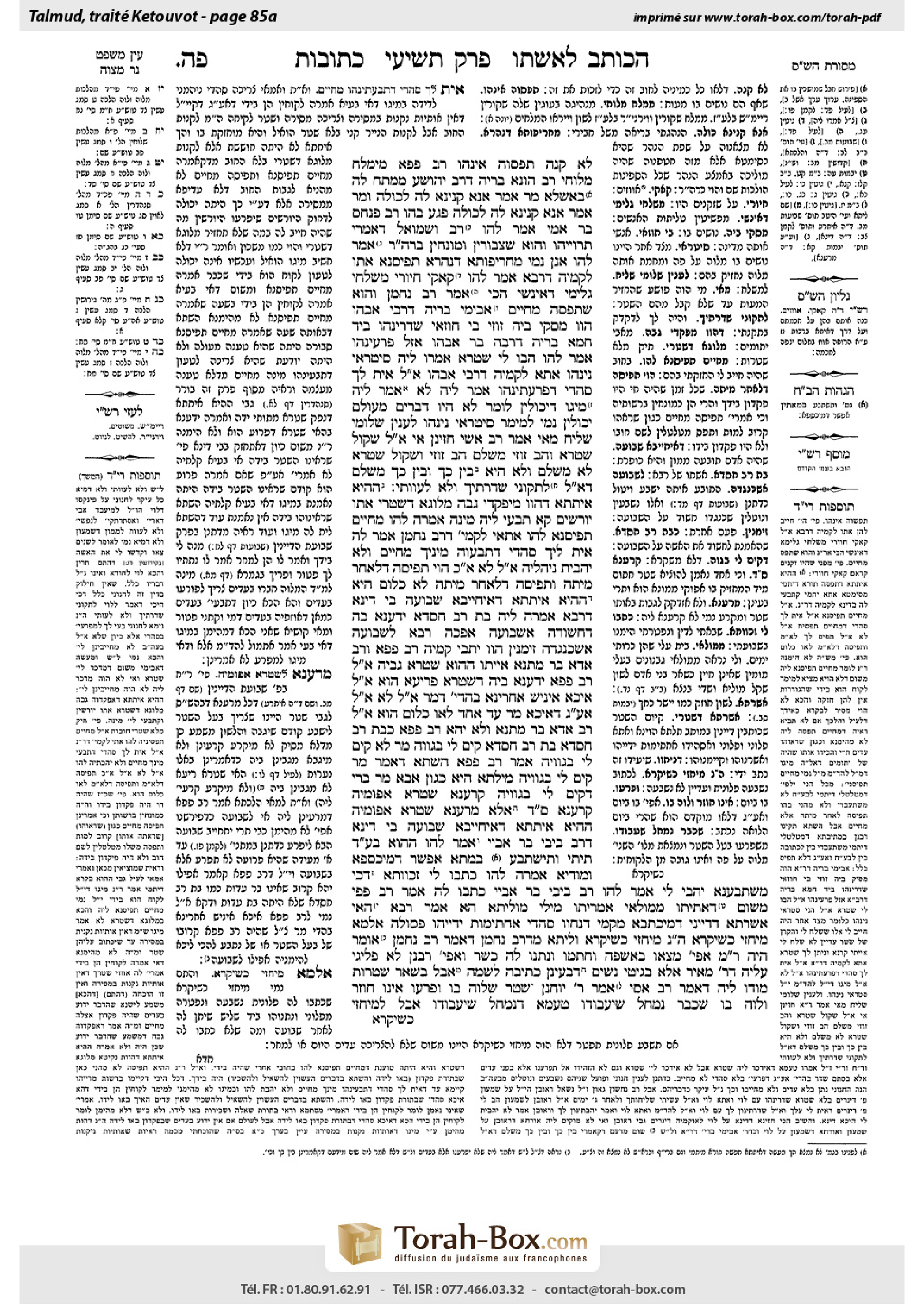
Ketubot 85a: Talmud study for Daf Yomi
Daf Yomi is the daily study of one Talmud folio. Explore 37 tractates with scans, Hebrew text, Sefaria English and AI-generated French translations where annotated.
Passage selection and English or AI-generated French translation are available where the scan has annotations. Daf Study is independent of Torah-Box and Sefaria.
Browse Ketubot · כתובות · All tractatesKetubot 85a text and translations
This page of Ketubot includes the Aramaic text, an English translation and an AI-generated French translation, alongside the scan above.
כתובות פ״ה א · Aramaic and Hebrew text
לֹא קָנָה. תַּפְסוּהָ אִינְהוּ. רַב פָּפָּא מְימַלַּח מַלּוֹחֵי. רַב הוּנָא בְּרֵיהּ דְּרַב יְהוֹשֻׁעַ מְמַתַּח לַהּ בְּאַשְׁלָא. מָר אָמַר: אֲנָא קָנֵינָא לַהּ לְכוּלַּהּ, וּמָר אָמַר: אֲנָא קָנֵינָא לַהּ לְכוּלַּהּ.
פְּגַע בְּהוּ רַב פִּנְחָס בַּר אַמֵּי, אֲמַר לְהוּ: רַב וּשְׁמוּאֵל דְּאָמְרִי תַּרְוַיְיהוּ וְהוּא שֶׁצְּבוּרִין וּמוּנָּחִין בִּרְשׁוּת הָרַבִּים! אֲמַר לְהוּ: אֲנַן נָמֵי מֵחֲרִיפוּתָא דְנַהֲרָא תְּפֵיסְנָא.
אֲתוֹ לְקַמֵּיהּ דְּרָבָא, אֲמַר לְהוּ: קָאקֵי חִיוָּרֵי, מְשַׁלְּחֵי גְּלִימֵי דְאִינָשֵׁי! הָכִי אָמַר רַב נַחְמָן: וְהוּא שֶׁתְּפָסָהּ מֵחַיִּים.
אֲבִימִי בְּרֵיהּ דְּרַבִּי אֲבָהוּ הֲווֹ מַסְּקִי בֵּיהּ זוּזֵי בֵּי חוֹזָאֵי, שַׁדְּרִינְהוּ בְּיַד חָמָא בְּרֵיהּ דְּרַבָּה בַּר אֲבָהוּ. אֲזַל פַּרְעִינְהוּ. אֲמַר לְהוּ: הַבוּ לִי שְׁטָרָא. אֲמַרוּ לֵיהּ: סִיטְרָאֵי נִינְהוּ.
אֲתָא לְקַמֵּיהּ דְּרַבִּי אֲבָהוּ. אֲמַר לֵיהּ: אִית לְךָ סָהֲדֵי דִּפְרַעְתִּינְהוּ? אֲמַר לֵיהּ: לָא. אֲמַר לֵיהּ: מִיגּוֹ דִּיכוֹלִין לוֹמַר ״לֹא הָיוּ דְבָרִים מֵעוֹלָם״, יְכוֹלִין נָמֵי לְמֵימַר ״סִיטְרָאֵי נִינְהוּ״.
לְעִנְיַן שַׁלּוֹמֵי שָׁלִיחַ מַאי? אָמַר רַב אָשֵׁי: חָזֵינַן, אִי אֲמַר לֵיהּ ״שְׁקוֹל שְׁטָרָא וְהַב זוּזֵי״ — מְשַׁלֵּם. ״הַב זוּזֵי וּשְׁקוֹל שְׁטָרָא״ — לָא מְשַׁלֵּם.
וְלָא הִיא, בֵּין כָּךְ וּבֵין כָּךְ מְשַׁלֵּם. דְּאָמַר לֵיהּ: ״לְתַקּוֹנֵי שַׁדַּרְתָּיךָ וְלָא לְעַוּוֹתֵי״.
הָהִיא אִיתְּתָא דַּהֲווֹ מִיפַּקְדִי גַּבַּהּ מְלוּגָא דִשְׁטָרֵי. אֲתוֹ יוֹרְשִׁים קָא תָּבְעִי לֵיהּ מִינַּהּ. אֲמַרָה לְהוּ: מֵחַיִּים תְּפֵיסְנָא לְהוּ. אֲתַאי לְקַמֵּיהּ דְּרַב נַחְמָן, אֲמַר לַהּ: אִית לִיךְ סָהֲדֵי דְּתַבְעוּהָ מִינִּיךְ מֵחַיִּים וְלָא יְהַבְיתְּ נִיהֲלֵיהּ? אָמְרָה לֵיהּ: לָא. אִם כֵּן, הָוֵי תְּפִיסָה דִּלְאַחַר מִיתָה, וּתְפִיסָה דִּלְאַחַר מִיתָה — לֹא כְּלוּם הִיא.
הָהִיא אִיתְּתָא דְּאִיחַיַּיבָא שְׁבוּעָה בֵּי דִינָא דְּרָבָא. אֲמַרָה לֵיהּ בַּת רַב חִסְדָּא: יָדְעָנָא בָּהּ דַּחֲשׁוּדָה אַשְּׁבוּעָה. אַפְכַהּ רָבָא לִשְׁבוּעָה אַשֶּׁכְּנֶגְדָּהּ.
זִימְנִין הָווּ יָתְבִי קַמֵּיהּ רַב פָּפָּא וְרַב אַדָּא בַּר מַתְנָא, אַיְיתוֹ הָהוּא שְׁטָרָא גַּבֵּיהּ. אֲמַר לֵיהּ רַב פָּפָּא: יָדַעְנָא בֵּיהּ דִּשְׁטָרָא פְּרִיעָא הוּא. אֲמַר לֵיהּ: אִיכָּא אִינִישׁ אַחֲרִינָא בַּהֲדֵיהּ דְּמָר? אֲמַר לֵיהּ: לָא. אֲמַר לֵיהּ: אַף עַל גַּב דְּאִיכָּא מָר, עֵד אֶחָד לָאו כְּלוּם הוּא.
אֲמַר לֵיהּ רַב אַדָּא בַּר מַתְנָא: וְלֹא יְהֵא רַב פָּפָּא כְּבַת רַב חִסְדָּא? בַּת רַב חִסְדָּא קִים לִי בְּגַוַּוהּ, מָר לָא קִים לִי בְּגַוֵּויהּ.
אָמַר רַב פָּפָּא: הַשְׁתָּא דְּאָמַר מָר ״קִים לִי בְּגַוֵּויהּ״ מִילְּתָא הִיא, כְּגוֹן אַבָּא מָר בְּרִי דְּקִים לִי בְּגַוֵּויהּ, קָרַעְנָא שְׁטָרָא אַפּוּמֵּיהּ.
קָרַעְנָא סָלְקָא דַּעְתָּךְ?! אֶלָּא: מַרַעְנָא שְׁטָרָא אַפּוּמֵּיהּ.
הָהִיא אִיתְּתָא דְּאִיחַיַּיבָא שְׁבוּעָה בֵּי דִינָא דְּרַב בִּיבִי בַּר אַבָּיֵי. אֲמַר לְהוּ הַהוּא בַּעַל דִּין: תֵּיתֵי וְתִישְׁתְּבַע בְּמָתָא, אֶפְשָׁר דְּמִיכַּסְפָא וּמוֹדְיָא. אֲמַרָה לְהוּ: כְּתֻבוּ לִי זַכְווֹתָא, דְּכִי מִשְׁתְּבַעְנָא יָהֲבִי לִי. אֲמַר לְהוּ רַב בִּיבִי בַּר אַבָּיֵי: כִּתְבוּ לַהּ.
אָמַר רַב פַּפֵּי: מִשּׁוּם דְּאָתֵיתוּ מִמּוּלָאֵי אָמְרִיתוּ מִילֵּי מוּלְיָתָא?!
הָא אָמַר רָבָא: הַאי אַשַּׁרְתָּא דְּדַיָּינֵי דְּמִיכַּתְבָא מִקַּמֵּי דְּנַחְווֹ סָהֲדֵי אַחֲתִימוּת יְדַיְיהוּ — פְּסוּלָה. אַלְמָא מִיחְזֵי כְּשִׁיקְרָא, הָכִי נָמֵי מִיחְזֵי כְּשִׁיקְרָא.
וְלֵיתַהּ, מִדְּרַב נַחְמָן. דְּאָמַר רַב נַחְמָן, אוֹמֵר הָיָה רַבִּי מֵאִיר: אֲפִילּוּ מְצָאוֹ בְּאַשְׁפָּה וַחֲתָמוֹ וּנְתָנוֹ לָהּ — כָּשֵׁר. וַאֲפִילּוּ רַבָּנַן לָא פְּלִיגִי עֲלֵיהּ דְּרַבִּי מֵאִיר אֶלָּא בְּגִיטֵּי נָשִׁים, דְּבָעֵינַן כְּתִיבָה לִשְׁמָהּ, אֲבָל בִּשְׁאָר שְׁטָרוֹת מוֹדוּ לֵיהּ.
דְּאָמַר רַב אַסִּי אָמַר רַבִּי יוֹחָנָן: שְׁטָר שֶׁלָּוָה בּוֹ וּפְרָעוֹ — אֵינוֹ חוֹזֵר וְלֹוֶה בּוֹ. שֶׁכְּבָר נִמְחַל שִׁיעְבּוּדוֹ: טַעְמָא דְּנִמְחַל שִׁיעְבּוּדוֹ, אֲבָל לְמִיחְזֵי
Ketubot 85a · English translation
has not acquired it. He cannot act to the detriment of others without their consent, and his acquisition harms the other creditors. Those Sages were also owed money by that same man, so they both seized the boat for himself. Rav Pappa steered it with an oar, while Rav Huna, son of Rav Yehoshua, pulled it with a rope. This Sage said: I acquired all of it; and that Sage said: I acquired all of it.
Rav Pineḥas bar Ami encountered them and said to them: What of the opinion of Rav and Shmuel, who both say: And this, that whoever first takes possession has acquired them, is the halakha provided that the items are arranged in a pile and placed in the public domain, which is not the case with this boat? They said to him: We too seized it from the current of the river, i.e., the middle of the river, which has the status of a public domain.
They came before Rava to ask him who had acquired the boat. He said to them: You are white geese [kakei ḥivvarei], in reference to their white beards, who remove people’s cloaks, i.e., your actions were unlawful from the start. This is what Rav Naḥman said: And this, that whoever takes possession has acquired them, is the halakha provided that one seized them from the debtor while he was alive. In this case, however, the boat was seized after the debtor’s death, when the heirs had already taken possession of it.
The Gemara relates another incident: Avimi, son of Rabbi Abbahu, owed money to people from Bei Ḥozai. He sent the money in the possession of Ḥama, son of Rabba bar Abbahu, who went and paid the money that Avimi, son of Rabbi Abbahu, owed, and he then said to the people from Bei Ḥozai: Give me back the document that shows that the person who sent me owes you money. They said to him: The money that you paid us was for side debts, i.e., money from a different debt, which was not written in a document. We accepted the money from you as payment of that debt. We will therefore not return the document to you, as he has yet to pay off the debt listed in the document.
This case came before Rabbi Abbahu. He said to Ḥama, son of Rabba bar Abbahu: Do you have witnesses that you paid them? He said to him: No. Rabbi Abbahu said to him: He could have made a more advantageous claim [miggo]. Since they can say: These matters never occurred, i.e., you never paid them anything, they can also say: These are side debts. Therefore, you cannot demand from them either the money or the document.
The Gemara asks: With regard to the payment of the agent, what is the halakha? Must the agent reimburse the one who appointed him for his loss? Rav Ashi said: We see that if the one who appointed him said to him: Take the document from them and give them money, then the agent disobeyed his instructions by first paying the money and must pay back the one who appointed him. If, however, the one who appointed him said to the agent: Give the money and take the document, he does not pay, as the one who appointed him was not particular about instructing the agent to take the document before giving them money.
The Gemara comments: And this is not so; Rav Ashi’s ruling is not accepted as halakha. Whether the instructions were given in this manner or whether the instructions were given in that manner, the agent must pay, as the one who appointed him can say to him: I sent you to act for my benefit, and not to my detriment. His right to act as an agent did not extend to a case where it was to the detriment of the one who designated him.
The Gemara relates another incident: There was a certain woman who had a bag [meloga] full of documents deposited with her. The heirs came and claimed it from her. She said to them: I seized the bag of documents from the deceased while he was alive, as he owed me money. They came before Rav Naḥman for judgment. He said to her: Do you have witnesses that the deceased claimed the bag from you while he was alive and you did not give it to him? She said to him: No, I do not have witnesses to this effect. He replied: If so, this is considered a case of seizing property after death, and seizing after death is nothing. As stated earlier, seizing property to recover a debt is effective only when done during the lifetime of the debtor. It is ineffective once he is dead and others have inherited his property.
The Gemara relates another incident: There was a certain woman who was obligated to take an oath in order to avoid payment in Rava’s court. The daughter of Rav Ḥisda said to Rava, her husband: I know that she is suspect with regard to taking a false oath. Rava reversed the obligation of the oath so that it fell onto the other party, who now had the option of taking an oath that the woman owes him money and collecting his debt. This is how to act when the court does not trust the one who is obligated to take an oath.
The Gemara continues: On another occasion, Rav Pappa and Rav Adda bar Mattana were sitting before Rava. A certain document was brought before Rava to be examined in court. Rav Pappa said to Rava: I know about this document, that it records a debt that has already been paid. Rava said to him: Is there another person who can testify with the Master about the document? He said to him: No, I am the only one who knows. Rava said to him: Although there is the Master here who attests that the document has been paid, one witness is nothing.
Rav Adda bar Mattana said to Rava: And should Rav Pappa not be trusted like Rav Ḥisda’s daughter, who as a woman is disqualified from testimony? Rava replied: I relied on Rav Ḥisda’s daughter because I know with certainty about her that she is always truthful. However, I cannot rely on the Master because I do not know with the same degree of certainty about him that he is always truthful, and I cannot rule on the basis of one witness unless I have complete certainty.
Rav Pappa said: Now that the Master, Rava, has said that the claim: I know with certainty about him, is a significant matter, i.e., a claim that can be used in court, if a judge knows that someone is telling the truth, although under normal circumstances his testimony would be inadmissible, in this case it does have a certain legal validity. For example, if Abba Mar, my son, about whom I know with certainty always tells the truth, claims that a document that records a debt has already been paid, then I can tear the document on the basis of his word.
The Gemara asks: How can it enter your mind that the court can tear a document based on the word of a single witness? Rather, the statement should be that I can weaken the document on the basis of his word, by not allowing it to be used for claiming payment without further proof.
The Gemara relates another incident: There was a certain woman who was obligated to take an oath in Rav Beivai bar Abaye’s court. The opposing litigant said to the judges: Let her come and take an oath in the town. It is possible that she will be ashamed of her lies and will admit that she is liable. She said to the judges: Write a document of rights for me, so that when I take the oath they will give it to me, and I will then be willing to take an oath in the town. Rav Beivai bar Abaye said to them: Write the document for her.
Rav Pappi said: Is it because you come from unfortunate people [de’atitu mimmula’ei] that you say unfortunate things? Rav Beivai was from the house of Eli, whose descendants were sentenced to die at a young age.
Rav Pappi said that Rav Beivai bar Abaye was wrong to say what he said because of a statement of Rava. Didn’t Rava say: This ratification of judges, which was written on a document before the witnesses had seen and testified about their signature, is invalid, although the witnesses later attested that it was their signatures? Apparently, it has the appearance of falsehood because they affirmed the validity of a document before hearing the testimony. Here too, if the judges wrote a document of rights before the woman took her oath, the document would have the appearance of falsehood, and the court should not write a document of rights for her before she takes an oath.
The Gemara comments: And this halakha of Rava’s is not accepted because of a statement of Rav Naḥman, as Rav Naḥman said: Rabbi Meir would say: Even if the husband found a bill of divorce with names identical to those of his and his wife’s, in the garbage, and he had it signed by witnesses and gave it to his wife, it is valid. Rav Naḥman adds: And the Rabbis do not disagree with Rabbi Meir, except in the case of bills of divorce of women, since the Rabbis hold that the writing of the bill of divorce needs to be done for the sake of the woman getting divorced. But for all other documents, they concede to him that it makes no difference when the document was written.
The proof of this is that Rav Asi said that Rabbi Yoḥanan said: With regard to a document that one borrowed money based on it and then repaid the debt, he may not borrow money again based on it. This is because its lien has already been forgiven. Once the debt has been repaid, the lien resulting from the loan is no longer in force. The witnesses did not sign the document at the time of the second loan, so the lien will not be in effect, and the loan will have the status of one by oral agreement. The Gemara infers: The reason that he cannot reuse the document is because its lien has been forgiven, so that the document is no longer accurate; but as for the fact that it has the appearance
Ketubot 85a · Traduction française (IA)
ne l’a pas acquis. Il ne peut agir au détriment d’autrui sans son consentement, et son acquisition porte préjudice aux autres créanciers. Ces Sages avaient eux aussi une créance sur ce même homme ; ils se saisirent donc tous deux du bateau, chacun pour son propre compte. Rav Pappa le dirigeait à l’aide d’une rame, tandis que Rav Huna, fils de Rav Yehoshua, le tirait avec une corde. L’un disait : « Je l’ai acquis en entier », et l’autre disait : « Je l’ai acquis en entier. »
Rav Pineḥas bar Ami les rencontra et leur dit : « Qu’en est-il de l’opinion de Rav et de Shmuel, qui disent tous deux : “La règle selon laquelle celui qui prend possession le premier acquiert les biens ne s’applique que si les objets sont disposés en tas et placés dans le domaine public” ? Or, ce n’est pas le cas de ce bateau. » Ils lui répondirent : « Nous aussi, nous nous en sommes saisis dans le courant du fleuve, c’est-à-dire au milieu du fleuve, qui a le statut de domaine public. »
Ils se présentèrent devant Rava pour lui demander qui avait acquis le bateau. Il leur dit : « Vous êtes des oies blanches [kakei ḥivvarei » — en référence à leurs barbes blanches — « qui dépouillent les gens de leurs manteaux »], c’est-à-dire que vos actes étaient illégaux dès le départ. Voici ce que Rav Naḥman a dit : “La règle selon laquelle celui qui prend possession acquiert les biens ne s’applique que si on les a saisis du vivant du débiteur.” Dans ce cas, cependant, le bateau avait été saisi après la mort du débiteur, lorsque les héritiers en avaient déjà pris possession.
La Guemara rapporte un autre incident : Avimi, fils de Rabbi Abbahu, devait de l’argent à des gens de Bei Ḥozai. Il envoya l’argent par l’intermédiaire de Ḥama, fils de Rabba bar Abbahu. Celui-ci alla payer la somme qu’Avimi, fils de Rabbi Abbahu, devait, puis dit aux gens de Bei Ḥozai : « Rendez-moi le document qui atteste que la personne qui m’a envoyé vous doit de l’argent. » Ils lui répondirent : « L’argent que tu nous as versé correspond à des dettes annexes, c’est-à-dire à une autre dette, qui n’était pas consignée dans un document. Nous avons accepté ton argent en paiement de cette dette. Nous ne te rendrons donc pas le document, puisqu’il n’a pas encore réglé la dette qui y est inscrite. »
Cette affaire fut portée devant Rabbi Abbahu. Il demanda à Ḥama, fils de Rabba bar Abbahu : « As-tu des témoins attestant que tu les as payés ? » Il lui répondit : « Non. » Rabbi Abbahu lui dit : « Ils auraient pu avancer un argument plus avantageux [miggo]. Puisqu’ils peuvent dire : “Cela ne s’est jamais produit”, c’est-à-dire que tu ne leur as jamais rien payé, ils peuvent aussi dire : “Il s’agissait de dettes annexes.” Tu ne peux donc leur réclamer ni l’argent ni le document. »
La Guemara demande : Qu’en est-il du remboursement par le mandataire ? Doit-il indemniser celui qui l’a envoyé pour la perte qu’il a subie ? Rav Ashi dit : Il faut examiner la situation ainsi : si celui qui l’a envoyé lui a dit : « Prends le document auprès d’eux, puis donne-leur l’argent », le mandataire a désobéi à ses instructions en versant d’abord l’argent et doit rembourser celui qui l’a envoyé. En revanche, si celui qui l’a envoyé lui a dit : « Donne l’argent et prends le document », il n’a pas à rembourser, car celui qui l’a envoyé ne tenait pas à ce que le mandataire prenne le document avant de leur donner l’argent.
La Guemara fait remarquer : Il n’en est pas ainsi ; la décision de Rav Ashi n’est pas retenue comme halakha. Quelles que soient les instructions données, le mandataire doit payer, car celui qui l’a envoyé peut lui dire : « Je t’ai envoyé pour agir dans mon intérêt, et non à mon détriment. » Le mandat qu’il lui avait confié ne s’étendait pas à un acte préjudiciable à celui qui l’avait désigné.
La Guemara rapporte un autre incident : une femme avait en dépôt un sac [meloga] rempli de documents. Les héritiers vinrent le lui réclamer. Elle leur dit : « Je me suis saisie du sac de documents du vivant du défunt, car il me devait de l’argent. » Ils se présentèrent devant Rav Naḥman pour faire juger l’affaire. Il lui demanda : « As-tu des témoins attestant que le défunt t’a réclamé le sac de son vivant et que tu ne le lui as pas rendu ? » Elle lui répondit : « Non, je n’ai pas de témoins à cet égard. » Il lui dit : « Dans ce cas, il s’agit d’une saisie de biens après la mort, et une saisie après la mort est sans effet. » Comme cela a été dit plus haut, la saisie de biens pour recouvrer une dette n’est efficace que si elle a lieu du vivant du débiteur. Après sa mort, une telle saisie est sans effet, car d’autres ont hérité de ses biens.
La Guemara rapporte un autre incident : une femme devait prêter serment pour éviter de payer, devant le tribunal de Rava. La fille de Rav Ḥisda dit à Rava, son mari : « Je sais qu’elle est suspecte de faux serment. » Rava inversa l’obligation de prêter serment, de sorte qu’elle incomba à l’autre partie, qui pouvait désormais jurer que la femme lui devait de l’argent et recouvrer sa créance. Voilà comment il faut agir lorsque le tribunal ne fait pas confiance à la personne tenue de prêter serment.
La Guemara poursuit : une autre fois, Rav Pappa et Rav Adda bar Mattana étaient assis devant Rava. Un document fut présenté à Rava pour être examiné au tribunal. Rav Pappa lui dit : « Je sais que ce document constate une dette qui a déjà été remboursée. » Rava lui demanda : « Y a-t-il une autre personne qui puisse témoigner avec le Maître au sujet de ce document ? » Il lui répondit : « Non, je suis le seul à le savoir. » Rava lui dit : « Même si le Maître est ici et atteste que la dette constatée par le document a été payée, le témoignage d’un seul témoin ne vaut rien. »
Rav Adda bar Mattana dit à Rava : « Rav Pappa ne devrait-il pas être cru comme la fille de Rav Ḥisda, qui, en tant que femme, est inapte à témoigner ? » Rava répondit : « Je me suis fié à la fille de Rav Ḥisda parce que je sais avec certitude qu’elle dit toujours la vérité. Mais je ne peux pas me fier au Maître, car je ne sais pas avec la même certitude qu’il dit toujours la vérité ; or, je ne peux statuer sur la base du témoignage d’un seul témoin que si j’ai une certitude absolue. »
Rav Pappa dit : « Maintenant que le Maître, Rava, a déclaré que l’affirmation “Je sais avec certitude ce qu’il en est de lui” est importante, c’est-à-dire qu’elle peut être invoquée au tribunal, si un juge sait qu’une personne dit la vérité, son témoignage a une certaine valeur juridique dans ce cas, même si, en temps normal, il ne serait pas recevable. Par exemple, si Abba Mar, mon fils, dont je sais avec certitude qu’il dit toujours la vérité, affirme qu’un document constatant une dette a déjà été payé, je peux alors déchirer le document sur la foi de ses paroles. »
La Guemara demande : Comment peut-on penser que le tribunal puisse déchirer un document sur la foi d’un seul témoin ? Il faut plutôt dire que je peux affaiblir la valeur du document sur la foi de ses paroles, en ne permettant pas qu’il serve à réclamer un paiement sans preuve supplémentaire.
La Guemara rapporte un autre incident : une femme devait prêter serment devant le tribunal de Rav Beivai bar Abaye. La partie adverse dit aux juges : « Qu’elle vienne prêter serment en ville. Peut-être aura-t-elle honte de ses mensonges et reconnaîtra-t-elle qu’elle est redevable. » Elle dit aux juges : « Rédigez-moi un document attestant mes droits, afin que, lorsque j’aurai prêté serment, ils me le remettent ; alors, je consentirai à prêter serment en ville. » Rav Beivai bar Abaye leur dit : « Rédigez-lui le document. »
Rav Pappi dit : « Est-ce parce que vous êtes issus de gens malheureux [de’atitu mimmula’ei] que vous dites des choses malheureuses ? » Rav Beivai descendait de la maison d’Eli, dont les descendants avaient été condamnés à mourir jeunes.
Rav Pappi dit que Rav Beivai bar Abaye avait eu tort de dire ce qu’il avait dit, en raison d’une déclaration de Rava. Rava n’a-t-il pas dit : « Cette validation par les juges, inscrite sur un document avant que les témoins aient vu et attesté leurs signatures, est invalide », même si les témoins attestent ensuite qu’il s’agit bien de leurs signatures ? Apparemment, cela a une apparence de fausseté, car les juges ont confirmé la validité d’un document avant d’avoir entendu le témoignage. Ici aussi, si les juges rédigeaient un document attestant les droits de la femme avant qu’elle prête serment, le document aurait une apparence de fausseté ; le tribunal ne devrait donc pas lui rédiger un tel document avant qu’elle prête serment.
La Guemara fait remarquer : Cette halakha de Rava n’est pas retenue, en raison d’une déclaration de Rav Naḥman, car Rav Naḥman a dit : « Rabbi Meir disait : Même si le mari trouve dans les ordures un acte de divorce portant des noms identiques aux siens et à ceux de sa femme, qu’il le fasse signer par des témoins et le remette à sa femme, l’acte est valide. » Rav Naḥman ajoute : « Les Rabbins ne sont en désaccord avec Rabbi Meir que dans le cas des actes de divorce, car ils estiment que leur rédaction doit être faite en vue du divorce de la femme. Mais, pour tous les autres documents, ils lui concèdent que le moment où le document a été rédigé n’a aucune importance. »
La preuve en est que Rav Asi a dit au nom de Rabbi Yoḥanan : « Si quelqu’un a emprunté de l’argent sur la base d’un document, puis a remboursé la dette, il ne peut pas emprunter de nouveau sur la base de ce même document. En effet, le privilège de gage qui y est attaché a déjà été éteint. Une fois la dette remboursée, le privilège de gage résultant du prêt n’est plus en vigueur. Les témoins n’ayant pas signé le document au moment du second prêt, le privilège de gage ne sera pas en vigueur, et le prêt aura le statut d’un prêt fondé sur un accord oral. » La Guemara en déduit que la raison pour laquelle on ne peut pas réutiliser le document est que son privilège de gage a été éteint, de sorte que le document n’est plus exact ; mais quant au fait qu’il a l’apparence
Traduction française générée par IA à partir de l’édition anglaise de Sefaria. Vérifie toujours un passage avec le texte source.
Text from Sefaria: William Davidson Edition - Vocalized Aramaic (CC BY NC); William Davidson Edition - English (CC BY NC).