Ketubot 85b: Talmud study for Daf Yomi
Daf Yomi is the daily study of one Talmud folio. Explore 37 tractates with scans, Hebrew text, Sefaria English and AI-generated French translations where annotated.
Passage selection and English or AI-generated French translation are available where the scan has annotations. Daf Study is independent of Torah-Box and Sefaria.
Browse Ketubot · כתובות · All tractatesKetubot 85b text and translations
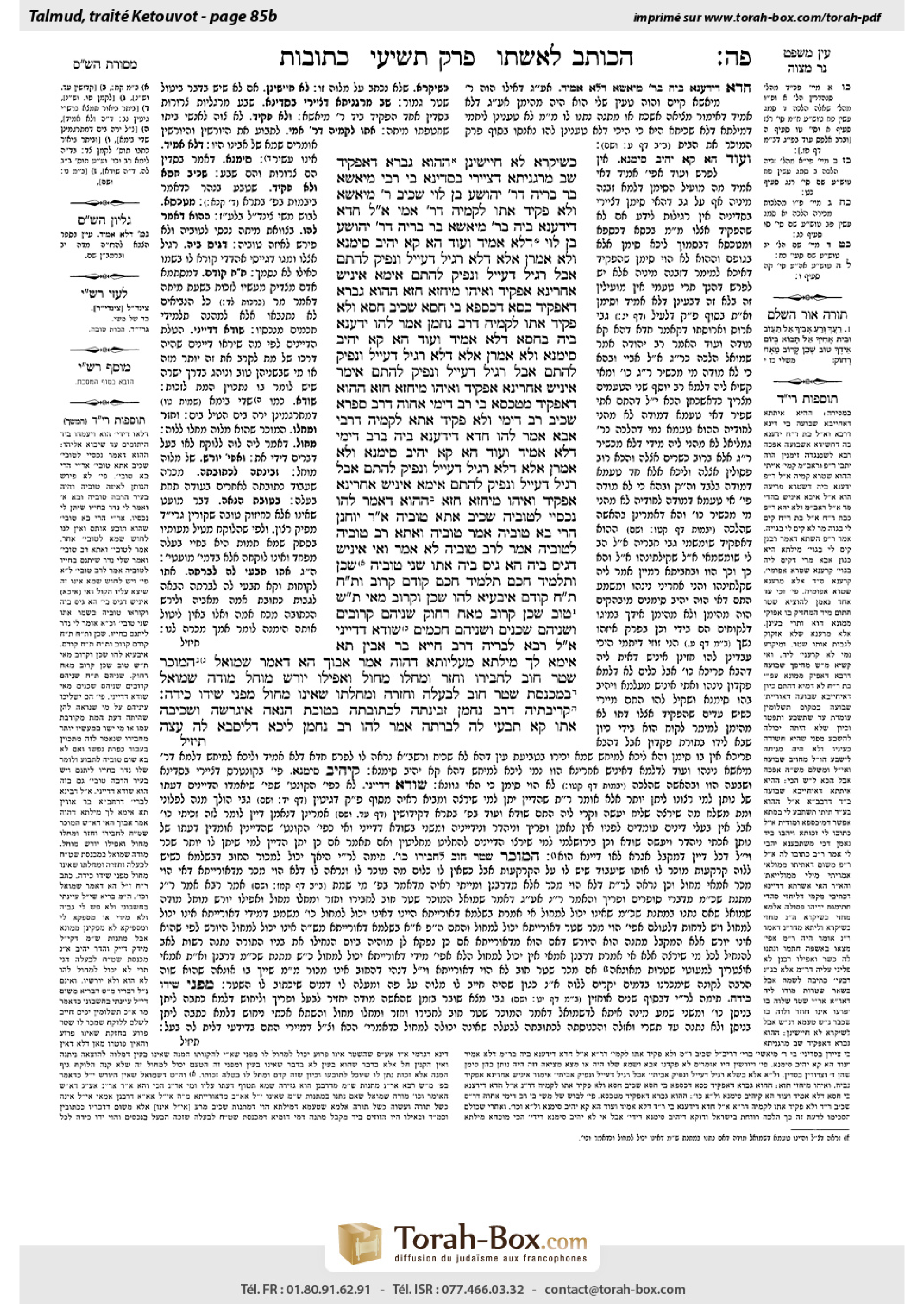
This page of Ketubot includes the Aramaic text, an English translation and an AI-generated French translation, alongside the scan above.
כתובות פ״ה ב · Aramaic and Hebrew text
כְּשִׁיקְרָא לָא חָיְישִׁינַן.
הָהוּא גַּבְרָא דְּאַפְקֵיד שַׁב מַרְגָּנְיָתָא דְּצַיְירִי בִּסְדִינָא בֵּי רַבִּי מְיָאשָׁא בַּר בְּרֵיהּ דְּרַבִּי יְהוֹשֻׁעַ בֶּן לֵוִי. שְׁכֵיב רַבִּי מְיָאשָׁא וְלָא פַּקֵּיד. אֲתוֹ לְקַמֵּיהּ דְּרַבִּי אַמֵּי, אֲמַר לְהוּ: חֲדָא, דְּיָדַעְנָא בֵּיהּ בְּרַבִּי מְיָאשָׁא בַּר בְּרֵיהּ דְּרַבִּי יְהוֹשֻׁעַ בֶּן לֵוִי דְּלָא אֲמִיד. וְעוֹד, הָא קָא יָהֵיב סִימָנָא.
וְלָא אֲמַרַן אֶלָּא דְּלָא רְגִיל דְּעָיֵיל וְנָפֵיק לְהָתָם. אֲבָל רָגִיל דְּעָיֵיל וְנָפֵיק לְהָתָם, אֵימָא אִינִישׁ אַחֲרִינָא אַפְקֵיד וְאִיהוּ מִיחְזָא חֲזָא.
הָהוּא גַּבְרָא דְּאַפְקֵיד כָּסָא דְכַסְפָּא בֵּי חָסָא. שָׁכֵיב חָסָא, וְלָא פַּקֵּיד. אֲתוֹ לְקַמֵּיהּ דְּרַב נַחְמָן אֲמַר לְהוּ: יָדַעְנָא בֵּיהּ בְּחָסָא דְּלָא אֲמִיד. וְעוֹד, הָא קָא יָהֵיב סִימָנָא. וְלָא אֲמַרַן אֶלָּא דְּלָא רְגִיל דְּעָיֵיל וְנָפֵיק לְהָתָם, אֲבָל רְגִיל דְּעָיֵיל וְנָפֵיק לְהָתָם, אֵימַר אִינִישׁ אַחֲרִינָא אַפְקֵיד וְאִיהוּ מִיחְזָא חֲזָא.
הָהוּא דְּאַפְקֵיד מְטַכְסָא בֵּי רַב דִּימִי אֲחוּהּ דְּרַב סָפְרָא, שָׁכֵיב רַב דִּימִי וְלָא פַּקֵּיד. אֲתָא לְקַמֵּיהּ דְּרַבִּי אַבָּא, אֲמַר לְהוּ: חֲדָא, דְּיָדַעְנָא בֵּיהּ בְּרַב דִּימִי דְּלָא אֲמִיד. וְעוֹד, הָא קָא יָהֵיב סִימָנָא. וְלָא אֲמַרַן אֶלָּא דְּלָא רְגִיל דְּעָיֵיל וְנָפֵיק לְהָתָם, אֲבָל רְגִיל דְּעָיֵיל וְנָפֵיק לְהָתָם, אֵימָא אִינִישׁ אַחֲרִינָא אַפְקֵיד וְאִיהוּ מִיחְזָא חֲזָא.
הָהוּא דַּאֲמַר לְהוּ: נִכְסַיי לְטוֹבִיָּה. שָׁכֵיב, אֲתָא טוֹבִיָּה. אָמַר רַבִּי יוֹחָנָן: הֲרֵי בָּא טוֹבִיָּה.
אֲמַר ״טוֹבִיָּה״ וַאֲתָא רַב טוֹבִיָּה — לְטוֹבִיָּה אֲמַר, לְרַב טוֹבִיָּה לָא אֲמַר. וְאִי אִינִישׁ דְּגִיס בֵּיהּ, הָא גִּיס בֵּיהּ. אֲתוֹ שְׁנֵי טוֹבִיָּה, שָׁכֵן וְתַלְמִיד חָכָם — תַּלְמִיד חָכָם קוֹדֵם. קָרוֹב וְתַלְמִיד חָכָם — תַּלְמִיד חָכָם קוֹדֵם.
אִיבַּעְיָא לְהוּ: שָׁכֵן וְקָרוֹב מַאי? תָּא שְׁמַע: ״טוֹב שָׁכֵן קָרוֹב מֵאָח רָחוֹק״. שְׁנֵיהֶם קְרוֹבִים, וּשְׁנֵיהֶם שְׁכֵנִים, וּשְׁנֵיהֶם חֲכָמִים? שׁוּדָא דְּדַיָּינֵי.
אֲמַר לֵיהּ רָבָא לִבְרֵיהּ דְּרַב חִיָּיא בַּר אָבִין: תָּא אֵימָא לָךְ מִילְּתָא מְעַלַּיְותָא דַּהֲוָה אָמַר אֲבוּךְ. הָא דְּאָמַר שְׁמוּאֵל הַמּוֹכֵר שְׁטַר חוֹב לַחֲבֵירוֹ וְחָזַר וּמְחָלוֹ — מָחוּל, וַאֲפִילּוּ יוֹרֵשׁ מוֹחֵל — מוֹדֶה שְׁמוּאֵל בְּמַכְנֶסֶת שְׁטַר חוֹב לְבַעְלָהּ, וְחָזְרָה וּמְחָלַתּוֹ — שֶׁאֵינוֹ מָחוּל, מִפְּנֵי שֶׁיָּדוֹ כְּיָדָהּ.
קָרִיבְתֵּיהּ דְּרַב נַחְמָן זַבֵּינְתַּהּ לִכְתוּבְּתַהּ בְּטוֹבַת הֲנָאָה — אִיגָּרַשָׁה וּשְׁכִיבָה. אֲתוֹ קָא תָבְעִי לַהּ לִבְרַתַּהּ. אֲמַר לְהוּ רַב נַחְמָן: לֵיכָּא דְּלַיסְּבַהּ (לָהּ) עֵצָה?!
Ketubot 85b · English translation
of falsehood, as it was written prior to the second loan, we are not concerned. So too here, the fact that the judges wrote the document before the event is not a matter of concern.
The Gemara examines cases involving disputes concerning the property of the deceased. There was a certain man who deposited seven pearls [marganita] tied up in a sheet in the house of Rabbi Meyasha, son of the son of Rabbi Yehoshua ben Levi. Rabbi Meyasha passed away without instructing the members of his household on his deathbed, and without explaining to whom the gems belonged. Rabbi Meyasha’s family and the depositor came before Rabbi Ami to discuss the ownership of the gems. He said to them: They belong to the claimant, first of all, since I know about Rabbi Meyasha, son of the son of Rabbi Yehoshua ben Levi, that he is not wealthy enough to be able to afford such gems. And furthermore, the depositor has provided a distinguishing mark that proves that he is the owner.
The Gemara comments: And we said that a distinguishing mark is effective only if the claimant does not usually enter and exit there. But if that person usually enters and exits there, one can say that a different person might have deposited the object, and he merely saw it there and was able to provide distinguishing marks.
The Gemara relates a similar incident: There was a certain man who deposited a silver goblet in the house of the Sage Ḥasa. Ḥasa passed away without instructing anything about the goblet. They came before Rav Naḥman to discuss the ownership of the goblet. He said to them: I know about Ḥasa that he is not wealthy, and this goblet would not have belonged to him. And furthermore, the depositor has provided a distinguishing mark. And we said so only if the claimant does not usually enter and exit there. But if that person usually enters and exits there, one can say that a different person might have deposited the object and he merely saw it there.
The Gemara relates another similar story: There was a certain man who deposited silk [metakesa] in the house of Rav Dimi, brother of Rav Safra. Rav Dimi passed away without instructing anything about the silk. They came before Rabbi Abba to discuss the ownership of the silk. He said to them: It belongs to the claimant, first of all, since I know about Rav Dimi that he is not wealthy. And furthermore, he has provided a distinguishing mark. And we said so only if he does not usually enter and exit there. But if that person usually enters and exit there, one can say that a different person might have deposited the object, and he merely saw it there.
The Gemara relates the story of a certain man who said to those present at his deathbed: My property should go to Toviya. He passed away, and Toviya came to claim his possessions. Rabbi Yoḥanan said: Toviya has come, and there is no need to be concerned that he might have meant a different Toviya.
The Gemara adds: If the deceased had said: My property should go to Toviya, and Rav Toviya came forward, it is assumed that this is not the person the deceased had in mind, for he said: My property should go to Toviya. He did not say: My property should go to Rav Toviya. But if Rav Toviya is a person who is familiar with the deceased, then it can be assumed that the deceased called him by his personal name and not by his title because he was familiar with him. If two men named Toviya came forward, and one of them was the deceased’s neighbor and the other a Torah scholar but not his neighbor, the Torah scholar takes precedence. Similarly, if one was a relative and the other a Torah scholar, the Torah scholar takes precedence.
A dilemma was raised before the Sages: If two men have the same name and one was a neighbor and the other one was a relative, what is the halakha? The Gemara answers: Come and hear the solution from the following verse: “A close neighbor is better than a distant brother” (Proverbs 27:10). If they were both relatives, or both neighbors, or both scholars, there is no systematic way of determining who is entitled to the property, and the decision is left to the discretion of the judges.
§ Rava said to the son of Rav Ḥiyya bar Avin: Come, and I will tell you something excellent that your father would say about that which Shmuel said: Shmuel said that in the case of one who sells a promissory note to another, and the seller went back and forgave the debtor his debt, it is forgiven, since the debtor essentially had a non-transferable obligation to the creditor alone, and even the creditor’s heir can forgive the debt. With regard to this halakha, Rav Ḥiyya bar Avin said: Shmuel concedes with regard to a woman who brings in a promissory note to the marriage for her husband, and she went back and forgave the debtor his debt, that the debt is not forgiven. Why not? Because his hand is like her hand, i.e., the husband shares equal rights to her property, and she cannot unilaterally forgive the debt.
The Gemara relates an incident: A relative of Rav Naḥman sold her marriage contract for financial advantage. In other words, she received a sum of money and in exchange agreed that if she were to be divorced and become entitled to her marriage contract, the money would belong to the purchaser of the rights to her marriage contract. She was subsequently divorced from her husband and died, leaving the right to her marriage contract to her daughter. The purchasers came and claimed the value of the marriage contract from her daughter. Rav Naḥman said to the people around him: Is there no one who can give the daughter advice,
Ketubot 85b · Traduction française (IA)
de faux, comme il avait été écrit avant le second prêt, nous ne nous en inquiétons pas. De même ici, le fait que les juges aient rédigé le document avant l’événement n’est pas préoccupant.
La Guemara examine des cas de litiges portant sur les biens d’un défunt. Un homme avait déposé sept perles [marganita], nouées dans un linge, dans la maison de Rabbi Meyasha, fils du fils de Rabbi Yehoshua ben Levi. Rabbi Meyasha mourut sans avoir donné d’instructions à sa famille sur son lit de mort ni précisé à qui appartenaient les pierres précieuses. Sa famille et le déposant se présentèrent devant Rabbi Ami pour discuter de la propriété des pierres précieuses. Il leur dit : « Elles appartiennent au demandeur, tout d’abord parce que je sais que Rabbi Meyasha, fils du fils de Rabbi Yehoshua ben Levi, n’est pas assez riche pour pouvoir se procurer de telles pierres précieuses. De plus, le déposant a fourni un signe distinctif qui prouve qu’il en est le propriétaire. »
La Guemara fait remarquer : Nous avons dit qu’un signe distinctif n’est efficace que si le demandeur n’a pas l’habitude d’entrer et de sortir de cet endroit. Mais si cette personne a l’habitude d’y entrer et d’en sortir, on peut dire qu’une autre personne a pu y déposer l’objet et qu’elle l’a simplement vu sur place, ce qui lui a permis de fournir des signes distinctifs.
La Guemara rapporte un incident similaire : Un homme avait déposé une coupe en argent dans la maison du sage Ḥasa. Ḥasa mourut sans avoir donné d’instructions au sujet de la coupe. Les intéressés se présentèrent devant Rav Naḥman pour discuter de la propriété de la coupe. Il leur dit : « Je sais que Ḥasa n’est pas riche et que cette coupe ne lui appartenait pas. De plus, le déposant a fourni un signe distinctif. Nous n’avons dit cela que si le demandeur n’a pas l’habitude d’entrer et de sortir de cet endroit. Mais si cette personne a l’habitude d’y entrer et d’en sortir, on peut dire qu’une autre personne a pu y déposer l’objet et qu’elle l’a simplement vu sur place. »
La Guemara rapporte une autre histoire similaire : Un homme avait déposé de la soie [metakesa] dans la maison de Rav Dimi, frère de Rav Safra. Rav Dimi mourut sans avoir donné d’instructions au sujet de la soie. Les intéressés se présentèrent devant Rabbi Abba pour discuter de la propriété de la soie. Il leur dit : « Elle appartient au demandeur, tout d’abord parce que je sais que Rav Dimi n’est pas riche. De plus, il a fourni un signe distinctif. Nous n’avons dit cela que s’il n’a pas l’habitude d’entrer et de sortir de cet endroit. Mais si cette personne a l’habitude d’y entrer et d’en sortir, on peut dire qu’une autre personne a pu y déposer l’objet et qu’elle l’a simplement vu sur place. »
La Guemara rapporte l’histoire d’un homme qui dit aux personnes présentes à son chevet : « Que mes biens reviennent à Toviya. » Il mourut, et Toviya vint réclamer ses biens. Rabbi Yoḥanan dit : « Toviya est venu, et il n’y a pas lieu de craindre que le défunt ait voulu désigner un autre Toviya. »
La Guemara ajoute : Si le défunt avait dit : « Que mes biens reviennent à Toviya », et que Rav Toviya s’était présenté, on présume qu’il ne s’agit pas de la personne que le défunt avait en tête, car il avait dit : « Que mes biens reviennent à Toviya », et non : « Que mes biens reviennent à Rav Toviya. » Mais si Rav Toviya connaissait le défunt, on peut présumer que celui-ci l’a appelé par son prénom et non par son titre parce qu’il le connaissait bien. Si deux hommes nommés Toviya se présentent, et que l’un était le voisin du défunt tandis que l’autre était un érudit en Torah mais pas son voisin, l’érudit en Torah a priorité. De même, si l’un était un parent et l’autre un érudit en Torah, l’érudit en Torah a priorité.
Une question fut posée aux Sages : Si deux hommes portent le même nom et que l’un était un voisin et l’autre un parent, quelle est la halakha ? La Guemara répond : Venez et entendez la solution tirée du verset suivant : « Un voisin proche vaut mieux qu’un frère éloigné » (Proverbes 27, 10). S’ils étaient tous deux parents, ou tous deux voisins, ou tous deux érudits, il n’existe aucun moyen systématique de déterminer qui a droit aux biens ; la décision est laissée à l’appréciation des juges.
§ Rava dit au fils de Rav Ḥiyya bar Avin : « Viens, je vais te dire quelque chose d’excellent que ton père disait au sujet de l’enseignement de Shmuel. » Shmuel a enseigné que, lorsqu’une personne vend à une autre un billet à ordre, puis revient sur sa décision et remet sa dette au débiteur, la dette est remise. En effet, le débiteur était en réalité tenu envers le seul créancier par une obligation non cessible, et même l’héritier du créancier peut remettre la dette. Au sujet de cette halakha, Rav Ḥiyya bar Avin a dit : « Shmuel reconnaît que, dans le cas d’une femme qui apporte dans le mariage un billet à ordre dont son mari bénéficie, et qui revient sur sa décision pour remettre la dette au débiteur, la dette n’est pas remise. » Pourquoi ? Parce que la main du mari est comme la sienne, c’est-à-dire que le mari partage à égalité avec elle les droits sur ses biens ; elle ne peut donc pas remettre la dette unilatéralement.
La Guemara rapporte un incident : Une parente de Rav Naḥman vendit les droits liés à sa ketouba pour en tirer un avantage financier. Autrement dit, elle reçut une somme d’argent et accepta en échange que, si elle était divorcée et devenait titulaire des droits prévus par sa ketouba, cette somme revienne à l’acquéreur de ces droits. Elle fut ensuite divorcée par son mari et mourut, laissant à sa fille les droits liés à sa ketouba. Les acquéreurs vinrent réclamer à sa fille le montant de la ketouba. Rav Naḥman dit aux personnes qui l’entouraient : « N’y a-t-il personne qui puisse conseiller la fille, »
Traduction française générée par IA à partir de l’édition anglaise de Sefaria. Vérifie toujours un passage avec le texte source.
Text from Sefaria: William Davidson Edition - Vocalized Aramaic (CC BY NC); William Davidson Edition - English (CC BY NC).