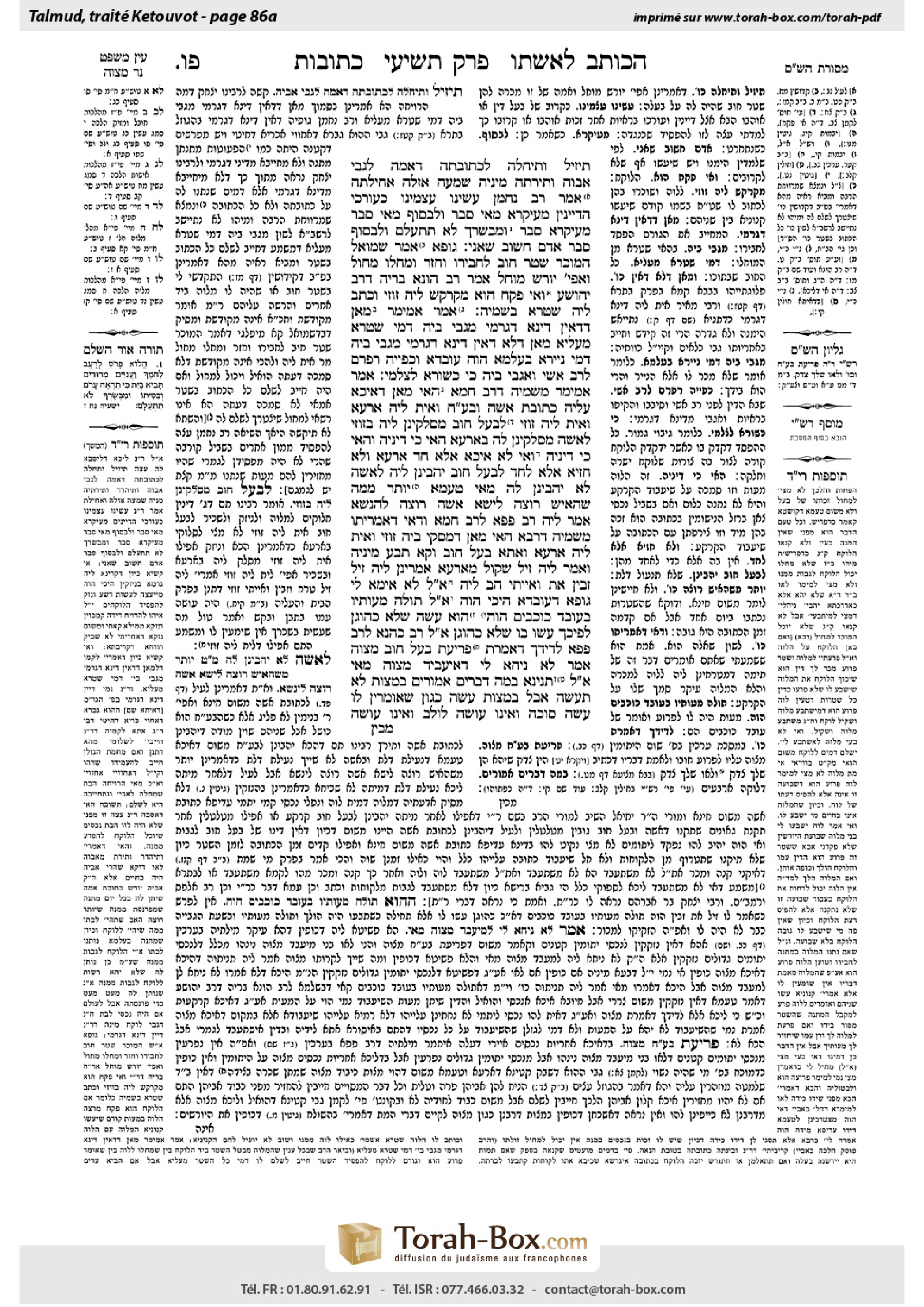
Ketubot 86a: Talmud study for Daf Yomi
Daf Yomi is the daily study of one Talmud folio. Explore 37 tractates with scans, Hebrew text, Sefaria English and AI-generated French translations where annotated.
Passage selection and English or AI-generated French translation are available where the scan has annotations. Daf Study is independent of Torah-Box and Sefaria.
Browse Ketubot · כתובות · All tractatesKetubot 86a text and translations
This page of Ketubot includes the Aramaic text, an English translation and an AI-generated French translation, alongside the scan above.
כתובות פ״ו א · Aramaic and Hebrew text
תֵּיזִיל וְתַיחֲלַהּ לִכְתוּבְּתַהּ דְּאִמַּהּ לְגַבֵּי אֲבוּהּ, וְתֵירְתַהּ מִינֵּיהּ. שְׁמַעָה אֲזַלָה אַחֵילְתַּהּ.
אֲמַר רַב נַחְמָן: עָשִׂינוּ עַצְמֵינוּ כְּעוֹרְכֵי הַדַּיָּינִין. מֵעִיקָּרָא מַאי סְבַר, וּלְבַסּוֹף מַאי סְבַר? מֵעִיקָּרָא סְבַר: ״וּמִבְּשָׂרְךָ לֹא תִתְעַלָּם״, וּלְבַסּוֹף סָבַר: אָדָם חָשׁוּב שָׁאנֵי.
גּוּפָא, אָמַר שְׁמוּאֵל: הַמּוֹכֵר שְׁטַר חוֹב לַחֲבֵירוֹ, וְחָזַר וּמְחָלוֹ — מָחוּל, וַאֲפִילּוּ יוֹרֵשׁ מוֹחֵל. אָמַר רַב הוּנָא בְּרֵיהּ דְּרַב יְהוֹשֻׁעַ: וְאִי פִּקֵּחַ הוּא, מְקַרְקֵשׁ לֵיהּ זוּזֵי, וְכָתֵב לֵיהּ שְׁטָרָא בִּשְׁמֵיהּ.
אָמַר אַמֵּימָר: מַאן דְּדָאֵין דִּינָא דִגְרָמֵי — מַגְבֵּי בֵּיהּ דְּמֵי שְׁטָרָא מְעַלְּיָא. מַאן דְּלָא דָּאֵין דִּינָא דְגַרְמֵי, מַגְבֵּי בֵּיהּ דְּמֵי נְיָירָא בְּעָלְמָא.
הֲוָה עוֹבָדָא וְכַפְיֵיהּ רַפְרָם לְרַב אָשֵׁי, וְאַגְבִּי בֵּיהּ כִּי כְשׁוּרָא לְצַלְמֵי.
אָמַר אַמֵּימָר מִשְּׁמֵיהּ דְּרַב חָמָא: הַאי מַאן דְּאִיכָּא עֲלֵיהּ כְּתוּבַּת אִשָּׁה וּבַעַל חוֹב, וְאִית לֵיהּ אַרְעָא וְאִית לֵיהּ זוּזֵי — לְבַעַל חוֹב מְסַלְּקִינַן לֵיהּ בְּזוּזֵי, לְאִשָּׁה מְסַלְּקִינַן לַהּ בְּאַרְעָא, הַאי כִּי דִינֵיהּ וְהַאי כִּי דִינֵיהּ.
וְאִי לָא אִיכָּא אֶלָּא חַד אַרְעָא וְלָא חַזְיָא אֶלָּא לְחַד — לְבַעַל חוֹב יָהֲבִינַן לֵיהּ, לְאִשָּׁה לָא יָהֲבִינַן לַהּ. מַאי טַעְמָא — יוֹתֵר מִמַּה שֶּׁהָאִישׁ רוֹצֶה לִישָּׂא, אִשָּׁה רוֹצָה לְהִנָּשֵׂא.
אֲמַר לֵיהּ רַב פָּפָּא לְרַב חָמָא: וַדַּאי דְּאָמְרִיתוּ מִשְּׁמֵיהּ דְּרָבָא, הַאי מַאן דְּמַסְּקִי בֵּיהּ זוּזֵי, וְאִית לֵיהּ אַרְעָא, וַאֲתָא בַּעַל חוֹב וְקָא תָבַע מִינֵּיהּ, וְאָמַר לֵיהּ: ״זִיל שְׁקוֹל מֵאַרְעָא״, אָמְרִינַן לֵיהּ: ״זִיל זַבֵּין אַתְּ, וְאַיְיתִי הַב לֵיהּ״? אֲמַר לֵיהּ: לָא.
אֵימָא לִי גּוּפָא דְעוֹבָדָא הֵיכִי הֲוָה. אֲמַר לֵיהּ: תּוֹלֶה מְעוֹתָיו בְּגוֹי הֲוָה, הוּא עָשָׂה שֶׁלֹּא כַּהוֹגֶן — לְפִיכָךְ עָשׂוּ בּוֹ שֶׁלֹּא כַּהוֹגֶן.
אֲמַר לֵיהּ רַב כָּהֲנָא לְרַב פָּפָּא: לְדִידָךְ דְּאָמְרַתְּ פְּרִיעַת בַּעַל חוֹב מִצְוָה, אָמַר: ״לָא נִיחָא לִי דְּאֶיעְבֵּיד מִצְוָה״, מַאי? אֲמַר לֵיהּ, תְּנֵינָא: בַּמֶּה דְּבָרִים אֲמוּרִים — בְּמִצְוַת לֹא תַעֲשֶׂה, אֲבָל בְּמִצְוַת עֲשֵׂה, כְּגוֹן שֶׁאוֹמְרִין לוֹ עֲשֵׂה סוּכָּה וְאֵינוֹ עוֹשֶׂה, לוּלָב וְאֵינוֹ עוֹשֶׂה —
Ketubot 86a · English translation
that she should go and forgive her mother’s marriage contract for her father, and she will subsequently inherit the sum of the marriage contract from him? The marriage contract is a document of the debt owed by her father to her mother. The daughter, who has inherited the document from her mother, can forgo her father’s obligation, so rendering nugatory the right of the purchasers. The father then retains the amount owed to the purchasers of the marriage contract, and his daughter will inherit that amount when he dies. The daughter heard this, and went and forgave her father’s obligation in the marriage contract, as recommended by Rav Naḥman.
Rav Naḥman later said in regret: We have made ourselves like advisors of judges. We have acted like lawyers who give practical advice to litigants rather than like independent judges. The Gemara asks: At the outset, what did he hold when he intended the daughter to hear his advice, and ultimately, what did he hold that made him regret his action? The Gemara explains: At the outset, he held that the verse teaches: “And you should not hide yourself from your own flesh” (Isaiah 58:7), and therefore it is correct to give help and advice to relatives. And ultimately he held that in the case of an important person who must be very careful to avoid any impression of having favored his family in judgment, the situation is different.
Since the Gemara had previously mentioned a halakha stated by Shmuel, it turns its attention to the matter itself. Shmuel said: With regard to one who sells a promissory note to another, and the seller went back and forgave the debtor his debt, it is forgiven, since the debtor essentially had a non-transferable obligation to the creditor alone, and even the creditor’s heir can forgive the debt. Rav Huna, son of Rav Yehoshua, said: And if the purchaser of the document is perspicacious, and is wary of such a ploy, he should jangle [mekarkesh] dinars in the debtor’s ears, i.e., he should pay the debtor or promise him money, and the debtor will write for him a new promissory note in the purchaser’s name, thereby preventing the latter from losing out.
Ameimar said: One who judges cases of liability for indirect damage and maintains that someone whose actions cause damage is obligated to pay, even if he has not directly harmed another, collects in this case the value of the proper document. Since by forgiving the loan the creditor voided the document and caused the purchaser financial loss, he must compensate the purchaser for the amount recorded in the document. One who does not judge cases of liability for indirect damage collects in this case only the value of the paper on which the document was written.
The Gemara relates that there was an incident like this one, and Rafram pressured Rav Ashi by means of verbal persuasion to render an unequivocal ruling in this matter, and Rav Ashi collected in this case as if he damaged a beam used for crafting a sculpture, i.e., the full value of the debt listed in the promissory note.
Ameimar said in the name of Rav Ḥama: With regard to one who has incumbent upon himself the obligation of his wife’s marriage contract and also owes money to a creditor, and he possesses land and possesses money, the obligation to the creditor is settled with the payment of money, whereas the debt to the woman of her marriage contract is settled with the payment of land, this one in accordance with his law, and that one in accordance with her law. Since the creditor gave him money, it is fitting that he should receive ready cash in return. The woman, in contrast, did not give him anything but relied upon the lien on his land, so she is therefore given land.
And if there is only one plot of land, and it is adequate for the payment of only one debt, we give it to the creditor, and we do not give it to the woman. What is the reason for this? Even more than a man wants to marry, a woman wants to be married. Women do not get married because they wish to receive their marriage contract. It is better to give preference to the creditor so that he will not lose out, so as not to discourage people from lending money.
Rav Pappa said to Rav Ḥama: Is it correct that you say in the name of Rava: With regard to one who owes money and has land, and the creditor comes and demands from him his money, and the debtor says to him: Go and take the amount you are owed from the land, we say to him: Go and sell the land yourself and give him money? Rav Ḥama said to him: I did not say this in the name of Rava.
Rav Pappa replied: Tell me the incident itself, what happened and what exactly occurred that caused this opinion to be attributed to Rava. Rav Ḥama said to him: The debtor was one who attached his money to a gentile. He possessed money, but he claimed that this money belonged to a gentile and therefore could not be demanded from him. This man acted improperly, and consequently, the Sages acted improperly with him by forcing him to sell the land.
Rav Kahana said to Rav Pappa: According to your opinion, that you say the repayment of a creditor is a mitzva, if the debtor said: It is not amenable to me to perform a mitzva, what would be the halakha? If there is no obligation to repay a loan other than to perform a mitzva, then what happens if someone is not interested in performing the mitzva? He said to him: We already learned this halakha in a baraita: In what case is this statement said, that one is liable to receive forty lashes for committing a transgression? It is said with regard to negative mitzvot. However, with regard to positive mitzvot, for example, if the court says to someone: Perform the mitzva of the sukka, and he does not do so, or: Perform the mitzva of the palm branch, and he does not do so,
Ketubot 86a · Traduction française (IA)
qu’elle aille renoncer, au profit de son père, à la créance de la ketouba de sa mère, puis qu’elle hérite de lui du montant de la ketouba ? La ketouba est un document constatant la dette de son père envers sa mère. La fille, qui a hérité du document de sa mère, peut renoncer à l’obligation de son père, annulant ainsi le droit des acheteurs. Le père conserve alors la somme due aux acheteurs de la ketouba, et sa fille héritera de cette somme à sa mort. La fille entendit cela, alla renoncer à l’obligation de son père au titre de la ketouba, comme Rav Naḥman le lui avait conseillé.
Rav Naḥman déclara plus tard, avec regret : « Nous nous sommes conduits comme des conseillers de juges. » Nous avons agi comme des avocats qui donnent des conseils pratiques aux plaideurs, plutôt que comme des juges indépendants. La Guemara demande : Au début, quelle était son opinion lorsqu’il voulait que la fille entende son conseil ? Et finalement, quelle opinion l’amena à regretter son geste ? La Guemara explique : Au début, il estimait que le verset enseigne : « Ne te dérobe pas à ton prochain » (Isaïe 58, 7), et qu’il convient donc d’aider ses proches et de leur donner des conseils. Mais finalement, il estima que la situation est différente lorsqu’il s’agit d’un personnage éminent, qui doit veiller particulièrement à ne pas donner l’impression d’avoir favorisé sa famille dans un jugement.
Comme la Guemara avait précédemment mentionné une halakha énoncée par Shmuel, elle revient à cette question. Shmuel dit : Si quelqu’un vend à autrui un billet à ordre, puis renonce à la dette du débiteur, celle-ci est annulée, car le débiteur était en réalité lié par une obligation non transférable envers le seul créancier ; même l’héritier du créancier peut renoncer à la dette. Rav Huna, fils de Rav Yehoshua, dit : Si l’acheteur du document est perspicace et se méfie d’une telle manœuvre, il doit faire tinter [mekarkesh] des dinars aux oreilles du débiteur, c’est-à-dire lui verser de l’argent ou lui en promettre, afin que le débiteur rédige un nouveau billet à ordre en faveur de l’acheteur, à son nom, et que celui-ci ne subisse ainsi aucune perte.
Ameimar dit : Celui qui statue que l’auteur d’un dommage indirect est tenu de payer, même s’il n’a pas directement porté atteinte à autrui, fait payer ici la valeur correspondant au montant dû selon le document. Puisque le créancier a annulé le document en renonçant à la dette, causant ainsi une perte financière à l’acheteur, il doit indemniser celui-ci à hauteur du montant inscrit sur le document. Celui qui ne statue pas dans les cas de responsabilité pour dommage indirect ne fait payer ici que la valeur du papier sur lequel le document a été rédigé.
La Guemara rapporte qu’un cas semblable se produisit : Rafram pressa Rav Ashi, par une argumentation orale, de rendre une décision sans équivoque sur cette question, et Rav Ashi fit payer dans ce cas comme s’il s’agissait du dommage causé à une poutre destinée à la sculpture, c’est-à-dire à hauteur de la valeur intégrale de la dette inscrite sur le billet à ordre.
Ameimar dit au nom de Rav Ḥama : Si quelqu’un est tenu de payer la ketouba de son épouse et doit également de l’argent à un créancier, et qu’il possède à la fois des terres et de l’argent, la dette envers le créancier est réglée en argent, tandis que la dette envers son épouse au titre de sa ketouba est réglée en terres : chacun selon son droit. Puisque le créancier lui a prêté de l’argent, il convient qu’il reçoive de l’argent comptant en retour. La femme, en revanche, ne lui a rien donné et s’est fiée au droit de gage sur ses terres ; on lui attribue donc des terres.
Et s’il n’y a qu’une seule parcelle de terre, suffisante pour régler une seule dette, on la donne au créancier, et non à la femme. Pourquoi ? Une femme désire être mariée encore plus qu’un homme ne désire se marier. Les femmes ne se marient pas dans le but de recevoir leur ketouba. Mieux vaut donner la priorité au créancier afin qu’il ne subisse pas de perte et que les gens ne soient pas dissuadés de prêter de l’argent.
Rav Pappa dit à Rav Ḥama : Est-il exact que tu dis au nom de Rava que, si quelqu’un doit de l’argent et possède des terres, et que le créancier vient lui réclamer son dû tandis que le débiteur lui dit : « Va prendre sur mes terres le montant qui t’est dû », on lui répond : « Va vendre toi-même les terres et donne-lui de l’argent » ? Rav Ḥama lui répondit : Je n’ai pas dit cela au nom de Rava.
Rav Pappa répondit : Raconte-moi l’incident lui-même : que s’est-il passé exactement pour que cette opinion soit attribuée à Rava ? Rav Ḥama lui dit : Le débiteur était quelqu’un qui avait confié son argent à un non-Juif. Il possédait de l’argent, mais prétendait qu’il appartenait à un non-Juif et qu’on ne pouvait donc pas le lui réclamer. Cet homme s’était conduit de façon inconvenante ; les Sages se conduisirent donc de façon inconvenante envers lui en le contraignant à vendre ses terres.
Rav Kahana dit à Rav Pappa : Selon ton opinion, puisque tu dis que rembourser un créancier est une mitsva, quelle serait la halakha si le débiteur disait : « Je ne suis pas disposé à accomplir une mitsva » ? Si l’on n’est tenu de rembourser un prêt que pour accomplir une mitsva, que se passe-t-il si quelqu’un ne souhaite pas accomplir cette mitsva ? Rav Pappa lui répondit : Nous avons déjà appris cette halakha dans une baraïta : Dans quel cas dit-on qu’on est passible de quarante coups de fouet pour avoir commis une transgression ? Cela concerne les mitsvot négatives. En revanche, pour les mitsvot positives, par exemple, si le tribunal dit à quelqu’un : « Accomplis la mitsva de la soukka », et qu’il ne le fait pas, ou : « Accomplis la mitsva du lulav », et qu’il ne le fait pas,
Traduction française générée par IA à partir de l’édition anglaise de Sefaria. Vérifie toujours un passage avec le texte source.
Text from Sefaria: William Davidson Edition - Vocalized Aramaic (CC BY NC); William Davidson Edition - English (CC BY NC).