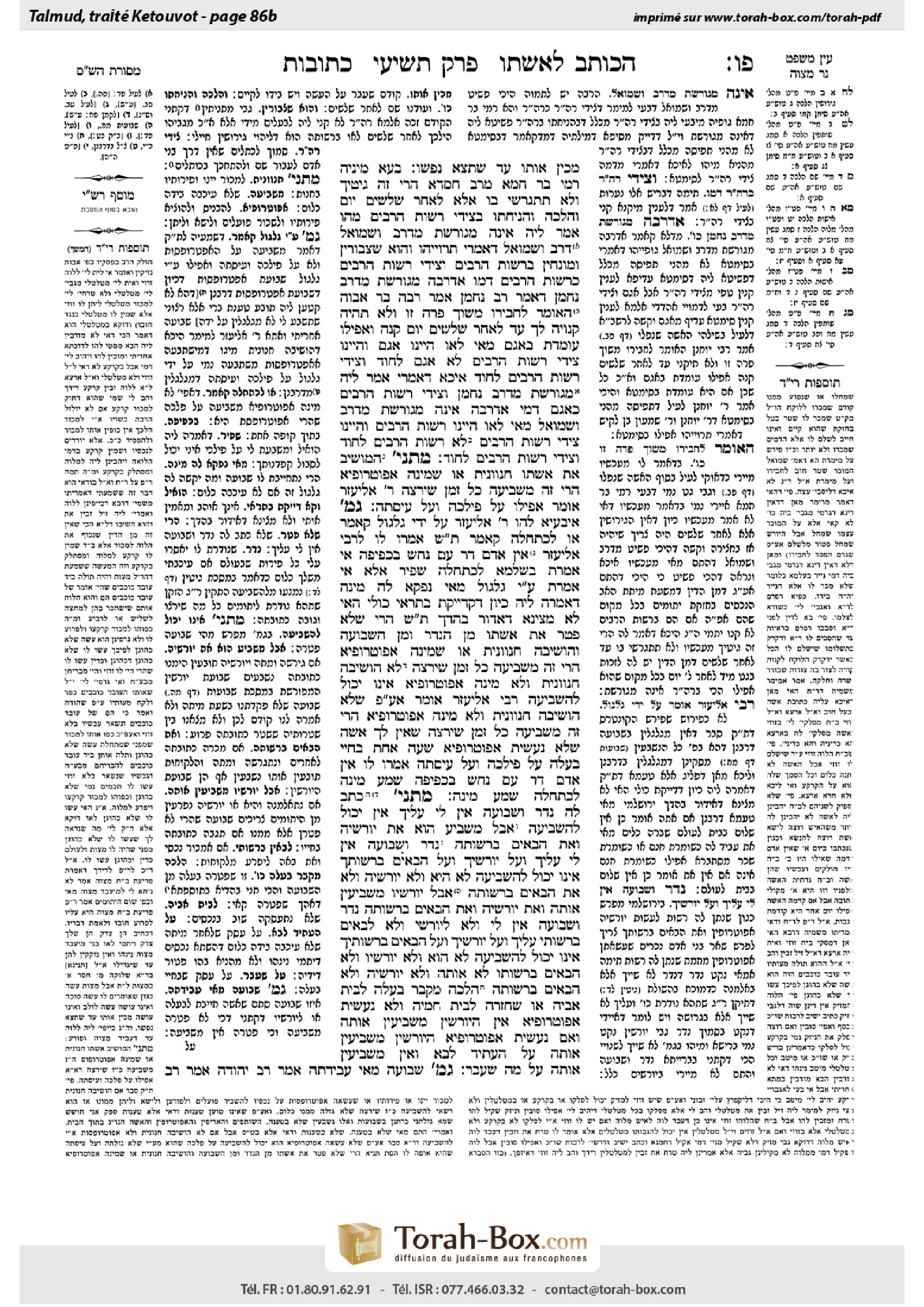
Ketubot 86b: Talmud study for Daf Yomi
Daf Yomi is the daily study of one Talmud folio. Explore 37 tractates with scans, Hebrew text, Sefaria English and AI-generated French translations where annotated.
Passage selection and English or AI-generated French translation are available where the scan has annotations. Daf Study is independent of Torah-Box and Sefaria.
Browse Ketubot · כתובות · All tractatesKetubot 86b text and translations
This page of Ketubot includes the Aramaic text, an English translation and an AI-generated French translation, alongside the scan above.
כתובות פ״ו ב · Aramaic and Hebrew text
מַכִּין אוֹתוֹ עַד שֶׁתֵּצֵא נַפְשׁוֹ.
בְּעָא מִינֵּיהּ רָמֵי בַּר חָמָא מֵרַב חִסְדָּא: ״הֲרֵי זֶה גִּיטֵּיךְ, וְלֹא תִּתְגָּרְשִׁי בּוֹ אֶלָּא לְאַחַר שְׁלֹשִׁים יוֹם״, וְהָלְכָה וְהִנִּיחַתּוּ בְּצִידֵּי רְשׁוּת הָרַבִּים, מַהוּ?
אֲמַר לֵיהּ: אֵינָהּ מְגוֹרֶשֶׁת, מִדְּרַב וּשְׁמוּאֵל. דְּרַב וּשְׁמוּאֵל דְּאָמְרִי תַּרְוַיְיהוּ, וְהוּא שֶׁצְּבוּרִין וּמוּנָּחִין בִּרְשׁוּת הָרַבִּים, וְצִידֵּי רְשׁוּת הָרַבִּים כִּרְשׁוּת הָרַבִּים דָּמוּ.
אַדְּרַבָּה, מְגוֹרֶשֶׁת, מִדְּרַב נַחְמָן. דְּאָמַר רַב נַחְמָן אָמַר רַבָּה בַּר אֲבוּהּ: הָאוֹמֵר לַחֲבֵירוֹ: ״מְשׁוֹךְ פָּרָה זוֹ, וְלֹא תִּהְיֶה קְנוּיָה לָךְ עַד לְאַחַר שְׁלֹשִׁים יוֹם״ — קָנָה, וַאֲפִילּוּ עוֹמֶדֶת בַּאֲגַם. מַאי לָאו: הַיְינוּ אֲגַם, וְהַיְינוּ צִידֵּי רְשׁוּת הָרַבִּים? לָא, אֲגַם לְחוּד וְצִידֵּי רְשׁוּת הָרַבִּים לְחוּד.
אִיכָּא דְאָמְרִי, אֲמַר לֵיהּ: מְגוֹרֶשֶׁת, מִדְּרַב נַחְמָן. וְצִידֵּי רְשׁוּת הָרַבִּים כַּאֲגַם דָּמֵי. אַדְּרַבָּה: אֵינָהּ מְגוֹרֶשֶׁת, מִדְּרַב וּשְׁמוּאֵל. מַאי לָאו: הַיְינוּ ״רְשׁוּת הָרַבִּים״, וְהַיְינוּ ״צִידֵּי רְשׁוּת הָרַבִּים״. לָא, רְשׁוּת הָרַבִּים לְחוֹד, וְצִידֵּי רְשׁוּת הָרַבִּים לְחוֹד.
מַתְנִי׳ הַמּוֹשִׁיב אֶת אִשְׁתּוֹ חֶנְווֹנִית, אוֹ שֶׁמִּינָּהּ אַפּוֹטְרוֹפְּיָא — הֲרֵי זֶה מַשְׁבִּיעָהּ כׇּל זְמַן שֶׁיִּרְצֶה. רַבִּי אֱלִיעֶזֶר אוֹמֵר: אֲפִילּוּ עַל פִּילְכָּהּ וְעַל עִיסָּתָהּ.
גְּמָ׳ אִיבַּעְיָא לְהוּ: רַבִּי אֱלִיעֶזֶר עַל יְדֵי גִלְגּוּל קָאָמַר — אוֹ לְכַתְּחִלָּה קָאָמַר?
תָּא שְׁמַע, אָמְרוּ לוֹ לְרַבִּי אֱלִיעֶזֶר: אֵין אָדָם דָּר עִם נָחָשׁ בִּכְפִיפָה. אִי אָמְרַתְּ בִּשְׁלָמָא לְכַתְּחִלָּה — שַׁפִּיר. אֶלָּא אִי אָמְרַתְּ עַל יְדֵי גִלְגּוּל, מַאי נָפְקָא לַהּ מִינַּהּ?
דְּאָמְרָה לֵיהּ: כֵּיוָן דְּקָדָיְיקַתְּ בָּתְרַאי כּוּלֵּי הַאי — לָא מָצְיָנָא דְּאֵדוּר בַּהֲדָךְ.
תָּא שְׁמַע: הֲרֵי שֶׁלֹּא פָּטַר אֶת אִשְׁתּוֹ מִן הַנֶּדֶר וּמִן הַשְּׁבוּעָה, וְהוֹשִׁיבָהּ חֶנְווֹנִית, אוֹ שֶׁמִּינָהּ אַפּוֹטְרוֹפְּיָא — הֲרֵי זֶה מַשְׁבִּיעָהּ כׇּל זְמַן שֶׁיִּרְצֶה. לֹא הוֹשִׁיבָהּ חֶנְווֹנִית, וְלֹא מִינָּהּ אַפּוֹטְרוֹפְּיָא — אֵינוֹ יָכוֹל לְהַשְׁבִּיעָהּ.
רַבִּי אֱלִיעֶזֶר אוֹמֵר: אַף עַל פִּי שֶׁלֹּא הוֹשִׁיבָהּ חֶנְווֹנִית, וְלֹא מִינָּהּ אַפּוֹטְרוֹפְּיָא — הֲרֵי זֶה מַשְׁבִּיעָהּ כׇּל זְמַן שֶׁיִּרְצֶה, שֶׁאֵין לְךָ אִשָּׁה שֶׁלֹּא נַעֲשֵׂית אַפּוֹטְרוֹפְּיָא שָׁעָה אַחַת בְּחַיֵּי בַּעְלָהּ עַל פִּילְכָּהּ וְעַל עִיסָּתָהּ. אָמְרוּ לוֹ: אֵין אָדָם דָּר עִם נָחָשׁ בִּכְפִיפָה. שְׁמַע מִינָּהּ לְכַתְּחִלָּה שְׁמַע מִינָּהּ.
מַתְנִי׳ כָּתַב לָהּ ״נֶדֶר וּשְׁבוּעָה אֵין לִי עָלַיִךְ״ — אֵין יָכוֹל לְהַשְׁבִּיעָהּ, אֲבָל מַשְׁבִּיעַ הוּא אֶת יוֹרְשֶׁיהָ, וְאֶת הַבָּאִים בִּרְשׁוּתָהּ.
״נֶדֶר וּשְׁבוּעָה אֵין לִי עָלַיִךְ וְעַל יוֹרְשַׁיִךְ וְעַל הַבָּאִים בְּרִשּׁוּתֶיךָ״ — אֵינוֹ יָכוֹל לְהַשְׁבִּיעָהּ, לֹא הִיא, וְלֹא יוֹרְשֶׁיהָ, וְלֹא אֶת הַבָּאִים בִּרְשׁוּתָהּ. אֲבָל יוֹרְשָׁיו מַשְׁבִּיעִין אוֹתָהּ וְאֶת יוֹרְשֶׁיהָ, וְאֶת הַבָּאִים בִּרְשׁוּתָהּ.
״נֶדֶר וּשְׁבוּעָה אֵין לִי, וְלֹא לְיוֹרְשַׁי, וְלֹא לַבָּאִים בִּרְשׁוּתִי עָלַיִךְ, וְעַל יוֹרְשַׁיִךְ, וְעַל הַבָּאִים בִּרְשׁוּתִיךְ״ — אֵינוֹ יָכוֹל לְהַשְׁבִּיעָהּ, לֹא הוּא וְלֹא יוֹרְשָׁיו וְלֹא הַבָּאִים בִּרְשׁוּתוֹ, לֹא אוֹתָהּ וְלֹא יוֹרְשֶׁיהָ, וְלֹא הַבָּאִים בִּרְשׁוּתָהּ.
הָלְכָה מִקֶּבֶר בַּעְלָהּ לְבֵית אָבִיהָ, אוֹ שֶׁחָזְרָה לְבֵית חָמִיהָ וְלֹא נַעֲשֵׂית אַפּוֹטְרוֹפְּיָא — אֵין הַיּוֹרְשִׁין מַשְׁבִּיעִין אוֹתָהּ. וְאִם נַעֲשֵׂית אַפּוֹטְרוֹפְּיָא — הַיּוֹרְשִׁין מַשְׁבִּיעִין אוֹתָהּ עַל הֶעָתִיד לָבֹא, וְאֵין מַשְׁבִּיעִין אוֹתָהּ עַל מַה שֶּׁעָבַר.
גְּמָ׳ שְׁבוּעָה מַאי עֲבִידְתֵּהּ? אָמַר רַב יְהוּדָה אָמַר רַב:
Ketubot 86b · English translation
the court strikes him an unlimited number of times, even until his soul departs, in order to force him to perform the mitzva. The payment of a debt is a positive mitzva, and one who refuses to pay a debt can be compelled to do so in this manner.
§ Rami bar Ḥama inquired of Rav Ḥisda: If a man said to his wife: This is your bill of divorce but you are divorced with it only after thirty days, and she took the bill of divorce and went and placed it in the sides of the public domain, i.e., in a place that was open to the public domain but not an actual part of it, and the bill of divorce was still there after thirty days, what is the halakha? Is she divorced?
Rav Ḥisda said to him: She is not divorced. This halakha is learned from the opinion of Rav and Shmuel, as it is Rav and Shmuel who both say with regard to the mishna: Any of the creditors of a deceased person can seize items of his movable property provided that they are arranged in piles and placed in the public domain, as in that case the heirs of the deceased do not receive it as part of their inheritance. Similarly, the woman will not acquire the bill of divorce after thirty days if it is in that location. Rav Ḥisda adds: And the sides of the public domain are considered like the public domain.
Rami bar Ḥama responded: On the contrary, she is divorced, in accordance with the opinion of Rav Naḥman, as Rav Naḥman said that Rabba bar Avuh said: With regard to one who says to his friend: Go and pull this cow now and it will be acquired by you only after thirty days, he has acquired the cow. And this is true even if the cow was standing after those thirty days in an ownerless meadow [agam]. Since the acquisition began properly at the start of the thirty-day period, it applies even after the thirty-day period. What, is it not the case that this is the halakha of a meadow and this is also the halakha of the sides of the public domain, as the two places have a similar status? Rav Ḥisda rejects this argument: No, the case of a meadow is discrete, and the case of the sides of the public domain is discrete, as the latter is considered an actual part of the public domain, and an ownerless meadow is not.
Some say a different version of the dispute between Rami bar Ḥama and Rav Ḥisda, in which Rav Ḥisda said to Rami bar Ḥama: She is divorced, based on the ruling of Rav Naḥman pertaining to acquiring a cow, and the sides of the public domain are considered like a meadow. In this version, it was Rami bar Ḥama who replied: On the contrary, she is not divorced, as can be learned from the opinion of Rav and Shmuel pertaining to seizing objects in the public domain. What, is it not the case that this is the halakha of the public domain and this is similarly the halakha of the sides of the public domain? Rav Ḥisda responded: No, the public domain is discrete and the sides of the public domain are discrete.
MISHNA: If there is one who establishes his wife as a storekeeper in his store, or if he appointed her as a steward to handle his property and workers, this one, i.e., the husband, can administer an oath to her, having her state that she did not appropriate any of his possessions, whenever he wants. Rabbi Eliezer says: He can administer an oath even with regard to the products of her spindle and for her dough, which are matters related to the household, and not her function as a storekeeper.
GEMARA: A dilemma was raised before the Sages: When Rabbi Eliezer says that a husband can administer an oath to her with regard to any item, is he saying that this is by means of extension of an oath, i.e., once he administers an oath to her in her capacity as his storekeeper he can extend the oath to cover other matters, or, is he saying that he can administer an oath to her ab initio?
The Gemara suggests: Come and hear a solution from a baraita: The Rabbis said to Rabbi Eliezer: A person does not reside in a basket with a snake. A woman is not expected to live with a husband who constantly suspects her of stealing. The Gemara explains: Granted, if you say that Rabbi Eliezer is referring to an oath administered ab initio, the Rabbis spoke well. However, if you say that the husband can administer an oath only by means of an extension of an oath, what difference does it make to her? As she must take an oath with regard to matters that concern the store, it does not cause any greater difficulty for her to take an oath with regard to the household matters.
The Gemara refutes this argument, as it is possible that she says to him: Since you are so exacting with me, I cannot live with you. Even if there is no additional oath, the sentiment engendered by his demand is grounds for dissatisfaction, and there is no proof that Rabbi Eliezer holds that he can administer an oath to her ab initio.
The Gemara suggests another proof. Come and hear a proof from a baraita: With regard to one who did not exempt his wife in the marriage contract from a vow and from an oath, and he established her as his storekeeper or appointed her as his steward, he can administer an oath to her whenever he wants. If he did not establish her as his storekeeper or appoint her as his steward, he cannot administer an oath to her.
The baraita continues: Rabbi Eliezer says: Although he did not establish her as his storekeeper or appoint her as his steward, he can administer an oath to her whenever he wants, as you have no wife who did not become a steward for one hour in her husband’s lifetime at least for her spindle and for her dough. The Rabbis said to him: A person does not reside in a basket with a snake. One can conclude from this that according to Rabbi Eliezer a husband can administer an oath to his wife with regard to her conduct, even ab initio. The Gemara concludes: Conclude from it that it is so.
MISHNA: If one wrote to his wife in the marriage contract: I do not have the right to administer a vow or an oath upon you, he cannot administer an oath to her. However, he can administer an oath to her heirs, and to those who come on her authority, either as her representatives or because they purchased her marriage contract.
If the husband wrote: I do not have the right to administer a vow or an oath upon you, or upon your heirs, or upon those who come on your authority, he cannot administer an oath to her; not to her, nor her heirs, nor those who come on her authority. But the husband’s heirs can administer an oath to her, and to her heirs, and to those who come on her authority.
If he wrote: Neither I, nor my heirs, nor those who come on my authority have the right to administer a vow or an oath upon you, or upon your heirs, or upon those who come on your authority, he cannot administer an oath to her or to them; not he, nor his heirs, nor those who come on his authority may administer an oath, not to her, nor to her heirs, nor to those who come on her authority.
If a woman who was exempted from an oath by her husband went from her husband’s grave, immediately after her husband’s death, to her father’s house, without handling her late husband’s property, or in a case where she returned to her father-in-law’s house and did not become a steward over the property at all throughout this period, then the heirs cannot administer an oath to her with regard to her actions in their father’s lifetime, as the husband exempted her from an oath to the heirs. And if she became a steward, the heirs may administer an oath to her about the future, i.e., anything she did with the property after the death of her husband, but they cannot administer an oath to her with regard to what took place in the past, during her husband’s lifetime.
GEMARA: The Gemara asks: What is the purpose of an oath? What oath can he administer to her that caused him to add this condition to her marriage contract? Rav Yehuda said that Rav said:
Ketubot 86b · Traduction française (IA)
Le tribunal le frappe sans limite, même jusqu’à ce que son âme le quitte, afin de le contraindre à accomplir la mitsva. Le paiement d’une dette est une mitsva positive, et celui qui refuse de payer une dette peut être contraint de cette manière.
§ Rami bar Ḥama demanda à Rav Ḥisda : Si un homme dit à sa femme : « Voici ton acte de divorce, mais tu ne seras divorcée par celui-ci qu’au bout de trente jours », et qu’elle prend l’acte de divorce, s’en va et le dépose en bordure du domaine public, c’est-à-dire dans un endroit ouvert sur le domaine public, mais qui n’en fait pas réellement partie, et que l’acte de divorce s’y trouve encore au bout de trente jours, quelle est la halakha ? Est-elle divorcée ?
Rav Ḥisda lui dit : Elle n’est pas divorcée. Cette halakha s’apprend de l’avis de Rav et de Shmuel, car tous deux disent, à propos de la Michna : N’importe lequel des créanciers d’un défunt peut saisir des biens meubles lui ayant appartenu, à condition qu’ils soient disposés en tas et placés dans le domaine public, car dans ce cas, les héritiers du défunt ne les reçoivent pas dans le cadre de leur héritage. De même, la femme n’acquerra pas l’acte de divorce au bout de trente jours s’il se trouve à cet endroit. Rav Ḥisda ajoute : Les abords du domaine public sont considérés comme le domaine public.
Rami bar Ḥama répondit : Au contraire, elle est divorcée, conformément à l’avis de Rav Naḥman, car Rav Naḥman a dit que Rabba bar Avuh a dit : Si quelqu’un dit à son ami : « Va tirer cette vache maintenant, et elle ne sera acquise par toi qu’au bout de trente jours », celui-ci acquiert la vache. Cela reste vrai même si, au bout de ces trente jours, la vache se trouve dans un pré sans propriétaire [agam]. Puisque l’acquisition a commencé correctement au début de la période de trente jours, elle prend effet même après cette période. N’est-il pas vrai que la halakha applicable à un pré est aussi applicable aux abords du domaine public, ces deux endroits ayant un statut semblable ? Rav Ḥisda rejette cet argument : Non, le cas d’un pré est distinct de celui des abords du domaine public, car ces derniers sont considérés comme faisant réellement partie du domaine public, contrairement à un pré sans propriétaire.
Certains rapportent une autre version de la controverse entre Rami bar Ḥama et Rav Ḥisda. Rav Ḥisda dit à Rami bar Ḥama : Elle est divorcée, selon la décision de Rav Naḥman concernant l’acquisition d’une vache, et les abords du domaine public sont considérés comme un pré. Dans cette version, Rami bar Ḥama répondit : Au contraire, elle n’est pas divorcée, comme on peut l’apprendre de l’avis de Rav et de Shmuel concernant la saisie d’objets dans le domaine public. N’est-il pas vrai que la halakha applicable au domaine public est aussi applicable aux abords du domaine public ? Rav Ḥisda répondit : Non, le domaine public est distinct des abords du domaine public.
MICHNA : Si un homme établit sa femme comme commerçante dans son magasin, ou s’il la nomme intendante chargée de ses biens et de ses ouvriers, il peut, lui, c’est-à-dire le mari, lui faire prêter serment quand il le veut, en lui faisant déclarer qu’elle ne s’est approprié aucun de ses biens. Rabbi Eliezer dit : Il peut lui faire prêter serment même au sujet des produits de son fuseau et de sa pâte, c’est-à-dire sur des questions liées au foyer et non à sa fonction de commerçante.
GUEMARA : Les Sages posèrent une question : Lorsque Rabbi Eliezer dit que le mari peut lui faire prêter serment au sujet de n’importe quel élément, veut-il dire qu’il peut le faire par extension d’un serment, c’est-à-dire qu’après lui avoir fait prêter serment en sa qualité de commerçante, il peut étendre le serment à d’autres sujets, ou veut-il dire qu’il peut d’emblée lui faire prêter serment ?
La Guemara propose : Viens et entends une réponse tirée d’une baraïta : Les Sages dirent à Rabbi Eliezer : « Un homme ne vit pas dans un panier avec un serpent. » Une femme n’est pas censée vivre avec un mari qui la soupçonne constamment de voler. La Guemara explique : Il est compréhensible que les Sages aient bien parlé si l’on dit que Rabbi Eliezer fait référence à un serment imposé d’emblée. En revanche, si l’on dit que le mari ne peut lui faire prêter serment que par extension d’un serment, en quoi cela la gêne-t-il ? Puisqu’elle doit prêter serment au sujet des affaires du magasin, prêter aussi serment au sujet des questions du foyer ne lui cause pas de difficulté supplémentaire.
La Guemara réfute cet argument : il est possible qu’elle lui dise : « Puisque tu es si pointilleux avec moi, je ne peux pas vivre avec toi. » Même s’il n’y a pas de serment supplémentaire, le sentiment suscité par sa demande suffit à lui causer du mécontentement ; on ne peut donc pas en déduire que, selon Rabbi Eliezer, il peut d’emblée lui faire prêter serment.
La Guemara propose une autre preuve. Viens et entends une preuve tirée d’une baraïta : Celui qui n’a pas exempté sa femme, dans le contrat de mariage, d’un vœu et d’un serment, et qui l’a établie comme commerçante ou nommée intendante, peut lui faire prêter serment quand il le veut. S’il ne l’a pas établie comme commerçante ni nommée intendante, il ne peut pas lui faire prêter serment.
La baraïta poursuit : Rabbi Eliezer dit : Même s’il ne l’a pas établie comme commerçante ni nommée intendante, il peut lui faire prêter serment quand il le veut, car il n’existe aucune femme qui n’ait pas été intendante pendant au moins une heure au cours de la vie de son mari, ne serait-ce que pour son fuseau et sa pâte. Les Sages lui dirent : « Un homme ne vit pas dans un panier avec un serpent. » On peut en conclure que, selon Rabbi Eliezer, un mari peut faire prêter serment à sa femme au sujet de sa conduite, même d’emblée. La Guemara conclut : Déduis-en que c’est bien le cas.
MICHNA : Si quelqu’un a écrit à sa femme dans le contrat de mariage : « Je n’ai pas le droit de t’imposer un vœu ou un serment », il ne peut pas lui faire prêter serment. Cependant, il peut faire prêter serment à ses héritiers et à ceux qui tiennent leurs droits d’elle, soit comme ses représentants, soit parce qu’ils ont acheté son contrat de mariage.
Si le mari a écrit : « Je n’ai pas le droit de t’imposer un vœu ou un serment, ni à tes héritiers ni à ceux qui tiennent leurs droits de toi », il ne peut faire prêter serment ni à elle, ni à ses héritiers, ni à ceux qui tiennent leurs droits d’elle. Mais les héritiers du mari peuvent faire prêter serment à la femme, à ses héritiers et à ceux qui tiennent leurs droits d’elle.
S’il a écrit : « Ni moi, ni mes héritiers, ni ceux qui tiennent leurs droits de moi n’avons le droit de t’imposer un vœu ou un serment, ni à tes héritiers ni à ceux qui tiennent leurs droits de toi », il ne peut faire prêter serment ni à elle ni à eux ; ni lui, ni ses héritiers, ni ceux qui tiennent leurs droits de lui ne peuvent faire prêter serment, ni à elle, ni à ses héritiers, ni à ceux qui tiennent leurs droits d’elle.
Si une femme que son mari a exemptée d’un serment se rend, immédiatement après sa mort, du tombeau de son mari chez son père, sans s’occuper des biens de son défunt mari, ou si elle retourne chez son beau-père et ne devient à aucun moment intendante des biens pendant cette période, les héritiers ne peuvent pas lui faire prêter serment au sujet de sa conduite du vivant de leur père, puisque son mari l’a exemptée de tout serment à leur égard. Et si elle est devenue intendante, les héritiers peuvent lui faire prêter serment au sujet de la période ultérieure, c’est-à-dire de tout ce qu’elle a fait des biens après la mort de son mari, mais ils ne peuvent pas lui faire prêter serment au sujet du passé, de ce qui s’est produit du vivant de son mari.
GUEMARA : La Guemara demande : À quoi sert un serment ? Quel serment peut-il lui faire prêter, au point d’avoir ajouté cette clause à son contrat de mariage ? Rav Yehouda a dit au nom de Rav :
Traduction française générée par IA à partir de l’édition anglaise de Sefaria. Vérifie toujours un passage avec le texte source.
Text from Sefaria: William Davidson Edition - Vocalized Aramaic (CC BY NC); William Davidson Edition - English (CC BY NC).