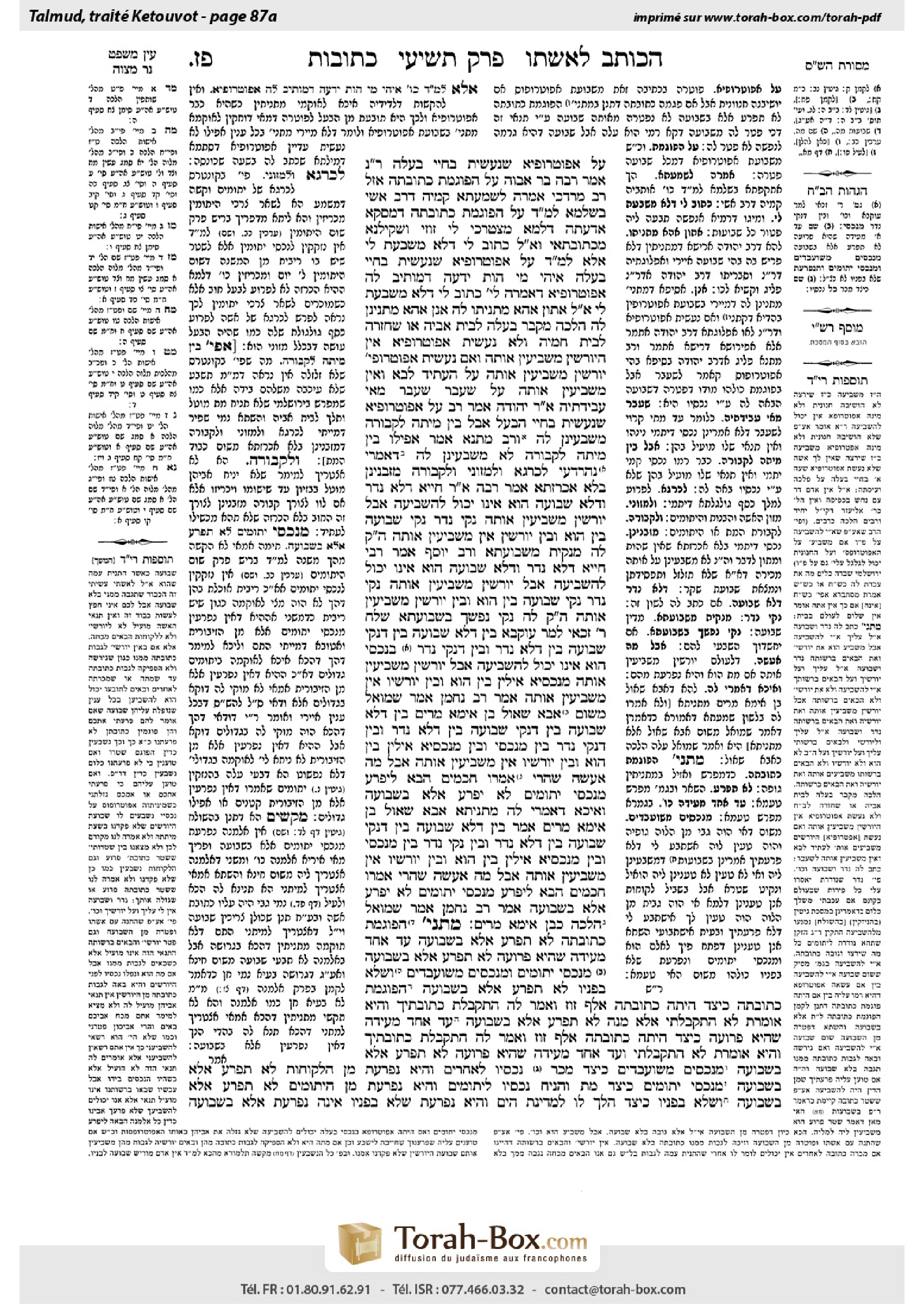
Ketubot 87a: Talmud study for Daf Yomi
Daf Yomi is the daily study of one Talmud folio. Explore 37 tractates with scans, Hebrew text, Sefaria English and AI-generated French translations where annotated.
Passage selection and English or AI-generated French translation are available where the scan has annotations. Daf Study is independent of Torah-Box and Sefaria.
Browse Ketubot · כתובות · All tractatesKetubot 87a text and translations
This page of Ketubot includes the Aramaic text, an English translation and an AI-generated French translation, alongside the scan above.
כתובות פ״ז א · Aramaic and Hebrew text
עַל אַפּוֹטְרוֹפְּיָא שֶׁנַּעֲשֵׂית בְּחַיֵּי בַעְלָהּ. רַב נַחְמָן אָמַר רַבָּה בַּר אֲבוּהּ: עַל הַפּוֹגֶמֶת כְּתוּבָּתָהּ.
אֲזַל רַב מָרְדֳּכַי, אַמְרַהּ לִשְׁמַעְתָּא קַמֵּיהּ דְּרַב אָשֵׁי: בִּשְׁלָמָא לְמַאן דְּאָמַר עַל הַפּוֹגֶמֶת כְּתוּבָּתָהּ — דְּמַסְּקָא אַדַּעְתַּהּ: דִּלְמָא מִצְטָרְכִי לִי זוּזֵי וְשָׁקֵילְנָא מִכְּתוּבְּתַאי, וְאָמְרָה לֵיהּ: כְּתוֹב לִי דְּלָא מַשְׁבְּעַתְּ לִי. אֶלָּא לְמַאן דְּאָמַר עַל אַפּוֹטְרוֹפְּיָא שֶׁנַּעֲשֵׂית בְּחַיֵּי בַעְלָהּ, אִיהִי מִי הֲוָת יָדְעָה דְּמוֹתֵיב לַהּ אַפּוֹטְרוֹפְּיָא, דְּאָמְרָה לֵיהּ: ״כְּתוֹב לִי דְּלָא מַשְׁבְּעַתְּ לִי״?
אֲמַר לֵיהּ: אַתּוּן, אַהָא מַתְנִיתוּ לַהּ, אֲנַן אַהָא מַתְנֵינַן לַהּ: הָלְכָה מִקֶּבֶר בַּעְלָהּ לְבֵית אָבִיהָ, אוֹ שֶׁחָזְרָה לְבֵית חָמִיהָ וְלֹא נַעֲשֵׂית אַפּוֹטְרוֹפְּיָא — אֵין הַיּוֹרְשִׁין מַשְׁבִּיעִין אוֹתָהּ. וְאִם נַעֲשֵׂית אַפּוֹטְרוֹפְּיָא — יוֹרְשִׁין מַשְׁבִּיעִין אוֹתָהּ עַל הֶעָתִיד לָבֹא, וְאֵין מַשְׁבִּיעִין אוֹתָהּ עַל שֶׁעָבַר.
שֶׁעָבַר מַאי עֲבִידְתֵּיהּ? אָמַר רַב יְהוּדָה אָמַר רַב: עַל אַפּוֹטְרוֹפְּיָא שֶׁנַּעֲשֵׂית בְּחַיֵּי הַבַּעַל,
אֲבָל בֵּין מִיתָה לִקְבוּרָה מַשְׁבְּעִינַן לַהּ. וְרַב מַתְנָא אָמַר: אֲפִילּוּ בֵּין מִיתָה לִקְבוּרָה לָא מַשְׁבְּעִינַן לַהּ, דְּאָמְרִי נְהַרְדָּעֵי: לִכְרָגָא וְלִמְזוֹנֵי וְלִקְבוּרָה — מְזַבְּנִינַן בְּלָא אַכְרָזְתָּא.
אָמַר רַבָּה אָמַר רַבִּי חִיָּיא: ״דְּלָא נֶדֶר וּדְלָא שְׁבוּעָה״ — הוּא אֵינוֹ יָכוֹל לְהַשְׁבִּיעָהּ, אֲבָל יוֹרְשִׁין מַשְׁבִּיעִין אוֹתָהּ. ״נְקִי נֶדֶר נְקִי שְׁבוּעָה״ — בֵּין הוּא וּבֵין יוֹרְשִׁין אֵין מַשְׁבִּיעִין אוֹתָהּ. הָכִי קָאָמַר לַהּ: מְנַקְּיַתְּ מִשְּׁבוּעֲתָא.
וְרַב יוֹסֵף אָמַר רַבִּי חִיָּיא: ״דְּלָא נֶדֶר וּדְלָא שְׁבוּעָה״ — הוּא אֵינוֹ יָכוֹל לְהַשְׁבִּיעָהּ, אֲבָל יוֹרְשִׁין מַשְׁבִּיעִין אוֹתָהּ. ״נְקִי נֶדֶר נְקִי שְׁבוּעָה״ — בֵּין הוּא וּבֵין יוֹרְשִׁין מַשְׁבִּיעִין אוֹתָהּ. הָכִי קָאָמַר לַהּ: נַקַּי נַפְשִׁךְ בִּשְׁבוּעֲתָא.
שְׁלַח רַבִּי זַכַּאי לְמָר עוּקְבָא: בֵּין ״דְּלָא שְׁבוּעָה״, בֵּין ״דִּנְקִי שְׁבוּעָה״, בֵּין ״דְּלָא נֶדֶר״ וּבֵין ״דִּנְקִי נֶדֶר״ — ״בְּנִכְסַי״ הוּא אֵינוֹ יָכוֹל לְהַשְׁבִּיעָהּ, אֲבָל יוֹרְשִׁין מַשְׁבִּיעִין אוֹתָהּ. מִנִּכְסַיָּא אִילֵּין — בֵּין הוּא וּבֵין יוֹרְשָׁיו אֵין מַשְׁבִּיעִין אוֹתָהּ.
אָמַר רַב נַחְמָן אָמַר שְׁמוּאֵל מִשּׁוּם אַבָּא שָׁאוּל בֶּן אִימָּא מִרְיָם: בֵּין ״דְּלָא שְׁבוּעָה״, בֵּין ״דִּנְקִי שְׁבוּעָה״, בֵּין ״דְּלָא נֶדֶר״, וּבֵין ״דִּנְקִי נֶדֶר״, בֵּין ״מִנִּכְסַי״, וּבֵין ״מִנִּכְסַיָּא אִילֵּין״ — בֵּין הוּא וּבֵין יוֹרְשָׁיו אֵין מַשְׁבִּיעִין אוֹתָהּ. אֲבָל מָה אֶעֱשֶׂה שֶׁהֲרֵי אָמְרוּ חֲכָמִים: הַבָּא לִיפָּרַע מִנִּכְסֵי יְתוֹמִים לֹא יִפָּרַע אֶלָּא בִּשְׁבוּעָה.
וְאִיכָּא דְּאָמְרִי לַהּ, מַתְנִיתָא אַבָּא שָׁאוּל בֶּן אִימָּא מִרְיָם אָמַר: בֵּין ״דְּלָא שְׁבוּעָה״, בֵּין ״דִּנְקִי שְׁבוּעָה״, בֵּין ״דְּלָא נֶדֶר״, וּבֵין ״נְקִי נֶדֶר״, בֵּין ״מִנִּכְסֵי״, וּבֵין ״מִנִּכְסַיָּא אִילֵּין״ — בֵּין הוּא וּבֵין יוֹרְשָׁיו אֵין מַשְׁבִּיעִין אוֹתָהּ, אֲבָל מָה אֶעֱשֶׂה שֶׁהֲרֵי אָמְרוּ חֲכָמִים: הַבָּא לִיפָּרַע מִנִּכְסֵי יְתוֹמִים לֹא יִפָּרַע אֶלָּא בִּשְׁבוּעָה. אָמַר רַב נַחְמָן אָמַר שְׁמוּאֵל: הֲלָכָה כְּבֶן אִימָּא מִרְיָם.
מַתְנִי׳ הַפּוֹגֶמֶת כְּתוּבָּתָהּ — לֹא תִּפָּרַע אֶלָּא בִּשְׁבוּעָה. עֵד אֶחָד מְעִידָהּ שֶׁהִיא פְּרוּעָה — לֹא תִּפָּרַע אֶלָּא בִּשְׁבוּעָה. מִנִּכְסֵי יְתוֹמִים, וּמִנְּכָסִים מְשׁוּעְבָּדִים, וְשֶׁלֹּא בְּפָנָיו — לֹא תִּפָּרַע אֶלָּא בִּשְׁבוּעָה.
הַפּוֹגֶמֶת כְּתוּבָּתָהּ כֵּיצַד? הָיְתָה כְּתוּבָּתָהּ אֶלֶף זוּז, וְאָמַר לָהּ: הִתְקַבַּלְתְּ כְּתוּבָּתִיךְ, וְהִיא אוֹמֶרֶת: לֹא הִתְקַבַּלְתִּי אֶלָּא מָנֶה — לֹא תִּפָּרַע אֶלָּא בִּשְׁבוּעָה.
עֵד אֶחָד מְעִידָהּ שֶׁהִיא פְּרוּעָה, כֵּיצַד? הָיְתָה כְּתוּבָּתָהּ אֶלֶף זוּז, וְאָמַר לָהּ: הִתְקַבַּלְתְּ כְּתוּבָּתִיךְ, וְהִיא אוֹמֶרֶת: לֹא הִתְקַבַּלְתִּי, וְעֵד אֶחָד מְעִידָהּ שֶׁהִיא פְּרוּעָה — לֹא תִּפָּרַע אֶלָּא בִּשְׁבוּעָה.
מִנְּכָסִים מְשׁוּעְבָּדִים כֵּיצַד? מָכַר נְכָסָיו לַאֲחֵרִים וְהִיא נִפְרַעַת מִן הַלָּקוֹחוֹת — לֹא תִּפָּרַע אֶלָּא בִּשְׁבוּעָה.
מִנִּכְסֵי יְתוֹמִים כֵּיצַד? מֵת וְהִנִּיחַ נְכָסָיו לִיתוֹמִים, וְהִיא נִפְרַעַת מִן הַיְּתוֹמִים — לֹא תִּפָּרַע אֶלָּא בִּשְׁבוּעָה.
וְשֶׁלֹּא בְּפָנָיו כֵּיצַד? הָלַךְ לוֹ לִמְדִינַת הַיָּם, וְהִיא נִפְרַעַת שֶׁלֹּא בְּפָנָיו — אֵינָהּ נִפְרַעַת אֶלָּא בִּשְׁבוּעָה.
Ketubot 87a · English translation
It is referring to a woman who became a steward during her husband’s lifetime, as it was common for a man to leave his wife in charge of his property while exempting her from taking an oath. Rav Naḥman said that Rabba bar Avuh said: It is referring to a woman who claims that she received partial payment of her marriage contract, who must take an oath that she received no more than the amount she admits to. The mishna is referring to a husband who exempted his wife from this oath.
Rav Mordekhai went and said this halakha before Rav Ashi and asked him the following question: Granted, according to the one who says that it is referring to a woman who claims that she received partial payment of her marriage contract, it makes sense that it enters her mind that this might happen, as she thinks: Perhaps I will require money, and I will take what I need from my marriage contract up front. And she therefore says to him before their marriage: Write for me that you will not administer an oath to me when I come to collect the rest of my marriage contract. However, according to the one who says that it is referring to a woman who became a steward during her husband’s lifetime, did she know beforehand that her husband would establish her as a steward, to know to say to him: Write for me that you will not administer an oath to me?
Rav Ashi said to him: You teach this halakha of Rav Yehuda with regard to that part of the mishna, and therefore you find it difficult. We, however, teach it with regard to this part of the mishna: If she went from her husband’s grave to her father’s house without handling her late husband’s property, or in a case where she returned to her father-in-law’s house and did not become a steward over the property at all throughout this period, then the heirs cannot administer an oath to her with regard to her actions in their father’s lifetime, as the husband exempted her from an oath to the heirs. And if she became a steward, the heirs may administer an oath to her about the future, i.e., anything she did with the property after the death of her husband, but they cannot administer an oath to her with regard to what took place in the past, during her husband’s lifetime.
It was with regard to this statement that the Gemara asked: What is the purpose of mentioning the past? What oath would they have wanted her to take with regard to the past? And it was in response to this question that Rav Yehuda said that Rav said: It is referring to a woman who became a steward during her husband’s lifetime.
The Gemara presents a dispute as to what is considered the past, first continuing the quote from Rav Yehuda: But they can administer an oath to her with regard to her conduct between her husband’s death and his burial. And Rav Mattana said: Even concerning her actions between her husband’s death and his burial, they cannot administer an oath to her, as the Sages of Neharde’a say: For the purpose of paying head tax [karga], and for payment to provide for children’s sustenance, and for burial, we sell property inherited by orphans without an announcement. In these urgent matters, the court is not particular about a possible loss incurred by the heirs. Similarly, a woman need not take an oath with regard to how she conducted her affairs for her husband’s funeral, because in such a time of stress she cannot manage her accounts in a precise manner.
§ Rabba said that Rabbi Ḥiyya said: If a husband wrote: Not a vow and not an oath, this means that he cannot administer an oath to her, but his heirs can administer an oath to her. If he wrote: She is clear, i.e., exempt, from a vow and clear from an oath, neither he nor his heirs can administer an oath to her. This is because in effect this is what he is saying to her: You are clear from the oath, no matter who seeks to administer it to you.
But Rav Yosef said that Rabbi Ḥiyya said the opposite ruling with regard to the second clause: If he wrote: Not a vow and not an oath, he cannot administer an oath to her, but his heirs can administer an oath to her. If he wrote: She is clear from a vow and clear from an oath, either he or his heirs can administer an oath to her. This is because in effect this is what he is saying to her: Clear yourself from any suspicion by means of an oath.
Rabbi Zakkai sent the following ruling to Mar Ukva from Eretz Yisrael: Whether he wrote: Not an oath, or whether he wrote: Clear from an oath, and whether he wrote: Not a vow, or whether he wrote: Clear from a vow, if he added the phrase: With regard to my property, he cannot administer an oath to her, but his heirs can administer an oath to her. However, if he added the phrase: From these properties, neither he nor his heirs can administer an oath to her.
Rav Naḥman said that Shmuel said in the name of Abba Shaul ben Imma Miriam: Whether he wrote: Not an oath, or whether he wrote: Clear from an oath, and whether he wrote: Not a vow, or whether he wrote: Clear from a vow, and whether he added: From my property, or whether he added: From these properties, neither he nor his heirs can administer an oath to her according to the letter of the law. However, what can I do, as the Sages said that one who comes to collect a debt from the property of orphans may collect it only by means of an oath? Therefore, she is compelled to take an oath in any case involving a claim from the orphans.
And some say this halakha in the form of a baraita, not as a quote from an amora: Abba Shaul ben Imma Miriam said: Whether he wrote: Not an oath, or whether he wrote: Clear from an oath, and whether he wrote: Not a vow, or whether he wrote: Clear from a vow, and whether he added: From my property, or whether he added: From these properties, neither he nor his heirs can administer an oath to her according to the letter of the law. However, what can I do, as the Sages said that one who comes to collect a debt from the property of orphans may collect it only by means of an oath? The Gemara comments: Rav Naḥman said that Shmuel said: The practical halakha is in accordance with the opinion of ben Imma Miriam.
MISHNA: A woman who vitiates her marriage contract by acknowledging that she has received partial payment can collect the rest of her marriage contract only by means of an oath. Similarly, if one witness testifies that her marriage contract is paid, she can collect it only by means of an oath. In any case where she seeks to claim her marriage contract from the property of orphans, or from liened property that has been sold to a third party, or when not in her husband’s presence, she can collect it only by means of an oath.
The mishna elaborates: With regard to a woman who vitiates her marriage contract, how so, how does this situation arise? If her marriage contract was a thousand dinars, and her husband said to her: You already received your marriage contract, and she says: I received only one hundred dinars, she has made a partial admission and can collect her marriage contract only by means of an oath.
If one witness testifies that her marriage contract is paid, how so? If her marriage contract was a thousand dinars, and her husband said to her: You already received your marriage contract, and she says: I did not receive payment, and one witness testifies about the marriage contract that it is paid, she can collect it only by means of an oath.
From liened property, how so? If while they were married the husband sold his property to others, and she comes to collect her marriage contract from the purchasers, she can collect it only by means of an oath. She may seize property from the purchasers because her husband’s obligation undertaken in the marriage contract predates his obligation in the document of sale.
From the property of orphans, how so? If the husband died and left his property to orphans, and she comes to collect her marriage contract from the orphans, she can collect it only by means of an oath.
Or when not in his presence, how so? If he went to a country overseas and sent her a bill of divorce, so that she collects her marriage contract when not in his presence, she can collect it only by means of an oath.
Ketubot 87a · Traduction française (IA)
Il s’agit d’une femme qui était devenue administratrice du vivant de son mari, car il était courant qu’un homme confie la gestion de ses biens à sa femme tout en l’exemptant de prêter serment. Rav Naḥman dit au nom de Rabba bar Avuh : Il s’agit d’une femme qui affirme avoir reçu une partie du paiement de sa ketouba et qui doit prêter serment qu’elle n’a reçu que le montant qu’elle reconnaît avoir reçu. La Michna parle d’un mari qui avait exempté sa femme de ce serment.
Rav Mordekhaï alla exposer cette halakha devant Rav Ashi et lui posa la question suivante : Certes, selon celui qui dit qu’il s’agit d’une femme qui affirme avoir reçu une partie du paiement de sa ketouba, on comprend qu’elle puisse envisager une telle éventualité, puisqu’elle se dit : « Peut-être aurai-je besoin d’argent et prendrai-je d’avance ce dont j’ai besoin sur ma ketouba. » Elle lui dit donc avant leur mariage : « Écris-moi que tu ne me feras pas prêter serment lorsque je viendrai réclamer le reste de ma ketouba. » Mais selon celui qui dit qu’il s’agit d’une femme qui était devenue administratrice du vivant de son mari, savait-elle à l’avance que son mari la nommerait administratrice, au point de penser à lui dire : « Écris-moi que tu ne me feras pas prêter serment » ?
Rav Ashi lui dit : Tu enseignes cette halakha de Rav Yehouda à propos de cette partie de la Michna, et c’est pourquoi tu rencontres une difficulté. Nous, en revanche, l’enseignons à propos de cette partie de la Michna : si elle est passée de la tombe de son mari à la maison de son père sans s’occuper des biens de son défunt mari, ou si elle est retournée dans la maison de son beau-père et n’a jamais été administratrice des biens pendant toute cette période, les héritiers ne peuvent pas lui faire prêter serment au sujet de ses actes du vivant de leur père, car son mari l’avait exemptée de prêter serment aux héritiers. Et si elle était devenue administratrice, les héritiers peuvent lui faire prêter serment au sujet de ce qu’elle a fait après la mort de son mari, mais ils ne peuvent pas lui faire prêter serment au sujet de ce qui s’est passé auparavant, du vivant de son mari.
C’est à propos de cette déclaration que la Guemara demanda : Pourquoi mentionner le passé ? Quel serment aurait-on voulu lui faire prêter au sujet du passé ? C’est en réponse à cette question que Rav Yehouda dit au nom de Rav : Il s’agit d’une femme qui était devenue administratrice du vivant de son mari.
La Guemara présente une controverse sur ce qui est considéré comme le passé, en poursuivant d’abord la citation de Rav Yehouda : Mais ils peuvent lui faire prêter serment au sujet de sa conduite entre la mort de son mari et son enterrement. Rav Mattana dit : Même au sujet de ses actes entre la mort de son mari et son enterrement, ils ne peuvent pas lui faire prêter serment. En effet, les Sages de Nehardéa disent : Pour payer l’impôt par tête [karga], pour subvenir aux besoins des enfants et pour les frais d’enterrement, on vend les biens hérités par des orphelins sans annonce préalable. Dans ces situations urgentes, le tribunal ne tient pas compte d’une éventuelle perte pour les héritiers. De même, une femme n’a pas à prêter serment sur la manière dont elle a réglé les affaires liées aux funérailles de son mari, car, dans un tel moment de détresse, elle ne peut pas tenir ses comptes avec précision.
§ Rabba dit au nom de Rabbi Ḥiyya : Si un mari a écrit : « Ni vœu ni serment », cela signifie qu’il ne peut pas faire prêter serment à sa femme, mais que ses héritiers le peuvent. S’il a écrit : « Elle est quitte de tout vœu et quitte de tout serment », ni lui ni ses héritiers ne peuvent lui faire prêter serment. En effet, ce qu’il lui dit en réalité, c’est : « Tu es quitte du serment, quelle que soit la personne qui cherche à te le faire prêter. »
Mais Rav Yossef dit au nom de Rabbi Ḥiyya le contraire au sujet de la seconde proposition : Si le mari a écrit : « Ni vœu ni serment », il ne peut pas faire prêter serment à sa femme, mais ses héritiers le peuvent. S’il a écrit : « Elle est quitte de tout vœu et quitte de tout serment », lui ou ses héritiers peuvent lui faire prêter serment. En effet, ce qu’il lui dit en réalité, c’est : « Lève tout soupçon qui pèse sur toi au moyen d’un serment. »
Rabbi Zakkaï envoya la décision suivante à Mar Oukva depuis la Terre d’Israël : Qu’il ait écrit « pas de serment » ou « quitte de tout serment », et qu’il ait écrit « pas de vœu » ou « quitte de tout vœu », s’il a ajouté la formule « concernant mes biens », il ne peut pas faire prêter serment à sa femme, mais ses héritiers le peuvent. Toutefois, s’il a ajouté la formule « concernant ces biens », ni lui ni ses héritiers ne peuvent lui faire prêter serment.
Rav Naḥman dit au nom de Shmuel, lui-même au nom d’Abba Shaul ben Imma Miriam : Qu’il ait écrit « pas de serment » ou « quitte de tout serment », et qu’il ait écrit « pas de vœu » ou « quitte de tout vœu », et qu’il ait ajouté « concernant mes biens » ou « concernant ces biens », ni lui ni ses héritiers ne peuvent, selon la stricte lettre de la loi, faire prêter serment à sa femme. Mais que puis-je faire, puisque les Sages ont dit que celui qui vient recouvrer une créance sur les biens d’orphelins ne peut le faire qu’au moyen d’un serment ? Par conséquent, elle est tenue de prêter serment dans tous les cas où elle réclame une créance aux orphelins.
Certains transmettent cette halakha sous la forme d’une baraïta, et non comme une citation d’un amora : Abba Shaul ben Imma Miriam a dit : Qu’il ait écrit « pas de serment » ou « quitte de tout serment », et qu’il ait écrit « pas de vœu » ou « quitte de tout vœu », et qu’il ait ajouté « concernant mes biens » ou « concernant ces biens », ni lui ni ses héritiers ne peuvent, selon la stricte lettre de la loi, faire prêter serment à sa femme. Mais que puis-je faire, puisque les Sages ont dit que celui qui vient recouvrer une créance sur les biens d’orphelins ne peut le faire qu’au moyen d’un serment ? La Guemara commente : Rav Naḥman dit au nom de Shmuel : La halakha pratique est conforme à l’opinion de ben Imma Miriam.
MICHNA : Une femme qui compromet sa ketouba en reconnaissant en avoir reçu une partie ne peut recouvrer le reste de sa ketouba qu’au moyen d’un serment. De même, si un témoin atteste que sa ketouba a été payée, elle ne peut la recouvrer qu’au moyen d’un serment. Dans tous les cas où elle cherche à recouvrer sa ketouba sur les biens d’orphelins, sur des biens grevés d’un privilège qui ont été vendus à un tiers, ou en l’absence de son mari, elle ne peut la recouvrer qu’au moyen d’un serment.
La Michna précise : Dans le cas d’une femme qui compromet sa ketouba, comment cela se présente-t-il ? Si sa ketouba s’élevait à mille dinars et que son mari lui dit : « Tu as déjà reçu le montant de ta ketouba », tandis qu’elle répond : « Je n’ai reçu que cent dinars », elle a reconnu une partie de la dette et ne peut recouvrer sa ketouba qu’au moyen d’un serment.
Si un témoin atteste que sa ketouba a été payée, comment cela se présente-t-il ? Si sa ketouba s’élevait à mille dinars et que son mari lui dit : « Tu as déjà reçu le montant de ta ketouba », tandis qu’elle répond : « Je n’ai reçu aucun paiement », et qu’un témoin atteste que la ketouba a été payée, elle ne peut la recouvrer qu’au moyen d’un serment.
Que signifie « sur des biens grevés d’un privilège » ? Si, alors qu’ils étaient mariés, le mari a vendu ses biens à d’autres personnes et qu’elle vient recouvrer sa ketouba auprès des acheteurs, elle ne peut la recouvrer qu’au moyen d’un serment. Elle peut saisir des biens auprès des acheteurs, car l’obligation contractée par son mari dans la ketouba est antérieure à celle inscrite dans l’acte de vente.
Que signifie « sur les biens d’orphelins » ? Si le mari est mort en laissant ses biens à des orphelins et qu’elle vient recouvrer sa ketouba auprès d’eux, elle ne peut la recouvrer qu’au moyen d’un serment.
Et que signifie « en l’absence de son mari » ? Si celui-ci est parti dans un pays d’outre-mer et lui a envoyé un acte de divorce, de sorte qu’elle recouvre sa ketouba en son absence, elle ne peut la recouvrer qu’au moyen d’un serment.
Traduction française générée par IA à partir de l’édition anglaise de Sefaria. Vérifie toujours un passage avec le texte source.
Text from Sefaria: William Davidson Edition - Vocalized Aramaic (CC BY NC); William Davidson Edition - English (CC BY NC).