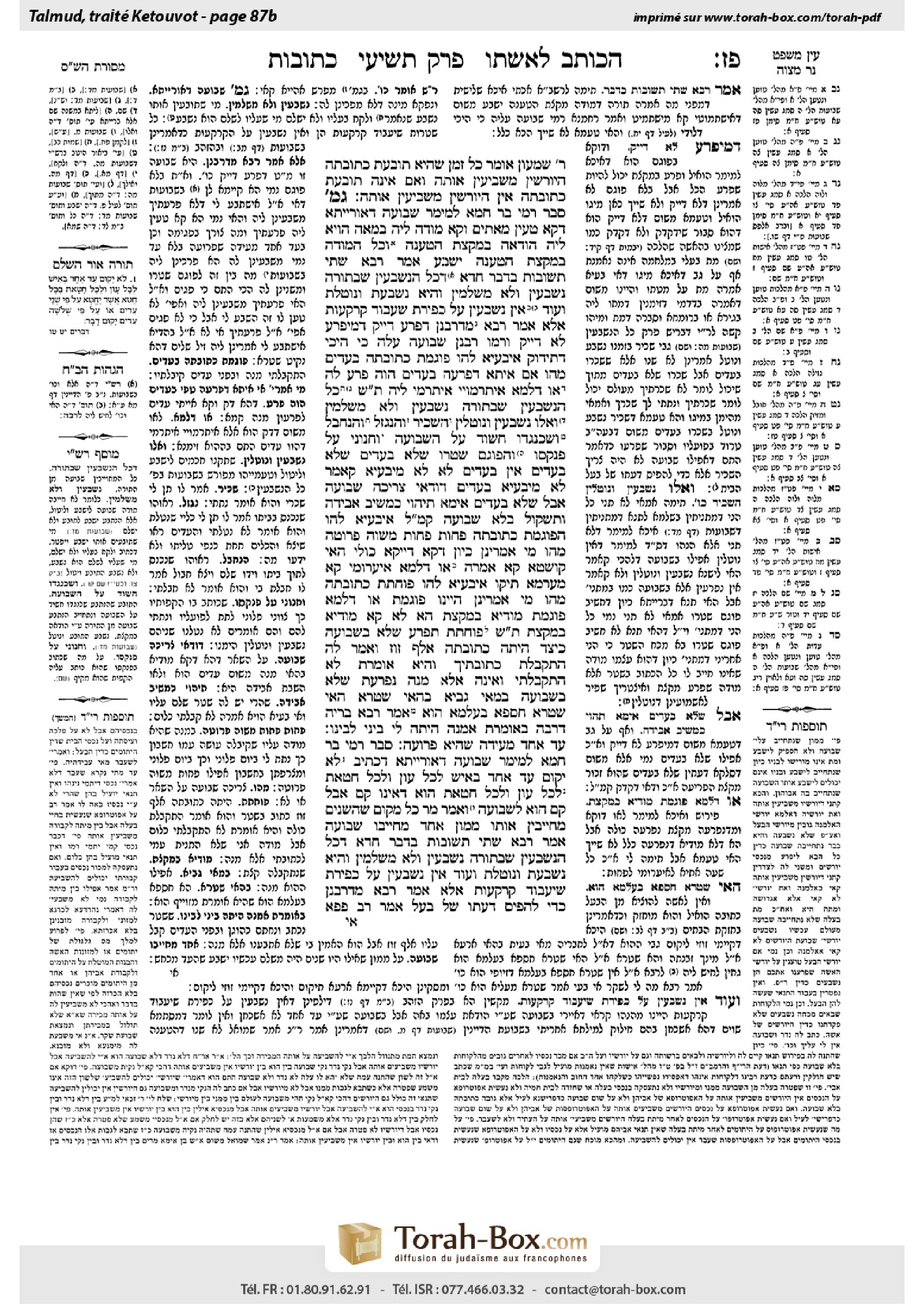
Ketubot 87b: Talmud study for Daf Yomi
Daf Yomi is the daily study of one Talmud folio. Explore 37 tractates with scans, Hebrew text, Sefaria English and AI-generated French translations where annotated.
Passage selection and English or AI-generated French translation are available where the scan has annotations. Daf Study is independent of Torah-Box and Sefaria.
Browse Ketubot · כתובות · All tractatesKetubot 87b text and translations
This page of Ketubot includes the Aramaic text, an English translation and an AI-generated French translation, alongside the scan above.
כתובות פ״ז ב · Aramaic and Hebrew text
רַבִּי שִׁמְעוֹן אוֹמֵר: כׇּל זְמַן שֶׁהִיא תּוֹבַעַת כְּתוּבָּתָהּ — הַיּוֹרְשִׁין מַשְׁבִּיעִין אוֹתָהּ, וְאִם אֵינָהּ תּוֹבַעַת כְּתוּבָּתָהּ — אֵין הַיּוֹרְשִׁין מַשְׁבִּיעִין אוֹתָהּ.
גְּמָ׳ סָבַר רָמֵי בַּר חָמָא לְמֵימַר שְׁבוּעָה דְּאוֹרָיְיתָא — דְּקָא טָעֵין מָאתַיִם וְקָא מוֹדֵה לֵיהּ בְּמֵאָה, הָוְיָא לֵיהּ הוֹדָאָה בְּמִקְצָת הַטַּעֲנָה, וְכׇל הַמּוֹדֶה בְּמִקְצָת הַטַּעֲנָה — יִשָּׁבַע.
אָמַר רָבָא: שְׁתֵּי תְשׁוּבוֹת בַּדָּבָר: חֲדָא — דְּכׇל הַנִּשְׁבָּעִין שֶׁבַּתּוֹרָה נִשְׁבָּעִין וְלֹא מְשַׁלְּמִין, וְהִיא נִשְׁבַּעַת וְנוֹטֶלֶת. וְעוֹד: אֵין נִשְׁבָּעִין עַל כְּפִירַת שִׁעְבּוּד קַרְקָעוֹת.
אֶלָּא אָמַר רָבָא: מִדְּרַבָּנַן, דְּפָרַע — דָּיֵיק, דְּמִיפְּרַע — לָא דָּיֵיק, וּרְמוֹ רַבָּנַן שְׁבוּעָה עֲלַהּ כִּי הֵיכִי דְּתִידּוֹק.
אִיבַּעְיָא לְהוּ: פּוֹגֶמֶת כְּתוּבָּתָהּ בְּעֵדִים, מַהוּ? אִם אִיתָא דְּפָרְעָה — בְּעֵדִים הֲוָה פָּרַע לַהּ, אוֹ דִלְמָא אִיתְרְמוֹיֵי אִיתְרְמִי לֵיהּ?
תָּא שְׁמַע: כׇּל הַנִּשְׁבָּעִין שֶׁבַּתּוֹרָה נִשְׁבָּעִין וְלֹא מְשַׁלְּמִין. וְאֵלּוּ נִשְׁבָּעִין וְנוֹטְלִין: הַשָּׂכִיר, וְהַנִּגְזָל, וְהַנֶּחְבָּל, וְשֶׁכְּנֶגְדּוֹ חָשׁוּד עַל הַשְּׁבוּעָה, וְחֶנְוָנִי עַל פִּנְקָסוֹ, וְהַפּוֹגֵם שְׁטָרוֹ שֶׁלֹּא בְּעֵדִים. שֶׁלֹּא בְּעֵדִים — אִין, בְּעֵדִים — לָא!
לָא מִיבַּעְיָא קָאָמַר: לָא מִיבַּעְיָא בְּעֵדִים — דְּוַדַּאי צְרִיכָה שְׁבוּעָה, אֲבָל שֶׁלֹּא בְּעֵדִים, אֵימָא תֶּיהְוֵי כְּמֵשִׁיב אֲבֵידָה וְתִשְׁקוֹל בְּלֹא שְׁבוּעָה, קָא מַשְׁמַע לַן.
אִיבַּעְיָא לְהוּ: הַפּוֹגֶמֶת כְּתוּבָּתָהּ פָּחוֹת פָּחוֹת מִשָּׁוֶה פְּרוּטָה, מַהוּ? מִי אָמְרִינַן: כֵּיוָן דְּקָא דָיְיקָא כּוּלֵּי הַאי, קוּשְׁטָא קָא אַמְרַהּ, אוֹ דִלְמָא אִיעָרוֹמֵי קָא מִעָרְמָא? תֵּיקוּ.
אִיבַּעְיָא לְהוּ: פּוֹחֶתֶת כְּתוּבָּתָהּ, מַהוּ? מִי אָמְרִינַן הַיְינוּ פּוֹגֶמֶת, אוֹ דִלְמָא: פּוֹגֶמֶת מוֹדְיָא בְּמִקְצָת, הָא לָא קָא מוֹדְיָא בְּמִקְצָת.
תָּא שְׁמַע: פּוֹחֶתֶת — תִּפָּרַע שֶׁלֹּא בִּשְׁבוּעָה. כֵּיצַד? הָיְתָה כְּתוּבָּתָהּ אֶלֶף זוּז, וְאָמַר לָהּ ״הִתְקַבַּלְתְּ כְּתוּבָּתִיךְ״, וְהִיא אוֹמֶרֶת ״לֹא הִתְקַבַּלְתִּי, וְאֵינָהּ אֶלָּא מָנֶה״ — נִפְרַעַת שֶׁלֹּא בִּשְׁבוּעָה.
בְּמַאי גָּבְיָא? בְּהַאי שְׁטָרָא? הַאי שְׁטָרָא חַסְפָּא בְּעָלְמָא הוּא! אָמַר רָבָא בְּרֵיהּ דְּרַבָּה: בְּאוֹמֶרֶת ״אֲמָנָה הָיְתָה לִי בֵּינִי לְבֵינוֹ״.
עֵד אֶחָד מְעִידָהּ שֶׁהִיא פְּרוּעָה. סְבַר רָמֵי בַּר חָמָא לְמֵימַר שְׁבוּעָה דְּאוֹרָיְיתָא, דִּכְתִיב: ״לֹא יָקוּם עֵד אֶחָד בְּאִישׁ לְכׇל עָוֹן וּלְכׇל חַטָּאת״. לְכׇל עָוֹן וּלְכׇל חַטָּאת הוּא דְּאֵינוֹ קָם, אֲבָל קָם הוּא לִשְׁבוּעָה. וְאָמַר מָר: כׇּל מָקוֹם שֶׁהַשְּׁנַיִם מְחַיְּיבִין אוֹתוֹ מָמוֹן — אֶחָד מְחַיְּיבוֹ שְׁבוּעָה.
אָמַר רָבָא, שְׁתֵּי תְּשׁוּבוֹת בַּדָּבָר. חֲדָא: דְּכׇל הַנִּשְׁבָּעִין שֶׁבַּתּוֹרָה נִשְׁבָּעִין וְלֹא מְשַׁלְּמִין, וְהִיא נִשְׁבַּעַת וְנוֹטֶלֶת. וְעוֹד: אֵין נִשְׁבָּעִין עַל כְּפִירַת שִׁיעְבּוּד קַרְקָעוֹת.
אֶלָּא אָמַר רָבָא: מִדְּרַבָּנַן, כְּדֵי לְהָפִיס דַּעְתּוֹ שֶׁל בַּעַל.
אָמַר רַב פָּפָּא:
Ketubot 87b · English translation
Rabbi Shimon says: Whenever she claims payment of her marriage contract, the heirs administer an oath to her. And if she does not claim payment of her marriage contract, the heirs do not administer an oath to her.
GEMARA: Rami bar Ḥama thought to say that the oath of a woman who vitiates her marriage contract is an oath required by Torah law, which is the oath of one who makes a partial admission, as the husband claims that he paid her two hundred and she concedes to him with regard to one hundred. This is a partial admission of the claim, and the principle is that whoever admits to part of a claim must take an oath according to Torah law to receive the remaining amount.
Rava said: There are two answers in the matter, in refutation of your argument: One response is that anyone who is obligated to take an oath that is enumerated in the Torah takes an oath and does not pay. By Torah law, one takes an oath only to exempt himself from payment, and in this case she takes an oath and takes her money. And furthermore, there is a principle that one does not take an oath with regard to a denial of a lien on land. The oaths of the Torah apply only to moveable property, not land. This means that if a claim involves a lien on land of any form, the oath of a partial admission does not apply, and a marriage contract includes a lien on land.
Rather, Rava said: This oath is by rabbinic law. It was instituted because the one who pays is precise and recalls that he paid his debt, whereas the one who was paid is not precise. When the husband claims to have paid her, he remembers clearly what happened, and therefore the Sages imposed the obligation of an oath upon her, so that she should be precise and remember exactly what occurred.
§ A dilemma was raised before the Sages: In a case where a woman vitiates her marriage contract by accepting partial payment in the presence of witnesses, what is the halakha? Do we say that if it is so that he has paid her the rest of the marriage contract, he would have paid her in the presence of witnesses, and since he has no such witnesses, this is proof that she never received the rest of the money, and she is exempt from an oath? Or perhaps he simply happened to have witnesses for part of the payment, and he gave her the rest without witnesses, and she must take an oath with regard to the remainder of the sum?
The Gemara suggests: Come and hear proof from a mishna (Shevuot 44b): Anyone who is obligated to take an oath that is enumerated in the Torah takes an oath and does not pay. And these take an oath and take their payment: The hired worker who demands his wages from his employer; and one who was robbed; and one who was injured, who claims compensation from the one who caused him damage; and if the one opposing him, the other litigant in a case, was supposed to take an oath but he is suspected with regard to oaths; and a storekeeper who makes a claim on the basis of what is written in his notebook [pinkaso]; and one who receives partial payment of his document not in the presence of witnesses. Conclude from this last clause that if one received partial payment of a document not in the presence of witnesses, then yes, he is obligated to take an oath, but if he received the payment in the presence of witnesses, then no, he is not obligated to take an oath.
The Gemara refutes this argument: The mishna is speaking utilizing the style of: It is not necessary: It is not necessary to state that if part of the marriage contract was paid in the presence of witnesses, she certainly requires an oath. However, if a partial payment was made not in the presence of witnesses, one might say that her partial admission should be like one who restores lost property. Since there are no witnesses that the husband paid anything, when she concedes to part of the claim it is as though she has restored to him a lost item. And she should therefore take the rest of the money without an oath, in accordance with the halakha that one who returns lost property does not have to take an oath that he did not appropriate part of what he found for himself. The tanna therefore teaches us that even in this case an oath is required.
A dilemma was raised before the Sages: With regard to a woman who vitiates her marriage contract and details with precision every sum of money that she received, specifying not only large sums of money but also sums so small that they amounted to less than the value of a peruta, what is the halakha? Do we say that since she is precise to such an extent she must be telling the truth, or perhaps she is deceiving us? This question shall stand unresolved.
Another dilemma was raised before the Sages: In the case of a woman who reduces her marriage contract by saying that its sum was less than the usual amount, or less than the figure specified in the document, what is the halakha? Do we say that this is like the case of a woman who vitiates her marriage contract, and the halakha is the same in both instances? Or perhaps there is a difference between the two cases because a woman who vitiates her marriage contract admits to part of the claim, whereas this one does not admit to part of the claim. Here, she claims that she has received nothing at all, but that she is owed less than what was initially thought.
The Gemara suggests: Come and hear a resolution from a baraita: One who reduces her marriage contract can collect it without an oath. How so? If her marriage contract was a thousand dinars, and her husband said to her: You have received your marriage contract, and she says: I have not received my marriage contract, but it is only one hundred dinars, she may collect it without an oath.
The Gemara asks: If her claim is accepted, with what does she in fact collect payment? With this marriage contract document? This document is merely a shard of earthenware, as she herself admits that the document is not a valid document because it records a fictitious sum. Rava, son of Rabba, said: It is referring to one who says: There was an agreement of trust between him and me that although the marriage contract records a large sum, I will claim only part of it, but the document itself is genuine.
§ The mishna teaches that if one witness testifies that the marriage contract was paid she must take an oath. Rami bar Ḥama thought to say that this is an oath required by Torah law, as it is written: “One witness shall not rise up against a man for any iniquity, or for any sin” (Deuteronomy 19:15). From here it is inferred: It is for any iniquity or for any sin that he may not rise up, i.e., the testimony of one witness is not enough for these purposes, but he may rise up for an oath. And the Master said: In any place, i.e., situation, where two witnesses are able to deem one liable to pay money, the testimony of one witness obligates him to take an oath.
Rava said: There are two answers in the matter, in refutation of your argument: One response is that anyone who is obligated to take an oath that is enumerated in the Torah takes an oath and does not pay. By Torah law, one takes an oath only to exempt himself from payment, and in this case she takes an oath and takes her money. And furthermore, there is a principle that one does not take an oath with regard to a denial of a lien on land.
Rather, Rava said: That oath was instituted by rabbinic law, in order to put the husband’s mind at ease. Since a witness contradicts her claim, the Sages imposed an oath upon her so that the husband would be sure that he is not giving away his money for no reason.
Rav Pappa said:
Ketubot 87b · Traduction française (IA)
Rabbi Shimon dit : Chaque fois qu’elle réclame le paiement de sa ketouba, les héritiers lui font prêter serment. Mais si elle ne réclame pas le paiement de sa ketouba, les héritiers ne lui font pas prêter serment.
GUEMARA : Rami bar Ḥama pensa que le serment imposé à une femme qui reconnaît avoir reçu une partie du montant de sa ketouba est un serment exigé par la Torah, à savoir celui de la personne qui reconnaît partiellement une créance : le mari affirme lui avoir versé deux cents, et elle reconnaît qu’il lui en a versé cent. Il s’agit d’une reconnaissance partielle de la réclamation, et le principe est que quiconque reconnaît une partie d’une réclamation doit prêter serment selon la Torah afin de percevoir le montant restant.
Rava dit : Il y a deux réponses à cela, qui réfutent ton argument. Première réponse : quiconque est tenu de prêter un serment mentionné dans la Torah prête serment et ne reçoit pas de paiement. Selon la Torah, on ne prête serment que pour être exempté de paiement ; or, dans ce cas, elle prête serment et reçoit son argent. De plus, il existe un principe selon lequel on ne prête pas serment au sujet de la contestation d’un privilège portant sur un bien immobilier. Les serments prévus par la Torah ne s’appliquent qu’aux biens mobiliers, et non aux biens immobiliers. Cela signifie que si une réclamation porte, sous quelque forme que ce soit, sur un privilège portant sur un bien immobilier, le serment dû en cas de reconnaissance partielle ne s’applique pas ; or, une ketouba comporte un privilège portant sur des biens immobiliers.
Rava dit plutôt : Ce serment relève du droit rabbinique. Il a été institué parce que celui qui paie se souvient précisément avoir payé sa dette, tandis que celui qui a été payé ne se souvient pas avec autant de précision. Lorsque le mari affirme l’avoir payée, il se souvient clairement de ce qui s’est passé ; les Sages lui ont donc imposé l’obligation de prêter serment, afin qu’elle se remémore précisément les faits.
§ Un dilemme fut soumis aux Sages : dans le cas où une femme reconnaît avoir reçu une partie du montant de sa ketouba en présence de témoins, quelle est la halakha ? Dirons-nous que, s’il lui avait réellement payé le reste de la ketouba, il le lui aurait payé en présence de témoins ; et que, puisqu’il ne dispose pas de tels témoins, cela prouve qu’elle n’a jamais reçu le reste de l’argent et qu’elle est dispensée de prêter serment ? Ou peut-être avait-il simplement eu des témoins pour une partie du paiement et lui avait-il remis le reste sans témoins ; elle doit alors prêter serment au sujet du solde.
La Guemara suggère : Viens entendre une preuve tirée d’une Michna (Shevouot 44b) : quiconque est tenu de prêter un serment mentionné dans la Torah prête serment et ne reçoit pas de paiement. Et ceux-ci prêtent serment et reçoivent leur paiement : le salarié qui réclame son salaire à son employeur ; celui qui a été volé ; celui qui a été blessé et réclame une indemnité à celui qui lui a causé un dommage ; l’autre partie au procès, qui aurait dû prêter serment, mais qui est soupçonnée de faux serment ; le commerçant qui présente une réclamation fondée sur ce qui est inscrit dans son registre [pinkaso] ; et celui qui reçoit un paiement partiel au titre de son acte de créance en l’absence de témoins. Conclus de cette dernière clause que si quelqu’un a reçu un paiement partiel au titre d’un acte de créance en l’absence de témoins, alors, oui, il doit prêter serment ; mais s’il a reçu le paiement en présence de témoins, alors, non, il n’est pas tenu de prêter serment.
La Guemara réfute cet argument : la Michna s’exprime selon le principe « il n’est pas nécessaire de dire » : il n’est pas nécessaire de préciser que si une partie de la ketouba a été payée en présence de témoins, elle doit certainement prêter serment. En revanche, si le paiement partiel a été effectué en l’absence de témoins, on aurait pu dire que sa reconnaissance partielle équivaut à la restitution d’un objet perdu. Puisqu’il n’y a pas de témoins attestant que le mari a payé quoi que ce soit, lorsqu’elle reconnaît une partie de la réclamation, c’est comme si elle lui restituait un objet perdu. Elle devrait donc recevoir le reste de l’argent sans prêter serment, conformément à la halakha selon laquelle celui qui restitue un objet perdu n’a pas à prêter serment qu’il ne s’est pas approprié une partie de ce qu’il a trouvé. Le tanna nous enseigne donc qu’un serment est exigé même dans ce cas.
Un dilemme fut soumis aux Sages : concernant une femme qui reconnaît avoir reçu une partie du montant de sa ketouba et détaille avec précision chaque somme reçue, indiquant non seulement les sommes importantes, mais aussi celles qui sont si petites qu’elles valent moins d’une perouta, quelle est la halakha ? Dirons-nous que, puisqu’elle est si précise, elle doit dire la vérité, ou peut-être nous trompe-t-elle ? Cette question reste sans réponse.
Un autre dilemme fut soumis aux Sages : dans le cas d’une femme qui réduit le montant de sa ketouba en disant qu’il était inférieur au montant habituel ou à celui indiqué dans l’acte, quelle est la halakha ? Dirons-nous que c’est comme le cas d’une femme qui reconnaît avoir reçu une partie du montant de sa ketouba et que la halakha est la même dans les deux cas ? Ou peut-être les deux cas diffèrent-ils, car la femme qui reconnaît avoir reçu une partie du montant de sa ketouba reconnaît une partie de la réclamation, tandis que l’autre ne reconnaît pas une partie de la réclamation. Ici, elle affirme n’avoir absolument rien reçu, mais qu’on lui doit moins que ce qu’on avait d’abord pensé.
La Guemara suggère : Viens entendre une résolution tirée d’une baraïta : celle qui réduit le montant de sa ketouba peut la recouvrer sans prêter serment. Comment cela ? Si sa ketouba s’élevait à mille dinars et que son mari lui dit : « Tu as reçu le montant de ta ketouba », et qu’elle répond : « Je n’ai pas reçu le montant de ma ketouba, mais celui-ci ne s’élève qu’à cent dinars », elle peut la recouvrer sans prêter serment.
La Guemara demande : Si sa réclamation est acceptée, sur quoi se fonde-t-elle pour recouvrer effectivement le paiement ? Sur cet acte de ketouba ? Cet acte n’est qu’un tesson de poterie, puisqu’elle-même reconnaît qu’il n’est pas valable, car il indique un montant fictif. Rava, fils de Rabba, dit : cela concerne une femme qui dit : « Lui et moi avions conclu un accord de confiance : bien que la ketouba indique un montant élevé, je ne réclamerai qu’une partie de celui-ci » ; l’acte lui-même est toutefois authentique.
§ La Michna enseigne que si un témoin atteste que la ketouba a été payée, elle doit prêter serment. Rami bar Ḥama pensa qu’il s’agit d’un serment exigé par la Torah, comme il est écrit : « Un seul témoin ne pourra se lever contre un homme pour quelque iniquité ou quelque péché que ce soit » (Deutéronome 19, 15). On en déduit que c’est pour quelque iniquité ou quelque péché qu’il ne peut se lever, c’est-à-dire que le témoignage d’un seul témoin ne suffit pas à ces fins ; mais il peut se lever pour imposer un serment. Et le Maître a dit : partout, c’est-à-dire dans toute situation où deux témoins peuvent obliger quelqu’un à payer, le témoignage d’un seul témoin l’oblige à prêter serment.
Rava dit : Il y a deux réponses à cela, qui réfutent ton argument. Première réponse : quiconque est tenu de prêter un serment mentionné dans la Torah prête serment et ne reçoit pas de paiement. Selon la Torah, on ne prête serment que pour être exempté de paiement ; or, dans ce cas, elle prête serment et reçoit son argent. De plus, il existe un principe selon lequel on ne prête pas serment au sujet de la contestation d’un privilège portant sur un bien immobilier.
Rava dit plutôt : Ce serment a été institué par les rabbins afin d’apaiser l’esprit du mari. Puisqu’un témoin contredit sa réclamation, les Sages lui ont imposé un serment afin que le mari soit certain de ne pas donner son argent sans raison.
Rav Pappa dit :
Traduction française générée par IA à partir de l’édition anglaise de Sefaria. Vérifie toujours un passage avec le texte source.
Text from Sefaria: William Davidson Edition - Vocalized Aramaic (CC BY NC); William Davidson Edition - English (CC BY NC).