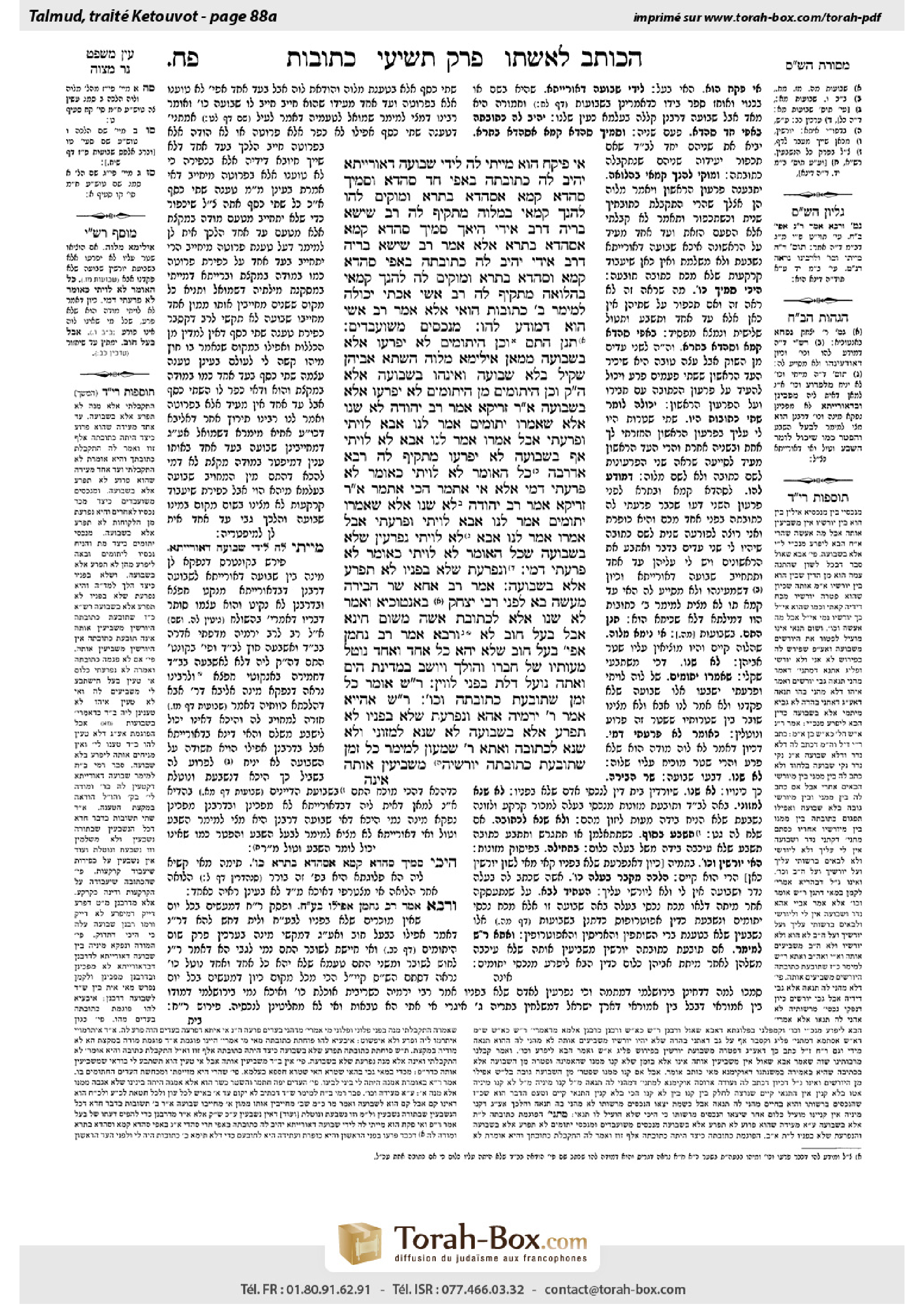
Ketubot 88a: Talmud study for Daf Yomi
Daf Yomi is the daily study of one Talmud folio. Explore 37 tractates with scans, Hebrew text, Sefaria English and AI-generated French translations where annotated.
Passage selection and English or AI-generated French translation are available where the scan has annotations. Daf Study is independent of Torah-Box and Sefaria.
Browse Ketubot · כתובות · All tractatesKetubot 88a text and translations
This page of Ketubot includes the Aramaic text, an English translation and an AI-generated French translation, alongside the scan above.
כתובות פ״ח א · Aramaic and Hebrew text
אִי פִּיקֵּחַ הוּא, מַיְיתֵי לַהּ לִידֵי שְׁבוּעָה דְּאוֹרָיְיתָא. יָהֵיב לַהּ כְּתוּבְּתַהּ בְּאַפֵּי חַד סָהֲדָא, וְסָמֵיךְ סָהֲדָא קַמָּא אַסָּהֲדָא בָּתְרָא, וּמוֹקֵים לְהוּ לְהָנָךְ קַמָּאֵי בְּמִלְוָה.
מַתְקֵיף לַהּ רַב שִׁישָׁא בְּרֵיהּ דְּרַב אִידִי: הֵיאַךְ סָמֵיךְ סָהֲדָא קַמָּא אַסָּהֲדָא בָּתְרָא? אֶלָּא אָמַר רַב שִׁישָׁא בְּרֵיהּ דְּרַב אִידִי: יָהֵיב לַהּ כְּתוּבְּתַהּ בְּאַפֵּי סָהֲדָא קַמָּא וְסָהֲדָא בָּתְרָא וּמוֹקֵים לְה[וּ] לְהָנָךְ קַמָּאֵי בְּהַלְוָאָה.
מַתְקֵיף לַהּ רַב אָשֵׁי, אַכַּתִּי יְכוֹלָה לְמֵימַר: שְׁתֵּי כְּתוּבּוֹת הֲוַאי! אֶלָּא אָמַר רַב אָשֵׁי: הוּא דְּמוֹדַע לְהוּ.
מִנְּכָסִים מְשׁוּעְבָּדִים. תְּנַן הָתָם: וְכֵן הַיְּתוֹמִים לֹא יִפָּרְעוּ אֶלָּא בִּשְׁבוּעָה.
מִמַּאן? אִילֵימָא מִלֹּוֶה — הַשְׁתָּא אֲבִיהֶן שָׁקֵיל בְּלָא שְׁבוּעָה, וְאִינְהוּ בִּשְׁבוּעָה?! אֶלָּא הָכִי קָאָמַר: וְכֵן הַיְּתוֹמִים מִן הַיְּתוֹמִים — לֹא יִפָּרְעוּ אֶלָּא בִּשְׁבוּעָה.
אָמַר רַב זְרִיקָא אָמַר רַב יְהוּדָה, לֹא שָׁנוּ אֶלָּא שֶׁאָמְרוּ יְתוֹמִים: אָמַר לָנוּ אַבָּא ״לָוִיתִי וּפָרַעְתִּי״, אֲבָל אָמְרוּ: אָמַר לָנוּ אַבָּא ״לֹא לָוִיתִי״ — אַף בִּשְׁבוּעָה לֹא יִפָּרְעוּ.
מַתְקֵיף לַהּ רָבָא, אַדְּרַבָּה: כׇּל הָאוֹמֵר ״לֹא לָוִיתִי״ — כְּאוֹמֵר ״לֹא פָּרַעְתִּי״ דָּמֵי,
אֶלָּא אִי אִתְּמַר, הָכִי אִתְּמַר, אָמַר רַב זְרִיקָא אָמַר רַב יְהוּדָה: לֹא שָׁנוּ אֶלָּא שֶׁאָמְרוּ יְתוֹמִים: אָמַר לָנוּ אַבָּא ״לָוִיתִי וּפָרַעְתִּי״, אֲבָל אָמְרוּ: אָמַר לָנוּ אַבָּא ״לֹא לָוִיתִי״ — נִפְרָעִין שֶׁלֹּא בִּשְׁבוּעָה. שֶׁכׇּל הָאוֹמֵר ״לֹא לָוִיתִי״ כְּאוֹמֵר ״לֹא פָּרַעְתִּי״ דָּמֵי.
וְנִפְרַעַת שֶׁלֹּא בְּפָנָיו, לֹא תִּפָּרַע אֶלָּא בִּשְׁבוּעָה. אָמַר רַב אַחָא שַׂר הַבִּירָה: מַעֲשֶׂה בָּא לִפְנֵי רַבִּי יִצְחָק בְּאַנְטוֹכְיָא, וְאָמַר: לֹא שָׁנוּ אֶלָּא לִכְתוּבַּת אִשָּׁה, מִשּׁוּם חִינָּא. אֲבָל בַּעַל חוֹב — לָא.
וְרָבָא אָמַר רַב נַחְמָן: אֲפִילּוּ בַּעַל חוֹב, שֶׁלֹּא יְהֵא כׇּל אֶחָד וְאֶחָד נוֹטֵל מְעוֹתָיו שֶׁל חֲבֵרוֹ, וְהוֹלֵךְ וְיוֹשֵׁב בִּמְדִינַת הַיָּם, וְאַתָּה נוֹעֵל דֶּלֶת בִּפְנֵי לוֹוִין.
רַבִּי שִׁמְעוֹן אוֹמֵר: כׇּל זְמַן שֶׁתּוֹבַעַת כְּתוּבָּתָהּ וְכוּ׳. רַבִּי שִׁמְעוֹן אַהֵיָיא? אָמַר רַבִּי יִרְמְיָה, אַהָא: וְנִפְרַעַת שֶׁלֹּא בְּפָנָיו, לָא תִּפָּרַע אֶלָּא בִּשְׁבוּעָה. לָא שְׁנָא לִמְזוֹנֵי וְלָא שְׁנָא לִכְתוּבָּה. וַאֲתָא רַבִּי שִׁמְעוֹן לְמֵימַר: כׇּל זְמַן שֶׁתּוֹבַעַת כְּתוּבָּתָהּ — יוֹרְשֶׁיהָ מַשְׁבִּיעִין אוֹתָהּ.
Ketubot 88a · English translation
If the husband is perspicacious, he can induce her to become obligated to take an oath by Torah law even in a case where only one witness saw the payment of the marriage contract, as follows: He now gives her the payment of her entire marriage contract in the presence of one witness, and joins the first witness to the last witness, so that there are now two witnesses to the payment of the entire marriage contract. And then, he establishes this first payment, about which the first witness had testified, as a loan, and claims payment of that sum from her, supported by the testimony of the first witness. With regard to this claim, her oath would serve the purpose of exempting her from payment, and it is not connected with a lien on land. Therefore, the witness can obligate her in an oath by Torah law.
Rav Sheisha, son of Rav Idi, objects to this: How can he join the first witness to the last witness when their testimonies do not refer to the same action? Rather, Rav Sheisha, son of Rav Idi, said: He now gives her the payment of her entire marriage contract in the presence of both the first witness and the last witness. And then, he establishes this first payment, about which the first witness had testified, as a loan, and claims payment of that sum from her, supported by the testimony of the first witness.
Rav Ashi objects to this: The woman can still say: I had two marriage contracts. She can claim that he wrote two marriage contracts and she collected the payments at two separate points in time, but there was never a loan. Rather, Rav Ashi said: It is possible for him to obligate her to take an oath if he informs the two witnesseses that on this occasion he is paying her for the one marriage contract that he wrote. She is then unable to claim that it was a different marriage contract, and he can compel her to take an oath by Torah law about the first payment, which is now established as a loan.
§ The mishna teaches that if a woman comes to claim her marriage contract from liened property that had been sold to a third party, she must first take an oath. We learned in a mishna there (Shevuot 45a): And similarly, orphans can collect payment only by means of an oath.
The Gemara asks: From whom can the orphans collect payment only by means of an oath? If we say that they can collect payment only with an oath from one who borrowed money from their father, then it is difficult to understand how this can be so. Now, can it be that their father, the lender, had the right to take payment from the borrower without an oath by relying on the document, and they, the orphans, with regard to whom the Sages were lenient, can claim the loan only by means of an oath? Rather, this is what the mishna is saying: And similarly, the orphans of the lender who come to collect payment from the orphans of the borrower can collect only by means of an oath.
Rav Zerika said that Rav Yehuda said: It was taught that those who take an oath can collect a debt from orphans only if the borrower’s orphans said: Our father said to us: I borrowed and repaid. However, if the orphans said: Our father said to us: I did not borrow, then they may not collect from the orphans even with an oath.
Rava objects to this: On the contrary, there is a principle in the halakhot of claims that anyone who says: I did not borrow is considered like one who says: I did not repay. Therefore, when there is evidence that he did borrow, he must pay the entire amount without the lender having to take an oath.
Rather, the Gemara emends the above statement: If it was stated, it was stated like this: Rav Zerika said that Rav Yehuda said: They taught this halakha only if the orphans said: Our father said to us: I borrowed and repaid. However, if they said: Our father said to us: I did not borrow, those who collect debts from them can collect even without an oath, for anyone who says: I did not borrow is considered like one who says: I did not repay.
§ The mishna teaches that one who comes to collect her marriage contract when not in her husband’s presence can collect it only by means of an oath. Rav Aḥa Sar HaBira said: An incident came before Rabbi Yitzḥak in Antioch, and he said: They taught this halakha only with regard to the wife’s marriage contract; she may collect her marriage contract in her husband’s absence, because the Sages wanted men to find favor in the eyes of women. In order to ensure that women would want to marry, the Sages instituted decrees with regard to a marriage contract that are for the woman’s benefit. However, a creditor does not have the right to collect his debt even with an oath if the borrower is absent, in case he has already been paid.
And Rava said that Rav Naḥman said: Even a creditor can collect payment with an oath in the borrower’s absence, so that each and every person will not take his friend’s money by means of a loan and go and reside in a country overseas to prevent the lender from collecting the money from his property. And if that were to occur, you would be locking the door in the face of borrowers, as no one would be willing to lend them money.
§ The mishna teaches: Rabbi Shimon says: Whenever she claims her marriage contract, the heirs administer an oath to her. The Gemara asks: To which statement in the mishna is Rabbi Shimon referring? Rabbi Yirmeya said: He is referring to this statement: And one who comes to collect her marriage contract when not in her husband’s presence can collect it only by means of an oath. This implies that the halakha is no different if she comes to claim money from the orphans for sustenance, and it is no different if she demands payment for her marriage contract. And Rabbi Shimon comes to say that whenever she claims her marriage contract the heirs can administer an oath to her that she has not taken anything of theirs.
Ketubot 88a · Traduction française (IA)
Si le mari est perspicace, il peut la contraindre à prêter serment selon la Torah, même si un seul témoin a vu le paiement de la ketouba, de la manière suivante : il lui verse maintenant la totalité de sa ketouba en présence d’un témoin, puis joint le premier témoin au dernier, de sorte qu’il y a désormais deux témoins du paiement de la totalité de la ketouba. Ensuite, il présente comme un prêt ce premier versement, dont le premier témoin avait attesté, et lui réclame cette somme en s’appuyant sur le témoignage du premier témoin. Dans le cadre de cette réclamation, son serment servirait à l’exempter du paiement et ne concernerait pas un droit de gage sur un bien-fonds. Le témoin peut donc la contraindre à prêter serment selon la Torah.
Rav Sheisha, fils de Rav Idi, objecte : comment peut-il joindre le premier témoin au dernier, alors que leurs témoignages ne portent pas sur le même acte ? Rav Sheisha, fils de Rav Idi, dit plutôt : il lui verse maintenant la totalité de sa ketouba en présence du premier et du dernier témoin. Ensuite, il présente comme un prêt ce premier versement, dont le premier témoin avait attesté, et lui réclame cette somme en s’appuyant sur le témoignage du premier témoin.
Rav Ashi objecte : la femme peut encore dire : « J’avais deux ketoubot. » Elle peut prétendre qu’il a rédigé deux ketoubot et qu’elle en a perçu les paiements à deux moments distincts, mais qu’il n’y a jamais eu de prêt. Rav Ashi dit plutôt : il peut la contraindre à prêter serment s’il informe les deux témoins qu’à cette occasion, il la paie au titre de l’unique ketouba qu’il a rédigée. Elle ne peut alors prétendre qu’il s’agissait d’une autre ketouba, et il peut la contraindre à prêter serment selon la Torah au sujet du premier versement, qui est désormais présenté comme un prêt.
§ La Michna enseigne que si une femme vient réclamer sa ketouba sur des biens grevés qui ont été vendus à un tiers, elle doit d’abord prêter serment. Nous avons appris dans une Michna, là-bas (Shevouot 45a) : de même, les orphelins ne peuvent recouvrer une créance que par un serment.
La Guemara demande : auprès de qui les orphelins ne peuvent-ils recouvrer une créance que par un serment ? Si l’on dit qu’ils ne peuvent recouvrer une créance auprès de celui qui a emprunté de l’argent à leur père qu’en prêtant serment, il est difficile de comprendre comment cela pourrait être. Est-il possible que leur père, le prêteur, ait eu le droit d’obtenir le paiement de l’emprunteur sans prêter serment, en se fondant sur le document, tandis qu’eux, les orphelins, à l’égard desquels les Sages se sont montrés indulgents, ne puissent réclamer le prêt qu’en prêtant serment ? La Michna dit plutôt ceci : de même, les orphelins du prêteur qui viennent réclamer le paiement aux orphelins de l’emprunteur ne peuvent recouvrer la créance qu’en prêtant serment.
Rav Zerika a dit au nom de Rav Yehuda : il a été enseigné que ceux qui réclament une dette ne peuvent la recouvrer auprès des orphelins qu’en prêtant serment, et seulement si les orphelins de l’emprunteur ont dit : « Notre père nous a dit : “J’ai emprunté et j’ai remboursé.” » Toutefois, si les orphelins ont dit : « Notre père nous a dit : “Je n’ai pas emprunté” », les créanciers ne peuvent rien recouvrer auprès des orphelins, même en prêtant serment.
Rava objecte : au contraire, selon un principe relatif aux réclamations, quiconque dit : « Je n’ai pas emprunté » est considéré comme disant : « Je n’ai pas remboursé. » Par conséquent, lorsqu’il est établi qu’il a bien emprunté, il doit payer la totalité de la somme, sans que le prêteur ait à prêter serment.
La Guemara rectifie plutôt l’énoncé précédent : si cette enseignement a été rapporté, il l’a été ainsi : Rav Zerika a dit au nom de Rav Yehuda : ils n’ont enseigné cette halakha que si les orphelins ont dit : « Notre père nous a dit : “J’ai emprunté et j’ai remboursé.” » Toutefois, s’ils ont dit : « Notre père nous a dit : “Je n’ai pas emprunté” », les créanciers peuvent recouvrer leurs créances auprès d’eux même sans serment, car quiconque dit : « Je n’ai pas emprunté » est considéré comme disant : « Je n’ai pas remboursé. »
§ La Michna enseigne que celle qui vient réclamer sa ketouba en l’absence de son mari ne peut la recouvrer qu’en prêtant serment. Rav Aḥa Sar HaBira a dit : une affaire s’est présentée devant Rabbi Yitzḥak à Antioche, et celui-ci a dit : ils n’ont enseigné cette halakha qu’à propos de la ketouba d’une épouse ; elle peut réclamer sa ketouba en l’absence de son mari, car les Sages voulaient que les hommes trouvent grâce aux yeux des femmes. Afin que les femmes souhaitent se marier, les Sages ont institué, concernant la ketouba, des dispositions en faveur des femmes. Cependant, un créancier n’a pas le droit de recouvrer sa créance, même en prêtant serment, en l’absence de l’emprunteur, de crainte que celui-ci ne l’ait déjà remboursé.
Et Rava a dit au nom de Rav Naḥman : même un créancier peut recouvrer le paiement en prêtant serment en l’absence de l’emprunteur, afin que chacun ne prenne pas l’argent de son prochain en lui accordant un prêt, puis parte résider dans un pays d’outre-mer pour empêcher le prêteur de recouvrer l’argent sur ses biens. Si cela devait se produire, vous fermeriez la porte aux emprunteurs, car personne ne voudrait leur prêter de l’argent.
§ La Michna enseigne : Rabbi Shimon dit : chaque fois qu’elle réclame sa ketouba, les héritiers lui font prêter serment. La Guemara demande : à quelle déclaration de la Michna Rabbi Shimon fait-il référence ? Rabbi Yirmeya a dit : il fait référence à cette déclaration : celle qui vient réclamer sa ketouba en l’absence de son mari ne peut la recouvrer qu’en prêtant serment. Cela implique que la halakha est la même, qu’elle vienne réclamer aux orphelins de l’argent pour sa subsistance ou qu’elle demande le paiement de sa ketouba. Rabbi Shimon vient enseigner que chaque fois qu’elle réclame sa ketouba, les héritiers peuvent lui faire prêter serment qu’elle n’a rien pris de leurs biens.
Traduction française générée par IA à partir de l’édition anglaise de Sefaria. Vérifie toujours un passage avec le texte source.
Text from Sefaria: William Davidson Edition - Vocalized Aramaic (CC BY NC); William Davidson Edition - English (CC BY NC).