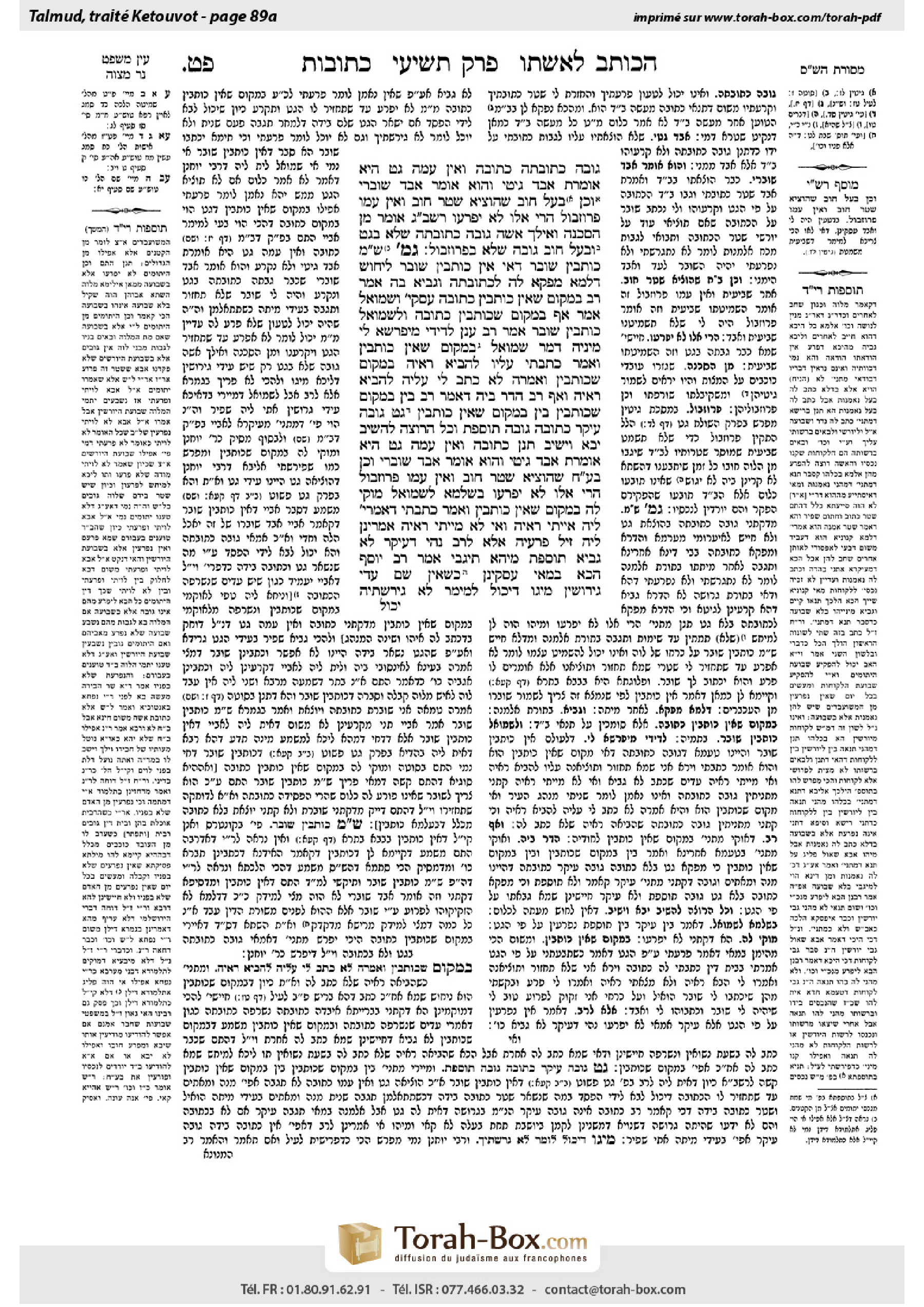
Ketubot 89a: Talmud study for Daf Yomi
Daf Yomi is the daily study of one Talmud folio. Explore 37 tractates with scans, Hebrew text, Sefaria English and AI-generated French translations where annotated.
Passage selection and English or AI-generated French translation are available where the scan has annotations. Daf Study is independent of Torah-Box and Sefaria.
Browse Ketubot · כתובות · All tractatesKetubot 89a text and translations
This page of Ketubot includes the Aramaic text, an English translation and an AI-generated French translation, alongside the scan above.
כתובות פ״ט א · Aramaic and Hebrew text
גּוֹבָה כְּתוּבָּתָהּ.
כְּתוּבָּה וְאֵין עִמָּהּ גֵּט, הִיא אוֹמֶרֶת: אָבַד גִּיטִּי. וְהוּא אוֹמֵר: אָבַד שׁוֹבָרִי. וְכֵן בַּעַל חוֹב שֶׁהוֹצִיא שְׁטַר חוֹב וְאֵין עִמּוֹ פְּרוֹזְבּוּל — הֲרֵי אֵלּוּ לֹא יִפָּרְעוּ.
רַבָּן שִׁמְעוֹן בֶּן גַּמְלִיאֵל אוֹמֵר: מִן הַסַּכָּנָה וְאֵילָךְ — אִשָּׁה גּוֹבָה כְּתוּבָּתָהּ שֶׁלֹּא בְּגֵט, וּבַעַל חוֹב גּוֹבֶה שֶׁלֹּא בִּפְרוֹזְבּוּל.
גְּמָ׳ שְׁמַע מִינַּהּ כּוֹתְבִין שׁוֹבָר. דְּאִי אֵין כּוֹתְבִין שׁוֹבָר, לֵיחוּשׁ דִּלְמָא מַפְּקָא לַהּ לִכְתוּבְּתַהּ, וְגָבְיָא בַּהּ.
אָמַר רַב: בִּמְקוֹם שֶׁאֵין כּוֹתְבִין כְּתוּבָּה עָסְקִינַן. וּשְׁמוּאֵל אָמַר: אַף בְּמָקוֹם שֶׁכּוֹתְבִין כְּתוּבָּה.
וְלִשְׁמוּאֵל כּוֹתְבִין שׁוֹבָר? אָמַר רַב עָנָן: לְדִידִי מִיפָּרְשָׁא לִי מִינֵּיהּ דְּמָר שְׁמוּאֵל: בִּמְקוֹם שֶׁאֵין כּוֹתְבִין וְאָמַר ״כָּתַבְתִּי״ — עָלָיו לְהָבִיא רְאָיָה. בִּמְקוֹם שֶׁכּוֹתְבִין וְאָמְרָה ״לֹא כָּתַב לִי״ — עָלֶיהָ לְהָבִיא רְאָיָה.
וְאַף רַב הֲדַר בֵּיהּ, דְּאָמַר רַב: בֵּין בִּמְקוֹם שֶׁכּוֹתְבִין, בֵּין בִּמְקוֹם שֶׁאֵין כּוֹתְבִין, גֵּט — גּוֹבָה עִיקָּר. כְּתוּבָּה — גּוֹבָה תּוֹסֶפֶת. וְכׇל הָרוֹצֶה לְהָשִׁיב — יָבֹא וְיָשִׁיב.
תְּנַן: כְּתוּבָּה וְאֵין עִמָּהּ גֵּט, הִיא אוֹמֶרֶת ״אָבַד גִּיטִּי״, וְהוּא אוֹמֵר ״אָבַד שׁוֹבָרִי״. וְכֵן בַּעַל חוֹב שֶׁהוֹצִיא שְׁטַר חוֹב וְאֵין עִמּוֹ פְּרוֹזְבּוּל — הֲרֵי אֵלּוּ לֹא יִפָּרְעוּ.
בִּשְׁלָמָא לִשְׁמוּאֵל — מוֹקֵי לַהּ בִּמְקוֹם שֶׁאֵין כּוֹתְבִין וְאָמַר כָּתַבְתִּי, דְּאָמְרִינַן לֵיהּ: אַיְיתִי רְאָיָה, וְאִי לָא מַיְיתֵי רְאָיָה, אָמְרִינַן לֵיהּ: זִיל פַּרְעֵיהּ.
אֶלָּא לְרַב: נְהִי דְּעִיקָּר לָא גָּבְיָא, תּוֹסֶפֶת מִיהָא תִּיגְבֵּי.
אָמַר רַב יוֹסֵף: הָכָא בְּמַאי עָסְקִינַן — כְּשֶׁאֵין שָׁם עֵדֵי גֵירוּשִׁין. מִיגּוֹ דְּיָכוֹל לְמֵימַר: לֹא גֵּירַשְׁתִּיהָ,
Ketubot 89a · English translation
she collects payment of her marriage contract, and he cannot claim that he already paid it.
If she produced a marriage contract, and it was unaccompanied by a bill of divorce, and she says: My bill of divorce was lost, and he says: Just as your bill of divorce was lost, so too my receipt for the payment of your marriage contract was lost; and likewise, in a case of a creditor who produced a promissory note after the Sabbatical Year, unaccompanied by a document that prevents the Sabbatical Year from forgiving an outstanding debt [prosbol], and demanded payment of the debt, these debts may not be collected.
Rabban Shimon ben Gamliel says: From the time of danger and onward, after the ruling authorities banned the performance of mitzvot, people would destroy a bill of divorce or a prosbol immediately after they were signed, a woman collects payment of her marriage contract without a bill of divorce, and a creditor collects debts owed to him without a prosbol. The assumption is that due to the circumstances these documents were written but were not preserved.
GEMARA: Conclude from the mishna that when one repays a debt, the creditor writes a receipt and gives it to the debtor as proof of payment, as, if one does not write a receipt, then in the case in the mishna where she receives payment of her marriage contract by producing her bill of divorce, let us be concerned lest she produce her marriage contract in a different court and collect payment with it a second time. In the absence of a receipt, the husband cannot prove that the debt was paid.
Rav said: That is no proof, as we are dealing with a place where one does not write a marriage contract. In those places, there is a general stipulation of the Sages that a husband must pay his wife the sum of the marriage contract even if no document was written. Therefore, there is no concern lest she produce the marriage contract at a later stage. And Shmuel said that the mishna is referring even to a place where one writes a marriage contract, which she claims to have lost.
The Gemara asks: And according to Shmuel, does one in fact write a receipt? Rav Anan said: It was explained to me personally by the Sage Shmuel himself: The mishna is addressing two different cases. In a place where one does not write a marriage contract and the husband said: I wrote a marriage contract, it is incumbent upon him to bring proof that he wrote one. In that case, if he does not provide proof, she can collect payment. In a place where one writes a marriage contract and she said: He did not write one for me, she must bring proof that he did not write a marriage contract. Only then can she collect payment without one.
And even Rav retracted his interpretation of the mishna, as Rav said the following ruling: Both in a place where one writes a marriage contract and in a place where one does not write a marriage contract, if she produces only a bill of divorce, she collects the main sum of the marriage contract. The Sages established minimum sums to serve as the principal payment of the marriage contract: Two hundred dinars for a virgin and one hundred for a non-virgin. If she produces a marriage contract that specifies a larger sum, she collects only the additional sum and not the main sum, as there is a concern that she collected the main sum previously by producing the bill of divorce. And whoever wishes to challenge this solution, let him come and challenge it. There is no longer any possibility of deceit, as she will gain nothing by producing the marriage contract in a second court after having collected her marriage contract by producing her bill of divorce in a first court.
The Gemara objects: We learned in the mishna: If she produced a marriage contract, and it was unaccompanied by a bill of divorce, and she says: My bill of divorce was lost, and he says: Just as your bill of divorce was lost, so too my receipt for the payment of your marriage contract was lost; and likewise, in a case of a creditor who produced a promissory note after the Sabbatical Year, unaccompanied by a prosbol, and demanded payment of the debt, these debts may not be collected.
The Gemara presents the question: Granted, according to Shmuel, this is reasonable. He establishes the mishna as referring to a place where the common practice is that one does not write a marriage contract, and the husband previously had said: I wrote one, and therefore did not want to pay the marriage contract when she produced the bill of divorce, as he was concerned that she would later produce the marriage contract and demand payment again. As in that case we say to him, according to Shmuel: Bring proof that you wrote a marriage contract, and if he does not bring proof, we say to him: Go and pay her based on the bill of divorce. Now, when she produces her marriage contract and the husband claims that he paid her by means of the bill of divorce and has lost the receipt, the mishna rules that this debt cannot be collected.
The Gemara completes the question: However, according to Rav, why does the mishna state that the debt cannot be collected? Although she cannot now collect the main sum of her marriage contract, because he can claim that she already received this sum in a different court by means of her bill of divorce, she should be able to collect the additional sum by virtue of the marriage contract, as she could not have received that by producing the bill of divorce alone.
Rav Yosef said: With what are we dealing here? It is a case where there are no witnesses to the divorce present there. Since the husband can say: I did not divorce her and she is entitled to nothing,
Ketubot 89a · Traduction française (IA)
Elle perçoit le paiement de sa ketouba, et il ne peut prétendre l’avoir déjà payée.
Si elle présente une ketouba sans acte de divorce et dit : « J’ai perdu mon acte de divorce », tandis qu’il dit : « De même que tu as perdu ton acte de divorce, j’ai moi aussi perdu le reçu attestant le paiement de ta ketouba » ; et de même, dans le cas d’un créancier qui présente un billet à ordre après l’année sabbatique, sans document empêchant celle-ci d’effacer une dette impayée [prosbol], et réclame le paiement de la dette, ces dettes ne peuvent pas être recouvrées.
Rabban Shimon ben Gamliel dit : À partir de l’époque des persécutions, après que les autorités eurent interdit l’accomplissement des mitsvot, les gens détruisaient les actes de divorce ou les prosbol immédiatement après leur signature. Dès lors, une femme peut percevoir le paiement de sa ketouba sans acte de divorce, et un créancier peut recouvrer les dettes qui lui sont dues sans prosbol. On présume que, compte tenu des circonstances, ces documents avaient été rédigés, mais n’avaient pas été conservés.
GUEMARA : Déduis de la Michna que, lorsqu’une dette est remboursée, le créancier rédige un reçu et le remet au débiteur comme preuve du paiement. En effet, si l’on ne rédigeait pas de reçu, dans le cas de la Michna où elle perçoit le paiement de sa ketouba en présentant son acte de divorce, ne faudrait-il pas craindre qu’elle présente sa ketouba devant un autre tribunal et en perçoive une seconde fois le paiement ? En l’absence de reçu, le mari ne pourrait pas prouver que la dette a été payée.
Rav dit : Cela ne prouve rien, car il s’agit d’un endroit où l’on ne rédige pas de ketouba. Dans ces endroits, les Sages ont établi une règle générale selon laquelle le mari doit verser à sa femme la somme prévue par la ketouba, même si aucun document n’a été rédigé. Il n’y a donc pas lieu de craindre qu’elle présente ultérieurement la ketouba. Chmouel dit, quant à lui, que la Michna se réfère également à un endroit où l’on rédige une ketouba, et où elle prétend avoir perdu celle-ci.
La Guemara demande : Selon Chmouel, rédige-t-on effectivement un reçu ? Rav Anan dit : Le sage Chmouel lui-même me l’a expliqué : la Michna traite de deux cas différents. Dans un endroit où l’on ne rédige pas de ketouba, si le mari dit : « J’en ai rédigé une », il lui incombe de prouver qu’il en a rédigé une. S’il n’en apporte pas la preuve, elle peut percevoir le paiement. Dans un endroit où l’on rédige une ketouba, si elle dit : « Il ne m’en a pas rédigé », c’est à elle de prouver qu’il n’en a pas rédigé. Ce n’est qu’alors qu’elle peut percevoir le paiement sans présenter de ketouba.
Rav lui aussi a renoncé à son interprétation de la Michna, car il a enseigné la halakha suivante : aussi bien dans un endroit où l’on rédige une ketouba que dans un endroit où l’on n’en rédige pas, si elle ne présente qu’un acte de divorce, elle perçoit le montant principal de la ketouba. Les Sages ont fixé des montants minimaux pour le principal de la ketouba : deux cents dinars pour une vierge et cent pour une femme qui ne l’est pas. Si elle présente une ketouba indiquant un montant supérieur, elle ne perçoit que le supplément, et non le montant principal, car on craint qu’elle n’ait déjà perçu le principal en présentant son acte de divorce. Que celui qui souhaite contester cette solution vienne le faire. Il n’y a désormais plus de risque de fraude, car elle n’aura rien à gagner à présenter la ketouba devant un second tribunal après avoir perçu le paiement de sa ketouba devant un premier tribunal en présentant son acte de divorce.
La Guemara objecte : Nous avons appris dans la Michna : Si elle présente une ketouba sans acte de divorce et dit : « J’ai perdu mon acte de divorce », tandis qu’il dit : « De même que tu as perdu ton acte de divorce, j’ai moi aussi perdu le reçu attestant le paiement de ta ketouba » ; et de même, dans le cas d’un créancier qui présente un billet à ordre après l’année sabbatique, sans prosbol, et réclame le paiement de la dette, ces dettes ne peuvent pas être recouvrées.
La Guemara pose la question : Cela se comprend selon Chmouel. Il considère que la Michna se réfère à un endroit où l’usage est de ne pas rédiger de ketouba et où le mari avait auparavant dit : « J’en ai rédigé une ». C’est pourquoi il avait refusé de payer la ketouba lorsqu’elle avait présenté l’acte de divorce : il craignait qu’elle ne présente ensuite la ketouba et ne réclame une seconde fois le paiement. Dans un tel cas, selon Chmouel, on lui dit : « Apporte la preuve que tu as rédigé une ketouba », et, s’il n’en apporte pas, on lui dit : « Va et paie-la sur la base de l’acte de divorce. » Or, lorsqu’elle présente sa ketouba et que le mari prétend l’avoir payée au moyen de l’acte de divorce et avoir perdu le reçu, la Michna tranche que cette dette ne peut pas être recouvrée.
La Guemara achève la question : Cependant, selon Rav, pourquoi la Michna dit-elle que la dette ne peut pas être recouvrée ? Même si elle ne peut pas percevoir à présent le montant principal de sa ketouba, puisqu’il peut prétendre qu’elle a déjà reçu ce montant devant un autre tribunal au moyen de son acte de divorce, elle devrait pouvoir percevoir le supplément grâce à la ketouba, puisqu’elle n’aurait pas pu l’obtenir en présentant le seul acte de divorce.
Rav Yossef dit : De quoi s’agit-il ici ? D’un cas où aucun témoin du divorce ne se trouve sur place. Puisque le mari peut dire : « Je ne l’ai pas divorcée et elle n’a droit à rien »,
Traduction française générée par IA à partir de l’édition anglaise de Sefaria. Vérifie toujours un passage avec le texte source.
Text from Sefaria: William Davidson Edition - Vocalized Aramaic (CC BY NC); William Davidson Edition - English (CC BY NC).