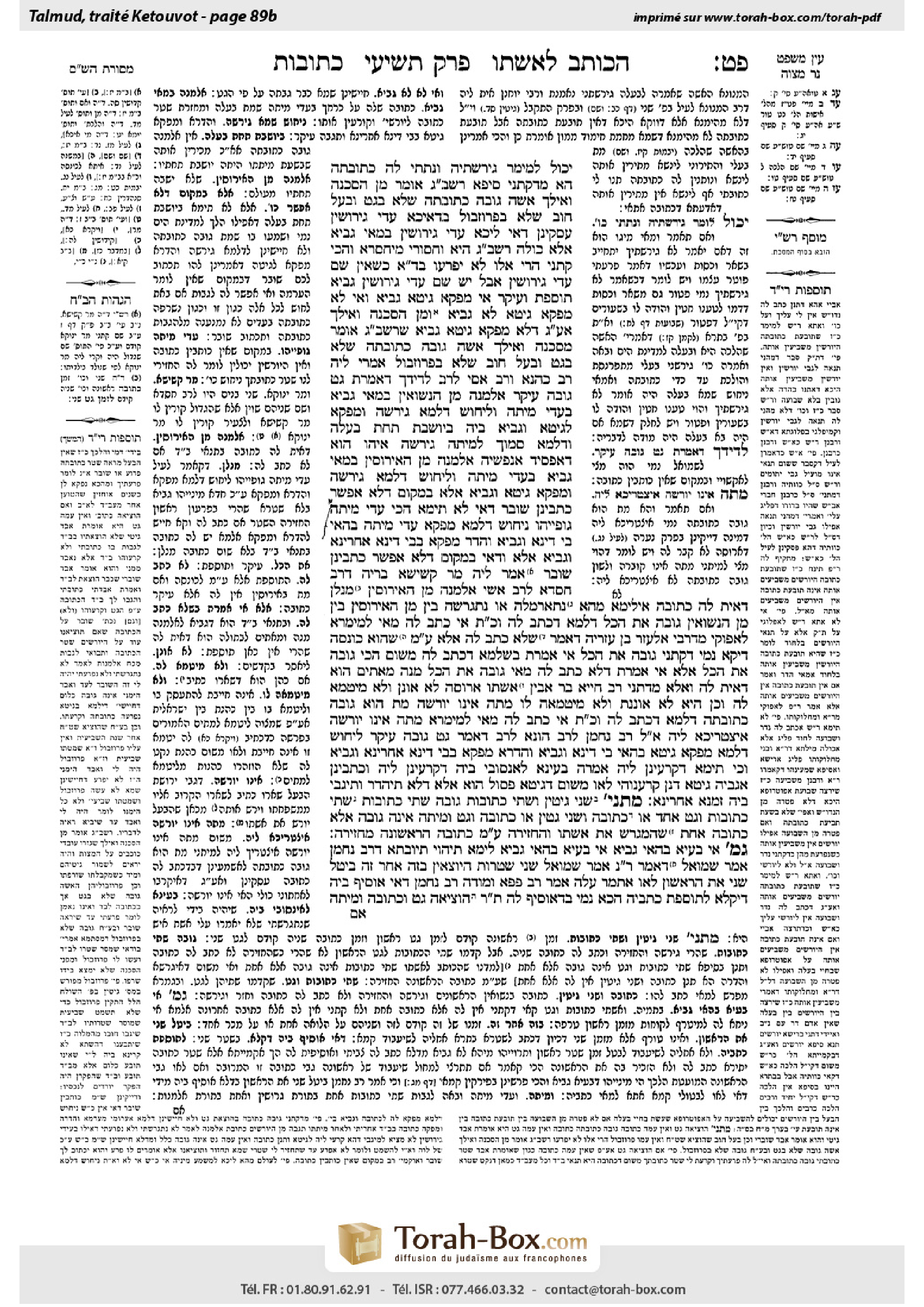
Ketubot 89b: Talmud study for Daf Yomi
Daf Yomi is the daily study of one Talmud folio. Explore 37 tractates with scans, Hebrew text, Sefaria English and AI-generated French translations where annotated.
Passage selection and English or AI-generated French translation are available where the scan has annotations. Daf Study is independent of Torah-Box and Sefaria.
Browse Ketubot · כתובות · All tractatesKetubot 89b text and translations
This page of Ketubot includes the Aramaic text, an English translation and an AI-generated French translation, alongside the scan above.
כתובות פ״ט ב · Aramaic and Hebrew text
יָכוֹל לְמֵימַר: גֵּירַשְׁתִּיהָ וְנָתַתִּי לָהּ כְּתוּבָּתָהּ.
הָא מִדְּקָתָנֵי סֵיפָא: רַבָּן שִׁמְעוֹן בֶּן גַּמְלִיאֵל אוֹמֵר: מִן הַסַּכָּנָה וְאֵילָךְ אִשָּׁה גּוֹבָה כְּתוּבָּתָהּ שֶׁלֹּא בְּגֵט, וּבַעַל חוֹב שֶׁלֹּא בִּפְרוֹזְבּוּל. בִּדְאִיכָּא עֵדֵי גֵירוּשִׁין עָסְקִינַן. דְּאִי לֵיכָּא עֵדֵי גֵירוּשִׁין, בְּמַאי גָּבְיָא?
אֶלָּא כּוּלָּהּ רַבָּן שִׁמְעוֹן בֶּן גַּמְלִיאֵל הִיא, וְחַסּוֹרֵי מִיחַסְּרָא וְהָכִי קָתָנֵי: הֲרֵי אֵלּוּ לֹא יִפָּרְעוּ. בַּמֶּה דְּבָרִים אֲמוּרִים: כְּשֶׁאֵין שָׁם עֵדֵי גֵירוּשִׁין, אֲבָל יֵשׁ שָׁם עֵדֵי גֵירוּשִׁין — גָּבְיָא תּוֹסֶפֶת. וְעִיקָּר, אִי מַפְּקָא גִּיטָּא — גָּבְיָא, וְאִי לָא מַפְּקָא גִּיטָּא — לָא גָּבְיָא.
וּמִן הַסַּכָּנָה וְאֵילָךְ, אַף עַל גַּב דְּלָא מַפְּקָא גִּיטָּא — גָּבְיָא. שֶׁרַבָּן שִׁמְעוֹן בֶּן גַּמְלִיאֵל אוֹמֵר: מִסַּכָּנָה וְאֵילָךְ אִשָּׁה גּוֹבָה כְּתוּבָּתָהּ שֶׁלֹּא בְּגֵט, וּבַעַל חוֹב שֶׁלֹּא בִּפְרוֹזְבּוּל.
אָמְרִי לֵיהּ רַב כָּהֲנָא וְרַב אַסִּי לְרַב: לְדִידָךְ דְּאָמְרַתְּ גֵּט גּוֹבָה עִיקָּר, אַלְמָנָה מִן הַנִּשּׂוּאִין בְּמַאי גָּבְיָא? בְּעֵדֵי מִיתָה. וְלֵיחוּשׁ דִּלְמָא גֵּירְשָׁהּ, וּמַפְּקָא לְגִיטָּא וְגָבְיָא בֵּיהּ?! בְּיוֹשֶׁבֶת תַּחַת בַּעְלָהּ.
וְדִלְמָא סָמוּךְ לְמִיתָה גֵּירְשָׁהּ! אִיהוּ הוּא דְּאַפְסֵיד אַנַּפְשֵׁיהּ.
אַלְמָנָה מִן הָאֵירוּסִין בְּמַאי גָּבְיָא — בְּעֵדֵי מִיתָה, וְלֵיחוּשׁ דִּלְמָא גֵּירְשָׁהּ, וּמַפְּקָא גִּיטָּא וְגָבְיָא!
אֶלָּא: בִּמְקוֹם דְּלָא אֶפְשָׁר כָּתְבִינַן שׁוֹבָר. דְּאִי לָא תֵּימָא הָכִי, עֵדֵי מִיתָה גּוּפַיְיהוּ נֵיחוּשׁ דִּלְמָא מַפְּקָא עֵדֵי מִיתָה בְּהַאי בֵּי דִינָא וְגָבְיָא, וַהֲדַר מַפְּקָא בְּבֵי דִינָא אַחֲרִינָא וְגָבְיָא. אֶלָּא וַדַּאי בִּמְקוֹם דְּלָא אֶפְשָׁר כָּתְבִינַן שׁוֹבָר.
אֲמַר לֵיהּ מָר קַשִּׁישָׁא בְּרֵיהּ דְּרַב חִסְדָּא לְרַב אָשֵׁי: אַלְמָנָה מִן הָאֵירוּסִין, מְנָלַן דְּאִית לַהּ כְּתוּבָּה? אִילֵּימָא מֵהָא: נִתְאַרְמְלָה אוֹ נִתְגָּרְשָׁה, בֵּין מִן הָאֵירוּסִין בֵּין מִן הַנִּשּׂוּאִין, גּוֹבָה אֶת הַכֹּל — דִּלְמָא דִּכְתַב לַהּ.
וְכִי תֵּימָא: אִי כְּתַב לַהּ, מַאי לְמֵימְרָא! לְאַפּוֹקֵי מִדְּרַבִּי אֶלְעָזָר בֶּן עֲזַרְיָה, דְּאָמַר: שֶׁלֹּא כָּתַב לָהּ אֶלָּא עַל מְנָת שֶׁהוּא כּוֹנְסָהּ.
דַּיְקָא נָמֵי, דְּקָתָנֵי: גּוֹבָה אֶת הַכֹּל. אִי אָמְרַתְּ בִּשְׁלָמָא דְּכָתַב לָהּ — מִשּׁוּם הָכִי גּוֹבָה אֶת הַכֹּל. אֶלָּא אִי אָמְרַתְּ דְּלָא כְּתַב לַהּ. מַאי ״גּוֹבָה אֶת הַכֹּל״? מָנֶה מָאתַיִם הוּא דְּאִית לָהּ!
וְאֶלָּא, מִדְּתָנֵי רַב חִיָּיא בַּר אָבִין: אִשְׁתּוֹ אֲרוּסָה, לֹא אוֹנֵן וְלֹא מִיטַּמֵּא לָהּ. וְכֵן הִיא, לֹא אוֹנֶנֶת וְלֹא מִיטַּמְּאָה לוֹ. מֵתָה — אֵינוֹ יוֹרְשָׁהּ, מֵת הוּא — גּוֹבָה כְּתוּבָּתָהּ.
דִּלְמָא דִּכְתַב לַהּ. וְכִי תֵּימָא: אִי כְּתַב לַהּ מַאי לְמֵימְרָא? מֵתָה אֵינוֹ יוֹרְשָׁהּ אִיצְטְרִיכָא לֵיהּ.
אֲמַר לֵיהּ רַב נַחְמָן לְרַב הוּנָא: לְרַב דְּאָמַר גֵּט גּוֹבָה עִיקָּר, לֵיחוּשׁ דִּלְמָא מַפְּקָא גִּיטָּא בְּהַאי בֵּי דִינָא וְגָבְיָא, וְהָדְרָא מַפְּקָא בְּבֵי דִינָא אַחֲרִינָא וְגָבְיָא? וְכִי תֵּימָא דְּקָרְעִינַן לֵיהּ! אָמְרָה: בָּעֵינָא לְאִנְּסוֹבֵי בֵּיהּ.
דְּקָרְעִינַן לֵיהּ וְכָתְבִינַן אַגַּבֵּיהּ: גִּיטָּא דְּנַן קְרַעְנוֹהִי לָאו מִשּׁוּם דְּגִיטָּא פָּסוּל הוּא, אֶלָּא דְּלָא תִּיהְדַּר וְתִיגְבֵּי בֵּיהּ זִמְנָא אַחֲרִינָא.
מַתְנִי׳ שְׁנֵי גִיטִּין וּשְׁתֵּי כְתוּבּוֹת, גּוֹבָה שְׁתֵּי כְתוּבּוֹת.
שְׁתֵּי כְתוּבּוֹת וְגֵט אֶחָד, אוֹ כְּתוּבָּה וּשְׁנֵי גִטִּין, אוֹ כְּתוּבָּה וְגֵט וּמִיתָה — אֵינָהּ גּוֹבָה אֶלָּא כְּתוּבָּה אַחַת. שֶׁהַמְגָרֵשׁ אֶת אִשְׁתּוֹ וְהֶחְזִירָהּ — עַל מְנָת כְּתוּבָּה הָרִאשׁוֹנָה מַחְזִירָהּ.
גְּמָ׳ אִי בָּעֲיָא בְּהַאי — גָּבְיָא, אִי בָּעֲיָא בְּהַאי — גָּבְיָא?
לֵימָא תֶּיהְוֵי תְּיוּבְתָּא דְּרַב נַחְמָן אָמַר שְׁמוּאֵל. דְּאָמַר רַב נַחְמָן אָמַר שְׁמוּאֵל: שְׁנֵי שְׁטָרוֹת הַיּוֹצְאִין בָּזֶה אַחַר זֶה, בִּיטֵּל שֵׁנִי אֶת הָרִאשׁוֹן.
לָאו אִתְּמַר עֲלַהּ, אָמַר רַב פָּפָּא: וּמוֹדֵה רַב נַחְמָן דְּאִי אוֹסֵיף בֵּיהּ דִּיקְלָא, לְתוֹסֶפֶת כַּתְבֵיהּ. הָכָא נָמֵי בִּדְאוֹסֵיף לַהּ.
תָּנוּ רַבָּנַן: הוֹצִיאָה גֵּט וּכְתוּבָּה וּמִיתָה,
Ketubot 89b · English translation
he can also say: I divorced her and gave her the payment of her marriage contract.
The Gemara asks: From the fact that the last clause of the mishna teaches that Rabban Shimon ben Gamliel says: From the time of danger and onward, a woman collects payment of her marriage contract without a bill of divorce, and a creditor collects payment without a prosbol, apparently we are dealing with a case when there are witnesses to the divorce. As, if there are no witnesses to the divorce, with what proof does she collect the marriage contract? The mishna must be referring to a case where there are witnesses present, and therefore the husband cannot claim that he never divorced her.
Rather, the Gemara rejects the previous explanation and explains: The entire mishna is according to the opinion of Rabban Shimon ben Gamliel, and the mishna is incomplete and is this is what it is teaching: These debts may not be collected. In what case is this statement said? It is when there are no witnesses to the divorce present there. However, if there are witnesses to the divorce present there, she collects the additional sum listed in the document and not the main sum, lest she later produce the bill of divorce and demand payment a second time. And as for the main sum of the marriage contract, if she produces a bill of divorce, she collects it. But if she does not produce a bill of divorce, she does not collect it.
The Gemara continues the modified version of the mishna: And from the time of danger and onward, even if she does not produce a bill of divorce, she collects the main sum of her marriage contract as well, as Rabban Shimon ben Gamliel says: From the time of danger and onward a woman collects payment of her marriage contract without a bill of divorce, and a creditor collects payment without a prosbol.
Rav Kahana and Rav Asi said to Rav: According to your opinion, that you said that a woman who produces a bill of divorce collects the main sum, then in the case of a widow from marriage, with what proof does she collect the main sum of her marriage contract, as she has no bill of divorce? She can claim the main sum with witnesses to his death. But shouldn’t we be concerned that perhaps he divorced her before he passed away, and after receiving her marriage contract by means of the witnesses to his death, she will produce the bill of divorce he gave her and collect payment with it a second time? Rav answered: She can collect payment with witnesses to her husband’s death only when she was living under the jurisdiction of her husband the entire time, and it is clear that he did not divorce her.
The Gemara raises a difficulty: But perhaps he divorced her near his death, in which case it is not known that she was divorced. She could then demand payment for her marriage contract twice. The Gemara answers: In that case, it is he who caused his own loss, by failing to inform others of the divorce, and it is not necessary to be concerned that such a situation could occur.
Rav Kahana and Rav Asi asked Rav another question: With what proof can a widow from betrothal collect her marriage contract? She can collect the payment with witnesses to his death. But once again, shouldn’t we be concerned that perhaps he divorced her beforehand, and after receiving her marriage contract based on the evidence of the witnesses, she will produce the bill of divorce he gave her and collect a second time with it? Since a betrothed woman does not live with her husband, there would be no indication that he had divorced her.
Rather, it must be that wherever it is not possible otherwise to know if a woman already received her marriage contract, one writes a receipt, as if you do not say so with regard to the witnesses to his death themselves, we should be concerned that perhaps she will bring out witnesses to his death in this court and collect payment for her marriage contract, and again bring out witnesses in a different court and collect payment for her marriage contract a second time. This could continue many times. Rather, it must certainly be the case that wherever it is not possible otherwise to know if a woman already received her marriage contract, one writes a receipt.
Mar the Elder, son of Rav Ḥisda, said to Rav Ashi: From where do we know that a widow from betrothal has a marriage contract? Perhaps the Sages instituted the marriage contract only for married women. If we say that it is derived from this mishna (54b): If a woman is widowed or divorced, whether from betrothal or whether from marriage, she collects the entire amount of her marriage contract, including the additional sum, this mishna is not proof. Perhaps the mishna is referring to a case where he wrote a marriage contract for her on his own accord. That does not prove that there is an enactment of the Sages that a husband must write a marriage contract for his betrothed.
And if you would say in response that if that mishna is referring to a case where he wrote the marriage contract for her, what is the purpose of stating that she collects the entire sum, since it is clear that she receives the full amount, as she has the document in her possession; perhaps this is meant to exclude the statement of Rabbi Elazar ben Azarya, who said that a betrothed woman who was divorced or widowed is not entitled to the additional sum written in the marriage contract, as the groom wrote this additional amount for her only in order to marry her.
The Gemara comments: The language of the mishna is also precise, that it is referring to a case where he wrote the marriage contract for her, as it teaches: She collects the entire amount. Granted, if you say that he wrote a marriage contract for her, it is due to that reason that she collects the entire amount, both the main sum and additional sum written in the marriage contract. But if you say that he did not write a marriage contract for her, and she collects a payment only because of the rabbinic ordinance, what is the meaning of: She collects the entire sum? She has only one hundred dinars or two hundred dinars, as enacted by the Sages, and no more. The phrase: Entire sum, is inappropriate according to this opinion.
But rather, the proof that a widow from betrothal receives a marriage contract is from that which was taught by Rav Ḥiyya bar Avin: Upon the death of one’s betrothed wife, he does not receive the status of an acute mourner, one whose close relative has died but has not yet been buried, nor become impure if he is a priest. And likewise, she neither receives the status of an acute mourner nor becomes impure for him. If she dies, he does not inherit from her. If he dies, she collects payment of her marriage contract. This shows that a widow from betrothal receives a marriage contract.
The Gemara refutes this proof in the same manner as before: Perhaps this is referring to a case where he wrote a marriage contract for her on his own accord. And if you would say in response that if that mishna is referring to a case where he wrote the marriage contract for her, what is the purpose of stating that she collects the payment, as this is obvious and teaches nothing new; perhaps it was necessary for him to mention that despite the fact that the man wrote a marriage contract for her, if she dies, he does not inherit from her. The discussion concludes without a source for the halakha that a widow from betrothal receives a marriage contract.
Rav Naḥman said to Rav Huna: According to Rav, who said that if she produces a bill of divorce she can collect the main sum of her marriage contract, shouldn’t there be a concern lest she produce the bill of divorce in this court and collect with it, and again produce it in a different court and collect with it? And should you say that we tear it, as the court does to other documents that have been paid, she will not let us do so, for she will say: I do not want you to tear the bill of divorce because I need it, so that when I want to marry again I can prove with it that I am divorced.
Rav Huna responded: The solution is that we tear it and write the following on its back: We tore this bill of divorce, not because it is an invalid bill of divorce, but in order that she not return and collect with it another time.
MISHNA: If a woman had two bills of divorce and two marriage contracts as a result of her divorce and remarriage to the same man, the fact that she is in possession of these documents proves that she was never paid for her first marriage contract, and she collects two marriage contracts.
If she was in possession of two marriage contracts and only one bill of divorce; or if she had one marriage contract and two bills of divorce; or if she had a marriage contract, a bill of divorce, and witnesses to her husband’s death after their remarriage, she collects payment of only one marriage contract. This is because there is a presumption that one who divorces his wife and remarries her, remarries her with the intention of using her first marriage contract, and she agrees that she collects payment of only the original document. This is the presumption, unless he wrote another marriage contract for her.
GEMARA: The mishna states that if she had two marriage contracts and one bill of divorce, she can collect only one marriage contract. However, it does not specify which marriage contract she can claim. Does this mean that if she desires, she can collect payment of the marriage contract with this one, and if she desires, she can collect payment with that one? In that case, if she prefers she can use the document that promises the larger sum, and if she prefers to use the marriage contract with the earlier date in order to be able to collect property that her husband had sold to others between the dates on the two documents, she may collect with that one.
The Gemara asks: If that is the case, let us say that it is a conclusive refutation of a statement that Rav Naḥman said that Shmuel said, as Rav Naḥman said that Shmuel said: If there are two documents that are issued one after the other, each recording the same transaction of a sale or a gift and they are separated by a few days, it is assumed that the second document cancels the first one. Why not say in this case as well that the second marriage contract voids the first one?
The Gemara answers: Was it not stated with regard to the halakha Rav Naḥman quoted in the name of Shmuel that Rav Pappa said: And Rav Naḥman concedes that if he added to the transaction detailed in the second document a palm tree that was not mentioned in the first document, this shows that he did not intend to cancel the first document. Rather, he wrote the second document as an addition to the first document. Here too, the Gemara is dealing with a case when he added an additional sum for her in the second marriage contract. This proves that he wanted to add to the first marriage contract, and not to void it.
The Sages taught: If she produced a bill of divorce, a marriage contract, and witnesses to her husband’s death,
Ketubot 89b · Traduction française (IA)
Il peut aussi dire : « Je l’ai répudiée et je lui ai versé le montant de sa ketouba. »
La Guemara demande : Puisque la dernière clause de la Michna enseigne que Rabban Shimon ben Gamliel dit : « À partir de l’époque de la persécution, une femme recouvre le paiement de sa ketouba sans acte de divorce, et un créancier recouvre sa créance sans prosbol », il semble que l’on parle d’un cas où des témoins de la répudiation sont présents. En effet, s’il n’y avait pas de témoins de la répudiation, sur quelle preuve pourrait-elle recouvrer le paiement de sa ketouba ? La Michna doit donc parler d’un cas où des témoins sont présents ; le mari ne peut donc pas prétendre qu’il ne l’a jamais répudiée.
La Guemara rejette plutôt l’explication précédente et explique : Toute la Michna suit l’opinion de Rabban Shimon ben Gamliel, mais son texte est incomplet. Voici ce qu’elle enseigne : Ces créances ne peuvent pas être recouvrées. Dans quel cas cette déclaration s’applique-t-elle ? Lorsqu’il n’y a pas sur place de témoins de la répudiation. En revanche, si des témoins de la répudiation sont présents sur place, elle recouvre le montant supplémentaire inscrit dans l’acte, mais pas le montant principal, de peur qu’elle ne produise ensuite l’acte de divorce et ne réclame une seconde fois le paiement. Quant au montant principal de la ketouba, si elle produit un acte de divorce, elle le recouvre ; mais si elle n’en produit pas, elle ne le recouvre pas.
La Guemara poursuit la version amendée de la Michna : À partir de l’époque de la persécution, même si elle ne produit pas d’acte de divorce, elle recouvre également le montant principal de sa ketouba, conformément à ce que dit Rabban Shimon ben Gamliel : « À partir de l’époque de la persécution, une femme recouvre le paiement de sa ketouba sans acte de divorce, et un créancier recouvre sa créance sans prosbol. »
Rav Kahana et Rav Asi dirent à Rav : Selon ton opinion, puisque tu as dit qu’une femme qui produit un acte de divorce recouvre le montant principal, comment une veuve qui était mariée peut-elle recouvrer le montant principal de sa ketouba, puisqu’elle n’a pas d’acte de divorce ? Elle peut réclamer le montant principal grâce à des témoins du décès de son mari. Mais ne devrait-on pas craindre qu’il l’ait répudiée avant de mourir et qu’après avoir recouvré le paiement de sa ketouba grâce aux témoins de son décès, elle produise l’acte de divorce qu’il lui a remis et recouvre une seconde fois le paiement ? Rav répondit : Elle ne peut recouvrer le paiement grâce à des témoins du décès de son mari que si elle a vécu sous l’autorité de son mari pendant toute cette période, ce qui établit clairement qu’il ne l’a pas répudiée.
La Guemara soulève une difficulté : Mais peut-être l’a-t-il répudiée peu avant sa mort, de sorte qu’on ne sache pas qu’elle a été répudiée. Elle pourrait alors réclamer deux fois le paiement de sa ketouba. La Guemara répond : Dans ce cas, c’est lui qui a causé sa propre perte en omettant d’informer les autres de la répudiation ; il n’est pas nécessaire de craindre qu’une telle situation se produise.
Rav Kahana et Rav Asi posèrent une autre question à Rav : Grâce à quelle preuve une veuve dont le mariage n’a pas été consommé peut-elle recouvrer sa ketouba ? Elle peut recouvrer le paiement grâce à des témoins du décès de son mari. Mais ne devrait-on pas de nouveau craindre qu’il l’ait répudiée auparavant et qu’après avoir recouvré le paiement de sa ketouba sur la foi des témoins, elle produise l’acte de divorce qu’il lui a remis et recouvre une seconde fois le paiement grâce à cet acte ? Puisqu’une femme fiancée ne vit pas avec son mari, rien n’indiquerait qu’il l’a répudiée.
Il faut plutôt dire que, chaque fois qu’il n’est pas possible autrement de savoir si une femme a déjà reçu le paiement de sa ketouba, on rédige un reçu. En effet, si l’on ne soutenait pas cela au sujet des témoins de son décès eux-mêmes, il faudrait craindre qu’elle présente des témoins de son décès devant ce tribunal et recouvre le paiement de sa ketouba, puis présente de nouveau des témoins devant un autre tribunal et recouvre une seconde fois le paiement de sa ketouba. Cela pourrait se répéter de nombreuses fois. Il faut donc nécessairement conclure que, chaque fois qu’il n’est pas possible autrement de savoir si une femme a déjà reçu le paiement de sa ketouba, on rédige un reçu.
Mar l’Ancien, fils de Rav Ḥisda, dit à Rav Ashi : D’où savons-nous qu’une veuve dont le mariage n’a pas été consommé a droit à une ketouba ? Peut-être les Sages n’ont-ils institué la ketouba que pour les femmes mariées. Si l’on dit que cela se déduit de cette Michna (54b) : « Si une femme devient veuve ou est répudiée, qu’elle le soit à la suite de fiançailles ou de mariage, elle recouvre le montant entier de sa ketouba, y compris le montant supplémentaire », cette Michna ne constitue pas une preuve. Peut-être parle-t-elle d’un cas où il lui a rédigé une ketouba de sa propre initiative. Cela ne prouve pas que les Sages ont institué qu’un mari doit rédiger une ketouba pour sa fiancée.
Et si l’on répondait que, si cette Michna parle d’un cas où il lui a rédigé une ketouba, il est inutile de préciser qu’elle recouvre le montant entier, puisqu’il est évident qu’elle reçoit le montant complet, l’acte étant en sa possession ? Peut-être est-ce pour exclure l’opinion de Rabbi Elazar ben Azarya, qui a dit qu’une femme fiancée, répudiée ou devenue veuve, n’a pas droit au montant supplémentaire inscrit dans la ketouba, car le marié ne lui a promis ce montant supplémentaire que pour l’épouser.
La Guemara fait remarquer que la formulation de la Michna est également précise et indique qu’il s’agit d’un cas où il lui a rédigé une ketouba, puisqu’elle enseigne : « Elle recouvre le montant entier. » En effet, si tu dis qu’il lui a rédigé une ketouba, c’est pour cette raison qu’elle recouvre le montant entier, à savoir le montant principal et le montant supplémentaire inscrits dans la ketouba. Mais si tu dis qu’il ne lui a pas rédigé de ketouba et qu’elle ne reçoit un paiement qu’en vertu de l’ordonnance rabbinique, que signifie « elle recouvre le montant entier » ? Elle n’a droit qu’à cent ou deux cents dinars, comme l’ont institué les Sages, et pas davantage. Selon cette opinion, l’expression « montant entier » ne convient pas.
Il faut plutôt tirer la preuve qu’une veuve dont le mariage n’a pas été consommé reçoit une ketouba de ce qu’a enseigné Rav Ḥiyya bar Avin : À la mort de sa fiancée, l’homme n’a pas le statut d’endeuillé dont le proche parent est mort mais n’a pas encore été enterré, et il ne devient pas impur s’il est prêtre. De même, elle n’a pas ce statut d’endeuillée et ne devient pas impure à cause de lui. Si elle meurt, il n’hérite pas d’elle. S’il meurt, elle recouvre le paiement de sa ketouba. Cela montre qu’une veuve dont le mariage n’a pas été consommé reçoit une ketouba.
La Guemara réfute cette preuve comme précédemment : Peut-être s’agit-il d’un cas où il lui a rédigé une ketouba de sa propre initiative. Et si l’on répondait que, si cette Michna parle d’un cas où il lui a rédigé une ketouba, il est inutile de préciser qu’elle recouvre le paiement, puisque c’est évident et que cela n’enseigne rien de nouveau, on peut dire qu’il était nécessaire de préciser que, bien que l’homme lui ait rédigé une ketouba, s’il meurt, elle n’hérite pas de lui. La discussion s’achève sans qu’aucune source n’ait établi la halakha selon laquelle une veuve dont le mariage n’a pas été consommé reçoit une ketouba.
Rav Naḥman dit à Rav Huna : Selon Rav, qui a dit que si elle produit un acte de divorce, elle peut recouvrer le montant principal de sa ketouba, ne devrait-on pas craindre qu’elle produise l’acte de divorce devant ce tribunal et recouvre le paiement grâce à lui, puis le produise de nouveau devant un autre tribunal et recouvre encore le paiement ? Et si tu dis qu’on le déchire, comme le tribunal le fait pour les autres documents acquittés, elle ne nous laissera pas faire : elle dira qu’elle ne veut pas que nous déchirions l’acte de divorce, car elle en a besoin pour pouvoir prouver, lorsqu’elle voudra se remarier, qu’elle est divorcée.
Rav Huna répondit : La solution consiste à le déchirer et à inscrire au verso : « Nous avons déchiré cet acte de divorce, non parce qu’il est invalide, mais afin qu’elle ne revienne pas recouvrer le paiement une autre fois grâce à lui. »
MICHNA : Si une femme possède deux actes de divorce et deux ketoubot à la suite de sa répudiation puis de son remariage avec le même homme, le fait qu’elle détienne ces documents prouve qu’elle n’a jamais reçu le paiement de sa première ketouba ; elle recouvre donc le paiement de deux ketoubot.
Si elle possède deux ketoubot et un seul acte de divorce, ou une ketouba et deux actes de divorce, ou encore une ketouba, un acte de divorce et des témoins du décès de son mari après leur remariage, elle ne recouvre le paiement que d’une seule ketouba. En effet, on présume que celui qui répudie sa femme puis la reprend en mariage le fait avec l’intention d’utiliser sa première ketouba, et qu’elle accepte de ne recouvrer le paiement que du document initial. Telle est la présomption, à moins qu’il ne lui ait rédigé une autre ketouba.
GUEMARA : La Michna enseigne que si elle possède deux ketoubot et un acte de divorce, elle ne peut recouvrer le paiement que d’une seule ketouba. Cependant, elle ne précise pas laquelle elle peut réclamer. Cela signifie-t-il que, si elle le souhaite, elle peut recouvrer le paiement avec l’une et, si elle le souhaite, avec l’autre ? Dans ce cas, si elle préfère, elle peut utiliser le document qui promet le montant le plus élevé ; et si elle préfère utiliser la ketouba portant la date la plus ancienne, afin de pouvoir recouvrer des biens que son mari a vendus à d’autres entre les dates des deux documents, elle peut recouvrer le paiement avec celle-ci.
La Guemara demande : Si c’est le cas, ne faut-il pas conclure qu’il s’agit d’une réfutation décisive de ce que Rav Naḥman a dit au nom de Shmuel ? En effet, Rav Naḥman a dit au nom de Shmuel : Si deux documents sont émis successivement, chacun consignant la même transaction de vente ou de don, et que quelques jours les séparent, on présume que le second document annule le premier. Pourquoi ne pas dire ici aussi que la seconde ketouba annule la première ?
La Guemara répond : N’a-t-il pas été précisé, au sujet de la halakha que Rav Naḥman a rapportée au nom de Shmuel, que Rav Pappa a dit : Rav Naḥman reconnaît que si, dans le second document, il a ajouté à la transaction un palmier qui ne figurait pas dans le premier, cela montre qu’il n’avait pas l’intention d’annuler le premier document. Il a plutôt rédigé le second document pour compléter le premier. Ici aussi, la Guemara traite d’un cas où il lui a accordé un montant supplémentaire dans la seconde ketouba. Cela prouve qu’il voulait ajouter à la première ketouba, et non l’annuler.
Les Sages ont enseigné : Si elle produit un acte de divorce, une ketouba et des témoins du décès de son mari,
Traduction française générée par IA à partir de l’édition anglaise de Sefaria. Vérifie toujours un passage avec le texte source.
Text from Sefaria: William Davidson Edition - Vocalized Aramaic (CC BY NC); William Davidson Edition - English (CC BY NC).