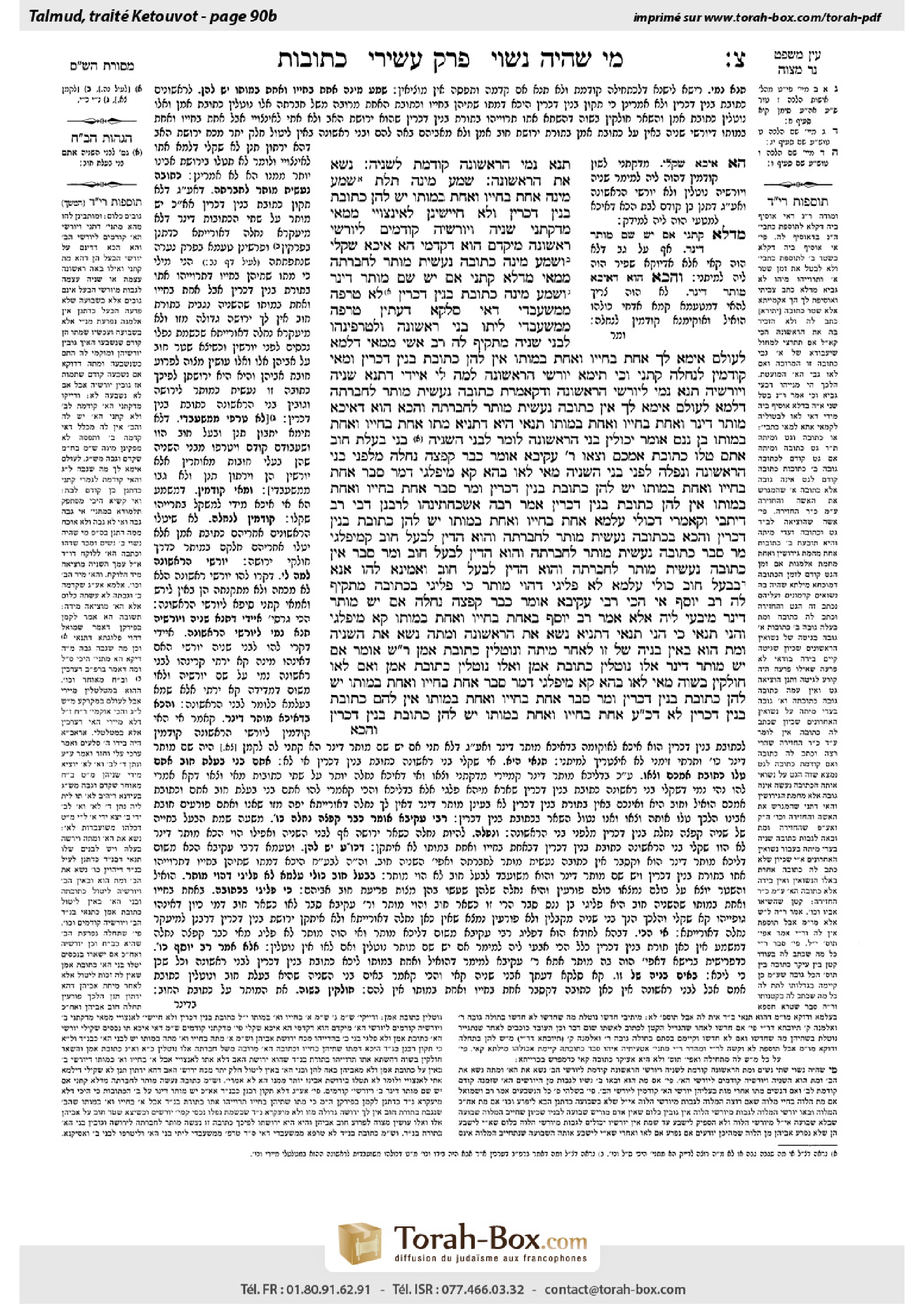
Ketubot 90b: Talmud study for Daf Yomi
Daf Yomi is the daily study of one Talmud folio. Explore 37 tractates with scans, Hebrew text, Sefaria English and AI-generated French translations where annotated.
Passage selection and English or AI-generated French translation are available where the scan has annotations. Daf Study is independent of Torah-Box and Sefaria.
Browse Ketubot · כתובות · All tractatesKetubot 90b text and translations
This page of Ketubot includes the Aramaic text, an English translation and an AI-generated French translation, alongside the scan above.
כתובות צ׳ ב · Aramaic and Hebrew text
תְּנָא נָמֵי: הָרִאשׁוֹנָה קוֹדֶמֶת לַשְּׁנִיָּה.
נָשָׂא אֶת הָרִאשׁוֹנָה. שְׁמַע מִינַּהּ תְּלָת: שְׁמַע מִינַּהּ אַחַת בְּחַיָּיו וְאַחַת בְּמוֹתוֹ יֵשׁ לָהֶן כְּתוּבַּת בְּנִין דִּכְרִין, וְלָא חָיְישִׁינַן לְאִינְּצוֹיֵי.
מִמַּאי — מִדְּקָתָנֵי: שְׁנִיָּה וְיוֹרְשֶׁיהָ קוֹדְמִים לְיוֹרְשֵׁי רִאשׁוֹנָה, מִיקְדָּם הוּא דְּקָדְמִי, הָא אִיכָּא — שָׁקְלִי.
וּשְׁמַע מִינַּהּ: כְּתוּבָּה נַעֲשֵׂית מוֹתָר לַחֲבֶרְתָּהּ.
מִמַּאי? מִדְּלָא קָתָנֵי ״אִם יֵשׁ שָׁם מוֹתַר דִּינָר״.
וּשְׁמַע מִינַּהּ: כְּתוּבַּת בְּנִין דִּכְרִין לָא טָרְפָה מִמְּשַׁעְבְּדִי, דְּאִי סָלְקָא דַּעְתִּין טָרְפָה מִמְּשַׁעְבְּדִי — לֵיתוֹ בְּנֵי רִאשׁוֹנָה וְלִטְרְפִינְהוּ לִבְנֵי שְׁנִיָּה.
מַתְקֵיף לַהּ רַב אָשֵׁי: מִמַּאי? דִּלְמָא לְעוֹלָם אֵימָא לָךְ אַחַת בְּחַיָּיו וְאַחַת בְּמוֹתוֹ אֵין לָהֶן כְּתוּבַּת בְּנִין דִּכְרִין, וּמַאי ״קוֹדְמִין״ — לְנַחֲלָה קָתָנֵי.
וְכִי תֵּימָא: ״יוֹרְשֵׁי הָרִאשׁוֹנָה״ לְמָה לִי? אַיְּידֵי דִּתְנָא ״שְׁנִיָּה וְיוֹרְשֶׁיהָ״, תְּנָא נָמֵי ״לְיוֹרְשֵׁי הָרִאשׁוֹנָה״.
וּדְקָאָמְרַתְּ: כְּתוּבָּה נַעֲשֵׂית מוֹתָר לַחֲבֶרְתָּהּ — דִּלְמָא לְעוֹלָם אֵימָא לָךְ: אֵין כְּתוּבָּה נַעֲשֵׂית מוֹתָר לַחֲבֶרְתָּהּ, וְהָכָא הוּא דְּאִיכָּא מוֹתַר דִּינָר.
״וְאַחַת בְּחַיָּיו וְאַחַת בְּמוֹתוֹ״ — תַּנָּאֵי הִיא, דְּתַנְיָא: מֵתוּ אַחַת בְּחַיָּיו וְאַחַת בְּמוֹתוֹ, בֶּן נַנָּס אוֹמֵר: יְכוֹלִין בְּנֵי הָרִאשׁוֹנָה לוֹמַר לִבְנֵי הַשְּׁנִיָּה: בְּנֵי בַּעֲלַת חוֹב אַתֶּם, טְלוּ כְּתוּבַּת אִמְּכֶם וּצְאוּ.
רַבִּי עֲקִיבָא אוֹמֵר: כְּבָר קָפְצָה נַחֲלָה מִלִּפְנֵי בְּנֵי הָרִאשׁוֹנָה וְנָפְלָה לִפְנֵי בְּנֵי הַשְּׁנִיָּה.
מַאי לָאו בְּהָא קָא מִיפַּלְגִי, דְּמָר סָבַר: אַחַת בְּחַיָּיו וְאַחַת בְּמוֹתוֹ — יֵשׁ לָהֶן כְּתוּבַּת בְּנִין דִּכְרִין, וּמָר סָבַר: אַחַת בְּחַיָּיו וְאַחַת בְּמוֹתוֹ — אֵין לָהֶן כְּתוּבַּת בְּנִין דִּכְרִין.
אָמַר רַבָּה, אַשְׁכַּחְתִּינְהוּ לְרַבָּנַן דְּבֵי רַב דְּיָתְבִי וְקָאָמְרִי: דְּכוּלֵּי עָלְמָא אַחַת בְּחַיָּיו וְאַחַת בְּמוֹתוֹ — יֵשׁ לָהֶן כְּתוּבַּת בְּנִין דִּכְרִין, וְהָכָא בִּכְתוּבָּה נַעֲשֵׂית מוֹתָר לַחֲבֶרְתָּהּ וְהוּא הַדִּין לְבַעַל חוֹב קָמִיפַּלְגִי.
מָר סָבַר: כְּתוּבָּה נַעֲשֵׂית מוֹתָר לַחֲבֶרְתָּהּ, וְהוּא הַדִּין לְבַעַל חוֹב, וּמַר סָבַר: אֵין כְּתוּבָּה נַעֲשֵׂית מוֹתָר לַחֲבֶרְתָּהּ, וְהוּא הַדִּין לְבַעַל חוֹב,
וְאָמֵינָא לְהוּ אֲנָא: בְּבַעַל חוֹב כּוּלֵּי עָלְמָא לָא פְּלִיגִי דְּהָוֵי מוֹתָר, כִּי פְּלִיגִי בִּכְתוּבָּה.
מַתְקֵיף לַהּ רַב יוֹסֵף: אִי הָכִי, ״רַבִּי עֲקִיבָא אוֹמֵר: כְּבָר קָפְצָה נַחֲלָה״ — ״אִם יֵשׁ מוֹתַר דִּינָר״ מִיבְּעֵי לֵיהּ!
אֶלָּא אָמַר רַב יוֹסֵף: בְּאַחַת בְּחַיָּיו וְאַחַת בְּמוֹתוֹ קָא מִיפַּלְגִי.
וְהָנֵי תַּנָּאֵי כִּי הָנֵי תַּנָּאֵי, דְּתַנְיָא: נָשָׂא אֶת הָרִאשׁוֹנָה וָמֵתָה, נָשָׂא אֶת הַשְּׁנִיָּה וּמֵת הוּא — בָּאִין בָּנֶיהָ שֶׁל זוֹ לְאַחַר מִיתָה וְנוֹטְלִין כְּתוּבַּת אִמָּן. רַבִּי שִׁמְעוֹן אוֹמֵר: אִם יֵשׁ מוֹתַר דִּינָר — אֵלּוּ נוֹטְלִין כְּתוּבַּת אִמָּן, וְאֵלּוּ נוֹטְלִין כְּתוּבַּת אִמָּן. וְאִם לָאו — חוֹלְקִין בְּשָׁוֶה.
מַאי לָאו בְּהָא קָא מִיפַּלְגִי, דְּמָר סָבַר: אַחַת בְּחַיָּיו וְאַחַת בְּמוֹתוֹ — יֵשׁ לָהֶן כְּתוּבַּת בְּנִין דִּכְרִין, וּמָר סָבַר: אַחַת בְּחַיָּיו וְאַחַת בְּמוֹתוֹ — אֵין לָהֶם כְּתוּבַּת בְּנִין דִּכְרִין.
לָא, דְּכוּלֵּי עָלְמָא אַחַת בְּחַיָּיו וְאַחַת בְּמוֹתוֹ — יֵשׁ לָהֶן כְּתוּבַּת בְּנִין דִּכְרִין,
Ketubot 90b · English translation
it taught the first clause as well with the same wording: The first woman precedes the second, without elaborating that the property would not be expropriated from the second if she were to seize it in payment of her marriage contract.
§ The mishna taught: If he married the first woman, etc. The Gemara notes: Conclude three conclusions from this statement: Conclude from it that if one of the man’s wives died in his lifetime and the other one died following his death, then the sons of the first wife are entitled to collect the marriage contract concerning male children and we are not concerned that this would lead to quarreling.
The Gemara asks: From where is it known that this is correct? From the fact that it teaches: The second wife and her heirs precede the heirs of the first wife, it can be inferred that they precede the heirs of the first, but if there are enough funds in the estate for all the claims against it, then the children of the first wife do take their share of the dowry.
The second point one can conclude from it is that one marriage contract becomes surplus for the other. The Sages ruled that each son may claim his mother’s marriage settlement only when the value of the estate exceeds the sum total of the marriage contracts by at least one dinar, so that the biblical laws of inheritance can be fulfilled. Since the marriage settlement collected by the heirs of the second wife is considered a debt owed by the estate, this sum is considered to have been paid equally by all the heirs. The biblical laws of inheritance have thereby been fulfilled, and the sons of the first wife can claim the marriage contract concerning male children even if nothing will be left in the estate after they have collected their payment.
The Gemara asks: From where is it known that this is correct? The Gemara answers: From the fact that it does not teach in the mishna: If there is a surplus of a dinar in addition to the value of all the marriage contracts.
And conclude from it a third point, that when one collects the payment for the marriage contract concerning male children, he cannot seize liened property that his father sold to others, as one can when collecting a debt. As, if it should enter your mind that it can be repossessed from liened property, then let the sons of the first wife come and repossess land already claimed by the sons of the second wife as payment for their mother’s marriage contract, since the land the sons of the second wife took was previously liened, due to the marriage contract of the first wife. Rather, the children of the first wife are viewed not as creditors but as heirs, who cannot repossess property sold by their father.
Rav Ashi objects to two of the three conclusions stated above: From where is it known that all of this is correct? Perhaps I could actually say to you that if one wife died in his lifetime and one died following his death, then no one is entitled to collect the marriage contract concerning male children. And what does the mishna mean when it says precede? It does not mean that if there are enough assets remaining, the sons of the first wife receive the sum of their mother’s marriage settlement. Rather, it is teaching that after the sons of the second wife receive the sum of their mother’s marriage settlement, the sons from both marriages inherit equal shares of the remaining estate.
And if you would say that if the mishna is referring to the inheritance of the remainder of the estate, why do I need the mishna to mention the heirs of the first wife; since it is teaching a halakha concerning their inheritance from their father and not their inheritance from their mother, why refer to them as the heirs of the first wife? One could reply that since it taught: The second wife and her heirs, the mishna also taught the parallel phrase: The heirs of the first wife, but no halakhic conclusions should be drawn from this.
And concerning what you said that one marriage contract becomes surplus for the other, this too can be rejected: Perhaps I could actually say to you that one marriage contract does not become surplus for the other, and that the case under discussion here is where there is a surplus of an additional dinar, and the reason why it was not explicitly mentioned is because it is not the subject of our mishna.
§ The Gemara notes that in a case where one wife died in his lifetime and one died following his death, there is a dispute between tanna’im if the sons of the wife who died in her husband’s lifetime are entitled to collect their mother’s marriage settlement. As it is taught in a baraita: If they died, one in his lifetime and one following his death, ben Nanas says: The sons of the first wife can say to the sons of the second wife: You are the children of a creditor, so collect your mother’s marriage contract and leave, and we will inherit the rest of the estate due to the marriage contract concerning male children.
Rabbi Akiva says: When the husband died, the inheritance already eluded the sons of the first wife and came into the possession of the sons of the second wife as an inheritance, i.e., the Sages did not institute the marriage contract concerning male children in a case where one of the wives was alive when the husband died. Consequently, after the sons of the second wife collect their mother’s marriage settlement, the remainder of the estate is divided evenly between all the man’s sons.
The Gemara comments: What, is it not that they disagree about this: One Sage, ben Nanas, holds that in a case where one wife died in his lifetime and one died following his death, the first wife’s sons are entitled to collect the marriage contract concerning male children. And the other Sage, Rabbi Akiva, holds that in a case where one wife died in his lifetime and one died following his death, the first wife’s sons are not entitled to collect the marriage contract concerning male children.
Rabba said: I found the Sages of the school of Rav sitting and saying: Everyone agrees that in a case where one wife died in his lifetime and one died following his death, the first wife’s sons are entitled to collect the marriage contract concerning male children. Here, however, they disagree with regard to the question of whether or not one marriage contract becomes surplus for the other in a case where there is no surplus of an additional dinar with which to fulfill the biblical laws of inheritance. And the same is true with regard to payment made to a creditor, i.e., they disagree whether paying a creditor of their father is a sufficient fulfillment of the biblical laws of inheritance to allow collection of the marriage contract concerning male children.
One Sage, ben Nanas, holds that one marriage contract becomes surplus for the other, and the same is true with regard to payment made to a creditor, and one Sage, Rabbi Akiva, holds that one marriage contract does not become surplus for the other, and the same is true with regard to the debt owed to a creditor.
Rabba continues: And I said to them: With regard to payment made to a creditor, everyone agrees that it is considered surplus and fulfills the biblical laws of inheritance, even given the lien attached to it. When they disagree it is with regard to whether a marriage contract can be considered surplus.
Rav Yosef objects to this. If that is so, then why did it say in the baraita that Rabbi Akiva says: The inheritance already eluded them? Rather, it should have said: If there is a surplus of a dinar, since that is the actual focal point of the disagreement.
Rather, Rav Yosef said: They disagree with regard to the basic issue of whether the Sages instituted the marriage contract concerning male children in a case where one wife died in his lifetime and one died following his death, as was explained initially.
And these tanna’im, ben Nanas and Rabbi Akiva, are like those other tanna’im, who debated this very same point, as it is taught in a baraita: If he married a first woman and she subsequently died, and he then married a second woman and he subsequently died, the sons of this woman, i.e., the second wife, come after her death and collect payment of their mother’s marriage contract if she did not collect it while she was alive, while the rest of the estate is distributed equally between all the sons. Rabbi Shimon says: If there is a surplus of a dinar, these sons of the first wife collect their mother’s marriage contract, namely, the marriage contract concerning male offspring, and these sons of the second wife collect their mother’s marriage contract, and if not, they divide the entire estate equally among themselves.
What, is it not that they disagree with regard to the following: One Sage, Rabbi Shimon, holds that in a case where one wife died in his lifetime and one died following his death, the sons of the first wife are entitled to collect the marriage contract concerning male children; and one Sage, the first tanna, holds that in a case where one wife died in his lifetime and one died following his death, the sons of the first wife are not entitled to collect the marriage contract concerning male children, and only the second wife’s sons collect their mother’s marriage contract.
The Gemara rejects this: No, it is possible to say that everyone agrees that in a case where one wife died in his lifetime and one died following his death, the sons of the first wife are entitled to collect the marriage contract concerning male children,
Ketubot 90b · Traduction française (IA)
Il a également enseigné la première clause dans les mêmes termes : la première épouse passe avant la seconde, sans préciser que les biens ne seraient pas repris à la seconde si elle les saisissait en paiement de sa ketouba.
§ La Michna enseigne : « S’il a épousé la première femme, etc. » La Guemara relève : Tirons de cette déclaration trois conclusions. Premièrement, si l’une des épouses de l’homme est morte de son vivant et l’autre après sa mort, les fils de la première épouse ont le droit de percevoir la ketouba au titre des fils mâles, et nous ne craignons pas que cela provoque des querelles.
La Guemara demande : D’où sait-on que cela est exact ? On peut le déduire de ce qu’elle enseigne : « La seconde épouse et ses héritiers passent avant les héritiers de la première épouse » ; ils passent donc avant les héritiers de la première, mais, si la succession comporte suffisamment de biens pour couvrir toutes les créances, les enfants de la première épouse reçoivent bien leur part de la dot.
La deuxième conclusion que l’on peut en tirer est qu’une ketouba peut constituer un surplus par rapport à l’autre. Les Sages ont statué que chaque fils ne peut réclamer la somme prévue par la ketouba de sa mère que si la valeur de la succession dépasse d’au moins un dinar le montant total des ketoubot, afin que les lois bibliques de l’héritage puissent être appliquées. Puisque la somme perçue par les héritiers de la seconde épouse au titre de sa ketouba est considérée comme une dette due par la succession, elle est réputée avoir été payée à parts égales par tous les héritiers. Les lois bibliques de l’héritage ont ainsi été respectées, et les fils de la première épouse peuvent réclamer la ketouba au titre des fils mâles, même s’il ne reste rien dans la succession après qu’ils ont perçu leur dû.
La Guemara demande : D’où sait-on que cela est exact ? La Guemara répond : On peut le déduire du fait que la Michna ne dit pas : « S’il y a un surplus d’un dinar par rapport à la valeur de toutes les ketoubot. »
On peut également en tirer une troisième conclusion : lorsqu’on perçoit la somme prévue par la ketouba au titre des fils mâles, on ne peut saisir les biens grevés d’un privilège que leur père a vendus à autrui, contrairement à ce que l’on peut faire pour recouvrer une dette. En effet, si l’on pouvait reprendre ces biens grevés, les fils de la première épouse pourraient venir reprendre les terres déjà obtenues par les fils de la seconde épouse en paiement de la ketouba de leur mère, puisque les terres reçues par les fils de la seconde épouse étaient auparavant grevées d’un privilège en raison de la ketouba de la première épouse. Il faut plutôt considérer les enfants de la première épouse non comme des créanciers, mais comme des héritiers, qui ne peuvent reprendre les biens vendus par leur père.
Rav Ashi conteste deux des trois conclusions énoncées ci-dessus : D’où sait-on que tout cela est exact ? Peut-être pourrait-on en réalité dire que, si une épouse est morte du vivant de son mari et l’autre après sa mort, personne n’a le droit de percevoir la ketouba au titre des fils mâles. Que signifie alors « passent avant » dans la Michna ? Cela ne signifie pas que, s’il reste suffisamment de biens, les fils de la première épouse reçoivent le montant de la ketouba de leur mère. La Michna enseigne plutôt qu’après que les fils de la seconde épouse ont reçu le montant de la ketouba de leur mère, les fils des deux unions héritent à parts égales du reste de la succession.
Et si tu dis que la Michna parle de l’héritage du reste de la succession, pourquoi doit-elle mentionner les héritiers de la première épouse ? Puisqu’elle enseigne une halakha concernant leur héritage de leur père, et non leur héritage de leur mère, pourquoi les désigner comme les héritiers de la première épouse ? On pourrait répondre que, puisqu’elle a enseigné : « La seconde épouse et ses héritiers », la Michna a également employé la formule parallèle : « Les héritiers de la première épouse » ; mais il ne faut tirer de cela aucune conclusion halakhique.
Quant à ce que tu as dit, à savoir qu’une ketouba peut constituer un surplus par rapport à l’autre, on peut également le réfuter ainsi : peut-être pourrait-on en réalité dire qu’une ketouba ne constitue pas un surplus par rapport à l’autre, et que le cas dont il est question ici est celui où il y a un dinar supplémentaire ; si cela n’est pas mentionné explicitement, c’est parce que ce n’est pas le sujet de notre Michna.
§ La Guemara relève qu’il existe un désaccord entre des tannaïm sur le droit des fils de l’épouse morte du vivant de son mari à percevoir la ketouba de leur mère, dans le cas où une épouse est morte du vivant de son mari et l’autre après sa mort. En effet, il est enseigné dans une baraïta : « Si elles sont mortes, l’une du vivant de leur mari et l’autre après sa mort, ben Nanas dit : Les fils de la première épouse peuvent dire aux fils de la seconde épouse : “Vous êtes les enfants d’une créancière ; percevez donc la ketouba de votre mère et partez, et nous hériterons du reste de la succession au titre de la ketouba des fils mâles.” »
Rabbi Akiva dit : À la mort du mari, l’héritage avait déjà échappé aux fils de la première épouse et était entré en possession des fils de la seconde épouse par voie d’héritage ; autrement dit, les Sages n’ont pas institué la ketouba au titre des fils mâles dans le cas où l’une des épouses était encore en vie au moment de la mort du mari. Par conséquent, après que les fils de la seconde épouse ont perçu la ketouba de leur mère, le reste de la succession est partagé à parts égales entre tous les fils de l’homme.
La Guemara commente : N’est-ce pas sur ce point qu’ils sont en désaccord ? Un Sage, ben Nanas, soutient que, lorsqu’une épouse est morte du vivant de son mari et l’autre après sa mort, les fils de la première épouse ont le droit de percevoir la ketouba au titre des fils mâles. L’autre Sage, Rabbi Akiva, soutient que, dans ce cas, les fils de la première épouse n’ont pas le droit de percevoir la ketouba au titre des fils mâles.
Rabba dit : « J’ai trouvé les Sages de l’école de Rav assis et disant : Tout le monde convient que, lorsqu’une épouse est morte du vivant de son mari et l’autre après sa mort, les fils de la première épouse ont le droit de percevoir la ketouba au titre des fils mâles. Leur désaccord porte cependant sur la question de savoir si une ketouba peut ou non constituer un surplus par rapport à l’autre lorsqu’il n’y a pas de dinar supplémentaire permettant de respecter les lois bibliques de l’héritage. Il en va de même du paiement effectué à un créancier : ils sont en désaccord sur la question de savoir si le remboursement d’un créancier de leur père suffit à respecter les lois bibliques de l’héritage et à permettre la perception de la ketouba au titre des fils mâles. »
Un Sage, ben Nanas, soutient qu’une ketouba peut constituer un surplus par rapport à l’autre, et qu’il en va de même du paiement effectué à un créancier. Un autre Sage, Rabbi Akiva, soutient qu’une ketouba ne peut pas constituer un surplus par rapport à l’autre, et qu’il en va de même de la dette due à un créancier.
Rabba poursuit : « Je leur ai dit : En ce qui concerne le paiement effectué à un créancier, tout le monde convient qu’il est considéré comme un surplus et qu’il permet de respecter les lois bibliques de l’héritage, même compte tenu du privilège qui y est attaché. Leur désaccord porte sur la question de savoir si une ketouba peut être considérée comme un surplus. »
Rav Yosef conteste cela. Si tel était le cas, pourquoi la baraïta dit-elle que Rabbi Akiva affirme : « L’héritage leur a déjà échappé » ? Elle aurait plutôt dû dire : « S’il y a un surplus d’un dinar », puisque c’est là le véritable point du désaccord.
Rav Yosef dit plutôt : Leur désaccord porte sur la question fondamentale de savoir si les Sages ont institué la ketouba au titre des fils mâles dans le cas où une épouse est morte du vivant de son mari et l’autre après sa mort, comme cela a été expliqué au début.
Et ces tannaïm, ben Nanas et Rabbi Akiva, sont comme ces autres tannaïm, qui ont débattu exactement de cette même question, comme il est enseigné dans une baraïta : « S’il a épousé une première femme et qu’elle est morte par la suite, puis qu’il a épousé une seconde femme et qu’elle est morte à son tour, les fils de cette femme, c’est-à-dire de la seconde épouse, viennent après sa mort et perçoivent la somme prévue par la ketouba de leur mère si elle ne l’a pas perçue de son vivant, tandis que le reste de la succession est réparti à parts égales entre tous les fils. Rabbi Shimon dit : S’il y a un surplus d’un dinar, les fils de la première épouse perçoivent la ketouba de leur mère, à savoir la ketouba au titre des fils mâles, et les fils de la seconde épouse perçoivent la ketouba de leur mère ; sinon, ils se partagent à parts égales toute la succession. »
N’est-ce pas sur le point suivant qu’ils sont en désaccord ? Un Sage, Rabbi Shimon, soutient que, lorsqu’une épouse est morte du vivant de son mari et l’autre après sa mort, les fils de la première épouse ont le droit de percevoir la ketouba au titre des fils mâles. L’autre Sage, le premier tanna, soutient que, dans ce cas, les fils de la première épouse n’ont pas le droit de percevoir la ketouba au titre des fils mâles, et que seuls les fils de la seconde épouse perçoivent la ketouba de leur mère.
La Guemara rejette cette interprétation : Non, on peut dire que tout le monde convient que, lorsqu’une épouse est morte du vivant de son mari et l’autre après sa mort, les fils de la première épouse ont le droit de percevoir la ketouba au titre des fils mâles,
Traduction française générée par IA à partir de l’édition anglaise de Sefaria. Vérifie toujours un passage avec le texte source.
Text from Sefaria: William Davidson Edition - Vocalized Aramaic (CC BY NC); William Davidson Edition - English (CC BY NC).