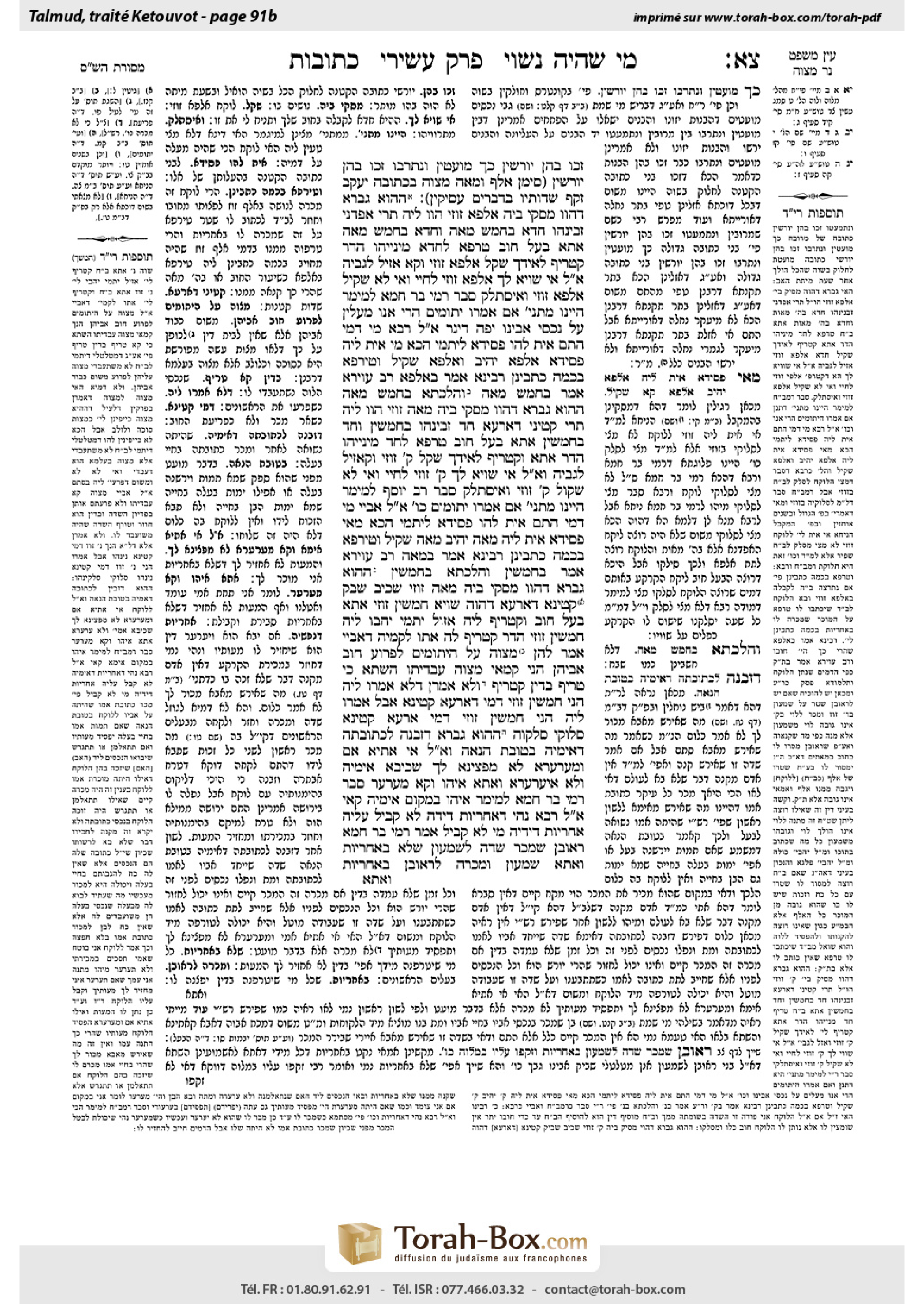
Ketubot 91b: Talmud study for Daf Yomi
Daf Yomi is the daily study of one Talmud folio. Explore 37 tractates with scans, Hebrew text, Sefaria English and AI-generated French translations where annotated.
Passage selection and English or AI-generated French translation are available where the scan has annotations. Daf Study is independent of Torah-Box and Sefaria.
Browse Ketubot · כתובות · All tractatesKetubot 91b text and translations
This page of Ketubot includes the Aramaic text, an English translation and an AI-generated French translation, alongside the scan above.
כתובות צ״א ב · Aramaic and Hebrew text
זָכוּ בָּהֶן יוֹרְשִׁין — כָּךְ מוּעָטִין וְנִתְרַבּוּ זָכוּ בָּהֶן יוֹרְשִׁין.
(סִימַן: אֶלֶף וּמֵאָה מִצְוָה בִּכְתוּבָּה יַעֲקֹב זָקַף שְׂדוֹתָיו בִּדְבָרִים עֲסִיקִין).
הָהוּא גַּבְרָא דַּהֲווֹ מַסְּקִי בֵּיהּ אַלְפָּא זוּזֵי, הֲווֹ לֵיהּ תְּרֵי אַפַּדְנֵי, זַבְּנִינְהוּ חֲדָא בַּחֲמֵשׁ מְאָה וַחֲדָא בַּחֲמֵשׁ מְאָה. אֲתָא בַּעַל חוֹב טַרְפַאּ לַחֲדָא מִינַּיְיהוּ, הֲדַר קָטָרֵיף לְאִידַּךְ.
שְׁקַל אַלְפָּא זוּזֵי וְקָא אָזֵיל לְגַבֵּיהּ, אֲמַר לֵיהּ: אִי שַׁוְיָא לָךְ אַלְפָּא זוּזֵי — לְחַיֵּי, וְאִי לָא — שְׁקֹיל אַלְפָּא זוּזֵי וְאִיסְתַּלַּק.
סְבַר רָמֵי בַּר חָמָא לְמֵימַר: הַיְינוּ מַתְנִיתִין אִם אָמְרוּ יְתוֹמִים ״הֲרֵי אָנוּ מַעֲלִין עַל נִכְסֵי אָבִינוּ יָפֶה דִּינָר״.
אֲמַר לֵיהּ רָבָא: מִי דָּמֵי? הָתָם — אִית לְהוּ פְּסֵידָא לְיַתְמֵי, הָכָא — מִי אִית לֵיהּ פְּסֵידָא? אַלְפָּא יָהֵיב וְאַלְפָּא שָׁקֵיל!
וְטִירְפָא, בְּכַמָּה כָּתְבִינַן?
רָבִינָא אָמַר: בְּאַלְפָּא. רַב עַוִּירָא אָמַר: בַּחֲמֵשׁ מְאָה. וְהִלְכְתָא: בַּחֲמֵשׁ מְאָה.
הָהוּא גַּבְרָא דַּהֲווֹ מַסְּקִי בֵּיהּ מְאָה זוּזֵי. הֲווֹ לֵיהּ תְּרֵי קַטִּינֵי דְאַרְעָא, (חַד זַבֵּינְהוּ) [זַבְּנִינְהוּ לְחַד] בְּחַמְשִׁין וְחַד בְּחַמְשִׁין. אֲתָא בַּעַל חוֹב טַרְפַאּ לְחַד מִינַּיְיהוּ, הֲדַר אֲתָא וְקָטָרֵיף לְאִידַּךְ.
שְׁקַל מְאָה זוּזֵי וְקָאָזֵיל לְגַבֵּיהּ וַאֲמַר לֵיהּ: אִי שָׁוְיָא לָךְ מְאָה זוּזֵי — לְחַיֵּי, וְאִי לָא — שְׁקוֹל מְאָה זוּזֵי וְאִיסְתַּלַּק.
סָבַר רַב יוֹסֵף לְמֵימַר: הַיְינוּ מַתְנִיתִין אִם אָמְרוּ יְתוֹמִים כּוּ׳. אֲמַר לֵיהּ אַבָּיֵי: מִי דָּמֵי? הָתָם — אִית לְהוּ פְּסֵידָא לְיַתְמֵי, הָכָא — מַאי פְּסֵידָא אִית לֵיהּ? מְאָה יָהֵיב, מְאָה שָׁקֵיל.
וְטִירְפָּא בְּכַמָּה כָּתְבִינַן? רָבִינָא אָמַר: בִּמְאָה, רַב עַוִּירָא אָמַר: בְּחַמְשִׁין. וְהִלְכְתָא בְּחַמְשִׁין.
הָהוּא גַּבְרָא דַּהֲווֹ מַסְּקִי בֵּיהּ מְאָה זוּזֵי. שָׁכֵיב, שְׁבַק קַטִּינָא דְּאַרְעָא דַּהֲוָה שָׁוְיָא חַמְשִׁין זוּזֵי. אֲתָא בַּעַל חוֹב וְקָטָרֵיף לֵיהּ, אֲזוּל יַתְמֵי יְהַבוּ לֵיהּ חַמְשִׁין זוּזֵי, הֲדַר קָטָרֵיף לַהּ.
אֲתוֹ לְקַמֵּיהּ דְּאַבָּיֵי. אָמַר לָהֶן: מִצְוָה עַל הַיְּתוֹמִים לִפְרוֹעַ חוֹב אֲבִיהֶן. הָנֵי קַמָּאֵי מִצְוָה עָבְדִיתוּ, הַשְׁתָּא כִּי טָרֵיף — בְּדִין קָטָרֵיף.
וְלָא אֲמַרַן דְּלָא אֲמַרוּ לֵיהּ: ״הָנֵי חַמְשִׁין זוּזֵי דְּמֵי דְּאַרְעָא קַטִּינָא״, אֲבָל אֲמַרוּ לֵיהּ: ״הָנֵי חַמְשִׁין זוּזֵי דְּמֵי אַרְעָא קַטִּינָא״ — סַלּוֹקֵי סַלְּקוּהּ.
הָהוּא גַּבְרָא דְּזַבְּנַהּ לִכְתוּבְּתַהּ דְּאִימֵּיהּ בְּטוֹבַת הֲנָאָה, וַאֲמַר לֵיהּ: אִי אָתְיָא אֵם וּמְעַרְעֲרָא, לָא מְפַצֵּינָא לָךְ.
שְׁכִיבָא אִימֵּיהּ וְלָא (אִי)עַרְעַרָא, וַאֲתָא אִיהוּ וְקָא מְעַרְעַר. סְבַר רָמֵי בַּר חָמָא לְמֵימַר: אִיהוּ בִּמְקוֹם אִימֵּיהּ קָאֵי. אֲמַר לֵיהּ רָבָא: נְהִי דְּאַחְרָיוּת דִּידַהּ לָא קַבֵּיל עֲלֵיהּ, אַחְרָיוּת דִּידֵיהּ מִי לָא קַבֵּיל?
אָמַר רָמֵי בַּר חָמָא: רְאוּבֵן שֶׁמָּכַר שָׂדֶה לְשִׁמְעוֹן שֶׁלֹּא בְּאַחְרָיוּת, וַאֲתָא שִׁמְעוֹן וּמְכָרָהּ לִרְאוּבֵן בְּאַחְרָיוּת,
Ketubot 91b · English translation
the heirs acquired rights to the mothers’ marriage contracts due to the value of the estate when their father died, so too, in a case where the properties were few and the value subsequently appreciated, the heirs have acquired rights to divide the entire estate equally, due to the value of the estate when their father died.
§ This is a mnemonic device for the following halakhot, which are connected in one way or another to the problem being dealt with in the mishna: One thousand, and one hundred, mitzva, in the marriage contract, Ya’akov, set up, his fields, with words, disputants.
There was a certain man who had a creditor with a claim of one thousand dinars against him. He had two mansions [appedanei]. He sold them, one for five hundred and the other one also for five hundred. The creditor came and repossessed one of them from the purchaser, as the repayment of part of his debt. He subsequently sought to repossess the other mansion as well, in payment for the remainder of his debt.
The purchaser took one thousand dinars and went to the creditor. He said to him: If the first mansion that you repossessed is worth one thousand dinars to you, very well, let it be yours in exchange for the entire sum that is owed to you, and if not, take these one thousand dinars and abrogate your rights to both of the mansions, leaving them both in my possession.
Rami bar Ḥama thought to say that this case is identical to that which is taught in the mishna: If the orphans say: We inflate the value of our father’s property by a dinar, the court does not listen to them. This appears to be the case here as well, and the value of the mansion should not be assessed at higher than its market value.
Rava said to him: Are the two cases comparable? There, in the mishna, the other orphans whose mother’s marriage contract was of lesser value will suffer a financial loss if the property is assessed at a value greater than it is actually worth. Here, in the case of the creditor, does he incur a loss? He lent one thousand dinars and took one thousand dinars; consequently, it would be cruel on his part to refuse to take the money and to insist on taking the second mansion from the purchaser.
The Gemara asks: If the creditor decided to hold on to the first mansion and to forgive the remainder of the debt, what amount is written in the document of authorization to repossess liened property, through which the purchaser will claim compensation from the seller? The purchaser had paid only five hundred dinars for the mansion that was repossessed, but the repossession of that mansion earned the seller one thousand dinars, as his entire debt was paid off.
Ravina said: It is written for one thousand dinars. Rav Avira said: It is written for five hundred dinars; the fact that the creditor forgave the full amount of the debt in exchange for this house was his own personal decision and does not reflect an increase in the property value of the house. The Gemara concludes: The halakha is that it is written for five hundred dinars.
It is also related that there was a certain man who had a creditor with a claim of one hundred dinars against him. He had two small tracts of land. He sold one for fifty and he also sold the other one for fifty. The creditor came and repossessed one of them from the purchaser as the collection of part of his debt. He subsequently came, seeking to repossess the other tract of land as well, as payment for the rest of the debt owed to him.
The purchaser took one hundred dinars and went to the creditor. He said to him: If this tract is worth one hundred dinars to you, very well, and if not, take one hundred dinars and abrogate your rights to both of the tracts, leaving them both in my possession.
Rav Yosef thought to say that this case is identical to that which is taught in the mishna, whereby if the orphans say: We inflate the value of our father’s property by a dinar, the court does not listen to them. Abaye said to him: Are the two cases comparable? There, in the mishna, the other orphans suffer a financial loss if the property is assessed at a value greater than it is actually worth; here, what loss does the creditor incur? He lent one hundred dinars and took one hundred dinars. It would be cruel on his part to refuse to take the money and to insist on taking the land from the purchaser.
The Gemara asks: If the creditor decided to hold on to the first tract of land and to forgive the remainder of the debt, what amount is written in the document of authorization to repossess liened property, through which the purchaser will claim compensation from the seller? Ravina said that it is written for one hundred. Rav Avira said it is written for fifty. The Gemara concludes: The halakha is that it is written for fifty dinars.
The Gemara relates that there was a certain man who had a creditor with a claim of one hundred dinars against him. He died and left a small tract of land worth fifty dinars. The creditor came and repossessed it. The orphans came and gave him fifty dinars and redeemed the property from him. He returned and repossessed it again in order to collect the remainder of the debt.
They came before Abaye to complain. He said to them: It is a mitzva for orphans to settle their father’s debt. Consequently, with the money you paid the creditor initially, you performed a mitzva, as you partially settled a debt your father owed. However, this payment did not cancel the lien on the property, and so now, when he repossesses the land, he is repossesses it lawfully.
The Gemara notes: And we said this ruling only in a case where the orphans did not say to the creditor: These fifty dinars are payment for the small tract of land. However, if they said to him: These fifty dinars are payment for the small tract of land, they have successfully removed him from the land and he has no further claim to it.
§ The Gemara relates that there was a certain man who sold the rights to his mother’s marriage contract for a certain financial advantage, i.e., he received a certain sum on the condition that if he would inherit his mother’s marriage contract, which would occur if his mother’s husband would die prior to his mother, the purchaser would obtain the right to collect the money. And he told the purchaser: If my mother comes and objects to the sale, I will not reimburse you for your purchase.
His mother died after her husband died, and had not objected to the sale. He, however, came and contested the sale. Rami bar Ḥama thought to say that he stands in his mother’s place and since he is her proxy, he has the right to object to the sale. Rava said to him: Granted that he did not take upon himself to guarantee the sale against his mother’s objections, but did he not take upon himself to guarantee it against his own objections? When he sold the right to collect the marriage contract, he most certainly guaranteed that he would not renege on the sale.
The Gemara relates a similar discussion. Rami bar Ḥama said: If Reuven sold a field to Shimon without a guarantee, and Shimon came and sold the field back to Reuven, but he sold it with a guarantee that if the field is repossessed, he will compensate the buyer for his loss,
Ketubot 91b · Traduction française (IA)
Les héritiers ont acquis des droits sur les contrats de mariage de leurs mères en fonction de la valeur de la succession au moment de la mort de leur père. De même, lorsque les biens étaient peu nombreux et que leur valeur a ensuite augmenté, les héritiers ont acquis le droit de partager toute la succession à parts égales, en fonction de sa valeur au moment de la mort de leur père.
§ Voici un moyen mnémotechnique pour les halakhot suivantes, qui sont liées d’une manière ou d’une autre au problème traité dans la Michna : mille, cent, mitsva, contrat de mariage, Ya’akov, établir, ses champs, paroles, plaideurs.
Il y avait un homme qui devait mille dinars à un créancier. Il possédait deux manoirs [appedanei]. Il les vendit, l’un pour cinq cents dinars et l’autre, lui aussi, pour cinq cents. Le créancier vint et reprit l’un des manoirs à l’acheteur, en remboursement d’une partie de sa dette. Il chercha ensuite à reprendre également l’autre manoir, en paiement du reste de sa dette.
L’acheteur prit mille dinars et alla trouver le créancier. Il lui dit : « Si le premier manoir que tu as repris vaut mille dinars à tes yeux, fort bien, qu’il soit à toi en échange de la totalité de la somme qui t’est due. Sinon, prends ces mille dinars et renonce à tes droits sur les deux manoirs, en me les laissant tous deux en possession. »
Rami bar Ḥama pensa dire que ce cas est identique à celui enseigné dans la Michna : si les orphelins disent : « Nous augmentons d’un dinar la valeur des biens de notre père », le tribunal ne les écoute pas. Il semble que ce soit également le cas ici, et la valeur du manoir ne devrait pas être estimée au-delà de sa valeur marchande.
Rava lui dit : « Les deux cas sont-ils comparables ? Dans la Michna, les autres orphelins, dont la mère avait un contrat de mariage de moindre valeur, subiraient une perte financière si les biens étaient estimés à une valeur supérieure à leur valeur réelle. Ici, dans le cas du créancier, subit-il une perte ? Il a prêté mille dinars et en a reçu mille. Par conséquent, il serait cruel de sa part de refuser de prendre l’argent et d’insister pour reprendre le second manoir à l’acheteur. »
La Guemara demande : Si le créancier décidait de garder le premier manoir et d’abandonner le reste de la dette, quel montant inscrirait-on dans l’acte d’autorisation de reprendre un bien grevé d’un privilège, grâce auquel l’acheteur réclamerait une indemnisation au vendeur ? L’acheteur n’avait payé que cinq cents dinars pour le manoir repris, mais la reprise de ce manoir avait rapporté mille dinars au vendeur, puisque la totalité de sa dette avait été acquittée.
Ravina dit : « On y inscrit mille dinars. » Rav Avira dit : « On y inscrit cinq cents dinars ; le fait que le créancier ait abandonné la totalité de la dette en échange de cette maison relevait de sa décision personnelle et ne reflète pas une augmentation de la valeur du bien. » La Guemara conclut : la halakha est qu’on y inscrit cinq cents dinars.
Il est également rapporté qu’un homme devait cent dinars à un créancier. Il possédait deux petites parcelles de terre. Il en vendit une pour cinquante dinars, et l’autre également pour cinquante dinars. Le créancier vint et en reprit une à l’acheteur, en recouvrement d’une partie de sa dette. Il revint ensuite, cherchant à reprendre également l’autre parcelle, en paiement du reste de la dette qui lui était due.
L’acheteur prit cent dinars et alla trouver le créancier. Il lui dit : « Si cette parcelle vaut cent dinars à tes yeux, fort bien. Sinon, prends cent dinars et renonce à tes droits sur les deux parcelles, en me les laissant toutes deux en possession. »
Rav Yosef pensa dire que ce cas est identique à celui enseigné dans la Michna, selon lequel si les orphelins disent : « Nous augmentons d’un dinar la valeur des biens de notre père », le tribunal ne les écoute pas. Abaye lui dit : « Les deux cas sont-ils comparables ? Dans la Michna, les autres orphelins subissent une perte financière si les biens sont estimés à une valeur supérieure à leur valeur réelle. Ici, quelle perte le créancier subit-il ? Il a prêté cent dinars et en a reçu cent. Il serait cruel de sa part de refuser de prendre l’argent et d’insister pour reprendre la terre à l’acheteur. »
La Guemara demande : Si le créancier décidait de garder la première parcelle et d’abandonner le reste de la dette, quel montant inscrirait-on dans l’acte d’autorisation de reprendre un bien grevé d’un privilège, grâce auquel l’acheteur réclamerait une indemnisation au vendeur ? Ravina dit qu’on y inscrit cent dinars. Rav Avira dit qu’on y inscrit cinquante dinars. La Guemara conclut : la halakha est qu’on y inscrit cinquante dinars.
La Guemara rapporte qu’un homme devait cent dinars à un créancier. Il mourut et laissa une petite parcelle de terre d’une valeur de cinquante dinars. Le créancier vint et la reprit. Les orphelins vinrent et lui donnèrent cinquante dinars pour racheter le bien. Il revint et le reprit de nouveau afin de recouvrer le reste de la dette.
Ils vinrent se plaindre devant Abaye. Il leur dit : « C’est une mitsva pour les orphelins de régler la dette de leur père. Par conséquent, avec l’argent que vous avez initialement versé au créancier, vous avez accompli une mitsva, puisque vous avez réglé une partie de la dette de votre père. Toutefois, ce paiement n’a pas levé le privilège grevant le bien. Ainsi, à présent, lorsqu’il reprend la terre, il le fait légalement. »
La Guemara précise : Nous n’avons énoncé cette décision que dans le cas où les orphelins n’ont pas dit au créancier : « Ces cinquante dinars sont le paiement de la petite parcelle de terre. » En revanche, s’ils lui ont dit : « Ces cinquante dinars sont le paiement de la petite parcelle de terre », ils l’ont effectivement évincé de la terre et il n’a plus aucun droit sur elle.
§ La Guemara rapporte qu’un homme vendit les droits sur le contrat de mariage de sa mère en échange d’une somme d’argent, à condition que, s’il héritait du contrat de mariage de sa mère — ce qui se produirait si le mari de sa mère mourait avant elle —, l’acheteur obtienne le droit d’en recouvrer le montant. Il dit à l’acheteur : « Si ma mère vient contester la vente, je ne te rembourserai pas ton achat. »
Sa mère mourut après son mari et n’avait pas contesté la vente. Lui, cependant, vint la contester. Rami bar Ḥama pensa dire qu’il prenait la place de sa mère et que, puisqu’il était son mandataire, il avait le droit de contester la vente. Rava lui dit : « Certes, il ne s’est pas engagé à garantir la vente contre les objections de sa mère, mais ne s’est-il pas engagé à la garantir contre ses propres objections ? En vendant le droit de recouvrer le contrat de mariage, il a certainement garanti qu’il ne reviendrait pas sur la vente. »
La Guemara rapporte une discussion similaire. Rami bar Ḥama dit : « Si Reouven a vendu un champ à Chimon sans garantie, et que Chimon est venu vendre le champ à Reouven, mais qu’il l’a vendu avec la garantie que, si le champ est repris, il indemnisera l’acheteur de sa perte, »
Traduction française générée par IA à partir de l’édition anglaise de Sefaria. Vérifie toujours un passage avec le texte source.
Text from Sefaria: William Davidson Edition - Vocalized Aramaic (CC BY NC); William Davidson Edition - English (CC BY NC).