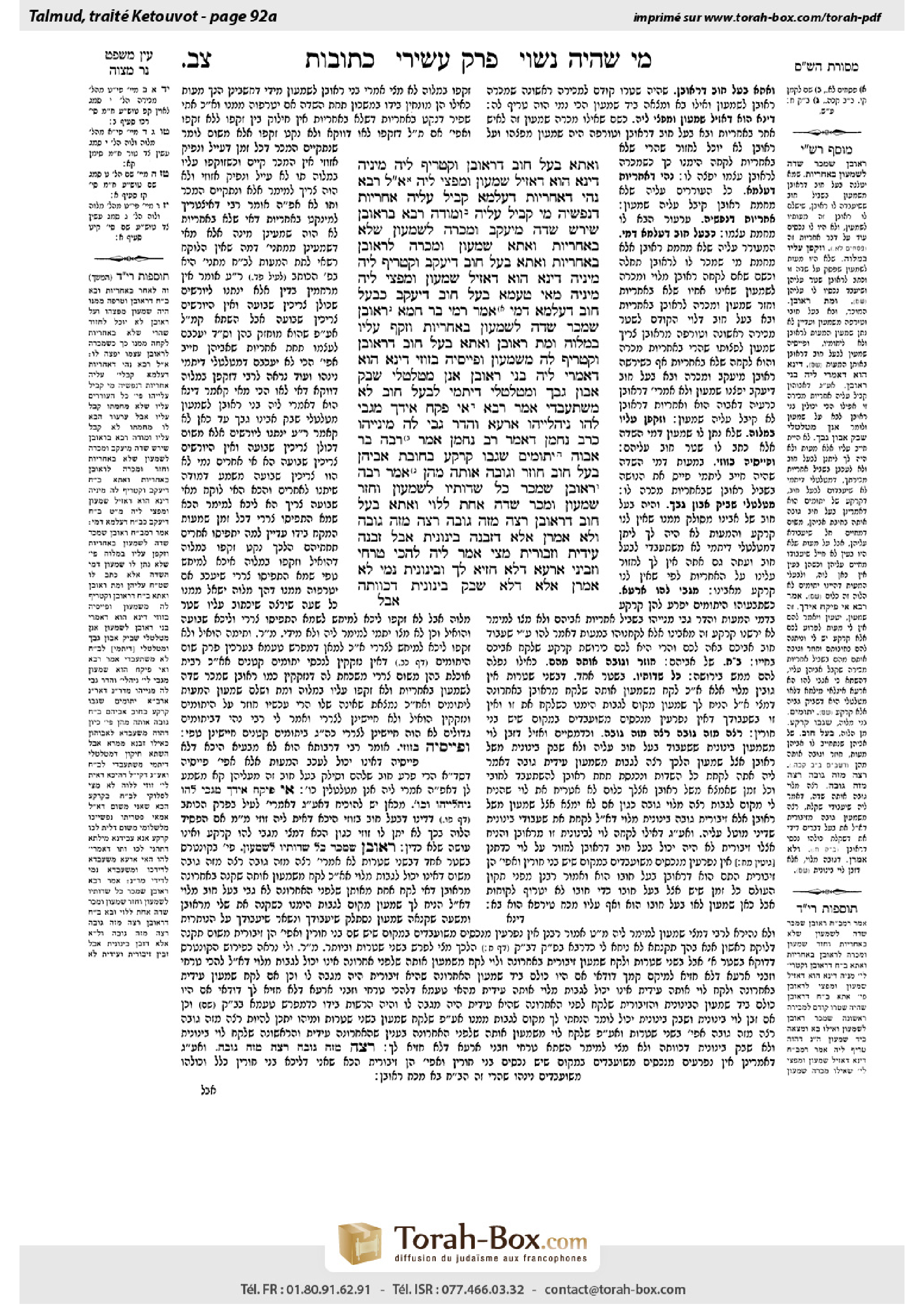
Ketubot 92a: Talmud study for Daf Yomi
Daf Yomi is the daily study of one Talmud folio. Explore 37 tractates with scans, Hebrew text, Sefaria English and AI-generated French translations where annotated.
Passage selection and English or AI-generated French translation are available where the scan has annotations. Daf Study is independent of Torah-Box and Sefaria.
Browse Ketubot · כתובות · All tractatesKetubot 92a text and translations
This page of Ketubot includes the Aramaic text, an English translation and an AI-generated French translation, alongside the scan above.
כתובות צ״ב א · Aramaic and Hebrew text
וַאֲתָא בַּעַל חוֹב דִּרְאוּבֵן וְקָטָרֵיף לֵיהּ מִינֵּיהּ — דִּינָא הוּא דְּאָזֵיל שִׁמְעוֹן וּמְפַצֵּי לֵיהּ.
אֲמַר לֵיהּ רָבָא: נְהִי דְּאַחְרָיוּת דְּעָלְמָא קַבֵּיל עֲלֵיהּ, אַחְרָיוּת דְּנַפְשֵׁיהּ מִי קַבֵּיל עֲלֵיהּ?
וּמוֹדֶה רָבָא בִּרְאוּבֵן שֶׁיָּרַשׁ שָׂדֶה מִיַּעֲקֹב, וּמְכָרָהּ לְשִׁמְעוֹן שֶׁלֹּא בְּאַחְרָיוּת, וַאֲתָא שִׁמְעוֹן וּמְכָרָהּ לִרְאוּבֵן בְּאַחְרָיוּת, וַאֲתָא בַּעַל חוֹב דְּיַעֲקֹב, וְקָטָרֵיף לֵיהּ מִינֵּיהּ — דִּינָא הוּא דְּאָזֵיל שִׁמְעוֹן וּמְפַצֵּי לֵיהּ מִינֵּיהּ.
מַאי טַעְמָא? בַּעַל חוֹב דְּיַעֲקֹב כְּבַעַל חוֹב דְּעָלְמָא דָּמֵי.
אָמַר רָמֵי בַּר חָמָא: רְאוּבֵן שֶׁמָּכַר שָׂדֶה לְשִׁמְעוֹן בְּאַחְרָיוּת, וְזָקַף עָלָיו בְּמִלְוָה, וּמֵת רְאוּבֵן, וַאֲתָא בַּעַל חוֹב דִּרְאוּבֵן וְקָטָרֵיף לַהּ מִשִּׁמְעוֹן וּפַיְּיסֵיהּ בְּזוּזֵי —
דִּינָא הוּא דְּאָמְרִי לֵיהּ בְּנֵי רְאוּבֵן: אֲנַן מִטַּלְטְלִי שְׁבַק אֲבוּן גַּבָּךְ, וּמִטַּלְטְלִי דְיַתְמֵי לְבַעַל חוֹב לָא מִשְׁתַּעְבְּדִי.
אָמַר רָבָא: אִי פִּקֵּחַ אִידַּךְ, מַגְבֵּי לְהוּ נִיהֲלַיְיהוּ אַרְעָא וַהֲדַר גָּבֵי לַהּ מִינַּיְיהוּ, כְּרַב נַחְמָן. דְּאָמַר רַב נַחְמָן אָמַר רַבָּה בַּר אֲבוּהּ: יְתוֹמִים שֶׁגָּבוּ קַרְקַע בְּחוֹבַת אֲבִיהֶן — בַּעַל חוֹב חוֹזֵר וְגוֹבֶה אוֹתָהּ מֵהֶן.
אָמַר רַבָּה: רְאוּבֵן שֶׁמָּכַר כׇּל שְׂדוֹתָיו לְשִׁמְעוֹן, וְחָזַר שִׁמְעוֹן וּמָכַר שָׂדֶה אַחַת לְלֵוִי, וַאֲתָא בַּעַל חוֹב דִּרְאוּבֵן — רָצָה מִזֶּה גּוֹבֶה, רָצָה מִזֶּה גּוֹבֶה.
וְלָא אֲמַרַן אֶלָּא דְּזַבְּנֵהּ בֵּינוֹנִית, אֲבָל זַבְּנֵהּ עִידִּית וְזִבּוּרִית, מָצֵי אֲמַר לֵיהּ: לְהָכִי טְרַחִי וּזְבַינִי אַרְעָא דְּלָא חַזְיָא לָךְ.
וּבֵינוֹנִית נָמֵי לָא אֲמַרַן, אֶלָּא דְּלָא שְׁבַק בֵּינוֹנִית דִּכְווֹתַהּ,
Ketubot 92a · English translation
and Reuven’s creditor came and repossessed the field from him, i.e., from Reuven, the law is that Shimon must go and compensate [mefatzei] Reuven, since he sold him the field with a guarantee, while Reuven owes Shimon nothing, since he sold him the field without a guarantee.
Rava said to him: Granted, that Shimon took upon himself to guarantee the sale in general, i.e., if the field were to be repossessed by his own creditors or those of a previous owner of the field; did he also take upon himself to guarantee the sale if it were to be repossessed by the purchaser’s own creditors?
The Gemara notes: And Rava concedes to Rami bar Ḥama in the following case: Reuven inherited a field from his father, Ya’akov, and sold it to Shimon with no guarantee. Shimon came and sold it back to Reuven with a guarantee. Then, Ya’akov’s creditor came and repossessed the field from Reuven. In this case, Rava would concede that the law is that Shimon must go and compensate Reuven for his loss.
The Gemara asks: What is the reason for this halakha? The Gemara answers: Ya’akov’s creditor is comparable to a general case of a creditor, i.e., a creditor of a previous owner. Even Rava would agree that this is not comparable to a case where Reuven’s creditor repossessed the field. Consequently, Shimon bears responsibility to compensate Reuven.
Rami bar Ḥama said: Consider a case where Reuven sold a field to Shimon with a guarantee that if it is repossessed he will compensate Shimon for his loss. Shimon did not pay for the purchase, and instead set up the value of the field as a loan by writing a promissory note for this amount. Reuven subsequently died, and a creditor of Reuven came and repossessed the field from Shimon. Shimon, not wanting the creditor to take the field from him, tried to appease him with money so the creditor would allow him to keep the field.
The law is that the sons of Reuven can say to Shimon that he must pay them the money he owes for the field, and they are not required to pay Shimon if he demands compensation for the repossession of the field. They may say to him: Our father left us movable property with you, i.e., the money you owe us for the field, and the movable property of orphans is not liened to a creditor. The orphans can claim that the field belongs to Shimon, and as there is no land left for the orphans, there is no way for Shimon to recover the compensation that he is owed. The money he owes Reuven is considered movable property, and therefore he cannot recover his losses from these funds.
Rava said with regard to this case: If the other individual, Shimon, is clever he will pay them what he owes with real estate and not with money. Since they now have real estate inherited from their father’s estate, Shimon can then collect the field from them as compensation for the repossession of the original field that Reuven sold to Shimon. This is in accordance with the opinion of Rav Naḥman, as Rav Naḥman said that Rabba bar Avuh said: When orphans collect real estate for a debt owed to their father from one person, their father’s creditor can come and seize this land from them.
The Gemara addresses a similar matter. Rabba said: If Reuven sold all his fields to Shimon, and Shimon then sold one field to Levi, and then Reuven’s creditor came to repossess one of the fields that was mortgaged to him: If he desires, he can collect from this one, Shimon, and if he desires, he can collect from that one, Levi, since he has a lien that applies equally to all the properties that once belonged to Reuven.
And we said this only if Shimon sold Levi land of intermediate quality, but if he sold him land of superior quality or inferior quality, Levi can say to the creditor: It was for this reason that I made an effort to buy land that is not fit for you, as a creditor is supposed to repossess land of intermediate quality. Therefore, go to Shimon and collect your debt from the land of intermediate quality that is in his possession.
The Gemara notes further: And even if Shimon sold Levi land of intermediate quality, we said that the creditor may repossess Levi’s land only in a case where Levi did not leave Shimon with equivalent land of intermediate quality.
Ketubot 92a · Traduction française (IA)
Le créancier de Réouven vint et lui reprit le champ, c’est-à-dire à Réouven. La halakha est alors que Chim’on doit aller indemniser [mefatzei] Réouven, puisqu’il lui a vendu le champ avec garantie, tandis que Réouven ne doit rien à Chim’on, puisqu’il lui a vendu le champ sans garantie.
Rava lui dit : Admettons que Chim’on ait accepté de garantir la vente de manière générale, c’est-à-dire dans le cas où le champ serait repris par ses propres créanciers ou par ceux d’un propriétaire antérieur ; a-t-il également accepté de garantir la vente si le champ était repris par les créanciers de l’acheteur lui-même ?
La Guemara relève : Rava concède à Rami bar Ḥama dans le cas suivant : Réouven hérita d’un champ de son père, Ya’akov, et le vendit à Chim’on sans garantie. Chim’on vint ensuite le revendre à Réouven avec garantie. Alors, le créancier de Ya’akov vint et reprit le champ à Réouven. Dans ce cas, Rava concéderait que Chim’on doit indemniser Réouven de sa perte.
La Guemara demande : Quelle est la raison de cette halakha ? La Guemara répond : Le créancier de Ya’akov est comparable à un créancier dans le cas général, c’est-à-dire au créancier d’un propriétaire antérieur. Même Rava conviendrait que ce cas n’est pas comparable à celui où le créancier de Réouven a repris le champ. Par conséquent, Chim’on est tenu d’indemniser Réouven.
Rami bar Ḥama dit : Considérons le cas où Réouven vendit un champ à Chim’on en garantissant que, si le champ était repris, il indemniserait Chim’on de sa perte. Chim’on ne paya pas le prix d’achat ; il établit plutôt la valeur du champ comme un prêt en rédigeant un billet de dette pour ce montant. Réouven mourut par la suite, et un créancier de Réouven vint reprendre le champ à Chim’on. Ne voulant pas que le créancier lui prenne le champ, Chim’on tenta de l’apaiser avec de l’argent afin que le créancier le laisse conserver le champ.
La halakha est que les fils de Réouven peuvent dire à Chim’on qu’il doit leur payer l’argent qu’il leur doit pour le champ, et qu’ils ne sont pas tenus de payer Chim’on s’il leur réclame une indemnisation pour la reprise du champ. Ils peuvent lui dire : « Notre père nous a laissé des biens mobiliers entre tes mains », c’est-à-dire l’argent que tu nous dois pour le champ, « et les biens mobiliers des orphelins ne sont pas grevés au profit d’un créancier. » Les orphelins peuvent soutenir que le champ appartient à Chim’on et que, puisqu’il ne reste aucun terrain aux orphelins, Chim’on ne peut recouvrer l’indemnisation qui lui est due. L’argent qu’il doit à Réouven est considéré comme un bien mobilier ; il ne peut donc pas recouvrer ses pertes sur ces fonds.
Au sujet de ce cas, Rava dit : Si l’autre partie, Chim’on, est habile, il les paiera avec un bien immobilier plutôt qu’avec de l’argent. Puisqu’ils posséderont alors un bien immobilier hérité de la succession de leur père, Chim’on pourra ensuite leur reprendre le champ à titre d’indemnisation pour la reprise du champ initial que Réouven lui avait vendu. Cela est conforme à l’avis de Rav Naḥman, car Rav Naḥman a dit que Rabba bar Avuh a dit : Lorsque des orphelins recouvrent un bien immobilier auprès d’une personne pour une dette due à leur père, le créancier de leur père peut venir leur saisir ce bien.
La Guemara aborde une question similaire. Rabba dit : Si Réouven vendit tous ses champs à Chim’on, puis que Chim’on vendit un champ à Lévi, et qu’ensuite le créancier de Réouven vint reprendre l’un des champs qui lui étaient hypothéqués, il peut, s’il le souhaite, recouvrer sa créance auprès de Chim’on ou, s’il le souhaite, auprès de Lévi, car son privilège s’applique également à tous les biens qui avaient appartenu à Réouven.
Et nous n’avons dit cela que si Chim’on vendit à Lévi un terrain de qualité moyenne. Mais s’il lui vendit un terrain de qualité supérieure ou inférieure, Lévi peut dire au créancier : « C’est pour cette raison que je me suis donné la peine d’acheter un terrain qui ne te convient pas, car un créancier est censé reprendre un terrain de qualité moyenne. Va donc trouver Chim’on et recouvre ta créance sur le terrain de qualité moyenne qu’il possède. »
La Guemara relève en outre : Même si Chim’on vendit à Lévi un terrain de qualité moyenne, nous avons dit que le créancier ne peut reprendre le terrain de Lévi que dans le cas où Lévi n’a pas laissé à Chim’on un terrain de qualité moyenne équivalente.
Traduction française générée par IA à partir de l’édition anglaise de Sefaria. Vérifie toujours un passage avec le texte source.
Text from Sefaria: William Davidson Edition - Vocalized Aramaic (CC BY NC); William Davidson Edition - English (CC BY NC).