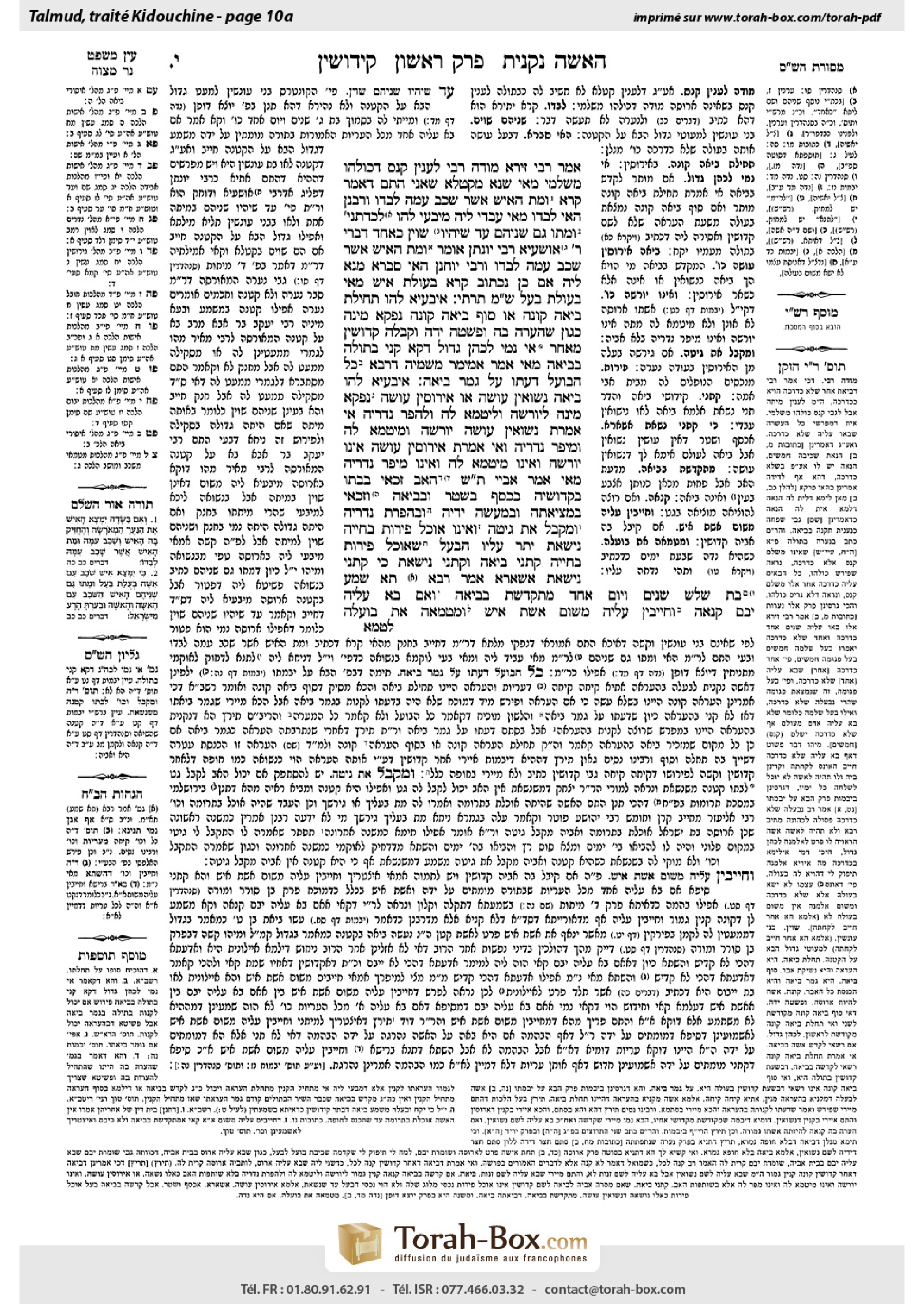
Kiddushin 10a: Talmud study for Daf Yomi
Daf Yomi is the daily study of one Talmud folio. Explore 37 tractates with scans, Hebrew text, Sefaria English and AI-generated French translations where annotated.
Passage selection and English or AI-generated French translation are available where the scan has annotations. Daf Study is independent of Torah-Box and Sefaria.
Browse Kiddushin · קידושין · All tractatesKiddushin 10a text and translations
This page of Kiddushin includes the Aramaic text, an English translation and an AI-generated French translation, alongside the scan above.
קידושין י׳ א · Aramaic and Hebrew text
אָמַר רַבִּי זֵירָא: מוֹדֶה רַבִּי לְעִנְיַן קְנָס דְּכוּלְּהוּ מְשַׁלְּמִי. מַאי שְׁנָא מִקְּטָלָא? שָׁאנֵי הָתָם, דְּאָמַר קְרָא: ״וּמֵת הָאִישׁ אֲשֶׁר שָׁכַב עִמָּהּ לְבַדּוֹ״.
וְרַבָּנַן הַאי ״לְבַדּוֹ״ מַאי עָבְדִי לֵיהּ? מִיבְּעֵי לְהוּ לְכִדְתַנְיָא, ״וּמֵתוּ גַּם שְׁנֵיהֶם״ – עַד שֶׁיִּהְיוּ שָׁוִין כְּאֶחָד, דִּבְרֵי רַבִּי אוֹשַׁעְיָא. רַבִּי יוֹנָתָן אוֹמֵר: ״וּמֵת הָאִישׁ אֲשֶׁר שָׁכַב עִמָּהּ לְבַדּוֹ״.
וְרַבִּי יוֹחָנָן, הַאי סְבָרָא מְנָא לֵיהּ? אִם כֵּן נִכְתּוֹב קְרָא ״בְּעוּלַת אִישׁ״, מַאי ״בְּעוּלַת בַּעַל״ – שְׁמַע מִינַּהּ תַּרְתֵּי.
אִיבַּעְיָא לְהוּ: תְּחִילַּת בִּיאָה קוֹנָה אוֹ סוֹף בִּיאָה קוֹנָה? נָפְקָא מִינַּהּ כְּגוֹן שֶׁהֶעֱרָה בָּהּ, וּפָשְׁטָה יָדָהּ וְקִבְּלָה קִדּוּשִׁין מֵאַחֵר.
אִי נָמֵי, לְכֹהֵן גָּדוֹל דְּקָא קָנֵי בְּתוּלָה בְּבִיאָה, מַאי? אָמַר אַמֵּימָר מִשְּׁמֵיהּ דְּרָבָא: כׇּל הַבּוֹעֵל – דַּעְתּוֹ עַל גְּמַר בִּיאָה.
אִיבַּעְיָא לְהוּ: בִּיאָה נִשּׂוּאִין עוֹשָׂה, אוֹ אֵירוּסִין עוֹשָׂה? נָפְקָא מִינַּהּ – לְיוֹרְשָׁהּ,
וְלִיטַמֵּא לָהּ, וּלְהָפֵר נְדָרֶיהָ. אִי אָמְרַתְּ נִשּׂוּאִין עוֹשָׂה – יוֹרְשָׁהּ וּמִיטַּמֵּא לָהּ וּמֵיפֵר נְדָרֶיהָ, וְאִי אָמְרַתְּ אֵירוּסִין עוֹשָׂה – אֵינוֹ יוֹרְשָׁהּ וְאֵינוֹ מִיטַּמֵּא לָהּ וְאֵינוֹ מֵיפֵר נְדָרֶיהָ. מַאי?
אָמַר אַבָּיֵי: תָּא שְׁמַע: הָאָב זַכַּאי בְּבִתּוֹ בְּקִדּוּשֶׁיהָ בְּכֶסֶף בִּשְׁטָר וּבְבִיאָה, וְזַכַּאי בִּמְצִיאָתָהּ וּבְמַעֲשֵׂה יָדֶיהָ, וּבַהֲפָרַת נְדָרֶיהָ, וּמְקַבֵּל אֶת גִּיטָּהּ, וְאֵינוֹ אוֹכֵל פֵּירוֹת בְּחַיֶּיהָ. נִישֵּׂאת – יָתֵר עָלָיו הַבַּעַל שֶׁאוֹכֵל פֵּירוֹת בְּחַיֶּיהָ.
קָתָנֵי ״בִּיאָה״, וְקָתָנֵי ״נִישֵּׂאת״! כִּי קָתָנֵי ״נִישֵּׂאת״ – אַשְּׁאָרָא.
אָמַר רָבָא: תָּא שְׁמַע: בַּת שָׁלֹשׁ שָׁנִים וְיוֹם אֶחָד מִתְקַדֶּשֶׁת בְּבִיאָה, וְאִם בָּא עָלֶיהָ יָבָם – קְנָאָהּ, וְחַיָּיבִין עָלֶיהָ מִשּׁוּם אֵשֶׁת אִישׁ, וּמְטַמְּאָה אֶת בּוֹעֲלָהּ
Kiddushin 10a · English translation
Rabbi Zeira said: Rabbi Yehuda HaNasi concedes with regard to the fine of a rapist and a seducer that they all pay this fine, and they are not exempt merely because their acts of intercourse were with a non-virgin. The Gemara asks: In what way is this case different from the death penalty? With respect to the death penalty they are punished as though they engaged in intercourse with a betrothed non-virgin, and yet concerning the fine, they pay as though they engaged in intercourse with a virgin. The Gemara answers: It is different there, with regard to capital punishment, as the verse states: “Then the man only who lay with her shall die” (Deuteronomy 22:25), which indicates that only one man is executed for having sexual intercourse with a virgin, and no more.
The Gemara asks: And the Rabbis, what do they do with this term “only”? The Gemara answers: They require it for that which is taught in a baraita. The verse states: “Then they shall both of them die” (Deuteronomy 22:22). This indicates that this is not the case unless the two of them are equal, i.e., both deserve punishment. But if one of them cannot be punished, e.g., if he is a minor, the other is not executed either. This is the statement of Rabbi Oshaya. Rabbi Yonatan says that the verse: “Then the man only who lay with her shall die,” indicates that in some cases only one of them is liable to receive the death penalty.
The Gemara asks: And Rabbi Yoḥanan, from where does he derive this conclusion that only a woman’s husband can render her a non-virgin through intercourse in an atypical manner, if he uses this verse to derive the mode of betrothal by means of sexual intercourse? The Gemara answers: If so, that this verse is teaching only one halakha, let the verse write: If a man be found lying with a beulat ish, literally, a woman who engaged in sexual intercourse with a man. What is indicated by the term “beulat ba’al,” literally, who engaged in sexual intercourse with a husband? Learn two halakhot from it: First, that one can betroth a woman through intercourse, and second, that only a woman’s husband can render her a non-virgin by intercourse in an atypical manner.
§ A dilemma was raised before the Sages: Since intercourse is not a momentary act but has different stages, does the beginning of intercourse effect acquisition or does the end of intercourse effect acquisition? When exactly is the moment of betrothal? The Gemara comments: The practical difference resulting from this question is in a case where one engaged in only the initial stage of intercourse with her and in the meantime she reached her hand out and accepted betrothal from another man. If the beginning of sexual intercourse effects acquisition, the other man’s betrothal is meaningless. If the end of sexual intercourse effects acquisition, she is betrothed to the other man.
Alternatively, there is a difference with regard to a High Priest who acquires a virgin through sexual intercourse. If only the end of intercourse effects acquisition, she is no longer a virgin at the time of the betrothal, which would mean that a High Priest cannot acquire a woman through intercourse, as it is prohibited for him to marry a non-virgin (Leviticus 21:14). What, then, is the halakha? Ameimar said in the name of Rava: Anyone who engages in sexual intercourse has the completion of the act of intercourse in mind, not the beginning. Therefore, the acquisition is complete only when the act has been completed.
Additionally, a dilemma was raised before the Sages: Does the sexual intercourse that is performed to effect betrothal effect marriage at the same time that it effects betrothal, or does it effect only betrothal? The practical difference that arises from this question concerns all cases where it matters whether a woman is betrothed or married. For example, one issue is whether the act allows him to inherit property from her. If he betroths her through intercourse, does he inherit her property when she dies as he would if they were married?
And if he is a priest, is he required to become ritually impure to bury her, as he must do for his wife? And similarly, does a betrothal through intercourse allow him to nullify her vows by himself, without her father’s participation? If you say that intercourse effects marriage, he inherits property from her, and he becomes impure to bury her, and he nullifies her vows alone. And if you say that it effects only betrothal, he does not inherit property from her, and he does not become ritually impure to bury her, and he cannot nullify her vows alone. What, then, is the halakha?
Abaye said: Come and hear a resolution from the following mishna (Ketubot 46b): A father has authority over his daughter with regard to her betrothal, whether it is through money, through a document, or through sexual intercourse. Likewise, a father has a right to items she has found, and to her earnings, and to effect the nullification of her vows, i.e., a father may nullify his daughter’s vows. And he accepts her bill of divorce on her behalf if she is divorced from betrothal before she becomes a grown woman. And although he inherits her property when she dies, e.g., property she inherited from her mother’s family, he does not enjoy the profits of her property during her lifetime. If the daughter married, the husband has more rights and obligations than her father had before the marriage, as he enjoys the profits of her property during her lifetime.
The mishna teaches that a man has rights to his daughter’s betrothal through sexual intercourse, and it subsequently teaches: If the daughter married. This indicates that intercourse effects only betrothal. The Gemara rejects this claim: When it teaches: If the daughter married, that is referring to the other modes mentioned here, i.e., betrothal by means of money or a document. In these cases there is a difference between betrothal and marriage, while it is possible that betrothal through intercourse effects marriage as well.
Rava said: Come and hear a resolution from a baraita: A girl who is three years and one day old can be betrothed through intercourse, and if her yavam engaged in intercourse with her, he has acquired her. And if she is married, one is liable if he engages in intercourse with her, due to her status as a married woman. And if she is impure as a menstruating woman, she renders one who engages in intercourse with her ritually impure for seven days.
Kiddushin 10a · Traduction française (IA)
Rabbi Zeira a dit : Rabbi Yehouda HaNassi reconnaît, concernant l’amende due par un violeur ou un séducteur, qu’ils doivent tous payer cette amende et qu’ils n’en sont pas exemptés simplement parce qu’ils ont eu des rapports avec une femme qui n’était pas vierge. La Guemara demande : En quoi ce cas diffère-t-il de la peine de mort ? Pour la peine de mort, ils sont punis comme s’ils avaient eu des rapports avec une femme non vierge fiancée ; pourtant, pour l’amende, ils paient comme s’ils avaient eu des rapports avec une vierge. La Guemara répond : Le cas de la peine capitale est différent, car le verset dit : « Seul l’homme qui a couché avec elle mourra » (Deutéronome 22,25), ce qui indique qu’un seul homme est exécuté pour avoir eu des rapports avec une vierge, et pas davantage.
La Guemara demande : Et que font les Rabbins de ce terme « seul » ? La Guemara répond : Ils en ont besoin pour ce qui est enseigné dans une baraïta. Le verset dit : « Alors ils mourront tous les deux » (Deutéronome 22,22). Cela indique que cette règle ne s’applique que si les deux sont égaux, c’est-à-dire si tous deux méritent d’être punis. Mais si l’un d’eux ne peut pas être puni, par exemple s’il est mineur, l’autre n’est pas non plus exécuté. Telle est l’opinion de Rabbi Oshaya. Rabbi Yonatan dit que le verset « Seul l’homme qui a couché avec elle mourra » indique que, dans certains cas, un seul des deux est passible de la peine de mort.
La Guemara demande : Et d’où Rabbi Yoḥanan tire-t-il cette conclusion selon laquelle seul le mari d’une femme peut la rendre non vierge par des rapports ayant lieu d’une manière atypique, s’il utilise ce verset pour déduire que les rapports sexuels constituent un mode de fiançailles ? La Guemara répond : Si ce verset n’enseignait qu’une seule halakha, qu’il soit écrit : « Si un homme est trouvé couché avec une beulat ish », littéralement, une femme qui a eu des rapports sexuels avec un homme. Qu’indique le terme « beulat ba’al », littéralement, qui a eu des rapports sexuels avec un mari ? Il faut en déduire deux halakhot : premièrement, qu’on peut fiancer une femme par des rapports sexuels ; deuxièmement, que seul le mari d’une femme peut la rendre non vierge par des rapports ayant lieu d’une manière atypique.
§ Les Sages ont soulevé un dilemme : puisque les rapports sexuels ne sont pas un acte instantané, mais comportent différentes étapes, est-ce le début des rapports qui réalise l’acquisition, ou leur fin ? À quel moment précis les fiançailles prennent-elles effet ? La Guemara fait remarquer que la différence pratique découlant de cette question concerne le cas où un homme n’a eu avec elle que le début des rapports et où, entre-temps, elle a tendu la main et accepté les fiançailles d’un autre homme. Si le début des rapports réalise l’acquisition, les fiançailles de l’autre homme sont sans effet. Si c’est la fin des rapports qui réalise l’acquisition, elle est fiancée à l’autre homme.
Une autre différence concerne le grand prêtre qui acquiert une vierge par des rapports sexuels. Si seule la fin des rapports réalise l’acquisition, elle n’est plus vierge au moment des fiançailles ; cela signifierait qu’un grand prêtre ne peut pas acquérir une femme par des rapports sexuels, car il lui est interdit d’épouser une femme non vierge (Lévitique 21,14). Quelle est donc la halakha ? Ameimar a dit au nom de Rava : Quiconque a des rapports sexuels a à l’esprit d’en achever l’acte, et non de s’en tenir au début. Par conséquent, l’acquisition n’est complète qu’une fois l’acte achevé.
De plus, les Sages ont soulevé un dilemme : les rapports sexuels accomplis pour réaliser les fiançailles produisent-ils en même temps le mariage, ou ne produisent-ils que les fiançailles ? La différence pratique qui découle de cette question concerne tous les cas où il importe de savoir si une femme est fiancée ou mariée. Par exemple, l’une des questions est de savoir si cet acte lui permet d’hériter de ses biens. S’il la fiance par des rapports sexuels, hérite-t-il de ses biens à sa mort, comme il le ferait s’ils étaient mariés ?
Et s’il est prêtre, doit-il se rendre rituellement impur pour l’enterrer, comme il doit le faire pour son épouse ? De même, des fiançailles par rapports sexuels lui permettent-elles d’annuler seul ses vœux, sans la participation de son père ? Si l’on dit que les rapports produisent le mariage, il hérite de ses biens, se rend rituellement impur pour l’enterrer et annule seul ses vœux. Et si l’on dit qu’ils ne produisent que les fiançailles, il n’hérite pas de ses biens, ne se rend pas rituellement impur pour l’enterrer et ne peut pas annuler seul ses vœux. Quelle est donc la halakha ?
Abaye a dit : Viens entendre une réponse tirée de la Michna suivante (Ketoubot 46b) : un père a autorité sur sa fille en matière de fiançailles, qu’elles soient réalisées par de l’argent, par un acte écrit ou par des rapports sexuels. De même, un père a droit aux objets que sa fille trouve et à ses revenus ; il peut aussi annuler ses vœux, c’est-à-dire les vœux de sa fille. Il accepte également en son nom son acte de divorce si elle est répudiée après ses fiançailles, avant de devenir majeure. Bien qu’il hérite de ses biens à sa mort, par exemple des biens qu’elle a hérités de la famille de sa mère, il ne jouit pas des revenus de ses biens de son vivant. Si la fille s’est mariée, son mari a davantage de droits et d’obligations que son père n’en avait avant le mariage, puisqu’il jouit des revenus de ses biens de son vivant.
La Michna enseigne qu’un homme a des droits sur les fiançailles de sa fille réalisées par des rapports sexuels, puis elle enseigne : « Si la fille s’est mariée. » Cela indique que les rapports sexuels ne produisent que les fiançailles. La Guemara rejette cette affirmation : lorsqu’elle enseigne « Si la fille s’est mariée », cela se rapporte aux autres modes mentionnés ici, c’est-à-dire aux fiançailles réalisées par de l’argent ou par un acte écrit. Dans ces cas, il existe une différence entre les fiançailles et le mariage, tandis qu’il est possible que des fiançailles par rapports sexuels produisent également le mariage.
Rava a dit : Viens entendre une réponse tirée d’une baraïta : une fille âgée de trois ans et un jour peut être fiancée par des rapports sexuels et, si son yavam a des rapports avec elle, il l’a acquise. Si elle est mariée, celui qui a des rapports avec elle est passible d’une peine en raison de son statut de femme mariée. Et si elle est impure parce qu’elle a ses règles, elle rend rituellement impur pendant sept jours celui qui a des rapports avec elle.
Traduction française générée par IA à partir de l’édition anglaise de Sefaria. Vérifie toujours un passage avec le texte source.
Text from Sefaria: William Davidson Edition - Vocalized Aramaic (CC BY NC); William Davidson Edition - English (CC BY NC).