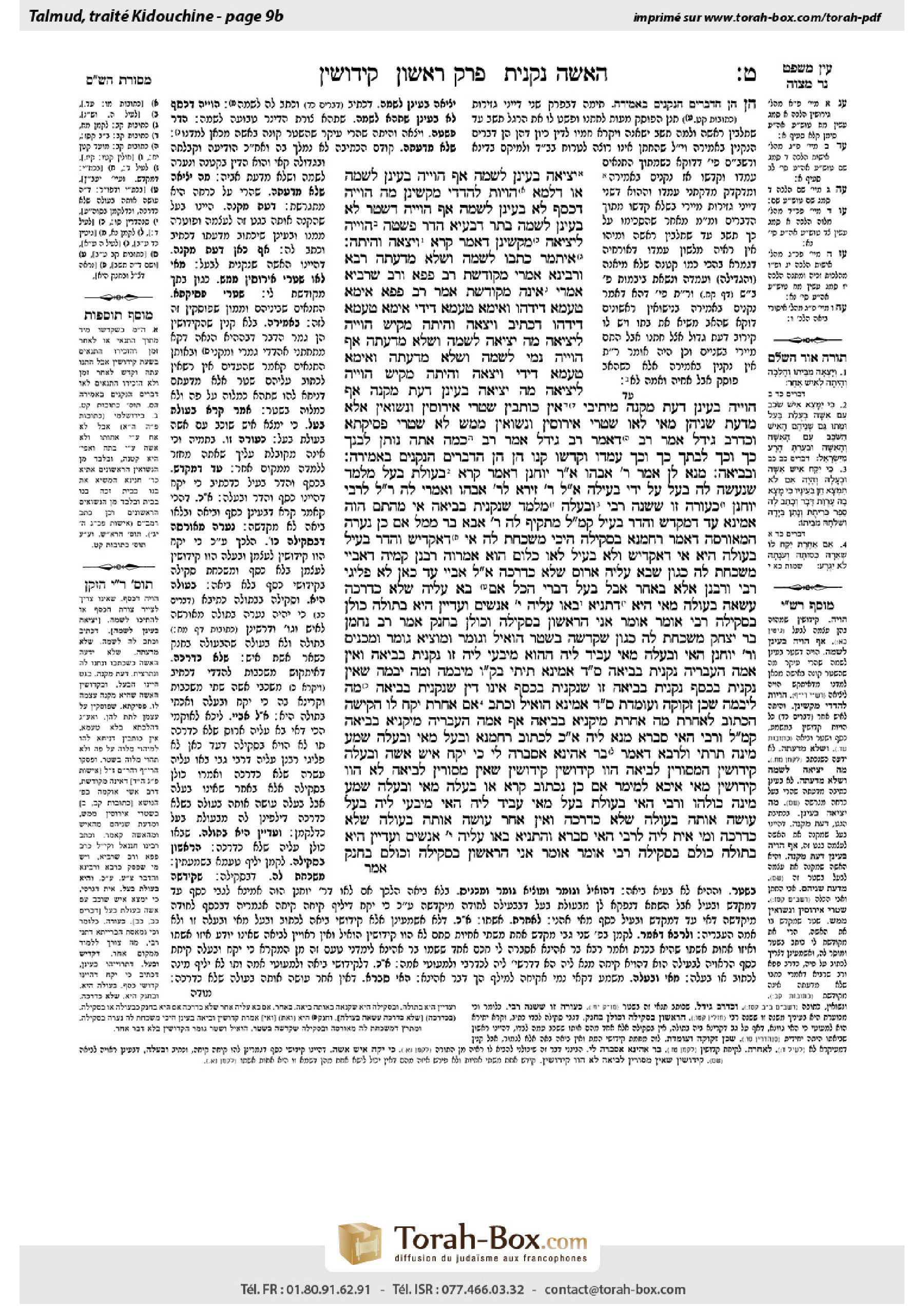
Kiddushin 9b: Talmud study for Daf Yomi
Daf Yomi is the daily study of one Talmud folio. Explore 37 tractates with scans, Hebrew text, Sefaria English and AI-generated French translations where annotated.
Passage selection and English or AI-generated French translation are available where the scan has annotations. Daf Study is independent of Torah-Box and Sefaria.
Browse Kiddushin · קידושין · All tractatesKiddushin 9b text and translations
This page of Kiddushin includes the Aramaic text, an English translation and an AI-generated French translation, alongside the scan above.
קידושין ט׳ ב · Aramaic and Hebrew text
יְצִיאָה בָּעֵינַן לִשְׁמָהּ – אַף הֲוָיָיה בָּעֵינַן לִשְׁמָהּ, אוֹ דִלְמָא הֲוָיוֹת לַהֲדָדֵי מַקְּשִׁינַן, מָה הֲוָיָיה דְכֶסֶף לָא בָּעֵינַן לִשְׁמָהּ – אַף הֲוָיָיה דִשְׁטָר לָא בָּעֵינַן לִשְׁמָהּ?
בָּתַר דְּבַעְיָא הֲדַר פַּשְׁטַהּ: הֲוָיָיה לִיצִיאָה מַקְּשִׁינַן, דְּאָמַר קְרָא ״וְיָצְאָה״ ״וְהָיְתָה״.
אִיתְּמַר: כְּתָבוֹ לִשְׁמָהּ, וְשֶׁלֹּא מִדַּעְתָּהּ – רָבָא וְרָבִינָא אָמְרִי: מְקוּדֶּשֶׁת. רַב פָּפָּא וְרַב שֵׁרֵבְיָא אָמְרִי: אֵינָהּ מְקוּדֶּשֶׁת. אָמַר רַב פָּפָּא: אֵימָא טַעְמָא דִידְהוּ וְאֵימָא טַעְמָא דִידִי. אֵימָא טַעְמָא דִידְהוּ – דִּכְתִיב: ״וְיָצְאָה״ ״וְהָיְתָה״ – מַקִּישׁ הֲוָיָיה לִיצִיאָה, מָה יְצִיאָה לִשְׁמָהּ וְשֶׁלֹּא מִדַּעְתָּהּ, אַף הֲוָיָיה נָמֵי לִשְׁמָהּ וְשֶׁלֹּא מִדַּעְתָּהּ.
וְאֵימָא טַעְמָא דִידִי: ״וְיָצְאָה״ ״וְהָיְתָה״ – מַקִּישׁ הֲוָיָיה לִיצִיאָה, מָה יְצִיאָה בָּעֵינַן דַּעַת מַקְנֶה, אַף הֲוָיָיה בָּעֵינַן דַּעַת מַקְנֶה.
מֵיתִיבִי: אֵין כּוֹתְבִין שְׁטָרֵי אֵירוּסִין וְנִשּׂוּאִין אֶלָּא מִדַּעַת שְׁנֵיהֶן. מַאי לָאו שְׁטָרֵי אֵירוּסִין וְנִשּׂוּאִין מַמָּשׁ! לָא, שְׁטָרֵי פְּסִיקָתָא. וְכִדְרַב גִּידֵּל אָמַר רַב,
דְּאָמַר רַב גִּידֵּל אָמַר רַב: ״כַּמָּה אַתָּה נוֹתֵן לְבִנְךָ״? – ״כָּךְ וְכָךְ״, ״לְבִתְּךָ״? – ״כָּךְ וְכָךְ״, עָמְדוּ וְקִדְּשׁוּ – קָנוּ, הֵן הֵן הַדְּבָרִים הַנִּקְנִים בַּאֲמִירָה.
וּבְבִיאָה. מְנָא לַן? אָמַר רַבִּי אֲבָהוּ אָמַר רַבִּי יוֹחָנָן: דְּאָמַר קְרָא ״בְּעֻלַת בַּעַל״ – מְלַמֵּד שֶׁנַּעֲשֶׂה לָהּ בַּעַל עַל יְדֵי בְעִילָה. אֲמַר לֵיהּ רַבִּי זֵירָא לְרַבִּי אֲבָהוּ וְאָמְרִי לַהּ רֵישׁ לָקִישׁ לְרַבִּי יוֹחָנָן: כְּעוּרָה זוֹ שֶׁשָּׁנָה רַבִּי ״וּבְעָלָהּ״ – מְלַמֵּד שֶׁנִּקְנֵית בְּבִיאָה?
אִי מֵהָתָם, הֲוָה אָמֵינָא עַד דִּמְקַדֵּשׁ וַהֲדַר בָּעֵיל, קָא מַשְׁמַע לַן.
מַתְקֵיף לַהּ רַבִּי אַבָּא בַּר מֶמֶל: אִם כֵּן, נַעֲרָה הַמְאוֹרָסָה, דְּאָמַר רַחֲמָנָא בִּסְקִילָה, הֵיכִי מַשְׁכַּחַתְּ לַהּ?
אִי דְּאקַדֵּישׁ וַהֲדַר בְּעֵיל בְּעוּלָה הִיא, אִי דְּאקַדֵּישׁ וְלָא בְּעֵיל לָאו כְּלוּם הוּא! אַמְרוּהָ רַבָּנַן קַמֵּיהּ דְּאַבָּיֵי: מַשְׁכַּחַתְּ לַהּ, כְּגוֹן שֶׁבָּא עָלֶיהָ אָרוּס שֶׁלֹּא כְּדַרְכָּהּ.
אֲמַר לְהוּ אַבָּיֵי: עַד כָּאן לָא פְּלִיגִי רַבִּי וְרַבָּנַן אֶלָּא בְּאַחֵר, אֲבָל בַּעַל – דִּבְרֵי הַכֹּל אִם בָּא עָלֶיהָ שֶׁלֹּא כְּדַרְכָּהּ – עֲשָׂאָהּ בְּעוּלָה!
מַאי הִיא? דְּתַנְיָא: בָּאוּ עָלֶיהָ עֲשָׂרָה אֲנָשִׁים, וַעֲדַיִין הִיא בְּתוּלָה – כּוּלָּן בִּסְקִילָה. רַבִּי אוֹמֵר, אוֹמֵר אֲנִי: הָרִאשׁוֹן בִּסְקִילָה, וְכוּלָּן בְּחֶנֶק.
אָמַר רַב נַחְמָן בַּר יִצְחָק: מַשְׁכַּחַתְּ לַהּ כְּגוֹן שֶׁקִּדְּשָׁהּ בִּשְׁטָר, הוֹאִיל וְגוֹמֵר וּמוֹצִיא, גּוֹמֵר וּמַכְנִיס.
וְרַבִּי יוֹחָנָן, הַאי ״וּבְעָלָהּ״, מַאי עָבֵיד לֵיהּ? הַהוּא מִיבְּעֵי לֵיהּ – זוֹ נִקְנֵית בְּבִיאָה, וְאֵין אָמָה הָעִבְרִיָּה נִקְנֵית בְּבִיאָה.
סָלְקָא דַּעְתָּךְ אָמֵינָא תֵּיתֵי בְּקַל וָחוֹמֶר מִיבָמָה: וּמָה יְבָמָהּ שֶׁאֵין נִקְנֵית בְּכֶסֶף, נִקְנֵית בְּבִיאָה, זוֹ, שֶׁנִּקְנֵית בְּכֶסֶף, אֵינוֹ דִּין שֶׁנִּקְנֵית בְּבִיאָה?
מָה לִיבָמָה, שֶׁכֵּן זְקוּקָה וְעוֹמֶדֶת. סָלְקָא דַּעְתָּךְ אָמֵינָא: הוֹאִיל וּכְתִב ״אִם אַחֶרֶת יִקַּח לוֹ״, הִקִּישָׁהּ הַכָּתוּב לְאַחֶרֶת. מָה אַחֶרֶת מִיקַּנְיָא בְּבִיאָה – אַף אָמָה הָעִבְרִיָּה מִיקַּנְיָא בְּבִיאָה, קָא מַשְׁמַע לַן.
וְרַבִּי, הַאי סְבָרָא מְנָא לֵיהּ? אִם כֵּן לִכְתּוֹב רַחֲמָנָא ״וּבָעַל״, מַאי ״וּבְעָלָהּ״ – שְׁמַע מִינַּהּ תַּרְתֵּי.
וּלְרָבָא דְּאָמַר: בַּר אֲהִינָא אַסְבְּרַהּ לִי: ״כִּי יִקַּח אִישׁ אִשָּׁה וּבְעָלָהּ״ – קִידּוּשִׁין הַמְסוּרִין לְבִיאָה הָווּ קִידּוּשִׁין, קִידּוּשִׁין שֶׁאֵין מְסוּרִין לְבִיאָה לָא הָווּ קִידּוּשִׁין. מַאי אִיכָּא לְמֵימַר?
אִם כֵּן נִכְתּוֹב קְרָא ״אוֹ בְעָלָהּ״, מַאי ״וּבְעָלָהּ״ – שְׁמַע מִינַּהּ כּוּלְּהוּ.
וְרַבִּי, הַאי ״בְּעֻלַת בַּעַל״, מַאי עָבֵיד לֵיהּ? הַאי מִיבְּעֵי לֵיהּ – בַּעַל עוֹשֶׂה אוֹתָהּ בְּעוּלָה שֶׁלֹּא כְּדַרְכָּהּ, וְאֵין אַחֵר עוֹשֶׂה אוֹתָהּ בְּעוּלָה שֶׁלֹּא כְּדַרְכָּהּ.
וּמִי אִית לֵיהּ לְרַבִּי הַאי סְבָרָא? וְהָתַנְיָא: בָּאוּ עָלֶיהָ עֲשָׂרָה אֲנָשִׁים וַעֲדַיִין הִיא בְּתוּלָה – כּוּלָּם בִּסְקִילָה. רַבִּי אוֹמֵר: אוֹמֵר אֲנִי הָרִאשׁוֹן בִּסְקִילָה, וְכוּלָּם בְּחֶנֶק!
Kiddushin 9b · English translation
we require that the document of leaving, i.e., a bill of divorce, must be written specifically for her sake, so too, we require that the document of becoming betrothed be written for her sake. Or perhaps we juxtapose the different modes of becoming betrothed to each other and say: Just as we do not require that becoming betrothed with money must be carried out with coins minted for her sake, so too, we do not require that becoming betrothed with a document must be with a document written for her sake.
After he raised the dilemma, Rabbi Shimon ben Lakish then resolved it. We juxtapose becoming betrothed to leaving a marriage, as the verse states: “And she departs out of his house, and goes and becomes” (Deuteronomy 24:2). This shows that the halakhot of a betrothal document are derived from those of a bill of divorce, and therefore a document of betrothal must also be written for her sake.
It was stated that amora’im disagreed with regard to the following issue: If a man wrote a document of betrothal for her sake but without her consent, i.e., she did not know at the time that they were writing it but accepted it afterward, Rava and Ravina say: She is betrothed. Rav Pappa and Rav Sherevya say: She is not betrothed. Rav Pappa said: I will say their reason and I will say my reason. I will state their reason, as it is written: “And she departs out of his house, and goes and becomes,” by which the verse juxtaposes becoming betrothed to leaving a marriage. Just as a bill of divorce, written for leaving a marriage must be written for her own sake but can be written without her consent, so too, a document written for becoming betrothed must be written for her own sake and can even be without her consent.
And I will say my reason: The verse says: “And she departs out of his house, and goes and becomes.” The verse juxtaposes becoming betrothed to leaving a marriage. Just as with regard to a bill of divorce, written for leaving a marriage, we require the consent of the one transferring ownership, i.e., the man, as he divorces and transfers authority of the woman to herself, so too, with regard to a document written for becoming betrothed, we require the consent of the one transferring ownership, which in this case is the woman, who must agree to the marriage.
The Gemara raises an objection from a mishna (Bava Batra 167b) against the opinion that she is betrothed if the document was written without her consent. One writes documents of betrothal and marriage only with the consent of both the man and woman. What, is the mishna not referring to actual documents of betrothal and marriage, which indicates that the document must be written with the woman’s consent? The Gemara rejects this proof: No, this is referring to documents of stipulation, which contain the details of the dowry. And this statement is in accordance with that which Rav Giddel says that Rav says.
As Rav Giddel says that Rav says: If the father of one member of the couple says to the father of the other: How much are you giving to your son? And he answers: Such and such, and adds: How much are you giving to your daughter? And the other responds: Such and such, then if they, the couple, subsequently arose and became betrothed, they acquire everything that was promised. These are the matters that are acquired through speech, and they do not require an act of acquisition. The documents of betrothal mentioned here that require the woman’s consent are those which contain this type of monetary obligation, not actual documents of betrothal.
§ The mishna teaches that a woman can be betrothed through sexual intercourse. The Gemara asks: From where do we derive this? Rabbi Abbahu said that Rabbi Yoḥanan said that the verse states: “If a man be found lying with a married woman [beulat ba’al]” (Deuteronomy 22:22). This teaches that he becomes her husband [ba’al] by means of sexual intercourse [be’ila]. Rabbi Zeira said to Rabbi Abbahu, and some say it was Reish Lakish who said this to Rabbi Yoḥanan: Is this other proof, taught by Rabbi Yehuda HaNasi, unacceptable: “When a man takes a woman and engages in sexual intercourse with her” (Deuteronomy 24:1)? This verse teaches that she can be acquired through intercourse.
The Gemara answers that the verse cited by Rabbi Yehuda HaNasi is insufficient proof that a woman can be betrothed via intercourse, as, if this halakha were derived only from there, I would say that she is not considered his wife unless he first betroths her through money, indicated by the phrase “takes a woman,” and then engages in intercourse with her. This is the only valid mode of betrothal, and intercourse alone is not enough. Therefore, the verse states “a married woman [beulat ba’al]” and teaches us that intercourse by itself is a valid means of betrothal.
Rabbi Abba bar Memel objects to this: The above suggestion, that both money and sexual intercourse are required for betrothal, cannot be the correct interpretation of the verse: “When a man takes a woman and engages in sexual intercourse with her.” This is because, if it is so, that a woman can be acquired only through both betrothal money and intercourse, the case of one who engages in intercourse with a betrothed young woman, concerning which the Merciful One states in the Torah that he is punished by stoning (see Deuteronomy 22:23–24), how can you find a case where he is liable to be punished in this manner?
Rabbi Abba bar Memel elaborates: If this is referring to a case where he betrothed her with money and then engaged in sexual intercourse with her, she is a non-virgin, and the punishment of stoning applies only to one who engages in intercourse with a betrothed young virgin. If it is referring to a case where he betrothed her with money and did not engage in intercourse with her, this is nothing, as the betrothal has not been completed. The Rabbis said before Abaye: You find it in a case where he betrothed her with money and then the betrothed man engaged in intercourse with her in an atypical manner, i.e., anal intercourse. Despite the fact that she is still a virgin, the betrothal has taken effect by means of this type of sexual intercourse.
Abaye said to those Sages: The verse cannot be explained in that manner, as Rabbi Yehuda HaNasi and the Rabbis disagree only with regard to another man, i.e., whether a woman is considered to be a virgin after engaging in anal intercourse with another man. But with regard to her husband, everyone agrees that if he engages in intercourse in an atypical manner with her he has rendered her a non-virgin. If so, she is no longer considered a virgin with regard to the halakha of a betrothed young woman.
The Gemara clarifies: What is the dispute to which Abaye refers? As it is taught in a baraita (Tosefta, Sanhedrin 10:4): If ten men engaged in sexual intercourse with a betrothed young woman, and she is still a virgin, as they engaged in anal intercourse with her, they are all punished by stoning. Rabbi Yehuda HaNasi says: I say that the first one is punished by stoning, as he engaged in intercourse with a virgin young woman, but all the others are punished by strangulation. Once the first man engages in intercourse with her she is no longer considered a virgin, even if he engaged in anal intercourse with her.
Rav Naḥman bar Yitzḥak said a different answer to Rabbi Abba bar Memel’s question: You find a situation where a man who engages in intercourse with a betrothed young woman is punished by stoning in a case where he betrothed her with a document. Everyone agrees that since a document, i.e., a bill of divorce, completely removes a woman from her husband, without the need for an additional act, it also completely brings her into the state of betrothal. If a young woman is betrothed by means of a document, she can be a betrothed young woman while remaining a virgin.
The Gemara returns to the different derivations of Rabbi Yehuda HaNasi and Rabbi Yoḥanan. And Rabbi Yoḥanan, who maintains that the mode of betrothal through intercourse is derived from the verse: “If a man be found lying with a married woman [beulat ba’al]” (Deuteronomy 22:22), what does he do with this verse: “When a man takes a woman and engages in sexual intercourse with her” (Deuteronomy 24:1)? The Gemara answers: He requires that verse for a different halakha, as he maintains that it teaches that this woman can be acquired through intercourse, but a Hebrew maidservant cannot be acquired through intercourse.
As it might enter your mind to say: Let the halakha of a Hebrew maidservant be derived through an a fortiori inference from the halakha of a yevama: Just as a yevama, who cannot be acquired through money at all, nevertheless can be acquired through intercourse, which indicates that the ability of an act of sexual intercourse to effect acquisition is greater than that of money, is it not logical that this Hebrew maidservant, who can be acquired through money, can also be acquired through intercourse?
The Gemara rejects this opinion: What is unique about a yevama is that she is bound and standing waiting for the yavam, i.e., there is already a connection between them. Perhaps it is for this reason that intercourse enables a yavam to acquire a yevama, and the same cannot be said of a maidservant. Rather, it might enter your mind to say a different claim: Since it is written with regard to a the master of a Hebrew maidservant: “If he take himself another wife” (Exodus 21:10), this verse juxtaposes a Hebrew maidservant with another woman that a master marries: Just as another woman that a master marries can be acquired through intercourse, so too, a Hebrew maidservant can be acquired through intercourse. Therefore, the verse teaches us, with the phrase “and engages in sexual intercourse with her,” that this is not the case.
The Gemara asks: And Rabbi Yehuda HaNasi, who learns that betrothal can be effected through sexual intercourse from this verse, from where does he derive this conclusion that a Hebrew maidservant cannot be acquired through intercourse? The Gemara answers: If so, that this verse is teaching only one halakha, let the Merciful One write simply: And he engages in sexual intercourse. What is the meaning of the phrase “And he engages in sexual intercourse with her”? Learn two halakhot from it. One can learn from this verse both that a woman can be acquired through intercourse, and that an ordinary woman can be betrothed through intercourse but a Hebrew maidservant cannot be acquired through intercourse.
The Gemara asks: And according to the opinion of Rava, who said: Bar Ahina explained this to me by citing a proof from the following verse: “When a man takes a woman and engages in sexual intercourse with her” (Deuteronomy 24:1), which teaches that betrothal that is given to consummation, i.e., betrothal when it is permitted for the man and woman to engage in intercourse, is a betrothal, but betrothal that is not given to consummation is not a valid betrothal, what is there to say? Since he uses this verse for a different purpose, from where does Rava derive that a woman can be betrothed through intercourse and that a Hebrew maidservant cannot be acquired in this manner?
The Gemara answers: If so, that a woman cannot be betrothed through intercourse, let the verse write: When a man takes a woman or engages in intercourse with her. What is indicated by the phrase: “And engages in sexual intercourse with her”? One can learn from the verse all these halakhot, that intercourse is a valid mode of betrothing a woman but not acquiring a maidservant, and betrothal is effective only when it is given to consummation.
The Gemara asks: And Rabbi Yehuda HaNasi, what does he do with this verse: “If a man be found lying with a married woman [beulat ba’al]” (Deuteronomy 22:22), from which Rabbi Yoḥanan derives that intercourse is a valid means of betrothal? The Gemara answers: Rabbi Yehuda HaNasi requires this verse for the halakha that the husband renders her a non-virgin even if he engages in intercourse with her in an atypical manner, but no other man renders her a non-virgin by engaging in intercourse with her in an atypical manner.
The Gemara asks: And does Rabbi Yehuda HaNasi accept this opinion? But isn’t it taught in a baraita: If ten men engaged in intercourse with a betrothed young woman, and she is still a virgin, they are all punished by stoning. Rabbi Yehuda HaNasi says: I say that the first one is punished by stoning, but the others are all punished by strangulation. This proves that in the opinion of Rabbi Yehuda HaNasi, even one who is not her husband can render a woman a non-virgin by engaging in anal intercourse with her.
Kiddushin 9b · Traduction française (IA)
Nous exigeons que le document de séparation, c'est-à-dire le lettre de divorce, soit rédigé spécifiquement pour elle ; de même, nous exigeons que le document de fiançailles soit rédigé pour elle. Ou peut-être rapprochons-nous les différentes modalités de la fiançailles entre elles et disons-nous : De même que nous n'exigeons pas que la fiançailles par argent soit réalisée avec des pièces frappées pour elle, de même nous n'exigeons pas que la fiançailles par document soit réalisée avec un document rédigé pour elle.
Après avoir posé cette difficulté, Rabbi Shimon ben Lakish l'a résolue. Nous rapprochons la fiançailles de la séparation conjugale, comme l'indique le verset : « Et elle sort de sa maison, et va et devient » (Deutéronome 24:2). Cela montre que les halakhot du document de fiançailles sont dérivées de celles du lettre de divorce, et par conséquent, un document de fiançailles doit également être rédigé pour elle.
Il a été dit que les amoraïm étaient en désaccord sur la question suivante : Si un homme a rédigé un document de fiançailles pour elle, mais sans son consentement, c'est-à-dire qu'elle ne savait pas au moment de la rédaction qu'il était en train d'être écrit, mais qu'elle l'a accepté par la suite, Rava et Ravina disent : Elle est fiancée. Rav Pappa et Rav Sherevya disent : Elle n'est pas fiancée. Rav Pappa a dit : Je vais exposer leur raisonnement et je vais exposer mon raisonnement. Je vais d'abord exposer leur raisonnement, car il est écrit : « Et elle sort de sa maison, et va et devient », par lequel le verset rapproche la fiançailles de la séparation conjugale. De même qu'un lettre de divorce, rédigé pour la séparation conjugale, doit être rédigé pour elle-même mais peut l'être sans son consentement, de même, un document rédigé pour la fiançailles doit être rédigé pour elle-même et peut même l'être sans son consentement.
Et voici mon raisonnement : Le verset dit : « Et elle sort de sa maison, et va et devient ». Le verset rapproche la fiançailles de la séparation conjugale. De même qu'en ce qui concerne une lettre de divorce, rédigée pour la séparation conjugale, nous exigeons le consentement de celui qui transfère la propriété, c'est-à-dire l'homme, car il divorce et transfère l'autorité sur la femme à elle-même, de même, en ce qui concerne un document rédigé pour la fiançailles, nous exigeons le consentement de celui qui transfère la propriété, qui dans ce cas est la femme, et qui doit consentir au mariage.
La Guemara soulève une objection à partir d'une Michna (Bava Batra 167b) contre l'opinion selon laquelle elle est fiancée si le document a été rédigé sans son consentement. On rédige des documents de fiançailles et de mariage uniquement avec le consentement de l'homme et de la femme. Quoi, la Michna ne fait-elle pas référence à des documents réels de fiançailles et de mariage, ce qui indiquerait que le document doit être rédigé avec le consentement de la femme ? La Guemara rejette cette preuve : Non, cela fait référence à des documents de stipulation, qui contiennent les détails de la dot. Et cette déclaration est conforme à ce que Rav Giddel dit que Rav dit.
Car Rav Giddel dit que Rav dit : Si le père d'un membre du couple dit au père de l'autre : Combien donnes-tu à ton fils ? Et il répond : Tel montant, et ajoute : Combien donnes-tu à ta fille ? Et l'autre répond : Tel montant, alors si eux, le couple, se lèvent par la suite et se fiancent, ils acquièrent tout ce qui a été promis. Ce sont les affaires qui sont acquises par la parole, et elles ne nécessitent pas un acte d'acquisition. Les documents de fiançailles mentionnés ici, qui nécessitent le consentement de la femme, sont ceux qui contiennent ce type d'obligation monétaire, et non des documents réels de fiançailles.
§ La Michna enseigne qu'une femme peut être fiancée par le rapport sexuel. La Guemara demande : D'où dérivons-nous cela ? Rabbi Abbahu a dit que Rabbi Yoḥanan a dit que le verset indique : « Si un homme est trouvé couchant avec une femme mariée [beulat ba’al] » (Deutéronome 22:22). Cela enseigne qu'il devient son mari [ba’al] par le moyen du rapport sexuel [be’ila]. Rabbi Zeira a dit à Rabbi Abbahu, et certains disent que c'est Reish Lakish qui a dit cela à Rabbi Yoḥanan : Cette autre preuve, enseignée par Rabbi Yehuda HaNasi, n'est-elle pas acceptable : « Quand un homme prend une femme et a un rapport sexuel avec elle » (Deutéronome 24:1) ? Ce verset enseigne qu'elle peut être acquise par le rapport sexuel.
La Guemara répond que le verset cité par Rabbi Yehuda HaNasi est une preuve insuffisante qu'une femme peut être fiancée par le rapport sexuel, car, si cette halakha était dérivée uniquement de là, je dirais qu'elle n'est pas considérée comme sa femme à moins qu'il ne la fiançe d'abord par l'argent, indiqué par la phrase « prend une femme », et qu'il n'ait ensuite un rapport sexuel avec elle. C'est le seul mode de fiançailles valide, et le rapport sexuel seul ne suffit pas. Par conséquent, le verset indique « une femme mariée [beulat ba’al] » et nous enseigne que le rapport sexuel par lui-même est un moyen valide de fiançailles.
Rabbi Abba bar Memel objecte à cela : La suggestion ci-dessus, selon laquelle l'argent et le rapport sexuel sont tous deux requis pour la fiançailles, ne peut pas être l'interprétation correcte du verset : « Quand un homme prend une femme et a un rapport sexuel avec elle ». Car, si c'est ainsi, qu'une femme ne peut être acquise que par la fiançailles par argent et le rapport sexuel, le cas de celui qui a un rapport sexuel avec une jeune femme fiancée, au sujet duquel le Tout-Puissant déclare dans la Torah qu'il est puni par la lapidation (voir Deutéronome 22:23–24), comment pouvez-vous trouver un cas où il est passible d'être puni de cette manière ?
Rabbi Abba bar Memel précise : Si cela fait référence à un cas où il l'a fiancée par l'argent et qu'il a ensuite eu un rapport sexuel avec elle, elle n'est plus vierge, et la punition de la lapidation ne s'applique qu'à celui qui a un rapport sexuel avec une jeune vierge fiancée. Si cela fait référence à un cas où il l'a fiancée par l'argent et n'a pas eu de rapport sexuel avec elle, cela ne compte pour rien, car la fiançailles n'a pas été accomplie. Les Sages ont dit devant Abaye : Vous le trouvez dans un cas où il l'a fiancée par l'argent et que l'homme fiancé a ensuite eu un rapport sexuel avec elle d'une manière atypique, c'est-à-dire un rapport anal. Malgré le fait qu'elle soit encore vierge, la fiançailles a pris effet par le moyen de ce type de rapport sexuel.
Abaye dit à ces Sages : Le verset ne peut pas être expliqué de cette manière, car Rabbi Yehuda HaNasi et les Rabbins ne sont en désaccord qu'en ce qui concerne un autre homme, c'est-à-dire si une femme est considérée comme vierge après avoir eu des rapports anaux avec un autre homme. Mais en ce qui concerne son mari, tout le monde est d'accord pour dire que s'il a des rapports avec elle d'une manière atypique, il l'a rendue non vierge. Si tel est le cas, elle n'est plus considérée comme vierge au regard de la halakha d'une jeune femme fiancée.
La Guemara précise : Quel est le désaccord auquel Abaye fait référence ? Comme il est enseigné dans une baraïta (Tosefta, Sanhedrin 10:4) : Si dix hommes ont eu des rapports sexuels avec une jeune femme fiancée, et qu'elle est encore vierge, car ils ont eu des rapports anaux avec elle, ils sont tous punis par la lapidation. Rabbi Yehuda HaNasi dit : Je dis que le premier est puni par la lapidation, car il a eu des rapports avec une jeune femme vierge, mais tous les autres sont punis par la strangulation. Dès que le premier homme a des rapports avec elle, elle n'est plus considérée comme vierge, même s'il a eu des rapports anaux avec elle.
Rav Naḥman bar Yitzḥak a donné une réponse différente à la question de Rabbi Abba bar Memel : Vous trouvez une situation où un homme qui a des rapports sexuels avec une jeune femme fiancée est puni par la lapidation, dans un cas où il l'a fiancée par un document. Tout le monde est d'accord pour dire qu'un document, c'est-à-dire un acte de divorce, retire complètement une femme de son mari, sans la nécessité d'un acte supplémentaire, et qu'il l'introduit donc complètement dans l'état de fiançailles. Si une jeune femme est fiancée au moyen d'un document, elle peut être une jeune femme fiancée tout en restant vierge.
La Guemara revient aux différentes déductions de Rabbi Yehuda HaNasi et de Rabbi Yoḥanan. Et Rabbi Yoḥanan, qui soutient que le mode de fiançailles par les rapports sexuels est déduit du verset : « Si un homme est trouvé couchant avec une femme mariée [beulat ba’al] » (Deutéronome 22:22), que fait-il de ce verset : « Quand un homme prend une femme et a des rapports sexuels avec elle » (Deutéronome 24:1) ? La Guemara répond : Il a besoin de ce verset pour une autre halakha, car il soutient qu'il enseigne que cette femme peut être acquise par les rapports sexuels, mais qu'une servante hébraïque ne peut pas être acquise par les rapports sexuels.
Car il pourrait entrer dans votre esprit de dire : Que la halakha d'une servante hébraïque soit déduite par une inférence a fortiori de la halakha d'une yevama : Tout comme une yevama, qui ne peut pas être acquise par l'argent du tout, peut néanmoins être acquise par les rapports sexuels, ce qui indique que la capacité d'un acte sexuel à effectuer une acquisition est supérieure à celle de l'argent, n'est-il pas logique que cette servante hébraïque, qui peut être acquise par l'argent, puisse également être acquise par les rapports sexuels ?
La Guemara rejette cet avis : Qu'est-ce qui est particulier chez une yevama ? C'est qu'elle est liée et se tient en attente du yavam, c'est-à-dire qu'il existe déjà un lien entre eux. Peut-être est-ce pour cette raison que les rapports sexuels permettent à un yavam d'acquérir une yevama, et la même chose ne peut pas être dite d'une servante. Plutôt, il pourrait entrer dans votre esprit de dire une autre affirmation : Puisqu'il est écrit au sujet du maître d'une servante hébraïque : « S'il se prend une autre femme » (Exode 21:10), ce verset juxtapose une servante hébraïque avec une autre femme qu'un maître épouse : Tout comme une autre femme qu'un maître épouse peut être acquise par les rapports sexuels, de même, une servante hébraïque peut être acquise par les rapports sexuels. Par conséquent, le verset nous enseigne, par la phrase « et a des rapports sexuels avec elle », que ce n'est pas le cas.
La Guemara demande : Et Rabbi Yehuda HaNasi, qui apprend que les fiançailles peuvent être effectuées par les rapports sexuels à partir de ce verset, d'où déduit-il cette conclusion qu'une servante hébraïque ne peut pas être acquise par les rapports sexuels ? La Guemara répond : Si tel est le cas, que ce verset n'enseigne qu'une seule halakha, que le Tout-Puissant écrive simplement : Et il a des rapports sexuels. Quel est le sens de la phrase « Et il a des rapports sexuels avec elle » ? Apprenez deux halakhot de là. On peut apprendre de ce verset à la fois qu'une femme peut être acquise par les rapports sexuels, et qu'une femme ordinaire peut être fiancée par les rapports sexuels mais qu'une servante hébraïque ne peut pas être acquise par les rapports sexuels.
La Guemara demande : Et selon l'avis de Rava, qui a dit : Bar Ahina m'a expliqué cela en citant une preuve tirée du verset suivant : « Quand un homme prend une femme et a des rapports sexuels avec elle » (Deutéronome 24:1), qui enseigne que les fiançailles qui sont destinées à la consommation, c'est-à-dire les fiançailles lorsque l'homme et la femme sont autorisés à avoir des rapports sexuels, sont des fiançailles valides, mais que les fiançailles qui ne sont pas destinées à la consommation ne sont pas des fiançailles valides, que peut-on dire ? Puisqu'il utilise ce verset pour un autre but, d'où Rava déduit-il qu'une femme peut être fiancée par les rapports sexuels et qu'une servante hébraïque ne peut pas être acquise de cette manière ?
La Guemara répond : Si tel est le cas, qu'une femme ne peut pas être fiancée par les rapports sexuels, que le verset écrive : Quand un homme prend une femme ou a des rapports sexuels avec elle. Qu'est-ce qui est indiqué par la phrase : « Et a des rapports sexuels avec elle » ? On peut apprendre du verset toutes ces halakhot, que les rapports sexuels sont un mode valide de fiançailles d'une femme mais pas d'acquisition d'une servante, et que les fiançailles ne sont effectives que lorsqu'elles sont destinées à la consommation.
La Guemara demande : Et Rabbi Yehuda HaNasi, que fait-il de ce verset : « Si un homme est trouvé couchant avec une femme mariée [beulat ba’al] » (Deutéronome 22:22), duquel Rabbi Yoḥanan déduit que les rapports sexuels sont un moyen valide de fiançailles ? La Guemara répond : Rabbi Yehuda HaNasi a besoin de ce verset pour la halakha selon laquelle le mari la rend non vierge même s'il a des rapports avec elle d'une manière atypique, mais qu'aucun autre homme ne la rend non vierge en ayant des rapports avec elle d'une manière atypique.
La Guemara demande : Rabbi Yehuda HaNasi accepte-t-il cet avis ? Or, n'est-il pas enseigné dans une baraïta : Si dix hommes ont eu des rapports sexuels avec une jeune femme fiancée, et qu'elle est encore vierge, ils sont tous punis par la lapidation. Rabbi Yehuda HaNasi dit : Je dis que le premier est puni par la lapidation, mais les autres sont tous punis par la strangulation. Cela prouve que, selon l'avis de Rabbi Yehuda HaNasi, même celui qui n'est pas son mari peut rendre une femme non vierge en ayant des rapports anaux avec elle.
Traduction française générée par IA à partir de l’édition anglaise de Sefaria. Vérifie toujours un passage avec le texte source.
Text from Sefaria: William Davidson Edition - Vocalized Aramaic (CC BY NC); William Davidson Edition - English (CC BY NC).