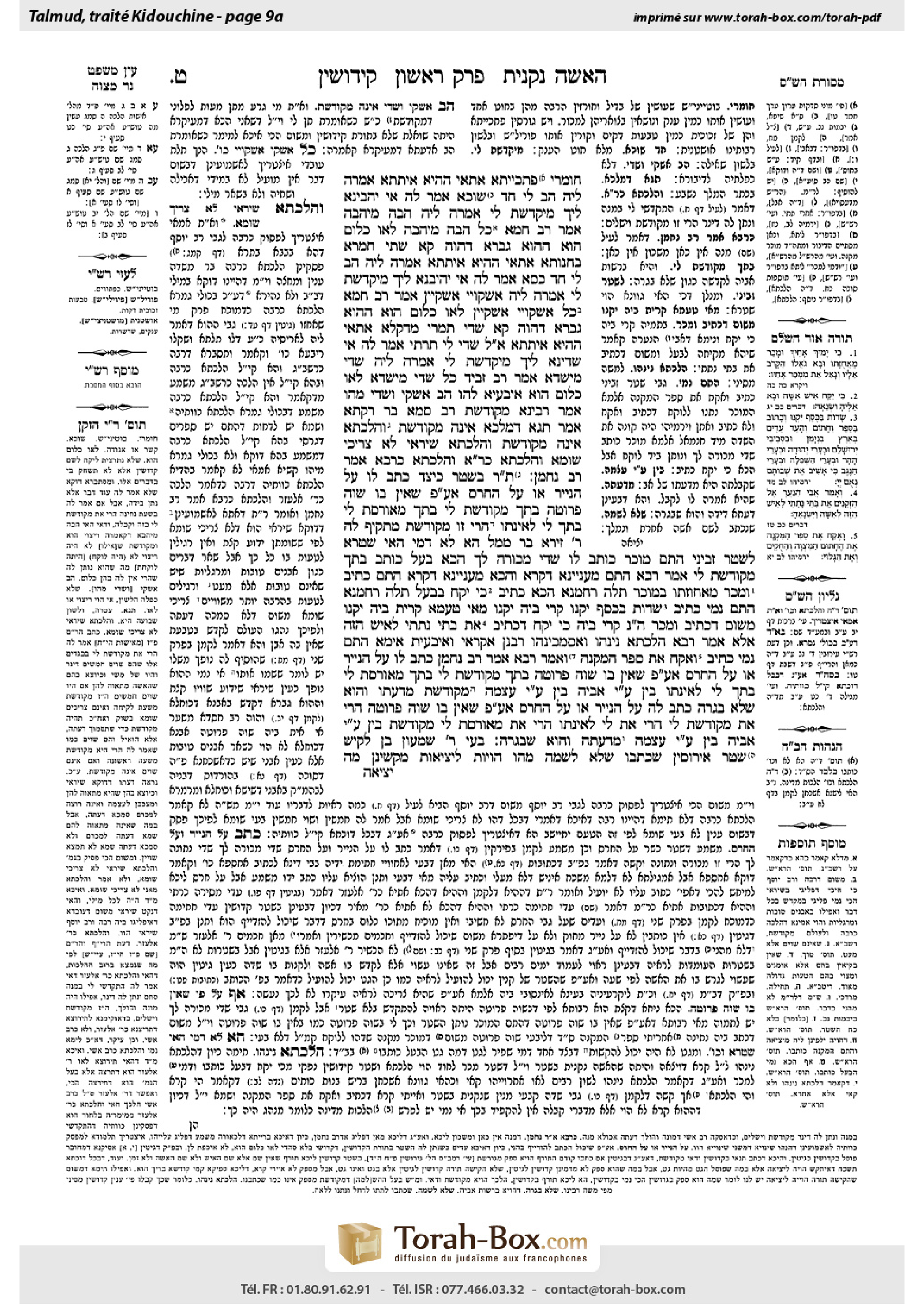
Kiddushin 9a: Talmud study for Daf Yomi
Daf Yomi is the daily study of one Talmud folio. Explore 37 tractates with scans, Hebrew text, Sefaria English and AI-generated French translations where annotated.
Passage selection and English or AI-generated French translation are available where the scan has annotations. Daf Study is independent of Torah-Box and Sefaria.
Browse Kiddushin · קידושין · All tractatesKiddushin 9a text and translations
This page of Kiddushin includes the Aramaic text, an English translation and an AI-generated French translation, alongside the scan above.
קידושין ט׳ א · Aramaic and Hebrew text
חוּמְרֵי פְּתַכְיָיתָא. אֲתַאי הָהִיא אִיתְּתָא, אֲמַרָה לֵיהּ: ״הַב לִי חַד שׂוֹכָא״. אֲמַר לַהּ: ״אִי יָהֲבִינָא לִיךְ מִיקַּדְּשַׁתְּ לִי״? אֲמַרָה לֵיהּ: ״הַבָה מֵיהֲבָה״. אָמַר רַב חָמָא: כֹּל ״הַבָה מֵיהֲבָה״ לָאו כְּלוּם הוּא.
הָהוּא גַּבְרָא דַּהֲוָה קָא שָׁתֵי חַמְרָא בְּחָנוּתָא. אֲתַאי הָהִיא אִיתְּתָא, אֲמַרָה לֵיהּ: ״הַב לִי חַד כָּסָא״. אֲמַר לַהּ: ״אִי יָהֵיבְנָא לִיךְ מִיקַּדְּשַׁתְּ לִי״? אֲמַרָה לֵיהּ: ״אַשְׁקוֹיֵי אַשְׁקְיַין״. אָמַר רַב חָמָא: כֹּל ״אַשְׁקוֹיֵי אַשְׁקְיַין״ לָאו כְּלוּם הוּא.
הָהוּא גַּבְרָא דַּהֲוָה קָא שָׁדֵי תַּמְרֵי מִדִּקְלָא. אֲתַאי הָהִיא אִיתְּתָא, אֲמַרָה לֵיהּ: ״שְׁדִי לִי תַּרְתֵּי״! אֲמַר לַהּ: ״אִי שָׁדֵינָא לִיךְ מִיקַּדְּשַׁתְּ לִי״? אֲמַרָה לֵיהּ: ״שְׁדִי מִישְׁדָּא״. אָמַר רַב זְבִיד: כֹּל ״שְׁדִי מִישְׁדָּא״ לָאו כְּלוּם הוּא.
אִיבַּעְיָא לְהוּ: ״הַב״, ״אַשְׁקִי״, ״וּשְׁדִי״, מַהוּ? – אָמַר רָבִינָא: מְקוּדֶּשֶׁת. רַב סַמָּא בַּר רַקְתָּא אָמַר: תָּגָא דְמַלְכָּא! אֵינָהּ מְקוּדֶּשֶׁת. וְהִלְכְתָא: אֵינָהּ מְקוּדֶּשֶׁת.
וְהִלְכְתָא: שִׁירָאֵי לָא צְרִיכִי שׁוּמָא. וְהִלְכְתָא כְּרַבִּי אֶלְעָזָר, וְהִלְכְתָא כְּרָבָא אָמַר רַב נַחְמָן.
תָּנוּ רַבָּנַן: בִּשְׁטָר כֵּיצַד? כָּתַב לוֹ עַל הַנְּיָיר אוֹ עַל הַחֶרֶס, אַף עַל פִּי שֶׁאֵין בּוֹ שָׁוֶה פְרוּטָה, ״בִּתְּךָ מְקוּדֶּשֶׁת לִי״, ״בִּתְּךָ מְאוֹרֶסֶת לִי״, ״בִּתְּךָ לִי לְאִינְתּוּ״ – הֲרֵי זוֹ מְקוּדֶּשֶׁת.
מַתְקֵיף לַהּ רַבִּי זֵירָא בַּר מֶמֶל: הָא לָא דָּמֵי הַאי שְׁטָרָא לִשְׁטַר זְבִינֵי! הָתָם, מוֹכֵר כּוֹתֵב לוֹ ״שָׂדִי מְכוּרָה לָךְ״, הָכָא בַּעַל כּוֹתֵב ״בִּתְּךָ מְקוּדֶּשֶׁת לִי״!
אָמַר רָבָא: הָתָם מֵעִנְיָינָא דִּקְרָא וְהָכָא מֵעִנְיָינָא דִּקְרָא. הָתָם כְּתִיב ״וּמָכַר מֵאֲחֻזָּתוֹ״ – בְּמוֹכֵר תְּלָה רַחֲמָנָא, הָכָא כְּתִיב ״כִּי יִקַּח״ – בְּבַעַל תְּלָה רַחֲמָנָא.
הָתָם נָמֵי כְּתִיב ״שָׂדוֹת בַּכֶּסֶף יִקְנוּ״! קְרִי בֵּיהּ ״יַקְנוּ״. מַאי טַעְמָא קָרֵית בֵּיהּ ״יַקְנוּ״ – מִשּׁוּם דִּכְתִיב ״וּמָכַר״, הָכִי נָמֵי קְרִי בֵּיהּ ״כִּי יַקַּח״, דִּכְתִיב ״אֶת בִּתִּי נָתַתִּי לָאִישׁ הַזֶּה״.
אֶלָּא אָמַר רָבָא: הִלְכְתָא נִינְהוּ וְאַסְמְכִינְהוּ רַבָּנַן אַקְּרָאֵי. וְאִיבָּעֵית אֵימָא: הָתָם נָמֵי כְּתִיב ״וָאֶקַּח אֶת סֵפֶר הַמִּקְנָה״.
וְאָמַר רָבָא אָמַר רַב נַחְמָן: כָּתַב לוֹ עַל הַנְּיָיר אוֹ עַל הַחֶרֶס, אַף עַל פִּי שֶׁאֵין בּוֹ שָׁוֶה פְרוּטָה, ״בִּתְּךָ מְקוּדֶּשֶׁת לִי״, ״בִּתְּךָ מְאוֹרֶסֶת לִי״, ״בִּתְּךָ לִי לְאִינְתּוּ״, בֵּין עַל יְדֵי אָבִיהָ בֵּין עַל יְדֵי עַצְמָהּ – מְקוּדֶּשֶׁת מִדַּעְתּוֹ, וְהוּא שֶׁלֹּא בָּגְרָה.
כָּתַב לָהּ עַל הַנְּיָיר אוֹ עַל הַחֶרֶס, אַף עַל פִּי שֶׁאֵין בּוֹ שָׁוֶה פְרוּטָה, ״הֲרֵי אַתְּ מְקוּדֶּשֶׁת לִי״, ״הֲרֵי אַתְּ לִי לְאִינְתּוּ״, ״הֲרֵי אַתְּ מְאוֹרֶסֶת לִי״ – מְקוּדֶּשֶׁת, בֵּין עַל יְדֵי אָבִיהָ, בֵּין עַל יְדֵי עַצְמָהּ, מִדַּעְתָּהּ, וְהוּא שֶׁבָּגְרָה.
בָּעֵי רַבִּי שִׁמְעוֹן בֶּן לָקִישׁ: שְׁטַר אֵירוּסִין שֶׁכְּתָבוֹ שֶׁלֹּא לִשְׁמָהּ, מַהוּ? הֲוָיוֹת לִיצִיאוֹת מַקְּשִׁינַן, מָה
Kiddushin 9a · English translation
beads [ḥumrei] of glass [petakhyata]. A certain woman came and said to him: Give me one string. He said to her: If I give you this string will you be betrothed to me with it? She said to him: Give, give. Rav Ḥama said: Any use of the expression: Give, give, is nothing. Although she said: Give, give, she did not agree to the condition, as she was mocking him and had no intention of actually becoming betrothed.
The Gemara relates a similar incident: There was a certain man who was drinking wine in a store. A woman came in and said to him: Give me one cup of wine. He said to her: If I give you a cup of wine will you be betrothed to me with it? She said to him: Give to drink, give it to me to drink. Rav Ḥama said that any use of the expression: Give to drink, give it to me to drink, is nothing, i.e., she certainly did not intend to accept the condition and she is not betrothed.
The Gemara further relates: There was a certain man who was picking dates from a date tree. A certain woman came and said to him: Throw me two. He said to her: If I throw two dates to you will you be betrothed to me with them? She said to him: Throw, throw. Rav Zevid said: Any use of the expression: Throw, throw, is nothing, and she is not betrothed.
A dilemma was raised before the Sages: If she said: Give, or: Give to drink, or: Throw, without the additional emphasis of the repetition, what is the halakha? Does this straightforward statement indicate that she actually meant him to give it to her in accordance with his stated condition, or does she not agree to betrothal even here? Ravina said: She is betrothed. Rav Sama bar Rakta said in the form of an oath: By the king’s crown! She is not betrothed. The Gemara states: And the halakha is that she is not betrothed.
The Gemara issues further rulings concerning the previous cases. And the halakha is: With regard to silk garments that are worth more than one peruta, appraisal is not necessary before a woman can be betrothed with them. And the halakha is in accordance with the opinion of Rabbi Elazar, that if a man promised a woman one hundred dinars as betrothal money and gave her only a dinar, she is betrothed. And the halakha is in accordance with the opinion of Rava, who said that Rav Naḥman said that if he promised one hundred dinars and gave her only collateral, this is not a valid betrothal.
§ The Sages taught: How is betrothal performed with a document? If he wrote the following for a young woman’s father on paper or earthenware, despite the fact that the paper or earthenware is not worth one peruta: Your daughter is betrothed [mekuddeshet] to me, or: Your daughter is betrothed [me’oreset] to me, or: Your daughter is to me as a wife, then she is betrothed. There is no requirement for the paper or earthenware to be worth one peruta, as she is not betrothed through the value of the paper or earthenware.
Rabbi Zeira bar Memel objects to this description of the writing of the document: But this document is not comparable to a bill of sale. There, in the case of a bill of sale, the seller is the one who writes to the buyer: My field is sold to you. Here, the husband, who is akin to a buyer, is the one who writes: Your daughter is betrothed to me.
Rava said: There, in the case of a sale, the formulation of the document is taken from the context of the verse, and here, in the case of betrothal, the formulation of the document is likewise taken from the context of the verse. Rava elaborates: There, with regard to a sale, it is written: “And sells of his ancestral land” (Leviticus 25:25), which indicates that the Merciful One renders the transaction dependent on the seller. Here, it is written: “If a man takes a woman” (Deuteronomy 22:13), meaning that the Merciful One renders the betrothal dependent on the husband.
The Gemara asks: There, in the case of a sale, it is also written: “Men shall buy [yiknu] fields for money” (Jeremiah 32:44), which indicates that the matter depends upon the buyer. The Gemara answers: Read into the verse: Shall sell [yikkanu]. The Gemara asks: What is the reason that you read it as yikkanu; because it is written in the verse in Leviticus: “And sells,” and there is a preference to have the verse from the Prophets accord with that of the Torah? So too, instead of: “If a man takes [ki yikaḥ]” (Deuteronomy 22:13), read into the verse: When he is given [ki yakiaḥ], as it is written: “I gave my daughter to this man” (Deuteronomy 22:16), so that the verses will accord with each other.
Rather, Rava said: There is no proof from the verses for these rulings, as they are a halakha received through tradition, and the Sages based them on the verses. And if you wish, say: There too, in the case in Jeremiah, it is written with regard to the buyer: “And I took the deed of purchase” (Jeremiah 32:11), thereby indicating that it is the seller who writes the document.
And Rava says that Rav Naḥman says: If he wrote the following for him on paper or earthenware, despite the fact that the paper or earthenware is not worth one peruta: Your daughter is betrothed [mekuddeshet] to me, or: Your daughter is betrothed [me’oreset] to me, or: Your daughter is to me as a wife, whether he gave it to her father or whether he gave it directly to her, she is betrothed with the consent of her father. And this is the halakha provided that she has not yet reached her majority, before which her father alone has the authority to betroth her.
If he wrote for her on paper or earthenware, despite the fact that the paper or earthenware is not worth one peruta: You are hereby betrothed [mekuddeshet] to me, or: You are hereby to me as a wife, or: You are hereby betrothed [me’oreset] to me, then she is betrothed whether he gave it to her father or to her, as long as this was with her consent. And this is the halakha provided that she has reached her majority and is under her own authority.
§ Rabbi Shimon ben Lakish raises a dilemma: With regard to a document of betrothal that was written not for her sake, i.e., not for this particular woman, what is the halakha? Do we juxtapose the halakhot of the modes of becoming betrothed to the halakhot of the modes of leaving a marriage, i.e., divorce? If so, one should say: Just as
Kiddushin 9a · Traduction française (IA)
des perles [ḥumrei] en verre [petakhyata]. Une certaine femme vint lui dire : « Donne-moi un fil. » Il lui dit : « Si je te donne ce fil, seras-tu fiancée à moi par son intermédiaire ? » Elle lui répondit : « Donne, donne. » Rav Ḥama dit : Toute réponse formulée ainsi — « Donne, donne » — ne vaut rien. Bien qu’elle ait dit : « Donne, donne », elle n’a pas accepté la condition, car elle se moquait de lui et n’avait aucune intention de se fiancer réellement.
La Guemara rapporte un incident similaire : un certain homme buvait du vin dans une boutique. Une femme entra et lui dit : « Donne-moi un verre de vin. » Il lui dit : « Si je te donne un verre de vin, seras-tu fiancée à moi par son intermédiaire ? » Elle lui répondit : « Donne-moi à boire, donne-le-moi à boire. » Rav Ḥama dit que toute réponse formulée ainsi — « Donne-moi à boire, donne-le-moi à boire » — ne vaut rien, c’est-à-dire qu’elle n’avait certainement pas l’intention d’accepter la condition et qu’elle n’est pas fiancée.
La Guemara rapporte encore : un certain homme cueillait des dattes sur un palmier-dattier. Une certaine femme vint et lui dit : « Jette-m’en deux. » Il lui dit : « Si je te jette deux dattes, seras-tu fiancée à moi par leur intermédiaire ? » Elle lui répondit : « Jette, jette. » Rav Zevid dit : Toute réponse formulée ainsi — « Jette, jette » — ne vaut rien, et elle n’est pas fiancée.
Les Sages soulevèrent une question : si elle dit « Donne », ou « Donne-moi à boire », ou « Jette », sans répéter le mot pour insister, quelle est la halakha ? Cette réponse directe indique-t-elle qu’elle voulait réellement qu’il le lui donne conformément à la condition qu’il avait énoncée, ou bien n’accepte-t-elle pas les fiançailles même dans ce cas ? Ravina dit : elle est fiancée. Rav Sama bar Rakta déclara sous serment : « Par la couronne du roi ! Elle n’est pas fiancée. » La Guemara conclut : la halakha est qu’elle n’est pas fiancée.
La Guemara énonce d’autres décisions concernant les cas précédents. La halakha est la suivante : pour des vêtements de soie valant plus d’une perouta, il n’est pas nécessaire d’en faire estimer la valeur avant qu’une femme puisse être fiancée avec eux. La halakha suit l’avis de Rabbi Elazar : si un homme a promis à une femme cent dinars comme argent de fiançailles et ne lui en a donné qu’un, elle est fiancée. La halakha suit également l’avis de Rava, qui rapporte que Rav Naḥman a dit que si un homme a promis cent dinars et ne lui a donné qu’un gage, les fiançailles ne sont pas valides.
§ Les Sages ont enseigné : Comment procède-t-on à des fiançailles au moyen d’un document ? Si un homme écrit pour le père d’une jeune fille, sur du papier ou un tesson, même si le papier ou le tesson ne vaut pas une perouta : « Ta fille m’est fiancée [mekuddeshet] », ou « Ta fille m’est promise [me’oreset] », ou « Ta fille est pour moi comme épouse », alors elle est fiancée. Il n’est pas nécessaire que le papier ou le tesson vaille une perouta, car elle n’est pas fiancée en raison de la valeur du papier ou du tesson.
Rabbi Zeira bar Memel objecte à cette description de la rédaction du document : Mais ce document n’est pas comparable à un acte de vente. Dans le cas d’un acte de vente, c’est le vendeur qui écrit à l’acheteur : « Mon champ t’est vendu. » Ici, c’est le mari, qui est comparable à un acheteur, qui écrit : « Ta fille m’est fiancée. »
Rava dit : Dans le cas d’une vente, la formulation du document est tirée du contexte du verset ; de même, dans le cas des fiançailles, sa formulation est tirée du contexte du verset. Rava explique : pour la vente, il est écrit : « Et vend de son patrimoine foncier » (Lévitique 25:25), ce qui indique que le Miséricordieux fait dépendre la transaction du vendeur. Ici, il est écrit : « Si un homme prend une femme » (Deutéronome 22:13), ce qui signifie que le Miséricordieux fait dépendre les fiançailles du mari.
La Guemara demande : dans le cas d’une vente, il est aussi écrit : « Des hommes achèteront [yiknu] des champs contre de l’argent » (Jérémie 32:44), ce qui indique que l’affaire dépend de l’acheteur. La Guemara répond : lis dans le verset « vendront [yikkanu] ». La Guemara demande : Pourquoi lis-tu yikkanu ? Parce qu’il est écrit dans le verset du Lévitique « et vend », et qu’il est préférable que le verset des Prophètes concorde avec celui de la Torah ? De même, au lieu de « Si un homme prend [ki yikaḥ] » (Deutéronome 22:13), lis dans le verset « quand on lui donne [ki yakiaḥ] », comme il est écrit : « J’ai donné ma fille à cet homme » (Deutéronome 22:16), afin que les versets concordent entre eux.
Rava dit plutôt : Ces décisions ne sont pas prouvées par les versets, car il s’agit d’une halakha transmise par tradition, que les Sages ont rattachée aux versets. Et si tu veux, dis ceci : là aussi, dans le passage de Jérémie, il est écrit au sujet de l’acheteur : « Et je pris l’acte d’achat » (Jérémie 32:11), ce qui indique que c’est le vendeur qui rédige le document.
Rava dit aussi que Rav Naḥman dit : si un homme écrit pour le père de la jeune fille, sur du papier ou un tesson, même si le papier ou le tesson ne vaut pas une perouta : « Ta fille m’est fiancée [mekuddeshet] », ou « Ta fille m’est promise [me’oreset] », ou « Ta fille est pour moi comme épouse », qu’il remette le document à son père ou directement à elle, elle est fiancée avec le consentement de son père. Cette halakha s’applique à condition qu’elle n’ait pas encore atteint sa majorité, âge avant lequel seul son père a autorité pour la fiancer.
Si un homme écrit pour elle, sur du papier ou un tesson, même si le papier ou le tesson ne vaut pas une perouta : « Tu m’es fiancée [mekuddeshet] », ou « Tu es pour moi comme épouse », ou « Tu m’es promise [me’oreset] », alors elle est fiancée, qu’il remette le document à son père ou directement à elle, pourvu qu’elle y consente. Cette halakha s’applique à condition qu’elle ait atteint sa majorité et soit sous sa propre autorité.
§ Rabbi Shimon ben Lakish soulève une question : quelle est la halakha concernant un document de fiançailles qui a été rédigé sans l’avoir été pour elle, c’est-à-dire pas pour cette femme en particulier ? Établit-on un parallèle entre les règles des modes de fiançailles et celles des modes de dissolution du mariage, c’est-à-dire du divorce ? Si oui, il faudrait dire : de même que
Traduction française générée par IA à partir de l’édition anglaise de Sefaria. Vérifie toujours un passage avec le texte source.
Text from Sefaria: William Davidson Edition - Vocalized Aramaic (CC BY NC); William Davidson Edition - English (CC BY NC).