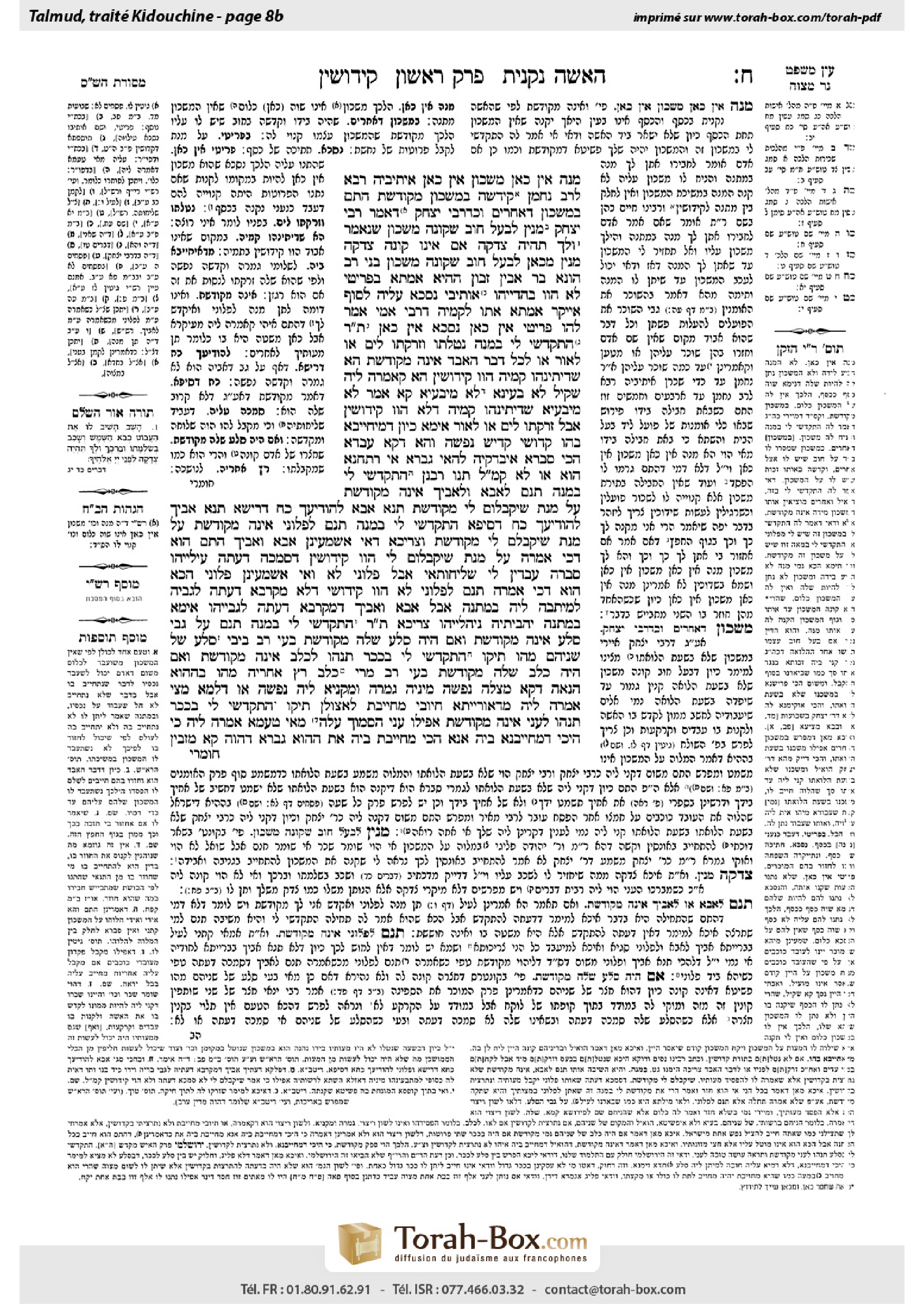
Kiddushin 8b: Talmud study for Daf Yomi
Daf Yomi is the daily study of one Talmud folio. Explore 37 tractates with scans, Hebrew text, Sefaria English and AI-generated French translations where annotated.
Passage selection and English or AI-generated French translation are available where the scan has annotations. Daf Study is independent of Torah-Box and Sefaria.
Browse Kiddushin · קידושין · All tractatesKiddushin 8b text and translations
This page of Kiddushin includes the Aramaic text, an English translation and an AI-generated French translation, alongside the scan above.
קידושין ח׳ ב · Aramaic and Hebrew text
מָנֶה אֵין כָּאן – מַשְׁכּוֹן אֵין כָּאן. אֵיתִיבֵיהּ רָבָא לְרַב נַחְמָן: קִידְּשָׁה בְּמַשְׁכּוֹן מְקוּדֶּשֶׁת! הָתָם בְּמַשְׁכּוֹן דַּאֲחֵרִים וְכִדְרַבִּי יִצְחָק.
דְּאָמַר רַבִּי יִצְחָק: מִנַּיִן לְבַעַל חוֹב שֶׁקּוֹנֶה מַשְׁכּוֹן – שֶׁנֶּאֱמַר: ״וּלְךָ תִּהְיֶה צְדָקָה״ – אִם אֵינוֹ קוֹנֶה, צְדָקָה מִנַּיִן? מִכָּאן לְבַעַל חוֹב שֶׁקּוֹנֶה מַשְׁכּוֹן.
בְּנֵי רַב הוּנָא בַּר אָבִין זְבוּן הָהִיא אַמְתָּא בִּפְרִיטֵי, לָא הֲווֹ בַּהֲדַיְיהוּ, אוֹתִיבוּ נְסָכָא עֲלֵיהּ. לְסוֹף אִיַּיקַּר אַמְתָּא. אֲתוֹ לְקַמֵּיהּ דְּרַבִּי אַמֵּי, אֲמַר לְהוּ: פְּרִיטֵי אֵין כָּאן, נְסָכָא אֵין כָּאן.
תָּנוּ רַבָּנַן: ״הִתְקַדְּשִׁי לִי בְּמָנֶה״, נְטָלַתּוּ וּזְרָקַתּוּ לַיָּם אוֹ לָאוּר אוֹ לְכׇל דָּבָר הָאָבֵד – אֵינָהּ מְקוּדֶּשֶׁת. הָא שְׁדֵיתִינְהוּ קַמֵּיהּ – הָווּ קִידּוּשִׁין? הָא קָאָמְרָה לֵיהּ: שְׁקֵיל, לָא בָּעֵינָא!
לָא מִיבַּעְיָא קָא אָמַר: לָא מִיבַּעְיָא שְׁדֵיתִינְהוּ קַמֵּיהּ דְּלָא הָווּ קִידּוּשִׁין, אֲבָל זְרָקַתּוּ לַיָּם אוֹ לָאוּר אֵימָא כֵּיוָן דְּמִיחַיְּיבָא בְּהוּ, קַדּוֹשֵׁי קַדִּישׁ נַפְשָׁהּ, וְהָא דְּקָא עָבְדָא הָכִי, סָבְרָא: אֶיבְדְּקֵיהּ לְהַאי גַּבְרָא אִי רַתְחָנָא הוּא אוֹ לָא, קָא מַשְׁמַע לַן.
תָּנוּ רַבָּנַן: ״הִתְקַדְּשִׁי לִי בְּמָנֶה״ – ״תְּנֵם, לְאַבָּא וּלְאָבִיךָ״ – אֵינָהּ ״מְקוּדֶּשֶׁת. ״עַל מְנָת שֶׁיְּקַבְּלוּם לִי״ – מְקוּדֶּשֶׁת.
תְּנָא אַבָּא לְהוֹדִיעֲךָ כֹּחַ דְּרֵישָׁא, תְּנָא אָבִיךָ לְהוֹדִיעֲךָ כֹּחַ דְּסֵיפָא.
״הִתְקַדְּשִׁי לִי בְּמָנֶה״ – ״תְּנֵם לִפְלוֹנִי״ – אֵינָהּ מְקוּדֶּשֶׁת. ״עַל מְנָת שֶׁיְּקַבְּלֵם לִי״ – מְקוּדֶּשֶׁת. וּצְרִיכָא,
דְּאִי אַשְׁמְעִינַן ״אַבָּא וְאָבִיךְ״, הָתָם הוּא דְּכִי אָמְרָה ״עַל מְנָת שֶׁיְּקַבְּלוּם לִי״ – הָווּ קִידּוּשִׁין, דְּסָמְכָה דַּעְתַּהּ עִילָּ[וַ]יְהוּ, סָבְרָה: עָבְדִין לִי שְׁלִיחוּתַאי. אֲבָל פְּלוֹנִי – לָא,
וְאִי אַשְׁמְעִינַן פְּלוֹנִי, הָכָא הוּא דְּכִי אַמְרַהּ ״תְּנֵם לִפְלוֹנִי״ – לָא הָווּ קִידּוּשֵׁי, דְּלָא מְקָרְבָא דַּעְתַּהּ לְגַבֵּיהּ לְמִיתְּבֵהּ לֵיהּ בְּמַתָּנָה, אֲבָל ״אַבָּא וְאָבִיךְ״, דִּמְקָרְבָא דַּעְתַּהּ לְגַבַּיְיהוּ, אֵימָא בְּמַתָּנָה יַהֲבִיתֵיהּ נִיהֲלַיְיהוּ, צְרִיכָא.
תָּנוּ רַבָּנַן: ״הִתְקַדְּשִׁי לִי בְּמָנֶה״ – ״תְּנֵם עַל גַּבֵּי סֶלַע״ – אֵינָהּ מְקוּדֶּשֶׁת. וְאִם הָיָה סֶלַע שֶׁלָּהּ – מְקוּדֶּשֶׁת. בָּעֵי רַב בִּיבִי: סֶלַע שֶׁל שְׁנֵיהֶם, מַהוּ? תֵּיקוּ.
״הִתְקַדְּשִׁי לִי בְּכִכָּר״ – ״תְּנֵהוּ לְכֶלֶב״ – אֵינָהּ מְקוּדֶּשֶׁת. וְאִם הָיָה כֶּלֶב שֶׁלָּהּ – מְקוּדֶּשֶׁת. בָּעֵי רַב מָרִי: כֶּלֶב רָץ אַחֲרֶיהָ, מַהוּ?
בְּהָהוּא הֲנָאָה דְּקָא מַצְּלָה נַפְשָׁהּ מִינֵּיהּ גָּמְרָה וּמַקְנְיָא לֵיהּ נַפְשָׁהּ, אוֹ דִלְמָא מָצֵי אָמְרָה לֵיהּ: ״מִדְּאוֹרָיְיתָא חַיּוֹבֵי מְחַיְּיבַתְּ לַאֲצוּלַן״? תֵּיקוּ.
״הִתְקַדְּשִׁי לִי בְּכִכָּר״ – ״תְּנֵהוּ לְעָנִי״ – אֵינָהּ מְקוּדֶּשֶׁת, אֲפִילּוּ עָנִי הַסָּמוּךְ עָלֶיהָ. מַאי טַעְמָא? אָמְרָה לֵיהּ: כִּי הֵיכִי דִּמְחַיַּיבְנָא בֵּיהּ אֲנָא, הָכִי מְחַיְּיבַתְּ בֵּיהּ אַתְּ.
הָהוּא גַּבְרָא דַּהֲוָה קָא מְזַבֵּין
Kiddushin 8b · English translation
There is no one hundred dinars here, as he has not yet given her one hundred dinars, and there is no collateral here, since this collateral is not a gift but merely a security. He has therefore not given her anything. Rava raised an objection to Rav Naḥman from the following baraita: If he betrothed her with collateral, she is betrothed. The Gemara answers: There, it is referring to collateral belonging to other people, which was in the possession of the man who betrothed her, and this is in accordance with the opinion of Rabbi Yitzḥak.
As Rabbi Yitzḥak says: From where is it derived that a creditor acquires collateral, i.e., that the individual in possession of the collateral has the actual rights to it? As it is stated: “You shall surely restore him the pledge when the sun goes down that he may sleep in his garment, and bless you; and it shall be righteousness to you” (Deuteronomy 24:13). If the creditor does not acquire the pledge or collateral, from where does this considering his return of the collateral as righteousness stem? The creditor is not giving an item belonging to him; why is this considered a righteous act? Rather, from here it is derived that a creditor acquires collateral to a certain extent.
The Gemara relates: The sons of Rav Huna bar Avin bought a certain maidservant on the condition that they would pay with copper perutot. They did not have the money at the time, and therefore they gave a piece of silver [naskha] for her as collateral. Ultimately, the price of the maidservant increased and the sellers wanted to cancel the sale. They came before Rabbi Ami for his ruling and he said to them: There are no perutot here, and there is no piece of silver here either. There was no valid act of acquisition at all because they did not actually give the money, and the collateral does not transfer ownership.
§ The Sages taught in a baraita (Tosefta 2:9): If a man said to a woman: Be betrothed to me with one hundred dinars, and she took it from his hand and threw it into the sea, or into the fire, or into anything that destroys, she is not betrothed. The Gemara expresses surprise at this ruling: The baraita indicates that she is not betrothed only if the one hundred dinars are destroyed, but if she threw the coins before him but did not destroy them, that is a betrothal. Why should this be? By throwing the coins at him she is effectively saying to him: Take this; I do not want your betrothal.
The Gemara answers: The tanna of the baraita is speaking using the style of: It is not necessary, as follows: It is not necessary to state in a case where she throws the money before him that it is not a betrothal, as her action indicates that she does not want to be betrothed. But when she throws it into the sea or into the fire, one might say that since she is obligated to pay for the money he gave her, perhaps she betrothed herself with the money she received. And as for the reason why she did this act of destroying the money, she thought: I will test this man to see if he is an individual of an angry temperament or not. Therefore, the tanna teaches us that even in that case it is not a betrothal.
The Sages taught in a baraita (Tosefta 2:9): If a man said to a woman: Be betrothed to me with one hundred dinars, and she said to him: Give the money to my father, or: Give the money to your father, she is not betrothed. If she said: Give the money to my father, or Give the money to your father on the condition that he accepts them for me, she is betrothed.
The Gemara comments: The baraita taught the case where she said: Give the money to my father, to convey the far-reaching nature of the halakha of the first clause. If she simply said that he should give the money to anybody else, even her own father, whom it can be assumed she wants to benefit, she is still not betrothed. And the baraita taught the case where she said: Give the money to your father, to convey the far-reaching nature of the halakha of the latter clause. If she said that someone else should receive the money on her behalf, it is a valid betrothal even if she said the money should be given to his father.
The Gemara cites a similar case. If he said to her: Be betrothed to me with one hundred dinars, and she said to him: Give them to so-and-so, she is not betrothed. But if she said to him: On the condition that he accepts them for me, she is betrothed. The Gemara comments: It is necessary to issue this ruling, despite the fact that it is apparently identical to the previous halakha.
The Gemara elaborates: This is because if the tanna had taught us only the case where she said: Give the money to my father, or: Give the money to your father, one would say that it is in that case there, when she said: On the condition that one of these relatives accepts them for me, that it is a betrothal, as she relies on them and she thinks: They will do my bidding for me and will hold this money on my behalf. But if she says: Give it to so-and-so, someone who is not related to either of them, no, the betrothal is not valid.
And conversely, if the tanna had taught us only the case of so-and-so, one might say: It is here, when she said: Give it to so-and-so, that it is not a betrothal, as she is not close to him and is not interested in giving him this money as a gift. But if she said: Give the money to my father, or: Give the money to your father, to whom she is close, one might say that she gave it to them as a gift, i.e., she accepted the sum as her betrothal money and decided to give it as a gift. If so, she should be betrothed. It was therefore necessary for the tanna to issue both rulings and clarify that she is not betrothed in either case.
The Sages taught: If a man said to a woman: Be betrothed to me with one hundred dinars, and she said to him: Place them on a rock, she is not betrothed. And if the rock was hers, she is betrothed. Rav Beivai raises a dilemma: If the rock was the property of both of them, what is the halakha? No answer was found, and the Gemara states that the dilemma shall stand unresolved.
The Gemara discusses a similar case. If a man said to a woman: Be betrothed to me with a loaf of bread, and she said to him: Give it to a dog, she is not betrothed. And if this dog was hers, she is betrothed. Rav Mari raises a dilemma: If a dog was chasing her to bite her, and she said to him: Give the loaf to the dog, what is the halakha?
The Gemara presents the two sides of the dilemma: Does one say that she commits herself to betrothal and transfers herself to him through this benefit that she receives by being rescued from the dog? Or perhaps she can say to him: By Torah law you are required to rescue me, due to the injunction: “Neither shall you stand idly by the blood of your neighbor” (Leviticus 19:16), and therefore she is not betrothed with the loaf because she does not owe him anything. This problem is also left unanswered, and the Gemara again states that the dilemma shall stand unresolved.
If a man said to a woman: Be betrothed to me with a loaf of bread, and she said: Give it to a poor person, she is not betrothed, even if it was a poor person who is dependent upon her, i.e., a poor person who regularly receives food from that woman. What is the reason for this? She could say to him: Just as I am required to give charity to him, so too you are required to give charity to him. Therefore, this donation is not an indication that she has agreed to the betrothal.
The Gemara relates: There was a certain man who was selling
Kiddushin 8b · Traduction française (IA)
Il n’y a ici ni cent dinars, puisqu’il ne les lui a pas encore donnés, ni gage, car ce gage n’est pas un don, mais seulement une garantie. Il ne lui a donc rien donné. Rava objecta à Rav Naḥman en citant la baraïta suivante : « S’il l’a fiancée au moyen d’un gage, elle est fiancée. » La Guemara répond : Là, il s’agit d’un gage appartenant à d’autres personnes, qui était en possession de l’homme qui l’a fiancée, et cela correspond à l’opinion de Rabbi Yitzḥak.
Car Rabbi Yitzḥak dit : D’où sait-on qu’un créancier acquiert le gage, c’est-à-dire que celui qui détient le gage en acquiert effectivement les droits ? Car il est dit : « Tu lui rendras certainement son gage au coucher du soleil, afin qu’il puisse dormir dans son vêtement et te bénir ; et cela sera pour toi une justice » (Deutéronome 24:13). Si le créancier n’acquiert pas le gage, d’où vient que le fait de le lui rendre soit considéré comme un acte de justice ? Le créancier ne donne pas un objet qui lui appartient ; pourquoi cela serait-il considéré comme un acte méritoire ? On en déduit plutôt qu’un créancier acquiert le gage dans une certaine mesure.
La Guemara rapporte : Les fils de Rav Huna bar Avin achetèrent une servante à condition de la payer en peroutot de cuivre. Comme ils n’avaient pas l’argent à ce moment-là, ils donnèrent une pièce d’argent [naskha] en gage pour elle. Par la suite, le prix de la servante augmenta et les vendeurs voulurent annuler la vente. Ils se présentèrent devant Rabbi Ami pour qu’il statue, et celui-ci leur dit : « Il n’y a ici ni peroutot ni pièce d’argent. » Il n’y a donc eu aucun acte d’acquisition valide, puisqu’ils n’ont pas effectivement remis l’argent, et le gage ne transfère pas la propriété.
§ Les Sages enseignèrent dans une baraïta (Tosefta 2:9) : Si un homme dit à une femme : « Sois fiancée à moi pour cent dinars », et qu’elle prend l’argent de sa main puis le jette dans la mer, dans le feu ou dans tout ce qui le détruit, elle n’est pas fiancée. La Guemara s’étonne de cette décision : La baraïta indique qu’elle n’est pas fiancée seulement si les cent dinars sont détruits ; mais si elle jette les pièces devant lui sans les détruire, cela constituerait des fiançailles. Pourquoi donc ? En lui jetant les pièces, elle lui dit en fait : « Reprends-les ; je ne veux pas être fiancée à toi. »
La Guemara répond : Le tanna de la baraïta s’exprime selon la formule « il n’est pas nécessaire », comme suit : Il n’est pas nécessaire de préciser que, lorsqu’elle jette l’argent devant lui, il ne s’agit pas de fiançailles, puisque son geste indique qu’elle ne veut pas être fiancée. Mais lorsqu’elle le jette dans la mer ou dans le feu, on pourrait dire que, puisqu’elle est tenue de payer l’argent qu’il lui a donné, elle s’est peut-être fiancée au moyen de l’argent qu’elle a reçu. Quant à la raison pour laquelle elle a détruit l’argent, elle s’est dit : « Je vais mettre cet homme à l’épreuve pour voir s’il est colérique ou non. » Le tanna nous enseigne donc que, même dans ce cas, il ne s’agit pas de fiançailles.
Les Sages enseignèrent dans une baraïta (Tosefta 2:9) : Si un homme dit à une femme : « Sois fiancée à moi pour cent dinars », et qu’elle lui dit : « Donne l’argent à mon père » ou : « Donne l’argent à ton père », elle n’est pas fiancée. Si elle dit : « Donne l’argent à mon père » ou : « Donne l’argent à ton père, à condition qu’il l’accepte pour moi », elle est fiancée.
La Guemara fait remarquer : La baraïta a enseigné le cas où elle dit : « Donne l’argent à mon père », afin de faire ressortir la portée de la halakha de la première partie. Si elle dit simplement de donner l’argent à quelqu’un d’autre, même à son propre père, dont on peut supposer qu’elle souhaite favoriser les intérêts, elle n’est toujours pas fiancée. Et la baraïta a enseigné le cas où elle dit : « Donne l’argent à ton père », afin de faire ressortir la portée de la halakha de la seconde partie. Si elle dit que quelqu’un d’autre doit recevoir l’argent pour son compte, les fiançailles sont valides même si elle dit de donner l’argent à son père à lui.
La Guemara cite un cas similaire. S’il lui dit : « Sois fiancée à moi pour cent dinars », et qu’elle lui dit : « Donne-les à untel », elle n’est pas fiancée. Mais si elle lui dit : « À condition qu’il les accepte pour moi », elle est fiancée. La Guemara fait remarquer qu’il était nécessaire d’énoncer cette décision, bien qu’elle semble identique à la halakha précédente.
La Guemara explique : En effet, si le tanna nous avait enseigné seulement le cas où elle dit : « Donne l’argent à mon père » ou : « Donne l’argent à ton père », on aurait dit que c’est précisément dans ce cas, lorsqu’elle dit : « À condition que l’un de ces proches l’accepte pour moi », qu’il s’agit de fiançailles, car elle se fie à eux et pense : « Ils feront ce que je leur demande et garderont cet argent pour mon compte. » Mais si elle dit : « Donne-le à untel », quelqu’un qui n’est apparenté ni à elle ni à lui, alors non, les fiançailles ne sont pas valides.
Inversement, si le tanna nous avait enseigné seulement le cas d’untel, on aurait pu dire : C’est dans ce cas, lorsqu’elle dit : « Donne-le à untel », qu’il ne s’agit pas de fiançailles, car elle n’est pas proche de lui et ne souhaite pas lui donner cet argent en cadeau. Mais si elle dit : « Donne l’argent à mon père » ou : « Donne l’argent à ton père », dont elle est proche, on aurait pu dire qu’elle le leur donne en cadeau, c’est-à-dire qu’elle accepte la somme comme argent de fiançailles et décide de la leur offrir. Dans ce cas, elle devrait être fiancée. Le tanna devait donc énoncer les deux décisions et préciser qu’elle n’est fiancée dans aucun des deux cas.
Les Sages enseignèrent : Si un homme dit à une femme : « Sois fiancée à moi pour cent dinars », et qu’elle lui dit : « Dépose-les sur un rocher », elle n’est pas fiancée. Mais si le rocher lui appartient, elle est fiancée. Rav Beivai soulève une question : Quelle est la halakha si le rocher leur appartient à tous deux ? Aucune réponse n’a été trouvée, et la Guemara laisse la question sans réponse.
La Guemara examine un cas similaire. Si un homme dit à une femme : « Sois fiancée à moi avec un pain », et qu’elle lui dit : « Donne-le à un chien », elle n’est pas fiancée. Mais si ce chien lui appartient, elle est fiancée. Rav Mari soulève une question : Si un chien la poursuivait pour la mordre et qu’elle lui disait : « Donne le pain au chien », quelle est la halakha ?
La Guemara présente les deux aspects de la question : Faut-il dire qu’elle s’engage dans les fiançailles et se donne à lui en échange du bénéfice qu’elle reçoit en étant sauvée du chien ? Ou peut-être peut-elle lui dire : « Selon la Torah, tu es tenu de me sauver, en vertu de l’injonction : “Tu ne resteras pas inactif devant le sang de ton prochain” » (Lévitique 19:16), et elle n’est donc pas fiancée au moyen du pain, puisqu’elle ne lui doit rien. Ce problème reste lui aussi sans réponse, et la Guemara laisse de nouveau la question en suspens.
Si un homme dit à une femme : « Sois fiancée à moi avec un pain », et qu’elle dit : « Donne-le à un pauvre », elle n’est pas fiancée, même si ce pauvre dépend d’elle, c’est-à-dire s’il reçoit régulièrement de la nourriture de cette femme. Pourquoi ? Elle pourrait lui dire : « De même que je suis tenue de lui donner la charité, toi aussi tu es tenu de lui en donner. » Ce don n’indique donc pas qu’elle a consenti aux fiançailles.
La Guemara rapporte : Il y avait un homme qui vendait
Traduction française générée par IA à partir de l’édition anglaise de Sefaria. Vérifie toujours un passage avec le texte source.
Text from Sefaria: William Davidson Edition - Vocalized Aramaic (CC BY NC); William Davidson Edition - English (CC BY NC).