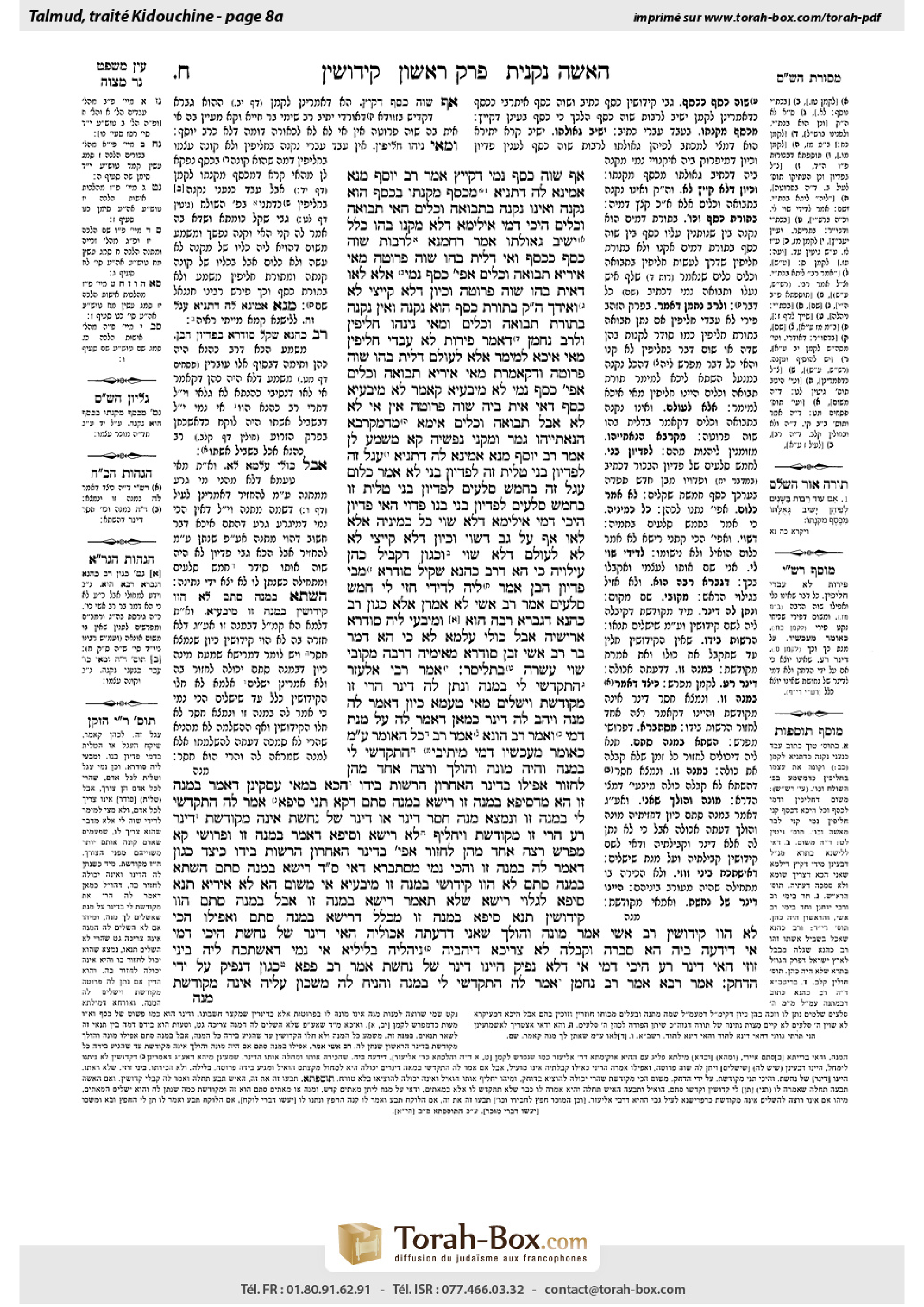
Kiddushin 8a: Talmud study for Daf Yomi
Daf Yomi is the daily study of one Talmud folio. Explore 37 tractates with scans, Hebrew text, Sefaria English and AI-generated French translations where annotated.
Passage selection and English or AI-generated French translation are available where the scan has annotations. Daf Study is independent of Torah-Box and Sefaria.
Browse Kiddushin · קידושין · All tractatesKiddushin 8a text and translations
This page of Kiddushin includes the Aramaic text, an English translation and an AI-generated French translation, alongside the scan above.
קידושין ח׳ א · Aramaic and Hebrew text
אַף שָׁוֶה כֶּסֶף נָמֵי דְּקִיץ.
אָמַר רַב יוֹסֵף: מְנָא אָמֵינָא לַהּ, דְּתַנְיָא: ״מִכֶּסֶף מִקְנָתוֹ״ – בְּכֶסֶף הוּא נִקְנֶה, וְאֵינוֹ נִקְנֶה בִּתְבוּאָה וְכֵלִים.
הַאי תְּבוּאָה וְכֵלִים הֵיכִי דָמֵי? אִילֵּימָא דְּלָא מַקְנוּ בְּהוּ כְּלָל, ״יָשִׁיב גְּאֻלָּתוֹ״ אָמַר רַחֲמָנָא – לְרַבּוֹת שָׁוֶה כֶּסֶף כְּכֶסֶף;
וְאִי דְּלֵית בְּהוּ שָׁוֶה פְּרוּטָה, מַאי אִירְיָא תְּבוּאָה וְכֵלִים, אֲפִילּוּ כֶּסֶף נָמֵי! אֶלָּא לָאו דְּאִית בְּהוּ שָׁוֶה פְּרוּטָה, וְכֵיוָן דְּלָא קַיְיצִי לָא?
וְאִידָּךְ, הָכִי קָאָמַר: בְּתוֹרַת כֶּסֶף הוּא נִקְנֶה, וְאֵין נִקְנֶה בְּתוֹרַת תְּבוּאָה וְכֵלִים, וּמַאי נִינְהוּ – חֲלִיפִין.
וּלְרַב נַחְמָן, דְּאָמַר: פֵּירוֹת לָא עָבְדִי חֲלִיפִין, מַאי אִיכָּא לְמֵימַר? אֶלָּא, לְעוֹלָם דְּלֵית בְּהוּ שָׁוֶה פְּרוּטָה. וּדְקָאָמְרַתְּ ״מַאי אִירְיָא תְּבוּאָה, וְכֵלִים אֲפִילּוּ כֶּסֶף נָמֵי!״, לָא מִיבַּעְיָא קָאָמַר:
לָא מִיבַּעְיָא כֶּסֶף, דְּאִי אִית בֵּיהּ שָׁוֶה פְּרוּטָה – אִין, אִי לָא – לָא, אֲבָל תְּבוּאָה וְכֵלִים, אֵימָא מִדִּמְקָרְבָא הֲנָאָתַיְיהוּ, גָּמַר וּמַקְנֵי נַפְשֵׁיהּ, קָא מַשְׁמַע לַן.
אָמַר רַב יוֹסֵף: מְנָא אָמֵינָא לַהּ, דְּתַנְיָא: ״עֵגֶל זֶה לְפִדְיוֹן בְּנִי״, ״טַלִּית זֹה לְפִדְיוֹן בְּנִי״ – לֹא אָמַר כְּלוּם. ״עֵגֶל זֶה בְּחָמֵשׁ סְלָעִים לְפִדְיוֹן בְּנִי״, ״טַלִּית זוֹ בְּחָמֵשׁ סְלָעִים לְפִדְיוֹן בְּנִי״ – בְּנוֹ פָּדוּי.
הַאי פִּדְיוֹן, הֵיכִי דָמֵי? אִילֵּימָא דְּלָא שָׁוֵי, כֹּל כְּמִינֵּיהּ? אֶלָּא לָאו אַף עַל גַּב דְּשָׁוֵי, וְכֵיוָן דְּלָא קַיְיצִי – לָא?
לָא, לְעוֹלָם דְּלָא שָׁוֵי, וּכְגוֹן דְּקַבֵּיל כֹּהֵן עִילָּוֵיהּ. כִּי הָא דְּרַב כָּהֲנָא שָׁקֵיל סוּדָרָא מִבֵּי פִּדְיוֹן הַבֵּן, אָמַר (לֵיהּ): לְדִידִי חֲזֵי לִי חָמֵשׁ סְלָעִים.
אָמַר רַב אָשֵׁי: לָא אֲמַרַן אֶלָּא כְּגוֹן רַב כָּהֲנָא, דְּגַבְרָא רַבָּה הוּא וּמִבְּעֵי לֵיהּ סוּדָרָא אַרֵישֵׁיהּ, אֲבָל כּוּלֵּי עָלְמָא – לָא. כִּי הָא דְּמָר בַּר רַב אָשֵׁי זְבַן סוּדָרָא מֵאִימֵּיהּ דְּרָבָא מִקּוּבֵּי שָׁוֵי עַשְׂרָה בִּתְלֵיסַר.
אָמַר רַבִּי אֶלְעָזָר: ״הִתְקַדְּשִׁי לִי בְּמָנֶה״, וְנָתַן לָהּ דִּינָר – הֲרֵי זוֹ מְקוּדֶּשֶׁת, וְיַשְׁלִים. מַאי טַעְמָא? כֵּיוָן דְּאָמַר לַהּ ״מָנֶה״ וְיָהֵב לַהּ דִּינָר, כְּמַאן דְּאָמַר לַהּ: ״עַל מְנָת״ דָּמֵי.
וְאָמַר רַב הוּנָא אָמַר רַב: כׇּל הָאוֹמֵר ״עַל מְנָת״ כְּאוֹמֵר ״מֵעַכְשָׁיו״ דָּמֵי.
מֵיתִיבִי: ״הִתְקַדְּשִׁי לִי בְּמָנֶה״, וְהָיָה מוֹנֶה וְהוֹלֵךְ, וְרָצָה אֶחָד מֵהֶן לַחֲזוֹר אֲפִילּוּ בַּדִּינָר הָאַחֲרוֹן – הָרְשׁוּת בְּיָדוֹ.
הָכָא בְּמַאי עָסְקִינַן, דְּאָמַר ״בְּמָנֶה זֶה״. הָא מִדְּסֵיפָא ״בְּמָנֶה זֶה״, רֵישָׁא בְּמָנֶה סְתָם,
דְּקָא תָנֵי סֵיפָא: אָמַר לָהּ ״הִתְקַדְּשִׁי לִי בְּמָנֶה זֶה״ וְנִמְצָא מָנֶה חָסֵר דִּינָר, אוֹ דִּינָר שֶׁל נְחֹשֶׁת – אֵינָהּ מְקוּדֶּשֶׁת. דִּינָר רַע – הֲרֵי זוֹ מְקוּדֶּשֶׁת, וְיַחְלִיף.
לָא, רֵישָׁא וְסֵיפָא דְּאָמַר ״בְּמָנֶה זֶה״, וּפָרוֹשֵׁי קָא מְפָרֵשׁ: רָצָה אֶחָד מֵהֶן לַחֲזוֹר, אֲפִילּוּ בְּדִינָר הָאַחֲרוֹן – הָרְשׁוּת בְּיָדוֹ. כֵּיצַד – כְּגוֹן דְּאָמַר לַהּ ״בְּמָנֶה זוֹ״.
וְהָכִי נָמֵי מִסְתַּבְּרָא, דְּאִי סָלְקָא דַעְתָּךְ רֵישָׁא בְּמָנֶה סְתָם, הַשְׁתָּא בְּמָנֶה סְתָם לָא הָווּ קִידּוּשֵׁי, ״בְּמָנֶה זֶה״ מִיבַּעְיָא?
אִי מִשּׁוּם הָא לָא אִירְיָא – תְּנָא סֵיפָא לְגַלּוֹיֵי רֵישָׁא, שֶׁלֹּא תֹּאמַר רֵישָׁא ״בְּמָנֶה זֶה״, אֲבָל בְּמָנֶה סְתָם הָווּ קִידּוּשִׁין, תְּנָא סֵיפָא ״בְּמָנֶה זֶה״, מִכְּלָל דְּרֵישָׁא בְּמָנֶה סְתָם, וַאֲפִילּוּ הָכִי לָא הָווּ קִידּוּשִׁין.
רַב אָשֵׁי אָמַר: מוֹנֶה וְהוֹלֵךְ שָׁאנֵי, דְּדַעְתַּהּ אַכּוּלֵּיהּ.
הַאי דִּינָר שֶׁל נְחֹשֶׁת, הֵיכִי דָמֵי? אִי דְּיָדְעָה בֵּיהּ – הָא סְבַרָה וְקַבִּלָה! לָא צְרִיכָא, דְּיַהֲבֵיהּ נִיהֲלַיהּ בְּלֵילְיָא, אִי נָמֵי דְּאִשְׁתְּכַח לַיהּ בֵּינֵי זוּזֵי.
הַאי דִּינָר רַע הֵיכִי דָמֵי? אִי דְּלָא נָפֵיק – הַיְינוּ דִּינָר שֶׁל נְחֹשֶׁת! אָמַר רַב פָּפָּא: כְּגוֹן דְּנָפֵיק עַל יְדֵי הַדְּחָק.
אָמַר רָבָא אָמַר רַב נַחְמָן: אָמַר לַהּ ״הִתְקַדְּשִׁי לִי בְּמָנֶה״, וְהִנִּיחַ לָהּ מַשְׁכּוֹן עֲלֵיהֶ[ם] – אֵינָהּ מְקוּדֶּשֶׁת,
Kiddushin 8a · English translation
so too, an item worth money must be set, i.e., it must have a clearly defined value.
Rav Yosef said: From where do I say this opinion? As it is taught in a baraita with regard to redeeming a Hebrew slave: “He shall give back the price of his redemption out of the money that he was bought for” (Leviticus 25:51), which indicates: He is acquired specifically through money and he is not acquired through grain or vessels.
Rav Yosef explains: What are the circumstances of these grains and vessels? If we say that a Hebrew slave cannot be acquired through them at all, as money alone may be used, the Merciful One states: “He shall give back the price of his redemption,” which serves to include all modes of repayment as valid equivalents of money, i.e., an item worth money is the same as money. There is no requirement to use money in particular; it is also possible to use items with monetary value.
And if you say that they do not have the value of one peruta, why mention specifically grain and vessels? Even money that is not worth one peruta cannot be used for acquiring a slave. Rather, is it not speaking here about a case where the grain and vessels do have the value of one peruta, but since they lack a set value, no, a Hebrew slave cannot be redeemed with them? The comparison with money teaches that a Hebrew slave can be redeemed only with an item that has a clearly defined value, like money.
And the other Sage, Rabba, who maintains that appraisal is not necessary, would respond: The tanna is referring to an item worth one peruta, but he is not teaching that one cannot redeem a slave with items whose value is not set. Rather, this is what he is saying: A Hebrew slave is acquired through the mode of money, and he is not acquired through the mode of grain or vessels. And what is this mode particular to the acquisition of grain and vessels? This is referring to symbolic exchange. A slave cannot be acquired through the mode of acquisition of symbolic exchange.
The Gemara notes: This explanation is valid only according to those who say that grain can be acquired through the mode of exchange; but according to the opinion of Rav Naḥman, who said that produce cannot effect symbolic exchange, as this mode of acquisition applies only to vessels, what can be said? Why does the tanna mention grain if grain cannot be used in symbolic exchange? Rather, the Gemara rejects this explanation in favor of the following: Actually, this is referring to a case where the grain and utensils do not have the value of one peruta. And as for that which you said: Why mention specifically grain and vessels; even money that is not worth one peruta cannot acquire either, one could say that the tanna is speaking utilizing the style of: It is not necessary.
The Gemara elaborates: It is not necessary to state with regard to money that if it has the value of one peruta, yes, one effects acquisition with it, and if not, then no, one cannot effect acquisition with it. But with regard to grain and vessels, one might say that as their benefit is readily available, i.e., one can enjoy them immediately in their current state, perhaps the slave decides and transfers ownership of himself to the master by even less than the worth of one peruta. Therefore, the tanna teaches us that an article less than the value of one peruta cannot effect acquisition notwithstanding the above reasoning.
Rav Yosef said: From where do I say that betrothal can be effected only with an item with a clearly defined value? As it is taught in a baraita (Tosefta, Bekhorot 6:4), that if one says to a priest: This calf should be for the redemption of my firstborn son, or: This cloak should be for the redemption of my firstborn son, then he has said nothing. But if he said: This calf worth the value of five sela should be for the redemption of my firstborn son, or: This cloak worth the value of five sela should be for the redemption of my firstborn son, then his son is redeemed.
The Gemara clarifies: What are the circumstances with regard to this redemption with a calf or a cloak that has no clearly defined value? If we say that they are not worth five sela, is it in his power to give a priest less than the established amount? Why would it even be considered that perhaps the son is redeemed? Rather, is it not referring to a case where even though they are worth this amount, one may not redeem with them in the case of the first clause since their value is not set? This shows that there is a difference between an item that has a set value and one that does not.
The Gemara rejects this suggestion: No; actually, this is referring to a case where the calf or cloak is not worth five sela, and the latter clause is referring to a case where the priest accepted upon himself to value the items as though they were worth this amount, which is why the son is redeemed. This is like this incident in which Rav Kahana, who was a priest, took a cloth [sudara] from the house of a man obligated to perform the redemption of his firstborn son. Rav Kahana said to the man: For me, I view this cloth as though it were worth five sela.
Rav Ashi said: We said that it is possible to redeem one’s son in this manner only when the priest is an individual such as Rav Kahana, who is a great man and is required to wear a cloth on his head. It was common practice for important people to wear a scarf on their heads. But with regard to everyone else, i.e., those who do not wear these cloths and cannot say it is worth that amount to them, no, they may not perform the redemption of the firstborn son in this manner. The Gemara cites a proof that a distinguished individual who needs a cloth will pay a large amount for one. This is like this incident in which Mar bar Rav Ashi bought a cloth from Rabba’s mother from Kovei for thirteen dinars, despite the fact that it was worth ten, because he needed a cloth.
§ Rabbi Elazar says: If a man said to a woman: Be betrothed to me with one hundred dinars, and he gave her one dinar out of the one hundred, she is betrothed immediately and he must subsequently complete the payment of the remainder of the amount he promised her. What is the reason for this? Since he said to her: Be betrothed to me with one hundred dinars, and yet he gave her only one dinar, he is like one who said to her: Be betrothed to me on the condition that I will give you one hundred dinars. In other words, he betroths her now with one dinar on the condition he will pay the remaining ninety-nine in the future. The betrothal therefore takes effect immediately, and he owes her the rest of the one hundred dinars.
The Gemara adds: And this is in accordance with the opinion that Rav Huna says that Rav says: With regard to anyone who states a provision employing the phrase: On the condition, it is tantamount to his stipulating that the agreement take effect retroactively from now. An agreement stipulated by means of the phrase: On the condition, takes effect immediately. This is not like an ordinary agreement, which takes effect only after the condition has been fulfilled.
The Gemara raises an objection from a baraita (Tosefta 2:10). If a man says to a woman: Be betrothed to me with one hundred dinars, and while he was counting the money, one of them wanted to retract the betrothal, it is in the power of either of them to do so even when only the last dinar remains to be given. This indicates that the betrothal does not take effect until the entire one hundred dinars has been paid.
The Gemara answers: With what are we dealing here? This is a case where he says to the woman: Be betrothed to me with this one hundred dinars. In this case the entire one hundred dinars, not just the first dinar, constitutes the betrothal money. The Gemara raises a difficulty with this answer: From the fact that the latter clause of the baraita uses the expression: With this one hundred dinars, it can be inferred that the first clause is dealing with an unspecified one hundred dinars.
As it is taught in the latter clause of that baraita, if he said to a woman: Be betrothed to me with this one hundred dinars, and it was found to be one hundred dinars less a dinar, or if it included a dinar of copper instead of silver, she is not betrothed. If one of the dinars was found to be a flawed dinar, i.e., it was a silver dinar but it was so worn that it would not be universally accepted, she is betrothed, and he must exchange that dinar for a different one. Since the latter clause of the baraita emphasizes the term: This one hundred dinars, evidently the first clause of the baraita must be referring to an unspecified one hundred dinars.
The Gemara rejects this opinion: No; one can say that the first clause and the latter clause are both referring to a case where he said: With this one hundred dinars, and the latter clause is explaining the first clause, as follows: If one of them wishes to retract the betrothal, it is in the power of either of them to do so even when only the last dinar remains to be given. How so? This is referring to a case where he said to her: With this one hundred dinars.
The Gemara comments: And so too, it is reasonable to explain the baraita this way, as, if it enters your mind that the first clause is referring to an unspecified one hundred dinars, consider the following: Now if it is not a betrothal in a case involving an unspecified one hundred dinars, and she can retract her agreement to the betrothal, is it necessary to say that she can retract it when he says: With this one hundred dinars? If that were the correct interpretation of the first clause, the ruling in the last clause would be unnecessary.
The Gemara rejects this proof: If it is due to that reason, there is no conclusive argument, i.e., the proof of the argument is inconclusive. The reason is that one could say that the tanna taught the latter clause to reveal the meaning of the first clause. The function of the latter clause is not to teach a novel halakha, but to preempt a mistaken reading of the first clause. The latter clause was stated so that you should not mistakenly say that the first clause is referring only to a situation when he said: With this one hundred dinars, but in a case of an unspecified one hundred dinars, it would be a betrothal. Therefore, the tanna taught in the latter clause: With this one hundred dinars, which teaches by inference that the first clause is referring to an unspecified one hundred dinars, and even so it is not a betrothal. Although this proof is rejected, the Gemara remains with its explanation that the first clause is referring to a case where he said to her: With this one hundred dinars.
Rav Ashi said: It is unnecessary to explain that the first clause of the baraita is referring to a case where he said: With this one hundred dinars, as a situation where he was counting the money is different. The reason is that she has the entirety of the one hundred dinars in mind, and therefore she will not be content with some of the money. His continuous action indicates that they both expect that he will give her the entire one hundred dinars, and consequently both parties can retract their agreement until he finishes counting.
The Gemara further analyzes the baraita: What are the circumstances of this copper dinar mentioned here? If she knows that it is a copper dinar, she knew and accepted this coin as a dinar. If so, she cannot later retract her betrothal. The Gemara answers: No; it is necessary in a case where he gave her this dinar at night and at the time she did not see that it was copper. Alternatively, it was found among the other dinars, and she did not notice that one of them one was copper.
The Gemara further asks: What are the circumstances of this flawed dinar, also mentioned in the baraita? If it cannot be spent, i.e., it cannot pass as a silver dinar, this is exactly like a copper dinar, as it too is not worth a full dinar. Rav Pappa said: This is referring to a case where the dinar can be spent with difficulty, i.e., it is difficult, but not impossible, to find someone who will accept it.
§ Rava says that Rav Naḥman says: If one said to a woman: Be betrothed to me with one hundred dinars, and instead of giving it to her he gave her collateral for the money, she is not betrothed.
Kiddushin 8a · Traduction française (IA)
De même, un objet ayant une valeur monétaire doit être évalué, c’est-à-dire que sa valeur doit être clairement déterminée.
Rav Yosef dit : D’où tiens-je cette opinion ? Comme il est enseigné dans une baraïta au sujet du rachat d’un esclave hébreu : « Il rendra le prix de son rachat sur la somme pour laquelle il a été acheté » (Lévitique 25, 51). Cela indique qu’il est acquis spécifiquement par de l’argent et non par des céréales ou des ustensiles.
Rav Yosef explique : Dans quelles circonstances ces céréales et ces ustensiles sont-ils concernés ? Si l’on dit qu’un esclave hébreu ne peut en aucun cas être acquis au moyen de ces objets, puisque seul l’argent peut être utilisé, le Miséricordieux dit : « Il rendra le prix de son rachat », ce qui sert à inclure tous les modes de remboursement comme équivalents valables de l’argent ; autrement dit, un objet ayant une valeur monétaire équivaut à de l’argent. Il n’est pas nécessaire d’utiliser de l’argent en particulier : on peut aussi utiliser des objets ayant une valeur monétaire.
Et si tu dis qu’ils ne valent pas une perouta, pourquoi mentionner spécifiquement les céréales et les ustensiles ? Même de l’argent qui ne vaut pas une perouta ne peut servir à acquérir un esclave. N’est-ce donc pas plutôt un cas où les céréales et les ustensiles valent une perouta, mais où, puisqu’ils n’ont pas de valeur déterminée, un esclave hébreu ne peut pas être racheté avec eux ? La comparaison avec l’argent enseigne qu’un esclave hébreu ne peut être racheté qu’avec un objet ayant une valeur clairement déterminée, comme l’argent.
L’autre Sage, Rabba, qui soutient qu’une évaluation n’est pas nécessaire, répondrait : Le tanna parle d’un objet valant une perouta, mais il n’enseigne pas qu’on ne peut pas racheter un esclave avec des objets dont la valeur n’est pas déterminée. Il dit plutôt ceci : un esclave hébreu est acquis selon le mode d’acquisition de l’argent, et non selon celui des céréales ou des ustensiles. Et quel est ce mode d’acquisition propre aux céréales et aux ustensiles ? Il s’agit de l’échange symbolique. Un esclave ne peut pas être acquis par échange symbolique.
La Guemara relève : Cette explication ne vaut que selon ceux qui disent que les céréales peuvent faire l’objet d’un échange symbolique ; mais que peut-on répondre selon l’opinion de Rav Naḥman, qui a dit que les produits agricoles ne peuvent pas réaliser un échange symbolique, car ce mode d’acquisition ne s’applique qu’aux ustensiles ? Pourquoi le tanna mentionnerait-il les céréales si elles ne peuvent pas servir à l’échange symbolique ? La Guemara rejette donc cette explication au profit de la suivante : en réalité, il s’agit d’un cas où les céréales et les ustensiles ne valent pas une perouta. Quant à ce que tu as dit, à savoir : pourquoi mentionner spécifiquement les céréales et les ustensiles, puisque même de l’argent qui ne vaut pas une perouta ne peut servir à une acquisition, on peut répondre que le tanna s’exprime selon la formule : « Il n’est pas nécessaire ».
La Guemara développe : Il n’est pas nécessaire de préciser, au sujet de l’argent, que s’il vaut une perouta, alors il permet une acquisition, et que sinon, il ne le peut pas. Mais au sujet des céréales et des ustensiles, on pourrait dire que, comme leur utilité est immédiatement accessible, c’est-à-dire qu’on peut en profiter aussitôt dans leur état actuel, l’esclave pourrait décider de se transférer au maître même pour moins que la valeur d’une perouta. Le tanna nous enseigne donc qu’un objet valant moins d’une perouta ne peut pas réaliser une acquisition, malgré ce raisonnement.
Rav Yosef dit : D’où tiens-je qu’un mariage peut être contracté uniquement au moyen d’un objet ayant une valeur clairement déterminée ? Comme il est enseigné dans une baraïta (Tosefta, Bekhorot 6, 4) que si quelqu’un dit à un prêtre : « Que ce veau serve au rachat de mon fils premier-né », ou : « Que ce vêtement serve au rachat de mon fils premier-né », il n’a rien dit. Mais s’il dit : « Que ce veau, d’une valeur de cinq sela, serve au rachat de mon fils premier-né », ou : « Que ce vêtement, d’une valeur de cinq sela, serve au rachat de mon fils premier-né », alors son fils est racheté.
La Guemara précise : Dans quelles circonstances le rachat est-il effectué avec un veau ou un vêtement dont la valeur n’est pas clairement déterminée ? Si l’on dit qu’ils ne valent pas cinq sela, a-t-il le droit de donner au prêtre moins que la somme fixée ? Pourquoi envisagerait-on que son fils soit éventuellement racheté ? N’est-ce pas plutôt un cas où, bien qu’ils valent cette somme, on ne peut pas les utiliser pour le rachat dans la première clause, parce que leur valeur n’est pas déterminée ? Cela montre qu’il y a une différence entre un objet dont la valeur est déterminée et un objet dont elle ne l’est pas.
La Guemara rejette cette suggestion : Non ; en réalité, il s’agit d’un cas où le veau ou le vêtement ne vaut pas cinq sela, et la dernière clause parle d’un cas où le prêtre a accepté d’évaluer les objets comme s’ils valaient cette somme, raison pour laquelle le fils est racheté. C’est comme dans cet épisode où Rav Kahana, qui était prêtre, prit un tissu [sudara] dans la maison d’un homme tenu de racheter son fils premier-né. Rav Kahana dit à l’homme : « Pour moi, je considère ce tissu comme s’il valait cinq sela. »
Rav Ashi dit : Nous avons dit qu’il est possible de racheter son fils de cette manière uniquement lorsque le prêtre est un homme comme Rav Kahana, un grand personnage qui doit porter un tissu sur la tête. Il était courant que les personnes importantes portent un foulard sur la tête. Mais pour tous les autres, c’est-à-dire ceux qui ne portent pas ces tissus et ne peuvent pas dire qu’ils valent une telle somme à leurs yeux, non, ils ne peuvent pas procéder de cette manière au rachat du fils premier-né. La Guemara apporte une preuve qu’un personnage éminent ayant besoin d’un tissu en paiera un prix élevé. C’est comme dans cet épisode où Mar bar Rav Ashi acheta un tissu à la mère de Rabba, à Kovei, pour treize dinars, alors qu’il n’en valait que dix, parce qu’il avait besoin d’un tissu.
§ Rabbi Elazar dit : Si un homme dit à une femme : « Sois-moi consacrée pour cent dinars », et qu’il lui donne un dinar sur les cent, elle est immédiatement consacrée et il doit ensuite compléter le paiement du reste de la somme qu’il lui a promise. Pour quelle raison ? Puisqu’il lui a dit : « Sois-moi consacrée pour cent dinars », mais ne lui a donné qu’un dinar, c’est comme s’il lui avait dit : « Sois-moi consacrée à condition que je te donne cent dinars. » Autrement dit, il la consacre maintenant avec un dinar, à condition de lui verser les quatre-vingt-dix-neuf autres plus tard. Le mariage prend donc effet immédiatement, et il lui doit le reste des cent dinars.
La Guemara ajoute : Cela est conforme à l’opinion que Rav Houna rapporte au nom de Rav : quiconque formule une stipulation au moyen de l’expression « à condition que » énonce par là que l’accord prend effet rétroactivement à partir de maintenant. Un accord stipulé au moyen de l’expression « à condition que » prend effet immédiatement. Il ne s’agit pas d’un accord ordinaire, qui ne prend effet qu’une fois la condition remplie.
La Guemara soulève une objection à partir d’une baraïta (Tosefta 2, 10). Si un homme dit à une femme : « Sois-moi consacrée pour cent dinars », et que, pendant qu’il compte l’argent, l’un des deux veut revenir sur le mariage, chacun d’eux en a le droit, même s’il ne reste plus que le dernier dinar à donner. Cela indique que le mariage ne prend effet qu’une fois les cent dinars entièrement versés.
La Guemara répond : De quel cas s’agit-il ici ? D’un cas où il dit à la femme : « Sois-moi consacrée avec ces cent dinars. » Dans ce cas, ce sont les cent dinars entiers, et non le premier dinar seulement, qui constituent l’argent du mariage. La Guemara soulève une difficulté contre cette réponse : du fait que la dernière clause de la baraïta emploie l’expression « avec ces cent dinars », on peut déduire que la première clause traite de cent dinars non spécifiés.
En effet, il est enseigné dans la dernière clause de cette baraïta que s’il dit à une femme : « Sois-moi consacrée avec ces cent dinars », et qu’on découvre qu’il n’y a que quatre-vingt-dix-neuf dinars, ou qu’ils comprennent un dinar de cuivre au lieu d’un dinar d’argent, elle n’est pas consacrée. Si l’un des dinars se révèle défectueux, c’est-à-dire qu’il s’agit d’un dinar d’argent si usé qu’il ne serait pas accepté partout, elle est consacrée et il doit échanger ce dinar contre un autre. Puisque la dernière clause de la baraïta souligne l’expression « ces cent dinars », il apparaît que la première clause de la baraïta doit traiter de cent dinars non spécifiés.
La Guemara rejette cette opinion : Non ; on peut dire que la première et la dernière clause traitent toutes deux d’un cas où il a dit : « Avec ces cent dinars », et que la dernière clause explique la première, comme suit : si l’un d’eux veut revenir sur le mariage, chacun d’eux en a le droit, même s’il ne reste plus que le dernier dinar à donner. Dans quel cas ? Lorsqu’il lui a dit : « Avec ces cent dinars. »
La Guemara fait remarquer : Il est également raisonnable d’expliquer ainsi la baraïta, car si tu envisages que la première clause traite de cent dinars non spécifiés, considère ceci : si le mariage ne prend pas effet dans le cas de cent dinars non spécifiés et qu’elle peut revenir sur son accord, est-il nécessaire de dire qu’elle peut revenir sur sa décision lorsqu’il dit : « Avec ces cent dinars » ? Si telle était la bonne interprétation de la première clause, la décision de la dernière clause serait superflue.
La Guemara rejette cette preuve : si c’est pour cette raison, l’argument n’est pas décisif. On pourrait dire que le tanna a enseigné la dernière clause pour éclairer le sens de la première. La dernière clause n’a pas pour fonction d’enseigner une halakha nouvelle, mais d’éviter une lecture erronée de la première clause. Elle a été énoncée afin que tu ne dises pas par erreur que la première clause ne traite que du cas où il a dit : « Avec ces cent dinars », tandis que, dans le cas de cent dinars non spécifiés, le mariage prendrait effet. Le tanna a donc enseigné dans la dernière clause : « Avec ces cent dinars », ce qui permet de déduire que la première clause traite de cent dinars non spécifiés et que, même dans ce cas, le mariage ne prend pas effet. Bien que cette preuve soit rejetée, la Guemara maintient son explication selon laquelle la première clause traite d’un cas où il lui a dit : « Avec ces cent dinars. »
Rav Ashi dit : Il n’est pas nécessaire d’expliquer que la première clause de la baraïta traite d’un cas où il a dit : « Avec ces cent dinars », car le cas où il comptait l’argent est différent. Elle a en vue la totalité des cent dinars et ne se contentera donc pas d’une partie de la somme. Le fait qu’il continue à compter indique qu’ils s’attendent tous deux à ce qu’il lui donne les cent dinars entiers ; par conséquent, chacun peut revenir sur son accord jusqu’à ce qu’il ait fini de les compter.
La Guemara analyse encore la baraïta : Dans quelles circonstances le dinar de cuivre mentionné ici se présente-t-il ? Si elle sait qu’il s’agit d’un dinar de cuivre, elle le savait et a accepté cette pièce comme un dinar. Dans ce cas, elle ne peut pas revenir ensuite sur son mariage. La Guemara répond : Non ; il faut envisager le cas où il lui a donné ce dinar la nuit, sans qu’elle voie alors qu’il était en cuivre. Autre possibilité : il se trouvait parmi les autres dinars, et elle n’a pas remarqué que l’un d’eux était en cuivre.
La Guemara demande encore : Dans quelles circonstances le dinar défectueux, lui aussi mentionné dans la baraïta, se présente-t-il ? S’il ne peut pas être dépensé, c’est-à-dire s’il ne peut pas passer pour un dinar d’argent, il est exactement comme un dinar de cuivre, puisqu’il ne vaut pas non plus un dinar entier. Rav Pappa dit : Il s’agit d’un cas où le dinar peut être dépensé avec difficulté, c’est-à-dire qu’il est difficile, mais pas impossible, de trouver quelqu’un qui l’accepte.
§ Rava rapporte au nom de Rav Naḥman : Si un homme dit à une femme : « Sois-moi consacrée pour cent dinars », et qu’au lieu de lui donner cette somme, il lui remet un gage en garantie de l’argent, elle n’est pas consacrée.
Traduction française générée par IA à partir de l’édition anglaise de Sefaria. Vérifie toujours un passage avec le texte source.
Text from Sefaria: William Davidson Edition - Vocalized Aramaic (CC BY NC); William Davidson Edition - English (CC BY NC).